Category: General Updates

Commentary on people, places, things, the news, current events, etc.

  • Looks like business as usual in New York City

    Looks like business as usual in New York City

    You look at what Governor Cuomo is saying, and especially Mayor De Blasio, and you’d think that death is literally stalking the streets, as if it would be like this if you went outside:

    But instead, it’s almost like nothing is going on at all. I think people are mostly not traveling out of their neighborhoods if they can, especially on the trains, but people are out on the streets in force, especially now that it’s the weekend.

    Heading downtown yesterday to 86th Street, the train actually felt crowded for 1:30 PM. On the way home, the platform was mostly empty, but the uptown 4 was standing room only when it arrived. It definitely wasn’t as crowded as it normally is at 2:50 PM, but it was still shoulder-to-shoulder.

    The uptown 4 train platform at 86th street on 3/20/2020, almost completely empty of people
    The uptown 4 train platform at 86th street on Friday afternoon 3/20/2020, almost completely empty of people

    I think this says a lot about neighborhoods and socio-economics in New York City. People from the Bronx have to take the trains because most people from the Bronx don’t have jobs that they can do from home. You don’t see a lot of people getting on the train at 86th Street because most of the people that live in that area are able to stay home and/or work from home.

    Proving the point, the train heading out of the Bronx this afternoon (Saturday) was almost empty.

    An empty 4 train today 3/21/2020
    An empty 4 train on Saturday afternoon, 3/21/2020. Photo credit: Marie Farless

    86th Street and Central Park are are both packed, though. My wife couldn’t believe how many people are out. She said it looks like a regular weekend, as if nothing is going on.

    A large crowd of people jogging and walking in Central Park today, 3/21/2020
    A large crowd of people jogging and walking in Central Park today, 3/21/2020. Photo credit: Marie Farless
    People in Central Park today, Saturday 3/21/2020. Photo credit: Marie Farless

    You’d think most people would be at home or at least keeping their distance from each other, but they’re all bunched up in crowds.

    I look at these people and think to myself, they’re out there huffing and puffing and blasting viruses into the air and then the next person is going to run through that. I read that coronavirus can hang around in the air for 3 hours, so if you’re running behind someone carrying the virus, you’re probably screwed, especially if there’s no breeze, but you won’t know it for about two weeks and in the meantime you’ll be infecting everyone you know and come in contact with.

    Anyway, based on what Cuomo was saying today, everything except essential services will be shut down as of 8 PM Sunday night. I wonder if that means restaurants too? No more take-out? No more delivery? No more runs to the liquor store?

    Plastic shielding and a sign at the entrance of a liquor shop requiring customers to remain outside
    A liqour shop on Ave B and 14th Street in Manhattan, NYC with plastic sheeting and a table at the front door, creating a makeshift take-out window.

    I wonder if that will push more people into panic buying at grocery stores today and tomorrow? And if more people will be congregating in parks afterwards?

    A little history of Central Park…

    Anyway, this situation with Central Park reminds me of when and why the park was originally built. In 1850, wealthy merchants and landowners argued that they needed somewhere to go for scenic carriage rides in the city. Another argument they presented to justify the expense of creating the park was that it would give working class people a healthy alternative to going to the saloons and hanging around in the streets.

    Before Central Park was built, people just had nowhere to go besides their ratty tenements, the streets, or the bars. Battery Park didn’t exist at the time. Neither did the paths along the rivers. Those were all shipping docks and commercial areas, or simply didn’t exist because the land reclamation hadn’t been done yet.

    Central Park probably didn’t work out that well for working class people back in the day because working class people wouldn’t have been able to afford the transit cost to get to there. Travel was harder and more expensive compared to wages at the time.

    Everything is getting shut down

    Now, with the coronavirus pandemic, people have nowhere to go because the “saloons” and other restaurants are closed so they’re finally gathering in Central Park and probably other parks across the city. After Sunday, even more businesses are going to be closed so that’s even more people with time on their hands and maybe heading to the park. I imagine it won’t be too much longer before Central Park is closed too.

    We started out with gatherings limited to 500, then 50, then 10, and now you can’t even have a 5 person game of basketball according to Cuomo. De Blasio is calling for the military to be brought in. It looks like they’re pushing for martial law and De Blasio has been fighting to restrict people to their homes since last week.

    I get that COVID-19 is serious, but it seems like the response they’re demanding is exaggerated. With about 45,000 tests done, New York City has found about 6,200 people that already have the virus. That doesn’t really tell us much about how rapidly the virus is spreading in the city because the testing is still trying to catch up to the actual number of people that are already infected. But let’s say there are 10,000 cases in New York City. That’s about 0.12% of the city’s population of ~8.4 million.

    I suppose they’re trying to prevent New York from winding up like Italy, but if the bar is so low, I wonder what’s going to count in terms of successfully overcoming the current situation. What I mean is, how few people have to have the virus before we can all get back to our regular lives?

    And, more importantly, how are the state and federal governments going to overcome the economic hurdle they’re creating?

    De Blasio, Cuomo, and the Federal Government need to figure out what they’re going to do when this situation drags on for weeks and months. People really aren’t going to be able to pay their bills. Putting a moratorium on evictions/utility cutoffs/etc. doesn’t even help, because once the moratorium is up, the evictions and cutoffs will start. You can’t expect people to suddenly have money after 3 months of not working just because the virus is gone and you declare the moratorium to be over. This situation is going to turn into a disaster. And maybe even sooner than 3 months if people run out of money to buy food.
  • Finding things to do while stuck at home during the coronapocalypse

    Finding things to do while stuck at home during the coronapocalypse

    De Blasio was throwing around the idea that there might be a “shelter in place order”, basically restricting all movement except essential services I guess, but Cuomo said De Blasio was basically full of crap and there was no such plan. Apparently, shutting down New York City is off the table, probably more for logistical and enforcement reasons than anything. How do you shut down a city this size? Would the police even attempt to or be able to check everyone still out to see if what they’re doing is authorized?

    Maybe? I imagine it’s easier to have the NYPD crack down on businesses that aren’t following the shutdown order than it would be to try to police millions of people out on the street.

    That being said, I’m stuck at home anyway, because my work requires me to be in venues of 50 or more people and gatherings that size are currently banned. I could go out and screw around and hey, maybe I will, but today I was at home using the time to try to catch up on some things.

    Basically, I was just cleaning and doing chores. Laundry, sweeping, mopping, sanitizing surfaces, dishes, cooking for my wife who is working remote. Digging out old Christmas hand sanitizers and Wet Wipes from the closet.

    Small containers of holiday scented hand sanitizer from 2018. LOL. And some Wet Wipes. We ordered 4 of those when the pandemic was first getting started.

    I spent time with my cats. I even stayed in bed for an hour this morning after waking up because my cat Dapper was resting on my arm. Why not? Not like I had anything that pressing to do and she always gets upset when I leave.

    Dapper snuggled in next to me on the bed this morning

    I updated my resume, Indeed, and LinkdIn. I transferred downloaded photos from my phone to my laptop.

    I finished The Bell Jar, by Sylvia Plath and started reading East of Eden, by John Steinbeck.

    I put a bunch of extra time into studying Japanese and Spanish on Memrise.

    I want to do some more reading tonight. Maybe I’ll play a video game. I’ve been meaning to get back to The Witcher III on my Switch. But really I’ll probably wind up shitposting on Twitter, Pleroma, and Facebook.

    Now what? I need to get out of the apartment for a while tomorrow to work out. While that’s still allowed. The gyms are closed. I guess I could do something here in the apartment and go for a bike ride.

    I’m not sure how I’ll feel if this goes on for a few weeks, but right now, I’m set. If the chores run out (and with the tax deadline looming and plenty of other cleaning to catch up on, that’s not likely to happen) there’s always Netflix, video games, board games, and books.

  • A little more corona madness

    A little more corona madness

    I was downtown in the East Village this afternoon. I was a little excited to see what was happening down there. I also had to get a power cable we need for a work monitor and I wanted to drop some stuff off at my Mom’s place.

    I keep going outside with this expectation that the city is going to look completely deserted, like it did in downtown Manhattan after Hurricane Sandy. It was creepy as hell at night back then because there was no power downtown. We had to use flashlights to get around and one night, it looked like my wife and I were the only two people on 14th Street for two blocks in either direction.

    Today, though, you wouldn’t think anything out of the ordinary was going on. It just looked like a typical afternoon. Maybe a Sunday afternoon instead of a Tuesday afternoon, though. And there was noticeably less traffic on the road for a weekday. But there were plenty of people out and about and only a few of them were wearing masks.

    I wore an N95 mask while outside today. It was kind of nice because people gave me a lot of extra space on the train bench, platforms, buses and on the street, just in case I was sick I guess. I might keep wearing an N95 mask for a while after this thing dies down!

    It’s hard to reconcile what I’m seeing on the street with what I’m hearing in the news about Italy. Who knows how bad this will all get here, though? I read that cases of corona virus more than doubled to over 1200 between last night and this morning. I doubt things have even come close to peaking in terms of the virus running its course.

    I went with my Mom over to C-Town on Avenue C. I think she asked me to come with her just in case the crowds were more than she could handle on her own. It wasn’t too bad when we got there but it’s like the crowd followed us.

    The near-empty bread shelves at C-Town

    The shelves were just about wiped out of pasta, fresh cut meat, bread, tortillas, canned soup, and some varieties of cooking and olive oils.

    The tortillas were wiped out at C-Town

    I still can’t understand what the hell people are thinking down there. I didn’t bother to check to see if they had liquid hand soap or toilet paper. We don’t need any.

    Toilet paper and paper towels at Key Foods in the Bronx
    Hand soap at Key Foods in the Bronx

    In the Bronx, by contrast, the stores are still relatively well stocked. The shelves at my two local groceries were empty of bottled water and some hand soaps, but there is plenty of toilet paper, paper towels, and more importantly fresh fruits and vegetables.

    Plenty of tortillas available at Key Foods in the Bronx too

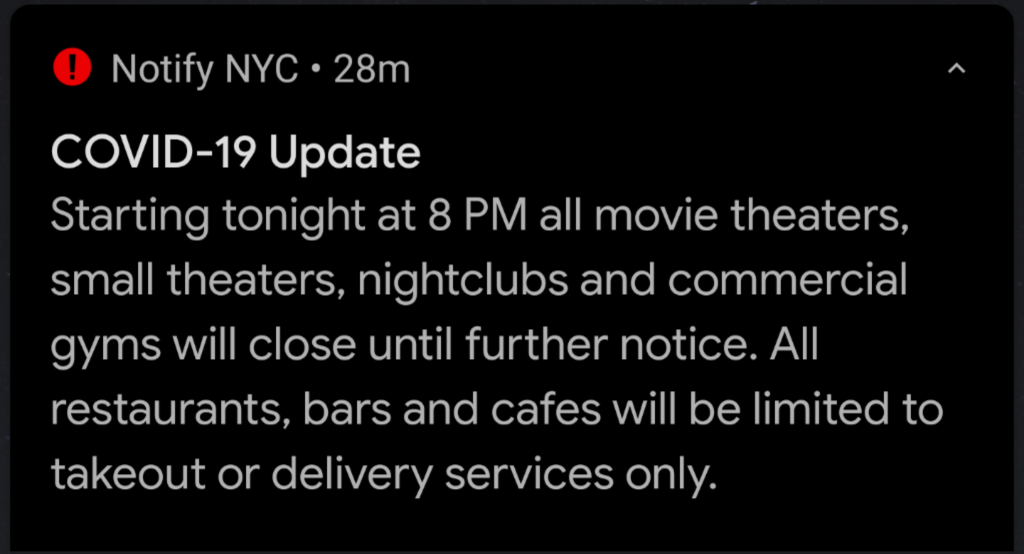
    I’m a little curious to know how this is all going to play out. I mean, Trump is saying this corona virus situation is going to continue through July or August. New York City is limiting gatherings to 50 or less and pretty much all venues are closed. Restaurants are limited to take out and delivery. Gyms are closed.

    Can businesses afford to be closed until August? Can people who work in the service industry afford to be out of a job for 5 months?

    I saw on Twitter than the government is talking about dropping some cash on the masses, but the figure they’re throwing around is $1000.00. For a large portion of the country that might be ok if the situation only lasts 2 weeks. In New York City that isn’t even rent, even in the bad parts of town. It certainly isn’t going to do anything to help people who suffer from underemployment or unemployment for 5 months.

    Not that I’m surprised, but with the economic situation this dire, most people are losing their minds because Trump referred to COVID-19 corona virus as the Chinese Flu. So what? No one cries that the 1918 flu is called Spanish Flu. And we all know it came from China. It doesn’t even matter what it’s called. If people want to be ignorant and abuse Chinese people, they’re going to do it regardless of what you call the virus.

    People seem to like getting themselves bogged down in minor battles over ideological purity. They lose the forest for the trees. And I think Trump does this stuff just to troll people. I think he trolls people just like other trolls troll people and for the same reason. Imagine the rush you would get if you could make millions of people have fits over a word choice that isn’t even offensive because it might, maybe, possibly, cause someone to be mean to Chinese people.

    I don’t even care. I’m going to ride this out and then I’m going to head to Chinatown and pig out.

    BTW, here are some pro-tips for people out panic buying:

    1. You can wash your hands with bar soap
    2. You can wash your butt with water
  • Corona Virus Update – Bronx, New York City

    Corona Virus Update – Bronx, New York City

    I went outside today for the first time since Thursday. It was quiet. Unusually quiet. There wasn’t even much traffic on Jerome Avenue, which was strange for that time of day. It was just me, a guy in a mask and gloves in front of the liquor store, and two people begging for money by the train stairs.

    I think the bubonic plague could hit New York City and that woman would still be sitting by the subway stairs asking if anyone has a quarter, though. She’s something special.

    Antillana on Jerome Ave has toilet paper. It has paper towels. There are plenty of canned goods too. But there’s no bottled water, which I thought was weird because even in China, Italy, and Spain, the hardest hit areas of the world, they never cut off the water. At least, I never heard that they did. I don’t understand the obsession with buying toilet paper either. Toilet paper isn’t going to save anyone from the virus. And you can wash your butt in the shower if you run out of TP.

    Antillana was pretty empty. It felt like an ordinary Sunday evening, though the customers seemed a bit edgy. They had everything I was looking for except bananas. Their bananas were there on display but they were all brown and rotten. Not sure why they left them out. I figure even people who are panic buying aren’t going to buy something that’s rotten. Probably.

    Key Food up the hill was quite a bit busier than usual, but still not all that crowded. Not like how I expected it to be. I found some nice bananas there. They seemed to be low on red onions, which struck me as strange. I bought a sweet onion. Not because I was panic buying. We’re just low on onions.

    I’m not sure what I expected. You’d think the world was ending based on the images of empty store shelves, fights over toilet paper, and all the closures. I got an update while I was out saying that the public schools are going to be closed through the end of April. The libraries are closed too. I had this feeling while I was on the street that at any moment, a zombie horde might show up and start chasing me. I’m not used to seeing the streets that empty.

    I guess this is all about “flattening the curve”.

    I saw a politician on Twitter saying that all the restaurants and bars in New York City should be ordered closed, but I don’t see that happening. Not unless the city agrees to discount every business a month’s property taxes or reimburse a month’s rent, plus lost income. And the city would have to agree to reimburse all of the employees for lost wages or something.

    A lot of people in New York City and, I imagine, the rest of the country, live paycheck to paycheck. That’s probably especially true here where rent is about $1500 a month even in poor neighborhoods.

    You close a business for a month and you make a bunch of people homeless or at risk of homelessness. You cause people to default on credit card payments and miss an electric payment or car payment.

    Corona virus hasn’t even hit New York City that hard but it’s already emphasizing the wealth disparity that exists and how dangerous it is for the economy as a whole. You can’t hoard wealth at the top if you want to keep making money. Money has to flow through all segments of the society to keep the economy moving. That’s just how it is. Does it matter how many yachts you can buy if your actions tank the country’s economy and your money no longer has value?

    Anyway, I’m going to be heading downtown tomorrow. I’m excited to see how things are in Manhattan.

  • Coronavirus in New York City

    Coronavirus in New York City

    Reactions to the threat of coronavirus in New York City seem to vary by neighborhood. Out on the street where I live (the Bronx), you would hardly notice that anything different is going on.

    No one is wearing masks. No one is keeping their distance. No one is doing the “wuhan shake”. No one is panic buying toilet paper or cleaning supplies. I don’t know if that has to do with ethnic background or socioeconomic class. Maybe just a culture of not panicking when it doesn’t seem like there’s a reason to panic yet. That’s an interesting idea. Are certain ethnic groups more likely to buy in to Armageddon panic buying than others?

    Anyway, don’t take this the wrong way, but maybe coronavirus is doing some good too. Of course it’s horrible that people are dying, but it’s illuminating some issues and making people do things they should have been doing already. It lowered pollution in China. It’s got the MTA actually cleaning trains every 72 hours. God knows how long they were going between cleanings before that. The MTA is cleaning train stations more regularly too. The mall in Jersey City almost reeked of cleaning fluid. And now it’s got people apparently finally cleaning their homes and their hands, given the shortage of soap and hand sanitizer in stores.

    Or at least they’re pretending to. I do see a lot of dudes not washing their hands in public bathrooms still. Or just wetting their fingers with water, then wiping their hands on their dirty pants and walking out, like that accomplishes anything. They probably went right out and started putting their dick-fingers on items on the shelves.

    Anyway, I was in Jersey City earlier today and both there and on the way back to my Mom’s place in Manhattan I noticed a lot of people wearing masks. I saw some people wearing latex or other types of gloves too. No gas masks or full on respirators, though. It was mostly Asians. I think they’re used to wearing masks because it’s something that’s already common in Asian culture. But I did see a few white people wearing masks too.

    I was pretty disappointed that I forgot my mask. I was around a lot of people today in buses and trains. With the number of diagnosed cases jumping so high so quickly in New York City and New York State, I’m going to be worried for a while now.

    I wish coronavirus would make wearing masks to prevent getting or spreading illnesses more of a thing in the US. I know health professionals are saying that they don’t work and you shouldn’t wear them if you’re healthy, but I don’t believe that. If that were true, health professionals wouldn’t wear masks either. I’m certain they’re not foolproof, guaranteed protection, but at least they’re something. If viruses are traveling on moisture particles from someone’s nose or mouth, at least they help stop that.

    Anyway, the stock market is crashing. The end is nigh. Or at least that’s how it seems from the news. Maybe they’re right. I’ve been wondering how the spread of coronavirus could be stopped in the US considering the political climate and actual limits of government here.

    Is it even lawful in this country for the government to forcefully quarantine people? I don’t know. What would that look like? Quarantine camps? Are we going to see trucks spraying weird sanitizing chemicals rolling down Park Avenue? That would be interesting, but considering how poorly the government is doing in even distributing test kits, I can’t imagine them moving on to more aggressive measures like China is undertaking.

    Guess I’ll just have to wait and see. If any part of the US turns into a complete disaster from coronavirus, I have complete confidence that it will be New York City. It’s just too dense and poorly managed. But probably nothing serious will happen. Americans have a weird tendency to predict and long for worst case scenarios, like the zombie apocalypse.

  • Another year…

    I’ve had this blog set up for something like 12 years now. I haven’t really been using it that much recently. It’s not so much that I don’t have things to talk about, but that I don’t know if what I have to say really matters in the grander scheme of things. Or would have any impact anyway.

    When I started this blog, I was living in Singapore. Or rather, I started a version of it there on Blogger. Then some other blogs, and then I rolled them all into this blog and kept posting. In Singapore, blogs seemed to matter quite a bit. People took them seriously in a way that they just never did in the US. So, when I posted something, I had an expectation of a reaction of some sort.

    Now, and maybe especially now with the rise of Twitter, Facebook, Tumblr, etc. etc., posting on a blog is sort of like screaming into the wind, or into the eternal void. You can make a lot of noise, but chances are that no one will hear you or even notice.

    And even if you say something really important and meaningful, it hardly matters anymore. Maybe I could add a blue check mark to the title of my blog? I dunno. I think it’s because of the polarization of online content in general. People only want to see what’s loudest on both ends of the spectrum. There’s not much room or interest for what’s in the middle. That’s pretty sad but I guess it must be human nature.

    And so I let this blog sort of stagnate.

    Beyond that feeling that blogging just didn’t matter as much here, I was having a lot of technical issues with Dreamhost. I still am, actually. I’ve had my blog constantly getting restarted by their server because it’s supposedly taking up too much RAM or eating up too much of the CPU, which seems ludicrous to me. I’ve trimmed it down to being really basic and it hardly gets that much traffic anymore, but it’s still apparently being problematic. I can’t even do updates without the thing crashing half the time. Honestly, I think Dreamhost is just punishing me for not upgrading to Dreampress.

    Fuck Dreamhost. Fuck them in their ass.

    I’ve been coming to a realization though, that I’ve been thinking about blogging the wrong way. Maybe I always have been. Or maybe I started doing this at some point without realizing it.

    There’s a difference between blogging to be heard and blogging for myself.

    And I think I was blogging to be heard and when I realized that I wouldn’t be heard, or most likely wouldn’t be heard, I lost interest.

    So maybe I should be blogging for me. As a way to get my thoughts down and work through them and maybe come to some interesting conclusions. A professor I took a history course with told me once that you never really know what you think about something until you have to write down your thoughts about it because it forces you to really clarify your opinions. She was right. Thanks, Professor.

    So, I’m going to try to be a bit more consistent here, even if what I’m posting is something that is only going to matter to me. I’m not trying to be a news outlet. Just a me outlet.

  • Evening Cycling – Central Park

    I’ve been trying to do a lot more exercise this year. Most of that has been cycling because it’s easy on the knees and that’s important when you’re trying to lose weight.

    I’m going to put more emphasis on running this month. I have a 10-mile run coming up at the end of next month. I’ve never done one before. I probably should have put more time into training for it, but life gets in the way. It’s nice to go out jogging again.

    My wife and I used to jog together all the time when we lived in Singapore. It’d be great if we could find a way to get back into the habit. We need to move, though. Where we live now makes it really inconvenient to just go out the door and run. We have to drive down to Central Park to make it work and that adds commute time to just working out.

  • Thoughts on “The View From Flyover Country”

    When I picked up The View From Flyover Country by Sarah Kendzior, I thought the book was going present a conservative or at least rural perspective on life and politics in the United States. I’m bombarded with the liberal and progressive viewpoint every day in almost every single news broadcast and social media post. The right-leaning viewpoints that do get airtime seem to be too far to the right of the political spectrum to be worth listening to. I was hoping for something center right, or traditional right, I guess.

    Unfortunately, this book is written by a liberal from a Midwest city. Not that there’s anything inherently wrong with that. It’s just not what I wanted. The book is a collection of essays and, after having finished reading the book, they come across as kind of mixed bag. The most impressive point of the book so far is how prescient some of the author’s insights were, considering that she wrote most of the essays prior to the 2016 election cycle for Al Jazeera.

    Kendzior’s diatribe against gentrification is well-intended but comes across as shallow and offensive. She had an opportunity to look at how class differences and the concentration of wealth were playing out in urban environments. Instead, she uses the issue to present whites as evil oppressors of minorities, forgetting that not all gentrifiers are white because not all wealthy people are white. “Hipsters” are a visible and catchy way to present gentrification but it ignores economic realities. Gentrification isn’t a race issue; it’s an economic issue and a class issue. Kendzior could have used gentrification as a segue into a discussion of income inequality but she chose to go the easy and provocative but less informative route of blaming white people.

    The section on underemployment and low pay are masterful. Kendzior isn’t saying anything that I haven’t heard before, but she said it before it was common discourse and her arguments are clear and well made. The situation she describes is maddening. Kendzior’s essay sounds more like she’s describing the plot of a dystopian fiction than reality.

    How does an adjunct lecturer work for a college for decades and die making penniless while still only making $10k a year? It sounds like the money in universities, like in the rest of US society, is being funneled into bureaucratic bloat instead of into paying educators. It should be illegal for companies to pay wages so low that costs are shifted onto taxpayers in the form of social welfare programs.

    But how can we implement a system of enforcement that won’t result in companies further reducing their workforces and overworking those who remain? It is something that will have to be forced. And it can be done. Companies paid living wages before. We had living wages and dignity. We can get there again. Will it take massive riots and strikes before our aristocratic Congress finally acts on behalf of the American people? Before they remember that they work for us and not for corporations?

    Regarding how Islam is portrayed, she writes under the assumption that US news organizations want to tell the news in an accurate and unbiased way, but they don’t. Of course, she probably had her suspicions about that when she was writing, but the true extent of the news industry’s dishonesty didn’t become apparent until after the 2016 election, when people simply couldn’t reconcile Hillary’s guaranteed win with the actual outcome. It’s almost as if the media industry was trying to create reality and expected the American people to act according to the narrative that they had presented.

    The disillusionment and shock people felt after the 2016 election cycle was heightened all the more by the clash between what they thought the US was, what they thought it stood for, and the reality of the country’s situation. Honesty and complex reporting don’t get clicks. It doesn’t generate ad revenue. It doesn’t sell because most people don’t want to read the truth. They don’t have time. With the wealth disparity in this country, most people spend so much time working or thinking about working, that they can’t find the energy or will to engage with social or political discourse in any meaningful way. So, they look for cheap entertainment that doesn’t require thought. They want to hear about Snooki’s butt implants, so news producers have turned reporting news into another form of reality entertainment. The more spin there is, the better for ratings, ad impressions, and revenue.

    For me, there were two big takeaways from The View From Flyover Country. One, the impact of income inquality, the wealth gap, on US society has far reaching consequences. Combined with a failure by our news organizations to maintain journalistic principles and keep the public informed can undermine our republic and cause more damage to US society than any foreign attacker.

  • Podcasts Addressing ISIS returnees to Western countries

    A screenshot of the BBC iPlayer page for "Back Home from ISIS", a podcast about an ISIS returnee to the UK
    A screenshot of the BBC iPlayer page for “Back Home from ISIS”, a podcast about an ISIS returnee to the UK

    Podcasts on ISIS Returnees

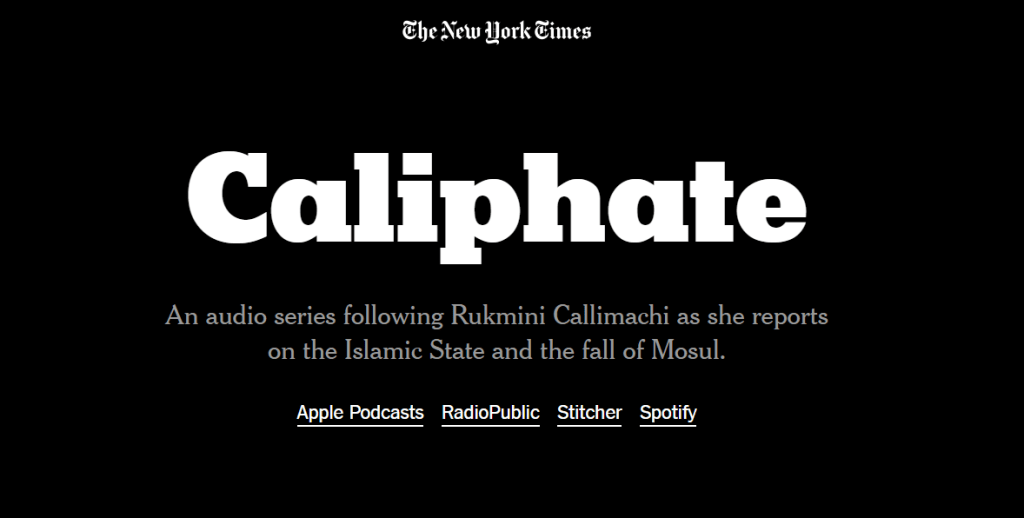
    “Back Home From ISIS” is a BBC documentary podcast. Along with the Caliphate series by Rukmini Callimachi at the New York Times, it is a great introduction to the problems that Western governments and societies face when ISIS members (former and current) leave the war-zone and return to their countries of citizenship. In the podcast, the BBC interviews an ISIS widow who returned to the UK after spending time in the Middle East and a Turkish prison.

    The Caliphate podcast series focuses on an ISIS returnee to Canada. Abu Hussayfa, as he prefers to be called, discusses the time he spent in Syria and how he is trying to reintegrate into Canadian society. The podcast goes on to cover interviews with victims in the Middle East and an exploration of ISIS documents discovered while in the field.

    As, or if, I find more podcasts related to the topic, I’ll come back and list them here.

    Thoughts on ISIS Returnees

    What do you do with ISIS when the Caliphate collapses? I had a conversation about this with members of a Facebook group called Muslims for Progressive Values. MPV is essentially an interfaith group with members who are Muslim, non-Muslim, agnostic, atheist, and/or secularist. The group discusses primarily Muslim and Islam-related issues. Someone posted a link to a story about a Glasgow student who had her UK passport stripped from her after the UK determined that she had traveled to Syria to be the wife of an ISIS member.

    Stripping Citizenship

    Stripping former (and probably current) members of ISIS of their citizenship for engaging in terrorism is a pretty solid move. It effectively prevents those people from entering a Western country that they’re ideologically at war with and carrying out attacks. It’s also a great punishment. If you don’t like “the West”, then why should you have the privilege of being a citizen of a Western country? And why would we give you access to a place you want to destroy?

    I found out later that the UK is only doing this to people who hold dual citizenship, which is also fine, but that leaves the problem of what to do with people who only have UK citizenship (or single citizenship of any country). I believe that terrorists should be denied re-entry to their country of origin and should be returned to Iraq or Syria to be tried and sentenced for the crimes they committed there. Why should they get to avoid what could and should be a harsher sentence by being tried under the laws of a Western country?

    Extraterritoriality and Justice

    Another commenter in the MPV group disagreed and said ISIS members shouldn’t be left in Syria or Iraq because of the lower quality of the justice systems there, which seems absurd to me. In a way, it reminds me of when the Taliban refused to turn Osama bin Laden over to the US for trial and insisted that he be given a trial in a neutral third-party country instead. The same MPV commenter also expressed concern about Western countries “dumping” ISIS members on Syria and Iraq, though I don’t think Iraqis and Syrians see it that way. Perhaps I’m just projecting, but I believe they’d be happier having the ISIS fighters remain there so they can seek justice.

    The idea that someone shouldn’t be subject to the laws and judicial system of a country where they’ve committed crimes is a colonialist mindset. It’s a status called “extraterritoriality”. It was weaponized and used against the Ottoman Empire in the 1800s to undermine the government’s sovereignty. Plus, it’s just common sense that you would face charges in the country where you committed a crime. It’s also an accepted international practice. If you commit a crime in a country and manage to flee, the government of the country where the crime took place requests that you be extradited for trial.

    The quality of the judicial system where the crimes took place or how the penalties stack up compared to what’s common in Western countries shouldn’t matter. These terrorist jackasses traveled to the Middle East and tried to build a terrorist state on the burning remains of Iraq and Syria. They committed murder, rape, ethnic cleansing, theft, destruction of cultural heritage, and who knows how many other crimes against both individuals, groups, and the countries themselves. Why would they not be made to face justice in those countries for crimes committed both in and against those countries?

    Let them hang

    Why would we not want to allow victims to get justice? These days, the only people with a form of extraterritoriality are diplomats, who have diplomatic immunity from lawsuits and prosecution unless that immunity is waived by the diplomat’s home country. Michael Fay got caned in Singapore for theft and vandalism in 1994. He didn’t get a pass. Why should terrorists? If they get hanged, they get hanged. If they’re beaten to death by a mob that drags them out of the jail, well, that’s not a great way to die, but for an ISIS member? I don’t really have any pity.

  • A Look Inside the Caliphate: A podcast about ISIS by Rukmini Callimachi

    A Look Inside the Caliphate: A podcast about ISIS by Rukmini Callimachi

    I started listening to this podcast a few weeks ago and I can’t get over how great it was. I was really disappointed when it ended at only 10 Chapters. I was hoping it would go further and that Callimachi would keep following up on the aftermath of ISIS in the Middle East.

    I’d like to hear more about ISIS fighters that are returning to Western countries and trying to avoid prosecution. I’d like to learn more about how Western countries are dealing with this problem, like, for example, how the UK is stripping some ISIS members of their UK passports. I’d also like to hear more “human interest” reports from people on the ground that were affected personally by ISIS. I’d rather hear it in an interview and investigative audio format than read about it later. Somehow, it seems more real and it’s certainly more engaging.

    The Caliphate podcast itself is well done, engaging, and informative. If you have any interest in the Middle East, I highly recommend it. I do need to warn you that most of the episodes contain descriptions of extreme violence, sometimes narrated by the perpetrators of that violence in interviews and sometimes by their victims. It starts out with interviews of an ISIS member who returned to Canada, Abu Hussayfa (nom de guerre), and then moves on to other topics, including scouring the front lines for documentation.

    I suppose what intrigued me the most about the podcast is how normal “Abu Hussayfa” sounds, considering what he did in Syria. I was also interested in how he tried to justify and excuse his actions. That seemed to be a trend among the people interviewed, which isn’t surprising in and of itself. The religious justifications he chose to use were what I found interesting.

    I was surprised to find out just how bureaucratic and organized ISIS was. I had this idea in my head that it was organized in the sense of being a good fighting group, but the fact that they kept careful financial records, criminal justice records, and had a hierarchical administration was unexpected. I suppose it’s hard to picture ISIS, on the one hand, destroying historical sites for being “haram,” and on the other hand acting like a modern bureaucratic state.

    Anyhow, again, if you have an interest in the Middle East you should really find time to listen to this podcast.