My wife has a small folding bicycle with little wheels and it just seemed really fun to ride it. It felt like I was on a kid’s bicycle. It’s pretty sturdy though, and a folding bicycle is easier to get around the city, whether by train or in the back of the car.
This is my first time uploading video to WordPress. Usually, I would use YouTube for video, but it feels like the right time to start moving content back to my own site instead of posting almost everything elsewhere for some company’s profit and benefit.
These roses under my window make no reference to former roses or to better ones; they are for what they are… There is simply the rose; it is perfect in every moment of its existence.
America is the wealthiest nation on Earth, but its people are mainly poor, and poor Americans are urged to hate themselves. To quote the American humorist Kin Hubbard, ‘It ain’t no disgrace to be poor, but it might as well be.’ It is in fact a crime for an American to be poor, even though America is a nation of poor. Every other nation has folk traditions of men who were poor but extremely wise and virtuous, and therefore more estimable than anyone with power and gold. No such tales are told by the American poor. They mock themselves and glorify their betters. The meanest eating or drinking establishment, owned by a man who is himself poor, is very likely to have a sign on its wall asking this cruel question: ‘if you’re so smart, why ain’t you rich?’ There will also be an American flag no larger than a child’s hand – glued to a lollipop stick and flying from the cash register.
Americans, like human beings everywhere, believe many things that are obviously untrue. Their most destructive untruth is that it is very easy for any American to make money. They will not acknowledge how in fact hard money is to come by, and, therefore, those who have no money blame and blame and blame themselves. This inward blame has been a treasure for the rich and powerful, who have had to do less for their poor, publicly and privately, than any other ruling class since, say Napoleonic times. Many novelties have come from America. The most startling of these, a thing without precedent, is a mass of undignified poor. They do not love one another because they do not love themselves.
This quote could have been published yesterday and it would still be just as true, though it would probably apply to more countries than just the United States now as Capitalist ideals have become more prevalent in other cultures.
No one wants to admit that they’re poor, even if they are, in the United States because there is still an assumption that poverty and unworthiness go hand in hand. If you’re poor, you must be stupid, as Vonnegut wrote, or lazy, or ridden with vices. I wonder how much of this idea is genuinely out there circulating among average people these days.
It seems like more people are starting to understand that you can work hard every day and still have nothing to show for it at the end of the month. That’s how the system is set up, and with increasing wealth disparities and higher prices for even necessary goods, let alone “luxury” items like basic entertainment, almost everyone is starting to feel the pinch. Even the faltering middle-class.
I don’t think the American poor hate themselves, though. I think the American poor hate being poor. I think the problem is just that people tend to think they need to be wealthy before they can be happy. It’s definitely easier to be happy when you can pay all of your bills and live comfortably, but I think we need something more than just material comfort for happiness. It would be incorrect to say that the poorest people in the country need assistance to reach a basic level of security, but I also think there has to be a change in mindset in terms of what we see as worthwhile ways to live.
Think of the people we idolize on television. Think of the Kardashians. They’re wealthy, but are they really role models? Are they what people should aspire to be? Are they worth glorifying? Are they better just because they’re wealthy? I don’t think so. There’s nothing necessarily good about being wealthy and there’s nothing necessarily bad about being poor. The goodness and badness of a person is based on more than that and value in life comes from more than the thickness of a person’s wallet.
I particularly enjoy the bit Vonnegut added about the tiny, poorly put together American flag attached to the register. I see it as symbolizing an idea that continually contributing to the current economic system is essential patriotism, even when you’re barely hanging on. There’s really no reason for our country to be this shabby when the country as a whole has so much wealth to go around. I’m not saying we should be wholly socialist, but I am saying we should have caps on wealth generation that force company executives to fairly distribute company earnings to all employees, say by limiting top earners to a percentage of what the bottom earners receive, including both real wages and stock options, bonuses, etc.
People who start businesses often come to the table with wealth in their pockets. They have ideas, but the employees who help them realize their vision are an essential part of the process. It’s absurd that people working at some of the most successful companies on Earth receive government subsidies because they’re paid poverty wages.
Money is definitely hard to come by and easy to spend. Depending one your circumstances in life, where you were born and what family you were born into particularly, you may never become wealthy, but that doesn’t mean you’re stupid, or not worthwhile. And fuck feeling grateful for being paid minimum wage. It’s called the minimum wage because it’s supposed to be the bare minimum a person should earn to be able to live. It’s not a requirement. It’s a choice. And employers should choose to reward employees who work hard to keep them rich.
The cherry on this quote from Vonnegut, though, is the comment about a pub owner being poor. If Vonnegut thought a small business owner was poor, then what would he think of the rest of us?
The interior of the restaurant was comfortable and there was a small outdoor dining section next to the brownstone’s stairs. Hummus, baba ganoush, and shakshuka with pita bread
This was in 2013 at the 9th Street location near Tompkins Square park in Lower Manhattan that no longer exists, which is a shame. It was a great place to get tasty, reasonably priced Middle Eastern food with fast access to a park to relax afterwards. I liked the vibes in that area as well. There are other locations, but the neighborhoods seem busier and less friendly.
The 9th street location closed quite a few years ago now and we also haven’t visited the neighborhood to eat out regularly in years. It seems like most of the places we enjoyed going to down there have closed or the quality has gone down and we’ve lost interest. I guess everything changes.
If you see someone being attacked and you step in to help them and you injure the attacker, the attacker will sue you and most of the time you’ll lose in the lawsuit.
If you see an injured person and try to help them and the person dies, the family will investigate you and sue you.
Why bother to help people?
Part of growing up is learning to respect other people. That’s something adults have to teach children. It’s obvious that it’s not happening though. And it’s obvious that something is being lost in our society by this idea that’s being promoted that it’s ok to let kids grow up thinking that disrespect, even to family members, is acceptable.
The only thing that matters is just them, the individual. Their reality, their perception, their “truth”. Their enjoyment. There’s no concept of responsibility to the community and other people.
Why are we building systems and social structures that privilege criminals over victims? That prizes selfishness and disrespect?
I see people complaining online, but you get the society you build. If you don’t like it, change the laws. Stop voting in the same dirtbag politicians. Stop making excuses for poor behavior, either your own or those of people around you.
Just got a random call from someone about Medicare benefits. I told her I’m not old enough. She asked me how old I am and I said 42. She hung up on me. It was probably a scam call, but all I can think about right now is the answer to the meaning of life, the universe, and everything.
Saga continues to delight and entertain. I really enjoy the author’s sense of humor and writing style and the art is excellent as well.
Monstress
The art isn’t elaborate like in Monstress by Marjorie Liu, but it’s clean, bright, and engaging and fits the tone of the story. The story also makes sense. Unlike in Monstress, which is bizarrely hard to keep up with. I think I got up to date with this series late last year but I won’t be reading any more. I think the main issue is that there are too many characters and a lot of them look alike.
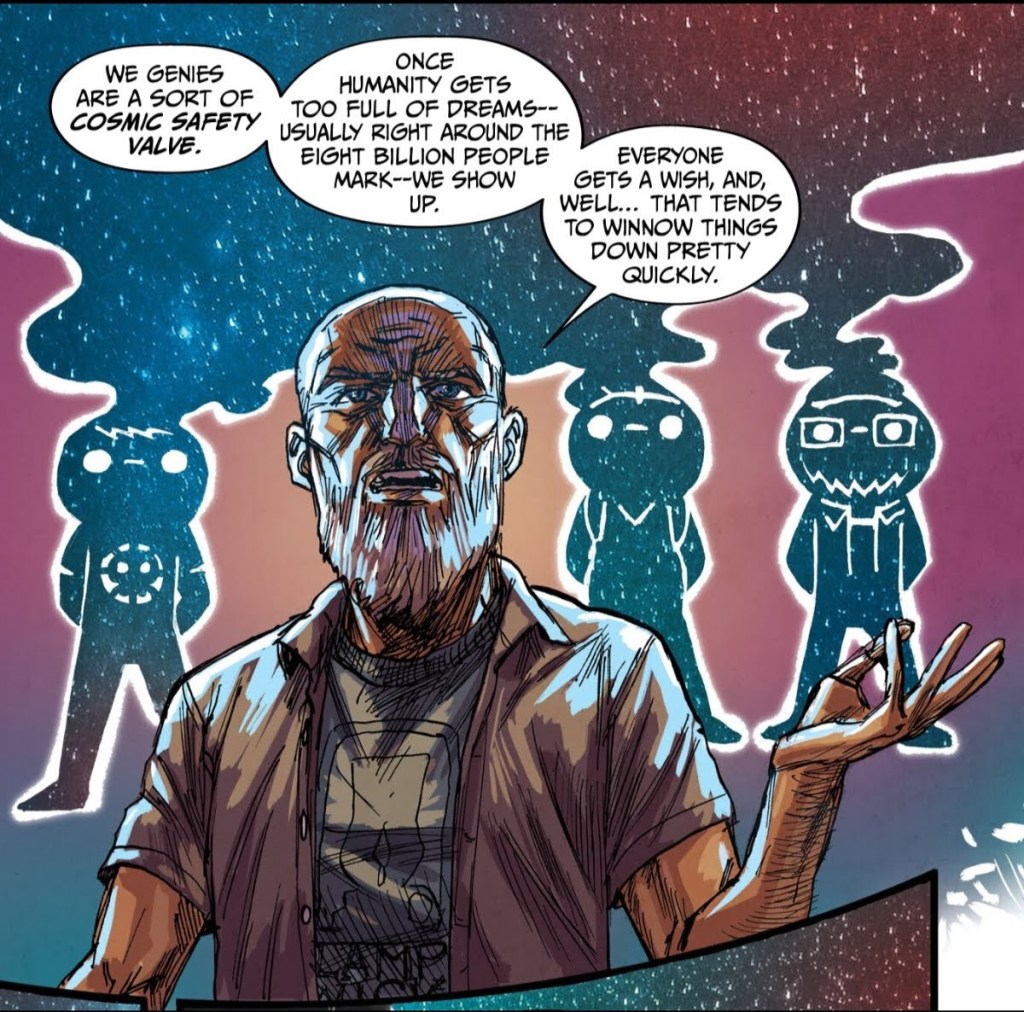
8 Billion Genies
I feel like 8 Billion Genies could have been as good as Saga but they tried to do too much in too few issues. There’s still one issue left, but covering 8 decades in 1 issue felt way too rushed. It’s still a brilliant concept and is well worth reading. The author didn’t include a lot of cheesy tropes and even in just 7 issues I started to care about the characters. I’m looking forward to reading the last issue, which should be out today.
Hopefully, this won’t be a once in a lifetime trip. It was incredible and overwhelming, honestly, but it was also a school study trip so it wasn’t an experience that I could share with my wife, which was a bit of a stumbling block to my full enjoyment of the sights and sounds of the country.
Visiting Israel was also a lot to process. I wanted time to think about the visit before I really wrote anything about it, and then I got busy and weeks became months and months became years. Now, it’s been 9 years since I was there, and I’m looking forward to going back if life permits.
Never forget that the universe is a single living organism possessed of one substance and one soul, holding all things suspended in a single consciousness and creating all things with a single purpose that they might work together spinning and weaving and knotting whatever comes to pass.
Marcus Aurelius
This is an interesting take on the nature of reality, because I wouldn’t expect to hear it from someone with Aurelius’s background. I guess I hadn’t put much thought into the idea of an afterlife from a Stoic point of view, because the philosophy predominantly addresses how to live in and enjoy the present.
What Aurelius is expressing is known as Pantheism, “the belief that God consists of everyone and everything. For example, a tree is God, a mountain is God, the universe is God, all people are God.” 1 It reminds me of the popular quote about how we are all the universe experiencing itself.
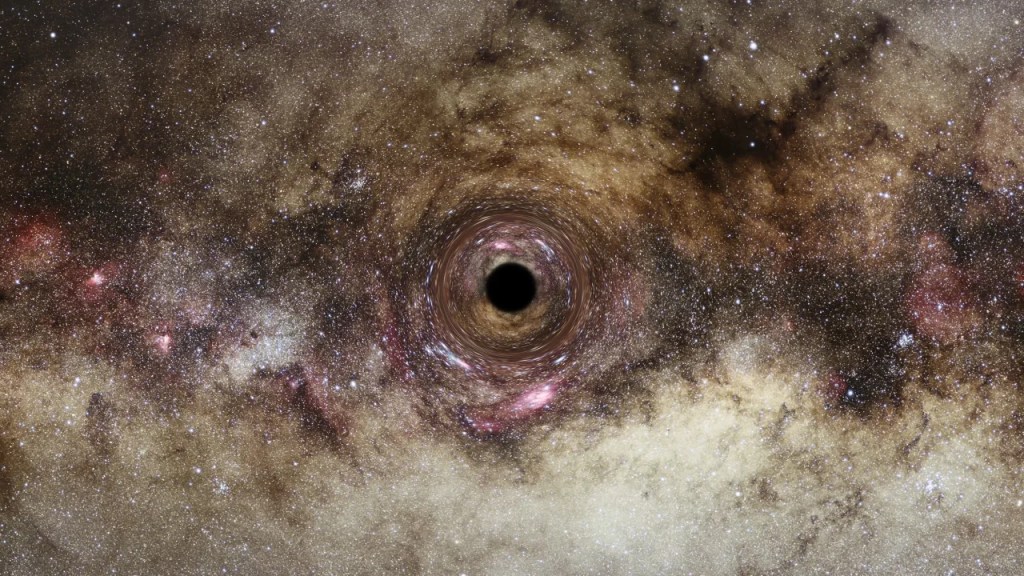
This is an artist’s impression of a black hole drifting through the Milky Way galaxy. 2
I’m also reminded of the fact that people are made up of smaller communities of creatures and systems that developed into humans over time, and then I think about the universe as a whole and wonder if the universe is some larger being, or part of a larger being. What if we’re actually just part of a digestive tract and black holes are how the energy we produce is passed on to the other systems of the larger organism? What if our universe is a marble in a sack of marbles? You never know.
But in terms of pantheism and how it was understood, that we are all manifestations of the divine or that some divine essence undergirds and flows through all existence, the idea seems to be common to some Buddhists, Hindus, and some forms of Christianity, like Unity, Christian Science, and Scientology. There is also some overlap between Stoicisms understanding of the soul returning to the Cosmic Fire and being reforged as a new soul and the Buddhist idea of the soul reaching Nirvana, escaping the cycle of rebirth and permanently reuniting with the divine essence. Early Christians believed in reincarnation as well, and the Christian idea was probably closer to the Stoic conception because in Buddhist reincarnation there is an expectation that souls retain something from previous lives, even if it’s just karma.
The concept of pantheism also has parallels with mainstream beliefs about Jesus being an expression of God in the physical realm. And of course, there’s the idea that God blew his breathe into humans to give us sentience, but humans carrying a divine spark is a bit different from the idea that all things are God.
Still, it’s interesting to see how ideas about divinity and existence develop over time, often overlapping, and have common themes between the past and present.











 Bradley's Old Fashioned Weblog