Recent updates

  • Old Spaghetti House at Galleria

    DSC05242

    Yesterday afternoon, after a day of running around trying to do job interviews and visit the GSIS office for my father-in-law, we stopped by Galleria on our way home to have dinner.  I wasn’t sure what to eat, but I was in the mood for something Italian, so my wife recommended Old Spaghetti House.  I’m glad we went.  The food there is great!  It’s not fine dining per se, but it’s well worth the money.

    DSC05243

    I went with the Vietnamese garlic spaghetti with shrimp.  I’m not sure if it’s actually a popular Vietnamese dish.  It tasted really good though!

    DSC05244

    My wife decided to have their puttanesca, which is translated literally as “whore’s spaghetti”.  There are conflicted theories about the origins of this dish, but the more colorful one is that it was a dish that prostitutes in Italy’s state run brothels made for themselves out of the odds and ends in their larders.  As a condition of working in the state run brothels, they were only allowed out one day a week, so they were often low on supplies and this light sauce made from few ingredients was the result of their attempts to get by.  More information can be found in the Wikipedia article.

    DSC05245

    After dinner, I finally got the chance to introduce my wife to funnel cake.  Funnel cakes are popular at fairs in the US, but they’re pretty rare in Asia.  I don’t recall ever seeing a place with this on the menu in Singapore.  She loved it!  You can see in the photo that they don’t add quite as much powdered sugar as they do in the US, but it came with a choice of toppings which made up for it.

    Speaking of Singapore… it seems like you can’t get away from it over here.  I found this stuff on the menu:

    DSC05240

    DSC05241

    I don’t care for the original Tom Yum soup, so I really don’t think I’d like the way it tastes as a pizza or spaghetti.

  • Canned Japanese Juice Drinks

    Canned Japanese Drinks
    Canned Japanese Drinks

    Ok, so one of them isn’t really a juice drink, but I love coffee so I couldn’t resist picking one up.  I bought these at a shop in Singapore that specialized in Japanese canned drinks and sake.  They were on a 10 for 10 SGD sale so I figured, why not?

    They were all pretty good, but I liked the Grape and Apple the best, probably because they’re the flavors of juice that I grew up drinking in the US.  The only one I actually didn’t care for too much was the Grapefruit juice.  It was a bit rough.  I think I could’ve used it to remove paint from the walls.  I’ve never liked grapefruit too much though.  When I used to eat it at my grandmother’s house I’d have to douse it in sugar to bury that harsh, acidic taste.

  • Which Sounds More Creepy? Muslim Call To Prayer Vs Catholic Rosary Chanting

    The first time I heard the Muslim call to prayer was in Iraq in 2003 when my unit was set up near a mosque in the outskirts of Baghdad.  It was strange, but it didn’t sound necessarily bad.  In fact, there’s a very musical quality to it that’s easy to appreciate when you’re not letting prejudice and/or fear get in the way.

    I thought Muslims were the only ones in the business of broadcasting prayers to the neighborhood over loudspeakers, but I was wrong.  Walking through a neighborhood in the Philippines one afternoon I heard this creepy chanting sound and I asked my wife what it is.  We were a bit far away from the source, so I couldn’t quite make out what was being said.  She told me that it’s the Rosary being chanted over loudspeakers from the Catholic church in the neighborhood.  It’s done every day around 2 or 3 PM, and if that weren’t enough, there are also announcements and other prayers broadcast to the neighborhood in the morning at around 6 AM I think.

    While I don’t think I could quite appreciate living close to either one, having to listen to them repeatedly every single day, I would opt for listening to the Muslim call to prayer if I had a choice.  Maybe it’s that I don’t understand the words, but there’s just something oddly disturbing to me about the Rosary being chanted and the entire neighborhood being forced to listen to it, whether they want to or not.  What adds to the whole creepy factor is that more often than not, it’s children that are being made to recite the Rosary over the loudspeakers.  They’re supplied with an afternoon snack as a lure or compensation to get them to do it.

    In the video below, I’ve mashed together clips of the Muslim call to prayer that I recorded in Kuala Lumpur, Malaysia and a clip of the Rosary chanting here in the Philippines.  Unfortunately, there weren’t children doing the chanting this time, which would have given you more of an idea of how weird it sounds on a normal day, but it’s creepy nonetheless.

    Judge for yourself.

    Feel free to comment, but don’t use the comment section as a Christians Vs Muslims bashing forum.  Comment only on this particular practice please.

    Update: The full text in English of the meaning of the Adhan, or Islamic call to prayer, is included below, from About.com:

    Allahu Akbar
    God is Great
    (said four times)

    Ashhadu an la ilaha illa Allah
    I bear witness that there is no god except the One God.
    (said two times)

    Ashadu anna Muhammadan Rasool Allah
    I bear witness that Muhammad is the messenger of God.
    (said two times)

    Hayya ‘ala-s-Salah
    Hurry to the prayer (Rise up for prayer)
    (said two times)

    Hayya ‘ala-l-Falah
    Hurry to success (Rise up for Salvation)
    (said two times)

    Allahu Akbar
    God is Great
    [said two times]

    La ilaha illa Allah
    There is no god except the One God

    For the pre-dawn (fajr) prayer, the following phrase is inserted after the fifth part above, towards the end:

    As-salatu Khayrun Minan-nawm
    Prayer is better than sleep
    (said two times)

  • Naruto Ramen Soup

    DSC05229

    If you look at the red underlined portion under the menu item ‘Batchoy’ you’ll see that the ramen includes ‘naruto’.  I don’t watch Naruto but I was really amused when I saw this.  I was wondering if it was a typo or if there actually is something called ‘naruto’.  Well, turns out that naruto is a type of kamaboko, which has the following definition on Wikipedia:

    Kamaboko|蒲鉾 is a type of cured surimi, a Japanese processed seafood product, in which various white fish are pureed, combined with additives such as MSG, formed into distinctive loaves, and then steamed until fully cooked and firm.

    It looks like this:

    Kamaboko

    Public Domain picture via Wikipedia. Originally uploaded by Kinori.

    Looks like I’ve eaten naruto quite a few times without even realizing it!

    One other thing I thought worth mentioning is that there’s also a town called Naruto on the eastern end of the island of Shikoku in Japan.

  • Lungs, Ears and Brains: Exotic Filipino Foods

    DSC05221

    The meat on the plate is actually pig lungs, boiled and fried.  My wife and her brother enjoy it and convinced me to try some.  It wasn’t horrible, but I didn’t think it was all that good either.  I probably won’t eat that again.  The meat on the stick, however is a grilled pig ear.  It was served with a brown gravy.  I thought about it after some of the stuff I’ve eaten, a pig ear really isn’t that weird.  I mean, I’ve eaten chicken feet and snails before, so why not an ear?  It wasn’t that bad.  It had a decent taste to it, though I didn’t care too much for the crunchy cartilage parts.  I finished it off.

    Philippines Feb 09 - 096

    This is pork sisig.  This is a short order type of dish that’s sometimes served as lunch and often served while drinking.  Up until recently, I believed it was just pieces of pork.  I didn’t really question it or think about it.  Turns out this is made from pig brains though.  Well, partly pig brains.  This dish became a popular part of Filipino cuisine as a result of the US establishing an air base in Pampanga province, called Clark Air Base.  Filipinos would buy the unused pig heads from the base commissary and this is the dish they developed from trying to make use of them.  I’ve actually tried this.  I didn’t know it was made from pig brains at the time.  No one thought to tell me either.  Sisig is such a common dish here, now found pre-packaged and branded in grocery stores even, that my wife and relatives likely don’t give it a second thought.  Now that I know, I don’t think I’ll ever look at it the same way again.  I’m still not sure if I’ll eat it again.

    Filipinos are pretty creative about making sure no part of an animal goes to waste.  I’m sure you’ll see that as I post about, and perhaps try, more of the unusual ‘delicacies’ found here.

  • Birds in my Bedroom

    Despite the fact that there are gates and unscreened windows in the house, we haven’t seen too many random animals inside, other than the occasional cat rapist.  Last night, it was pouring rain outside.  We opened the back door to our bedroom, which opens onto a veranda, so we could bring in the laundry before it was ruined.  I saw a black shadow shoot across the ceiling and when I finally spotted it, I was surprised.

    There was a bird sitting on the curtain rod…

    DSC05218

    Naturally, our cats started to go insane trying to catch the bird and as soon as I got a good photo of it we used a broom to shoo it back out the door before our bedroom was wrecked.  I guess it was scared of the storm outside but it definitely wasn’t sleeping in our bedroom with us overnight.  Luckily none of the cats chased him off into the neighborhood before we got the door closed!

  • Beginning Japanese and Beginning Japanese Workbook

    DSC04867

    I picked these books up in Singapore before leaving for the Philippines so I can start my adventure with learning the Japanese language.  I’ve also been using Smart.fm to help build vocabulary and familiarize myself with hiragana, katakana, and some basic kanji, but you can’t learn a language without understanding the grammar, conjugations and particles.  That’s just the tip of the iceberg of course, but you get the point.

    I haven’t had time yet to crack them open and get started on studying them.  Things have been pretty hectic around here.  Later on, after I’ve gone through them both a few times, I’ll post a review about how effective they are.  In the meantime, has anyone used these books before?  Thoughts?  Opinions?

  • Spring Kyushu Fair

    These are pictures from the Spring Kyushu Fair held in late March to early April of this year in Singapore.  This is what I meant about being agitated about not having a Japan blog, because I should have posted them then.  This is a bit dated, but I thought it was worth sharing anyway!

    Singapore (Random) - 413

    The fair’s banner was hanging in the center section of the Tampines Mall.  Tampines Mall is set up as round levels with an open center.

    Singapore (Random) - 414 

    This is the view from above, from I think the third floor.  The fair was set up in the middle of the mall and was jam packed with people every single day.

    Singapore (Random) - 415

    I was shocked at how expensive these arus melons from Miyazaki were.  If you look at the blue text on the sign you can see that 49 SGD was already the marked down price from their usual 60 SGD.  I think we went on the last day of the fair.  I tried to do a little research on the melon but there’s little available, through Google anyway.  What I did find says that the arus melon is considered “The King of Japanese Fruits” and is highly sought after as a gift for its fragrance, beautifully netted skin and great taste.

    Singapore (Random) - 416

    There was a booth selling selections of fine tea.  I kinda wish I’d bought some now that I look at the photo.

    Singapore (Random) - 417

    Singapore (Random) - 418

    Photos of the crowds and some of the booths.

    Singapore (Random) - 419

    A lot of the booths were doing cooking on the spot, like this booth, where a girl was preparing takoyaki balls.

    Singapore (Random) - 420

    And what Japan fair would be complete without a booth selling sake?  The sake he was holding was actually really, really good and I wanted a bottle of it but he had already sold out.  He didn’t mind letting me have a few shots from the sample bottle though, which was pretty cool of him.  We wound up getting a sparkling rose sake for my wife, but got so busy with getting ready for our trip to the Philippines at the beginning of May that we we gave it away as a gift instead.

    I’m looking forward to visiting another Japan-related Fair.  Hopefully there’ll be one in Manila sometime soon!

  • Using Geisha Imagery To Sell Modern Products

    The following image is of a soap that appears to be popular in the Philippines, where most women (and quite a few of them men) are obsessed with whitening their skin and maintaining a fair complexion.  The image of a painted geisha face very effectively communicates the idea of a fair complexion and the purpose of the soap.

    DSC04776

    It also puts across the idea that by using the soap you will be sophisticated, artistic and elite, which are all qualities possessed by true Japanese geisha.  Contrary to what most people believe, the highest class of geisha do not sell sex but are instead entertainers who sell their skills with instruments, gaming and conversation to high class clientele like politicians and wealthy businessmen.

  • The Manananggal Demon, A Filipino Superstition

    This morning I saw something bizarre going on up the street.  The men of a family were holding machetes and were busy chopping the branches off trees in their yard and shaving them down.

    DSC05210

    My father-in-law was outside and when I asked him what was going on, he said that they thought they saw a manananggal last night.  He then told me that the manananggal is a demon that comes in the form of a good looking woman with wings.  When it flies, the torso separates from the legs at the abdomen, so basically it’s like a half of a woman flying around bare-chested.

    Like western vampires, the manananggal avoids light and garlic.  Additionally, they don’t much care for salt, daggers, vinegar, spices, or the tail of a stingray which has been fashioned into a whip.  Also like vampires, the manananggal likes blood, but prefers to use a proboscis tongue to suck the heart of a fetus still in the womb.  Not quite as watered down as Edward Cullen is it?

    There used to be images of manananggal and aswang here, but I had to remove them because they’re apparently too shocking for Google and they were counted as Google Adsense policy violations.

    I’m not sure where cutting trees down comes in, but perhaps they wanted to reduce the amount of places that the manananggal could hide, so they could better see it coming.  Either way, it’s an interesting superstition with a lot of parallels to Western superstitions.  It’s just odd to see people so actively taking measures against it.  Most superstitions in the West are only believed by children.

    Update: February 25, 2019
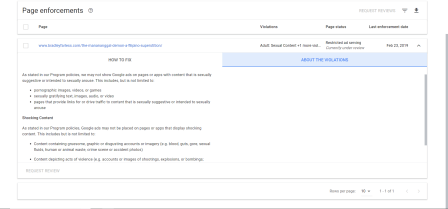
    A screenshot of Google's policy enforcement violation list for this page.
    A screenshot of Google’s policy enforcement violation list for this page.

    Who knew a drawn image of a mythological creature could be a violation of Google’s Adsense policies? I wonder if the same restriction is applied to images of Sirens or Medusa?

    But what’s really odd about the violation is that it suggests that someone would be sexually aroused by the upper torso of a woman with bat wings, or that the manananggal is intended to be sexually seductive when, in fact, it’s meant to be horrific and terrifying. Maybe some people are into that sort of thing, but intent has to count for more than one person’s perception or we’d never be able to say or do anything about anything.

    That being said, the images were kind of shocking, which is a violation of Google’s Adsense policy apparently. But, again, it’s a mythological creature that’s supposed to be scary. How can a topic of this sort not be ok? I don’t get it. We’re not allowed to have scary stuff next to Google Ads? It’s history and it’s folklore and it has a purpose and should be talked about and depicted and remembered.

    But, what are you going to do? One person has a problem and reports your page so you have to make changes. So, the images are censored heavily now. Hopefully, the censorship is heavy enough to be ok with Google’s review team.

    Update: April 3, 2020

    I came back and removed the images entirely. The page was reported again for “shocking content”. I can only assume that’s the images, because God forbid history and folklore should be considered too shocking to be monetized.