On Sunday afternoon, my wife and I were by the United Nations to take advantage of a Groupon deal I got for the Indigo Indian Bistro on East 50th Street. We didn’t realize the place closed for a while after lunch and before dinner, so we found ourselves standing in the cold with an hour and a half to kill.
I thought about going to the United Nations for a tour, since we were right next to it, but it looked like it was closed too. There weren’t even flags up on the poles. So, we started walking around. First, we poked our heads in at the Japan Society to see if there was anything going on (and to warm up a bit), but they were just finishing up a New Year’s celebration for kids. Then we went next door to look in the Holy Family Church. The building is really weird looking from the outside.
Turns out it’s a Catholic church. It’s sort of nice inside. The giant Jesus on the wall above the priest leading the service was a little scary looking. It made me think about the conflict inherent in the concept of a trinity model of monotheism, and whether or not a distant and cold concept of God was being replaced by the warm and gentle spirit of a man, someone that people could understand and empathize with. That’s a subject for another post, though. I’ve been doing a lot of theological reading that I’ve been slowly digesting, mentally.
Sculpture of an angel (I think)
After warming up in the church foyer, we went back out to find our next opportunity for passing time. As we were walking away, I noticed a side path that led into a garden that was covered in snow and ice. We figured it was worth a few minutes to go in and look around.
Frozen waterfall in the Holy Family Church garden.
What really peaked my interest was the fact that the garden pool was covered in a layer of ice and snow, and so was the artificial waterfall. I don’t suppose there’s anything unusual about a waterfall icing over in winter, but it’s not something I really expected to see in the middle of Manhattan; not even an artificial one. So, I think the unexpectedness of seeing what I didn’t expect to see made it more worth seeing, if that makes any sense. I’ve also always enjoyed religious settings and architecture, of a certain type. The more solemn and thoughtful type. I’ve always thought religion should be a solemn, thoughtful and meaningful thing.
When we were on our way back from our vacation in Georgia, I realized that I’d accidentally selected a return flight that would have us landing at Newark Liberty International Airport in New Jersey. I didn’t realize this until we were at Hartford International Airport in Atlanta, checking in. I couldn’t figure it out at first. When I picked these tickets, I’d selected to see only flights for “NYC” on the website. Why would the Delta site show Newark in New Jersey as a NYC airport? It’s not even the same state!
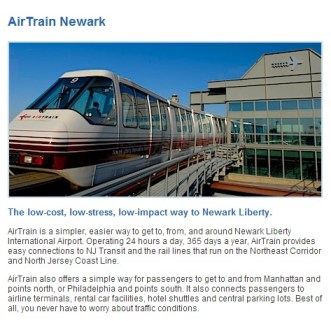
AirTrain Newark Description
So, while we were sitting in Hartford, waiting on our flight, we had to do a quick check to see what sort of transportation was available from Newark into the city. I did NOT want to spend 70+ dollars on a taxi. Luckily, there was another, affordable option: the AirTrain. On the website, it looked fairly new and the tickets weren’t that expensive. It’s been a few weeks, but I think they were only 11 dollars apiece to get to Penn Station.
The thing is, the site is a little misleading. I saw that shiny train and thought that’s what was going to take us to Penn Station. The reality is that it just drops you off at another train platform where you get on this old-timey looking train where conductors come through the cabs hollering to see your tickets.
Old NJ Transit train from Newark to Penn Station.
I couldn’t help but think of that scene in the Indiana Jones movie where Jones threw the bad guy off the zeppelin and then told the stunned crowd that he didn’t have his ticket.
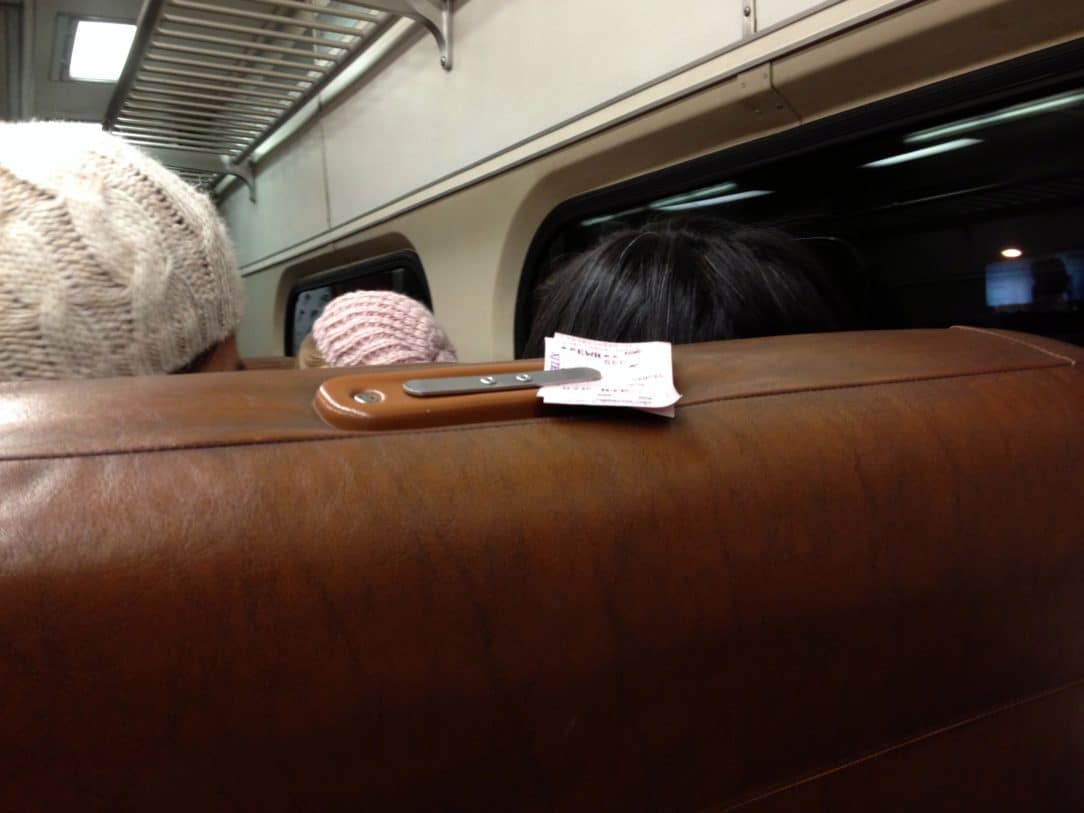
We had our tickets!Train tickets clipped to the back of the seat in front of us.
It wasn’t a bad experience. It’s really convenient, even. But, from now on I’ll definitely be double-checking that the travel websites are actually showing me NYC airports that are in NYC. Landing at Newark, as opposed to landing at LGA, added about an hour to our total travel time.
So, down in Georgia, there’s a river called the Chattahoochee. According to Alan Jackson, it gets hotter than a hoochee coochee and it’s a great place to learn to swim, love, and live.
Back in the 70’s, which is when I assume he’s talking about, that might have been true, but these days there’s so much industrial pollution and waste water run-off in the Chattahoochee that if it’s hot, it’s because it’s burning your skin. Atlanta pumps a lot of waste into the river, ruining it for all of the cities downstream.
Chattahoochee River, River Walk, Phenix City side.
That hasn’t stopped both Columbus (on the Georgia side of the river) and Phenix City (on the Alabama side of the river) from both trying to develop the area. One of their projects is a river walk. I remember when the Columbus government first started building the river walk back in the mid 90’s. If I remember right, I did a March of Dimes event there when I was a sophomore in high school. It was pretty nice. The view was good. Even going back there now, after having seen the skylines of so many cities in and outside the US, it’s still good, though that may be partly the nostalgia.
Blown dam on the Chattahoochee River
The other project that Columbus is working on is something to do with white water rafting. The city government has this idea in their head that if they build it, ‘they’ will come, in the hundreds of thousands, so, sure enough, several historic dams that were built to power factories that used to operate along the waterfront were blown open to create a ‘white water’ effect in the river. Personally, I think it looks more like a ‘lazy river’ ride at a theme park, way too tame for someone seeking a real white water thrill, but maybe they haven’t opened up all the dams yet.
My wife and I went down the Phenix City riverwalk with my dad and he was telling us about how the city made a big deal out of blowing the dam we happened to be looking at, at the time. It was televised and people were expecting a large explosion, but it wasn’t really anything special. I still wish I’d been there to see it, but mostly because I’d have been interested to see what was at the bottom of the river. I bet they pulled a lot of neat stuff out of there.
Covered over square tunnels visible in far walls.
Across the river from where we were, for example, there was a wall built of large square stones that was previously submerged. In the side of that wall there were square tunnels running back into the bank. I wonder what’s in there? Was it used fro waste run-off or sewage? The way it was built, with two walls in terraced set-up, it seemed like there used to be a road down there.
Old factories and a power station (small building 1/4 from the right)
Anyway, there’s a lot of history in that area. One of the last major wars of the Civil War was fought in Phenix City. Columbus used to produce most of the boots and swords for the Confederate Army. Columbus was also the end of the line for river cargo from the Gulf of Mexico, since it sits on the fall line. Now, those old factories are being converted into expensive lofts and the river is being turned into a commercialized tourist attraction (which will probably fail due to health concerns), but at least the river has a bit more character now. I wish I could get down in there with a metal detector…
While my wife and I were down in Georgia, it wouldn’t have made sense for me to not show her around Fort Benning. I did my basic training there in 1998, after all, on Sand Hill at 2/54 (2nd Battalion, 54th Infantry Regiment). After spending some time driving around Sand Hill, getting lost, using my phone to consult Google Maps and then finding our way back to the highway, we got over to the National Infantry Museum. Technically, it’s not on Fort Benning; it’s just out the gate in Columbus, Georgia.
The National Infantry Museum at Fort Benning Georgia.
I wasn’t really expecting much when we drove up to the parking lot. I’d heard good things about the NIM but I remembered how decrepit the old museum building was. I’d only gone there once when it happened to be closed and spent my time outside looking at the tanks. From the moment we walked up to the building entrance, though, I could tell the planners had put quite a bit of effort into making the NIM a place worth visiting.
Statue at the front of the National Infantry Museum
There was no fee to get in. That was a bit of a surprise. I guess I’m used to New York City, where every museum and art gallery wants to push you to the brink of poverty with their entrance prices, though those prices are usually just recommended donations, meaning you can give less and still get in. Anyway, there were donation boxes scattered around the lobby and we gave about ten bucks.
Information marker stone in front of the eight historic battle recreations.
The most visually appealing part of the museum is the ramp that stands directly ahead of the entrance. It takes you up through recreated scenes of eight famous battles that were decisively won by the infantry, from Redoubt #10 in the American Revolution to WWs I and II and up to the recent invasion of Iraq in 2003 (of which I was a part). There’s no Natural History Museum or any serious art galleries in Columbus, but having a military history museum available must be nice, especially considering that quite a few people in the area are military or military dependents (wife/husband/kids). While we were looking at the recreations, a man was walking up the ramp with what I assume were his sons, telling them about the battles and why they were significant. The kids looked really impressed. I wonder why it is that war is always such a hook for people (especially kids) when studying history?
Behind the ramp of the eight historic battles was an area that had a lot of photos and videos about drill sergeants and infantry training on Fort Benning, called OSUT now, which stands for One Station Unit Training. Unlike other job specialties in the military, infantryman do all of their training in one spot, from beginning to end as one unit. For example, I wasn’t infantry, so while I did my basic training in an infantry training battalion on Fort Benning, I did my advanced training at Fort Lee, Virginia.
Statue of mother and child left behind by soldier at war at the entrance to a small gallery about soldier’s families during deployments.
After you finish looking at the training stuff, you can go down to the lower level and look at thematic galleries that address different periods, wars, or theaters of war. Those were pretty cool. There were a lot more artifacts there than I expected, the most surprising of which to me was Hermann Goering’s Nazi baton.
Hermann Goering’s Nazi Baton, crusted in diamonds, presented by Adolph Hitler in February, 1938.
The baton made me think about how these days you can’t keep anything you find on the battlefield. Now they call them “war trophies” and a soldier can face legal action under the military justice system for sending that type of stuff home. I don’t know why. If you’re going to ask soldiers to do something stupid for ambiguous reasons, you ought to at least let them keep a souvenir. Not that I think wholesale looting should be allowed, either, though. I suppose the problem of where to draw the line led them to think it would be better to ban it all together.
Mock trench
My favorite parts of the display were the mock trench from the trench warfare in World War I and the explanations of how the 3rd Infantry Division got its motto: “Rock of the Marne”. I was in a unit attached to the 3rd ID during my first enlistment and while I was in Iraq. At Fort Stewart, Georgia, where the 3rd ID used to be based out of, we’d sing the Dog Faced Soldier song every morning before PT, and Rock of the Marne was a go-to phrase when greeting officers (ex: “Rock of the Marne, sir.”)
Captured artifacts from the Philippines Insurrection and Moro Wars in the late 19th / early 20th century.
I also enjoyed seeing the stuff from the war between America and the Philippines, which mostly revolved around fighting the tribes in Mindanao who refused to be subjugated. The information placards there indicated that the US eventually won that fight, though my wife disagreed and said that’s wrong, that those people were never conquered; they resisted the Spanish, the Japanese, the US, and even the national Philippines government. I think just recently the Philippines government had to grant them limited autonomy to get them to stop blowing stuff up.
A POW – MIA memorial outside the NIM.
A family member told me that a person could probably look through the entire place in about 4 hours, but I have to disagree. If we stopped to read and look at each exhibit thoroughly, we could easily spend two days there and not get bored. When we went, two of the galleries, the ones for the earliest periods of US history, weren’t even open yet. That would make the trip even longer. We wished we had more time to enjoy the museum, but we’d only set aside one afternoon of our vacation for the museum. We’ll have to go back again next time.
Statue at the front of the National Infantry Museum
Not shown: Personal Courage (LDRSHIP, Leadership)
Information marker stone in front of the eight historic battle recreations.
Statue of mother and child left behind by soldier at war at the entrance to a small gallery about soldier’s families during deployments.
A painting of a man leaving his family during the civil war.
Rock hard biscuit.
Also propaganda.
Propaganda
A recreation of the jungles of Vietnam at night.
A mock spike pit from a recreation of the jungles of Vietnam.
The view from the plane window en route from New York City’s LGA to Atlanta’s Hartford Airport.
For the week of Christmas, my wife and I flew down to Georgia to visit relatives. It was the first time I’d been there in about two years. It was really nice to get out of the city, see my family and relax. Going around town, looking at the places I went to school, the places I used to hang out, and sharing those memories with my wife was a good experience for both of us. She left feeling like she knew me better and I came away from the trip feeling a bit more grounded. Going to college and taking heavy course-loads with only short breaks between (I’ve been cramming in Summer and Winter classes as well) had me feeling like I was mentally flying off the rails for a while there. I’m also not taking a class this Winter. That’s mostly because I have Grand Jury Duty but I don’t think I would have taken a course anyway. I just need time to let everything I’ve learned sink in, and time to just unwind.
Highway signs in Alabama. Some of my family lives over there too, right on the border with Georgia.The National Infantry Museum at Fort Benning Georgia.
While we were in Georgia, my wife and I visited Sand Hill on Fort Benning, where I did my basic combat training back in 1998. We also went to the National Infantry museum. I’ll be posting about those experiences over the next couple of days. I can’t believe how much Sand Hill has changed, or how nice the Infantry Museum turned out to be. I was expecting something, but not something that well put together. It’s the Army, after all!
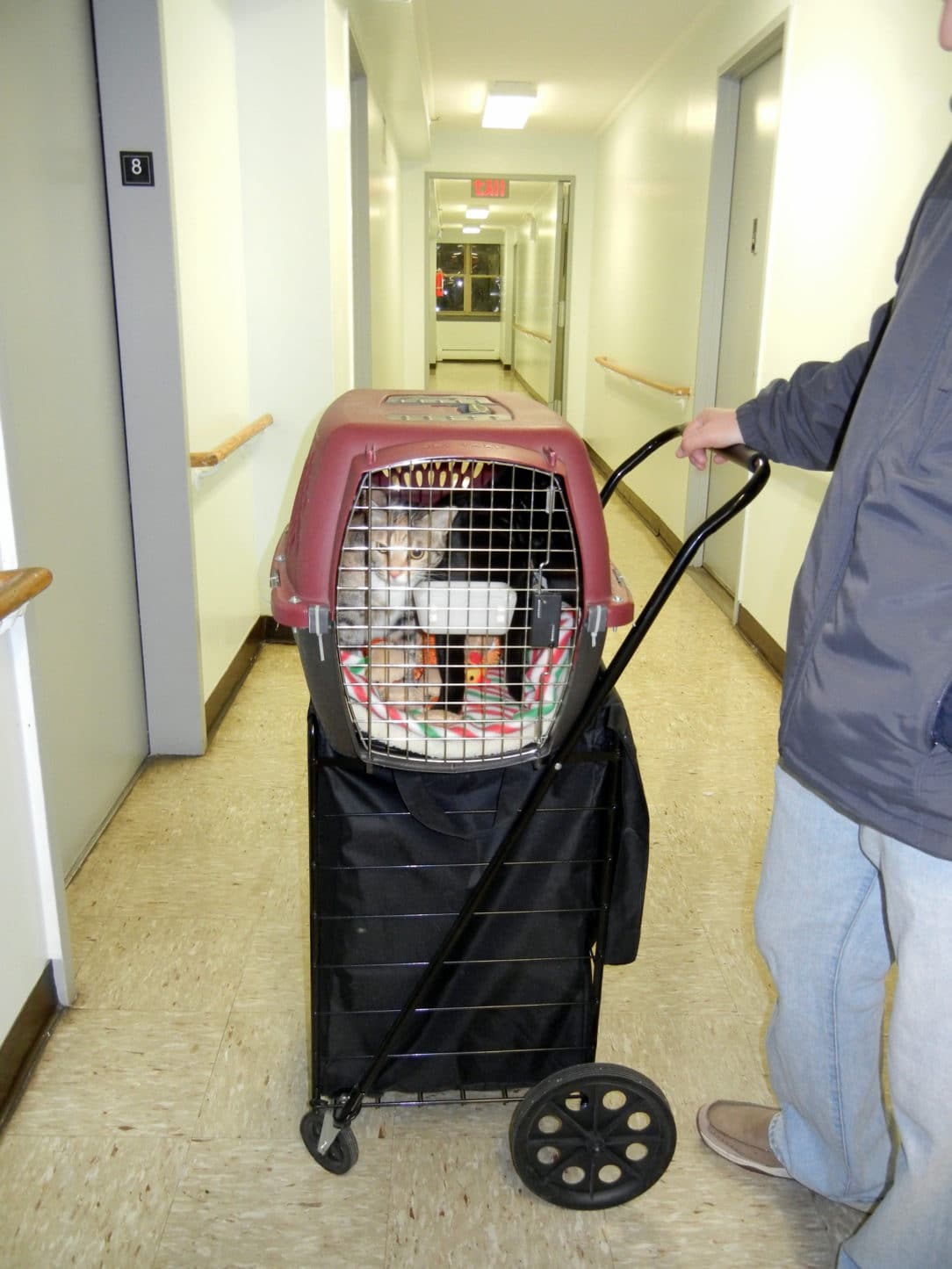
Carting our cats over to my mom’s apartment.
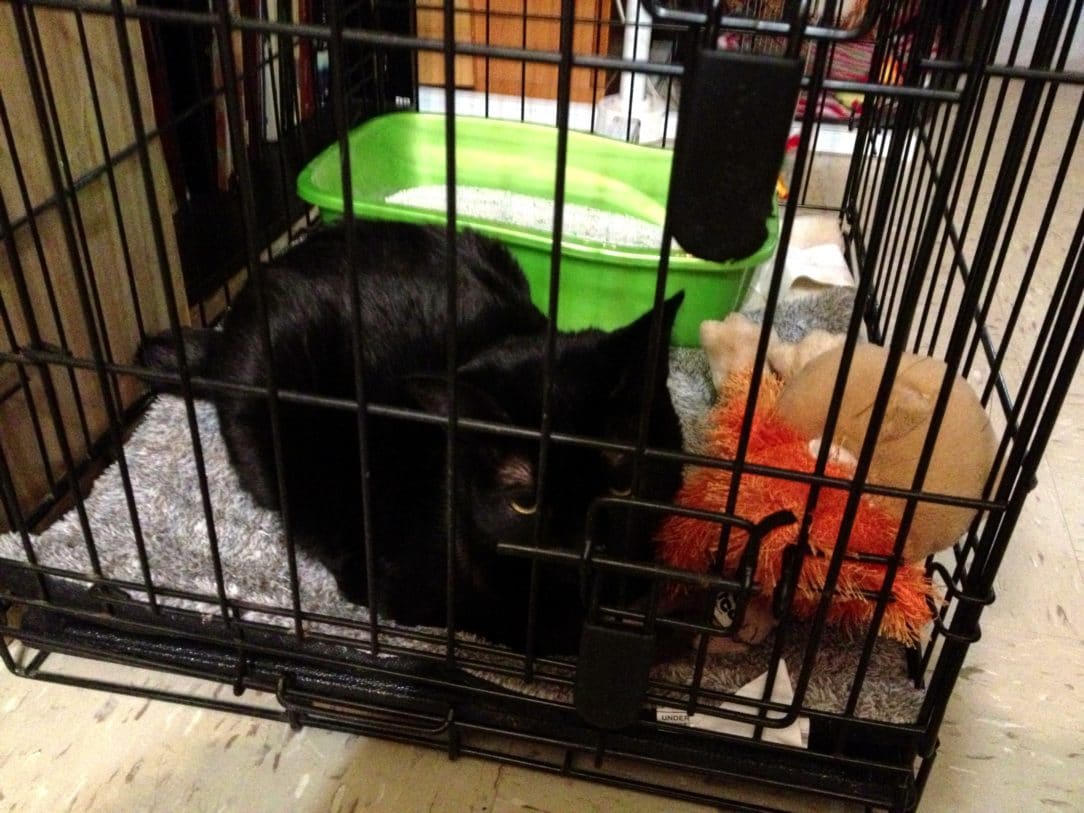
Anyway, before we left for Georgia, we had one small issue we had to take care of: the cats. Dapper and Thumper probably wouldn’t have wanted to fly with us to Georgia, even if it had been affordable, not to mention the fact that I don’t think my family would want cats running around their houses anyway. So, they had to stay at my mom’s place with their long-lost sister, Marble. They hadn’t seen each other in about six months and Thumper hasn’t gotten along with Marble since I left the Philippines with Marble instead of her back in 2010 and she had to sit there for a year waiting on me to bring her to NYC. I think she got jealous!
Marble, pissed off about unwanted house guests.Dapper, taking up a position on the high ground.Thumper, in solitary confinement because she likes to fight.
So, throwing them all back together for a week was probably not the best idea, but cat-sitting is so expensive these days, and I trust family more than I trust a pet-sitting service anyway. I figured they’d be ok. Everything seemed to have gone ok, anyway. Bringing them back was entertaining. We had to wrap the carrier up in blankets because it was about 24 degrees outside that night with a brisk wind. When we exited my mom’s building, one of our cats gave this horrified meow when she felt the breeze. Then she buried herself in blankets!
I hope everyone had as good a time over the holidays as we did, and that everyone’s year is off to a good start!








 Bradley's Old Fashioned Weblog