Deir Yassin and the Flight of the Palestinians

This is a paper I wrote for an undergraduate history course called Modern Middle East.  I was taking a very involved course on the Arab-Israeli Conflict at the same time, so my papers for the Modern Middle East class focused on Palestine and Israel as well.  The paper was given 15/15 points.  I’d like to have written more, but it was only supposed to be 5 pages.  If I’d had more time (or a requirement for more pages!) I’d probably have written more about how the Arabs and Jews both deliberately exaggerated to the events at Deir Yassin to their own advantage, and detriment.
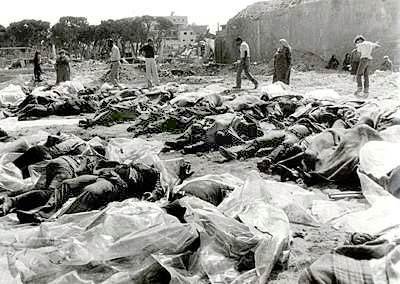
Deir Yassin Massacre Victims
Deir Yassin Massacre Victims via Palestine Solidarity Project

Impact of the Deir Yassin Massacre on the Palestinian Exodus in 1948

In 1917, Britain conquered Jerusalem and ruled the region through a military administration. In 1920, the San Remo Conference awarded Britain the mandate of Palestine, which was sanctioned by the League of Nations in 1922.[1] By 1947, the British had grown weary of the sectarian violence between the Zionist Jewish and Arab populations in Palestine and as part of an overall downsizing of their colonial holdings after the economic stresses of World War II turned over the Palestine Mandate to the United Nations, which decided, in UN General Assembly Resolution 181, to solve the problem by separating the parties through land partition.[2]

The 29 November 1947 UN partition plan would have granted 55% of the land (much of it desert) to the Jews and 40% to the Arabs, with Jerusalem and Bethlehem falling under international control. The Jews accepted the plan, reasoning that it would provide them a foundation from which to build a Jewish state. The Palestinians, on the other hand, rejected the partition and launched a three day general strike followed by a wave of anti-Jewish terrorism in the cities and on the roads.[3]

As British Mandatory rule drew to a close in early 1948, the conflict between immigrant Jews and native Arab Palestinians erupted into an open civil war. On May 14th, 1948, the day before the Mandate ended, David Ben-Gurion, the Executive Head of the World Zionist Organization and chairman of the Jewish Agency for Palestine, changed the nature of the conflict by declaring the establishment of a Jewish state. The fighting between Jews and Arabs stopped being a sectarian struggle and evolved into a national struggle, not just between the new Israelis and the Palestinians, but between the newly formed Israel and the surrounding Arab states, who joined in the fighting. The war in 1947 – 1948 later became known as the War of Liberation to Israelis and as al-Nakba (“Disaster,” or “Catastrophe” in English) to the Palestinians and Arabs in the Middle East.[4] The Arabs were soundly defeated, leaving the Israeli state in control of more land than originally granted to it by UN Resolution 181, which the Arabs rejected under the assumption that the combined powers of the Arab armies could defeat the Jews.[5]

The conflict was a total defeat for the Palestinians. They not only lost control of a majority portion of the Palestinian Mandate territory, but they also failed to establish political independence. Only the Gaza Strip and the West Bank (with larger boundaries than today) remained outside of Israeli control, but they were claimed by other countries who had participated in the war against Israel: Egypt and Jordan. After the 1948 war, Jordan retained control over the resource-rich West Bank and East Jerusalem while Egypt controlled the Gaza Strip.

Perhaps the worst blow to the Palestinians, however, was being driven from the land and being prevented from returning. During the fighting, Palestinians fled their homes in droves in advance of or during combat between the Jews and Arabs, or to evade Arab militias who abused villagers. A total of approximately 750,000 Palestinians were displaced by the 1948 war in Palestine, and the issue showed up time and again in peace talks in the form of demands for the right-of-return of refugees.[6] Today, the number of refugees has ballooned to approximately five million as new generations of Palestinians are born in refugee camps and inherit the refugee status of their parents.[7]

Many factors contributed to the creation of the Palestinian refugee problem, including expulsion orders, such as those signed by Yitzhak Rabin (later a Prime Minister of Israel) that ejected the Arab population from Lydda;[8] voluntary self-removal of the wealthier classes to other countries to avoid loss of capital during the fighting;[9] the flight of Palestinian leadership;[10] and as a result of Israeli actions during the implementation of “Plan Dalet” (also known as Plan D). Plan Dalet would later become known as a very controversial strategic operation which aimed at:

gaining control over the territory assigned to the Jewish state and defending its borders, as well as the blocs of Jewish settlement and such Jewish population as were outside those borders, against regular, para-regular, and guerrilla forces operating from bases outside or inside the nascent Jewish State.[11]

To its critics, especially those in Arab states, the plan called for nothing short of the ethnic cleansing of the land allotted to Israel in the 1947 United Nations General Assembly’s Resolution 181, which partitioned the land of Palestine into separate Jewish and Arab states.[12]

Plan Dalet wasn’t necessarily a political blueprint for the expulsion of Palestinians en masse. It was governed by military considerations and, given the nature of the war and the admixture of populations in Palestine, securing the interior of the Jewish state from ‘external’ threats required the depopulation and destruction of villages that housed hostile militias and irregulars.[13] It was also common for roving irregular forces from other Arab states to impose on villages by demanding housing, since they were there fighting for their interests, supposedly.[14] The people of Deir Yassin had decided to remain neutral in the conflict, refusing entry to outsiders, and worked out a system of signals with the nearby Jewish settlement of Givat Shaul to alert them that roving militias and irregulars were in the area. Deir Yassin hoped that by cooperating, their town would be spared the hardships of war.[15] They would, however, be disappointed.

A widely implemented tactic by the Arabs was to cut off supply lines between the Jewish coast and Jewish population centers inside the country, like Jerusalem and the Etzion Bloc. Opening up these supply lines became a priority.[16] At David Ben-Gurion’s insistence, a force of 1500 Jewish troops was mobilized to take part in Operation Nachshon. No longer would the Jews passively protect their convoys with guards; they would instead conquer and hold the routes themselves, as well as the heights surrounding them.[17] It was during Operation Nachshon that the Deir Yassin massacre occurred. The operational order of 3 or 4 April states that “all the Arab villages along the [Khulda-Jerusalem] axis were to be treated as enemy assembly or jump-off bases” and according to Plan Dalet, villages so defined, if offering resistance, should be depopulated (through forced migration) and destroyed.[18]

It’s not clear why, but the Haganah command allowed two Jewish militant extremist groups to participate in Operation Nachshon, perhaps because of the importance of securing the routes and the need for able bodied fighters. Irgun Zevai Leumi (Irgun) and Lohamei Herut Israel (Lehi, aka the “Stern Gang”) were widely regarded as terrorists by British mandatory authorities and the Israeli defense establishment itself.[19] For example, in 1946 the Irgun, acting under the direction of Menachem Begin, who would in 1977 become the Prime Minister of Israel under the Likud Party, ordered the bombing of the King David Hotel, which housed the British Mandate headquarters. The final casualty list included ninety-one British, Arab, and Jewish dead.[20]

The result of the Irgun and Lehi’s participation in Nachshon was a massacre of civilians. Despite Deir Yassin’s non-belligerency agreement with neighboring Givat Shaul, Irgun and Lehi forces entered the town to occupy it and met with unexpectedly strong resistance from residents who probably felt betrayed by their Jewish neighbors. During the fighting, Irgun and Lehi forces blew up several houses and gunned down families in the streets. They also rounded up groups of unarmed residents of both sexes and murdered them en masse. Some residents were paraded through the streets of Jerusalem before being taken back to Deir Yassin to be murdered.[21] A Haganah Intelligence Service report states that “whole families – women, old people, children – were killed.”[22] The following day the author of the report added: “[Lehi] members tell of the barbaric behavior of the [Irgun] toward the prisoners and the dead. They also relate that the [Irgun] men raped a number of Arab girls and murdered them afterward (we don’t know if this is true).”[23]

Regardless of whether or not it was true, reports like the one above and the stories told by the survivors rapidly spread throughout the region, becoming headline news. Altogether, about 100 – 120 villagers died that day, but the event became amplified through gossip and the media to such a degree that it became extremely influential in affecting the flight of the Palestinian population.[24] When trying to justify their actions after the fact, the Irgun cited the fear and panic the act caused and its beneficial impact on the Israeli war effort.[25]

The massacre and the way it was emphasized and possibly exaggerated in the media strengthened the resolve of Arab leaders to aid the embattled Palestinians and defeat the Jews. It also caused problems for the Jewish forces when criticized by the Western media, but the most important aspect of the massacre was the role it played in increasing flight from the Palestinian villages.[26] In Beit Iksa, fear caused the start of an immediate evacuation. The same occurred in al-Maliha and the residents of Fajja, near Petah Tikvah, Mansura, and near Ramle quickly called their Jewish neighbors and promised to not fight. In Haifa and surrounding villages, Palestinians heard rumors of Jewish atrocities at Deir Yassin and took flight. In the village of Saris, Arabs offered the attacking Haganah no resistance whatsoever, for fear of sharing Deir Yassin’s fate. [27] The fear of another Jewish massacre of civilians had an impact on the behavior of Palestinian villagers across the territory.

The British noted that whether or not all of those atrocities actually took place, the Haganah and the Jews had certainly profited from it and Jewish political leaders determined that the Deir Yassin massacre was one of two pivotal events in the exodus of Palestine’s Arabs, the other being the fall of Arab Haifa.[28] The psychological impact of the massacre may not have been the main cause of the Palestinian refugee crisis, but it certainly increased the number of people affected, making resolution of the Arab-Israeli conflict that much more difficult for generations to come.


[1] David Lesch, The Arab-Israeli Conflict: A History, p. 95.
[2] Ibid., p. 134.
[3] Benny Morris, The Birth of the Palestinian Refugee Problem Revisited, p. 13.
[4] Ibid., p. 145.
[5] Tom Segev, One Palestine: Complete, p. 496.
[6] Rashid Khalidi, The Iron Cage, p. 7.
[7] “Palestine refugees”, United Nations Relief and Works Agency for Palestine Refugees.
[8] Benny Morris, The Birth of the Palestinian Refugee Problem Revisited, p. 429.
[9] Ibid., p. 67.
[10] The Pittsburgh Press, “British Halt Jerusalem Battle,” 1948.
[11] Quoted in David Lesch, The Arab-Israeli Conflict: A History, p. 137.
[12] David Lesch, The Arab-Israeli Conflict: A History, p. 137.
[13] Benny Morris, The Birth of the Palestinian Refugee Problem Revisited, p. 164.
[14] Ibid., p. 123; p. 114.
[15] Ibid., pp. 90 – 91.
[16] Ibid., p. 66.
[17] Ibid., p. 233.
[18] Ibid.
[19] The Glasgow Herald, “Irgun Accept Ultimatum,” 22 September 1948; The Pittsburgh Press, “Two Palestine Hostages Dead, British Told,” 30 July 1947; St. Petersburg Times, “Jews Arrest Stern Gang Terrorists,” 19 September 1948; St. Petersburg Times, “French Uncover Plot To Bomb London,” 8 September 1947.
[20] David Lesch, The Arab-Israeli Conflict: A History, p. 129 & 259; The Glasgow Herald, “Irgun Message Admits Guilt in Death Blast,” 24 July 1946.
[21] Benny Morris, Birth of the Palestinian Refugee Problem Revisited, p 237.
[22] Ibid.
[23] Benny Morris, Birth of the Palestinian Refugee Problem Revisited, p. 238.
[24] Ibid., p. 238.
[25] Ibid., p. 239.
[26] The Indian Express, “Arab States Out To Undo Jewish State: Azzam Pasha Outlines New Policy,” 21 May 1948.
[27] Benny Morris, Birth of the Palestinian Refugee Problem Revisited, p. 240.
[28] Ibid.

Bibliography

“Arab States Out To Undo Jewish State.” The Indian Express 21 May 1948: 5. Web Archive. 18 May 2012. .
“British Halt Jerusalem Battle: Fresh Troops Pour into City To Keep Peace.” The Pittsburgh Press 3 May 1948: 1. Web Archive. 8 May 2012. .
“Irgun Accept Ultimatum.” The Glasgow Herald 22 Sep 1948: 5. Web Archive. 17 May 2012. .
“Irgun Message Admits Guilt In Death Blast: Communique Purported From Underground Claims Warning Went Unheeded.” The Montreal Gazette 24 Jul 1946: 1. Web Archive. 17 May 2012. .
“Jews Arrest Stern Gang Terrorists.” St. Petersburg Times 19 Sep 1948: 1. Web Archive. 17 May 2012. .
Khalidi, Rashid. The Iron Cage: The Story of the Palestinian Struggle for Statehood. New York: Beacon Press, 2007. Kindle edition.
Lesch, David W. The Arab-Israeli Conflict: A History. New York: Oxford University Press, 2008. Print.
McGhee, George Crews. On The Frontline in the Cold War: An Ambassador Reports. Santa Barbara: Greenwood Publishing Group, 1997. Google eBook.
Morris, Benny. The Birth of the Palestinian Refugee Problem Revisited. New York: Cambridge University Press, 2004. Print.
“Palestine refugees.” n.d. United Nations Relief and Works Agency for Palestine Refugees. Web. 17 May 2012. .
Segev, Tom. One Palestine, Complete: Jews and Arabs Under the British Mandate. New York: Henry Holt and Company, LLC, 2001. Print.
“Two Palestine Hostages Dead, British Told: Sergeants Hanged, Underground Claims.” The Pittsburgh Press 30 Jul 1947: 1. Web Archive. 17 May 2012. .

Unity, Support and Power: Failure of Palestinian Nationhood

Note: This is a paper that was written for a Modern Middle East undergraduate history course.  The paper was supposed to be five pages long, but I went a little overboard.  Even so, I don’t think I even came close to fully covering the topic, not that I really could in a semester, or in one short research paper.  Nonetheless, this paper received an A.

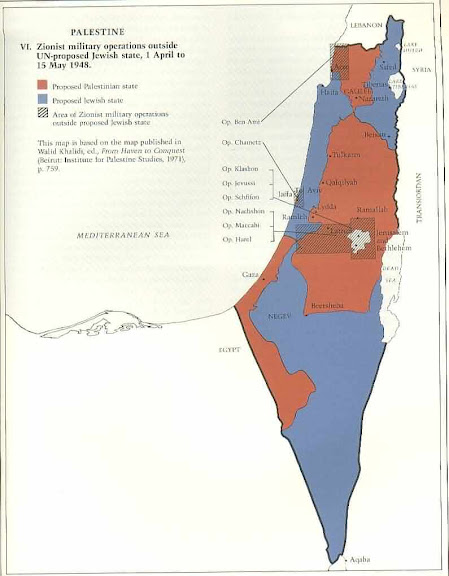
1948 Map of Conflicts in Palestine.
Zionist Military Operations Outside UN-proposed Jewish State, 1 April to 15 May 1948. (Source: Greenpolitics)

At the end of World War I, with the fall of the Ottoman Empire, the entire Middle East was in a state of flux. What used to be a single sovereign entity was carved up into modern nation states by the victorious European powers. At a conference in San Remo in 1920 Britain and France, according to an arrangement known as the Sykes-Picot Agreement (1916), drew the borders for four new states: Iraq, Syria, Lebanon and Palestine. In 1922, Palestine was further divided into Palestine and Transjordan. These new countries were legitimized as mandates of the League of Nations, states that would be protectorates of European powers and eventually gain independence. Thus, Britain retained control of Iraq, Palestine and Transjordan and France retained control of Syria and Lebanon, directly and indirectly.[1]

Over the following decades, each of the mandate states threw off the shackles of colonialism and won independence, with the exception of Palestine. The pursuit of national independence for Palestinians has been impeded by a series of complications, starting with the Balfour Declaration of 1917:

His Majesty’s Government [of England] view with favour the establishment in Palestine of a national home for the Jewish people, and will use their best endeavours to facilitate the achievement of this object, it being clearly understood that nothing shall be done which may prejudice the civil and religious rights of existing non-Jewish communities in Palestine, or the rights and political status enjoyed by Jews in any other country.[2]

The Balfour Declaration is a letter that was issued by the United Kingdom’s Foreign Secretary, Arthur James Balfour, to Baron Rothschild, a leader of the British Jewish community. British government officials believed that the Jewish ‘vote’ needed to be won to ensure victory in World War I. If the British didn’t secure Jewish backing, the Germans would “buy them” and use them to influence Russia into signing a separate peace treaty with Germany, allowing the Germans to focus on the western front.[3] The Balfour Declaration was a response both to the fear of the supposed power of world Jewry and the sympathetic nature of some British government officials to the Zionist cause.[4] Zionist leaders did their best to encourage these feelings, resulting in the inclusion of the wording of the Balfour Declaration in the League of Nations sanctioned British mandate for Palestine in 1922.[5]

Contrary to the popular idea that Palestine was a land without a people for a people without a land, the area was well populated. At the beginning of the Zionist influx into the Palestine Mandate area, there were approximately 450,000 Arab and 20,000 (Arab) Jewish residents.[6] Direct British rule and British efforts to fulfill the obligations of the Balfour declaration combined with the influx of European Jews created a volatile situation that retarded the national development of Palestine. Instead of developing modern governing institutions like other newly formed Middle Eastern nations, Palestine’s residents spent the mandate period in conflict and constant competition between British, Jewish and Arab interests.

The major conflict between the two groups was based on the meaning of the Balfour Declaration. The Zionist interpretation of the Balfour Declaration was that it intended the creation of a Jewish state that, as Chaim Weizmann (Chair of the Zionist Commission and later first president of Israel) said, would be as Jewish as England is English.[7] Critics of the Zionists interpreted the Balfour Declaration’s goal as the creation of a Jewish cultural center inside an independent Arab state. The ambiguity was introduced into the document to give the British room for diplomatic maneuvering, but in the end, all it did was complicate their position in Palestine. They were never able to resolve the contradiction inherent in their promise.[8]

The confusion in policy created by the Balfour Declaration led one senior British official to say, just prior to leaving the country, that Britain had “nothing but fluctuations of policy, hesitations…no policy at all.”[9] The British alternately supported Jewish development of a national home and Arab national aspirations in a precarious balancing act intended to maintain the status quo. This remained true until their withdrawal from Palestine in 1948, twenty five years later. When the last British High Commissioner departed Haifa, there was no formal transfer of powers to a new local government because there was no government in Palestine. When the mandate ended, the Jews and Arabs were left to struggle for supremacy.[10]

The internal struggle for power in the years and months leading up to the end of the British mandate for Palestine and the subsequent war that started on May 15th, 1948 with the end of British mandatory rule between Jewish and Arab irregular forces from the surrounding nations saw the birth of the state of Israel and the failure of the Palestinians to establish a nation. The reason for the success of the Jews over the Arabs boils down to three key differences: unity, external support and military power. The Jews entered Palestine with a unified goal, if not a unified ideology. They enjoyed wide support from Jewish and Christian communities around the world, as well as the backing from Britain guaranteed by the Balfour Declaration. They also took advantage of their ties to Europe to advance their military prowess, which proved decisive in the 1947-1948 conflict with the Arabs, also known as the first Arab-Israeli War. The Palestinian Arabs, on the other hand, were completely unprepared for the task ahead of them.

During the early years of the mandate, the Arab notables felt it was only natural that they should govern the land they had lived on for centuries.[11] They were convinced that at some point the British would come to their senses and stop supporting the Jews. In the meantime, the Arab notables in Palestine did what they could to maintain their social status, including working with the British mandate authorities, who supplied them with positions of authority.[12] For example, the British created the office of Grand Mufti of Jerusalem and assigned al-Hajj Amin al-Husayni to the role. Later the British created the Supreme Muslim council, which Husayni headed.

The reliance of Arab leadership on the British caused them to mostly work with, rather than against, the mandate government, which also meant that they were indirectly supporting the Zionist occupation of what they considered to be Arab land. The Arab notables attempted to negotiate with the British privately while condemning British support of Zionism publicly, all the while working to ensure there would be no disruptive mass political demonstrations that could destabilize their social and political positions.[13] The need to stay on good terms with the British undermined the authority of the Arab notables in the eyes of the public.[14] Further complicating the Arab political atmosphere in Palestine was the constant rivalry between the two prominent families in the region: the Husaynis and the Nashashibis. Their attempts to create rival power bases in Palestine prevented Arab unity. The inter-Arab rivalries and reliance on the British, together with the need to suppress popular movements to maintain their positions, caused the Palestinians to never be capable of forming a unified front, which effectively neutered the Palestinian political body and Palestinian aspirations of nationhood. It would be fair to say that the goals of the Arab leadership (to maintain their positions) did not match the goals of the Palestinians, but due to the Ottoman top-down power structure, the average Palestinian had no way to directly influence the decision making process until later in the mandatory period, when guerilla leaders like al-Qassim began to rally popular support.

Compounding the problem was the lack of any meaningful external support for the Palestinian Arabs. To start with, none of the Arab political institutions formed in mandate Palestine were recognized by any international authority, not even by the Arab states, who took it upon themselves to speak for the Palestinian Arabs.[15] But, their motives weren’t entirely pure either. Throughout the mandate period, the surrounding Arab states had, despite repeated requests, failed to supply the Palestinian Arabs with arms, food, or any financial support. The Arab states each had different agendas in terms of what they wanted to accomplish in Palestine, but the rights of the Palestinians themselves probably ranked very low on their list of priorities. Most of the surrounding states were solely interested in land grabs to increase the power of their respective states in terms of inter-Arab regional politics.[16]

By the time hostilities broke out in Palestine after the November 1947 announcement of the UN Partition Plan, the Arabs felt a distinct sense of abandonment. They had no effective leadership and they had been isolated by the surrounding Arab states. According to Rashid Khalidi,

The Palestinians entered the fighting which followed the passage of the UN Partition Resolution with a deeply divided leadership, exceedingly limited finances, no centrally organized military forces or centralized administrative organs, and no reliable allies.[17]

According to a Haganah Intelligence Service – Arab Division executive, the average Palestinian had come to the conclusion that they could not hold their own against the Jews.[18] HIS – AD further reported that most of the Arab public would be willing to accept the 1947 UN Partition Plan and lacked a desire to engage in a war with the Jews because of a lack of weapons and internal organization.[19] Many were unwilling to fight because if they died, there would be no compensation for their widows and/or orphans.


Ghandhi & Terrorism: Tackling the “Mad Idea”

With globalization being so popular an idea these days, we often seem to forget that nations do have sovereignty over their own territory.  That sovereignty comes with the ability to live in ways that don’t necessarily agree with our own values, expectations or religion and to create law systems that have a foundation on something other than a mirror of our (US) constitution.  One example that comes to mind right away is the shocked reaction that everyone had when Egyptians decided they wanted to replace Mubarak’s tyranny with a government based on Islamic values.

I mention sovereignty because it seems to me that most of the world’s problems come from unrealistic expectations that ones’ own way is not only the best way, but the only way.  If anyone doesn’t want our way, we use it as an excuse to force it on them for their own good while exploiting them for economic gain.  In India, that behavior led to a revolution that, thankfully, wound up being more peaceful than it would have been due to the hard work of a man named Mohandas Karamchand Gandhi, the Mahatma.  In the Middle East, Western meddling planted the seeds that would eventually grow into global terrorism on a grand scale.

Tying Gandhi’s philosophy of non-violent non-cooperation into modern day problems with terrorism was the focus of a class I took over Winter Session.  It was 3 weeks of class, 4 hours a day, 4 days a week, that culminated in an oral presentation and a 10 page paper after having read 3 books on Gandhi’s philosophy and 1 on the rise of religious terrorism.  It was difficult, but educational.  Looking at the paper now, I wish I’d had more time to directly compare Gandhi’s goals with bin Laden’s goals, and to compare their use of religion as a tool to achieve an end.  Instead, I tried to explain the mentality of religious violence and how meeting that violence with more violence only perpetuates the cycle and, even worse, justifies and empowers the terrorist ideology of hatred.  In a way, meeting violence with violence is cooperating with the terrorists, and after you read this you might have a better understanding of why.

[Sources and footnotes are listed at the bottom.]

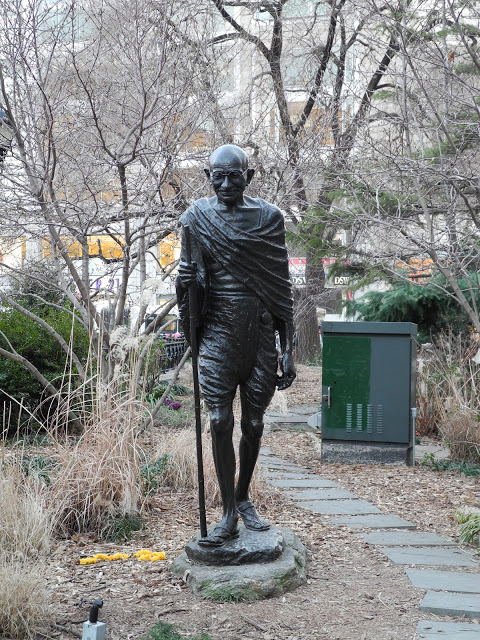
The Gandhi Memorial Statue in Union Square, New York City

On August 15, 1947, India acquired independence from the British Empire. The country’s road to freedom was paved not with violence, but with Satyagraha, a method of non-violent non-cooperation employed and promulgated by Mohandas Karamchand Gandhi, the Indian Mahatma (Great Soul) who expanded on this unique style of civil disobedience in South Africa.[1] The word Satyagraha is a Sanskrit composite formed from satya and agraha. Satya implies love and agraha firmness, which is synonymous with force in terms of the force born of “Truth and Love or Non-Violence…”[2] Gandhi didn’t claim to have invented Satyagraha. Rather, he just named it. Gandhi was certain of the existence of Satyagraha prior to his use of it by the very fact that the world still lived on, despite the constant warfare. He cited Satyagraha as the force that amiably dissolves the quarrels of millions of families daily and emphasized that the only reason it’s not mentioned in history books is because history itself is a record of the disruptions of Satyagraha, or ahimsa, which is the natural course of nature.[3]

Mahatma Gandhi successfully used Satyagraha to fight for Indian rights in South Africa. He used it again to win independence from the British Empire for India. Dr. Martin Luther King adapted Gandhi’s ideology to his own movement and successfully fought for equal rights for African Americans. Without using weapons, Gandhi’s Satyagraha has been proven to work. So, does that mean it has applications for today’s modern war on terrorism? And how would we go about making the changes necessary to effectively employ this force against the ‘enemy’ and bring about a peaceful resolution of conflicts?

Gandhi with a spinning wheel in India

Gandhi said, “…if we are Satyagrahis and offer Satyagraha, believing ourselves to be strong…we grow stronger and stronger every day.”[4] Satyagraha is an ideology of empowerment that places emphasis on maintaining the moral high ground through “self-help, self-sacrifice and faith in God…”[5] Naturally, this is something one must do oneself for it to work properly, which is why Gandhi said that Satyagraha is for self-help and declined the assistance of foreigners in fighting for India’s freedom, except insomuch as he wanted their attention and sympathy.

Gandhi believed that the process of Satyagraha could only happen if one maintained a total absence of violence, both in one’s actions and one’s thoughts. For Gandhi, a “struggle could be forceful…but it could not be violent,” so willing self-sacrifice played a key role in achieving one’s goal.[6] Through non-violent self-sacrifice a movement gains both public sympathy and the admiration and respect of the aggressor, eventually inducing a change of heart and an amiable resolution to conflicts.

Most importantly, by not using violence, Satyagraha creates solutions that break the cycle of violence. Gandhi said, “A non-co-operationist strives to compel attention and set an example not by his violence but by his unobtrusive humility.”[7] The moment violence is used the means become corrupted, which invariably leads to a corrupted end. Gandhi used this argument to counter the call for violent revolution against the British in India. He said that “by using similar means we can get only the same thing that [the British] got” and compared gaining morally pure rule through violence to planting weeds to grow roses.[8]

A violent response escalates the level of violence used. Gandhi believed that winning independence through violence would leave India just as bad off as it already was, because it would mean that violent people would be assuming control of the country.[9] He did agree that he would rather have bad home rule rather than suffer under a foreign master, but Gandhi’s goal was to achieve a free India that could initiate a new government with clean hands.[10] To do this, Gandhi believed that India had to break with modern secular Western society. He described the materialism of Western civilization as a sickness.[11] Britain’s industrialization, and all industrialization, relies on the exploitation of other countries. Engaging in industrialization would pollute India and India would become no better than the former masters’ whose yoke she had thrown off.[12]

1993 World Trade Center Bombers

According to Mark Juergensmeyer, the advent of modern Western society has devalued religious belief, replacing theology with secular morality and the Church with the nation state. Social identity has shifted from religious affiliation to national citizenship. Some religious activists believe that “secular society and modern nationalism can [not] provide the moral fiber that unites national communities or the ideological strength to sustain states buffeted by ethical, economic, and military failures.”[13]

In an interview with Mahmud Abouhalima, convicted of participating in the 1993 World Trade Center bombing, Mark Juergensmeyer asked him what it was that secular America was missing that caused it to not understand him and others like him. Abouhalima answered, “the soul of religion.”[14] He went on to compare secular life to an ink pen that was missing its ink. He said, “An ink pen, a pen worth two thousand dollars, gold and everything in it, it’s useless if there’s no ink in it. That’s the thing that gives life…”[15]

Western societies may see secularization as a positive process, a freeing of the population from archaic dogmas, but people like Abouhalima and even Gandhi were adamantly opposed to separating religion from life.[16] Without religion, Abouhalima would have no meaning in his life, and Gandhi would not have had the strength to free India. Thinking in those terms, any encroachment of Western society in the modern Middle East may be viewed by the locals as not only unbeneficial but harmful, and potentially as an attack on fundamental values and religion itself, which for Muslims constitutes a large portion of their everyday life and culture.[17] Gandhi believed that all change has to come from within to be lasting. It cannot be forced upon people, and attempting to use violence through sanctions that cause hardships or through rhetoric and demonizing will have no effect but to draw sympathy to the victimized, even if their cause is wrong.[18]

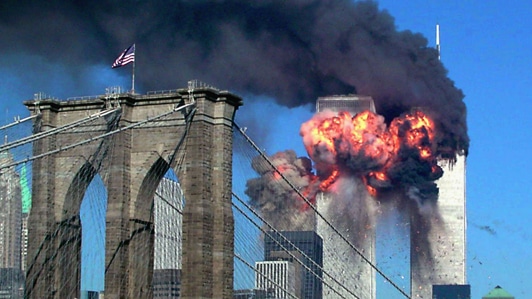
2001 attack and destruction of World Trade Center in New York City

In today’s War on Terror, responding to terrorism with acts of violence empowers the terrorists by cooperating with their ideology of hatred, by affirming that the secular West is indeed evil and intent on destroying the religion and culture of the average person. Mark Juergensmeyer wrote that “many secular political leaders have described [the War on Terror] as a war that must be won—not only to avenge savage acts as the destruction of New York’s World Trade Center, but also to allow civilization as the modern West has known it to survive.”[19] In a war between civilizations where the existence of each civilization’s future is at stake, only one can remain at the end of the conflict. The sort of rhetoric being used to promote the War on Terror is one of absolutes and only further justifies the teachings of terrorists: that the US must be defeated for Islam and Islamic culture to survive. The immediate response after the attacks on the World Trade Center in New York City was to launch a retaliatory attack, but has that attack actually solved anything? Did we not in fact validate the terrorists’ ideology of hatred by destroying the lives of the innocent along with the accused through long-term warfare?

Madanlal Dhingra
Madanlal Dhingra

In 1909, Madanlal Dhingra, an Indian student in England, assassinated Sir William Hutt Curzon Wyllie, a political aide to Lord George Hamilton, the Secretary of State for India. According to Sankar Ghose, “Winston Churchill regarded Dhingra’s last words “as the finest made in the name of patriotism…”[20] Gandhi had a completely different opinion of Dhingra: “It is not merely wine or bhang that makes one drunk, a mad idea can also do so… Dhingra was a patriot, but his love was blind. He gave his body in a wrong way, its ultimate result can only be mischevious.”[21] Gandhi, a man so religious that his last words after being shot by an assassin were “Hē Ram (Oh God),”[22] was absolutely opposed to violence in any form, for any objective, which makes it all the more surprising that terrorism today is most often tied to extreme religious views. In his own way, Gandhi was an extremist, but he was an extremist who used and advocated extremes of peace and love to achieve what he considered just ends. Today’s religious extremists are not so different from Gandhi, in that they go to extremes to ensure that their views are made known. In fact, Osama bin Laden’s goals were not that different from Gandhi’s.

In 1991, Iraqi forces invaded Kuwait, prompting a coalition force of Middle Eastern and Western nations (including the United States) to engage in military operations in defense of Kuwait. Military operations began on January 16th, 1991 with air and missile attacks on targets in both Kuwait and Iraq. After an unavoidable ground war, Iraqi forces were put into full retreat. On February 27th, 43 days later, President Bush declared a suspension of offensive combat. During the war, Saudi Arabia was used as a launching point for allied offensives against Iraq.[23] After the war ended, the US presence in Saudi Arabia remained, further outraging some religious conservatives that consider Saudi Arabia to be the holiest of Islamic lands, being home to both Mecca, where the Ka’aba resides, and Medina where the Prophet Muhammad established the first Muslim community. The Ka’aba is the center of the Muslim world. Muslims believe that the Ka’aba was built by Abraham and his son Ishmael. One of the five pillars of Islam is pilgrimage to Mecca, to circumambulate the Ka’aba.[24]

Osama bin Laden
Osama bin Laden

Among those angered by the continued presence of US troops on Saudi soil was Osama bin Laden, head of the Al Qaeda network. On August 3rd, 1995, he issued a message called “an Open Letter to King Fahd,” outlining grievances against the Saudi monarchy, notably calling for a guerilla campaign to drive U.S. forces out of Saudi Arabia. In July 10, 1996, a British newspaper (The Independent) quoted bin Laden as saying that Saudi Arabia had become an American colony. He also stated that the real enemy of the Saudi people is America. In August of 1996, bin Laden issued a document known as the “Declaration of War Against the Americans Who Occupy the Land of the Two Holy Mosques.” The two holy mosques he references are Mecca’s Ka’aba in Saudi Arabia, where US troops were stationed, and Al Aqsa in Jerusalem. Osama bin Laden considered Israel to be a US puppet regime, so fault for occupying Jerusalem was transferred to the United States. In a CNN interview in 1997, bin Laden began to solidify his message with demands that may sound familiar to anyone familiar with India’s struggle for independence from the British Empire. He said:

We declared jihad against the US government, because the US government is unjust, criminal and tyrannical. It has committed acts that are extremely unjust, hideous and criminal whether directly or through its support of the Israeli occupation…. For this and other acts of aggression and injustice, we have declared jihad against the US, because in our religion it is our duty to make jihad so that God’s word is the one exalted to the heights and so that we drive the Americans away from all Muslim countries…. The country of the Two Holy Places has in our religion a peculiarity of its own over the other Muslim countries. In our religion, it is not permissible for any non-Muslim to stay in our country.[25]

Almost a year later, he goes on to make the following demands:

For over seven years the United States has been occupying the lands of Islam in the holiest of places, the Arabian Peninsula, plundering its riches, dictating to its rulers, humiliating its people, terrorizing its neighbors, and turning its bases in the Peninsula into a spearhead through which to fight the neighboring Muslim peoples. We–with God’s help–call on every Muslim who believes in God and wishes to be rewarded to comply with God’s order to kill the Americans and plunder their money wherever and whenever they find it… in order to liberate the al-Aqsa Mosque and the holy mosque [Mecca] from their grip, and in order for their armies to move out of all the lands of Islam, defeated and unable to threaten any Muslim.[26]

Osama bin Laden and Mahatma Gandhi both had similar goals. Both felt oppressed by foreign powers who meddled in local affairs, to the detriment of the native populations, and in both cases as a result of something Gandhi warned of: the need to exploit other countries to support the industrialization of modern Western culture.

The implied conflict for the survival of civilizations and the perceived attack on religion causes some religious activists to use violence to try to bring attention to their stated goals. From Gandhi’s teachings, we know that he could have in no way supported the terrorism of today to attain independence from foreign oppression, but it is reasonable to believe that he would have empathized with Osama bin Laden’s goal.[27] When Gandhi condemned Dhingra, the Indian student who assassinated Sir Curzon Wyllie, he didn’t condemn his goal; he instead called him a patriot and condemned the means he used. This is where terrorists like Osama bin Laden differ from Gandhi, in the means they use to reach their ends. The results of the two methods have been drastically different. Where India gained the sympathy of the world and won her independence through Satyagraha, Osama bin Laden’s use of violence has escalated out of control. Osama bin Laden himself has met a foul end and the Middle East has not been freed of foreign influence.

Gandhi believed that violence created a cycle, saying “Who lives by the sword must perish by the sword, and if the Asiatic peoples take up the sword, they in their turn will succumb to a more powerful adversary.”[28] That teaching is just as applicable today as it was during his fight with the British. In 1998, when the US launched retaliatory missile strikes on Al Qaeda training camps in Afghanistan and Sudan, the attack “provoked a new round of terrorist bombing plots.”[29] The attacks also increased bin Laden’s image as an underdog and damaged the United States’ international reputation. In July of 2002, an Israeli plane bombed the home of Hamas leader Sheik Salah Shehada, wounding 140 people and killing 11 people, 7 of which were children. Another Hamas leader, Dr. Mahmoud al-Zahar, responded by opening up targeting of terrorist attacks to all Israelis, including women and children.[30] Violent actions only led to an escalation of the level of violence employed by each side. The only way to ‘win’ is by breaking the chain of violence. An example is the 1998 Omagh bombing by a fringe element called the “Real IRA”. The bombing occurred during peace talks that would stop the violence in Northern Ireland. Rather than retaliate with more acts of violence, the guilty parties were arrested and tried using the existing legal system.[31]

So, what is the solution for stopping violence in the Middle East today? Rather than dealing with the symptoms of terrorism, the violent actions, the US should instead tackle the source of the problem. Colin Powell, United States Secretary of State from 2001 to 2005 understood this and “spoke about the necessity of dealing with the social and economic grievances that fueled the anti-American disaffection in the Middle East and elsewhere as a way of undercutting al Qaeda support.”[32] Colin Powell was expressing an idea that Gandhi emphasized himself, in regards to responding to terrorism. Gandhi described Dhingra, the Indian student who assassinated Sir Curzon Wyllie as being like a drunkard, caught in a “mad idea.” It’s that mad idea that we need to tackle: the belief in the Middle East that the United States is incapable of good and morally unambiguous behavior.

The first step is to stop responding to violence with violence. Violent action only succeeds in causing the conflict to escalate. That’s not to say that nothing should be done in the face of violent terrorist attacks. Even Gandhi didn’t believe in inaction.[33] Gandhi believed that no one had a complete view of the truth and the very existence of a conflict was the proof. He believed that every conflict was an “encounter between differing “angles of vision” illuminating the same truth.”[34] The key, then, is to take the moral high ground and understand that a response of violence will be satisfying in the short term, but will yield no real results.

The second step to solving the problem would be to address the problem of public opinion of the United States in the Islamic countries. After many years of duplicitous behavior on the part of the United States, finding a way to positively engage the Islamic community may be difficult without inciting suspicion and distrust, so it would be a gradual progress, in much the same way that Satyagraha was a gradual progress. The first efforts would have to be in areas that are politically and religiously neutral, such as providing medical care, basic literacy education in English and Arabic, building homes for the homeless, and acting in advisory capacities for social programs that would address other needs of the country. It’s a small step, but small steps add up and 30 years of providing education to the poor will mean more to them than bombing their fields to smoke out suspected terrorists. Additionally, we could take the biggest step towards having a friendly relationship with Islamic countries by respecting their sovereignty and allowing the people to determine their own futures through their own elected governments. Additionally, we could remove the US troop presence from Islamic countries and allow the people to fight for and affect their own social reforms. That would mean more to them than having the reforms handed to them with the help of Westerners. As Gandhi said, lasting change has to come from within.

One of Gandhi’s favorite quotes from Tolstoy sums up this policy best:

…if we would but get off the backs of our neighbours the world would be quite all right without any further help from us. And if we can only serve our immediate neighbors by ceasing to prey upon them, the circle of unities thus grouped in the right fashion will ever grow in circumference till at last it is conterminous with that of the whole world.[35]


[1] M.K. Gandhi, Non-Violent Resistance (Satyagraha), Chapter 1, p. 3.
[2] Mahatma Gandhi, The Essential Gandhi, Chapter 6, p. 77.
[3] Ibid., p. 79.
[4] Ibid., p. 78.
[5] Ibid., p. 81.
[6] Mark Juergensmeyer, “Gandhi vs. Terrorism,” p. 4.
[7] M.K. Gandhi, Non-Violent Resistance (Satyagraha), Chapter 15, p. 59.
[8] Ibid., Chapter 4, p. 10.
[9] Mark Juergensmeyer, “Gandhi vs. Terrorism,” p. 4.
[10] Mahatma Gandhi, The Essential Gandhi, Chapter 7, p. 102.
[11] Mark Juergensmeyer, “Gandhi vs. Terrorism,” p. 4.
[12] Mahatma Gandhi, The Essential Gandhi, Chapter 22, p. 249.
[13] Ibid., Terror in the Mind of God, Chapter 11, p. 229.
[14] Ibid., Chapter 4, p. 70.
[15] Ibid.
[16] M.K. Gandhi, Non-Violent Resistance (Satyagraha), Chapter 171, pp. 364-365.
[17] “Introduction to Islam”, describes Islam as a comprehensive way of life.
[18] Mahatma Gandhi, The Essential Gandhi, Chapter 18, p. 220.
[19] Mark Juergensmeyer, Terror In The Mind of God, Chapter 11, p. 233.
[20] Sankar Ghose, Mahatma Gandhi, Chapter 10, p. 98.
[21] Ibid.
[22] “Gandhi’s last words not ‘Hey Ram’: book”.
[23] “1991 Gulf War chronology”.
[24] Rosemary Pennington, “What Is The Ka’aba?”.
[25] Osama bin Laden, “Osama bin Laden v. the U.S.”.
[26] Ibid.
[27] Mahatma Gandhi, The Essential Gandhi, Chapter 10, pp. 132-134.
[28] Ibid., Chapter 5, p. 71.
[29] Barbara Elias, “1998 Missile Strikes on Bin Laden May Have Backfired”.
[30] James Bennet, “A Hamas Chieftain Dies When Israelis Attack His Home”.
[31] Henry McDonald, “Four Real IRA leaders found liable for Omagh bombing”.
[32] Mark Juergensmeyer, Terror in the Mind of God, Chapter 11, p. 234.
[33] Mark Juergensmeyer, “Gandhi vs. Terrorism,” p. 4.
[34] Ibid., p. 3.
[35] M.K. Gandhi, Non-Violent Resistance (Satyagraha), Chapter 46, p. 112.


Works Cited

<!–[if supportFields]> BIBLIOGRAPHY <![endif]–>”1991 Gulf War chronology.” 3 September 1996. USA Today World. Web. 22 January 2012. .
Bennet, James. “A Hamas Chieftain Dies When Israelis Attack His Home.” 23 July 2002. The New York Times: World. Web. 23 January 2012. .
bin Laden, Osama. “Osama Bin Laden V. The U.S.: Edicts And Statements.” n.d. PBS Frontline. Web. 17 January 2012.
Elias, Barbara. “1998 Missile Strikes on Bin Laden May Have Backfired.” 20 August 2008. The George Washington University: The National Security Archive. Web. 22 January 2012.
Gandhi, M. K. Non-Violent Resistance (Satyagraha). New York: Dover Publications, 2001. Print.
Gandhi, Mahatma. The Essential Gandhi. New York: Vintage Spiritual Classics, 2002. Print.
“Gandhi’s last words not ‘Hey Ram’:book.” 29 January 2008. hindustantimes: news. Web. 22 January 2012. .
Ghose, Sankar. Mahatma Gandhi. Delhi: Allied Publishers, 1991. Print.
“Introduction to Islam.” 2000. islam.com. Web. 22 January 2012. .
Juergensmeyer, Mark. “Gandhi vs. Terrorism.” 2007. Mark Juergensmeyer: Global Studies, UCSB. Web. 16 January 2012. .
—. Terror in the Mind of God. Berkeley: University of California Press, 2003. Print.
McDonald, Henry. “Four Real IRA leaders found liable for Omagh bombing.” 8 June 2009. The Guardian. Web. 23 January 2012.
Pennington, Rosemary. “What Is The Ka’aba?” 22 October 2008. MuslimVoices.org. Web. 22 January 2012. .

Al-Andalus: From Convivencia to Limpieza de Sangre

The Rock of Gibraltar, the name of which is derived from
the Arabic Jabal Tariq, “Mount of Tariq,” in honor of
Tariq ibn Ziyad, the Berber Muslim conqueror
of ancient Iberia, and essentially the founder of al-Andalus.

In 711 CE, a force of Berber Muslims under the command of Tariq ibn Ziyad landed on the southern shores of the Iberian Peninsula and engaged in a campaign of rapid conquest that culminated in the displacement of Visigoth rule in all but the northernmost parts of Iberia.  The Visigoth controlled areas in the north later served as the launching point for the Reconquista, the ‘taking back’ of the Iberian peninsula from the Muslim invaders.  Muslim rule in Iberia officially ended with the surrender of the Emirate of Granada to King Ferdinand II of Aragon and Queen Isabella I of Castile in 1492, but for nearly eight-hundred years Muslims retained governance over at least a portion of the peninsula and created a glowing civilization that set an example that unfortunately would not be followed.

Ferdinand and Isabella; Image from:
Convent of the Augustinian Nuns, Avila

Under Islamic rule, the Iberian Peninsula was marked by a level of religious toleration that was unheard of at the time and Muslims, Jews and Christians lived together in relative peace.  There were tensions between the groups, and instances where violence seemed unavoidable, but by and large, the people of al-Andalus not only held their diverse nation together, they caused it to blossom into a society that still draws admiration today for its level of comparative advancement and toleration.  Toleration for ethnic diversity and religious differences were the keys to success for al-Andalus, but after Granada fell in 1492 and the Reconquista was complete, one of the first actions taken by the Christian monarchs, Ferdinand and Isabella, was to decree the expulsion of the Jews.  That was the same year the monarchs decided to fund Christopher Columbus’ voyage to what he hoped would be Asia.  Ferdinand and Isabella wasted no time in establishing themselves as a powerful monarchy, but the example of intolerance they set was in direct contradiction to the legacy that had been left to them by Islamic Spain.


The Muslim’s initial conquest of the peninsula met with little resistance, largely due to the fact that the Visigoth rulers had managed to alienate their supporters (Lowney 31 – 32).  The Iberians willingly submitted to the Muslims, since they were no harsher than the Visigoths had been.  In the case of the Jews, Muslim rule was a vast improvement (Lea 1).  The Jews were highly oppressed under the Visigoth rulers, who “forbade Jews from marrying Christians or owning Christian slaves, proscribed circumcision, outlawed observance of Jewish holy days, and ultimately offered Jews the stark choice of conversion, exile, or slavery” (Lowney 29).  It also helped that the Muslims offered their newly conquered subjects favorable surrender treaties, such as the treaty offered to the Christian Prince Theodomir of Murcia, which says:

The latter [Theodomir] receives peace and the promise, under the guarantee of Allah and of his Prophet, that there will not be any change in his situation nor in that of his people; that his right of sovereignty will not be contested; that his subjects will not be injured nor reduced to captivity; nor separated from their children nor their wives; that they will not be disturbed in the practice of their religion; that their churches will not be burned, nor despoiled of the objects of the cult found in them… (Lowney 38)

The tolerant treaties the Muslims offered their defeated opponents was in keeping with the traditions of the Qur’an and helped set the stage for later peaceful relations between the three faiths in Islamic Spain.


In Islam, Jews and Christians are known as ′Ahl al-Kitāb, People of the Book who are protected, albeit with a second-class status.  This protection, known as dhimmitude, is based on surah 29, aya 46 of the Qur’an, which says, “And dispute ye not with the People of the Book… but say, ‘We believe in the revelation which has come down to us and in that which came down to you; our God and your God is One’” (Lowney 38).  Non-Muslim subjects of Muslim regimes were considered to be autonomous but dependent groups who were responsible for organizing their own internal affairs, including social, religious and communal matters.  These minorities had leaders, appointed by the Muslim rulers, who were responsible for their group’s “ecclesiastical matters, internal disputes, and fines and taxes” (Lapidus 265).  The leaders of these minority groups had such a level of independence that in legal cases involving two members of the same faith, their judges could inflict the death penalty without consulting the Muslim rulers (Khadduri, Liebesny and Jackson 340).  So, Jews and Christians under Muslim rule had the ability to continue to practice and develop their faith, as well as practice their own legal system, within some limits.


The ability of subject faiths to practice their legal system had some restrictions.  When cases involved serious crimes that constituted a threat to public order, Islamic law always took precedence.  These included crimes such as murder, theft, or highway robbery (Khadduri et al., 340).  There were also problems with how non-Muslims and Muslims related to each other legally.  In legal cases that involved Muslims or a member of another subject faith, dhimmis were required to appear in Shari’ah courts, which took precedence over Christian or Jewish law.  Appearing in Muslim courts was likely problematic for dhimmis, since their testimony was considered invalid under Shari’ah law, though exceptions were probably made in cases involving two members of subject religions, as qadis(Islamic judges) would need some form of information to settle a lawsuit or legal case.  Another issue faced by dhimmis was that there were lesser penalties involved for a Muslim guilty of committing a crime against a dhimmi (Khadduri et al., 337).  Dhimmis also could not inherit from a Muslim, based on the Qur’anic rule which says, “God will by no means make a way for the unbelievers over the believers” and a hadith which says, “The Muslim will not inherit from the unbeliever nor the unbeliever from the Muslim” (Khadduri et al., 343).  So, a dhimmi was fully protected as a subject of the Muslim state, but suffered from certain drawbacks that relegated him to the status of a second-class citizen (Bennett 163).  However unbalanced, dhimmitude offered the Jews and Christians of al-Andalus legal recourse and protection under the law.  It gave them a legal place in the society, creating a state of convivencia, a coexistence where Muslims, Jews and Christians worked and lived together, if not as equals then at least as fellow citizens of the same nation (Rosser-Owen 77).


The status of dhimmis as being legal members of the state is part of Islamic religious law, but “there was no Scriptural basis for the legal status of Jews and Muslims under Christian rule; they were subject to the whims of rulers, the prejudices of the populace and the objections of the clergy” (Boase 22).  It stands to reason that there were Muslims among the early invaders who would have preferred cultural and religious homogeneity, as the later Reconquista Christian Spaniards would, but in the case of the Muslims, religious law dictated that they must respect dhimmis, at least insofar as the law dictated.  This religious legal requirement that offered Jews and Christians a place in Islamic society, which didn’t have a counterpart in their own societies, must have created a feeling of stability, safety and most importantly, belonging.


A sense of nationhood, of common standing with their fellow countrymen, could have inspired them to excel, and al-Andalus certainly excelled in many areas.  The mix of cultures stimulated the intellectual pursuits of academics that produced advanced knowledge of mathematics, medicine, spirituality, astronomy, philosophy, and theology, and gave birth to some of the greatest thinkers of the age, such as the Jewish kabbalist Moses de Leon, the Sufi mystic Ibn Arabi, the Jewish Moses Maimonides and the Muslim Averroes (Lowney 8 – 9).  The common thread that held the people of al-Andalus together and produced such remarkable figures as those mentioned above wasn’t ethnicity or religion; it was toleration for the beliefs of others and a commitment to Andalusian society as a whole, based on a sense of belonging and nationhood.


There were people who rejected the idea of Islamic rule or any form of nationhood under the power of another religion.  A good example is that of Eulogius, a traveling cleric from Córdoba.  In approximately 850 CE, Eulogius discovered one of the earliest Latin copies of a version of the biography of the prophet Muhammad in the monastery of Leyre near Pamplona in northern Spain.  The biography is titled simply, Istoria de Mahomet and, unfortunately, is an example of “the repositories of misconceptions about Islam that would be drawn upon over and over again by Christians trying to explain, or more appropriately, explain away the success of Islam” (Wolf 89).  Eulogius didn’t use it just to explain away the success of Islam.  He used the text to create a political movement, an early form of peaceful disobedience, to challenge established Muslim rule through a series of martyrdoms in the hopes of inciting a popular Christian revolt.


Shortly after Eulogius returned to Córdoba, a steady procession of Christians approached Muslim qadis and denounced the prophet Muhammad, eager to become martyrs:  “Now hand down the sentence, multiply your cruelty, be kindled with complete fury in vengeance for your prophet.  We profess Christ to be truly God and your prophet to be a precursor of antichrist” (Lowney 58).  These denunciations resulted in the execution of the offenders.  Over the course of a decade, approximately fifty Christians were killed executed.  Shortly after Eulogius’ death, the number of offenses and executions petered out, which paints him as the likely ringleader (Lowney 59).

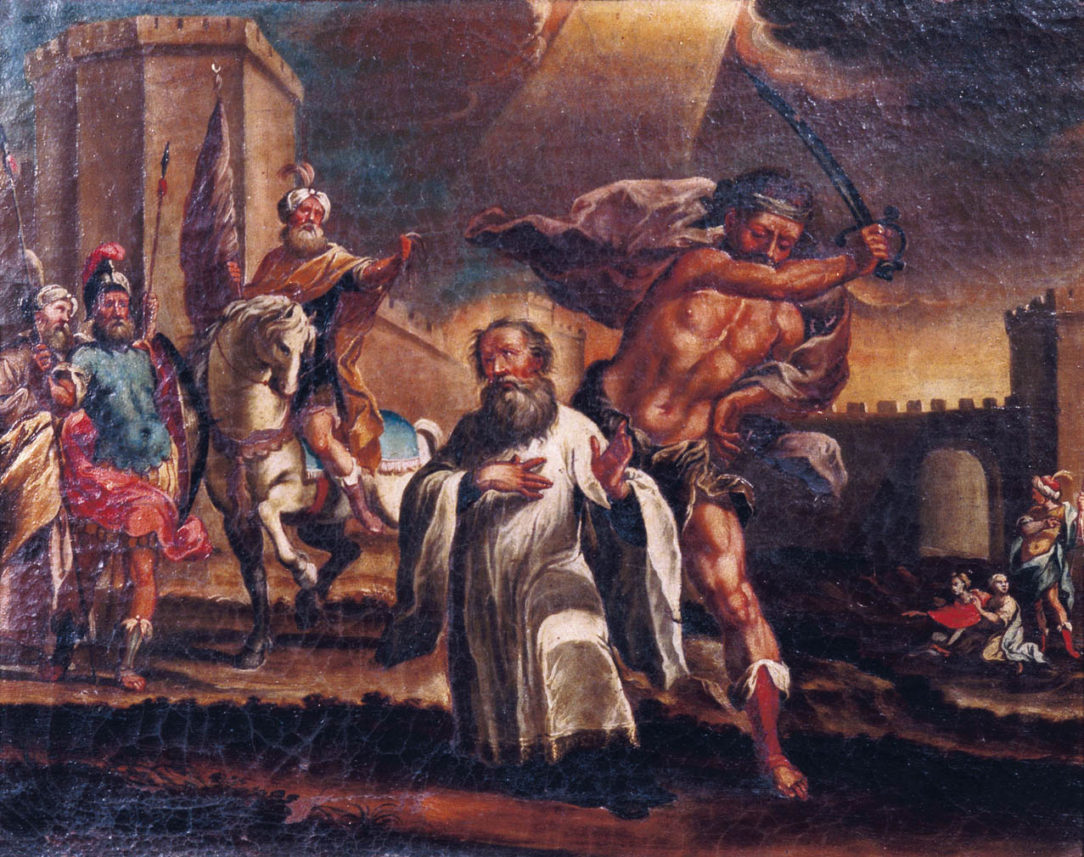
Eulogius, later canonized by the Catholic church, suffering execution for following in the footsteps of
the other Cordoban martyrs and being executed for intentionally blaspheming the Prophet Muhammad.


A notable point in the incidents of deliberate martyrdom was the lack of reaction from the public.  The executions failed to have the effect that Eulogius had hoped for.  The martyrs enjoyed support from distant monastic communities, where most of the martyrs were from, but in Córdoba itself, the opinion was little better than mixed.  According to Kenneth Wolf, the Christians who rejected the martyrs’ actions had assumed a new perspective of Islam as a different, but valid version of their own faith.  Wolf says that Christians adopted this idea from the Muslims, who in turn accepted the Christians as “monotheists and recipients of a revealed law” (Wolf 93).  In other words, they had assimilated the idea implied by dhimmitude, that all three religions worship the same God, with some differences.


Just 150 years into Islamic rule in Iberia, the people had come to accept and respect one another.  That may sound odd, considering the fact that Christians were being executed for blaspheming a religious figure, but consider the words of a Muslim court official who tried to persuade Eulogius into recanting his defamation of the prophet Muhammad:

If stupid and idiotic individuals have been carried away to such lamentable ruin, what is it that compels you…to commit yourself to this deadly ruin, suppressing the natural love of life?  Hear me, I beseech you, I beg you, lest you fall headlong to destruction.  Say something in this the hour of your need, so that afterward you may be able to practice your faith.” (Lowney 59)

The implication in this statement is that the court officials were following the letter of the law for the sake of maintaining the legal system, as well as for the sake of preserving the respectability of Islam, but even by the year 859, when Eulogius was executed, Andalusian Muslims in general had probably developed a strong sense of tolerance for the Christians and the Jews who worshipped the same God as them.  This sense of community may have been based on physical proximity and a sense of belonging to a certain physical location, rather than being drawn purely along theological lines.  The reality of people struggling to survive and coming to rely on the people around them sometimes gets lost in religious debate.


The medieval history of Spain shows little evidence of any conflicts being based solely on either race or religion (Lea 1).  Four-hundred and fifty years after Eulogius, as territory changed hands during the Reconquista, the people continued to coexist peacefully with their neighbors.  Rather than a stark black and white, the reality of conflict on the Iberian Peninsula was far more complex.  Alliances were often made between Christians and Muslims for the sake of pursuing similar goals, or for some gain.  For example, the thirteenth-century Christian king Alfonso X used religious rhetoric when it suited his self-interests and ignored it for the same reasons.  He was an avid supporter of Jewish translators in his court because of the wisdom they could make available to his subjects, but at the same time he mandated a death sentence for any Christian who was “so unfortunate as” to convert to Judaism (Lowney 10).  Additionally, he waged war against a Muslim kingdom only to later create an alliance with them for the purpose of waging war against a rebellious son.  His actions weren’t indicative of a monolithic Christianity versus a monolithic Islam; these were the actions of a man engaged in maintaining and building the prosperity of his own kingdom using whatever means he had available to him.  Race and religion were not factors in his decisions, which is a testament to the integration of Jews, Christians and Muslims into one cohesive Andalusian society.


As Muslim control in al-Andalus came to its conclusion in 1492, they left behind a society of three fully integrated faiths that had developed a unique character unlike any other place in the world.  Tolerance for religious diversity in al-Andalus did not, of course, meet modern standards, but it was a major advancement for its day that would lead a Christian nun from Europe named Hroswitha of Gandersheim to call Córdoba, the capital of the Ummayad Islamic Caliphate of al-Andalus, the “Ornament of the World” (Shedinger 81).  From the initial conquest in 711 to the surrender of Granada, relations between the three monotheistic faiths continually developed until al-Andalus was transformed into an integrated society where religion stopped playing a major part in the average affairs of rulers, except as a political tool.

The Alhambra palace at Granada.

Despite the success of convivencia, a multicultural and integrated al-Andalus, the Catholic Monarchs King Ferdinand II and Queen Isabella I took a radically different approach to religion and society: limieza de sangre, purity of blood.  After they completed their conquest of the Iberian Peninsula, they undertook a program that would ensure the eventual religious homogeneity of the Iberian Peninsula.  In 1492, immediately after the fall of Granada, they decreed the conversion, expulsion or execution of the Jews.  In 1502, a similar proclamation was made regarding Muslims.  Out of necessity, many chose to be baptized.  These two groups, known respectively as conversosand moriscos, continued to secretly practice the rituals of their own faiths while maintaining the outward appearance of Catholic Christianity until they were eventually weeded out through the institution of the Inquisition and a final expulsion in 1609 by decree of King Philip III.

The Court of Lions at Alhambra palace.

In the face of a long history of a successful and integrated culture, what was the purpose of Ferdinand and Isabella’s deviation from a model that had proven to be successful?  It is possible that Ferdinand and Isabella’s decision to expel the Jews and Muslims was merely a continuation of the evolution of religion in the peninsula: they were using it as a political tool.  Ferdinand and Isabella may have felt that, as Christians, their loyalties lay firmly with Europe and the rest of Christendom.  As rulers of a territory that had been part of the Islamic world for centuries, they may have felt that drastic measures were necessary to change public opinion of Spain.  Even today, 500 years after the expulsion of the Muslims and Jews, Spain is an off-color patch in the greater European fabric, with obvious reminders of its Islamic past buried in the architecture, art, and even the language.  Given how firmly Islamic culture was entrenched in Iberia, Ferdinand and Isabella may have felt that it would take drastic actions to change public perception of Spain in Europe, hence the expulsions or forced conversions of the Jews and Muslims.  It would also explain their petition to the Pope for the title “Catholic Monarchs.”  The total effect of expulsions and the gaining of a title affirming the Catholicism of the monarchy would have firmly put Spain in the European camp.  The definite causes of Ferdinand and Isabella’s change in policy would be an interesting topic for further research, but the level of tolerance and cooperation between religious groups in al-Andalus is a lesson that many parts of the world could still learn from today.

Works Cited

<!–[if supportFields]> BIBLIOGRAPHY <![endif]–>Bennett, Clinton. Muslims and modernity: an introduction to the issues and debates. London: Continuum International Publishing Group, 2005.
Boase, Roger. “The Muslim Expulsion From Spain.” History Today 52.4 (2002): 21-28.
Khadduri, Majid, Herbert J. Liebesny and Robert H. Jackson. Origin and Development of Islamic Law. Clark: The Lawbook Exchange, Ltd., 2010.
Lapidus, Ira M. A History of Islamic Societies. 2nd. New York: Cambridge University Press, 2002.
Lea, Henry Charles. The Moriscos of Spain: Their Conversion and Expulsion. Philadelphia: Lea Brothers & Co., 1901.
Lowney, Chris. A Vanished World: Muslims, Christians and Jews in Medieval Spain. New York: Oxford University Press, Inc., 2006.
Rosser-Owen, Mariam. Islamic Arts From Spain. London: V & A Publishing, 2010.
Shedinger, Robert F. Was Jesus a Muslim?: questioning categories in the study of religion. Minneapolis: Fortress Press, 2009.
Wolf, Kenneth B. “The Earliest Latin Lives of Muhammad.” Gervers, Michael, Ramzi Jibran Bikhazi and Pontifical Institute of Mediaeval Studies. Conversion and continuity: indigenous Christian communities in Islamic lands eighth to eighteenth centuries. Vol. 9. Toronto: Pontifical Institute of Mediaeval Studies, 1990. 89 – 102.


Note: This was a research paper turned in for a 100-level college course.  It received an A+, and the note: “A lively and interesting paper.”  I imagine it was checked more for consistency, style and obvious errors rather than having any deep fact checking done.  I would have liked a few more weeks to research and fine tune it, but I think it turned out well enough for the time I put into it, considering it’s a paper for an entry level course.

Faith and Unity: The ‘Ummah’ as the New Kinship Group

The Quran and prayer beads.

In approximately 610 CE, a man named Muhammad ibn Abdallah went to a cave in the hills above Mecca to meditate, as he was accustomed to do. There, he had a powerful religious experience and began reciting verses of what would become known as the Quran, the holy book of Islam. While reciting the surahs of the Quran in Mecca, the Prophet Muhammad would find both converts and enemies. His message would inspire both devotion and enmity. The Quran appealed to people for its beauty and its insistence on returning to principles of equity, but this would place the Prophet in confrontation with his tribe and create tension between converts and their families. The conflict between the new Muslims and the Meccan community escalated to a point that it caused the Prophet to commit the Muslim community to something unthinkable by contemporary standards: an emigration based not on blood ties, but on communal faith and unity. This event was so significant that it would become known as the Hijra and set the date for the first year of the Islamic calendar in 622 CE.

In pre-Islamic Arabian society, status, position and even personal well-being were all based on membership in kinship groups. Society was divided into a series of (usually[1]) blood-related groups organized in a hierarchical structure. The family group was the smallest organizational unit and was subordinate to a clan, which in turn was subordinate to a tribe. In these kinship groups, there was essentially no individual identity.[2] A man was a member of his family, clan and tribe. All acts between individual members of tribes assumed collective responsibility, sometimes leading to vendettas where the victim’s tribe would seek redress against any member of the offending party’s tribe.[3] This created situations in which a person was victimized based on the actions of another member of the tribe, though it wasn’t seen as wrong, because honor and responsibility were attributed to the group, rather than the individual. The more powerful the tribe one belonged to, the surer one could be that their family would be safe and prosperous.

In Muhammad: A Prophet For Our Time, Karen Armstrong details the loyalty of a man to his tribe using a quote from a Ghazziyya poet: “I am of Ghazziyya. If she be in error, I will be in error; and if Ghazziya be guided right, I will go with her.”[4] Tribal loyalties were so important that even if a man’s tribesman was in the wrong, he was obliged to help him for the sake of tribal solidarity. The concept of tribal solidarity would be both a boon and a problem for the Prophet Muhammad. Religion was not unknown to pre-Islamic Arab society, but it was tied to individual kinship groups. Each tribe had a deity, represented by an idol in the Ka’aba at Mecca, which was already an established pilgrimage site. Loyalty to the tribe also included loyalty to the tribal deity. This presented two problems to the success of the Prophet’s message. Converting to Islam meant forsaking the tribal deity and betraying the tribe, a violation of the tribal solidarity that is evidenced by the quote from the Ghazziya poet. More practically, the Prophet Muhammad’s message was an attack on the economic structure of Mecca, which relied on annual pilgrimages to the Ka’aba to remain viable. If people stopped worshipping the idols then they would no longer have a reason to visit Mecca. The Quraysh, the Prophet’s own tribe, would lose their source of income. In one stroke, the Prophet was insulting the tribe’s sense of community and attacking the economic foundation its prosperity depended on. The Quraysh were obligated to persecute the fledgling Muslim community.

The Prophet Muhammad’s attack on Meccan social norms was met first with resistance and then with violence, including a narrowly avoided assassination attempt. The Muslims initially benefited from the protection of the Prophet Muhammad’s uncle, Abu Talib, who was the head of the Banu Hashim, a respected clan in the Quraysh tribe. However, after his uncle died, the Prophet and his followers were left to fend for themselves, leaving them in a difficult position where they were open to violent retaliation from the Qurayshi families who felt both threatened and insulted by a perceived theft of family member loyalties.

This dilemma was resolved by a revolutionary idea, built on the foundation of the message that the Prophet preached in Mecca. The Muslims abandoned the idea of kinship groups based on blood and instead formed a new ‘tribe’ based on faith, known as the ummah. Membership in the ummah (as well as being a Muslim) required no family relation, no social status, and no prerequisite level of income; it only required acceptance of Allah as the one true God and of Muhammad as his Messenger. The ummah was a new community that offered the Muslims the protection and security they had previously received from their kinship groups.[5] The moment that defined the creation of this community is the Hijra, the emigration of Muslims to Yathrib. Prior to this, the Muslims had still considered themselves to be members of their own families, just with a different set of beliefs. Breaking away from their families and creating a new community based on faith rather than blood was an incredible social innovation, and clearly marks the birth of the Muslim community as an independent and functional social system, as well as a system of belief.

Eventually, the ummah would encompass all of Arabia, creating a new problem that challenged the traditional means of supplementing tribal income: raiding, which was known as ghazu. In times of scarcity, tribes would launch raids against each other to capture camels, cattle or slaves. Raids were carried out with precision and care, to prevent injuries or deaths that might result in blood fueds. These raids were an accepted fact of life and were not in any way morally reprehensible. They were instead a necessary means of redistributing wealth in an area of the world where there was often not enough to go around.[6] Unfortunately, this tradition conflicted with the new Muslim morality as defined by the Quran and the Prophet. Surah 3, ayah 103 of the Quran says, “Hold fast to God’s rope all together; do not split into factions. Remember God’s favour to you: you were enemies and then He brought your hearts together and you became brothers by His grace: you were about to fall into a pit of Fire and He saved you from it…”[7] Also, in his book, A History of the Arab Peoples, Hourani says that when the Prophet Muhammad made his last visit to Mecca in 632, he gave a speech and said, “…know that every Muslim is a Muslim’s brother, and that the Muslims are brethren.” He said that violence between Muslims should be avoided and old blood debts should be forgotten.[8]

As essentially members of one tribe, the ummah would have to reassess their society and find a new means of supporting themselves. Internal conflicts were no longer permitted under Islam, so the Arabs instead spread outward, taking their culture and religion with them. The outward spread of Arabs into the Middle East began as raiding parties in Syria and Palestine in the 630s,[9] but soon developed into full scale battle with the Byzantine and Sassanian Empires. The conquering Arabs would be victorious, creating a vast Islamic empire. The leap from pre-Islamic Bedouin society to Islamic Imperialism would again fundamentally alter Arab society.

Because of the principles of unity found in the Quran, the nomadic peoples of Arabia created a new social identity that revolved around faith. This was a clear break from the past and returned a sense of equity to the Muslim community. However, this new unity came with new problems. The Arabs had to find a new economic model to sustain their society. The Arabs solved this problem using traditional tactics. Since the tribe was replaced by the ummah, the push outward into the Middle East was a continuation of the tradition of ghazu, simply on a larger scale. Intentionally or not, a relatively simple people from the Arabian Peninsula quickly became a world power that would greatly influence world history, and continues to influence world history.


[1] On page 38 of The Great Arab Conquests, Kennedy states that membership in a tribe might increase or decrease based on the tribe’s level of success. New arrivals would claim that they “must have been in some way part of that kin all along,” maintaining the façade of biological kinship groups.
[2] Lapidus, page 13.
[3] Lapidus, pages 12.
[4] Muhammad: A Prophet For Our Time, pages 12 – 14.
[5] Kennedy, page 38.
[6] Muhammad: A Prophet For Our Time, page 11.
[7] The Qur’an; M.A.S. Abdel Haleem translation; Oxford World’s Classics version.
[8] Hourani, page 19.
[9] Kennedy, page 70.

Bibliography:

Armstrong, K. (2007). Muhammad: A Prophet For Our Time. New York: HarperCollins.
Armstrong, K. (2009). Islam: A Short History. London: Phoenix Press.
The Qur’an. (2010). (M. A. Haleem, Trans.) New York: Oxford University Press.
Hourani, A. (1991). A History Of The Arab Peoples. Cambridge: Belknap Press of Harvard University Press.
Kennedy, H. (2008). The Great Arab Conquests: How The Spread of Islam Changed The World We Live In. Philadelphia: Ca Capo Press.
Lapidus, I. M. (2002). A History of Islamic Societies (2nd ed.). New York: Cambridge University Press.
Note:
 
This was a paper written for a college course titled “Middle East Under Islam.”  The final grade was 15/15, 100%.

The Power of Religious Texts in History

This is something I wrote for a World Civilizations: Pre-History to 1500 (101) class.  The task was to pick a piece of literature, from religious texts to epic poems to economic records found at archaeological sites, and then describe how that work affected history.  I suppose you could say I took the easy way out and chose to write about the Bible and how it has affected history.  If you’re curious, this paper received an A.  Footnotes will be appended to the bottom of the post, along with the bibliography.

bible1

(Image via godisforreal.wordpress.com)

Literature has always played an important role in recorded history. It is a method of preservation of the moment. It captures the ideas, the problems, the aspirations and dreams of a society and, when read from a historical perspective it can offer an open window into the world of the writer. No form of literature has as much impact on history as religious texts. Perhaps the most influential religious work of all time, the Bible[1] has impacted the lives of countless people throughout history. In this paper, the impact of the Bible will be briefly explored to demonstrate the importance it has played in shaping, stabilizing, and sometimes disrupting society.

When Christianity first appeared in the Middle East it was a revolutionary movement with no specific set of religious texts. Various gospels and epistles were being circulated, but there was no accepted canon of scripture until perhaps the late 4th century AD.[2] The result of this is that there was a wide array of Christian sects, all with varying beliefs. There was no structure to the religion, which could cause confusion about what was and wasn’t ‘true’. Through the work of early church figures, like Bishop Athanasius of Alexandria, that changed. Bishop Athanasius worked to consolidate which scriptures would be regarded as canonical and which were, according to him, heretical.[3] Coming at about the same time that Theodosius I declared Catholic Christianity as the official and only permissible religion of the Roman Empire (380 AD), this acted as a strong unifying force that would have an enduring effect on history, European history most especially. The Catholic Church claimed its authority based on the newly standardized canon gospel of Matthew, citing chapter 16, verse 18, which says, “And I say also unto thee, That thou art Peter, and upon this rock I will build my church; and the gates of hell shall not prevail against it,” as the source of its legitimacy.[4] The acceptance of the canonicity of the gospel, what we know as the Bible today, is what allowed the Catholic Church to hold power over the people, as well as to stamp out opposition. The Church also used its divine authority to control the rulers of the people throughout Europe up until the French Revolution of 1789-99. With the Bible as its basis, the Papacy of the Catholic Church bestowed divine authority on the monarchies of the developing European nations, allowing for the formation of governments and modern nation states. Most of the countries in Europe today exist due to monarchical legitimization by the Catholic Church, which derived its religious authority from the Bible. These nations have played major roles in the development of the rest of the world and, in most cases, continue to be major world powers today. These nations that are shaping the world today were themselves shaped by Christianity and the Bible.

In addition to shaping nations, Christianity has played a role in creating social stability through Christian morality and Christian value based legal systems. Mircea Eliade wrote that “The manifestation of the sacred ontologically founds the world. In the homogenous and infinite expanse, in which no point of reference is possible and hence no orientation can be established, the hierophany[5] reveals an absolute fixed point, a center.” Or, in other words, religion creates a stable center for people to start from, a check to balance their view of the world and define their existence. The religion revealed through the Bible served this purpose for Christians. The Bible affects the lives of those who read and believe in it by influencing them to conform to a lifestyle that is in accordance to its teachings. John 14:6[6] tells believers that Jesus said, “I am the way, the truth, and the life: no man cometh unto the Father, but by me.” It is impossible to come to Jesus without repentance and living according to the teachings of the Bible. Getting into Heaven is a strong incentive to develop and maintain a Christian, Biblical lifestyle, which regulated everything from birth (baptism) to marriage (holy vows) to death (Christian funeral rites), and most things in between. As mentioned earlier, this belief in the Bible and Biblical living created the monarchies and modern nations which, along with creating common customs, stabilized society, but it also went a step further in creating social stability through later legal systems. The values established by Christianity were converted into the foundations of Western legal systems. Christian values have persisted in our Western legal systems and institutions up until the modern time. John Jay, the first Chief Justice of the United States (1789-95) once wrote in a letter that “The Bible is the best of all Books, for it is the Word of God, and teaches us the way to be happy in this world and the next. Continue therefore to read it, and to regulate your life by its precepts.”[7] While not expressed outright in the US Constitution or legal system, the values that Americans inherited from Christianity have influenced and continue to influence the workings of government. A good modern example is the current debate on the legality of homosexual marriage, which is undeniably being opposed on wholly religious grounds.

Using the same example, the Bible has been so influential that it has also caused disruptions in societies throughout history, including Christian societies and modern societies. As a sacred text, the meaning of the words it contains is open to constant interpretation based on who reads it. Those interpretations haven’t always had a positive effect. During the 11th, 12th and 13th centuries, the Roman Catholic Church used its Biblical authority to declare religious wars on neighboring nations. The effects of the Crusades continue to be felt today by Islamist terrorists using the concept of Crusades as a justification for violent and lethal actions against Western, ‘Christian’ nations. The Bible has also been used as a justification for the violent suppression of minorities throughout history. Well known examples are the Medieval Inquisitions, the Spanish Inquisition and the Salem Witch Trials. The Bible has been used to oppress women through selective quotation and reading out of context, with 1 Corinthians 14:34-35 being a prime example:

“Let your women keep silence in the churches: for it is not permitted unto them to speak; but they are commanded to be under obedience as also saith the law. And if they will learn anything, let them ask their husbands at home: for it is a shame for women to speak in the church.”[8]

The Bible was used to justify slavery in the United States, either arguing its morality through the omission of its condemnation in the Bible or by making a broad claim that God created slavery and so it must be good, as Jefferson Davis, the President of the Confederate States of America did. He said, “Slavery was established by the decree of Almighty God…. It is sanctioned in the Bible, in both Testaments, from Genesis to Revelation…. It has existed in all ages, has been found among the people of the highest civilization, and in the nations of the highest proficiency in the arts.”[9] Today, the Bible is used as a source of justification for the suppression of the right to equality that homosexuals should enjoy under the secular government in the United States. It is still used by fringe groups to support destructive beliefs. The Bible is just as strong a force for disruption of society as it is for good.

Throughout history, the Bible has been used extensively to justify both positive and negative actions. It has been used to stabilize and homogenize society. It has been used as the basis for customs, holidays, and the building of nations. It has also been used to destroy enemies, suppress minorities and justify violence. Without a doubt, the Bible is an epic piece of religious literature that has had a profound effect on our world, exemplifying the power of the written word to influence history.


[1] The general concept of a canonical written Bible as accepted by branches of Christianity, without considering the differences between accepted canon and apocryphal works in various traditions.

[2] According to the Columbia Apologetics Toolkit, adapted from the materials of Professor Paul Hahn of the University of St. Thomas, Houston, Texas.

[3] According to the National Geographic special, The Gospel of Judas.

[4] King James Version

[5] Mircea Eliade defines “hierophany” as the sum of its etymological content, “something sacred shows itself to us.”

[6] The Book of John, Chapter 14, Verse 6 of the King James Version of the Bible.

[7] John Jay to Peter Jay, April 8, 1784.

[8] King James Version.

[9] From the antebellum slavery debates in America, quoted in a book by Mason Lowance.

Bibliography

National Geographic: The Gospel of Judas. Directed by James Barrat. Performed by Peter Coyote. 2006.

“Development of the Biblical Canon.” Columbia: Apologetics Toolkit. 1995. http://www.columbia.edu/cu/augustine/a/canon.html (accessed July 9, 2011).

Eliade, Mircea. The Sacred and The Profane: The Nature of Religion. Orlando: Harcourt, Inc., 1959.

Hutson, James H. The Founders on Religion: A Book of Quotations. Princeton University Press, 2007.

Lowance, Mason I. A house divided: the antebellum slavery debates in America, 1776-1865. Princeton Univeristy Press, 2003.

Thomas Nelson Bibles. The Holy Bible; Containing the Old and New Testaments; Authorized King James Version. Nashville: Thomas Nelson, Inc., 2001.


The Chicago Assyrian Dictionary: Opening a New Door on History

This is a writing assignment I did for a World Civ 100 class I’m currently taking.  Expect more regular updates soon.

The question:

First you should summarize the article, then give your thoughts about it and tell how it might be useful in our class and to the scholarly world in general. You can certainly include negative andpositive thoughts about the article.

The article:  After 90 Years, A Dictionary of an Ancient World (NYTimes)

My response:

The Chicago Assyrian Dictionary: Opening a New Door on History

After 90 years of effort on the part of the Oriental Institute at the University of Chicago, a project titled the Chicago Assyrian Dictionary has finally been completed. This 21 volume dictionary compiles the definitions and usage explanations of words from the ancient Mesopotamian language, including its Babylonian and Assyrian dialects. This monumental achievement has opened a new door for all scholars interested in researching the Mesopotamian people and their culture.

According to a New York Times article published online (footnote was inserted here), this dictionary covers the language as it was used from roughly 2500 B.C. to 100 A.D. The project was initially started by Dr. James Henry Breasted in 1921, but didn’t make too much progress until after World War II, when the project was reorganized. The first volume of the set was published in 1956, with 20 following volumes being published over a 55 year period under the editorship of A. Leo Oppenheim, Erica Reiner and Dr. Martha Roth, the current dean of humanities at the University of Chicago. The dictionary is comprehensive, covering word usage and nuances, as well as cultural material available that relates to the word being defined.

The best way to understand any culture is by examining primary sources. The best primary source is a set of written records, but those records are meaningless if a scholar cannot completely understand the language. By unlocking the Assyrian language and making it accessible to scholars everywhere, the team at the University of Chicago has opened a door to new and hopefully more insightful studies of the Mesopotamian civilizations. Having a reviewed and reputable resource to draw from, scholars can now make better informed translations of the material they’re working with, whether it is a cuneiform tablet of a contract, or a literary work. The effort the team made in defining the nuances and various usages of the word, rather than giving simple definitions, added immense value to the work as a whole. The meaning of a text can sometimes change drastically based on a misinterpretation of one word. With a new standard to build from, scholars and translators can hopefully render the Assyrian language into English with greater efficiency and accuracy. Additionally, currently existing translations can now be vetted against this dictionary to check for accuracy.

This accomplishment can also greatly benefit classroom study. A common misconception among people today is that people from ancient civilizations were inherently less intelligent than modern people. By presenting examples of the Assyrian language (from entries in the Chicago University’s Assyrian Dictionary) to students today, a professor could demonstrate the complexity and depth not only of their language, but of their society as a whole. When discussing literature from Mesopotamia, the professor could introduce printouts of key terms from the work for classroom study so that students will have a greater understanding of the social constructs present in the work. As Gil Stein, the director of Chicago University’s Oriental Institute said in the New York Times article, this dictionary “is an indispensable research tool for any scholar anywhere who seeks to explore the written record of the Mesopotamian civilization.”

The compilation and publication of the Assyrian Dictionary by the University of Chicago will have a lasting and profound impact on the study of Mesopotamia. It is a vital and robust tool that can be used by professionals and scholars to make more accurate translations of the Assyrian language. For students, the dictionary will be an excellent tool for expanding their knowledge of the Mesopotamian world and ancient civilizations in general. The Assyrian Dictionary is a work of immense value that sheds new light on an ancient civilization and it will be used as a basis for research and study far into the future.

Bibliography

Wilford, John Noble. “After 90 Years, a Dictionary of an Ancient World.” The New York Times: Science. June 6, 2011. http://www.nytimes.com/2011/06/07/science/07dictionary.html (accessed July 7, 2011).

This paper received an A, but I don’t think it was graded too critically.

The Effects of “Strange Fruit”

The following is a main outline for a speech I wrote for my Speech Foundations class.  The information presented is true and includes a works cited section at the end of the blog post.  However, the information was presented in a fictional setting, with myself as a Professor of History at UGA speaking at the Jazz Education Network annual conference, which is a real conference.  Three other people presented speeches on the social impact of Jazz, besides myself.  The first person talked about the birth of Jazz in New Orleans.  The second person talked about the Harlem Renaissance.  I gave my speech, and then the last person spoke about how Jazz has spread to other countries, and about how it’s empowering.  The purpose of the assignment was to determine our ability to give an informative speech, but I’m glad I had the opportunity to do this research and presentation.  It gave me a new appreciation of Jazz music.

At the top of the speech text I’ve embedded the PowerPoint slides I used during my presentation.  Cues for changing the slides are in the text.  I hope you enjoy reading this as much as I enjoyed learning and speaking about it.

Title:  The Effects of “Strange Fruit”

Speaker:  Professor of US History, University of Georgia

Specific Purpose:  Recognizing the cultural influence of Strange Fruit, a Jazz song, at the third annual Jazz Education Network (JEN) conference.

Thesis Statement:  The Jazz song, Strange Fruit, played an important role in raising public awareness regarding the horrors of lynching and the necessity of ensuring civil rights.


I.  Introduction

1)      Attention Getter:  In 2009, a group of Caucasian and Latino firemen sued New Haven, Connecticut, for racial discrimination when a promotion test was thrown out, simply because no African Americans were able to pass (Tedford).  The fight to find equality between the races is far from over, but these days conflicts are usually resolved in court.  That wasn’t always the case.  There was a time when the answer to race conflict usually ended with a public lynching.  (slide 2)

2)      Establishment of Ethos:  As a professor of American history, I have been studying and teaching civil rights issues and how they have affected US History for almost 10 years.  What I’ve discovered is that…

3)      Thematic Statement:  … Jazz music, through Billie Holiday’s rendition of “Strange Fruit”, played a significant role in raising public awareness of civil rights issues.

4)      Preview of Main Points:

a)      Despite efforts and progress made during Reconstruction, racism increased dramatically, to the point it became publically acceptable and a source of pride among Caucasians.

b)      Racial tensions were running so high that Billie Holiday didn’t even want to sing “Strange Fruit” initially, but after agreeing, it became a huge success.

c)       Billie Holiday’s song, “Strange Fruit”, became an important reminder to the public of the horrors of lynching and a reminder to African Americans of what they were fighting against.

(Transition:  (Open image of lynching).  To get an idea of the social climate when “Strange Fruit” was first sung, let’s take a look at this photo of a lynching.)

II. Body

1)      If you look at this photo, you can see how widespread and publically acceptable it was to lynch African Americans during the years following Reconstruction.  If you look closely, (point to man pointing at bodies) you can see that for many people, it was even a source of pride.  This man definitely wants his peers to know he approves of what’s being done.  After the Reconstruction Era, race relations quickly degraded.  Gone With the Wind, first published in 1936 and often considered one of the best books ever written (Loewen 144), even “suggests that slavery was an ideal social structure whose passing is to be lamented” (Loewen 137).  (slide 3)  A passage from that book reads:  “The former field hands found themselves suddenly elevated to the seats of the mighty.  There they conducted themselves as creatures of small intelligence might naturally be expected to do.  Like monkeys or small children turned loose among treasured objects whose value is beyond their comprehension, they ran wild – either from perverse pleasure in destruction or simply because of their ignorance” (Loewen 144).  (slide 4, I added this after writing the speech, at the last minute, and spoke about how lynching was so publically acceptable that it developed into an industry like modern day tourism) With so much positive social reinforcement for keeping blacks in their ‘place’, is it any wonder that whites engaged in lynching or that they were in fact proud of their participation, even posing in lynching photos like this one?

2)      A picture very much like the one above prompted Abel Meeropol, a Jewish schoolteacher from the Bronx, to write “Strange Fruit”, which was originally a poem (Strange Fruit: The Film).  (Pass out lyrics to class).  Billie Holiday was first approached to sing the song while working at an establishment called Café Society.  When she read the lyrics, she was reluctant to commit to singing it. (slide 5, emphasize the climate of fear in the late 30s)  She later said, “I was scared that people would hate it” (White 49-50).  The café manager, Barney Josephson, insisted that she perform the song and turned it into a dramatic production.  When she sang, all service would stop and the lights would be turned off, with only a spotlight on Billie’s face.  Josephson said, “People had to remember Strange Fruit, get their insides burned with it” (White 50).  People did remember it.

3)      “Strange Fruit” climbed to #16 (Kolodzey) on the US Billboard Chart and, according to a PBS documentary, “made it impossible for white Americans and politicians to continue to ignore the Southern campaign of racist terror” (Strange Fruit: The Film).  According to Caryl Phillips, who wrote a stage play called “Strange Fruit”, based on themes in Billie Holiday’s song, “Those who heard “Strange Fruit” in the late 30s were shocked, for the true barbarity of southern violence was generally only discussed in black newspapers.  To be introduced to such realities by a song was unprecedented…” (Phillips).  What was truly revolutionary about this song was that it broke the traditional role of the café singer, which was to entertain (Phillips).  Instead, Billie Holiday was able to use this song to promote an idea to her audience, to educate them and leave them unable, as PBS said, to ignore the problems of racism.  Because of its high popularity, “Strange Fruit” is credited with a major role in increasing Caucasian social awareness of the fledgling civil rights movement (Kolodzey).  When she performed the song for an African American audience at the Apollo, the end of her song was followed by a moment of heavy silence and then a rustling noise as 2000 African American patrons collectively sighed, perhaps after mentally reliving horrors in their minds that they had themselves witnessed (White 55).  To Billie herself, the song came to symbolize “all the cruelties, all the deaths, from the quick snap of the neck to the slow dying from all kinds of starvation” (White 55).

(Transition:  You’ve heard about the social atmosphere during the 1930s.  You’ve heard about how the song was created and initially introduced to the public.  You’ve heard about the impact it had on American culture.  Now, I’d like to give you an opportunity to hear the song for yourself. )

(Slide 6, Play video. Note: Video doesn’t work in the embedded slideshow, so I’ve inserted it below)

III. Conclusion

1)      (slide 7)  Music is powerful.  Billie Holiday’s use of “Strange Fruit” to excite the public imagination regarding the horrors of lynching and the need for equality prove that.  In an atmosphere of fear, she was brave enough to sing it.  Because of her passion, she turned it into a powerful call to action that affected Caucasian Americans across the country.

2)     So, when you think of Billie Holiday, don’t just remember her for being an entertainer.  Remember her for using Jazz music as a platform for promoting the necessity of one of the greatest accomplishments in our nation’s history, the establishment of civil rights.

Works Cited

Kolodzey, Jody. “Stranger Than Fiction.” 24 March 2003. In These Times. 17 June 2011 .

Loewen, James W. Lies My Teacher Told Me: Everything Your American History Textbook Got Wrong. New York: Touchstone, 2007.

Phillips, Caryl. “Blood at the root.” 18 August 2007. Guardian.co.uk. 17 June 2011 .

“Strange Fruit: The Film.” n.d. PBS: Independent Lens. 17 June 2011 .

Tedford, Deborah. Ruling on Firefighters Tests Tensions In New Haven. 1 July 2009. 15 June 2011 .

White, John. Billie Holiday: Her Life & Times. New York: Universe Books, 1987.


The Olmecs and Potential African Influence

We’re covering research methodologies in my Introduction to Anthropology class right now, and to introduce us to a particular concept, which I’ll mention later, our professor had us read up on the Olmecs and then watch a video by a gentleman by the name of Dr. Van Sertima.

If you’re not familiar with the Olmecs, they were a civilization in Mesoamerica from roughly 1500 to 400 BCE and there’s a lot of controversy about whether or not they were a mother culture to the later Mesoamerican cultures, like the Toltecs and Mayans.  A lot of artifacts have been found, showing how the Olmecs’ culture diffused down and out into the other cultures, but nothing showing that the other civilizations’ cultures influenced the Olmecs in the same way.  You can read more about the Olmecs, and the “mother culture” / “sister culture” debate by clicking here, and by reading a New York Times article about it by clicking here, which closes by comparing the effect the Olmecs had on later Mesoamerican civilizations to the lasting effect Greek and Roman culture had on Western civilizations.

After reading up on the Olmecs, we were presented with the following video to watch:

http://video.google.com/googleplayer.swf?docid=-3924842503305971166&hl=en&fs=true

The video is about 46 minutes long.  If you don’t want to watch it all, here’s the relevant information:

This video is a recording of a presentation given by Dr. Van Sertima, where he presents evidence that the Olmecs had contact with Africans.  He goes on to prove this theory by first showing that it was possible for Africans to reach Central America using ocean currents.  He stated that there have been numerous trips made on small boats, some without sails, that have safely made it across the Atlantic, so it is possible.  He talks about the similarity between the depictions of one of the Olmec gods and one of the gods of Egypt, who Africans would have also had contact with.  He also noted that Olmec pyramids had a base that matched the size of the base of the Giza pyramids, and that Olmec rulers took to wearing purple, which was popular among Egyptian nobility.  He also points out that some of the Olmec monumental heads (pictured below) have distinctly African features, and that the helmet the monumental head is wearing looks Egyptian in design.

Olmec monumental head.

Dr. Van Sertima stated that he had been working for years to get the scientific community to at least acknowledge the possibility that Africans and Olmecs had contacted each other at some point, but everyone gave him excuses about why it couldn’t possibly be true, including things as ridiculous as saying the stone head must have fallen over, causing the lips and nose to flatten out.  One of my favorite lines was when he said that every other civilization in the world was traveling and establishing trade routes, so why would the Africans be the only ones that were sitting around doing nothing?  My first thought was that they weren’t as developed.  In some cases, Africans still aren’t as developed as other countries today.  However, in my Art History class we had just covered Sub Saharan African art, and I remembered reading that there were advanced cities in what is now modern day Nigeria as early as around 500 BC, and that remnants of goods from as far away as China have been found there.  That doesn’t necessarily mean they went there to get them, but it does speak volumes for the level of trade and advanced culture they’d developed.

So, do I think Dr. Van Sertima is right?  Well, it’s definitely possible, but given how much he emphasizes that Egyptian cultural traits are evident in Olmec culture, rather than African, I’d say that it’s more likely an Egyptian ship with African slaves got blown off course, possibly caught in a current, and wound up in Olmec territory.  It’s possible that, at some point, Africans sailed to Central America, but if that were the case, why would they have left the Olmecs with Egyptian styles of royal dress (use of the color purple) and why would the Olmecs have adopted an Egyptian god, rather than an African one?  I could argue against that by asking why, if the Africans were only slaves, does the monument resemble an African?  But, maybe the Africans aboard the Egyptian ships doubled as warriors when they landed in Central America, and the Olmecs admired their apparent strength?  Anyway, it’s all speculation, but an interesting topic to speculate about!

After discussing these topics in class, our professor asked us what we can learn about anthropological study from Dr. Van Sertima’s methodologies.  The best answer was something Dr. Van Sertima said: “…history leaves its mark on everything.”  What does that mean?  Well, you can’t put all of your eggs in one basket and rely solely on documents and written records.  You have to think bigger.  Also, it’s important to remember that any written records you come across, including your own, will likely be biased, either consciously or unconsciously, and that you have to take that into account when trying to decipher past events from the evidence we have left to us.