Founded on God, or Founded on Freedom?

US-founding-fathers

Someone I know was complaining on Facebook that people are forgetting that the US was “built on God but we can’t even pray now.”  I’m taking a US Government and Politics class right now, so this is fresh in my mind, and I think that people are forgetting what the country was founded on.  It wasn’t founded on God.  The country wasn’t built on God.  In fact, there is no mention of God, Christ, or Christianity in the Constitution or the Bill of Rights, and there are reasons for that.

The only mentions of religion in the US Constitution and Bill of Rights are in Article 6, Clause 3, which says no religious test will be required to hold an government office, and in Amendment 1, which prevents the establishment of a national religion or government restriction of religious practices

Article 6, Clause 3 (emphasis added):

The Senators and Representatives before mentioned, and the Members of the several State Legislatures, and all executive and judicial Officers, both of the United States and of the several States, shall be bound by Oath or Affirmation, to support this Constitution; but no religious Test shall ever be required as a Qualification to any Office or public Trust under the United States.

Amendment 1 (emphasis added):

Congress shall make no law respecting an establishment of religion, or prohibiting the free exercise thereof; or abridging the freedom of speech, or of the press; or the right of the people peaceably to assemble, and to petition the Government for a redress of grievances.

Some of the foundering fathers were Protestant Christians for sure, and likely they didn’t expect the encroachment of non-Protestant Christian religions in US society, but they did see the necessity of ensuring that the government couldn’t make any decisions regarding religion, which I think includes not allowing the government to give any indication that it sponsors one religion over another.  The reason for this is that they were quite aware of the abuse of the system in England, where the English monarch was also the head of of the church.  This gave the government far too much power over people.  It’s better for people to be able to have the freedom to make their own choices in regard to religion, without having any one brand of religion forced down their throats by the government.

The Pledge of Allegiance was written in 1892. During a religious revival, “under God” was added in 1954, but, since that implies state sponsored religion, it’s a violation of the 1st Amendment and shouldn’t have been added in the first place.

God shouldn’t be mentioned in any government run institution and it shouldn’t be mandated by government that people are obligated to make oaths or pledges to or by God. That treads on ground the founding fathers implicitly said was outside the government purview, and denial of those powers is explicitly enumerated in the Constitution.  References to God shouldn’t be present in government buildings, courts, classrooms, or government offices, since it violates the Constitution.

The US wasn’t founded on God. It was founded on the principles of freedom and republican democracy.  However, I think our government is being too aggressive in telling students that they can not pray if they want to in a school. To me, that impedes practice of religion, since praying in school voluntarily isn’t hurting anyone, or implying sponsored religion. People should be free to worship, and the government should never imply that it sponsors a particular religion, but it also shouldn’t be preventing people from having an opportunity to pray, meditate, have an out-of-body experience, mentally prepare for the day, review notes, etc.

A Car Blessing in the Philippines

Do people actually do this in any other country?  I’ve never heard of it before.  Is it strictly a Catholic thing?

A car being blessed by a Catholic priest in the Philippines.

In the image above, you can see a group of people gathered around a new vehicle.  The man in the white top and black pants is a priest, probably from the nearby Our Lady of Peace Cathedral, which is a popular pilgrimage destination for people who are about to embark on trips.

I’m not sure if there’s a process to this, if different parts of the vehicle are blessed at different times and I just stumbled across them as they were getting to the engine, or if having the hood raised and the engine running is just the standard way of having a vehicle blessed.

As weird as this seems, it makes sense in a way, and makes sense that they’d come to the Cathedral that’s known as a place for travelers to receive blessings to have it done.

If you stumbled across this post looking for information about how to get your car blessed at the Cathedral, click this link and then scroll to the bottom of the post to see a picture of the sign showing the hours for car blessings, as well as contact numbers.

Religious Procession Through The Town Center

Sometimes interesting things cross your path, in this case literally, which is why I’m glad I almost always have my camera with me!

We had just been dropped off in town by the tricycle so we could walk down the street and do a little shopping when we heard a bunch of loud bangs and then saw hordes of people with candles walking down the road we were supposed to cross.  When we got closer, we could see it was a procession coming from the Antipolo Cathedral and going down the main road.  I had no idea what was going on, but I figured it was a good time to take photos.

DSC05249

DSC05250

DSC05251

DSC05252

DSC05253

DSC05254

After getting my pictures I asked my wife if she knew what the procession was for.  I’d seen her asking someone what was going on, but she wasn’t sure what the guy was talking about.  He had said, “It’s the last procession of the month!”  That doesn’t make sense though, because these photos were taken just a day or two ago, at the beginning of July.  If there’s more than one procession a month, which his answer implies, then the last one wouldn’t be at the beginning of the month.

Regardless, it was an interesting sight and it was very lively with the fireworks going off just above us.  They weren’t the kind that make patterns or lights, just loud noises, or I’d have taken photos of those too.

This also reminded me of a segment of the Filipino history book I’m reading.  When the Spaniards first started imposing their way of life on the natives here in the Philippines, Catholic missionaries would try to lure in the more stubborn people by holding frequent festivals in the towns.  The festivals and religious ceremonies and events were purposely gaudy and exciting as a way to entice Filipinos to come, enjoy and then hopefully convert, and after converting start paying tithes of course.

Since we’re talking about tithes, I also read that back then if you were a member of the church and didn’t pay your tithe, you were publicly humiliated for it during the sermon in front of all of the people from your town.  My wife says this practice still occurs in some churches in the Philippines, most notably the Iglesia ni Cristos, which is a Christian sect in the Philippines.

Which Sounds More Creepy? Muslim Call To Prayer Vs Catholic Rosary Chanting

The first time I heard the Muslim call to prayer was in Iraq in 2003 when my unit was set up near a mosque in the outskirts of Baghdad.  It was strange, but it didn’t sound necessarily bad.  In fact, there’s a very musical quality to it that’s easy to appreciate when you’re not letting prejudice and/or fear get in the way.

I thought Muslims were the only ones in the business of broadcasting prayers to the neighborhood over loudspeakers, but I was wrong.  Walking through a neighborhood in the Philippines one afternoon I heard this creepy chanting sound and I asked my wife what it is.  We were a bit far away from the source, so I couldn’t quite make out what was being said.  She told me that it’s the Rosary being chanted over loudspeakers from the Catholic church in the neighborhood.  It’s done every day around 2 or 3 PM, and if that weren’t enough, there are also announcements and other prayers broadcast to the neighborhood in the morning at around 6 AM I think.

While I don’t think I could quite appreciate living close to either one, having to listen to them repeatedly every single day, I would opt for listening to the Muslim call to prayer if I had a choice.  Maybe it’s that I don’t understand the words, but there’s just something oddly disturbing to me about the Rosary being chanted and the entire neighborhood being forced to listen to it, whether they want to or not.  What adds to the whole creepy factor is that more often than not, it’s children that are being made to recite the Rosary over the loudspeakers.  They’re supplied with an afternoon snack as a lure or compensation to get them to do it.

In the video below, I’ve mashed together clips of the Muslim call to prayer that I recorded in Kuala Lumpur, Malaysia and a clip of the Rosary chanting here in the Philippines.  Unfortunately, there weren’t children doing the chanting this time, which would have given you more of an idea of how weird it sounds on a normal day, but it’s creepy nonetheless.

Judge for yourself.

Feel free to comment, but don’t use the comment section as a Christians Vs Muslims bashing forum.  Comment only on this particular practice please.

Update: The full text in English of the meaning of the Adhan, or Islamic call to prayer, is included below, from About.com:

Allahu Akbar
God is Great
(said four times)

Ashhadu an la ilaha illa Allah
I bear witness that there is no god except the One God.
(said two times)

Ashadu anna Muhammadan Rasool Allah
I bear witness that Muhammad is the messenger of God.
(said two times)

Hayya ‘ala-s-Salah
Hurry to the prayer (Rise up for prayer)
(said two times)

Hayya ‘ala-l-Falah
Hurry to success (Rise up for Salvation)
(said two times)

Allahu Akbar
God is Great
[said two times]

La ilaha illa Allah
There is no god except the One God

For the pre-dawn (fajr) prayer, the following phrase is inserted after the fifth part above, towards the end:

As-salatu Khayrun Minan-nawm
Prayer is better than sleep
(said two times)

Our Lady of Peace Cathedral in Antipolo

Exterior front of Antipolo Cathedral

I’m not sure if this cathedral is actually the center of town, but it certainly feels like it for me.  It’s where we usually get off the tricycle when riding into town from our neighborhood.  We catch the FX to Manila nearby.  The town hall is within sight of the front steps and the area is often host to a number of local celebrations and events like this ballroom style dancing that I saw and recorded a bit of in 2008:

http://www.youtube.com/v/4L2g5hQ9C54 

Alter area of Antipolo Cathedral

The main cathedral is simple, by Catholic standards at least (compared to St. Patrick’s Cathedral in New York City), but it still manages to convey a majestic, reverent atmosphere that reminded me to remove my cap when I passed through the doors.

Parishioners at Antipolo Cathedral

The pews inside are occupied by quite a few people at any given time of the day, but it’s especially jam packed on Saturday nights when mass is held.

Stained glass window at Antipolo Cathedral

Stained glass window at Antipolo Cathedral

These are some photos of the stained glass windows in the cathedral area.

Statues of Saints at Antipolo Cathedral

Statues of Saints at Antipolo Cathedral

And these are some of the statues of saints that are arrayed around the outer wall of the main chamber.  In the first image, you can see a woman laying her hand on one of the statues and praying.

People praying at a Jesus statue at Antipolo Cathedral

This is a very stylistic interpretation of Jesus carrying the cross, which people are laying hands on while offering prayers.

People lighting candles as offerings at Antipolo Cathedral

Burning candle offerings at Antipolo Cathedral

There are also areas where candles are lit.  I don’t understand the exact significance of these candles, except that they’re meant as symbolic offerings.  I suppose they’re used to ensure that the person’s prayers are heard?

This cathedral is known particularly as a place for travelers to pray for safe journey.  I was told by my wife, who grew up in the area, that it’s common for people to make a ‘pilgrimage’ there before embarking on international trips to pray for safety.

The thing I found most peculiar about the cathedral is this sign:

Antipolo Cathedral Car Blessing Sign

If you look towards the bottom right you’ll notice that there are services for car blessings.  My wife says that during this service the priest will sprinkle holy water on the car as a blessing against accidents.  Call me cynical, but this immediately brought to mind a time when the Catholic church would sell a blessing or an indulgence for just about anything, if you could pay the right price, especially with the name and logo of a bank at the bottom of the sign.

The Philippines is a VERY Catholic Country

When I think of the US, my first thought is that, for the most part, it’s a Christian country.  There are churches everywhere.  In even the smallest towns, there’s at least one church.  However, the idea and enforcement of a separation between church and state has made the religious nature of the country a lot more toned down than it is in the Philippines.

Everywhere you look in the Philippines there are reminders that you’re in a Christian country, and definitely a Catholic Christian country.  (For the purposes of this blog I’m not referring to the southern islands, which has been a stronghold of the Muslim faith for hundreds of years).  There are crosses and churches, religious graffiti, art, statues, pamphlets, and even religious themed custom paint jobs on vehicles, among other things.  This is especially true when you get outside of the Metro Manila area, like Antipolo, which is the town just north of Manila where I’m currently residing.

Since the arrival of the Spanish conquistadors and their 300 years of colonial rule, the Catholic religion has been very deeply embedded into the Filipino society.  I’m sure there are varying degrees from family to family, just like there are in other countries, but people in the Philippines are overwhelmingly Catholic in the way that Arabic countries are overwhelmingly Muslim.

Sometimes, this overwhelming Catholicism can border on the bizarre, or creepy.  At Muslim mosques, the call to prayer is announced from the minarets five times per day.  I remember the first time I heard it in Kuwait.  It was a bit unsettling, but beautiful in a way.  I sometimes stopped to listen to it when I was in Kuala Lumpur.  There’s something similar in the Philippines, or at least at the church in the neighborhood I’m staying in.  Every day at roughly 3 PM, you can hear the sounds of children chanting the rosary over and over, using loudspeakers mounted to the church.  It has a Children of the Corn vibe to it, especially since it echoes off the surrounding hills.  From what I’m told, these children are lured in to perform this task with promises of food and treats afterwards.

I’ve even heard tales of religion supplanting medicine in the Philippines.  Some people prefer to call a priest rather than a doctor when a person is ill.  The priest comes to perform an exorcism to get rid of the bad demons that are causing the sickness.  I don’t want to stray too far from the topic, but if God gave us wisdom to create medicine to heal ourselves, then isn’t it a bit rude to reject it and simply pray for miracles?  Anyhow, I also found a bottle of Holy Water in the medicine cabinet, right next to the headache pills and band aids.  Seriously.

DSC04782

Discovering What Halal Really Means

I recently came across an article about an ongoing problem in a town called Colne in the UK.  According to the article, the KFC there has switched to serving halal foods as part of a trial.  A KFC representative said this was done because there have been quite a few requests in the UK for halal restaurants.

So… what does that mean?  The article explained that halal meat is meat that has been prayed over and blessed by a Muslim cleric at the point of slaughter.  Also, for a restaurant to have a halal rating, all food products served in the establishment must be halal, and the establishment can also no longer serve pork products, which were on KFC’s menu previous to this trial.

This has angered a lot of non-Muslim local residents who don’t appreciate having food blessed by another religion forced on them.

The first time I ever ate something that was ‘halal’ was at a Hardee’s on a US military installation in Kuwait.  When I saw the phrase ‘halal certified’ on the outside of the restaurant I thought it was amusing, but didn’t give it a lot of thought.  I assumed that it just had something to do with how the food was prepared but I had no idea that it was being blessed by a Muslim cleric.  Thinking about it now, I suppose that was set up to cater to the Muslim foreign workers that were employed on the camp.

I’ve been living in Singapore for almost two years now and I’ve never given much thought to halal food at all.  I always figured that hey… halal, kosher, whatever.  It’s just prepared a special way and not mixed with what those people find ‘unclean’ right?

Now that I understand the true significance behind the meaning of food being halal… I suppose I still don’t really care all that much.  It does bother me a bit that the food is being blessed by another religion, because it reminds me so much of the rite of Communion, which is considered holy and something only Christians should take part in.  On the other hand, if I’m right and they’re wrong then the blessing isn’t going to amount to anything in the long run, is it?  Besides, halal or not it’s still just a piece of chicken.  A fried chicken leg isn’t going to jump off my plate and try to convert me.

I feel bad for the people in Colne, though, because in switching over the restaurant to halal to suit the needs of the Muslim minority, they’ve effectively alienated the Christian (minority?) who may not want to bend their religious principles to eat food blessed by another religion.  Depending on the size of the town, those people may have just lost their only KFC.  I also feel bad for them because people are labeling them as bigots just for standing up for their religious beliefs.  People from one religion not wanting to eat food blessed or ritually killed by another religion is nothing new.  According to AsianCook.co.uk, sikhs will not eat kosher or halal foods either.

What’s most interesting about the situation to me, though, is KFC’s religious insensitivity in the matter.  When confronted about the issue, they replied that the food they’re serving is “still made from the same great ingredients”, effectively dodging the primary issue.

[Note: Keep in mind that I don’t personally know the people in Colne that are protesting this.  All I know is what’s in the article I read. They may certainly be bigots that are using this as a platform for grandstanding.  Regardless, I believe in letting people believe in whatever they want, without putting undue restrictions on their religious rights, insomuch that it doesn’t cause harm to others.]

Malay Wedding Reception

In October of last year I had the opportunity to go to a Singaporean Chinese wedding reception and I was really impressed.  The food was incredible.  Everyone was dressed well.  It was formal and elegant.  It was also a sharp contrast to the Malay wedding reception we went to.  Not in a bad way of course.

I suppose the best way to put it is to say that the Malay wedding reception was more lively.  There were drums, bright colors, dancing and the atmosphere was much less formal.  I felt a bit overdressed in my fancy slacks and button up shirt.

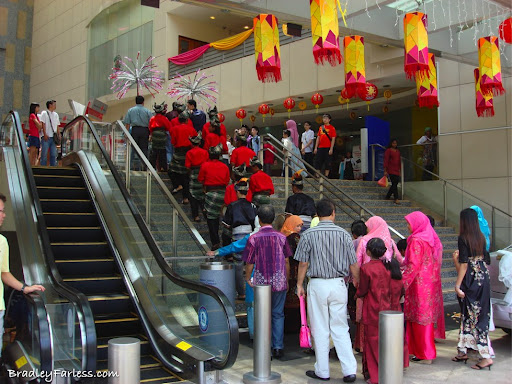
We arrived just in time to see the groom arrive.  In fact, we were kind of lost and when we heard the drums I said, “I wonder if that’s the wedding?”  So, we walked quickly over and saw a group of guys wearing red shirts playing drums, with a guy in a light purple garment walking at the front.  Sure enough, we’d found the wedding reception.

The music was really, really cool.  I tried to take some video of the event.  You can see it embedded below.  I had a problem where my camera didn’t want to focus properly and I think it has something to do with the shade of red that was being worn by the drummers, and the red cloth that was hanging behind the bride.  My camera uses a reddish colored light to focus its picture.  Regardless, it’s worth watching if for nothing more than to hear the drummers.

In the beginning, the video shows the groom’s retinue approaching the reception hall.  Then, it shows the groom sitting on the opposite side of the hall from the bride, with one of the drummers doing a ceremonial dance.  It looks almost as if the drummer passed something off to the groom.  The last two portions are when the groom is already seated beside the bride.

Here are a few photos of the event:

Year of the Tiger decorations in front of the reception hall.

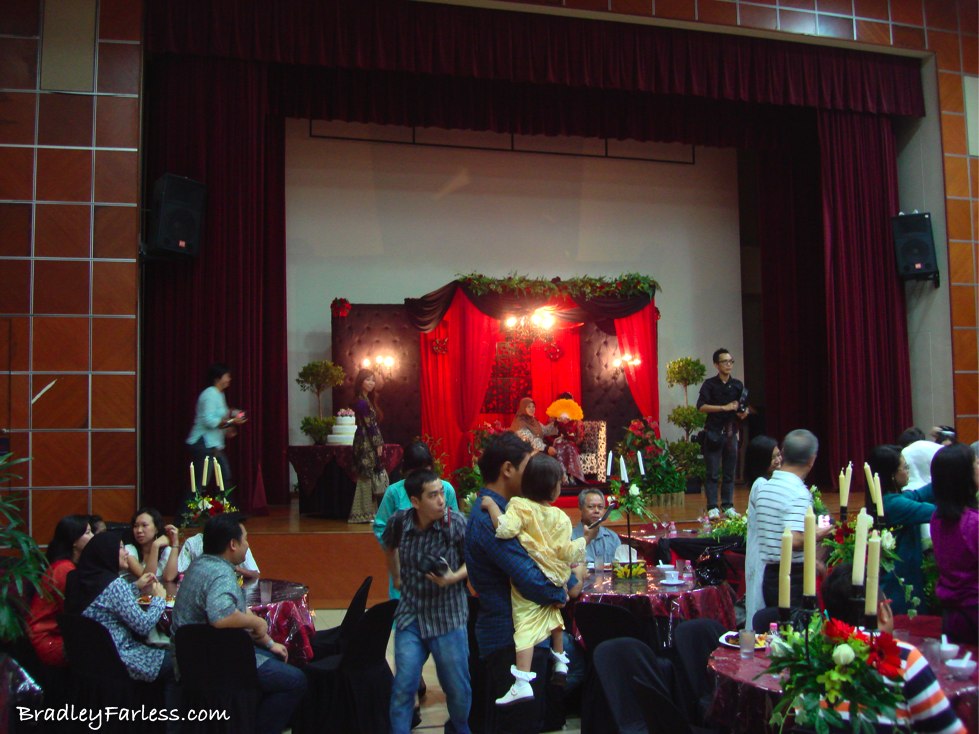
The bride, waiting on the dais next to her mother, with a fan hiding her face.

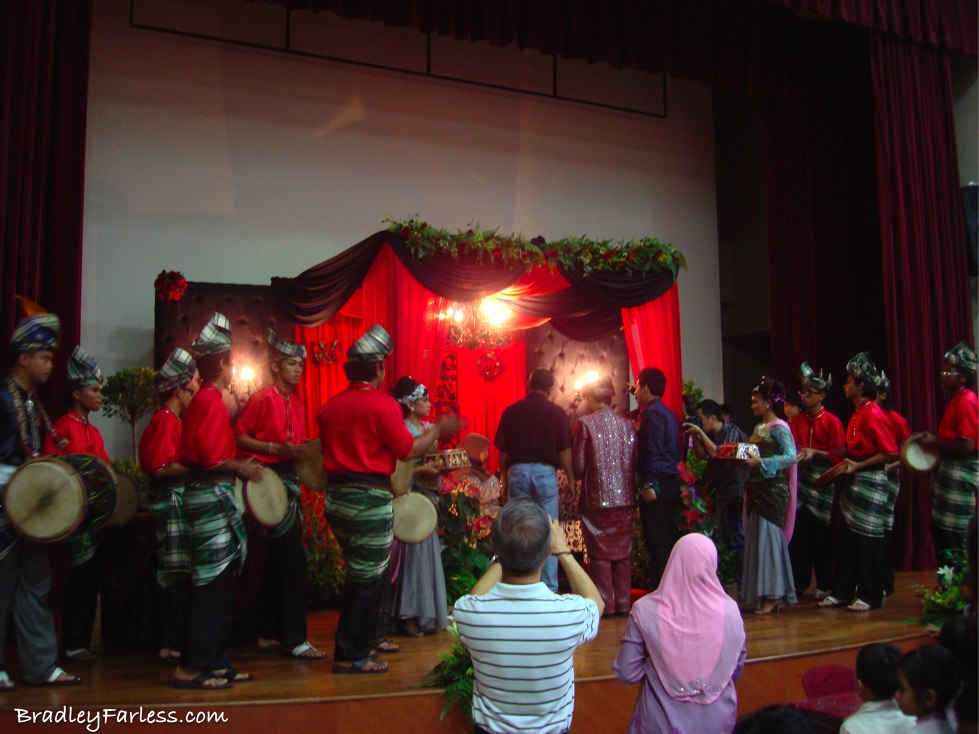
The groom at the stage, with his friends offering small envelopes (presumably with money inside) to the bride’s mother, to secure the groom’s position by his bride.

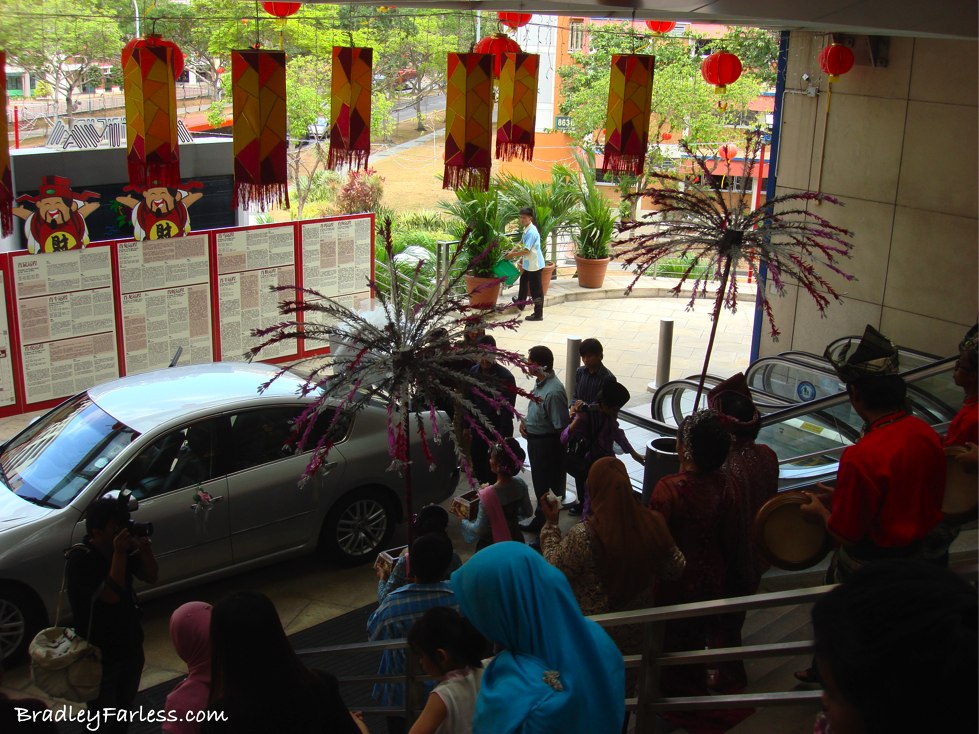
The bride and groom leaving the reception.

The car they’re taking.  They’re definitely riding in style!
We had a great time at the reception and enjoyed the music, the dancing, and the food.  I’m glad we had the chance to take part in the celebration.  It was a learning experience for us, and one I’m glad we didn’t miss out on during our stay here in Singapore.

The Problem With The 72 Virgins Theory

I was thinking about this theory of Islamic martyrs receiving 72 virgins and it doesn’t seem to add up.  This doesn’t really have anything to do with Singapore, but I’m an American who previously served in the Army and spent time in the Middle East, so it’s an issue that I have some interest in.  Extremists are constantly attacking Americans both in the US and abroad using suicide bombing tactics, presumably with this concept of martyrdom and rewards in mind.

So, I did some research and this is what I found:

The theory itself  has no basis in the Koran.  It is instead based on a supposed saying of Muhammad, but Muslim scholars have agreed that the chain of referrers for the supposed saying is fairly weak and that one of the people in the chain is known to have produced unauthentic ‘sayings’ before.  That’s from Wikipedia, so it may not be 100% spot on, but the information is usually pretty reliable.

What Muhammad supposedly said was:

‘The smallest reward for the people of Heaven is an abode where there are eighty thousand servants and seventy-two houri, over which stands a dome decorated with pearls, aquamarine and ruby, as wide as the distance from al-Jabiyyah to San’a.’

http://rcm.amazon.com/e/cm?t=talovecof-20&o=1&p=8&l=bpl&asins=1931930252&fc1=000000&IS2=1&lt1=_blank&m=amazon&lc1=0000FF&bc1=000000&bg1=FFFFFF&f=ifrThere is also some debate that if this were in fact said, the current translation is a misinterpretation and that what was meant was white raisins, rather than 72 virgin maidens.  White raisins were considered a delicacy at the time.  Also, Margaret Nydell, who wrote Understanding Arabs: A Guide for Modern Times, stated that many mainstream Muslims view the 72 virgin theory the way many Christians view the idea of getting wings and a harp and walking on clouds in Heaven.  It’s just a bit of myth and fluff, not really what you experience.  Unfortunately, the idea is being twisted and used by extremists to turn young men to a path of violence.

From the perspective of people who are far more knowledgeable in the subject, the idea of getting 72 virgins after martyrdom is a fantasy, rather than a reality.  I have to agree.  I tried to rationalize the whole thing, if it were true, but I couldn’t see how it would work.

Let’s just say that there are indeed 72 virgins waiting for martyrs in Heaven.  Where do they come from? That’s the question that I couldn’t get past.

At first, I thought that perhaps these 72 virgins are unbelievers or sinners who are serving in this position for eternity as some sort of punishment for their Earthly deeds.  However, that doesn’t stand to reason.  How many virgins do you know who’ve committed sins grave enough to be sentenced to an eternity of bodily servitude?  Besides that, how could they be serving their sentence in Heaven?  If these 72 virgins are waiting in Heaven, then they too have to be believers, or how else could they be admitted to Heaven in the first place?  And if they were believers and they were admitted to Heaven then wouldn’t they be in a position of reward?  How many women out there believe a reward in Heaven to be spending an eternity servicing a man you’ve never met along with 71 other women?  And of you who say this might be appealing to you, how many are virgins?  It could be possible that these women would be created out of thin air for this very purpose, but what just creator would construct sentient life and then sentence it to an eternity of servitude?

Perhaps I’m mixing my beliefs into this but I just don’t see it as feasible.  If these 72 virgins are live souls then there’s no way they could find themselves in that position.  If they’re created for the purpose of slavery then it’s unjust, and that doesn’t fit the description of anyone’s higher power that I’m aware of.

Keep in mind that this post isn’t meant to tear down Islam as a religion.  How could it?  I don’t understand Islam well enough to launch that kind of argument against it.  This is just my attempt to tackle a theory with common sense, and the series of thoughts I had regarding it.  Perhaps there’s a way to rationalize the existence of these virgins, but I don’t see it.

Having reached the conclusion I did, I wonder how it is that people allow themselves to be tricked into throwing their lives away?

Malaysia’s Church Bombings A Disappointment

“I think Singaporeans must have a care not to bring problems like this to themselves,” said DPM Wong at a community event in Singapore on Sunday.

“We live in an inter—connected world, we cannot be divorced from what happens in other countries. But at the same time we must be rational, and examine: when we bring such problems to our shores, what are we trying to do? Are we trying to express sympathy only, or will doing so result in more problems for our own community?”

Race and religion have always been seen as a potential minefield in Singapore.

via Yahoo! News

I’ve been following the news about the church bombings in Malaysia off and on and I think this guy’s message is pretty important.  It’s good to understand what’s going on in the world around us, as long as we don’t let it affect us so deeply that we begin to act on other people’s problems.  For all its ethnic and religious diversity, Singapore is probably the most peaceful country in the world.  It should stay that way.

This issue in Malaysia is one that boggles my mind.  Who knew that some people could be so deeply offended by such a small thing?  The universe is large, and God, or Allah, created all of it.  Do we really think that he would be so concerned over such a petty thing as non-believers using the name typically reserved for himself (in Malaysia)?  And even if Allah’s anger was piqued by non-believers using his name to refer to another idealization of God, isn’t it up to him to mete out Justice?

From my limited understanding of the use of Allah, it is typically used by Muslims when they reference God.  However, “Allah” is not a Muslim word.  It is an Arabic word, and as such is not subject to a monopoly by any certain group of people just as “God” isn’t subject to monopoly by Christians.

“The Allah ban is unusual in the Muslim world. The Arabic word is commonly used by Christians to describe God in such countries as Egypt, Syria and Indonesia, the world’s largest Muslim nation.”

via cnews WorldWatch

I also read that one argument against allowing the Catholic publication to use the word Allah is that it may confuse Muslims and lead to unwitting conversions.  That seems really weak to me though.  Do they have so little faith in people’s intelligence?  Or in their convictions?

The most disappointing part of this incident is that it has led to violent reactions allegedly on the part of Muslims.  Violence isn’t an answer.  It’s not going to make anyone change their mind.  Not in this day and age and especially not with petty acts of arson.  If anything, these actions have galvanized public opinion against extremist Muslims and painted Christians as the victims, lending public and international  favor to the court’s ruling to allow them the use of the word Allah.

On the other hand, this does is cast Malay Muslims in a poor light, even to other Muslims, since Islam as a religion is struggling to overcome international bias as a religion of war, terror and extremism.  There have been statements from the Malaysian government stressing that these actions are not condoned by the majority of Muslims in Malaysia.  There are also many Malay Muslims who have made contributions to have fire-bombed churches repaired, in a show of national solidarity against extremist attacks.

The controversy has pushed locals to turn to the Web in a bid to rally support for the affected buildings. A blogger who started an Internet fundraising campaign for the Metro Tabernacle Church, which was attacked by arsonists, raised 8,467 ringgit (US$2,493) in four days.

Mohamed Rafick Khan Abdul Rahman, 45, started the donation drive on his blog after learning about the attack in Kuala Lumpur. He said donations poured in nationwide, and from the U.K. and Europe.

via ZDNet Asia

I don’t pretend to understand Islam, since I’m not Muslim myself, but what I do know is that we as human beings should be able to settle our differences peacefully.  Any religion that purports itself to be a religion of peace can not, by definition, support violence as a mean’s to an end so committing violent acts in the name of Islam or Allah is contradictory.  People shouldn’t be so offended on religious grounds by a practice that’s already widely accepted by Muslims around the world.

In closing, it’s nice to see that while Singaporeans have taken in the news of religious strife in Malaysia, they’ve simply consumed the information for what it is and not let it affect the peaceful prosperity that Singapore is currently enjoying.