“The Big Bang Theory” Season 9, episode 21. In the comic book store:
Sheldon: I have a question about Batman. Batman is a man who dresses up like a bat. Man-bat is a part man, part bat hybrid. Now, if Man-Bat dressed up as a man to fight crime, would he be Man-Batman?
Leonard: No, he’d be Bat-Man-Bat.
Raj: But wouldn’t Man-Batman just be a Batman that was bitten by a radioactive man?
Howard: But Batman is a man. You’re talking about a man who would have the powers of a man. That’s just Man-Man.
Sheldon: Well, isn’t Man-Man just Man?
Leonard: But what if Man-Man dressed as a bat?
Raj: Well, that’s just Batman.
Leonard: No, if a man dresses as a bat, that’s Batman, but if Man-Man dresses as a bat, that’s Batman-Man.
Howard: So does that answer your question?
Sheldon: Oh, I haven’t asked it yet.
If Batman is a man dressed like a bat, then wouldn’t a Man-bat dressed like a man actually be Manman-bat?
Just thinking about how great life is when you can wake up surrounded by family and pets and good food and options for entertainment and personal enrichment that most people in the world only dream about.
Sometimes it’s hard to keep things in perspective, but even things I often take for granted are luxuries depending on where a person might be in the world.
I guess we’re late to the party on this one since making bread at home was popular last year, but we decided to get an automatic bread maker to use at home. I guess it makes more sense now since there aren’t huge flour shortages. I’d have been pretty disappointed if we bought a bread maker but couldn’t get flour.
The machine arrived yesterday and I decided to use it right away. I was too excited to wait so I was up late making bread. Or rather, watching the machine make bread. It’s bizarrely easy. I was worried about the results because of some of the reviews on the product page but I had zero issues even with using oat milk instead of cow milk. I think people were just using poor quality flour or yeast and expecting miracles.
A freshly baked 1-lb loaf of “basic white bread” made using the Cuisinart CBK110P1 automatic bread maker
The texture of the bread is thick like “artisan” bread you buy from the deli/bakery in the grocery store and not spongey like pre-packed bread in the bread aisle. It was thick, heavy, and slightly chewy. On the medium setting, the crust was firm without being hard on the teeth. I’m not sure I’d want to use the darker setting.
Most importantly, it tasted good. It tasted real. The basic white bread loaf seems like it would be best with butter, jam, or dipped in soup. I’m going to give the sandwich bread recipe a try.
This machine will also just knead and manage the rising of the dough for you so all you have to worry about is shaping and baking. It will even make pizza dough and pretzels.
I’ve wanted to make my own bread and do more baking. This takes the hard work out of it and lets me just have fun while making clean, better quality bread at home.
I rarely use Facebook, partly because it eats up a lot of time but mostly because I started to realize just how much Facebook was doing with and profiting from my personal data. It’s creepy. So, I cut back my Facebook time to about 30 – 40 minutes every month or so. I’m not keeping up with everything on Facebook anymore and sometimes I wish I could when it comes to family, but Facebook really isn’t about family updates anymore and hasn’t been for a long time so I don’t really feel as guilty about walking away from it as I might have 10 years ago.
With everything going on with the election and the inauguration, alternative social media platforms have been getting a lot of sun. I’m always keen to try out new platforms, mostly to see if there are any great memes, but I hadn’t heard of MeWe so I decided to give it a try. It’s surprisingly well put together and fun to use, once I got over the learning curve and figured out which groups to avoid.
There are, however, some really basic things wrong with MeWe that are surprising. Here are three things I’ve noticed so far:
If I create an album in My Cloud and upload photos to it, there’s no way to share that album with anyone, whether they be Close Contacts, Contacts, or Public. Those photos are dead weight. You have to create a photo post and add 50 images, share it, then create another photo post and add 50 images, share it, etc. That’s really messy. It would be nicer to create an album, caption the photos, and share it when it’s finished one time so people see the finished product. Granted, I don’t have a lot of albums that would need more than 50 photos, but I do have a few and other popular social sites offer this functionality and have offered it for many, many years.
There’s no way to delete an album and have it just delete the photos in the album as well. You have to first delete the album in My Cloud and then you have to manually select every photo in your Photostream, clicking one at a time and then clicking delete which is absurdly tiresome and shouldn’t be how things work in any social network, free or paid.
Once you’ve created your account, it’s apparently impossible to change your email address so I may have to delete my entire account to change to a new email address. Why this is a problem shouldn’t even need to be explained. I figured this out after opening a Proton Mail account, which is encrypted and comes with 500 MB of storage on the free account. I figured it might be nice to have a new account for professional messages, since my Gmail is now an advertising-filled dumpster fire like my Yahoo! email was before it.
I don’t want to use Facebook, but the alternatives really make it hard to settle in with glaringly obvious problems that should have been addressed a long, long time ago. MeWe isn’t brand new after all.
I’m reminded of how Signal is just now trying to add custom backgrounds and more customization options after this influx of users. They’re going to lose out to Telegram, which isn’t as secure, because it’s just more user friendly and more fun to use, because they didn’t take the initiative. It’s also possible to search for public channels or chat groups, which Signal doesn’t seem to support.
I submitted feedback about those issues more than once over the time I’ve been using the app. Now, the Signal boat is sinking and they’re trying to bail it out with new features rushed out in their beta version while people are choosing whether to hop on board or swim to the Telegram boat. I wonder how you explain that to all of the people who donated to Signal to create an exceptional and secure messaging app? That they created a product that lost out to another messaging app run by a Russian oligarch as a pet project?
I think I’m going to wind up using MeWe mostly for a handful of groups and some personal updates, but probably nothing too personal. I didn’t even sign up with my full name. The way that social media is being weaponized now is honestly terrifying and has a chilling effect on speech. Something you say today that is conventional might become a weapon to attack you in 10 years.
I think the 2020s are going to be a time when people take a step back and anonymize and the web goes back to how it was in 90s, before every post and comment online became part of a global ePeen contest. If we can get around current government and corporate efforts to prevent that from happening anyway. I imagine they want and need the US to move more towards a blending of offline and online identities leading to a shadow social scoring system. Sometimes I wonder if there isn’t one already in place.
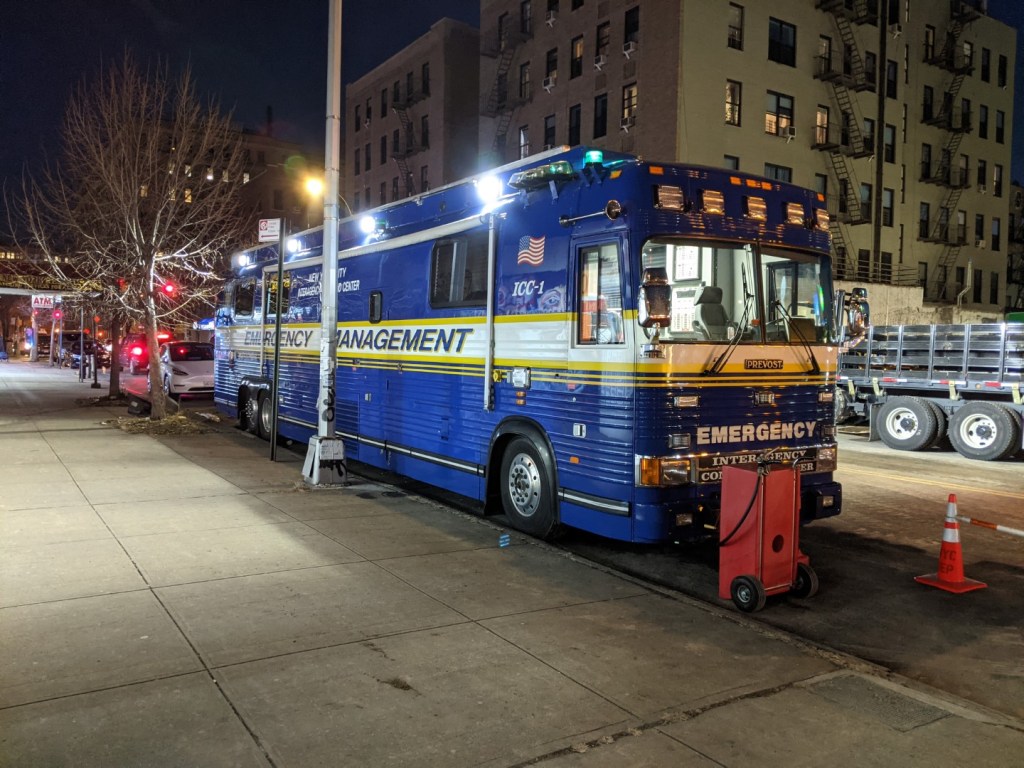
Living in the Bronx is exciting. You never know what you’re going to see when you go outside or even when you look out your window at 4 AM. For example, early last Thursday morning I saw a river where I expected to see an avenue.
4 AM Thursday Morning
A water main break at 175th Street was causing major flooding. The water main that broke was cast iron, 48″ across, and was installed in 1909. It’s kind of hard to believe that something installed in 1909 was still holding up considering all of the traffic that rolls across Jerome every day and the vibrations from the elevated 4 train. Maybe this will encourage local politicians to address the traffic issue in this area.
Jerome Avenue sits in a depression that I’ve always wondered about. Was it a river in the past that was converted into a roadway? Or just a natural valley? Regardless, it is now a major thoroughfare in the Bronx both for vehicles and for an elevated train line. That worked to funnel the water towards I-95, which sits at an even lower elevation and crosses under Jerome Ave a block away.
Eight people were trapped in their cars and nearby streets were underwater early Thursday when a water main break flooded the Cross Bronx Expressway, a major New York City highway. Emergency workers came to the drivers’ rescue. https://t.co/J8PKOkHHg9
I can’t say I was completely unhappy to see the street flooding, even though I was worried about my car and the impact on local businesses that I frequent. This stretch of Jerome Avenue is usually filthy. It needed a good wash. It needs a second wash for good measure, but I don’t suppose that’s going to happen anytime soon. Maybe when the two new buildings that are going up are finished and new people and businesses start moving into the neighborhood? I have hopes that this section of the Bronx, being right on a train line and with quick access to two major highways, will be vastly improved over the next year or so.
Anyway, looking out of my window at 4 AM, I could see that the water was hip deep and rising. Cars parked along the avenue were already half-submerged. What I couldn’t quite figure out is why the water seemed to be so deep between 177th Street and 175th Street, but was almost completely absent from 175th Street down towards I-95. I could see emergency workers standing in the road there. The difference in elevation from one block to the next isn’t that severe.
Thursday Evening
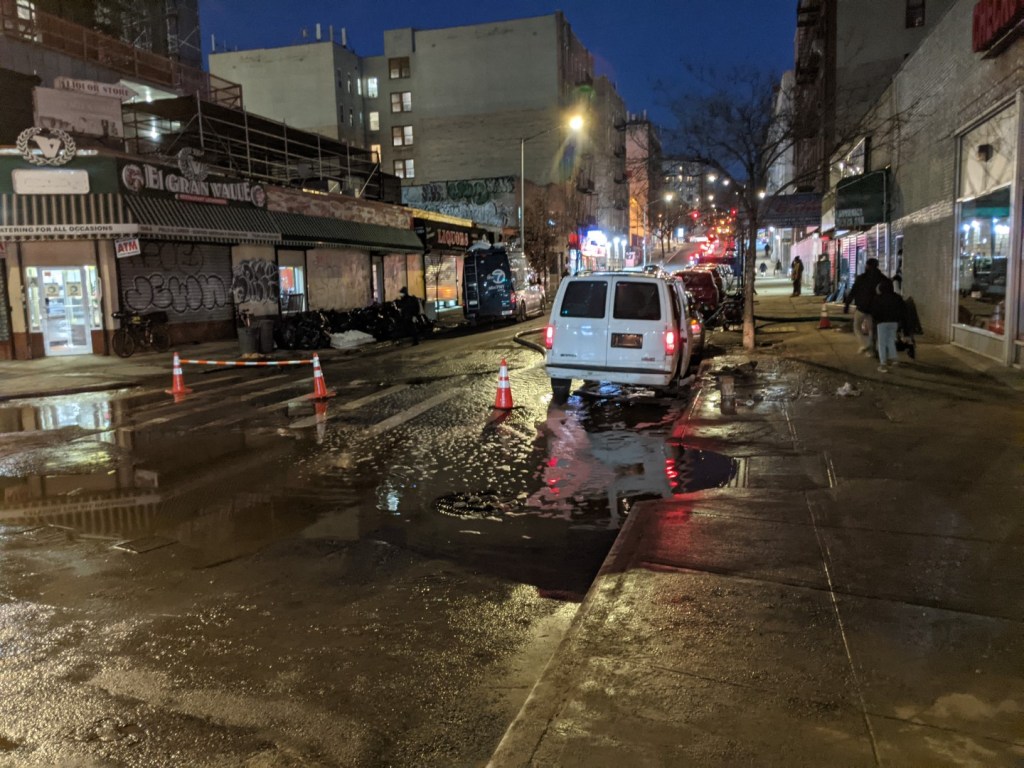
Later that evening I went out to get groceries and to look around. Most of the businesses along that stretch were closed or people were using pumps to remove water from the basements. I could see people in El Gran Valle on the corner of 176th and Jerome looking around and shaking their heads like they were dealing with a lost cause.
The road itself was covered with mud and there were emergency work crews surrounding huge holes in the intersection of 175th Street and Jerome, in front of the Dunkin’ Donuts. A reporter, Naveen Dhaliwal from Channel 7 I think, was on the corner. It looked like she was getting ready for the following news segment:
Friday
People clearing damaged items out of businesses on Friday afternoon.
Today (Friday), more than 48 hours later, water was still being pumped out of the basements of businesses and workers at a church and bodega were hauling damaged equipment, furniture, and other odds & ends out to the curb for disposal. Between the physical and fire damage from the riots and this week’s flooding, the area is really taking a beating. I can’t help but wonder if the damage was done intentionally to try to clear out some of these businesses so that more new buildings can be erected.
One last thing I wanted to note. ConEdison has closed Jerome Avenue between 176th Street and 175th Street for repairs. Today, some overly clever clown got out of his car, moved the cones, and drove down Jerome anyway. He was forced to turn around both by ConEdison workers and by the lack of a road in the 175th Street intersection. People really are something else in the Bronx.
The time of a man’s life is as a point; the substance of it ever flowing, the sense obscure; and the whole composition of the body tending to corruption. His soul is restless, fortune uncertain, and fame doubtful; to be brief, as a stream so are all things belonging to the body; as a dream, or as a smoke, so are all that belong unto the soul.
Marcus Aurelius
This is an interesting quote. I haven’t finished reading The Meditations or much about Aurelius’s life, so I don’t think I understand it fully, but it seems as though he’s saying that who we are physically and mentally changes from moment to moment and that we are all moving inexorably towards death.
I think it’s important to remember that people change over time and that the total time we have is fleeting. I’m not the same person I was 25 years ago and I won’t be the person I am today in 25 years, or even tomorrow. I do wonder if we should be struggling to make sure that every little thing we do is incredibly meaningful, though. I don’t know if that would make life more meaningful or just stressful. Sometimes it’s good to relax and enjoy frivolous things.
True understanding is to see the events of life in this way: ‘You are here for my benefit, though rumor paints you otherwise.’ And everything is turned to one’s advantage when he greets a situation like this: You are the very thing I was looking for. Truly whatever arises in life is the right material to bring about your growth and the growth of those around you. This, in a word, is art– and this art called ‘life’ is a practice suitable to both men and gods. Everything contains some special purpose and a hidden blessing; what then could be strange or arduous when all of life is here to greet you like an old and faithful friend.
Marcus Aurelius, Roman emperor from 161 to 180 and a Stoic philosopher
This is a really cool and healthy way of looking at life. As much as possible, I’d like to cultivate this attitude in myself.
I was just thinking to myself that I’d like to go to Georgia to visit family. Especially some of my family members that are starting to get a bit older. I’d like to see them while I still have the chance. I’ve been meaning to go see them for a while now.
I looked up the cost of a bus ticket. $106 one-way. Then I checked the price of an airline ticket. $126 round-trip. Wow. What a deal! But then I remembered that I’d heard about needing a COVID-19 test to be able to travel. I wonder how much that costs?
And then I realized that I’ve probably been exposed to the virus and that my desire to see my relatives before it’s too late really isn’t in their best interests, health-wise.
Plus, there are quarantine requirements there and here if I remember correctly.
The ability of the average person to freely travel is really being locked down. How much of these precautions are legitimate? How much is government overreach? Why was there never a huge bump in numbers after the closely packed protests and riots? When do things go back to normal? Next year? Next month? It’s really amazing and fascinating how questionable reality has become in the last 4-5 years.
It’s a testament to the power of the media to shape our understanding of the world. And probably a testament to the dangers of building profitability for a “news” site around ad revenue rather than subscriptions. Things probably went truly wrong with Facebook and Twitter, though. It became too easy to boost misleading and untrue narratives into the national consciousness.
Anyway, I’ll have to put off my travel for a bit longer. Until I’m sure I’m not going to ride into my relative’s homes on a white horse.
I’m really late to the party, the first book in the series having been published in 1997 when I was still in high school, but I’ve been borrowing the audiobooks of the Harry Potter series from the New York Public Library and I’m really enjoying them. I think I would have loved them as a kid but I was going through a phase where I was really into church dogma and the Harry Potter series was said to be evil and demonic because it supposedly encouraged children to engage in witchcraft.
Putting aside the question of whether witchcraft is real or not, I can see how the Harry Potter series was threatening to organized religion. It provides an alternative fantasy world that presents a set of moral values in a compelling way and, even when it doesn’t conflict with the church’s vision of morality, it competes for attention. I’d guess Harry Potter is probably winning that contest too, given the success of the books and movies and the ever dwindling levels of church attendance.
I wonder how much of the church’s problems these days comes from an insistence on biblical literalism? It’s been a while since I studied the Bible, either academically or religiously, but I do recall that many of the stories have parallels in other nearby cultures. For example, the story of Moses and the flood is essentially the same story as the Epic of Gilgamesh with modifications to fit the local culture. That alone should tell us that stories in the Bible were meant to be educational rather than literal history. It makes more sense to tell someone that they should be looking at a story in the Bible for moral guidance than to tell them to take it as literal word from God history and expect that story’s relevance to endure over any length of time.
And maybe that’s why Harry Potter does so well. We know it’s not word from God and we don’t face the choice of having to either swallow it whole or throw it out. We can instead appreciate it and think about it and try to apply it to our lives if it makes sense in relation to what we understand to be good and bad.
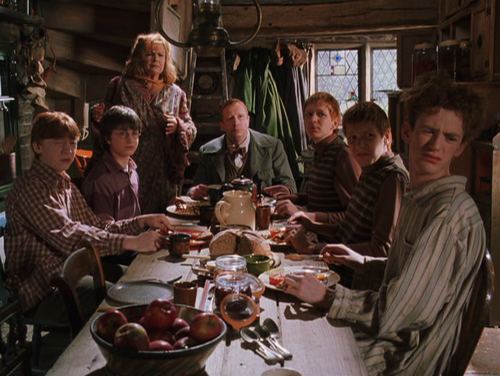
All of these thoughts congealed in my head as I started to realize how the Weasleys were being presented in the books. They may not have fancy clothes and they may not always get along but they value what’s important in life: their kids, each other, friendship, and (in Molly and Arthur’s case) their kids’ education. In addition, even though they’re struggling they essentially adopt Harry into the family, so there’s a lot of love and charity being displayed there. They share even when there’s not much to give. They’re loyal. They do things together. It’s sort of a model for the proper behavior of a family, especially when it comes in such stark contrast to how Harry is treated by his aunt and uncle. The fact that both Harry and Hermione later marry into the Weasley family reinforces the idea that they represent an ideal family.
I’m only partway through the fourth book and I wasn’t really thinking about the story too deeply until now, but there’s really more in these books than shallow entertainment. I’m not really surprised. I don’t think they would have done so well if they didn’t have something substantive to offer readers.
I used to think that needing a cabin in the woods to do any serious writing was over-dramatic and a little elitist. I’m thinking of people who have a summer cottage or any separate dwelling that they can go to for weeks at a time to tune out the world and just focus on writing.
I still think it’s elitist. I mean, how many people can really afford a second place to live? Or in this case, a second residence to just have on call for when you want a little solitude? I imagine most people are lucky if they even have a separate room where they can lock the door and be alone for a while and that doesn’t really, fully separate you mentally from the day-to-day because you can always be interrupted.
I feel like a person needs some space to be creative. A place to truly relax and let their mind run wild, where there are no pets, family, routines, or chores insistently tugging at the edges of one’s consciousness.
My wife was pretty good about giving me space when she saw I was trying to complete writing assignments, but I sometimes wonder how I managed to get through college with such good grades on the papers I turned in.
The next time we move, I’d like to try to find a place with an extra room. Or, if it’s outside of New York City, a place with a garage or shed that I can convert into a study. That way, when I have time, it’s easier to focus.