Why Life is Not Beautiful in Life is Beautiful: Holocaust in Film

Life is Beautiful, originally titled “La vita è bella,” was released in 1997 in Italy (1999 in the United States). The movie is a drama and romantic comedy that takes place during the 1930s in Arezzo, Italy and revolves around the comedic antics and acting talent of Roberto Benigni, who plays the role of Guido, a Jewish man who arrives in town with plans to open a bookshop. The first half of the movie follows Guido as he attempts to woo Dora away from her fiancé and starts a family with her. The second half of the movie takes place in what the audience is meant to believe is a death camp, where Guido and his son Giosué are interned. During this internment, Guido deceives his son into believing their incarceration is a game, where points are awarded for good behavior and the first person to earn a thousand points will win a tank.[1]

Life is Beautiful DVD Cover

In 1999, Life is Beautiful won three Oscars for Best Actor in a Leading Role, Best Foreign Language Film, and Best Music, Original Dramatic Score. The movie won 55 other awards and received 31 nominations.[2] But, did the movie actually earn those awards? Despite the movie having been called a modern masterpiece, there are many critics and reviewers who believe the movie doesn’t live up to the hype it received, referring to it as an “unholy film,” or a “cinematic abortion.”[3] This paper will explore and present major themes in those negative reviews, looking for common complaints that may be used to point out potential weaknesses in the movie. There are a number of criticisms of the movie among reviewers, but surprisingly, after reading approximately one-hundred reviews from IMDB and Rotten Tomatoes (which links to external sites, including Time Magazine, Salon.com, and SFGate), I discovered that almost all of the complaints fall into just a few categories, including poor acting, implausibility of the plot, historical inaccuracies, the poor choice of humor, and a general insensitivity to the victims and survivors of the Holocaust itself.

The main complaint regarding the quality of acting begins with Benigni himself, who one reviewer describes as “a six-year old trapped in the body of a middle-aged Italian man on a steady diet of Red Bull and Ecstasy.”[4] Benigni’s performance of Guido became difficult for some viewers to watch, for a few reasons. Benigni is, first of all, overly energetic throughout the movie and talks incessantly, rarely allowing any other character get a word in edgewise. This problem is also indicative of bad directing, since Benigni was both the director and lead actor. His overwhelming of the storyline through Guido leads directly to the next problem with acting in the movie: the nature of the other characters. Perhaps because they have so few lines, they have no room to develop as independent characters and remain two-dimensional, cardboard cutouts. One reviewer complained of the irony of Jews being dehumanized into a faceless mass by Life is Beautiful in much the same way they were dehumanized by the Holocaust itself. Overall, reviewers noted that all of the characters in the movie merely act as targets for Benigni’s gags or as foils to emphasize the good natured optimism of his leading character, Guido.[5]

The second largest complaint generally centers on the implausibility of the plot itself. The movie is divided into two distinct portions: the town scene, where Guido woos Dora, they get married and have kids; and the concentration camp scene, where Guido lies to his son about the nature of their surroundings in an effort to shield him from the horrors of reality and thereby preserve his innocence. Regarding the first half of the movie, most reviewers complained that Guido’s buffoon antics make him a completely unbelievable character that would not have been able to attract Dora, who would have, in the words of one reviewer, been more likely to have a restraining order issued against him. The first portion of the movie was generally described as contrived, predictable and ultimately useless in terms of lending anything useful to the second half of the movie. One reviewer summed it up quite well by saying that when the movie transitioned to the second half, he felt as though he had changed the channel on his television.[6]

In the second half of the movie, the implausibility of the plot was even more evident. Reviewers cited specific cases which make the movie impossible to believe or take seriously, starting with Guido’s intentional failure to relay important instructions to the Jews who have just arrived in the death camp, instead creating a fanciful speech about the rules of the “game” that he says is being played, for the sole benefit of his son. Had this really happened, it is entirely likely that it would have been discovered, leading to Guido’s death, either by the Nazis or by the Jews who were left in the dark about what was going on because of Guido’s disregard for their lives. Also hard to believe is that Guido is able to hide his son in a death camp after all of the other children are exterminated. And not only did Guido hide him, he had his son speaking on an intercom system to communicate with his mother in the conveniently nearby women’s camp, which did not result in the death of either the father or the son, though it should have. The biggest implausibility of all is that the kid actually believed the lies his father was telling him. Reviewers stated that the kid is depicted as being intelligent, so how could he have spent any time at all in a death camp without realizing what was going on, especially after all of the other kids disappeared?[7]

This leads directly into the next major complaint, which was the lack of historical consistency present in the movie. To start with, Guido and Dora’s marriage never could have happened, because marriages between Jews and non-Jews had been made illegal. The camp that Guido and his family are taken to is mentioned to have a crematoria and mass killings, which would make it a death camp, and yet, according to reviewers, all of the death camps were in Poland and Italian Jews remained in Italy. Most of the historical criticisms revolved around the conditions portrayed in the death camp itself. In a real death camp, people would not have appeared well-fed and well-dressed. People would not have had a bunk to themselves. Guido would not have had freedom of movement to wander the camp as he pleased. Central areas with intercom systems would not have been left unattended and had a Jew taken it upon himself to use the camp intercom without permission, he would have been killed on the spot. Had a Jew spoken to a guard, he would have been killed on the spot. Death wouldn’t have been hidden away in foggy piles of dream-like bodies; it would have been casual and ever-present. There is no way Giosué could have missed it. One reviewer wrote that the death camp looked more like a fat kids’ summer camp than a place where people were being systematically murdered. [8]

And perhaps that’s the biggest problem with the movie. The audience is led to believe that the lies being told are meant to spin a horrible situation into a fable to preserve the innocence of Guido’s son. In the beginning of the movie, the story is presented as a fable, but some reviewers didn’t feel that labelling the movie as a fable helped make it any more believable, because fables are meant to deliver a moral truth and what moral truth is there to Life is Beautiful? That lying makes life bearable? That’s certainly not what the movie is billed as delivering. The DVD box cover insists that “love, family and imagination conquer all,” but that’s not possible, or at least it’s not possible given the way the movie is portrayed, because if it were, no one would have died in the Holocaust. Certainly Guido wasn’t the only person who loved his family and had imagination. What about all of the other people? Why didn’t their humor save them? Maybe they weren’t funny enough.[9]

The type of humor used in the movie was another big issue with reviewers, including many reviewers who gave the movie moderately good ratings. Benigni’s brand of humor is very physical and includes a lot of slapstick humor, which for some was bad to start with, but for others could have been fine, had he been able to pull it off well. Many people complained that his jokes were entirely predictable and because you could see them coming, there was no reason to laugh when the moment arrived. For example, when an egg goes in a hat, it’s eventually going on someone’s head. Benigni was accused of grandstanding and trying so hard to be cute that he forgot to be funny. He was also accused of trying too hard to be Charlie Chaplain, but wound up just being loud and obnoxious. Reviewers also stated that instead of creating his own version of “The Great Dictator,” Benigni produced something much more similar to an extended episode of “Hogan’s Heroes.” He was accused of using the Holocaust as a prop to hide his poor comic ability and earn himself an Oscar, because including the Holocaust would make his movie critic-proof.[10]

That point brings us to the final, and perhaps most often cited, complaint about the movie: it is completely insensitive to the nature of the Holocaust, what it meant for the people who were victims of it, and what it should mean for those of us who learn about it today. The movie was, according to multiple reviewers, so sanitized that it probably wouldn’t even have offended the Nazis. A few reviewers said Life is Beautiful would have made great Nazi propaganda for Goebbels to show the Red Cross, to prove that life in the camps wasn’t so bad after all. Many reviewers called the movie an attempt at neo-Nazi revisionist history that denies the overwhelming horror of the Holocaust and that the movie obscures the human and historical events it set out to portray. It doesn’t expand our knowledge of the Holocaust and instead acts as a plot device to help Benigni bring more attention to himself.

The negative reviews of this movie have very strong arguments that point to serious flaws in the movie that could have been addressed to create a better movie. The movie doesn’t really show that life is beautiful. It shows that life for characters created in the author’s imagination is beautiful. If depicted realistically, this movie would not have ended well for any of the characters involved, and without those elements of realism, the movie cannot really hope to deliver a message as strong as family, love and imagination conquering all, because in the movie, that doesn’t happen. Instead, events are set up in such a way, and history is rewritten in such a way, to make it possible for “all” to be conquered. Had elements of real terror been included in the movie, alternated by more fantastical scenes as recollected by Giosué, it could have been possible to pull of what Benigni intended, but instead, he created a platform for selling himself, reducing all but the leading character to caricatures of human beings, doing implausible things in inaccurate settings using poorly thought out humor and ultimately desecrating the memory of millions of people who died in the camps.


[1] IMDb, “Plot Summary For Life is Beautiful,” 2013.

[2] IMDb, “Life is Beautiful (1997),” 2013.

[3] IMDb, “Reviews & Ratings for Life is Beautiful: La vita è bella (original title),” 2013.

[4] Ibid.

[5] Ibid.

[6] Ibid.

[7] Ibid.

[8] Ibid.

[9] Ibid.

[10] Ibid.

References

Flixster, Inc. 2013. “Life is Beautiful (La Vita è bella) Reviews.” Rotten Tomatoes by Flixster. March 8. Accessed June 13, 2013. http://www.rottentomatoes.com/m/1084398-life_is_beautiful/reviews/.

IMDb. 2013. “Life is Beautiful (1997).” Internet Movie Database. June 15. Accessed June 15, 2013. http://www.imdb.com/title/tt0118799/.

—. 2013. “Plot Summary for Life is Beautiful.” Internet Movie Database. June 15. Accessed June 15, 2013. http://www.imdb.com/title/tt0118799/plotsummary?ref_=tt_stry_pl.

—. 2013. “Reviews & Ratings for Life Is Beautiful: La vita è bella (original title).” Internet Movie Database. June 8. Accessed June 13, 2013. http://www.imdb.com/title/tt0118799/reviews?filter=chrono.
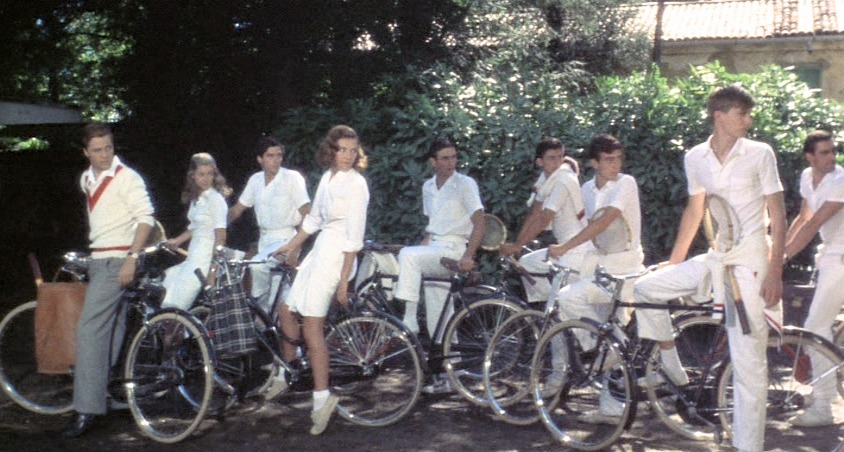

The Garden of the Finzi-Continis: The Holocaust in Film

The Garden of the Finzi-Continis (Image appropriated from Tumblr).

The Garden of the Finzi-Continis, originally released in Italy in 1970 under the title “Il giardino dei Finzi Contini,” was directed by Vittorio De Sica. The film uses the lives of an aristocratic Jewish family to tell a story about the Jewish community and fascism in 1930s Ferrara, Italy. The plot of the story seems to revolve primarily around the interactions between Giorgio and the Finzi-Contini family. The increasing limitations on the rights of Jewish people in Italy plays out in the background and only reaches center stage in the closing sequence of the film, when the Jewish people of the town are rounded up and concentrated in the school building.

http://www.youtube.com/watch?v=0pSQTTrfr0Q

The Garden of the Finzi-Continis is a color film that contains two very noticeable camera techniques. One technique used throughout the film is the blurred lens or soft focus. In some scenes, the soft focus is light and feels a little pointless. In other portions of the film the soft focus creates heavy blurring. An example is the scene where Micol is sitting in the back seat of a government car that is taking her and her family to the town’s school house as part of a collection and deportation process.  The blurring may have been added to the scene to emphasize the dreamy or surreal quality of the experience.

The other camera technique that is used extensively is zooming. In some scenes, the camera starts with a long-shot and zooms out until the actor is in the frame. In other scenes, the camera zooms in on things the director may have wanted to make sure his audience took note of, like the Hebrew inscription on the lintel of Giorgio’s home, or Micol’s Star of David necklace. Perhaps there is another reason for the zoomed in scenes of Jewish symbols, but it comes across to me as the director not trusting his audience to be able to figure out on their own that the Finzi-Continis and Giorgio’s family are Jewish without prompts and reminders. Maybe that’s the point, though? Reinforcing the fact that, despite social advancement, they’re still “only” Jews.

A large portion of the film takes place on the property of the Finzi-Continis. All of the characters that we are introduced to are wealthy, but the Finzi-Continis are exceptionally well-off, own extensive property and employ at least half a dozen servants. The film begins after the racial laws had already started being passed in the country, barring Jewish people from entering public buildings and clubs. Because of this, the Finzi-Continis are essentially restricted to their walled-in property. As Alberto puts it, even if he went out, what would he do? Where would he go? Alberto also mentions the fact that when he used to go outside of his family’s estate, he felt that he was constantly being spied on and envied. The Finzi-Contini family’s semi-voluntary seclusion behind their garden walls is an excellent foreshadowing of the fact that they will later be involuntarily restricted to a ghetto, or perhaps placed behind the “walls” of a concentration camp.

It is hard to relate to the lives of the people shown in the film, because they live such privileged lifestyles and, despite all that happens, manage to continue living privileged lives. I believe this was an important aspect of the film, because even though the Finzi-Continis are able to ignore many of the rules and live well in their walled garden, in the end, their wealth makes no difference. The fact that they are relatively non-practicing also makes no difference. For all their wealth and privilege and ability to ignore some of the racial laws, like continuing to employ domestiques after Jews are banned from having Italian servants, they receive no special treatment or consideration from the state. For example, the Finzi-Contini’s integrity as a family unit isn’t considered and they are placed in separate classrooms after they are arrested and transported to the school house. They are lumped in with the rest of the Jewish community. The message here may be that there was no escaping one’s Jewish heritage when the fascists came knocking. To the Italians, there was no distinction that mattered other than whether one was Jewish or not.

Trees are an important symbol in the film. At one point, Micol mentions that one of the trees on her family’s property was rumored to have been planted by Lucrezia Borgia and might be as much as 500 years old. The same tree is shown at various points during the film, including the last scene with Alberto, just before he dies. The camera focusing on the tree during Alberto’s death scene may have been done to emphasize the long presence of Jews in Ferrara and the imminent death of that community, because Alberto’s failing health can be seen as an indicator of the state of the Jewish community in Ferrara. As the film progresses and the Jews’ status in the town becomes more tenuous, Alberto’s health declines. In the scene right after Alberto’s funeral procession, we’re informed, through Giorgio’s interaction with the fair booth attendant that the round-up of Ferrara’s Jews has begun.

The Garden of the Finzi-Continis is an important film that gives the viewer a glimpse of what life was like for wealthy Jews in Ferrara during the round-ups and deportations during World War II. Beyond being a fascinating love-drama that sheds light on class and status within Jewish society, this film presents the Holocaust as an event that touched all Jewish lives in Europe, from the poorest to the wealthiest. It was the great equalizer. Religiosity and self-identification did not matter. All that counted was whether or not one was Jewish.

The Shop on Main Street: Holocaust in Film

Obchod na korze (original title)

The Shop on Main Street is a 1965 film directed by Ján Kadár. The film was originally presented in Slovak and Yiddish and was originally titled “Obchod na korze.” The film takes place in a small town in Slovakia during World War II and attempts to tackle the question of how the Jewish people were rounded up and deported to concentration camps. What was going through the minds of the Jewish people? Why didn’t they fight back? How did the average citizen allow their neighbors to be rounded up like animals and packed into cattle cars for deportation? Kadár addresses all of these questions and more. Besides being an informative and well-told story, The Shop on Main Street is packed with symbolism that further addresses the subject of the film. Symbolism is so prevalent in the film that Kadár was able to present much more information and meaning within the confines of the film’s running time than what seems possible.

The main conflict in the film is between the new fascist conception of the Slovakian nation-state and the Jewish people. Because of fascism’s focus on ultra-nationalism, “outside” elements had to be removed from perceived positions of authority and privilege, which resulted in Jewish people having their businesses removed from their ownership and placed under the control of an “Arisator,” an “Aryan” manager. The idea was that Slovakia was for Slovakians (expressed in the film through a marching cadence sung by soldiers marching down the street), and Jewish people were not considered to really be Slovakian. Later, the Jewish people were deported en masse for concentration camps. This conflict is the backdrop for the story that Kadár presents in his film, in which a bumbling “Aryan” carpenter named Tono Brtko is named the Arisator of a button shop on Main Street owned by a Jewish widow named Mrs. Lautmann.

Tono is a very complex character and his relationships with other people, how he interacts with them, is used as a plot device to symbolically portray the director’s opinion of the Aryanization and deportation process. Tono’s symbolism as a character in relation to other characters has multiple layers, starting with his wife in the opening scene, where Tono demonstrates a poor understanding of anything going on in the world while his wife badgers him for money. I felt that this was a critique of Slovakian society, and on a broader scale, Christian society in general, for the apparent greed displayed in the confiscation of Jewish shops and goods during the World War II deportations. It reminded me of something Elie Weisel wrote, when he said that while he and his family were being deported from their home town, he felt as if the people who had just previously been their neighbors were eagerly waiting for them to board the trains, so they could loot and pillage through their homes. Later in the film, Tono’s wife berates him for not finding the gold that Mrs. Lautmann must have buried somewhere in her house, as if all Jews were leprechauns and one need only catch one to receive a pot of treasure.

The other important symbolic relationship that Tono has is with Mrs. Lautmann, the owner of the shop he is supposedly taking over. Mrs. Lautmann is an old, slightly senile widow. Her late husband died in a war (World War I?) and since then she has been on her own, though technically she has been receiving a stipend from the rest of the Jewish community. Her shop is in complete disrepair, but she seems to be completely oblivious to the fact, and also demonstrates a lack of understanding of anything that’s going on around her, including her new “Arisator-Jew” relationship with Tono, until the last scenes in the film, when reality suddenly and painfully dawns on her. Even at that moment, however, instead of proactively trying to hide herself, she runs to her bedroom to study Torah. In this relationship, Tono clearly represents Slovakian society as a whole, while Mrs. Lautmann represents the Jewish community. In this film, while Slovakians are busy robbing the Jewish people of their property and preparing to deport them, the Jewish people are presented as being oblivious to the real dangers that are going on around them and only wake up to reality when it’s too late to do anything about it (Mrs. Lautmann suddenly recognizes the deportation event as a pogram near the end of the film).

The film does present a different view of the Jewish predicament in the form of Mr. Katz, who reminds the viewer that there really wasn’t much they could do in terms of rising up against their oppressors. After all, what could an old woman like Mrs. Lautmann and an old barber do when the fascist government troops were standing on every corner with automatic weapons? The film doesn’t present a clear and easy answer. I don’t think it intended to. It was meant to inform and make the viewer think about how and why something as tragic as the deportation and later near-extermination of the Jews could occur, and it does that well.

These observations are barely the tip of the iceberg when it comes to dissecting all of the symbolism and meaning in The Shop on Main Street. Ján Kadár’s film is excellently done, explaining both the mindset of the Slovakians and the relationship between the average Slovakian and the Jewish community that doesn’t overly simplify the situation into a black and white conflict. Other important aspects of the film are the references to animals and the natural order of the world vs. the activities of the Slovakian government, as well as an excellent use of music to set the tone, but those issues are beyond my ability to address in this short reaction paper.

Night and Fog: The Holocaust in Film

The documentary, Night and Fog, directed by Alain Resnais, was produced in 1955 as a short historical documentary about concentration camps used during the Holocaust. The film’s original language is French and the original title is “Nuit et brouillard.” I watched the film using English subtitles. Night and Fog doesn’t attempt to explain how the Holocaust happened. Rather, it is a short film that attempts to explain what happened using a combination of historical footage and contemporary images and video of several concentration camps in Poland. Night and Fog is full of juxtapositions of contradictions: contemporary scenes vs. historical scenes, idyllic music vs. dramatic music, the normal or mundane vs. the absurd reality of the camps.

Night and Fog mixes scenes of contemporary color footage with historical black and white footage. This is done in a way that contrasts the almost pastoral scenes of the period of filming with the reality of what happened in those places in the past. As the narrator says, almost any place, even a resort village with a county fair, could lead to a concentration camp. In the contemporary footage, the narrator reinforces this contradiction by describing how new grass is growing, how a person might mistake a building for an actual clinic, and how the only thing left to see is a shell, devoid of the actions, emotions and experiences of the people that lived there. To go beyond that faҫade of normalcy, the historical footage is used, showing what actually went on inside those buildings and on those grounds. It’s a powerful way to remind the viewer to not dismiss the intensity of the events that happened in concentration camps just because they do not look that dangerous anymore.

Music also played an important role in defining different scenes in the film. From nearly the beginning of the documentary, it became obvious that the music seemed to be intentionally off, playful when it should have been somber, dramatic when it should have been idyllic, and almost graceful when it should have been attempting to express the inexpressible sadness of the scene. One of the most obvious examples of misplaced music is the scene depicting what happens to those who are sent “right” (rather than left, to work) to mass extermination after arriving in the concentration camps. In a scene where the music should be dark and brooding, the tone is soft, graceful, and almost dreamy. Another example is the scene showing the latrine. The music in this scene is probably the most forceful of the whole film, but it comes in at a point where one of those most normal and mundane actions in human life occurs. Why is the music misplaced? Perhaps it is to more closely hold the attention of the viewer by intentionally being jarring and discordant.  And perhaps the fact that the most idyllic music is shown at moments of death is meant to emphasize the peace that death brought compared to those who suffered the horrors of life in the concentration camp, which also touches on the next point.

The juxtaposition of the mundane and normal with the horrific events going on in the camps seems to have been purposely done to both emphasize the unnaturalness of life in the camps and to show the scale of the atrocity. “Normal” life is shown in the home of the commandant, with his bored wife acting in much the same way as she would in “any garrison town.” Just beyond the fences were scenes of “normal” life in nearby villages and towns. These scenes are juxtaposed with the scenes of the “town” the SS had actually built, where every aspect of life is a struggle to survive, even the toilets, where every act of relieving oneself became a litmus test for life expectancy. Normal life for inmates before being brought to the concentration camps is expressed in the film through showing the images of people in their passports. The scale in terms of numbers of people is added by flipping through dozens and dozens of pages of a leger showing camp inmates. The scale of the violence is shown through the casual litter of bodies found by liberating forces and in the way they were disposed of, almost as if they were sacks of garbage. The absurdity of their living situation is shown through their sleeping accommodations coupled with images of the presence of a green house, a brothel and even a zoo on camp grounds. Why add these conflicting images? To continue to break down the idea that anything normal or regular was happening in the camps, to express that it was a break with the natural progress of humanity?

The imagery used in the film is graphic and shocking. The purpose seems to be to force the viewer to observe the real result and purpose of the camps. Close-ups are regularly used. The camera seems to continually focus on the eyes, both in still images and on the eyes of the dead. This might just be for shock value, but it might also be meant to remind the viewer of the images of living, happy people shown in the entry visa photos, before their lives were altered by being in the concentration camps.

Night and Fog uses many techniques to aid in the narration of what happened in the concentration camps, to add impact and express ideas that cannot necessarily be verbalized. The film’s biggest tool is that of juxtaposing imagery to deliver the messages of scale, violence, and absurdity, and the necessity of not forgetting what happened just because things seem to be ok ‘now’. The narrator expresses this need to not forget, to go beyond the apparent faҫade, and watch out for the return of “monsters” that would plunge the world back into the absurdity epitomized by the concentration camps.

Unity, Support and Power: Failure of Palestinian Nationhood

Note: This is a paper that was written for a Modern Middle East undergraduate history course.  The paper was supposed to be five pages long, but I went a little overboard.  Even so, I don’t think I even came close to fully covering the topic, not that I really could in a semester, or in one short research paper.  Nonetheless, this paper received an A.

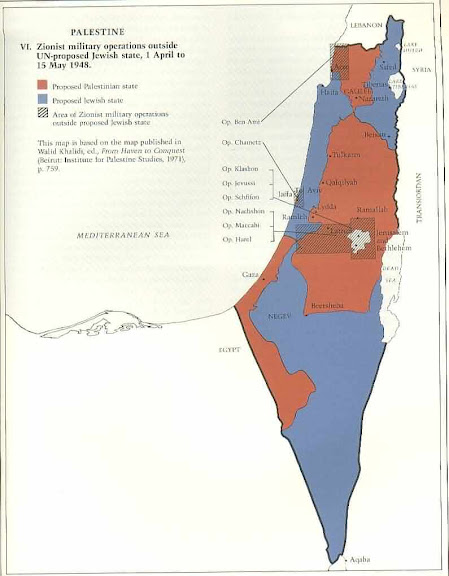
1948 Map of Conflicts in Palestine.
Zionist Military Operations Outside UN-proposed Jewish State, 1 April to 15 May 1948. (Source: Greenpolitics)

At the end of World War I, with the fall of the Ottoman Empire, the entire Middle East was in a state of flux. What used to be a single sovereign entity was carved up into modern nation states by the victorious European powers. At a conference in San Remo in 1920 Britain and France, according to an arrangement known as the Sykes-Picot Agreement (1916), drew the borders for four new states: Iraq, Syria, Lebanon and Palestine. In 1922, Palestine was further divided into Palestine and Transjordan. These new countries were legitimized as mandates of the League of Nations, states that would be protectorates of European powers and eventually gain independence. Thus, Britain retained control of Iraq, Palestine and Transjordan and France retained control of Syria and Lebanon, directly and indirectly.[1]

Over the following decades, each of the mandate states threw off the shackles of colonialism and won independence, with the exception of Palestine. The pursuit of national independence for Palestinians has been impeded by a series of complications, starting with the Balfour Declaration of 1917:

His Majesty’s Government [of England] view with favour the establishment in Palestine of a national home for the Jewish people, and will use their best endeavours to facilitate the achievement of this object, it being clearly understood that nothing shall be done which may prejudice the civil and religious rights of existing non-Jewish communities in Palestine, or the rights and political status enjoyed by Jews in any other country.[2]

The Balfour Declaration is a letter that was issued by the United Kingdom’s Foreign Secretary, Arthur James Balfour, to Baron Rothschild, a leader of the British Jewish community. British government officials believed that the Jewish ‘vote’ needed to be won to ensure victory in World War I. If the British didn’t secure Jewish backing, the Germans would “buy them” and use them to influence Russia into signing a separate peace treaty with Germany, allowing the Germans to focus on the western front.[3] The Balfour Declaration was a response both to the fear of the supposed power of world Jewry and the sympathetic nature of some British government officials to the Zionist cause.[4] Zionist leaders did their best to encourage these feelings, resulting in the inclusion of the wording of the Balfour Declaration in the League of Nations sanctioned British mandate for Palestine in 1922.[5]

Contrary to the popular idea that Palestine was a land without a people for a people without a land, the area was well populated. At the beginning of the Zionist influx into the Palestine Mandate area, there were approximately 450,000 Arab and 20,000 (Arab) Jewish residents.[6] Direct British rule and British efforts to fulfill the obligations of the Balfour declaration combined with the influx of European Jews created a volatile situation that retarded the national development of Palestine. Instead of developing modern governing institutions like other newly formed Middle Eastern nations, Palestine’s residents spent the mandate period in conflict and constant competition between British, Jewish and Arab interests.

The major conflict between the two groups was based on the meaning of the Balfour Declaration. The Zionist interpretation of the Balfour Declaration was that it intended the creation of a Jewish state that, as Chaim Weizmann (Chair of the Zionist Commission and later first president of Israel) said, would be as Jewish as England is English.[7] Critics of the Zionists interpreted the Balfour Declaration’s goal as the creation of a Jewish cultural center inside an independent Arab state. The ambiguity was introduced into the document to give the British room for diplomatic maneuvering, but in the end, all it did was complicate their position in Palestine. They were never able to resolve the contradiction inherent in their promise.[8]

The confusion in policy created by the Balfour Declaration led one senior British official to say, just prior to leaving the country, that Britain had “nothing but fluctuations of policy, hesitations…no policy at all.”[9] The British alternately supported Jewish development of a national home and Arab national aspirations in a precarious balancing act intended to maintain the status quo. This remained true until their withdrawal from Palestine in 1948, twenty five years later. When the last British High Commissioner departed Haifa, there was no formal transfer of powers to a new local government because there was no government in Palestine. When the mandate ended, the Jews and Arabs were left to struggle for supremacy.[10]

The internal struggle for power in the years and months leading up to the end of the British mandate for Palestine and the subsequent war that started on May 15th, 1948 with the end of British mandatory rule between Jewish and Arab irregular forces from the surrounding nations saw the birth of the state of Israel and the failure of the Palestinians to establish a nation. The reason for the success of the Jews over the Arabs boils down to three key differences: unity, external support and military power. The Jews entered Palestine with a unified goal, if not a unified ideology. They enjoyed wide support from Jewish and Christian communities around the world, as well as the backing from Britain guaranteed by the Balfour Declaration. They also took advantage of their ties to Europe to advance their military prowess, which proved decisive in the 1947-1948 conflict with the Arabs, also known as the first Arab-Israeli War. The Palestinian Arabs, on the other hand, were completely unprepared for the task ahead of them.

During the early years of the mandate, the Arab notables felt it was only natural that they should govern the land they had lived on for centuries.[11] They were convinced that at some point the British would come to their senses and stop supporting the Jews. In the meantime, the Arab notables in Palestine did what they could to maintain their social status, including working with the British mandate authorities, who supplied them with positions of authority.[12] For example, the British created the office of Grand Mufti of Jerusalem and assigned al-Hajj Amin al-Husayni to the role. Later the British created the Supreme Muslim council, which Husayni headed.

The reliance of Arab leadership on the British caused them to mostly work with, rather than against, the mandate government, which also meant that they were indirectly supporting the Zionist occupation of what they considered to be Arab land. The Arab notables attempted to negotiate with the British privately while condemning British support of Zionism publicly, all the while working to ensure there would be no disruptive mass political demonstrations that could destabilize their social and political positions.[13] The need to stay on good terms with the British undermined the authority of the Arab notables in the eyes of the public.[14] Further complicating the Arab political atmosphere in Palestine was the constant rivalry between the two prominent families in the region: the Husaynis and the Nashashibis. Their attempts to create rival power bases in Palestine prevented Arab unity. The inter-Arab rivalries and reliance on the British, together with the need to suppress popular movements to maintain their positions, caused the Palestinians to never be capable of forming a unified front, which effectively neutered the Palestinian political body and Palestinian aspirations of nationhood. It would be fair to say that the goals of the Arab leadership (to maintain their positions) did not match the goals of the Palestinians, but due to the Ottoman top-down power structure, the average Palestinian had no way to directly influence the decision making process until later in the mandatory period, when guerilla leaders like al-Qassim began to rally popular support.

Compounding the problem was the lack of any meaningful external support for the Palestinian Arabs. To start with, none of the Arab political institutions formed in mandate Palestine were recognized by any international authority, not even by the Arab states, who took it upon themselves to speak for the Palestinian Arabs.[15] But, their motives weren’t entirely pure either. Throughout the mandate period, the surrounding Arab states had, despite repeated requests, failed to supply the Palestinian Arabs with arms, food, or any financial support. The Arab states each had different agendas in terms of what they wanted to accomplish in Palestine, but the rights of the Palestinians themselves probably ranked very low on their list of priorities. Most of the surrounding states were solely interested in land grabs to increase the power of their respective states in terms of inter-Arab regional politics.[16]

By the time hostilities broke out in Palestine after the November 1947 announcement of the UN Partition Plan, the Arabs felt a distinct sense of abandonment. They had no effective leadership and they had been isolated by the surrounding Arab states. According to Rashid Khalidi,

The Palestinians entered the fighting which followed the passage of the UN Partition Resolution with a deeply divided leadership, exceedingly limited finances, no centrally organized military forces or centralized administrative organs, and no reliable allies.[17]

According to a Haganah Intelligence Service – Arab Division executive, the average Palestinian had come to the conclusion that they could not hold their own against the Jews.[18] HIS – AD further reported that most of the Arab public would be willing to accept the 1947 UN Partition Plan and lacked a desire to engage in a war with the Jews because of a lack of weapons and internal organization.[19] Many were unwilling to fight because if they died, there would be no compensation for their widows and/or orphans.


Al-Andalus: From Convivencia to Limpieza de Sangre

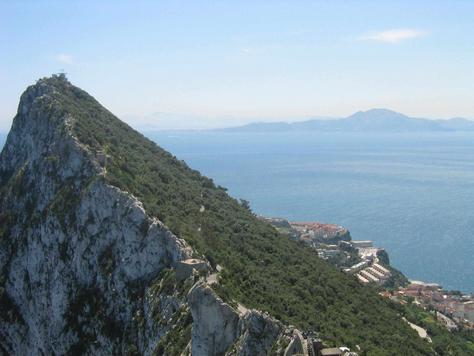
The Rock of Gibraltar, the name of which is derived from
the Arabic Jabal Tariq, “Mount of Tariq,” in honor of
Tariq ibn Ziyad, the Berber Muslim conqueror
of ancient Iberia, and essentially the founder of al-Andalus.

In 711 CE, a force of Berber Muslims under the command of Tariq ibn Ziyad landed on the southern shores of the Iberian Peninsula and engaged in a campaign of rapid conquest that culminated in the displacement of Visigoth rule in all but the northernmost parts of Iberia.  The Visigoth controlled areas in the north later served as the launching point for the Reconquista, the ‘taking back’ of the Iberian peninsula from the Muslim invaders.  Muslim rule in Iberia officially ended with the surrender of the Emirate of Granada to King Ferdinand II of Aragon and Queen Isabella I of Castile in 1492, but for nearly eight-hundred years Muslims retained governance over at least a portion of the peninsula and created a glowing civilization that set an example that unfortunately would not be followed.

Ferdinand and Isabella; Image from:
Convent of the Augustinian Nuns, Avila

Under Islamic rule, the Iberian Peninsula was marked by a level of religious toleration that was unheard of at the time and Muslims, Jews and Christians lived together in relative peace.  There were tensions between the groups, and instances where violence seemed unavoidable, but by and large, the people of al-Andalus not only held their diverse nation together, they caused it to blossom into a society that still draws admiration today for its level of comparative advancement and toleration.  Toleration for ethnic diversity and religious differences were the keys to success for al-Andalus, but after Granada fell in 1492 and the Reconquista was complete, one of the first actions taken by the Christian monarchs, Ferdinand and Isabella, was to decree the expulsion of the Jews.  That was the same year the monarchs decided to fund Christopher Columbus’ voyage to what he hoped would be Asia.  Ferdinand and Isabella wasted no time in establishing themselves as a powerful monarchy, but the example of intolerance they set was in direct contradiction to the legacy that had been left to them by Islamic Spain.


The Muslim’s initial conquest of the peninsula met with little resistance, largely due to the fact that the Visigoth rulers had managed to alienate their supporters (Lowney 31 – 32).  The Iberians willingly submitted to the Muslims, since they were no harsher than the Visigoths had been.  In the case of the Jews, Muslim rule was a vast improvement (Lea 1).  The Jews were highly oppressed under the Visigoth rulers, who “forbade Jews from marrying Christians or owning Christian slaves, proscribed circumcision, outlawed observance of Jewish holy days, and ultimately offered Jews the stark choice of conversion, exile, or slavery” (Lowney 29).  It also helped that the Muslims offered their newly conquered subjects favorable surrender treaties, such as the treaty offered to the Christian Prince Theodomir of Murcia, which says:

The latter [Theodomir] receives peace and the promise, under the guarantee of Allah and of his Prophet, that there will not be any change in his situation nor in that of his people; that his right of sovereignty will not be contested; that his subjects will not be injured nor reduced to captivity; nor separated from their children nor their wives; that they will not be disturbed in the practice of their religion; that their churches will not be burned, nor despoiled of the objects of the cult found in them… (Lowney 38)

The tolerant treaties the Muslims offered their defeated opponents was in keeping with the traditions of the Qur’an and helped set the stage for later peaceful relations between the three faiths in Islamic Spain.


In Islam, Jews and Christians are known as ′Ahl al-Kitāb, People of the Book who are protected, albeit with a second-class status.  This protection, known as dhimmitude, is based on surah 29, aya 46 of the Qur’an, which says, “And dispute ye not with the People of the Book… but say, ‘We believe in the revelation which has come down to us and in that which came down to you; our God and your God is One’” (Lowney 38).  Non-Muslim subjects of Muslim regimes were considered to be autonomous but dependent groups who were responsible for organizing their own internal affairs, including social, religious and communal matters.  These minorities had leaders, appointed by the Muslim rulers, who were responsible for their group’s “ecclesiastical matters, internal disputes, and fines and taxes” (Lapidus 265).  The leaders of these minority groups had such a level of independence that in legal cases involving two members of the same faith, their judges could inflict the death penalty without consulting the Muslim rulers (Khadduri, Liebesny and Jackson 340).  So, Jews and Christians under Muslim rule had the ability to continue to practice and develop their faith, as well as practice their own legal system, within some limits.


The ability of subject faiths to practice their legal system had some restrictions.  When cases involved serious crimes that constituted a threat to public order, Islamic law always took precedence.  These included crimes such as murder, theft, or highway robbery (Khadduri et al., 340).  There were also problems with how non-Muslims and Muslims related to each other legally.  In legal cases that involved Muslims or a member of another subject faith, dhimmis were required to appear in Shari’ah courts, which took precedence over Christian or Jewish law.  Appearing in Muslim courts was likely problematic for dhimmis, since their testimony was considered invalid under Shari’ah law, though exceptions were probably made in cases involving two members of subject religions, as qadis(Islamic judges) would need some form of information to settle a lawsuit or legal case.  Another issue faced by dhimmis was that there were lesser penalties involved for a Muslim guilty of committing a crime against a dhimmi (Khadduri et al., 337).  Dhimmis also could not inherit from a Muslim, based on the Qur’anic rule which says, “God will by no means make a way for the unbelievers over the believers” and a hadith which says, “The Muslim will not inherit from the unbeliever nor the unbeliever from the Muslim” (Khadduri et al., 343).  So, a dhimmi was fully protected as a subject of the Muslim state, but suffered from certain drawbacks that relegated him to the status of a second-class citizen (Bennett 163).  However unbalanced, dhimmitude offered the Jews and Christians of al-Andalus legal recourse and protection under the law.  It gave them a legal place in the society, creating a state of convivencia, a coexistence where Muslims, Jews and Christians worked and lived together, if not as equals then at least as fellow citizens of the same nation (Rosser-Owen 77).


The status of dhimmis as being legal members of the state is part of Islamic religious law, but “there was no Scriptural basis for the legal status of Jews and Muslims under Christian rule; they were subject to the whims of rulers, the prejudices of the populace and the objections of the clergy” (Boase 22).  It stands to reason that there were Muslims among the early invaders who would have preferred cultural and religious homogeneity, as the later Reconquista Christian Spaniards would, but in the case of the Muslims, religious law dictated that they must respect dhimmis, at least insofar as the law dictated.  This religious legal requirement that offered Jews and Christians a place in Islamic society, which didn’t have a counterpart in their own societies, must have created a feeling of stability, safety and most importantly, belonging.


A sense of nationhood, of common standing with their fellow countrymen, could have inspired them to excel, and al-Andalus certainly excelled in many areas.  The mix of cultures stimulated the intellectual pursuits of academics that produced advanced knowledge of mathematics, medicine, spirituality, astronomy, philosophy, and theology, and gave birth to some of the greatest thinkers of the age, such as the Jewish kabbalist Moses de Leon, the Sufi mystic Ibn Arabi, the Jewish Moses Maimonides and the Muslim Averroes (Lowney 8 – 9).  The common thread that held the people of al-Andalus together and produced such remarkable figures as those mentioned above wasn’t ethnicity or religion; it was toleration for the beliefs of others and a commitment to Andalusian society as a whole, based on a sense of belonging and nationhood.


There were people who rejected the idea of Islamic rule or any form of nationhood under the power of another religion.  A good example is that of Eulogius, a traveling cleric from Córdoba.  In approximately 850 CE, Eulogius discovered one of the earliest Latin copies of a version of the biography of the prophet Muhammad in the monastery of Leyre near Pamplona in northern Spain.  The biography is titled simply, Istoria de Mahomet and, unfortunately, is an example of “the repositories of misconceptions about Islam that would be drawn upon over and over again by Christians trying to explain, or more appropriately, explain away the success of Islam” (Wolf 89).  Eulogius didn’t use it just to explain away the success of Islam.  He used the text to create a political movement, an early form of peaceful disobedience, to challenge established Muslim rule through a series of martyrdoms in the hopes of inciting a popular Christian revolt.


Shortly after Eulogius returned to Córdoba, a steady procession of Christians approached Muslim qadis and denounced the prophet Muhammad, eager to become martyrs:  “Now hand down the sentence, multiply your cruelty, be kindled with complete fury in vengeance for your prophet.  We profess Christ to be truly God and your prophet to be a precursor of antichrist” (Lowney 58).  These denunciations resulted in the execution of the offenders.  Over the course of a decade, approximately fifty Christians were killed executed.  Shortly after Eulogius’ death, the number of offenses and executions petered out, which paints him as the likely ringleader (Lowney 59).

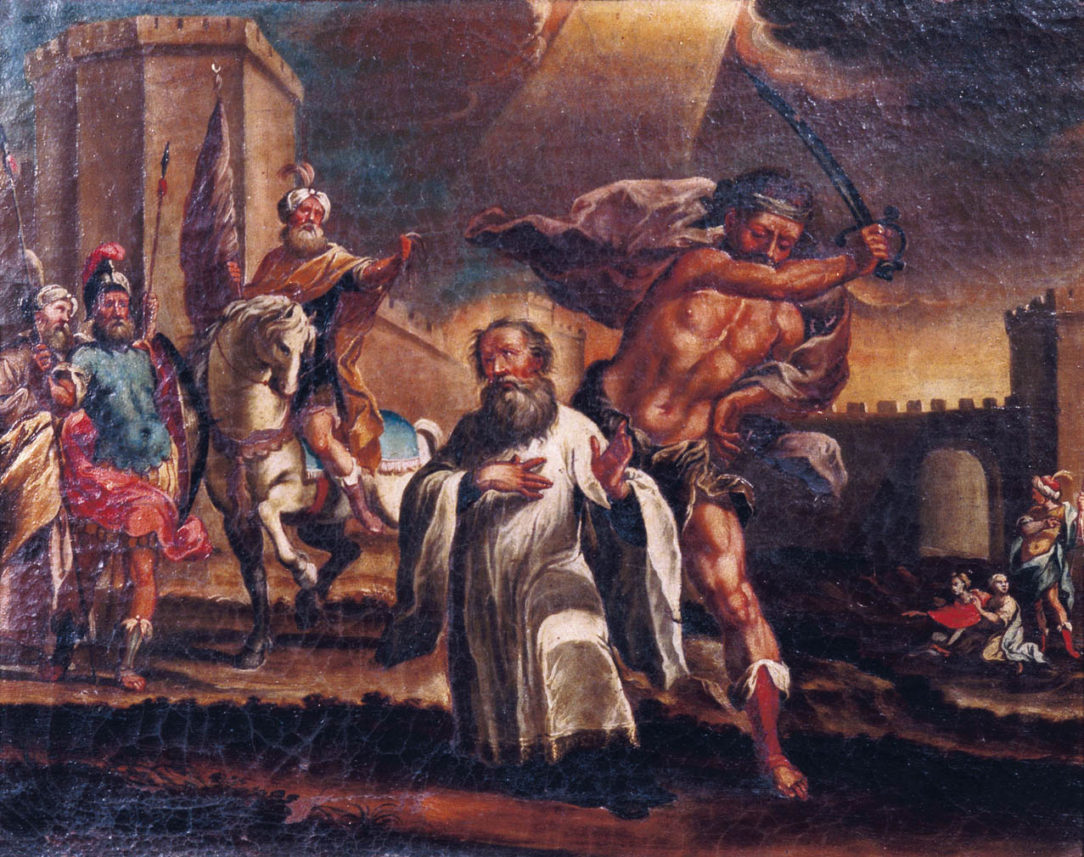
Eulogius, later canonized by the Catholic church, suffering execution for following in the footsteps of
the other Cordoban martyrs and being executed for intentionally blaspheming the Prophet Muhammad.


A notable point in the incidents of deliberate martyrdom was the lack of reaction from the public.  The executions failed to have the effect that Eulogius had hoped for.  The martyrs enjoyed support from distant monastic communities, where most of the martyrs were from, but in Córdoba itself, the opinion was little better than mixed.  According to Kenneth Wolf, the Christians who rejected the martyrs’ actions had assumed a new perspective of Islam as a different, but valid version of their own faith.  Wolf says that Christians adopted this idea from the Muslims, who in turn accepted the Christians as “monotheists and recipients of a revealed law” (Wolf 93).  In other words, they had assimilated the idea implied by dhimmitude, that all three religions worship the same God, with some differences.


Just 150 years into Islamic rule in Iberia, the people had come to accept and respect one another.  That may sound odd, considering the fact that Christians were being executed for blaspheming a religious figure, but consider the words of a Muslim court official who tried to persuade Eulogius into recanting his defamation of the prophet Muhammad:

If stupid and idiotic individuals have been carried away to such lamentable ruin, what is it that compels you…to commit yourself to this deadly ruin, suppressing the natural love of life?  Hear me, I beseech you, I beg you, lest you fall headlong to destruction.  Say something in this the hour of your need, so that afterward you may be able to practice your faith.” (Lowney 59)

The implication in this statement is that the court officials were following the letter of the law for the sake of maintaining the legal system, as well as for the sake of preserving the respectability of Islam, but even by the year 859, when Eulogius was executed, Andalusian Muslims in general had probably developed a strong sense of tolerance for the Christians and the Jews who worshipped the same God as them.  This sense of community may have been based on physical proximity and a sense of belonging to a certain physical location, rather than being drawn purely along theological lines.  The reality of people struggling to survive and coming to rely on the people around them sometimes gets lost in religious debate.


The medieval history of Spain shows little evidence of any conflicts being based solely on either race or religion (Lea 1).  Four-hundred and fifty years after Eulogius, as territory changed hands during the Reconquista, the people continued to coexist peacefully with their neighbors.  Rather than a stark black and white, the reality of conflict on the Iberian Peninsula was far more complex.  Alliances were often made between Christians and Muslims for the sake of pursuing similar goals, or for some gain.  For example, the thirteenth-century Christian king Alfonso X used religious rhetoric when it suited his self-interests and ignored it for the same reasons.  He was an avid supporter of Jewish translators in his court because of the wisdom they could make available to his subjects, but at the same time he mandated a death sentence for any Christian who was “so unfortunate as” to convert to Judaism (Lowney 10).  Additionally, he waged war against a Muslim kingdom only to later create an alliance with them for the purpose of waging war against a rebellious son.  His actions weren’t indicative of a monolithic Christianity versus a monolithic Islam; these were the actions of a man engaged in maintaining and building the prosperity of his own kingdom using whatever means he had available to him.  Race and religion were not factors in his decisions, which is a testament to the integration of Jews, Christians and Muslims into one cohesive Andalusian society.


As Muslim control in al-Andalus came to its conclusion in 1492, they left behind a society of three fully integrated faiths that had developed a unique character unlike any other place in the world.  Tolerance for religious diversity in al-Andalus did not, of course, meet modern standards, but it was a major advancement for its day that would lead a Christian nun from Europe named Hroswitha of Gandersheim to call Córdoba, the capital of the Ummayad Islamic Caliphate of al-Andalus, the “Ornament of the World” (Shedinger 81).  From the initial conquest in 711 to the surrender of Granada, relations between the three monotheistic faiths continually developed until al-Andalus was transformed into an integrated society where religion stopped playing a major part in the average affairs of rulers, except as a political tool.

The Alhambra palace at Granada.

Despite the success of convivencia, a multicultural and integrated al-Andalus, the Catholic Monarchs King Ferdinand II and Queen Isabella I took a radically different approach to religion and society: limieza de sangre, purity of blood.  After they completed their conquest of the Iberian Peninsula, they undertook a program that would ensure the eventual religious homogeneity of the Iberian Peninsula.  In 1492, immediately after the fall of Granada, they decreed the conversion, expulsion or execution of the Jews.  In 1502, a similar proclamation was made regarding Muslims.  Out of necessity, many chose to be baptized.  These two groups, known respectively as conversosand moriscos, continued to secretly practice the rituals of their own faiths while maintaining the outward appearance of Catholic Christianity until they were eventually weeded out through the institution of the Inquisition and a final expulsion in 1609 by decree of King Philip III.

The Court of Lions at Alhambra palace.

In the face of a long history of a successful and integrated culture, what was the purpose of Ferdinand and Isabella’s deviation from a model that had proven to be successful?  It is possible that Ferdinand and Isabella’s decision to expel the Jews and Muslims was merely a continuation of the evolution of religion in the peninsula: they were using it as a political tool.  Ferdinand and Isabella may have felt that, as Christians, their loyalties lay firmly with Europe and the rest of Christendom.  As rulers of a territory that had been part of the Islamic world for centuries, they may have felt that drastic measures were necessary to change public opinion of Spain.  Even today, 500 years after the expulsion of the Muslims and Jews, Spain is an off-color patch in the greater European fabric, with obvious reminders of its Islamic past buried in the architecture, art, and even the language.  Given how firmly Islamic culture was entrenched in Iberia, Ferdinand and Isabella may have felt that it would take drastic actions to change public perception of Spain in Europe, hence the expulsions or forced conversions of the Jews and Muslims.  It would also explain their petition to the Pope for the title “Catholic Monarchs.”  The total effect of expulsions and the gaining of a title affirming the Catholicism of the monarchy would have firmly put Spain in the European camp.  The definite causes of Ferdinand and Isabella’s change in policy would be an interesting topic for further research, but the level of tolerance and cooperation between religious groups in al-Andalus is a lesson that many parts of the world could still learn from today.

Works Cited

<!–[if supportFields]> BIBLIOGRAPHY <![endif]–>Bennett, Clinton. Muslims and modernity: an introduction to the issues and debates. London: Continuum International Publishing Group, 2005.
Boase, Roger. “The Muslim Expulsion From Spain.” History Today 52.4 (2002): 21-28.
Khadduri, Majid, Herbert J. Liebesny and Robert H. Jackson. Origin and Development of Islamic Law. Clark: The Lawbook Exchange, Ltd., 2010.
Lapidus, Ira M. A History of Islamic Societies. 2nd. New York: Cambridge University Press, 2002.
Lea, Henry Charles. The Moriscos of Spain: Their Conversion and Expulsion. Philadelphia: Lea Brothers & Co., 1901.
Lowney, Chris. A Vanished World: Muslims, Christians and Jews in Medieval Spain. New York: Oxford University Press, Inc., 2006.
Rosser-Owen, Mariam. Islamic Arts From Spain. London: V & A Publishing, 2010.
Shedinger, Robert F. Was Jesus a Muslim?: questioning categories in the study of religion. Minneapolis: Fortress Press, 2009.
Wolf, Kenneth B. “The Earliest Latin Lives of Muhammad.” Gervers, Michael, Ramzi Jibran Bikhazi and Pontifical Institute of Mediaeval Studies. Conversion and continuity: indigenous Christian communities in Islamic lands eighth to eighteenth centuries. Vol. 9. Toronto: Pontifical Institute of Mediaeval Studies, 1990. 89 – 102.


Note: This was a research paper turned in for a 100-level college course.  It received an A+, and the note: “A lively and interesting paper.”  I imagine it was checked more for consistency, style and obvious errors rather than having any deep fact checking done.  I would have liked a few more weeks to research and fine tune it, but I think it turned out well enough for the time I put into it, considering it’s a paper for an entry level course.

Avatar Used To Justify The Belief That 9/11 Attacks in NYC Were Staged

“In September 2001, the World Trade Centre was attacked allegedly by terrorists. I am not sure now that Muslim terrorists carried out these attacks. There is strong evidence that the attacks were staged. If they can make Avatar, they can make anything,” said Dr Mahathir during his speech at the General Conference for the Support of Al-Quds here. Al-Quds is the Arabic name for Jerusalem.

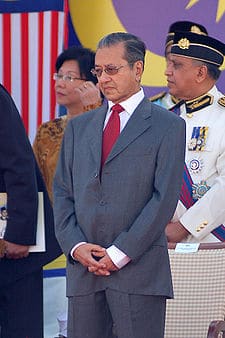
For those of you that don’t know, Dr Mahathir was the Prime Minister of Malaysia from 16 July 1981 to 31 October 2003. He gave this statement, and others that will be in this entry, on January 20th, 2010.

Now that you have some background on this guy, let’s dive right into the heart of the matter. This guy is either senile, crazy, or both, but he’s most obviously a racist and should no longer be allowed to get near a reporter or microphone. How the hell can you say that because the US can make a 3D movie, we were capable of staging the September 11th attacks that killed around 3000 people? It’s absurd. Guess what, Dr Mahathir? Those holes in the ground in NYC aren’t special effects. They’re real. The people that died weren’t extras that shared a beer and laughed about the film later. They were real too. And they’re dead. Al’Qaeda claimed responsibility for the attack. The last time I checked, Osama Bin Laden wasn’t the Commander in Chief.

And, as if this weren’t enough, he went on to make plenty of off-color comments about the Jewish people and Israel.

“The Jews had always been a problem in European countries. They had to be confined to ghettoes and periodically massacred. But still they remained, they thrived and they held whole governments to ransom.

“Even after their massacre by the Nazis of Germany, they survived to continue to be a source of even greater problems for the world. The Holocaust failed as a final solution,” said the outspoken Malaysian leader who was noted for his anti-Western and anti-Zionist stand while in power for 22 years, until October 2003.

Nice job projecting your racist views about Jews onto the entire European population. He seems to imply here that all Europeans wanted to get rid of the Jews all along and that, given the opportunity, would have sanctioned their mass extermination. I must have missed that page in my history book, and I certainly don’t recall World War II playing out quite that way.

The only sensible thing to come out of his mouth was what he had to say about Obama:

“Well, I am a bit disappointed because so far none of his promises have been kept. He promised to get out from Afghanistan but he ended up sending more troops there instead. He promised to close down Guantanamo but he has not closed down Guantanamo. Even other things he has not been able to do.

“It is quite easy to promise during election time but you know there are forces in the United States which prevents the president from doing some things. One of the forces is the Jewish lobby, IPAC,” he said.

I wonder why he went easy on him? It might be because he feels like Obama is a fellow Muslim being oppressed by supposed Jewish powers in Washington.  This guy’s paranoia runs deep.

There should come a point in all of our lives, famous politician, rock star, or whatever, where we realize that we’re no longer competent to speak to the public. If we can’t see it in ourselves, someone should tell us, because obviously Dr Mahathir’s time has long since come and gone.