On Sunday afternoon, my wife and I were by the United Nations to take advantage of a Groupon deal I got for the Indigo Indian Bistro on East 50th Street. We didn’t realize the place closed for a while after lunch and before dinner, so we found ourselves standing in the cold with an hour and a half to kill.
I thought about going to the United Nations for a tour, since we were right next to it, but it looked like it was closed too. There weren’t even flags up on the poles. So, we started walking around. First, we poked our heads in at the Japan Society to see if there was anything going on (and to warm up a bit), but they were just finishing up a New Year’s celebration for kids. Then we went next door to look in the Holy Family Church. The building is really weird looking from the outside.
Turns out it’s a Catholic church. It’s sort of nice inside. The giant Jesus on the wall above the priest leading the service was a little scary looking. It made me think about the conflict inherent in the concept of a trinity model of monotheism, and whether or not a distant and cold concept of God was being replaced by the warm and gentle spirit of a man, someone that people could understand and empathize with. That’s a subject for another post, though. I’ve been doing a lot of theological reading that I’ve been slowly digesting, mentally.
Sculpture of an angel (I think)
After warming up in the church foyer, we went back out to find our next opportunity for passing time. As we were walking away, I noticed a side path that led into a garden that was covered in snow and ice. We figured it was worth a few minutes to go in and look around.
Frozen waterfall in the Holy Family Church garden.
What really peaked my interest was the fact that the garden pool was covered in a layer of ice and snow, and so was the artificial waterfall. I don’t suppose there’s anything unusual about a waterfall icing over in winter, but it’s not something I really expected to see in the middle of Manhattan; not even an artificial one. So, I think the unexpectedness of seeing what I didn’t expect to see made it more worth seeing, if that makes any sense. I’ve also always enjoyed religious settings and architecture, of a certain type. The more solemn and thoughtful type. I’ve always thought religion should be a solemn, thoughtful and meaningful thing.
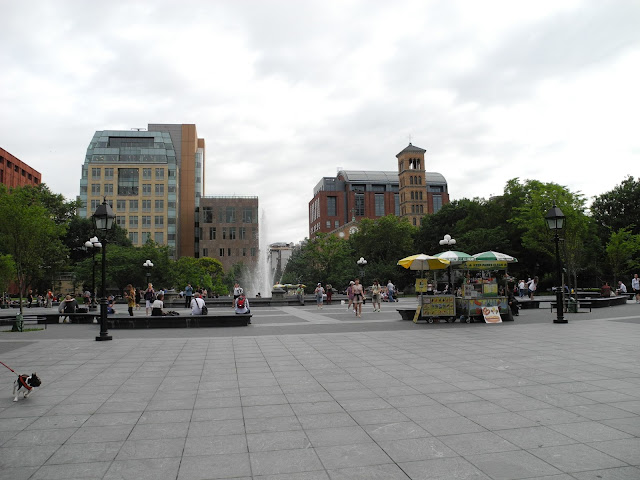
Washington Square and the NYU Spiritual Life Center (short building, just left of center)
Wednesday evening, I had the opportunity to visit New York University’s Spiritual Life Center at Washington Square in Lower Manhattan. NYU has organized a series of workshops that will take place every Wednesday night from last week until Ramadan begins, with each session focusing on a different aspect of Ramadan. I attended the workshop with a group of students from CCNY as a sort of field-trip for my anthropology course: “Islam in the West,” which explores the immigration of Muslim communities to Western nations and their interactions with the cultures and communities of their host nations.
I don’t want to dwell too long on the building, but the Center is very, very nice. I heard that the building is relatively new and the interior is very well appointed and in good condition. The first floor of the building is devoted to Catholics. The first floor is for Muslims. I don’t recall what other religious traditions have space in the building, but I was told that the building has a meditation room where people of all faiths can sit quietly and pray and/or reflect.
The fourth floor was designed specifically with the needs of Muslims in mind. Separate from the bathrooms (which were really nice too) there are men’s and women’s ablution rooms, where Muslims can perform ritual washing (“wudu”) before prayer. Outside of the prayer room there are shelves built into the walls where people can leave their shoes (Muslims don’t wear shoes in their sacred spaces). The room itself is carpeted and looks out over Washington Square Park. The qibla, the direction towards Mecca, which Muslims face when they pray is marked by a prayer rug.
Qibla direction for NYC
I found it interesting that the prayer direction is northeast. I assumed it would be southeast, since that’s where Mecca is on a map in relation to New York City. I’m probably not taking the curvature of the Earth into consideration or something.
When I first arrived on the floor, I initially felt a bit out of place, but that feeling passed more quickly than I thought it would. I didn’t ask other people in the class who aren’t Muslims, but I wonder if my experience was a bit different, given how much I’ve studied Middle Eastern and Islamic History?
Since we were new faces, a guy came up and said hello to us and showed us where to go. It turned out that he was the guy in charge of the workshops and the one who was giving the lecture that night. I think he said his name is Khalid, but I could be wrong. Regardless, he was a pretty pleasant guy. He’s also a very, very good speaker.
Muslim Prayer Room, NYU Spiritual Life Center
The workshop event was scheduled to begin at 6:30 PM, but it was preceded by the afternoon prayer, ‘asr. I know that sounds off, but the prayer times are scheduled according to daylight hours rather than Western concepts of what constitutes morning, afternoon and evening. For more information on Muslim prayer times, click here.
Watching the prayer up close and personal was an interesting experience. It seems like every popular movie that has anything to do with Islam or Muslims starts or has a scene overlooking a city-scape with the muezzin call playing in the background. It comes across as exotic, foreign, and given recent events in the world, a bit dangerous. But, when you’re sitting on a carpeted floor overlooking a park, chatting with people about life, school and work and a guy begins a call to prayer from the corner of the room, it has a different tone.
The room became hushed and the Muslims present gathered in lines (there were a decent amount of non-Muslim participants in the room), women on one side of the room and men on the other, to pray. It felt like being in a Christian church, listening to a pastor give the opening prayer while the congregation stood quietly with heads bowed. The ritual prayer (salaat) was pretty much what I’d expected to see. What was interesting, though, was noticing the differences between prayer styles. Depending on where a Muslim is from, they might do certain parts of the prayer a little bit different, but every Muslim believes in the ritual prayer as an integral practice of Islam.
After the prayer, everyone sat down and faced the lectern at the rear of the room (opposite the windows and the direction of prayer). I noticed that the women and men maintained their separation throughout the evening. When I first heard about that I assumed it had something to do with keeping women subservient, since the portion of the room where women pray is typically the back of the room, but the real reason is much more common sense than that. When you go to pray, when you go to learn about or hear about God, you’re there for God and worship, not to be distracted by the opposite gender. The only people that roamed wildly between the men and women were the children.
The actual workshop took off a bit awkwardly for me, but somewhere after the group project of coming up with an idea for a commercial about Islam and what demographic to market it to and the beginning of the lecture about Ramadan, everyone, including myself, seemed to settle in and get comfortable. The theme of the talk was to think about why you do the things you do, and not just when it comes to Ramadan, but anything. Why do you hang out with people who are bad for you? Why do you keep drinking if you know you shouldn’t? Why do you put on your hijab (head scarf that some Muslim women wear) in the morning? Why do you get up and pray fajr (the before dawn prayer)? Why do you fast during Ramadan? The point of the talk seemed to be to remind people that rather than just doing what they’ve always done because that’s how it’s been done, they should ask and know the reasons behind it.
The speaker (again, I think his name is Khalid) used an analogy of a woman who always cut the tip of the leg off her roast lamb leg because that’s how her mother had always done it, only to find out from the grandmother that it was unnecessary and the only reason she started doing it was because their oven was too small to fit the whole leg at one time.
The talk did touch on other points. The other thing I remember most clearly from the talk was a story that the speaker related. I think it was from a hadith (a recorded quote, saying or habit of the Prophet Muhammad). The short version is that a man killed 100 men and then realized he needed to change his life. He asked another man if he could be forgiven for what he’d done and the man said he could, but to be forgiven he’d have to go to another town. So, the man set off on a journey to the other town to find forgiveness but along the way he died. Two angels appear and begin arguing over whether to take him to Heaven or Hell. God intercedes and tells them that if he is closer to the second town (to forgiveness) then take him to Heaven; otherwise take him to Hell. In reality, the man was closer to the first town (Hell), but because God is merciful, he made it appear as though the man were closer to the second town, and the angels took him to Heaven. The moral of the story is that God is merciful and looks for excuses to be merciful. I thought that was a nice idea.
The talk ran a bit long and by the end I was ready to get going, but overall I enjoyed the experience. It could probably be considered overgeneralizing, but the experience reinforced my belief that Muslims as a whole are average people with average hopes, average problems and average dreams, just like anyone else. It also reinforced my belief that there are more similarities between Christianity, Judaism and Islam than differences. I think people try to create and widen differences whenever possible out of fear and misunderstanding, but sitting in that room and hearing messages about hope, mercy and fasting to remember the poor and hungry, I felt as though it could have been any religious youth group; not necessarily just Muslims.
The following is a paper I wrote for a Jewish Studies class I’m taking called “History of God.” The point of the paper was to examine a set of verses from the Old Testament from a historical perspective, discussing what the verses reveal about the people it describes, or that wrote it. This paper relies heavily on the Documentary Hypothesis theory and the concept of Spiral Dynamics as put forth by Ken Wilber.
For clarity, the paper was graded by George KC Forman and received an A-, as well as some notations about grammar and style corrections (which haven’t been made here). The professor’s notes on the last page are:
So close! Ask yourself, what was happening in J’s Day? What’s his point. Yes, free will. But to what end? Kingdom has arisen; we now have cities and power in Levant. So free will is in service of Solomon’s reign. How might story fit with that people’s needs and worries? Why free will? Why portray the many languages? I’d given this story answers the need for cooperation, under aegis and king. Unite, it says, to gain power, etc. But good work. Where is this doc. hypoth. book? Sounds great! A-
Essay:
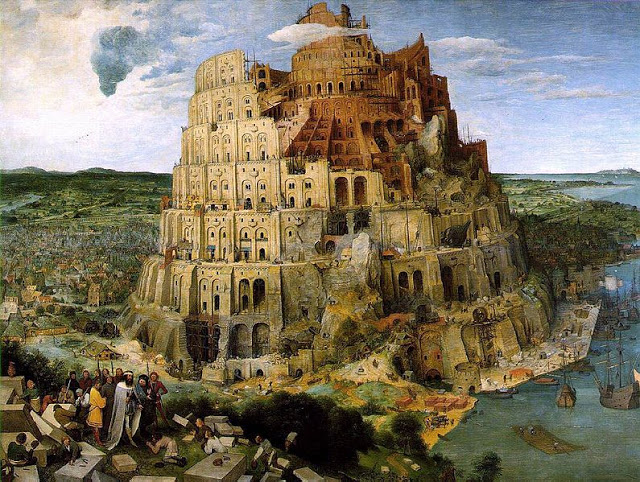
The Tower of Babel
The story of the Tower of Babel, found in the Book of Genesis in the Bible, is fascinating and complicated and is open to many levels of interpretation, especially since it is a story that was probably not original when it was added to the Bible. What does it mean that the people were attempting to build a tower “that reaches into the sky”?[1] And what does God’s response indicate about the nature of the relationship between man and the divine? What can we learn about the needs and wants of that society by analyzing these verses?
The story of the division of human language isn’t unique to the Bible, but that in itself isn’t remarkable. Something as mystifying as why all men don’t speak the same language is a problem that people from various cultures would have tried to solve the best way they knew how: attributing it to an act of the divine, leaving modern readers with a variety of similar myths. Obvious parallels exist in the stories of the Enuma Elish, the building of Babylon’s ziggurat, and a Sumerian story that tells of a time when all people spoke the same language. The closest parallel is a Sumerian epic titled “Enmerkar and the Lord of Aratta.”[2] It starts out describing a time when man had no rival and everyone spoke the same language, but:
Enki…the leader of the gods
Changed the speech in their mouths
Brought contention into it,
Into the speech of man that (until then) had been one.[3]
Whether J came up with the story of the Tower of Babel or borrowed the tradition, its inclusion in the religious tradition of the Hebrews is still significant. It indicates clearly that people identified with the story and felt that it reflected their own relationship with God.
According to the Documentary Hypothesis, the stories of the Pentateuch were not written by one author, but rather four authors and then collated into a single work by a series of redactors. These sources are J (Jawhist/Yawhist; approx. 950 BCE), E (Elohist; approx. 850 BCE), D (Deutoronomist; approx. 600 BCE), P (Priestly source; approx. 500 BCE) and R (the Redactors / Editors). Developed by Biblical scholars in the 18th and 19th centuries, the Documentary Hypothesis uses linguistic cues and source criticism to try to explain the apparent contradictions and repetitions in the Pentateuch. The story of the Tower of Babel (Genesis 11:1-9) is generally attributed to the Jawhist source, making it one of the earliest written stories of the Bible, despite its placement. According to the Documentary Hypothesis, J’s writing focuses on the interaction between God and man’s free will.[4]
Understanding how J writes can be helpful when examining the Tower of Babel story as presented in the Bible and for determining what it might mean about the people it describes. One interpretation is that it’s an origin story for the existence of different languages and cultures in the world. The beginning of the story says, “At one time all the people of the world spoke the same language and used the same words.”[5] By the end of the story, God has confused their languages and caused them to be scattered all over the world. However, this story conflicts with an earlier account that says (emphasis added):
4The descendants of Javan were Elishah, Tarshish, Kittim, and Rodanim. 5Their descendants became the seafaring peoples that spread out to various lands, each identified by its own language, clan, and national identity.[6]
The earlier account already describes the creation of multiple languages and cultures, directly contradicting the later Tower of Babel account. Also, Genesis 11:1-2 implies that all of the people in the world traveled together in one group, which contradicts the earlier account of Cain and Abel. When Cain was banished, God put a mark on his head so no one else would kill him and he went to the land of Nod.[7] This implies that there were people in Nod already that Cain had to be fearful of and that people weren’t traveling together in one group.
This is where it helps to understand the Documentary Hypothesis, which explains that the account in Genesis 10 was added much later, by P (the Priestly source). However, it doesn’t explain the contradiction in the Cain and Abel story, which is also attributed to J.[8] Because the two stories by J are contradictory, the Tower of Babel story must have been included for a symbolic reason, rather than to record factual events in the sense that a history book records factual events. It wasn’t the content itself that was important. It was the message it carried. Approaching the Tower of Babel story from this perspective lends support to the idea that it was borrowed from another culture’s religious tradition. The tower mentioned in the story is probably borrowed from the ziggurat dedicated to Marduk in Babylon called Etemenanki. The plot of the story is probably borrowed from earlier stories, like the Sumerian epic mentioned earlier.[9] So, how can this story tell us anything about the Hebrews?
For the story to be included in the oral and later written tradition of the religion means that the people identified with it strongly. While it’s not possible to apply the details of the people in the story to the Hebrews exactly, it’s possible to analyze the text and draw conclusions about the relationship between man and God, as they saw it. Understanding that the story is symbolic and knowing that one of J’s common themes is the struggle between man’s free will and God, it’s also reasonable to believe that this story is about man’s exercise of free will and the limits of man’s authority over the world.
The Tower of Babel story is about power. Genesis 11:2 describes a tribal, migratory people passing through the Fertile Crescent into Mesopotamia and arriving at a place suitable for settling. Upon arriving, their first thought is to establish themselves in the region through a show of power. They decide to build up a city and a tower that will reach into the heavens. Because they are united, they are able to make quick progress in reaching their goal. However, God has another plan for mankind and takes an active role in the world to push man onto the path He’s chosen for them.
The dialogue attributed to God in Genesis 11:6 gives Him a very anthropomorphic, active and human personality. God appears to be either afraid of what man might accomplish or jealous that man is able to create something monumental, which is a type of action that should be reserved for Him. To stop man from completing the tower, and thereby demonstrating his power of the world, God goes down and “confuse[s] the people with different languages…[so] they won’t be able to understand each other.”[10] After their languages are confused, the people have no choice but to abandon the project. They migrate away from the Tower of Babel, probably sorted into language groups.
It is hard to look at this story and find a way to paint God in a positive light, other than to say that perhaps this was part of a larger design, such as ensuring the fulfillment of his earlier command to Adam and Eve to go forth and populate the Earth. Adam and Eve’s descendants could not accomplish that task if they all stayed in one city. However, I think the key phrase from this passage is in verse 6: “The people are united…. Nothing they set out to do will be impossible for them!” The author of the story perhaps believed that man could achieve anything he put his mind to through unity with his fellow men, with only an act of God being able to stop him. Communal action to support and increase the power of the group is a very tribal action. The inclusion of this story in the religious tradition of the Hebrews could have greatly reinforced the importance of group solidarity, as well as the concept of not transgressing what is sacred at the same time.
The story of the Tower of Babel in the Bible is one version of a larger body of stories that attempt to explain or describe the division of the human race into language and culture groups. The story is not unique to Genesis, but the unique adaptation of the story helps to reveal how the ancient Hebrews may have thought of God, and what they thought of man in relation to that power. It is clear that when this story was introduced into the religious tradition, God was a much more active and anthropomorphic being than He is today. Most importantly, the story describes man’s potential in the world, his ability to do the unbelievable through group solidarity and effort. Where man’s power ends and God’s begins is a boundary that is constantly being redefined, even in the modern age over issues of cloning, for example, but it’s also an ancient argument that has been expressed in one of the earliest portions of the Bible and will continue to be expressed and redefined by generations to come.
[1] Genesis 11:4. [2] Jim Rovira, “Babel in Biblia.” [3] Ibid. [4] William Lyons, “Teaching the Documentary Hypothesis to Skeptical Students,” p. 134. [5] Genesis 11:1. [6] Ibid., 10:4-5. [7] Ibid., 4:14-16 [8] Timothy R. Carmody, Reading the Bible, p. 40. [9] Jona Lendering, “Etemenanki (The tower of Babel).” [10] Genesis 11:7.
Works Cited
Carmody, Timothy R. Reading the Bible: A Study Guide. Mahwah: Paulist Press, 2004. Web.
Lendering, Jona. “Etemenanki (The tower of Babel).” n.d. Livius: Articles on Ancient History. Web. 09 March 2012.
life Application Study Bible: Personal Size Edition. 2nd. Carol Stream: Tyndale House Publishers, Inc., 2004. Print.
Lyons, William L. “Teaching the Documentary Hypothesis to Skeptical Students.” Roncace, Mark and Patrick Gray. Teaching the Bible: Practical Strategies for Classroom Instruction. Atlanta: Society of Biblical Literature, 2005. 133-134. Web.
Rovira, Jim. “Babel in Biblia: The Tower in Ancient Literature.” July 1998. Babel. Web. 09 March 2012. .
Officials in Bay Minette, Alabama delayed a new program that would allow some nonviolent offenders to choose church over jail after a civil liberties group objected.
The “Operation Restore Our Community” initiative was slated to begin this week, but the southwest Alabama city’s legal team will take another look after the American Civil Liberties Union sent a cease-and-desist letter Monday.
What were they thinking? The officials in Bay Minette, I mean.
I saw a small article about this tucked into a corner of an issue of the NY Daily News a few days ago and decided to look up more information about it online. The Daily article didn’t mention anything about the ACLU or a protest; it was just all glowing and positive, and I couldn’t help but wonder if the reporter had suddenly forgotten about the separation of church and state provision in the US Constitution.
Reading the Daily article, I was mentally transported back to a time (a.k.a. the Dark Ages) when the Church presided over the sentencing and punishment/rehabilitation of criminals. I thought we’d covered this ground already and gotten past it with that whole Enlightenment thing that happened in Europe. The founding fathers of this country didn’t introduce the separation of church and state into the Constitution on a whim.
The officials mentioned in the article are trying to hide the obvious, that this is a drive to get criminals on the ‘right path’ by converting them to Christianity through extended exposure. They’re instead claiming the weekly ‘check-ins’ are just for the purpose of accountability, and to access community based resources to help them fix their lives.
I wonder if such a thinly veiled excuse to get people into local churches will stand up in court? I wouldn’t be surprised, since people can win lawsuits over spilled hot coffee, but I can’t believe that anyone would have thought that this would be OK, or that it would be true to the principles that this country stands for. I’m not against churches. I’m not against Christians practicing religion, but when you give someone an option of going to jail or going to church for a year, it’s not really a choice at all. It’s more like a European telling natives in a newly ‘discovered’ land that they can either convert or be sold into slavery, or perhaps killed. Freedom under a new religion will be preferable to a loss of liberty for most people.
There are reasons why church and state are separated in this country. The US is diverse. There are people of all faiths here and people who choose not to have any faith at all. It’s one of our freedoms, and we should never be forced to choose between going to church or going to jail, even if the person in question is guilty of a crime. A secular law system requires secular consequences.
When I think of the US, my first thought is that, for the most part, it’s a Christian country. There are churches everywhere. In even the smallest towns, there’s at least one church. However, the idea and enforcement of a separation between church and state has made the religious nature of the country a lot more toned down than it is in the Philippines.
Everywhere you look in the Philippines there are reminders that you’re in a Christian country, and definitely a Catholic Christian country. (For the purposes of this blog I’m not referring to the southern islands, which has been a stronghold of the Muslim faith for hundreds of years). There are crosses and churches, religious graffiti, art, statues, pamphlets, and even religious themed custom paint jobs on vehicles, among other things. This is especially true when you get outside of the Metro Manila area, like Antipolo, which is the town just north of Manila where I’m currently residing.
Since the arrival of the Spanish conquistadors and their 300 years of colonial rule, the Catholic religion has been very deeply embedded into the Filipino society. I’m sure there are varying degrees from family to family, just like there are in other countries, but people in the Philippines are overwhelmingly Catholic in the way that Arabic countries are overwhelmingly Muslim.
Sometimes, this overwhelming Catholicism can border on the bizarre, or creepy. At Muslim mosques, the call to prayer is announced from the minarets five times per day. I remember the first time I heard it in Kuwait. It was a bit unsettling, but beautiful in a way. I sometimes stopped to listen to it when I was in Kuala Lumpur. There’s something similar in the Philippines, or at least at the church in the neighborhood I’m staying in. Every day at roughly 3 PM, you can hear the sounds of children chanting the rosary over and over, using loudspeakers mounted to the church. It has a Children of the Corn vibe to it, especially since it echoes off the surrounding hills. From what I’m told, these children are lured in to perform this task with promises of food and treats afterwards.
I’ve even heard tales of religion supplanting medicine in the Philippines. Some people prefer to call a priest rather than a doctor when a person is ill. The priest comes to perform an exorcism to get rid of the bad demons that are causing the sickness. I don’t want to stray too far from the topic, but if God gave us wisdom to create medicine to heal ourselves, then isn’t it a bit rude to reject it and simply pray for miracles? Anyhow, I also found a bottle of Holy Water in the medicine cabinet, right next to the headache pills and band aids. Seriously.
I came across the following article today on ReporterNews:
Singapore prime minister: Religion threatens stability
Associated Press
Thursday, August 20, 2009
SINGAPORE — Singapore’s prime minister said in his National Day speech that “aggressive preaching” by religious groups and evangelizing threaten the tiny city-state’s stability.
Lee Hsien Loong, a Buddhist by birth, said his education at the island’s Roman Catholic High School was an example of how different religions can coexist peacefully.
“The most visceral and dangerous fault line (in Singapore) is race and religion,” Lee said.
Singapore’s majority Buddhist Chinese, Malay Muslims and Indian Hindus have largely avoided conflict since race riots between Chinese and Malays left about 40 dead in the 1960s.
“Christians can’t expect this to be a Christian society,” he said last Sunday. “Muslims can’t expect this to be a Muslim society, ditto with the Buddhists, the Hindus and the other groups.”
In the most recent census in 2000, 43 percent of Singaporeans said they were Buddhist, 15 percent Muslim, 15 percent Christian, 8.5 percent Taoist and 4 percent Hindu.
Lee cited the case of a Christian couple jailed earlier this year for distributing religious pamphlets deemed offensive to members of other faiths, and he condemned those who try to convert ailing hospital patients “who don’t want to be converted.”
He said the government must remain secular because Singapore’s authority and laws “don’t come from a sacred book.” Lee’s People’s Action Party has ruled Singapore since independence 50 years ago.
Lee said there has been a global surge in religious fervor, including in the United States and Islamic countries.
“There is a wave of revival, megachurches and televangelism,” Lee said. “Religion and politics are supposed to be separated in America, but in reality they are closely entangled.”
The title of the article is pretty provocative and it’s what originally made me stop to read this article. I can’t disagree with the guy. Race and religion are major contention points everywhere. There is always some religious persecution and tension.
It’s also true that people need to learn to look past those differences and get along with each other. Why can’t we all be friends? ^_^ Religion is important, but it shouldn’t become a stumbling block for a nation.
That being said, I think people should respect the laws in Singapore against forcefully proselytizing, especially when it comes to trying to push people that are on their death beds. Somehow, that doesn’t seem too Christian to me. Well, not modern Christian anyway. It could be a page out of a book about the days during the Grand Inquisition. If it’s not welcome, and certainly if it’s not legal, don’t do it! Give unto Rome what is Rome’s and give unto God what is God’s, right?
I’m not too sure about this global surge in religious fervor he mentioned, because I hadn’t noticed it, but it is true that no matter how much people try to deny it, the US Federal Government is based on and borrows heavily from Christianity. Separation of church and state aside, most of the US’s laws are taken from the Bible. Most of the country’s accepted values and morals are taken from the Bible as well.






 Bradley's Old Fashioned Weblog