The Human Condition, Ch. 5 “Action”, Analysis

If you’ve never heard of Hannah Arendt, well, I wouldn’t be all that surprised.  I’d never heard of her and her writing is very, very dense.  Quite a few weeks ago I was given a writing assignment, to write an analysis of a piece of writing.  We had a set of options, and I thought I wanted a challenge.  I guess I was feeling brave that day, or maybe I just really wanted to try to figure out what it is that Hannah Arendt was trying to say in Chapter 5 of The Human Condition.  Her ideas, once you can figure them out, or at least make an interpretation of them, are pretty fascinating.  I just don’t care for the density of the language.  I’ve always been more inclined to use clear, direct language.  Even then, I swear people misunderstand what I’m trying to say half the time.  But, everyone interprets things differently.

Anyway, by the time I got through my paper, I realized that what I’d done wasn’t an analysis; it was more of an exploratory writing where I wrote out my understanding of what she said, rather than discussing how she said it.  There’s a fine difference, and I suppose I wouldn’t have realized it without all the great instruction I’m getting in the class I’m taking.  I was a little anxious to see what my grade would be, and sure enough, it wasn’t an A like I was used to.  Also, it had the comment I expected, that it was too much summary.  I also got a comment about being a little “long-winded” in some areas.  Between the composition grade and the content grade I wound up with a B.  Lowest grade so far, but hey, I decided to try to challenge myself, and it was definitely a learning experience.

Anyhow, if you’re trying to get an idea about what Hannah Arendt is talking about in Chapter 5 of The Human Condition, I hope this helps!

Prisoners of Others’ Perceptions

In “Action”, the fifth chapter of the book, The Human Condition, Hannah Arendt analyzes the relationship between action and what it means to be human. She leads the reader through a progression of logic that leaves one with the conclusion that man is ultimately subject to the interpretations of others. What a person attempts to do in life passes through the filter of other people’s personal interpretations, producing reactions that may vary widely from what was intended. Essentially, man is a prisoner to the realities imposed on him by others.

Hannah Arendt bases her argument on the conflict between the indefinable ‘who’ and the sea of other ‘who’s that exist in human society. Who are you talking to? Hannah Arendt begins to answer this question by telling us how speech and action relate to the revelation of man’s unique character to others. She tells us that humanity is a paradox of plurality and that, through speech and action, individuals distinguish themselves and become distinct, revealing the ‘who’ behind the what. She goes as far as to say that to a unique individual, no one existed before he did, because they had not revealed themselves through speech and action. Each person perceives the world differently and an individual’s reality is only as large as what he or she perceives. A person that the individual hasn’t met doesn’t exist in that individual’s mind. When that unknown person intrudes on the individual’s reality through speech and action, they become real in the mind of the person experiencing them. The ‘new’ person begins to define who they are, rather than what they are. The act of revelation transitions the person from being an abstract ‘other’, another body in the sea of unknown bodies in the greater world around the individual, to being a ‘who’, another distinct individual. So, the author tells us that speech and action are a necessary part of the human experience, because they define us in the eyes of others.

But do speech and action really express who a person is, or simply what a person is? Hannah Arendt tells us that “in acting and speaking, men show who they are, revealing their unique personal identities,” but she goes on to say that “the moment we want to say who somebody is, our very vocabulary leads us astray into saying what he is.” Is it possible for a person to communicate who they are without being able to express it? The author tells us it is more likely that the ‘who’ remains hidden to the individual, but is clear to others. However, this ‘who’ that is clear to others is not the same ‘who’ that the individual wishes to express. There is a disconnection between what the person wants to express about themselves and what is perceived, perhaps because of the inability of language to express accurately who man is, rather than what man is. “He’s a kind man.” “She’s a devoted wife.” “This guy is well traveled.” These phrases express what the person is: kind, devoted, a traveler. They do not tell us who the person is. In other words, the essence of a person cannot be captured in language. The moment the individual opens his or her mouth to express themselves, they literally lose something in translation. The author indicates that the true self is something that is beyond expression, something that transcends speech, perhaps in the same way that the soul transcends definition. Hannah Arendt affirms this idea by saying that it is impossible to solidify in words “the living essence of the person as it shows itself in the flux of action and speech.” If the ‘who’ of a person cannot be quantified through language, then it is not possible to transmit the essence of that person beyond the self. If language cannot express who a person really is, then perhaps a person never really knows who they are, having no way to articulate it. Failing to articulate who they are, the people in close contact with that individual may glimpse a deeper truth about who the person is through experience of action combined with speech, but they could never verbally relay that information to another party. The essence of the person would be lost in the language, devolving into descriptions of ‘what’, instead of ‘who’.

She elaborates on this concept by discussing how the individual functions in relation to the people he interacts with, and how those people interpret the individual. She compares a person’s social relations to a web, where each movement (speech and action) a person makes causes the web to shake. In Hannah Arendt’s own words, “The disclosure of the “who” through speech, and the setting of a new beginning through action, always fall into an already existing web where their immediate consequences can be felt.” What are those consequences? Each person in the web of social relations is impacted by the movement, but it is felt differently depending on where in the web the person experiencing the movement is sitting. In the same way, a person’s speech and actions are interpreted differently by each person that experiences them, since each person is in turn a distinct individual that forms ideas and opinions based on personal experience. So, a person can make him or herself known to others through speech and action, but the exact interpretation of the ‘who’ is limited by the perceptions of those he interacts with. This is in addition to the already defined problem of using language to express ones self.

Hannah Arendt sums up this complex idea by telling us that “nobody is the author or producer of his own life story. … The results of action and speech … reveal an agent … but this agent is not an author or producer.” Though a man may act and speak with the best of intentions, his identity is subject to the interpretations of others. Those who know him personally may have a greater understanding of the ‘who’ behind the ‘what’, but they still interpret him through their own understanding. The truth that the individual projects is not the truth that is received by those he interacts with, and the legacy he leaves behind is one that will constantly be interpreted by others. The beauty of this argument is that while it makes man a prisoner in his own mind, revealing that man is so flawed that he cannot even express his true self to others, it also attests to man’s transcendence. Man is something so noble it is beyond his ability to even describe himself.

Citing ancient and respected thinkers like Plato and St. Augustine, as well as more recent medical research, Hannah Arendt has presented an argument that challenges a basic idea of freedom: that a person can choose to be the person he or she wants to be. She tells us that our freedom is limited, because we aren’t the ones that interpret what our speech and actions mean. Though we may be free to think and act, we are not at liberty to enforce how we are viewed by those around us.

The Mortality of Man, As Expressed in the Odyssey and The Epic of Gilgamesh

Underworld

(Orpheus in the Greek underworld.  On the left, Hades and Persephone are seated on their thrones.  Orpheus is attempting to win his wife’s freedom from the underworld through his beautiful music.)

The final paper that I wrote for ‘World Civilizations: Pre-History to 1500’ dealt with the concept of man’s mortality in the Odyssey and The Epic of Gilgamesh, two examples of epic literature from ancient history.  The Odyssey as we know it today was written down in roughly 700 BC and The Epic of Gilgamesh was composed sometime around 3000 BC.  Today, people look to medical science and wonder if or when immortality will be achieved.  A few hundred years ago, people were questing after the Fountain of Youth (which has a parallel in The Epic of Gilgamesh).  Before that, people looked to magic or grants of eternal life from the gods.  It’s amazing how some aspects of what it means to be human don’t change.  If you’re not a student doing research, this might be dry reading!  Footnotes are at the bottom, along with a bibliography.  The paper was graded and received an A.


The Epic of Gilgamesh, which dates back to approximately 3000 BC, is a story that originated in the Mesopotamian area. It has survived to the present in the form of stone tablets and fragments of stone tablets which are being excavated from the ruins of abandoned cities in the modern Middle East.[1] These tablets have been translated by linguists from their various languages and compiled into a readable story by N. K. Sandars. The Odyssey, a Greek tale, was composed and written down in roughly 700 BC[2], but the stories it contains are believed to date from the beginning of the 12th century BC[3]. Prior to being written down, these stories were transmitted from generation to generation orally by professional bards. There is some speculation as to who composed the version used today, but authorship is generally attributed to Homer. Despite the large amount of time that passed between the writing of The Epic of Gilgamesh and the Odyssey, the stories share many similarities, including an underlying theme of the mortality of man and what it means to die.

Both stories clearly define man’s distinction from the gods, in that men are mortal while the gods are not. In the second chapter of N. K. Sandar’s translation of The Epic of Gilgamesh, titled “The Forest Journey”, Enkidu and Gilgamesh are sitting together and discussing a dream that Gilgamesh has. Enkidu interprets his dream, telling Gilgamesh that “The father of the gods has given you kingship, such is your destiny, everlasting life is not your destiny.”[4] Gilgamesh later agrees by saying, “Where is the man who can clamber to heaven? Only the gods live for ever with glorious Shamash, but as for us men, our days are numbered, our occupations are a breath of wind.”[5] Gilgamesh recognizes the fact that man has a limited life span on earth and that only the gods have power over immortality. This sentiment is echoed by Penelope in the Odyssey when she tells Odysseus that “Men’s lives are short.”[6] Man’s mortality is also expressed in Odysseus’ encounter with Calypso. When Hermes informs Calypso that she is required by Zeus to send Odysseus on his way, she tells Odysseus that he “need grieve no more; [he] need not feel [his] life consumed”[7] there on her island. This demonstrates that man’s time is finite and that it will eventually be consumed and extinguished. She entreats him to stay with her forever and offers him immortality, reminding him that there is a clear difference between them and that without her intervention he will eventually die. She also asks him if his mortal wife, Penelope, can compare to her, an immortal goddess. In his reply, Odysseus affirms that death and old age are unknown to the gods, while at some point Penelope will grow old and die, as all mortals do.[8] In both The Epic of Gilgamesh and the Odyssey, every man knows that he must eventually die, but there are loopholes. With the assistance of the gods, life can be extended. If Odysseus stays with Calypso, he can be immortal in the sense that he lives forever, but if he leaves, he will age again. This is not true immortality. It is an extension of life. The gods cannot change the fate of man. They can merely delay it. In The Epic of Gilgamesh, Utnapishtim is said to be immortal, but his residence seems to be restricted to the island he lives on, presumably because that is where the plant that restores youth grows. One can infer that he is not truly immortal, but gains a modicum of immortality by remaining young through eating the plant, which may be a gift to him from the gods. True immortality is the realm of the gods, and while man may aspire to live forever, he cannot escape his mortality.

The only ‘immortality’ left to men is created and maintained in the memories of others through performing glorious and heroic deeds that will be spoken of, hopefully, for all time. It is with this in mind that Gilgamesh encourages Enkidu to accompany him to the Cedar Forest to do battle with Humbaba. Prior to leaving, Gilgamesh prays to Shamash for permission to enter the Cedar Forest, and in the course of explaining his desire, he again reiterates the idea that man cannot live forever and that he has to establish his name in another way. He tells Shamash, “I have looked over the wall and I see the bodies floating on the river, and that will be my lot also. Indeed I know it is so, for whoever is tallest among men cannot reach the heavens, and the greatest cannot encompass the earth.” He goes on to say that he will “set up [his] name where the names of famous men are written; and where no man’s name is written [he] will raise a monument to the gods.” He wants his name “stamped on brick.”[9] He wants glory and he wants to be remembered. He even welcomes the idea of falling in battle to Humbaba, believing that having his name linked to a great battle will ensure immortality in the memories of men. He tells Enkidu during their journey together to the forest that if they fall, they will “leave an enduring name.”[10] Of course, Gilgamesh does not wish for death, perhaps because that would prevent him from finding further glory, but if he dies, then he wants to die in a way that will ensure his name his remembered. The sister story to the Odyssey, the Illiad, says much about finding glory (‘kleos’) and a glorious death, but the Odyssey has no real parallel with this theme, since it is primarily a ‘nostos’ story, a story of homecoming. The only instance in the Odyssey where Odysseus could be said to be seeking glory is during his encounter with the Cyclops, Polyphemus. During this adventure, Odysseus and his men narrowly avoid being wholly slaughtered by the Cyclops, and while escaping on their ship, Odysseus says, “Kyklops, / if ever mortal man inquire / how you were put to shame and blinded, tell him / Odysseus, raider of cities, took your eye: / Laertes’ son, whose home’s on Ithaka!”[11] Because of the nature of the Odyssey as a ‘nostos’ story, a tale of homecoming and the tragedies of war, this act of glory-seeking is set up as the cause of all of Odysseus’ later problems. Humility, or at least the good sense to make a quick escape, would have had him pulling off quietly from the land of the Cyclops, but instead he taunts him, gives his name away, and thus reveals himself to Polyphemus’ father, Poseidon. Poseidon, enraged at Odysseus, takes actions that prevent him from reaching home, dragging out his return to Ithaka into a 10 year long ordeal that he barely survives. The Epic of Gilgamesh places a lot of emphasis on the necessity of seeking glory for one’s name. The Odyssey takes the opposite approach. In the Odyssey, Odysseus’ act of glory-seeking is the cause of the deaths of his whole crew and it is what prevents him from going home to his wife and son directly after the war. The suitors in his house, the suffering and mental anguish of his wife and son, his own suffering, all are a result of seeking glory. So, the Odyssey leaves the reader with the impression that glory alone isn’t enough, which is a theme that The Epic of Gilgamesh transitions to in the later stories.

Gilgamesh’s attitude towards death changes drastically after the encounter with the Bull of Heaven. Ishtar is offended by Gilgamesh and Enkidu and convinces the other gods that one of them must die. This fate falls on Enkidu and rather than dying gloriously in battle, he dies from sickness. Even worse, it is a prolonged sickness that leaves Gilgamesh traumatized. He realizes that “misery comes at last to the healthy man, the end of life is sorrow.”[12] Enkidu’s vision of the underworld, where even great men like kings and princes are reduced to bird-men that eat dust and clay, terrifies Gilgamesh. After Enkidu dies, he cries out, “Despair is in my heart. What my brother is now, that shall I be when I am dead.”[13] Gilgamesh sees that despite the great adventures they had together, Enkidu’s death is still final and a memory of past glories is not enough. Enkidu is still condemned to sit forever in the house of the dead. Gilgamesh suffers because his brother has been taken from him, but also because he does not want to share the same fate. He wants to live. He realizes that a glorious death is still death, but rather than accept it, he sets out to find immortality. This attitude towards death has a direct parallel in the Odyssey, expressed through Odysseus’ accumulating grief at seeing the ravaged state of the shades in Hades.[14] It reminds him of how final death is. In the shade of Elpenor, he sees that death comes to every man, great and small. In the shade of Agamemnon, he sees that death claims the great. In the shade of his mother, he feels his own impending death personally, as well as a more profound sense of loss at the memories and time with family he missed out on by leaving home in search of glory.[15] Even the shades of great heroes like Achilles and Heracles wind up in the realm of the dead, suffering the same fate as all men. They are separated from life and the people they love, as Gilgamesh finds himself separated from Enkidu. Achilles sums it up best, when he tells Odysseus that glory counts for nothing after death, that it is “better… to break sod as a farm hand / for some poor country man, on iron rations, / than lord it over all the exhausted dead.”[16] This is a lesson for Odysseus that he should enjoy every part of life while he can, before he dies, because after death glory means nothing, especially to the dead. Unlike Gilgamesh, he accepts it. After many trials and travels, Gilgamesh encounters his own shade of Achilles, in the form of a woman that lives in the garden of the gods named Siduri. She gives Gilgamesh advice that echoes Achilles’ statement. When she inquires as to why he has traveled so far, he tells her that he is searching for a way to live forever. She replies:

“Gilgamesh, where are you hurrying to? You will never find that life for which you are looking. When the gods created man they allotted to him death, but life they retained in their own keeping. As for you, Gilgamesh, fill your belly with good things; day and night, night and day, dance and be merry, feast and rejoice.”

Siduri tries to get Gilgamesh to see that his quest is futile and encourages him to enjoy the life he has left in him. Man cannot avoid death and there is no amount of glory that can change the fact that after death, a man will sit in the house of the dead, alongside kings and commoners. The important thing to do is to enjoy the world of the living while one still has life, which is a lesson that Odysseus learned by speaking to the shades of fallen friends and family. Life is more important than glory.

Prior to speaking to the shades in Hades, Odysseus was still living for adventure. The experience, especially of seeing his mother, whom he tried and failed to hug, twice, reminded him of how short life is, and what it really means to die. The Epic of Gilgamesh’s parallel for the Odyssey’s shades can be found in Gilgamesh’s encounter with Utnapishtim. Gilgamesh attempts to convince Utnapishtim to give him the secret to living forever by passing a test, which is itself a reminder of how ridiculous it is for a man to want to live forever. Unable to pass this test, Utnapishtim sends Gilgamesh home, but makes sure to reinforce his point through two more examples. Utnapishtim gives Gilgamesh a set of clothes to wear on his return journey that will not wear out or show signs of aging. This is a reminder to Gilgamesh that even simple objects will outlive a man. One last spur to drive the point home is the plant that Utnapishtim tells Gilgamesh about. It is a plant that will restore a man’s youth to him. Gilgamesh is successful in obtaining the plant, but before he returns with it to Uruk, or is able to use it himself, it is snatched away from him by a snake, reminding him that life is fleeting and cannot be held on to by man. Immortality is for the gods alone.

Despite being written by people from two different cultures, over one thousand years apart, the continuity of ideas regarding the afterlife presented in both works remains remarkably similar. In both The Epic of Gilgamesh and the Odyssey, the heroes admit outright that they know that immortality is reserved to the gods. In both stories, there are examples of opportunities to extend one’s life, perhaps to a semblance of immortality, but this is an exception, rather than a rule, and is not true immortality. Man has a fate and that fate is to eventually die. Only the gods live forever. In both stories, there is an obvious fear of being forgotten, and to avoid being forgotten, men go out seeking glory, to ensure that their names are remembered. Both stories, though, remind man that the best part of living is being alive and that glory counts for nothing after death. Even glorious heroes wind up in Hades or the house of the dead yearning for the living while the living yearn for the dead. What both of these stories try to impart to readers is that glory isn’t as good as it’s made out to be. Life is amazing and should be cherished by filling our bellies with good things, by dancing, being merry, feasting and rejoicing, because being alive and spending time with loved ones is worth more than lording it over all of the exhausted dead.


[1] Introduction by N. K. Sandars, Penguin Classics edition of The Epic of Gilgamesh.

[2] Page 3, “Date of Composition” section of Stanley P. Baldwin’s CliffsNotes on The Odyssey.

[3] Researchers have used astronomical events depicted in the Odyssey to determine that Odysseus slaughtered the suitors in his home on April 16th, 1178 BC.

[4] Page 70, The Epic of Gilgamesh, N. K. Sandars.

[5] Page 71, The Epic of Gilgamesh, N. K. Sandars.

[6] Book XIX, Line 386, Fitzgerald translation of the Odyssey.

[7] Book V, Lines 169 – 170, Fitzgerald translation of the Odyssey.

[8] Book V, Lines 212 – 228, Fitzgerald translation of the Odyssey.

[9] The previous three quotes are from page 72, The Epic of Gilgamesh, N. K. Sandars.

[10] Page 77, The Epic of Gilgamesh, N. K. Sandars.

[11] Book IX, Lines 548- 552, Fitzgerald translation of the Odyssey.

[12] Page 93, The Epic of Gilgamesh, N. K. Sandars.

[13] Page 97, The Epic of Gilgamesh, N. K. Sandars.

[14] In “Singers, heroes, and gods in the Odyssey”, Segal reaches this conclusion through the formulaic repetition of the line “When I saw him I wept and pitied him in my heart”, said by Odysseus, upon seeing the shades of Elpenor, his mother and Agamemnon. Page 41.

[15] Segal, Page 42.

[16] Book XI, Lines 579 – 581, Fitzgerald translation of the Odyssey.


Bibliography

Baldwin, Stanley P. CliffsNotes on Homer’s The Odyssey. John Wiley and Sons, 2000.

Fizgerald, Robert. The Odyssey. New York: Farrar, Straus and Giroux, Inc., 1998.

Maugh II, Thomas H. “Astronomers hit a homer with ‘Odyssey’.” Los Angeles Times. June 24, 2008. http://articles.latimes.com/2008/jun/24/science/sci-odyssey24 (accessed July 29, 2011).

Sandars, N. K. The Epic of Gilgamesh. New York: Penguin Classics, 1972.

Segal, Charles. Singers, heroes, and gods in the Odyssey. Cornell University Press, 2001.

<

p style=”line-height:22pt;margin:0;” class=”MsoNormal”> 

The Power of Religious Texts in History

This is something I wrote for a World Civilizations: Pre-History to 1500 (101) class.  The task was to pick a piece of literature, from religious texts to epic poems to economic records found at archaeological sites, and then describe how that work affected history.  I suppose you could say I took the easy way out and chose to write about the Bible and how it has affected history.  If you’re curious, this paper received an A.  Footnotes will be appended to the bottom of the post, along with the bibliography.

bible1

(Image via godisforreal.wordpress.com)

Literature has always played an important role in recorded history. It is a method of preservation of the moment. It captures the ideas, the problems, the aspirations and dreams of a society and, when read from a historical perspective it can offer an open window into the world of the writer. No form of literature has as much impact on history as religious texts. Perhaps the most influential religious work of all time, the Bible[1] has impacted the lives of countless people throughout history. In this paper, the impact of the Bible will be briefly explored to demonstrate the importance it has played in shaping, stabilizing, and sometimes disrupting society.

When Christianity first appeared in the Middle East it was a revolutionary movement with no specific set of religious texts. Various gospels and epistles were being circulated, but there was no accepted canon of scripture until perhaps the late 4th century AD.[2] The result of this is that there was a wide array of Christian sects, all with varying beliefs. There was no structure to the religion, which could cause confusion about what was and wasn’t ‘true’. Through the work of early church figures, like Bishop Athanasius of Alexandria, that changed. Bishop Athanasius worked to consolidate which scriptures would be regarded as canonical and which were, according to him, heretical.[3] Coming at about the same time that Theodosius I declared Catholic Christianity as the official and only permissible religion of the Roman Empire (380 AD), this acted as a strong unifying force that would have an enduring effect on history, European history most especially. The Catholic Church claimed its authority based on the newly standardized canon gospel of Matthew, citing chapter 16, verse 18, which says, “And I say also unto thee, That thou art Peter, and upon this rock I will build my church; and the gates of hell shall not prevail against it,” as the source of its legitimacy.[4] The acceptance of the canonicity of the gospel, what we know as the Bible today, is what allowed the Catholic Church to hold power over the people, as well as to stamp out opposition. The Church also used its divine authority to control the rulers of the people throughout Europe up until the French Revolution of 1789-99. With the Bible as its basis, the Papacy of the Catholic Church bestowed divine authority on the monarchies of the developing European nations, allowing for the formation of governments and modern nation states. Most of the countries in Europe today exist due to monarchical legitimization by the Catholic Church, which derived its religious authority from the Bible. These nations have played major roles in the development of the rest of the world and, in most cases, continue to be major world powers today. These nations that are shaping the world today were themselves shaped by Christianity and the Bible.

In addition to shaping nations, Christianity has played a role in creating social stability through Christian morality and Christian value based legal systems. Mircea Eliade wrote that “The manifestation of the sacred ontologically founds the world. In the homogenous and infinite expanse, in which no point of reference is possible and hence no orientation can be established, the hierophany[5] reveals an absolute fixed point, a center.” Or, in other words, religion creates a stable center for people to start from, a check to balance their view of the world and define their existence. The religion revealed through the Bible served this purpose for Christians. The Bible affects the lives of those who read and believe in it by influencing them to conform to a lifestyle that is in accordance to its teachings. John 14:6[6] tells believers that Jesus said, “I am the way, the truth, and the life: no man cometh unto the Father, but by me.” It is impossible to come to Jesus without repentance and living according to the teachings of the Bible. Getting into Heaven is a strong incentive to develop and maintain a Christian, Biblical lifestyle, which regulated everything from birth (baptism) to marriage (holy vows) to death (Christian funeral rites), and most things in between. As mentioned earlier, this belief in the Bible and Biblical living created the monarchies and modern nations which, along with creating common customs, stabilized society, but it also went a step further in creating social stability through later legal systems. The values established by Christianity were converted into the foundations of Western legal systems. Christian values have persisted in our Western legal systems and institutions up until the modern time. John Jay, the first Chief Justice of the United States (1789-95) once wrote in a letter that “The Bible is the best of all Books, for it is the Word of God, and teaches us the way to be happy in this world and the next. Continue therefore to read it, and to regulate your life by its precepts.”[7] While not expressed outright in the US Constitution or legal system, the values that Americans inherited from Christianity have influenced and continue to influence the workings of government. A good modern example is the current debate on the legality of homosexual marriage, which is undeniably being opposed on wholly religious grounds.

Using the same example, the Bible has been so influential that it has also caused disruptions in societies throughout history, including Christian societies and modern societies. As a sacred text, the meaning of the words it contains is open to constant interpretation based on who reads it. Those interpretations haven’t always had a positive effect. During the 11th, 12th and 13th centuries, the Roman Catholic Church used its Biblical authority to declare religious wars on neighboring nations. The effects of the Crusades continue to be felt today by Islamist terrorists using the concept of Crusades as a justification for violent and lethal actions against Western, ‘Christian’ nations. The Bible has also been used as a justification for the violent suppression of minorities throughout history. Well known examples are the Medieval Inquisitions, the Spanish Inquisition and the Salem Witch Trials. The Bible has been used to oppress women through selective quotation and reading out of context, with 1 Corinthians 14:34-35 being a prime example:

“Let your women keep silence in the churches: for it is not permitted unto them to speak; but they are commanded to be under obedience as also saith the law. And if they will learn anything, let them ask their husbands at home: for it is a shame for women to speak in the church.”[8]

The Bible was used to justify slavery in the United States, either arguing its morality through the omission of its condemnation in the Bible or by making a broad claim that God created slavery and so it must be good, as Jefferson Davis, the President of the Confederate States of America did. He said, “Slavery was established by the decree of Almighty God…. It is sanctioned in the Bible, in both Testaments, from Genesis to Revelation…. It has existed in all ages, has been found among the people of the highest civilization, and in the nations of the highest proficiency in the arts.”[9] Today, the Bible is used as a source of justification for the suppression of the right to equality that homosexuals should enjoy under the secular government in the United States. It is still used by fringe groups to support destructive beliefs. The Bible is just as strong a force for disruption of society as it is for good.

Throughout history, the Bible has been used extensively to justify both positive and negative actions. It has been used to stabilize and homogenize society. It has been used as the basis for customs, holidays, and the building of nations. It has also been used to destroy enemies, suppress minorities and justify violence. Without a doubt, the Bible is an epic piece of religious literature that has had a profound effect on our world, exemplifying the power of the written word to influence history.


[1] The general concept of a canonical written Bible as accepted by branches of Christianity, without considering the differences between accepted canon and apocryphal works in various traditions.

[2] According to the Columbia Apologetics Toolkit, adapted from the materials of Professor Paul Hahn of the University of St. Thomas, Houston, Texas.

[3] According to the National Geographic special, The Gospel of Judas.

[4] King James Version

[5] Mircea Eliade defines “hierophany” as the sum of its etymological content, “something sacred shows itself to us.”

[6] The Book of John, Chapter 14, Verse 6 of the King James Version of the Bible.

[7] John Jay to Peter Jay, April 8, 1784.

[8] King James Version.

[9] From the antebellum slavery debates in America, quoted in a book by Mason Lowance.

Bibliography

National Geographic: The Gospel of Judas. Directed by James Barrat. Performed by Peter Coyote. 2006.

“Development of the Biblical Canon.” Columbia: Apologetics Toolkit. 1995. http://www.columbia.edu/cu/augustine/a/canon.html (accessed July 9, 2011).

Eliade, Mircea. The Sacred and The Profane: The Nature of Religion. Orlando: Harcourt, Inc., 1959.

Hutson, James H. The Founders on Religion: A Book of Quotations. Princeton University Press, 2007.

Lowance, Mason I. A house divided: the antebellum slavery debates in America, 1776-1865. Princeton Univeristy Press, 2003.

Thomas Nelson Bibles. The Holy Bible; Containing the Old and New Testaments; Authorized King James Version. Nashville: Thomas Nelson, Inc., 2001.


The Chicago Assyrian Dictionary: Opening a New Door on History

This is a writing assignment I did for a World Civ 100 class I’m currently taking.  Expect more regular updates soon.

The question:

First you should summarize the article, then give your thoughts about it and tell how it might be useful in our class and to the scholarly world in general. You can certainly include negative andpositive thoughts about the article.

The article:  After 90 Years, A Dictionary of an Ancient World (NYTimes)

My response:

The Chicago Assyrian Dictionary: Opening a New Door on History

After 90 years of effort on the part of the Oriental Institute at the University of Chicago, a project titled the Chicago Assyrian Dictionary has finally been completed. This 21 volume dictionary compiles the definitions and usage explanations of words from the ancient Mesopotamian language, including its Babylonian and Assyrian dialects. This monumental achievement has opened a new door for all scholars interested in researching the Mesopotamian people and their culture.

According to a New York Times article published online (footnote was inserted here), this dictionary covers the language as it was used from roughly 2500 B.C. to 100 A.D. The project was initially started by Dr. James Henry Breasted in 1921, but didn’t make too much progress until after World War II, when the project was reorganized. The first volume of the set was published in 1956, with 20 following volumes being published over a 55 year period under the editorship of A. Leo Oppenheim, Erica Reiner and Dr. Martha Roth, the current dean of humanities at the University of Chicago. The dictionary is comprehensive, covering word usage and nuances, as well as cultural material available that relates to the word being defined.

The best way to understand any culture is by examining primary sources. The best primary source is a set of written records, but those records are meaningless if a scholar cannot completely understand the language. By unlocking the Assyrian language and making it accessible to scholars everywhere, the team at the University of Chicago has opened a door to new and hopefully more insightful studies of the Mesopotamian civilizations. Having a reviewed and reputable resource to draw from, scholars can now make better informed translations of the material they’re working with, whether it is a cuneiform tablet of a contract, or a literary work. The effort the team made in defining the nuances and various usages of the word, rather than giving simple definitions, added immense value to the work as a whole. The meaning of a text can sometimes change drastically based on a misinterpretation of one word. With a new standard to build from, scholars and translators can hopefully render the Assyrian language into English with greater efficiency and accuracy. Additionally, currently existing translations can now be vetted against this dictionary to check for accuracy.

This accomplishment can also greatly benefit classroom study. A common misconception among people today is that people from ancient civilizations were inherently less intelligent than modern people. By presenting examples of the Assyrian language (from entries in the Chicago University’s Assyrian Dictionary) to students today, a professor could demonstrate the complexity and depth not only of their language, but of their society as a whole. When discussing literature from Mesopotamia, the professor could introduce printouts of key terms from the work for classroom study so that students will have a greater understanding of the social constructs present in the work. As Gil Stein, the director of Chicago University’s Oriental Institute said in the New York Times article, this dictionary “is an indispensable research tool for any scholar anywhere who seeks to explore the written record of the Mesopotamian civilization.”

The compilation and publication of the Assyrian Dictionary by the University of Chicago will have a lasting and profound impact on the study of Mesopotamia. It is a vital and robust tool that can be used by professionals and scholars to make more accurate translations of the Assyrian language. For students, the dictionary will be an excellent tool for expanding their knowledge of the Mesopotamian world and ancient civilizations in general. The Assyrian Dictionary is a work of immense value that sheds new light on an ancient civilization and it will be used as a basis for research and study far into the future.

Bibliography

Wilford, John Noble. “After 90 Years, a Dictionary of an Ancient World.” The New York Times: Science. June 6, 2011. http://www.nytimes.com/2011/06/07/science/07dictionary.html (accessed July 7, 2011).

This paper received an A, but I don’t think it was graded too critically.

The Effects of “Strange Fruit”

The following is a main outline for a speech I wrote for my Speech Foundations class.  The information presented is true and includes a works cited section at the end of the blog post.  However, the information was presented in a fictional setting, with myself as a Professor of History at UGA speaking at the Jazz Education Network annual conference, which is a real conference.  Three other people presented speeches on the social impact of Jazz, besides myself.  The first person talked about the birth of Jazz in New Orleans.  The second person talked about the Harlem Renaissance.  I gave my speech, and then the last person spoke about how Jazz has spread to other countries, and about how it’s empowering.  The purpose of the assignment was to determine our ability to give an informative speech, but I’m glad I had the opportunity to do this research and presentation.  It gave me a new appreciation of Jazz music.

At the top of the speech text I’ve embedded the PowerPoint slides I used during my presentation.  Cues for changing the slides are in the text.  I hope you enjoy reading this as much as I enjoyed learning and speaking about it.

Title:  The Effects of “Strange Fruit”

Speaker:  Professor of US History, University of Georgia

Specific Purpose:  Recognizing the cultural influence of Strange Fruit, a Jazz song, at the third annual Jazz Education Network (JEN) conference.

Thesis Statement:  The Jazz song, Strange Fruit, played an important role in raising public awareness regarding the horrors of lynching and the necessity of ensuring civil rights.


I.  Introduction

1)      Attention Getter:  In 2009, a group of Caucasian and Latino firemen sued New Haven, Connecticut, for racial discrimination when a promotion test was thrown out, simply because no African Americans were able to pass (Tedford).  The fight to find equality between the races is far from over, but these days conflicts are usually resolved in court.  That wasn’t always the case.  There was a time when the answer to race conflict usually ended with a public lynching.  (slide 2)

2)      Establishment of Ethos:  As a professor of American history, I have been studying and teaching civil rights issues and how they have affected US History for almost 10 years.  What I’ve discovered is that…

3)      Thematic Statement:  … Jazz music, through Billie Holiday’s rendition of “Strange Fruit”, played a significant role in raising public awareness of civil rights issues.

4)      Preview of Main Points:

a)      Despite efforts and progress made during Reconstruction, racism increased dramatically, to the point it became publically acceptable and a source of pride among Caucasians.

b)      Racial tensions were running so high that Billie Holiday didn’t even want to sing “Strange Fruit” initially, but after agreeing, it became a huge success.

c)       Billie Holiday’s song, “Strange Fruit”, became an important reminder to the public of the horrors of lynching and a reminder to African Americans of what they were fighting against.

(Transition:  (Open image of lynching).  To get an idea of the social climate when “Strange Fruit” was first sung, let’s take a look at this photo of a lynching.)

II. Body

1)      If you look at this photo, you can see how widespread and publically acceptable it was to lynch African Americans during the years following Reconstruction.  If you look closely, (point to man pointing at bodies) you can see that for many people, it was even a source of pride.  This man definitely wants his peers to know he approves of what’s being done.  After the Reconstruction Era, race relations quickly degraded.  Gone With the Wind, first published in 1936 and often considered one of the best books ever written (Loewen 144), even “suggests that slavery was an ideal social structure whose passing is to be lamented” (Loewen 137).  (slide 3)  A passage from that book reads:  “The former field hands found themselves suddenly elevated to the seats of the mighty.  There they conducted themselves as creatures of small intelligence might naturally be expected to do.  Like monkeys or small children turned loose among treasured objects whose value is beyond their comprehension, they ran wild – either from perverse pleasure in destruction or simply because of their ignorance” (Loewen 144).  (slide 4, I added this after writing the speech, at the last minute, and spoke about how lynching was so publically acceptable that it developed into an industry like modern day tourism) With so much positive social reinforcement for keeping blacks in their ‘place’, is it any wonder that whites engaged in lynching or that they were in fact proud of their participation, even posing in lynching photos like this one?

2)      A picture very much like the one above prompted Abel Meeropol, a Jewish schoolteacher from the Bronx, to write “Strange Fruit”, which was originally a poem (Strange Fruit: The Film).  (Pass out lyrics to class).  Billie Holiday was first approached to sing the song while working at an establishment called Café Society.  When she read the lyrics, she was reluctant to commit to singing it. (slide 5, emphasize the climate of fear in the late 30s)  She later said, “I was scared that people would hate it” (White 49-50).  The café manager, Barney Josephson, insisted that she perform the song and turned it into a dramatic production.  When she sang, all service would stop and the lights would be turned off, with only a spotlight on Billie’s face.  Josephson said, “People had to remember Strange Fruit, get their insides burned with it” (White 50).  People did remember it.

3)      “Strange Fruit” climbed to #16 (Kolodzey) on the US Billboard Chart and, according to a PBS documentary, “made it impossible for white Americans and politicians to continue to ignore the Southern campaign of racist terror” (Strange Fruit: The Film).  According to Caryl Phillips, who wrote a stage play called “Strange Fruit”, based on themes in Billie Holiday’s song, “Those who heard “Strange Fruit” in the late 30s were shocked, for the true barbarity of southern violence was generally only discussed in black newspapers.  To be introduced to such realities by a song was unprecedented…” (Phillips).  What was truly revolutionary about this song was that it broke the traditional role of the café singer, which was to entertain (Phillips).  Instead, Billie Holiday was able to use this song to promote an idea to her audience, to educate them and leave them unable, as PBS said, to ignore the problems of racism.  Because of its high popularity, “Strange Fruit” is credited with a major role in increasing Caucasian social awareness of the fledgling civil rights movement (Kolodzey).  When she performed the song for an African American audience at the Apollo, the end of her song was followed by a moment of heavy silence and then a rustling noise as 2000 African American patrons collectively sighed, perhaps after mentally reliving horrors in their minds that they had themselves witnessed (White 55).  To Billie herself, the song came to symbolize “all the cruelties, all the deaths, from the quick snap of the neck to the slow dying from all kinds of starvation” (White 55).

(Transition:  You’ve heard about the social atmosphere during the 1930s.  You’ve heard about how the song was created and initially introduced to the public.  You’ve heard about the impact it had on American culture.  Now, I’d like to give you an opportunity to hear the song for yourself. )

(Slide 6, Play video. Note: Video doesn’t work in the embedded slideshow, so I’ve inserted it below)

III. Conclusion

1)      (slide 7)  Music is powerful.  Billie Holiday’s use of “Strange Fruit” to excite the public imagination regarding the horrors of lynching and the need for equality prove that.  In an atmosphere of fear, she was brave enough to sing it.  Because of her passion, she turned it into a powerful call to action that affected Caucasian Americans across the country.

2)     So, when you think of Billie Holiday, don’t just remember her for being an entertainer.  Remember her for using Jazz music as a platform for promoting the necessity of one of the greatest accomplishments in our nation’s history, the establishment of civil rights.

Works Cited

Kolodzey, Jody. “Stranger Than Fiction.” 24 March 2003. In These Times. 17 June 2011 .

Loewen, James W. Lies My Teacher Told Me: Everything Your American History Textbook Got Wrong. New York: Touchstone, 2007.

Phillips, Caryl. “Blood at the root.” 18 August 2007. Guardian.co.uk. 17 June 2011 .

“Strange Fruit: The Film.” n.d. PBS: Independent Lens. 17 June 2011 .

Tedford, Deborah. Ruling on Firefighters Tests Tensions In New Haven. 1 July 2009. 15 June 2011 .

White, John. Billie Holiday: Her Life & Times. New York: Universe Books, 1987.


Art Comparison: Qu’ran Manuscript and The Angel Gabriel

The following is the second paper I wrote for my Art History 100 class.  We were tasked with finding two art pieces in the Metropolitan Museum of Art in New York City and then writing a paper that compares and contrasts them based on form and content.  Our choices were restricted to certain art periods from specific locations, like French Gothic or Italian Renaissance.  I chose the following two pieces because I found them particularly interesting on a personal level, as well as being easy to write about.

I think I might have been a bit off the mark on fitting The Angel Gabriel to the Renaissance standard, but I won’t know for sure until September, when I can get in touch with the professor and see the paper.  It was due on the day of the final, so there’s no way for me to get it back and check it out.  I’ll update the grade received and any notes from the professor at some point, on the Essays page.

(Note: The images were not included in the paper that was turned in.  I added them here so readers that aren’t as familiar with art as my professor can get a better idea of what I’m talking about.)


Introduction and Location

The paper will be discussing the differences and similarities between two works: The Angel Gabriel and Qur’an Manuscript. The Angel Gabriel was created in approximately 1493, is attributed to Masseo Civitali and is believed to have originally been located in the oratory of Santa Maria dell’ Anunnziata in Lucca, Italy. The work is now located in gallery 500 on the first floor of the Metropolitan Museum of Art in the “European Sculpture and Decorative Arts” section. The Qur’an Manuscript was created in the early 14th century, by an anonymous artist in Iran or Iraq. The work is now located in a display case in gallery 203, on the Great Hall Balcony on the second floor of the Metropolitan Museum of Art.

Formal Aspect & Genre Descriptions

The Angel Gabriel, Sculpture, Metropolitan Museum of Art.

The Angel Gabriel is a Renaissance sculpture that is roughly life-sized. The sculpture is a painted and partially gilt terracotta statue. It appears to have been free standing on its original base, which is now broken. The statue is now anchored to a display base. The sculpture leans at an almost unnatural angle, covered in a draped garment that is smooth and flowing. The figure is naturalistically proportioned and detailed, though the face is idealized. On the back of the statue, there are two vertical slots where terracotta wings were probably inserted. Renaissance art was largely religious (Aston 105). Compared to the earlier Gothic style, Renaissance art focused more on the human aspect of the art subject. Where Gothic art was solemn and dignified, Renaissance works like The Angel Gabriel attempted to introduce tenderness and beauty into art without sacrificing the aura of divinity associated with religious figures (Aston 133). The introduction of a human element into the sculpture is apparent in the joyous expression on the face and in how the arms are crossed over the chest, as though the angel can barely contain the good news he is about to share. Rather than standing vertical, the angel is leaning forward towards the recipient of his news. Despite these included aspects of human emotion, the aura of the divine is still maintained through the idealized, androgynous face (angels have no gender), and the original presence of wings on its back.

Qu'ran Manuscript, 14th Century Iran or Iraq, Metropolitan Museum of Art

The Qur’an Manuscript is a non-illustrated manuscript folio and an example of Islamic art. The page on display is 34.9 x 27.3 centimeters and was made with ink, opaque watercolor and gold on paper. The page is primarily covered with naskh cursive text, but also contains decorative calligraphy and hand drawn vegetal and geometric images that are painted with gold. Islamic art as a whole is defined by a prohibition against making representations of living things, since it might create a temptation to commit idolatry (Evans 151). The resulting typical expression of Islamic art is mostly abstract, containing geometric patterns, references to vegetation and calligraphy. These elements were reflections of religious beliefs. The geometric patterns represent the perfection of Allah and the vegetation is a reference to paradise in the afterlife. Calligraphy also became a popular form of art, taking the place of images and being used to represent Allah. The main purpose of calligraphy was to appreciate the visual quality, rather than to read it. These elements are present in both secular and religious art, though secular art would not contain calligraphic quotations from the Qur’an.

Content

Theme

Both The Angel Gabriel and the Qu’ran Manuscript have a similar theme. Both works are the products of religious devotion. Gabriel is a prominent figure that is present in the Abrahamic religions of Judaism, Christianity and Islam. Stories about Gabriel appear in each religion’s holy texts. The Qur’an Manuscript is a handwritten and decorated page of the Qu’ran, the holy book of Islam. The difference between the two works is that while The Angel Gabriel represents a religious idea, it was mostly meant to be decorative, appearing in an oratory. The Qu’ran Manuscript, on the other hand, while being decorative was also meant to be functional, a holy book to read and learn from.

Depiction

The Angel Gabriel, Sculpture, Metropolitan Museum of Art.

The Angel Gabriel specifically depicts Gabriel, an angel, leaning forward, as if appearing to someone. The name Gabriel means “God is my strength” or “the strength of God” and he is known as The Great Communicator (Aquilina 69). Throughout the Bible, Gabriel appears to people to bring them news from God. In Daniel 8:15-17 he appears to Daniel to explain a vision to him. In Luke 1:16-17 he appears to Zechariah to tell him that he and his wife shall have a child and that his child, John the Baptist, will prepare the way for the Messiah. Later, in Luke 1:26-38, Gabriel appears to Mary, to tell her that she will be the mother of Jesus Christ, the son of God. According to the information placard on the sculpture’s display base, it is believed that The Angel Gabriel was originally part of a pair of statues which included the Virgin Mary. Together, they would have formed an Annunciation Group, which represents the moment when Gabriel shared the news of her divine pregnancy with her.

Qu'ran Manuscript, 14th Century Iran or Iraq, Metropolitan Museum of Art

The Qu’ran Manuscript is a page from the holy book of Islam, the Qu’ran. The top of the page contains a geometric, gold painted rectangular frame that contains decorative calligraphy which reads, “Surat Saud, Eighty Six Verses (Ayats), Mekka surat” (Hany), though Mr. Hany also noted that the surat actually has 88 verses. Just to the right of the rectangular frame is a drawing containing concentric circles around a vegetal image, probably of a flower, also in gold with a blue center. Additional matching representations of flowers, rosettes, are drawn throughout the text as markers between ayas, or verses. In the right margin are two decorative seals, one circular, one teardrop shaped, both in gold and surrounded by a blue outline. These seals contain kufic script in the center. The main text of the page is a cursive form of Arabic known as naskh, with recitation marks added in red ink. The text on the page on display is the last part of the 37th surah and the first 11 ayas of the 38th surah of the 23rd juz (part) of the Qu’ran, The Letter Saud, which was revealed to the Prophet Muhammad at Mecca. Preceding the beginning of the 1st aya in the 38th surah is the phrase, “In the name of Allah, the most gracious, the most merciful,” which is not part of the surah itself and precedes all of the surahs in the Qu’ran (Hany).

Purpose

The original purpose of The Angel Gabriel would have been to inspire believers and deepen their faith. Many people at the time the statue was created were illiterate, and learning about Christianity, outside of sermons given by clergy, was through observation of religious art. When looking at the sculpture of Gabriel, believers would have been reminded of the good news he shared with people in the Bible, and particularly with Mary. If The Angel Gabriel was originally paired with a statue of the Virgin Mary, then viewing them together would have reminded viewers of their hope of salvation through God’s grace and Jesus’ Christ’s death and resurrection on the cross. The Angel Gabriel was originally designed to be a decorative piece for casual observation and reflection and, though it is now located in a museum rather than a religious building, the effect is essentially the same. It causes the viewer to contemplate the meaning of Christianity and Gabriel’s role in the Bible.

The Qu’ran Manuscript was meant to be a functional copy of the Qu’ran, to be used by believers for study and recitation, as well as to inspire through the decorative artwork it contains. The Arabic text of the page, together with the rest of the text in the Qu’ran, is the physical representation of Allah through language (the written word) in the Islamic faith. The Qu’ran praises Allah and His creation, defines the relationship between Allah and the worshipper, explains the afterlife through eschatological texts and teaches Muslims how to practice their faith in everyday life. While the particular copy of the Qu’ran the page came from is no longer serving that purpose, the text of the Qu’ran has been copied, translated and distributed all over the world and continues to serve the function it was originally created for.

Presentation

The Angel Gabriel is presented in a small room with other Italian Renaissance pieces. The room is well lit, and Gabriel is the first work you notice as you walk into the room. The lighting brings out the remaining color from the original paint and gilding on the statue, giving the viewer an idea of what it might have originally looked like. Appreciation of how the piece was originally displayed would be helped by having a similar work of the Virgin Mary opposite Gabriel, though that is probably not possible due to limitations in the museum’s inventory. An alternative would be to have a digital rendering of what it might have looked like in place at the oratory displayed next to it, or on the display base. As it’s now displayed, Gabriel appears almost out of place in the room and it requires a lot of imagination to picture how it would have originally appeared.

The Qu’ran Manuscript is set in a glass display case along the wall of the Great Hall Balcony. The display case contains other Islamic works that represent highlights from the Department of Islamic Art. The works range in date from the seventh to the eighteenth century and include textiles, jewelry, pottery and other manuscript pages. Since the case shows a cross-section of art, the overall effect is a bit jarring, especially combined with the noise coming from the entry hall below the balcony and the strong smells coming from the balcony dining area. The benefit of being placed in that location is that it catches the eye of people walking by and the skylights and windows help to keep it well illuminated. It would be easier to appreciate this work in a smaller room with other Islamic manuscript pages from the same time period.

Works Cited

Aquilina, Mike. Angels of God: The Bible, The Church, And The Heavenly Hosts. Cincinnati: St. Anthony Messenger Press, 2009.

Aston, Margaret. The Renaissance Complete. London: Thames & Hudson Ltd., 1996.

Civitali, Masseo. The Angel Gabriel. Metropolitan Museum of Art, New York.

Evans, Gillian Rosemary. The Church in the Early Middle Ages: The I.B. Tauris History of the Christian Church. New York: I.B. Tauris & Co Ltd, 2007.

Hany, Islam. Translations and discussion of Qu’ran Manuscript and Qu’ran. Bradley J. Farless. 15 May 2011.

Unknown. Qu’ran Manuscript. Metropolitan Museum of Art, New York.


Where Does Fate End and Free Will Begin?

Note:  The following is the second and last paper I wrote for my World Humanities 1 class.  It deals with the issue of fate vs. free will in Oedipus the King, Macbeth, and the creation story of Genesis.  Please keep in mind that in regards to Genesis, this was written from a literary perspective and only using the information found in the first two chapters.  The paper has been edited slightly to look better as a blog post.

Introduction

Some of the earliest artwork that’s been found, like the cave paintings at Lascaux in France and the Venus of Willendorf, indicates that man has had an interest in the supernatural since before recorded history. Archaeological evidence shows intentional burial of the dead with objects needed in the afterlife as much as sixty-thousand years ago and evidence also exists of the universality of religion in historic and modern times (Ember, Ember and Peregrine 446). This preoccupation with religion has led to the development of complex belief systems throughout history, from the Greek pantheon of gods in ancient Greece to the monotheistic faiths of Judaism, Christianity and Islam, which are based on the Jewish Talmud and Torah.

Starting with Herodotus in the fifth century B.C., scholars, theologians, historians and philosophers have speculated about religion. This speculation has sometimes taken the form of literature, such as the creation story in the book of Genesis, Sophocles’ Oedipus the King and Shakespeare’s Macbeth. These stories present situations that place man at odds with the supernatural. They pose the question of whether or not man has any control over his own life. Does man have free will, or is he driven by fate to success or failure? Each of the three stories gives us a similar, but different possible answer.

Adam and Eve Were Doomed to Fail

Adam and Eve stained glass window.

The book of Genesis is a Jewish religious text, later recognized by both Christians and Muslims, that tells the story of creation. In Genesis, God creates the world and then places man in that world as the pinnacle of His creation. From man, God creates woman and they live together in a paradise on Earth called the Garden of Eden. God also chooses to place the tree of the knowledge of good and evil in the Garden of Eden. He tells Adam and Eve that they can enjoy the rest of the garden as much as they want, but they may not eat from that specific tree. Despite this warning, Eve does eventually eat the fruit of the tree and Adam joins her, causing them to be cast out of the garden.

Is it Adam and Eve’s fate to commit this sin, or do they have free will to avoid temptation? When God creates Adam and Eve, they are created without any concept of right or wrong. They have no concept of morality, because morality requires knowledge of right and wrong, or good and evil. When God places the tree of the knowledge of good and evil in the Garden of Eden, he is setting Adam and Eve up for failure. Despite his instruction to Adam and Eve to not eat from the tree, they cannot be reasonably expected to follow this instruction, since they do not know that disobeying it is wrong.

God also allows evil to come into the garden, in the form of a talking snake, to tempt Eve into doing what God says shouldn’t be done. Even when Eve decides to eat from the tree, she does not do it out of a conscious act of disobeying. She does it because the tree is pretty and the fruit looks tasty: “And when the woman saw that the tree was good for food, and that it was pleasant to the eyes … she took of the fruit thereof…” (King James Version, Gen. 3:6).

God could have placed the tree of the knowledge of good and evil anywhere in creation, but He chooses to place it in the Garden of Eden, where He also places man. God then tells Adam and Eve that they may not eat from the tree, but does not give them the mental capacity to understand that following His command is the right thing to do. God then allows the snake to tempt Eve. One could reasonably assume that an omniscient, all powerful God did these things for the sole purpose of ensuring that Adam and Eve would sin and fall from grace. Adam and Eve never had a choice in the matter.

(Image of Adam and Eve from The Rector’s Corner)

Laius and Oedipus Ruined Their Own Lives

Oedipus the KingIn Oedipus the King, Sophocles presents a tale showing that a foretold fate can be prevented, but is sometimes brought about by one’s own hands. The story revolves around two key prophecies from Apollo, one given to Laius and one given to Oedipus. Relating the story to Oedipus, Jocasta tells him that the oracle “declared that doom would strike [Laius] down at the hands of a son, / our son, to be born of our own flesh and blood” (Fagles 201). When Oedipus visits the oracle, he is told: “You are fated to couple with your mother, you will bring / a breed of children into the light no man can bear to see– / you will kill your father, the one who gave you life!” (Fagles 205).

Both of these prophecies set in motion chains of events that lead to their fulfilment, but not because of fate or an inability to change the future. Laius and Oedipus both make conscious choices, of their own free wills, to act, or not act, on these prophecies, influencing the final outcomes. After hearing the prophecy, Laius could have acted in other ways that would have prevented its fulfilment. Laius could have killed Oedipus himself, or he could have raised him. If he had killed Oedipus outright, the prophecy would have had no chance of coming true. If he had raised Oedipus in Thebes, the boy would have either grown up to love him, or at the least he’d know who his son is. Knowing who his son is would have allowed him to keep an eye on him. Instead, Laius sends the baby Oedipus into the mountains with a shepherd, to die from exposure.

Instead of being left to die, Oedipus is given away and becomes the adopted son of the King and Queen of Corinth, where he in turn grows up and receives his own prophecy. When Oedipus hears this prophecy, he makes a conscious choice to leave Corinth, to avoid killing the people he believes are his parents. However, he also makes a choice to not heed the remainder of the prophecy. When trying to escape from an unpleasant fate, shouldn’t one take into consideration the whole prophecy? It’s true that he believes his parents are Polybus and Merope, the King and Queen of Corinth, but considering the stipulations of the prophecy, he could have chosen to avoid killing or marrying anyone in the future.

When Oedipus encounters a rude traveller on the road, instead of choosing to avoid trouble and run away, he attacks and kills the man, who turns out to be his biological father. When presented with an opportunity to marry, he takes it and unwittingly marries his mother, rather than remembering the prophecy and abstaining from marriage altogether. Through their own actions and their own choices, Laius and Oedipus both fulfil the prophecies they are given.

(Image in this section from KevinStilley.com)

It’s All in the Journey, Because the End Doesn’t Change

Macbeth and Banquo with the three witches.

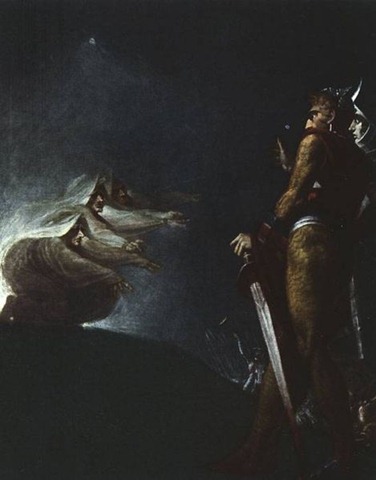
In Shakespeare’s Macbeth, we are presented with yet another way to view fate. While returning from battle, Macbeth and Banquo encounter three witches along the road that present Macbeth with two prophecies. The witches hail Macbeth as Thane of Glamis, which he is. They then hail him as Thane of Cawdor, which confuses him since there is already a Thane of Cawdor. Finally, they hail him as “…Macbeth, that shalt be king hereafter!” (Orgel 9). Shortly after the witches disappear, Macbeth finds out that he has been named the Thane of Cawdor. The witches do not tell him when these prophecies will come true and whether or not it is a deception on their part, Macbeth takes his immediate naming of Thane of Cawdor as a cue to act to ensure the fulfilment of the third prophecy.

At this point, Macbeth begins to control how he will bring about his own fate. Macbeth and his wife conspire to kill the current king, Duncan, and after succeeding, Macbeth is placed in power. He attains the kingship and his prophecy is fulfilled. However, because of the way Macbeth chooses to reach his prophesied destiny, his reward is short lived, violent and ends in tragedy. If Macbeth had chosen to wait for the prophecy to fulfil itself, he may have been a much older man when he was named king, but the transition would have likely been more peaceful and he might have even sat on the throne longer. In Macbeth, fate is absolute, but how Macbeth attains his fate is optional.

(Image of Macbeth and Banquo with the witches from Wikipedia)

Conclusion

These three works of literature each present a different view of how man is subject to fate. Is man locked into his fate with no chance to escape, like Adam and Eve in the Genesis creation story? Can man avoid fate altogether by acting on prophecy and making the proper choices, as evidenced by Oedipus the King? Or is our fate absolute, with only the way we get there left to our discretion, as in Macbeth? As long as man continues to believe in the supernatural, questions about man’s relationship with the divine will continue to be debated, because there is no way to definitively prove that any particular view is correct.

References

Ember, Carol R., Melvin R. Ember and Peter N. Peregrine. Anthropology: Thirteenth Edition. Upper Saddle River: Prentice Hall, 2010.
Fagles, Robert. The Three Theban Plays: Antigone, Oedipus the King, Oedipus at Colonus. London: Penguin Books Ltd, 1984.
Orgel, Stephen. Macbeth. London: Penguin Books Ltd, 2000.
Thomas Nelson Bibles. The Holy Bible; Containing the Old and New Testaments; Authorized King James Version. Nashville: Thomas Nelson, Inc., 2001.

Culture Clash: Small-Town American vs. Somalian Immigrant Culture

This is a paper I wrote for my 100 level Anthropology class.  It deals primarily with an incident that occurred in Lewiston, Maine, between the residents and a massive influx of Muslim Somali immigrant refugees, and the reactions of both sides.  The paper was written along specific guidelines, as well as from an anthropological and cultural perspective.  The purpose of the paper is not to debate whether or not it was ‘right’ for the Somalis to be in the town, or to have been admitted to the country.  It was, instead, to discuss how culture affects relations between people from different areas, what cultural concepts are being demonstrated, and possible accommodations or solutions that could be offered.

The specific guidelines for the essay are as follows:

1. Review the video on migration above. [Migration: A Profile of the US]

2. Read article “Mixed Welcome…” … and

3. Answer the following questions in your paper:

  • Explain how aspects like migration, religion, food, dress, language, & religious holidays are cultural.
  • How are these cultural elements different in Somali culture than they are in small-town American culture?
  • What is important to know about these cultural elements, as they apply to Somali culture?
  • What do the Somali immigrants and the local Lewiston residents probably have in common?
  • What could local American government institutions, schools, and residents do to make accommodations for—and be sensitive toward—the cross-cultural differences?
  • How does this experience of cross-cultural contact illustrate what we’ve learned about cultural knowledge, individual behavior, and the process of cultural change?

Additionally, the paper was to be written in APA style (which I hope I got right) with at least 5 different references for material covered in the course to date.  I’ve included the references at the end of the post, so that the in-text citations make sense, and so a potential reader can find more information or verify the information I’ve presented in case they’re doing their own research for a paper.  I’ve also added some images to make this long stretch of text a bit more visually appealing.

Please keep in mind that this paper was written based only on the information given, rather than on any more recent events in Lewiston.

If you have any questions about the paper, please feel free to contact me or leave a comment.


Culture Clash: Small-Town American vs. Somalian Immigrant Culture

America is a great melting pot of cultures, but sometimes, cultures don’t want to be melted. To be more specific, there are sometimes groups of people who immigrate to the United States, but don’t want to assimilate into American culture. They bring their culture with them and then create isolated pockets of their own cultures within the greater American society. This isn’t an issue that only comes from immigrants. There are groups in the United States who have been here for generations that we all accept, like the Amish, who do not embrace modern American culture. Perhaps the reason we don’t mind having these insular groups in the United States is because they are, in fact, insular. They don’t try to impose their beliefs on the established order. In the case of the Amish, many of the beliefs and practices are still similar enough to our own that we can, if not accept them, understand them.

Problems arise when two very different cultures attempt to interact with each without trying to understand or make accommodation for each other first. Each group makes demands of the other group, oftentimes without being willing to compromise in any way. This paper will be discussing the ways in which culture and the misunderstanding of it have led to culture clashes between Somali immigrants in Lewiston, Maine and the local, small-town American population already living there (Belluck, 2002).

What is Culture?
 

st_corporate_culture
Before trying to understand how cultural differences have led to misunderstandings between immigrant populations and the local, receiving populations, it will be helpful to understand just what culture is. The popular idea of culture is that it’s a desirable trait you can somehow acquire by attending a certain number of plays, visiting art galleries, or by going to classy concerts (Ember, Ember, & Peregrine, 2010). The reality is that culture is a difficult concept to nail down (Townsend, 2011) and an exact definition has been debated by anthropologists, with entire books being dedicated to the subject (White J. J., May/June 1998). The earliest definition of culture stated that it is “[t]hat complex whole which includes knowledge, belief, art, law, morals, custom, and any other capabilities and habits acquired by man as a member of society” (White E. B., 1871). This is a very inclusive definition, which leads you to believe that almost every aspect of daily life is cultural, and it is. Waking up in the morning and having a cup of coffee is cultural. Using an alarm clock to get out of bed at a set time is cultural. Driving your car to work every day is cultural. Going to church on Sunday is also cultural. Culture is everything we’ve been trained to do by the external sources that surround us (parents, television, education, radio, etc.), that allow us to function as well-integrated members of our societies.

So then, what is a society? And how do we define what cultural traits belongs to a society? A society is (Ember et al., 2010) “a group of people who occupy a particular territory and speak a common language not generally understood by neighboring peoples” (p. 224). These territories may or may not correspond to existing countries, which is the case with the Somali, who have populations in Somalia, Djibouti, Kenya, and Ethiopia (Shurgin, 2006). For a behavior to be considered a cultural trait of a particular society it must be a widely held belief or practice that is commonly found amongst the population (Ember et al., 2010). Using this information, it can readily be accepted that aspects of a society that are shared and practiced by the majority of a people are elements of that society’s distinct culture. This can include their choice of clothing, the types of food they eat, their language(s), holidays, and even beliefs. In regards to the Somali in Lewiston, even their migration can be seen as a result of culture. “Push and pull” (Migration: A Profile of the US, 2009) cultural factors in the country being emigrated from and the receiving country can act as powerful motivators to cause a migration. For example, the climate of war and conflict in Somalia, caused by the cultural tradition of clan loyalty is a strong push factor for emigration, whereas the relatively open, accepting, and peaceful society within the United States (caused by our culturally derived judicial and governmental systems) can be a strong pull factor, making it a desirable destination for immigrants.

So, culture is a powerful influence that affects almost every aspect of our lives. We grow up believing that the way we do things, our culture, is the normal way of doing things, and when we’re confronted with foreign cultures, especially those that are radically different from our own, it creates tension, and sometimes fear. However, it also challenges us to expand our view of the world and recognize how we’re different from other people, and how we’re the same. We have to allow for the fact that people are going to be different based on where they’re from, and because of these differences they may not see even the simplest aspects of life the same way we do. The tensions in Lewiston are caused by a failure to adequately understand other peoples’ cultures, both on the part of the Somali and the indigenous residents. One example is the mayor sending a letter to the Somali community, written in English, when most of the Somali don’t understand English. On the other hand, you could say that the Somali reaction to the letter was overly violent, because they immediately assumed it was an attack, instead of understanding the local economic situation and thinking of how their intrusion in the local culture has affected the original residents (Belluck, 2002).

These differences between cultures have become much more prominent in the media lately, specifically between what you could call Muslim culture and American culture, due to the United States’ military actions in the Middle East over the last decade. Because of these conflicts, Muslims in general are branded as the enemy. This idea of Muslims being the enemy has been well seated in the United States, and it is with this outlook that the Lewiston residents encountered and came into conflict with the obviously Muslim-influenced culture of the Somali immigrants.

Cultural Differences and Similarities:
 
Somali Immigrants vs. Lewiston Natives
 

Beginning to recognize differences between the culture of the Somali immigrants and the native culture of the Lewiston residents would help to shed light on the problem, and perhaps present solutions. The Somali come from a country on the Horn of Africa, which is predominantly Muslim. Many of the elements of their culture are borrowed from nearby Arab countries. Some of their practices may be seen as primitive or strange to Americans, but the culture of the Somali immigrants is simply a result of where they were born.

Somali immigrant workers.

 
(Image from: The Two Malcontents)

An important thing to understand about the Somali is that their culture and daily habits are heavily influenced by their religion, Islam, even to the point of their legal system being based on sharia (Islamic) law (Culture of Somalia, 2011). Despite President Obama’s recent announcement that the United States is not a Christian nation, the United States has been heavily influenced by the ideas and morals presented by the Bible. Many of our laws are based on Christian ideas and many of the great changes in our society, such as the end to slavery, were partially argued on the grounds that it violated the religious principles of Christianity (Gilson, 2009). It would be more accurate to say that the United States is a secular nation with Christian values. It’s easy to see how conflicts could arise between a Christian/secularist culture and a culture that is heavily influenced by Islam, especially since most Somalis hold their Muslim beliefs and practices in the highest regard.

The Somali’s adherence to Islam has had a profound effect on their culture. In terms of clothing, most Somali dress in adherence to Islamic principles. Men must wear clothing that covers them from neck to knee, and women must be covered from neck to ankle in non-form-fitting clothing. Married women may additionally wear a head scarf and/or a shawl (Culture of Somalia, 2011). The clothing they wear is sometimes based on region, sometimes adopted from neighboring Arab countries, but is almost always designed for a hot, arid climate and is in compliance with Islamic ideology. Most Somali speak the Somali language, but are illiterate. However, because of the influence of Islam, many Somali can speak and write Arabic, which is the language of the Qur’an. The Somali practice Muslim holidays, such as Ramadan, the month of fasting to celebrate the revelation of the Qur’an; Id al-Fitr; the First of Muharram, when an angel shakes the tree of life and death; Maulid an-Nabi (a celebration of Muhammad’s birth); and Id al-Adha, which commemorates the story of Abraham and his son Ishmael (Shurgin, 2006).

photo_lg_somalia

 
(Photograph by Kevin Fleming/CORBIS)

Other aspects of Somali culture are influenced by the region they come from. In addition to the clothing being adapted to hot, arid climates, the environment has affected their social structure and diet. Many Somali still live off the land as nomads and herders. Their diet consists mainly of cereals and grains, with few vegetables or meats. Due to adherence to Islam, alcohol and pork are not consumed. Milk, tea, coffee and water are the consumed drinks. Due to their nomadic lifestyle, a division of labor based on gender and age has been created, and people tend to live in multi-generational households. They also value interdependence and commonly have large families (Culture of Somalia, 2011).

By comparison, US society is very different. The most commonly recognized and observed holidays are secular or Christian. Individualism is highly valued in society, with children being shooed out the door as soon as possible. Families are typically small, with 2-3 children, rather than the 6+ in Somali families. Alcohol is consumed in great quantities, and a meal is not considered complete without meat, including pork at breakfast. The literacy rate in the US is high due to standardized education and people generally dress according to fashion, rather than a strict religious ideology. One of the greatest differences, though, is the separation of church and state. The Somali culture is incredibly Muslim, and as stated before, even their laws are drawn from their Islamic faith. Despite earlier Christian influences, our government is increasingly enforcing the separation of religion and government from public institutions. Private companies also try to enforce rules against actively promoting or practicing religion in the workplace. This active attempt to remove religion from daily life seems quite natural to Americans, because it’s a principle that the country was founded on. Religion has its place, and US society has determined that place to be outside of public areas. To a Somali Muslim, however, it may be seen as an attack on the Muslim faith, particularly since they require allowances for prayer times throughout the day, as well as facilities for performing ablutions before prayer (Mohammed, 2009). The denial of these facilities for those actions may be seen as a proper separation of church and state, but to a Muslim who is unaware of that cultural trend it may feel targeted.

Despite vast differences in culture, the Somali and the Lewiston residents both have things in common. Both groups have pride in their culture and are trying to do the best they can with the opportunities they’ve been given. Both groups hope for a better future for themselves and their families. Both groups likely value having a peaceful, happy town to live in, where they don’t have to be afraid of physical violence or racially motivated attacks. Both groups are likely hoping for a peaceful resolution that will allow for coexistence. At the time of the writing of Belluck’s article (2002), they also had one more thing in common. They failed to try to understand each other before reacting to the situation they found themselves in.

Accommodation and Cultural Change
 

Regardless of whether or not it is ‘right’ for the Somali immigrants to settle in Lewiston, or to have been admitted into the United States, it has already happened, and rather than create tension and possibly incite violence, this is an opportunity for these groups to learn about each other and possibly find a common ground to work from. For the residents of Lewiston, the only way for these two groups to come to grips with each other is through dialogue. This dialogue could be opened through town hall meetings. The local government could hold these meetings to address concerns in the town that everyone, including the immigrants, could voice their opinion on. The feeling of working together produced by these meetings would start building a sense of community. Additionally, qualified speakers could be brought in to talk about important cultural aspects of both Somali Muslim and American culture. Another possibility for Lewiston is that they could insert short, commercial-like infomercials into normal commercials that give a brief description of Somali Muslim cultural aspects, like why they wear burkas or why they pray five times a day. In the future, though, steps could be taken by the US government to prevent this type of situation from occurring in the first place.

somali-refugees-lewiston-IN04-wide-horizontal

Robert F. Bukaty / AP
Somali women and children in downtown Lewiston, Me.

When such large and foreign populations are introduced into American society, certain steps could be taken to ensure successful integration. The key to that success is education. It’s hard to predict where large groups of immigrants will attempt to settle, so the best solution for educating locals would be to introduce anthropological and cultural perspectives classes into secondary education as a mandatory requirement on a national level. The United States doesn’t exist alone, and understanding the world around us is beneficial for more reasons than just getting along with potential immigrants. As for the immigrants, mandatory and extended education about American culture, prior to being admitted into the general population, would likely go a long way towards accelerating their assimilation into society, or at the least, help them understand the people they’ll be interacting with. If the Somali immigrants in Lewiston had been taught about the role women play in our society, they wouldn’t have reacted the way they did to female employees (Belluck, 2002). Another helpful accommodation the government could make would be to provide English lessons for refugee immigrants that are admitted to the country. If the government is going to introduce groups of foreigners into US society, it should take responsibility for its actions and make sure these people are well equipped to, at the least, communicate with other Americans on a basic level. It is irresponsible to simply turn them loose in the US and expect them to become successful members of society. These refugee immigrants should also be evaluated for potential job skills, and if none are found, they should be trained. Again, it is irresponsible to simply release these people into American society, where they will invariably wind up living off the welfare system in perpetuity.

There are many things institutions, such as schools, could do to accommodate Muslim Somali immigrants, but the question to be asked is should they? As previously stated, the separation of church and state has rendered the practice of religion in public schools, for example, impossible except for the most private and innocuous of activities, such as praying silently (to yourself) over your meal at lunch time. If these sorts of restrictions have been placed on religion in public institutions, based on a Constitutional Amendment, should we make allowances for immigrant religions just for the sake of appeasement? Should we create a double standard where one religious group is excluded and another is permitted as much freedom as they want? Part of living in the United States is adhering to the local culture, which includes the local laws regulating what is acceptable in public institutions. If that means that religious traditions have to be slightly modified to fit the current situation, then it wouldn’t be the first time it has happened. Rather than ask what the government can do for them, they should ask what they can do for the government. Performing ablutions in a school’s gym showers would be perfectly fine, but allowing Muslim students to miss class time for religious practices would be unfair to the other religious groups that are denied similar privileges, as well as be detrimental to their education, since they would be missing instruction. If an accommodation for Muslims to practice religion in the schools is made, then that same accommodation should be afforded to people of all religions. If that were the case, then the solution would be simple. The school day could be extended by half an hour to 45 minutes, with a period of ‘free time’ beginning at noon. This would allow immigrant Muslim students to go to the gym showers to perform ablutions, conduct prayers in a designated location, and then return to class without missing out on anything. It would give students of other faiths time to have religious meetings, or to hang out with friends, or even to do homework. Another advantage would be that the practice of having a break between classes would start acclimating students to the educational atmosphere present in most colleges. In short, for a religious accommodation in a public institution, such as a school, it should be an ‘all-or-nothing’ policy that includes everyone.

somali_blog1

 
(Photo from ISEDSolutions (Institute For Social And Economic Development))

The experience of the Somali immigrants in Lewiston and the reactions of the locals (noted in Belluck’s article (2002)) illustrate some of the basic concepts of culture and cultural change. We, as individuals, are all products of our social and physical environments, meaning we are all shaped by the culture around us. The way we interpret the world around us depends as much on culture as it does our educations and economic abilities. Because the Somali’s grew up in their Muslim dominated African culture, they had certain expectations of what liberties they should have, what ‘place’ women should be in, and they also had certain expectations of what to believe in terms of ‘white people’. When the mayor of Lewiston presented them with his letter, they immediately assumed they were being put upon by an “ill-informed leader who is bent towards bigotry” (Belluck, 2002). They assumed that because he was white, his intentions toward them were racist, based simply on the color of his skin. In this instance, the mayor’s skin color acted as a “floating signifier” (Jhally, 1997), conferring certain expectations in regards to his behavior, and the behavior of the other white townspeople. The mayor’s letter was made based on the townspeople’s own interpretation of what “them people” (Belluck, 2002) did or did not understand about American culture, economics and the situation of the town. It was an assumption of the Somali’s level of intelligence, based on the fact that they’re from a third world country and have immigrated to the United States. The integration of the Somali immigrants into the Lewiston population also gives us a clear example of acculturation. Based on Belluck’s article (2002), we can see that the Somali immigrants did what most Americans do when confronted with a social problem: they turned to the media to gain attention for their situation and swing popular opinion in their favor. If that isn’t American, nothing is. You could also say that the Somali have adopted the “American Dream”, migrating from place to place within the US to try to find a better life for both themselves and their children, even going so far as to dream of having “a house by the beach one day” (Belluck, 2002).

Conclusion
 

Culture is a powerful factor that influences our lives in ways that most of us never even begin to guess. It affects our outlook on life and can cause us to come into conflict with people of other cultures due to differences and a lack of education. The Lewiston residents and the Somali immigrants to Lewiston found that out the hard way, by allowing conflict to occur, rather than initiating discussions to learn about each other and overcome differences and challenges as a unified group. These sorts of problems could be greatly alleviated by an aggressive education campaign among American secondary students and incoming refugee immigrants. Additionally, greater freedoms could be allowed to people in institutional settings for the accommodation of religious practices, so long as those practices do not interfere with the actual purpose of the institution and the implemented policies are unilaterally applied. The case of the Somali immigrants in Lewiston serves as a great example of the importance of understanding culture and how it works, or doesn’t work, for us in the real world, as well as showing us the beginnings of cultural acculturation of immigrants. The process of understanding and reaching common ground between groups with such different backgrounds will never be an easy one, but with proper education and respect it will be possible.

References

Migration: A Profile of the US. (2009). Retrieved April 2, 2011, from Pearson: myanthrolab: http://media.pearsoncmg.com/ph/hss/SSA_SHARED_MEDIA_1/anthropology/video/Migration_Profile_of_US.html
Culture of Somalia. (2011, January 18). Retrieved April 3, 2011, from Wikipedia: http://en.wikipedia.org/wiki/Culture_of_Somalia
Belluck, P. (2002, October 16). Mixed Welcome as Somalis Settle in a Maine City. Retrieved April 2, 2011, from The New York Times: http://www.nytimes.com/learning/teachers/featured_articles/20021016wednesday.html
Ember, C. R., Ember, M., & Peregrine, P. N. (2010). Anthropology. Prentice Hall.
Gilson, T. (2009, August 12). Christianity and the Abolitionsist Movement. Retrieved April 3, 2011, from Thinking Christian: http://www.thinkingchristian.net/2009/08/christianity-and-the-abolitionist-movement/
Jhally, S. (Director). (1997). Stuart Hall – Race, The Floating Signifier [Motion Picture].
Mohammed, H. (2009, June 3). The Somali Culture and Beliefs. Retrieved April 2, 2011, from The Somali Cultural Association: http://www.somalicultural.org/history/the-somali-culture-and-beliefs
Shurgin, A. H. (2006). Culture of Somalia. Retrieved April 2, 2011, from Countries and Their Cultures: http://www.everyculture.com/Sa-Th/Somalia.html
Townsend, C. (2011, March 30). Class Lecture. New York City, New York, USA.
White, E. B. (1871). Primitive Culture. London: John Murray Publisher.

White, J. J. (May/June 1998). Helping students deal with cultural differences. Social Studies, 107.

Significance and Consequences of ‘Xenia’ in The Odyssey

A map of places visited in The Odyssey.

(Image from: LordAlford.com)

This is a paper I wrote for my 100 level World Humanities class.  It deals with concepts of hospitality in The Odyssey.

The guidelines for this paper are as follows:

What is xenia?  What are the basic expectations that come with proper xenia?  List TWO examples of good xenia in The Odyssey, and one example of bad xenia.  (be sure to include at least one example from Books 13 – 24)  What are the consequences, good or bad, of each?  Why is xenia important to civilization?  What does it represent or establish in the minds of people of ancient Greece?

The paper was supposed to be at least 1400 words, double spaced in 12 point font, and in MLA format with a Works Cited page, so you’ll see that tacked onto the end of this so a reader can make sense of the in-text parenthetical citations that I’ll be copying into this blog post.

Introduction

Odysseus and Athena
Odysseus and Athena

One of the most important themes in The Odyssey is the concept of xenia, which is the old Greek word for hospitality. In modern times, hospitality is something we rarely think of, and the first thing that comes to mind is the hotel industry, but in ancient Greece, xenia was not about hotels, or just about etiquette, it was a way of life with many benefits in a world that was still mostly savage.

Xenia was more than just being polite to strangers. It was a set of rules and customs that defined the guest-host relationship between two individuals, two groups of people, or an individual and a group (Wilson 370).  Some basic rules of this relationship were that the guest could not insult the host, make demands, or refuse xenia. Additionally, the host could not insult the guest, fail to protect the guest, or fail to be as hospitable as possible. It was also customary for gifts to be given to the guest, or for a gift exchange to be conducted between guest-friends (Wilson 370).

This complicated guest-host relationship placed equal burden on both the host and the guest, starting with the guest finding a ‘proper’ place to seek xenia. The custom was for the guest to take shelter in a home that fit his social standing, so you would not normally see a beggar looking for hand-outs at the palace of a king, or a noble seeking xenia from a commoner under, ideal circumstances at least.

This custom of xenia also carried a burden of trust, where both the host and guest would have to rely on custom in regards to personal safety. This trust was reinforced by both fear of word getting out that the host had provided improper xenia, and fear of retribution by the gods (Biggs, Joseph and Bennet, Mollie), since one never knew when a traveller might actually be a god in disguise, come to test the level of your xenia. All travellers were seen as sent by Zeus and under his protection (Homer 153), so giving proper xenia was also a way of showing reverence for the gods, especially Zeus in the form of Zeus Xenios.

(Image above from: michaelromkey.typepad.com)

Examples of Xenia in The Odyssey

The Odyssey “may be viewed as a study in the laws of hospitality” (Pitt-Rivers 13) and is full of examples of both good and bad xenia, where good xenia is rewarded and bad xenia is punished. The theme of punishment and reward for how xenia is offered runs throughout The Odyssey, starting with Odysseus’ encounter with the cyclops Polyphemus to his return to Ithaka and eventual vengeance against the suitors. The story relies so heavily on concepts of xenia that The Odyssey could not have been written without it in mind. Almost every encounter between characters gives us demonstrations of how xenia should, or shouldn’t be carried out.

Good Xenia:  Odysseus and Nausikaa

One of the best examples of good xenia in The Odyssey is that of Nausikaa (Homer 104 – 108), a princess on the island of the Phaiakians. Odysseus had been shipwrecked and took refuge under a bush for the night. Late the next morning, he woke up to the sound of girls screaming while at play with a ball they had accidentally kicked into a nearby stream. Seeing an opportunity for help, he decided to approach them. Emerging from the bushes, rough, ragged, crusted with dried seawater and covered only by an olive branch, he approached Nausikaa and her maids-in-waiting. A natural reaction in this sort of situation would be to run and hide, which is what Nausikaa’s maids-in-waiting did, but Nausikaa, remembering the obligations of xenia, as well as the dream Athena had sent her the night before (Homer 99 – 100), stood her ground and waited for Odysseus, to hear him out.

After he spoke, she used what means she had available to her to offer good xenia to a guest on her father’s island. She called back her maids and reminded them that “Strangers and beggars come from Zeus: a small gift, then, is friendly” (Homer 105). She then directed her maids to take him to the river and bathe him, providing him with oils to rub onto his skin. She provided him with fresh clothing, taken from the laundry she’d washed in the river. She also offered him food and drink. These are all examples of good xenia to a stranger. She took care of his needs and then, afterwards, she even offered a parting gift: information about how he could accomplish his task of getting home. She told him how best to approach her parents and how best to win them over, so he would have a good chance of receiving the help he needed to get home.

Odysseus, for his part, also kept up his side of the obligations of xenia. He calculated how best to seek her aid without insulting her (“In his swift reckoning, he thought it best to trust in words to please her—and keep away; he might anger the girl, touching her knees.” (Homer 103)), made requests but not forceful demands, and gratefully accepted her gifts and advice. It’s easy to see the result of good xenia here, in terms of how Odysseus profited by it. He eventually encountered Nausikaa’s parents, was well received, entertained, and was sent on his way in a Phaiakian boat to Ithaka, loaded down with treasures.

It’s more of a stretch to see how the Phaiakian’s benefited from their good xenia, since the boat that took Odysseus home, along with its crew, was turned to stone within sight of Skheria Island, their home. It’s possible that the ability to tell future guests that they once played host to the great Odysseus may bring them some fame and honor. Also, because of their remote location, the Phaikians might have become complacent. This incident caused them to become more wary of helping strangers (Homer 235), which could be a good thing for them, especially in a speculative future where other, less hospitable, groups of people move into their area.

Good Xenia:  Odysseus and Eumaios

Another example of good xenia in The Odyssey is Odysseus’ reception by Eumaios (Homer 248 – 249), a swineherd on his estate in Ithaka. Even though Odysseus appeared to be a homeless, wandering beggar, he was still received well by Eumaios. He was immediately invited in for food and drink: “Come to the cabin. You’re a wanderer too. You must eat something, drink some win, and tell me where you are from and the hard times you’ve seen” (Homer 248). Eumaios even arranged his own bed as a bench for Odysseus to sit down, reminding Odysseus that “…rudeness to a stranger is not decency, poor though he may be…” (Homer 249). When evening came, Eumaios made a bed for Odysseus and even offered him his own cloak to keep him warm during the night. This level of courtesy towards a man, who, for all appearances, was nothing more than a beggar, shows Eumaios’ dedication to proper xenia. Odysseus continued to stay with Eumaios for multiple days, but at no point did Eumaios ever insist that he leave. He offered as much hospitality as he could to Odysseus, trusting in the customs of xenia that Odysseus would make no unreasonable demands or overstay his welcome.

For his part, Odysseus made no demands of Eumaios and did not threaten or insult him, despite his humble offerings. In fact, Homer repeatedly indicates Odysseus’ pleasure at Eumaios’ actions. Eumaios’ hospitality, and later his help, enables Odysseus to reclaim his house and get rid of the suitors. Because Eumaios treated Odysseus to good xenia, and proved his continuing loyalty to him during the conversations they had while Odysseus was in the guise of a beggar, his life was spared when Odysseus slaughtered the servants who had turned against him and against his house.

Bad Xenia:  Odysseus and The Suitors

Odysseus slaying his wife's suitors after returning to Ithaka.
Odysseus slaying his wife’s suitors after returning to Ithaka.

(Image from: FrogStorm)

One of the most obvious examples of bad xenia in The Odyssey is the treatment of Odysseus’ house, and Odysseus himself, by the suitors who, in his absence, have come to his home seeking his wife’s hand in marriage. The mere fact that they came to his house, seeking Penelope’s hand in marriage, isn’t necessarily wrong. Odysseus had been gone for nearly 15 years when the suitors showed up. There had been no solid news of him, and no one had any idea if he were alive or dead. What makes their behavior bad xenia is the way they went about it. They imposed themselves on the household, devouring the livestock, consuming the wine, insulting their host, Telemakhos, and refused to leave when their presence and intentions toward Penelope were obviously not wanted. Penelope tells the suitors in the hall, “Others who go to court a gentlewoman, daughter of a rich house, if they are rivals, bring their own beeves and sheep along; her friends ought to be feasted, gifts are due to her; would any dare to live at her expense?” (Homer 325) She also later reminds them, “suitors indeed, you commandeered this house” (Homer 393). The suitors even made plans to kill Telemakhos, to get him out of the way so they could further their goal of obtaining Penelope’s hand and dividing the spoils of the house. Since Odysseus was, in fact, still alive and master of his house, all of these transgressions of xenia can be seen as transgressions of xenia against Odysseus.

Additionally, when Odysseus returned home, though in disguise, the suitors continued to show bad xenia. Antinoos was particularly vicious to him. As he made his rounds of the suitors’ tables, in the guise of a beggar asking for hand-outs, Antinoos threatened him with violence, mocked him by calling him a pest, and then threw a stool at his back that hit him (Homer 326). These actions, along with further demonstrations of bad xenia on Antinoos’ part and from all the suitors in general, show us the exact opposite of what good xenia is.

In the role of the guest, the suitors insulted their host by overstaying their welcome, by making unreasonable demands on the house in terms of provisions, and by attempting to kill Telemakhos. In the role of the host, the suitors failed to provide proper xenia by insulting their guest, Odysseus, by injuring him instead of protecting him from harm, and by not being as hospitable as possible. Their bad xenia was well rewarded, since Odysseus was home with the blessings of Zeus, who avenges bad xenia, and Athena, Odysseus’ patron goddess. As Odysseus prepared to draw the first arrow, Zeus sent an omen signalling his approval, a loud thunderclap. Still playing up to his role, Odysseus proved himself by firing the arrow through the rings on the axe-heads, and then turned bring an end to the mockery the suitors had made of his house. Antinoos, the most vicious of the suitors, was the first to fall. In the end, all of the suitors died, and the disloyal servants with them. Bad xenia met with a bad end.

Importance of Xenia in Greek Civilization

The custom of xenia was, to the Greeks, the mark of civilization in the late 12th century BC, a time when most of the world was still savage. This is evident by Odysseus’ statement: “Now, by my life, mankind again! But who? Savages, are they, strangers to courtesy? Or gentle folk, who know and fear the gods?” (Homer 102) This was his reaction when he woke up on the island of Skheria and heard Nausikaa and her maids screaming while playing with their ball. He wondered if the people of the island would show courtesy (xenia), or if they were savages that had no regard for Zeus Xenios. This shows us that any place that did not practice xenia was considered uncivilized.

Besides being a measure for determining who was civilized and who wasn’t, it was an important part of the religious aspect of their life. Since they believed that Zeus was the patron god of travellers seeking xenia, honoring a guest was the same as honoring Zeus. Failure to honor a guest was to risk incurring the wrath of the gods. Xenia was also a good way for Greeks to develop reciprocal relationships with each other, creating bonds of trust between members of city states, and more importantly between the nobility of the city states. These bonds of xenia could prove useful if one friend were attacked. He could call on the people he’d shown good xenia to, to aid him in seeking reparations, or for making war. Hopefully, though, if good xenia is practiced by all, then hostilities would not be a problem, because proper respect would be shown by both the guest and host, reducing the chances of conflict. In this way, the Greeks’ sense of community is greatly aided by the relationships created through xenia.

Showing good xenia could also be a way of spreading fame for your house or country. When Odysseus is on the island of the Phaiakians, as part of King Alkinoos entertainment (his xenia toward Odysseus) he presents the Phaiakian dancers, in the hope that Odysseus would, “on his return tell his companions we excel the world in dance and song, as in our ships and running” (Homer 132). Later, when Odysseus is in his own house posing as a beggar, he implores Antinoos to give him a bit of bread, telling him, “Let me speak well of you as I pass on over the boundless earth” (Homer 324). In other words, he would tell others he met of Antinoos’ good xenia and raise his reputation and fame. Of course, that’s not what happened in that instance, but it’s still obvious that providing good xenia was beneficial to reputation and fame. Xenia was as important a part of Greek civilization as government, reinforced by religion and constantly producing beneficial results for all parties involved.

Conclusion

The Odyssey, with all of its examples of both good and bad xenia, offers us a look into the world of the Greeks, and the importance this cultural element played in their daily lives. Throughout the story, bad xenia is punished and good xenia brings rewards to those who offer it. It was religious, it was beneficial, and it distinguished the Greeks from their barbarian neighbors. The Odyssey, as well as being an entertaining story, reinforced the ideals of civility among the Greeks who heard it. Today, in addition to being a reference tool to better understand the Greeks, The Odyssey is just as entertaining, enlightening, and exciting to read.

Works Cited

Biggs, Cory, et al. The Value of Hospitality. n.d. 27 March 2011.

Homer. The Odyssey. New York: Farrar, Straus and Giroux, Inc., 1998.

Pitt-Rivers, Julian. “The Stranger, the Guest and the Hostile Host.” Peristiany, J. G. Contributions to Mediterranean Sociology. The Hague: Mouton, 1968.

Wilson, Nigel Guy. Encyclopedia of ancient Greece. Psychology Press, 2006.

“The Three-Headed Male Figure”—African Art (Kuyu)

You may remember last week I posted about the Metropolitan Museum of Art’s bizarre laptop policy.  This post is about the reason I was there.  I had to write an essay for my 100 level Art History class on either a Greek, Indian, Egyptian or Sub-Saharan African sculpture from the museum.  You’ll notice in the instructions below that it says we could write about paintings or architecture, but the professor told us to stick with sculptures in class.  It’s not a traditional essay, since there’s no real opening or closing paragraph, but these are the instructions we were given:

The paper (1 – 2 pages) should consist of four paragraphs.  It should be as follows:

Paragraph 1:  Identify the work briefly but adequately.  Start by stating that “the paper will be discussing the formal aspects and the museum presentation of the following piece”, then give the title of the work, name of artist if known –if unknown write anonymous—medium, country of origin and date.  Mention where it is located in the museum.

Paragraph 2:  Describe the work by writing a complete formal analysis.  In looking at the form you will consider the various aspects of form that are discussed in class, such as:  materials, size, texture, kind of shapes and lines, colors, light…etc.  A person who is not familiar with the pieces should get a clear idea of how they look through your description.

Paragraph 3:  Consider how the piece is exhibited (displayed).  That would include, the approximate size of the gallery (room), kind of light used in the gallery, the case where the piece is exhibited; if a painting, the way it is hung.  Mention the other objects in the room and their effect on your chosen piece.   In case you are working on an architectural piece such as a room, it will be within a larger gallery, consider its relation with its surroundings and what is displayed within it.  Do you think the display effects [sic] the piece and the visitor’s experience negatively or positively?  Explain.  If you were the curator, would you change the exhibit (display)? Yes, no, why?

Paragraph 4:  Suppose you’d like to do research on the piece.  What questions would you like to answer?  Write down any question for which an answer can’t be found by just looking at the piece.

So, those are the guidelines I was given to write this paper, and this is what I came up with:


Three-Headed Male Figure: Formal Aspects and Museum Presentation

The paper will be discussing the formal aspects and the museum presentation of the following piece: “Three-Headed Male Figure”. The work is a 19th century wood and pigment statue by an anonymous artist from the Kuyu peoples in the Congo Basin area of what is now the Republic of the Congo. The work is located on the ground floor of the Metropolitan Museum of Art in Manhattan, New York, in room 352 of the “Arts of Africa, Oceania, and the Americas” section.

The “Three-Headed Male Figure” is a free-standing, carved wood statue of a partially nude male figure. The statue is cylindrical and appears to be carved from one solid piece of wood. The figure is standing upright, in an erect, rigid posture. The statue’s feet are large and rounded, extending backward from the rear of the leg as far as they do forward. The legs are cylindrical and smooth and are disproportionately short compared to the rest of the body. The lower portions of the legs are covered by sets of raised carved wood lines that resemble simple torques. The arms are narrow and are carved flat against the torso, which is highly cylindrical and lacking in natural definition. The front and back of the torso are covered with an assortment of geometric patterns, as are the upper portions of the legs. A toggle shaped pattern covering the upper legs circles the whole form, but leaves the genitalia exposed in the front. The geometric patterns across the abdomen are mostly rounded, with shapes that include circles, curved lines similar to hills, and beaded areas which are also clustered in circles. The rear of the torso is covered in one pattern of lines with points that extend downward on each side of the spine. The patterns are carved from the same wood as the rest of the statue and are raised from the surface, in relief. They are carved deep enough to provide areas of shadow in the pattern, depending on how it is positioned in relation to a light source. The head of the statue is oblong and taller than natural. The cheeks and foreheads are covered with carved decorations. The features of the faces are carved deeply, with hard, strong lines. The faces are arranged so that one is pointed forward and the other two are angled backwards just behind each shoulder, with no gap between each face. Large portions of the statue were originally covered in white and red pigments. Some of those pigments still remain on the tops of the geometric designs on the upper legs and torso, as well as on portions of the faces.

The statue is positioned in a medium sized gallery room, which is filled with other African art pieces. The pieces are all contained in glass display cases which, in most cases, allow for viewing from all four sides. There are no external windows in the gallery and all of the lighting is artificial. Compared to the Greek and Roman gallery, the lighting is dim, with most of the light being focused on the individual pieces. The lower lighting in the room and the focus of the light sources on the pieces invites the viewer to more seriously consider the artwork on display. The positioning of the lighting also allows for the geometric patterns on the pieces to have areas of shadow, which adds to the viewing experience and gives the pieces more depth, emphasizing the three dimensional aspect of the sculptures. The “Three-Headed Male Figure” is positioned in the center of the rear portion of the room, in its own glass case, with multiple light sources illuminating the statue’s three faces. In addition to focusing the viewer’s attention on the pieces, the artificial lighting in the room protects the wood of the art pieces from sun damage and reduces the damage that could be done to the remaining pigments. The gallery the “Three-Headed Male Figure” is positioned in gives it context. The room is quiet, and the spotlight-style lighting greatly adds to the enjoyment of the viewing experience. The smaller pieces, which are grouped together in large display cases, are well positioned, but to improve the overall experience of viewing the sculptures and other large items in the room, benches could be added, so viewers could sit and reflect.

To better appreciate the “Three-Headed Male Figure”, it would be helpful to have a more thorough understanding of the piece’s background and use. African art is functional, so without understanding what it was used for, you can’t truly understand the significance of the art. To further that understanding, research into the traditions and culture of the Kuyu peoples, and other native peoples in the area, could lend insight into what the sculpture was used for. It would also be interesting to know who in the society made the piece: a professional, a priest, a family member, or the person (or persons) for whom the piece was intended to be used. Besides knowing how it was made and what it was used for, it would also be helpful to know how it was originally displayed in the community and whether or not the people that used it interacted with it, or if it was only viewed. Lastly, it would be worthwhile to find out if similar statues are still used by the native peoples of the region, or if the practice has died out completely.


The paper wound up being 2.5 pages, double spaced and in a 12 point font, which was also required.  The paper hasn’t been graded yet, but when it has, I’ll add that to the new “Essays (Graded)” page I added to this blog, which can be accessed from the tab bar under the header.

And now, the moment you’ve possibly been waiting for.  What does this “Three-Headed Male Figure” actually look like?  (Click on the images to see larger versions).

There’s a lot of fascinating stuff to look at in the Met, and I’m very much looking forward to my next trip there, where I can simply look and enjoy, without having to consider how to write a paper about the sculptures, though I think I will be able to appreciate them more, now that I have a better understanding of how these items are made and what they were used for.