The Brooklyn Museum Photo Gallery

I never would have guessed there was another big museum out in Brooklyn on the north end of Prospect Park, but some friends of ours asked us if we wanted to meet up out there and take a look around there and the Botanic Gardens. It turned out to be a really good trip.

The museum is bizarrely light on displayed items, considering how much the Met has sitting in storage, collecting dust. You’d think they’d share their inventory and more effectively utilize the space available in the Brooklyn Museum, but what they do have there is definitely worth the time it takes to have a look around, especially if you don’t want to deal with the crowds that are usually shuffling through the Met. My only other complaint is the big glass monstrosity (aka the new lobby) that was attached to the front of the building. It destroyed the beauty of the original architecture.

My favorite photos of stuff from the museum’s incredibly diverse collection:

Chabad Succah in Union Square for Sukkot

My wife and I were downtown last Thursday to get some supplies from Petco. After shopping, we were cutting across Union Square to get to a subway entrance that’s closer to the L train when we saw a booth set up. My first thought was that it was the beginnings of the Christmas market. I mean, it’s early, but why not? The month ends in a -ber, right? And it seems like stores start selling Christmas stuff earlier and earlier each year. But, when we got closer, I realized it was a booth for Sukkot. I thought the evergreen branches hanging off the roof were Christmas decorations, but nope. That’s part of the temporary structure. The roof is supposed to not be completely covered. The entire construction is supposed to be non-permanent, because it symbolizes the temporary dwellings of the Hebrews in the desert during the Mosaic diaspora period (between Egypt and Canaan / Israel).

Chabad Succot Booth 2013
Another view of the Chabad Succot booth for 2013.
Some guy painting over the decorations
Not sure who this guy is. Looked Japanese with a beard. He was painting over the words “Shabbat Shalom” on the door.

The decorations on the outside of the structure were nice. I didn’t realize how extravagant people can get with these things. If you’re wondering, “succah” is the name of the temporary dwelling. It’s just the Hebrew word for it, and during Sukkot Jewish people usually eat in their succah, unless it’s raining. For more info on Sukkot, click here.

Bus Breakdown

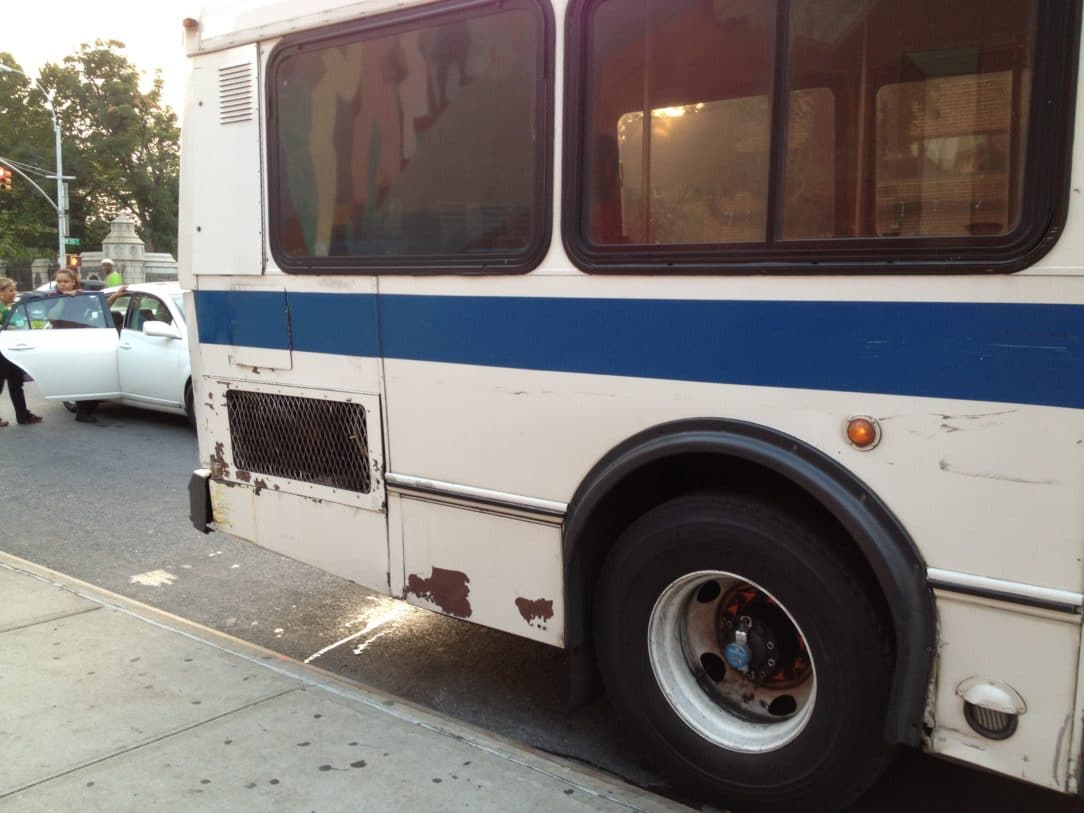
Broken down M100 Bus in Manhattan

NYC uses a mix of old and new buses in the city. A few days ago, I was on one of the older buses (the M100) when I started to smell something burning. At the next stop, the driver turned the bus off and told everyone to leave. I think the engine must have been overheating in a serious way for that much of an odor to enter the bus. I thought a building in the neighborhood was on fire. An overheating engine makes a lot more sense, since there weren’t any sirens.

It wasn’t really too big of a deal because we were able to board the following bus for free. New York City is pretty good about that sort of thing and often provides free shuttle buses during subway downtime as well. I felt bad for the guy in the wheelchair, though. With the engine screwed up, there was no way to get him off the bus. The engine usually revs pretty hard when the ramp is being extended, lowered and retracted. The newer buses are designed so that the floor of the bus is closer to the street level, which would make getting a guy in an electric, heavy wheelchair, out of a broken down bus much easier.

I hope everything turned out ok for the guy. He seemed pretty cool when I briefly spoke to him as I was getting off the bus. I thought about staying to help, but I figured I’d just get in the way. When we were pulling away on the following bus, three police officers were standing by the open rear doors, probably figuring out how to get the guy and his chair out. The bus driver was still talking on the bus phone, probably requesting help. I think the LCD said “Maintenance Call,” when I had walked by.

The Cloisters (Metropolitan Museum of Art – Medieval Gallery)

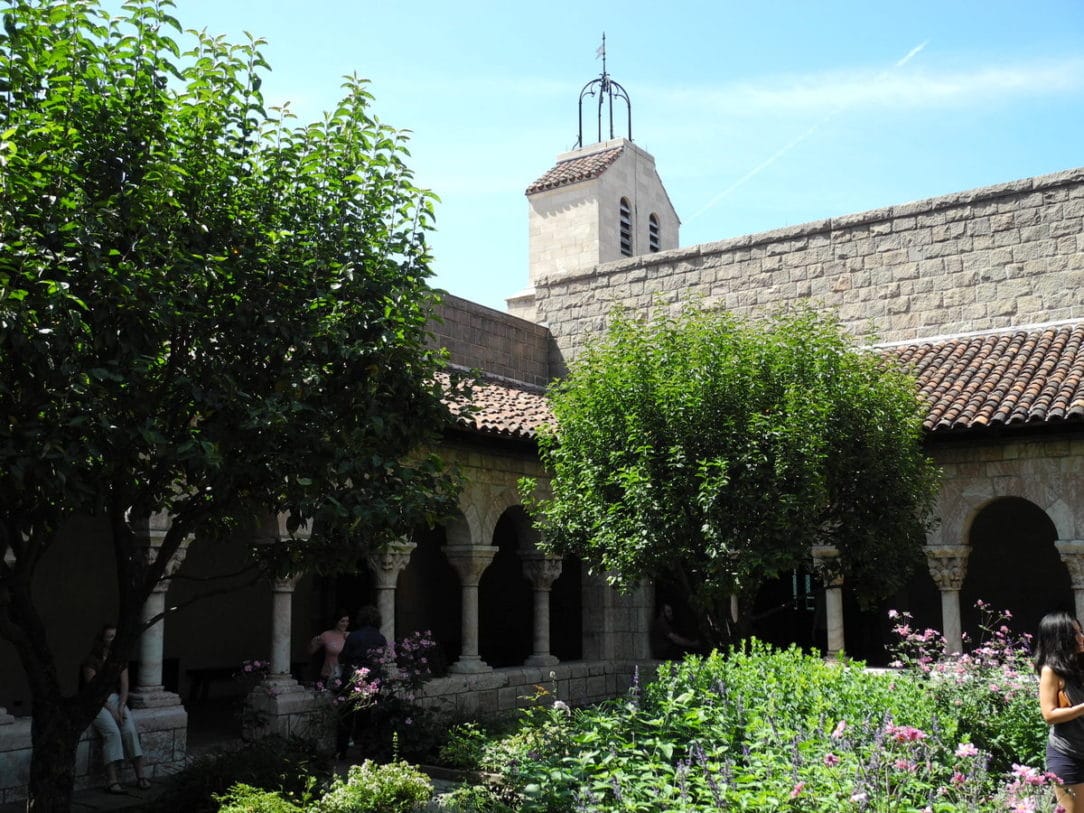
DSCN2697The Cloisters is the medieval art branch of the Metropolitan Museum of Art, located in Fort Tryon Park in upper Manhattan. The building that houses the galleries is an amazing conglomeration of multiple monasteries from Europe that were crated up, shipped here to New York, and then reconstructed on site using a mix of original and modern materials. The attempt was well done and walking through the Cloisters feels like walking through an old monastery. There’s a main chapel, a smaller chapel, gardens and exhibit halls. The gardens are full of growing herbs and plants that were used during the medieval period, from nightshade to hops.

Going to the Cloisters is a pretty short trip. You can easily see everything in a day, and that’s if you take your time walking around and reading all of the inscriptions. The Met advertises that you can pay at either the main branch or the Cloisters and then access both branches in the same day, but I think that’s a bit of stretch, unless you do it on a Friday or Saturday, when the main building doesn’t close until 9 PM. Also, keep in mind that the prices listed at the entrance are “suggested” prices, meaning that’s what they recommend. You don’t have to pay that much to get in, so if you’re a little tight for cash, you can give them a dollar or two and they’ll still let you in.

Another great thing about the Cloisters is the park it’s located in. Fort Tryon park has some great views. Unlike most parts of Central Park, Fort Tryon Park is extremely hilly, with lots of paths, stairs, and great places for photo opportunities. When my wife and I went to the Cloisters, we rode the bus in from the train station, but on the way out we walked through the park. We’re looking forward to going back to the Cloisters in the near future, but we’re looking forward to exploring the park just as much.

Rite Aid Hired Professional Graffiti Artists to Redecorate Exterior for Grand Re-Opening

Just up the road from us there’s a Rite Aid. The place looked pretty sleazy when we first moved in, but over the last few weeks they really fixed the place up. It looks modern and new and doesn’t have that cramped, dirty feel to it anymore. In addition to fixing up the outside of the store, the management decided to turn the dingy, yellowing paint on the exterior of the building into something fresh and new.

We walked up on these guys spray painting the outside of the building in the evening. It seems as though they were given a lot of freedom in their choices, but they did have to redo a portion of their mural which contained a space ship. Apparently, that wasn’t what the Rite Aid management was aiming for.

The finished product is pretty cool. I wonder if people are doing this outside of New York City now, and especially down south? I don’t remember graffiti being recognized as art or encouraged down there. Not that anyone in Georgia was painting murals like this, or anything on par with most of the graffiti in New York City, anyway.

Abandoned Buildings on Adam Clayton Powell Jr. Blvd (AKA 7th Avenue)

IMG_2528

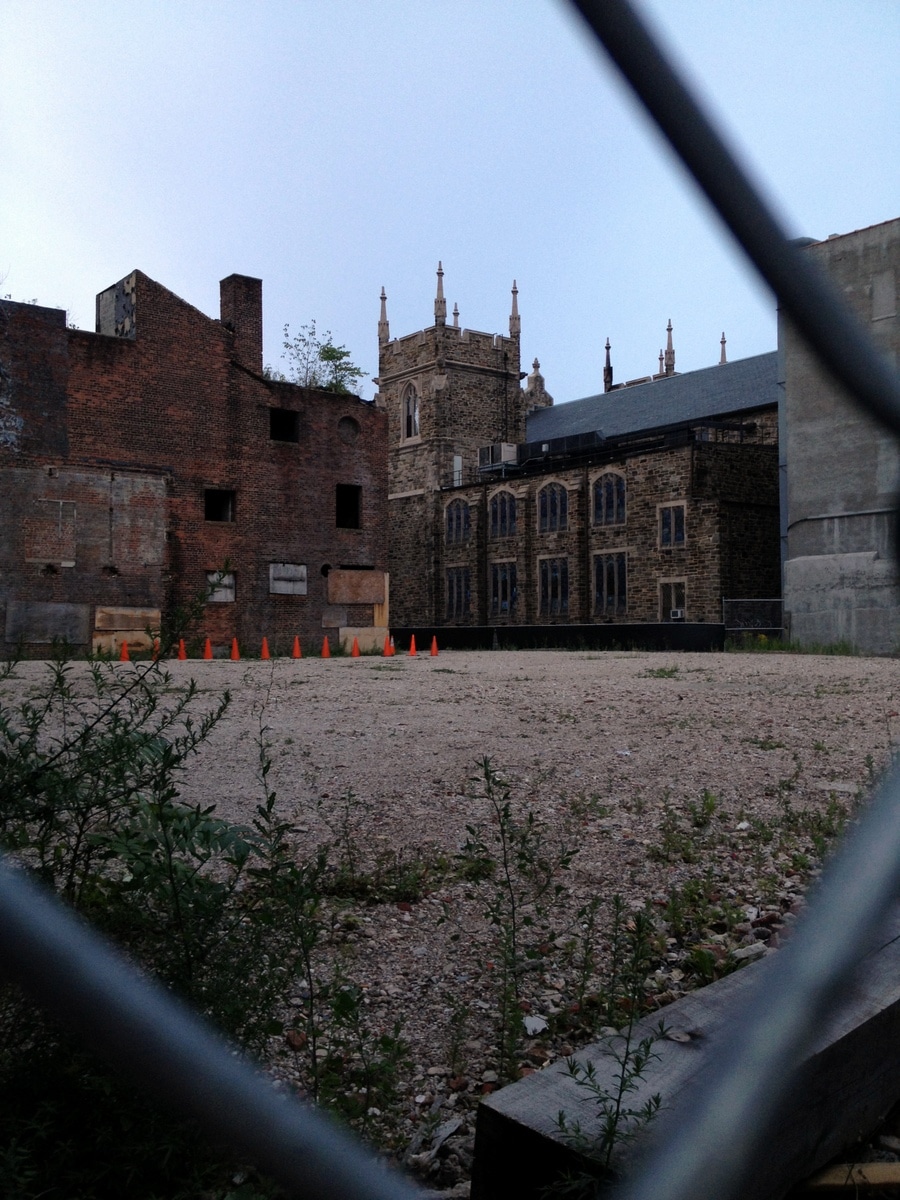
IMG_2529These are some pictures of two old, abandoned buildings we saw on Adam Clayton Powell Jr. Blvd (which is also Seventh Avenue). I have no idea what these buildings were originally built for, but the narrower one had been repurposed at least once. The arched openings had been sealed over with concrete blocks that had narrower doors set into them, equipped with drop-down security gates found on most stores in New York City that were built within the last twenty or thirty years. I got an approximation of an address (2341 Adam Clayton Powell Jr Blvd) for the narrower building from Google Maps and then searched for property records, but all I found was a record listing the place as a “Theater/Performing Arts” venue. I couldn’t find any information on the other, larger building.

IMG_2531

I like abandoned buildings. I always have. One of my earliest memories is of me and my brother exploring an abandoned building in a small town called Bell, in Germany, where we were living temporarily while waiting for on-base housing. I loved castle ruins too. It’s fun to see historical artifacts in a museum, but it’s a very different experience when you’re looking through a place where people used to live their lives, trying to put together an idea of what might have happened there.

IMG_2530

As a bonus, I realized that in the background of some of my photographs is the Abyssinian Baptist Church. The congregation that eventually constructed the church at its current location, which was completed in 1923 at a cost of roughly $334k, was established in 1808 as a result of a walkout from the First Baptist Church in lower Manhattan, when black parishioners were told to adhere to segregated seating. Adam Clayton Powell Jr., who that portion of Seventh Avenue is named after, was a pastor at the Abyssinian Baptist Church, which was named in honor of the place of origin of most of the founding members: modern Ethiopia.

Jackie Robinson Park in Manhattan, New York City

Jackie Robinson Park Sign on Edgecombe Avenue

New York City is full of parks. The more my wife and I walk around, the more obvious that becomes. There are many more parks here in the northern part of Manhattan than there are on the Lower East Side, or at least it seems that way. Everywhere you look, there are trees and grass. Not that that’s a bad thing. It helps to break up the monotony of concrete and high rise buildings. It gives a greener, fresher scent to the air up here. And, best of all, it makes our walks and jogs a lot more visually appealing.

Jackie Robinson Park isn’t exactly a park you can jog through though. It’s a narrow strip that runs north-south from 155th Street down to 145th Street, between Edgecombe Avenue and Bradhurst Avenue.

Half of the land occupied by the park is a steep slope that’s mostly unusable, except for sets of stairs spaced at intervals to help people get from Edgecombe to Bradhurst, and vice versa. The area that is flat has been used to build playgrounds for young kids, basketball courts, and a pool complex. It’s actually pretty nice looking.

I’m almost always impressed by how good city planners are about utilizing every bit of space in Manhattan, though I shouldn’t be surprised. When you’re working with a limited resource, you have to make the most out of it.