I’ve always been a bit of a geek, so when a friend of mine (at http://www.jamaipanese.com/) recommended that I try out a service called Loot Crate, I didn’t hesitate. I wasn’t disappointed. This program was a great way for me to remember to have a little bit of fun. These college semesters are grinding the life out of me. I will post more about what I found when unboxing my first Loot Crate later, but for now I want to share this image of one of the items I received.
Category: Reviews
Book, Movie, Television, and Product Reviews
Response: Selim Deringil’s “The Well-Protected Domains: Ideology and the Legitimation of Power in the Ottoman Empire 1876-1909”
![By Uncredited [Public domain], via Wikimedia Commons](https://bradleyfarless.com/wp-content/uploads/2021/09/aec5d-abdul_hamid_ii_1908.jpg?w=576&h=432)
Selim Deringil’s book, The Well-Protected Domains: Ideology and the Legitimation of Power in the Ottoman Empire 1876-1909, is an attempt to find a more balanced and realistic interpretation of the reign of Abdulhamid II than that proposed by either the Turkish left, which demonizes the period, or that of the Turkish right, which places Abdulhamid II on a pedestal. He accomplishes this by stepping outside of the modern argument and presenting Abdulhamid II’s reign and the Ottoman state in the context of the larger world, as perceived by the Ottoman elite in Istanbul. According to Deringil, the main problem facing the Ottoman Empire during this period was one of legitimation, a problem faced by all autocratic empires during that time period, and Abdulhamid II’s reign was an extended period of contest with other Great Powers to legitimate and protect the image of his Well Protected Domains.
To legitimate his rule of the multiethnic Ottoman state in a period that showed increasing signs of national consciousness and hostility from outside powers, Abdulhamid II had to manage his government’s image on two fronts: internally and externally. He had to ensure loyalty from his diverse citizenry and manage the empire’s public image abroad. Essentially, he was focusing on maintaining the three pillars of the Ottoman Empire as posited by Reşid Paşa: the Islamic nature of the state, Ottoman rule, and the continuity of Istanbul as the capital of the empire.
Within the empire, Abdulhamid II focused on efforts at reforming the sharia and the educational systems, both for the purposes of maintaining the Islamic character of the state and both as a response to Western influences. Western legal codes had become codified, so the Ottomans felt compelled to codify the sharia as well, to justify its image as a modern state. Unfortunately, the unintended consequence of codifying the sharia was that it removed a lot of the leeway individual jurists previously had when interpreting the law and applying it to cases. Also, the appearance of missionary schools created a problem for the Ottomans. Part of the state’s legitimacy was based on the Islamic character of the majority of the Ottoman’s subjects. Abdulhamid II feared that missionary schools would lead to large conversions of Muslims to Christianity, both removing his base of legitimacy and creating a situation where Ottoman subjects might feel greater loyalty to a foreign government.
One of the examples used, to justify this belief, was when the Maronite community bodily supported the French state during a war, but did not volunteer to enlist during the Ottoman’s war with Russia. To prevent this from happening, the Ottomans monitored, regulated and attempted to prevent missionary schools from being opened, utilizing many resources and man-hours on what ultimately proved to be a waste of time. The Ottomans realized the only way to compete with foreign education was to provide better local, Muslim services. Perhaps they could have done that if they hadn’t invested so much time, effort and resources into trying to prevent missionary schools from opening?
In a related push for domestic legitimacy, Abdulhamid II’s pushed for Islamic orthodoxy through education and forced conversion. A carrot-and-stick method was used to gain a conversion and then education facilities were established and teachers were posted to the areas to ensure the locals followed state Hanafi Islam. Deringil discusses the case of the Yezidi Kurds at length, showing how this policy of ensuring the conversion or correction of local Muslims could result in unintended consequences. In the case of the Kurds, mixed signals led to junior Ottoman officers engaging in violent behavior that only solidified resistance to central authority among Kurds. This also resulted in a loss of image in the international community.
International image management was also an important part of maintaining political legitimacy for the Ottomans. International press was closely monitored with the Sublime Porte frequently instructing local consulates and ambassador’s to issue rebuttals. The Ottomans also ensured that they were represented in any event that other Great Powers were participating in, such as World Fairs and Expos. The Ottomans often used their influence to shut down productions that they felt would insult the national honor and integrity of the Ottoman Empire. There was a Western tendency to make exotic the normal life of the Ottoman Empire, and to some degree the Ottomans internalized those images while fighting against them, as shown by their willingness to name their horses in World Fair exhibitions. The Ottoman’s preoccupation with ensuring a positive image in the world press was an effort to present themselves as a modern state, with just as much right to exist as a Great Power as Germany or Russia.
Selim Deringil’s book is a valuable and interesting resource that sheds light on how the Ottoman Empire interacted with other world powers in the late 19th to early 20th centuries, how it was similar to other world powers and how it guarded its political legitimacy both domestically and abroad. His attempt to humanize and normalize the Ottomans is an important step in breaking the stereotype of the Oriental ‘other’, so that we can better understand the development of the modern Middle East.
Response: Cem Behar’s “A Neighborhood in Ottoman Istanbul: Fruit Vendors and Civil Servants in Kasap Ilyas Mahalle”
In A Neighborhood in Ottoman Istanbul: Fruit Vendors and Civil Servants in Kasap Ilyas Mahalle, Cem Behar attempts to reconstruct the life of an Ottoman Istanbul neighborhood through the use of an exceptional collection of records that he claims are unique to Kasap Ilyas. The records he uses as a primary source for his reconstruction of the mahalle are the notebooks and records of the neighborhood’s imam and (later the) muhtar, which he supplements with data from the 1885 and 1907 censuses and Islamic court records from 1782 to 1924. Additionally, the author attempts to recreate the atmosphere of the neighborhood in the late Ottoman, early Republic period, by interviewing elderly residents of the modern neighborhood.
When considering the information used to create this account, one has to wonder how representative of Istanbul life in general it can possibly be. Behar is careful to point out that Kasap Ilyas’s history and circumstances are certainly unique, and while his findings cannot be used to generalize about Istanbul life, it can be used as a tool to essentially guess at what life in other parts of the city might have been like, given similar circumstances. How many other neighborhoods were there that could have replicated the situation in Kasap Ilyas, however? It does seem to have had many peculiarities, including the large public bath, the nearby wharf, and later the influx of a large population of immigrants from Arapkir. Certainly other parts of Istanbul must have had immigrant populations who were incorporated into society in a similar manner (claims of lost identity papers glossed over by local sponsorship), but how many other neighborhoods also had access to a wharf and warehouses, or to large gardens that provided work opportunities and properly accommodated a working class population? Certainly the elderly inhabitants of the modern neighborhood felt that there was something unique about their neighborhood when they bitterly complained about the destruction of the warehouses and the ‘upper mahalle’ as destroying something essential to their neighborhood.
The unique combination of people and resources (the wharf, gardens, and bath) created a sustainable neighborhood in a city where neighborhoods were routinely absorbed into neighboring mahalles. What I found most interesting about the structure of the neighborhoods, however, is both the diversity of economic classes and the living arrangements. Coming from a Western society, I took for granted that the division of neighborhoods by economic class was a universal occurrence. What factors influenced social norms in Istanbul that made it ok to live in socioeconomically diverse neighborhoods, with beggars living right next to mansions? What made Western society so different? Behar mentions that socioeconomic divisions of neighborhoods didn’t occur until the twentieth century, in response to Western influence. Was it really just as simple as people from similar ethnic and religious groups living together, as a priority over people of similar economic classes living together? Was this common in Islamic cities, or just Ottoman cities, or just in Anatolia? Regarding living arrangements, it was interesting to see that people would often list their business as their residence, but that speaks directly to the economic situation in the neighborhood.
Behar used the itinerant vending of fresh fruits as an example of an informal trade network and then used it to describe the difference between the common activities of recent immigrants from Arapkir to Kasap Ilyas and the more established Istanbulites who had stable businesses governed by regulations and guild organizations. He described an informal network as requiring little or no skill, no permit or license, and little to no startup costs. The only true requirement is that one have a customer base, which Behar describes as a “solid network of personal relations” (115). Behar’s point was probably to show what factors made Kasap Ilyas such an attractive point of entry to Istanbul for the Arapkir immigrants. The Arapkirlis had previously established a system of patronage through the retinue of a pasha who brought his household back to Kasap Ilyas. Alone, this would not have been enough, but because of the presence of the large vegetable gardens, like the Langa gardens, the Arapkirlis were able to incorporate themselves into the larger Istanbul economy through “entry-level” work. Certainly many maintained that lifestyle. Behar describes fathers and sons performing this work together, but Behar also describes other Arapkirlis using fruit vending as a starting point for upward mobility through civil service. I’m sure that there are many cities in many parts of the world that have experienced similar patterns of immigrant exploitation of a resource to establish an ethnically homogenous presence in a city where greater opportunities for social mobility are present. Considering the high rate of population turnover in the neighborhood, it is likely that not only the Arapkirlis were taking advantage of the neighborhood’s usefulness as a socioeconomic stepping stone.
One area of Behar’s work that I found problematic was his assumption of familiarity with foreign language terms. Of course, when writing this type of history, it would be fair to assume that the reader has some familiarity with ‘Islamic’ terms, but Behar’s text is liberally sprinkled with Latin phrases and words that have been borrowed from German. He places these phrases in Italics, signaling their rare usage, but then fails to give a definition. Admittedly, a reader could simply pick up a dictionary to learn the meaning on his own, but if Behar knew the usage of those phrases was problematic and put them in italics, he could have gone the extra mile and defined them at their first usage as well. There were also instances where he deliberately used a Latin word where an English word would have sufficed, like on page 40 where he uses nomenklatura instead of “nomenclature”. Given the context, it is unclear whether he is using the Latin term to replace the English term or if he is making a reference to different statuses within the elite classes of Communist bureaucracies. Another problematic use of language is on page 90, where Behar indicates that the ‘surname’ “binti Abdullah” is significant in connoting conversion to Islam, but does not explain why.
Overall, Cem Behar’s work does an outstanding job of using records to create an image of what Kasap Ilyas might have looked like over the course of Ottoman control of Istanbul. It helps the reader to understand the social and economic dynamics at play in the neighborhood and the city in general, as well as how neighborhoods operated internally.
Response: Norman Itzkowitz’s “Ottoman Empire and Islamic Tradition” and Leslie Pierce’s “The Imperial Harem”
In Ottoman Empire and Islamic Tradition, Norman Itzkowitz presents an account of the period traditionally considered to be the rise of the Ottoman Empire. His account is complex, explaining that the ghazis weren’t driven by a purely religious zeal for the conquering of new territories, though that was certainly a part of it, but also for economic and psychological reasons (11). He explains the process by which new areas were incorporated into the empire and ends his book with an explanation of the Ottoman world view at the height of their power, thinking little of Europe and only then as a backward place of no consequence, which Itzkowitz claims resulted in a feeling of complacency reinforced by the Islamic abhorrence for bid’a, or innovation (105-107).
In the reading, I was struck by the fact that much of the land the Ottomans gained in Europe was done through a long process of vassalage and annexation. Even more so, I was surprised to see that many lords offered their allegiance to the Ottomans willingly, as in the case when Stephen Dushan died (14). Obviously there were still wars, but when compared with other empire builders, the Ottoman’s methods come across as more gradual, purposeful and efficient. If local lords were convinced they wanted to be a part of the empire, then there wasn’t as much chance of them quickly rebelling, though according to Itzkowitz’s account, there were plenty of times when land and cities were reconquered multiple times. I also found it to be very telling of the status of corruption in local Balkan governments, that the Orthodox church peasants often preferred Ottoman rule to Christian rule because the taxes were more fair. Reading modern ideas back into Ottoman times, I’ve heard people say that it wasn’t good to be a religious minority in the Ottoman empire, because no matter how good they were treated, they were still considered second class citizens, and treated as such, but if that’s the case, then how much worse were they treated by their governments prior to becoming Ottoman citizens? And was it really a bad move?
I found it interesting that the fact that some families tried to safeguard their positions by converting their lands into waqfs, which the sultan Mohammed II then began confiscating anyway (29). It made me wonder if there were different tax codes relating to property that was in waqf status, and if this was an ancient form of tax evasion that the sultan became aware of and tried to stop. Also, the author characterized Suleiman the Magnificent’s anti-Hapsburg alliance with France in the early-mid 1500s as being in the “ghazi spirit” (34). Was this stated in some primary source document? Or is this the author applying the complicated idea of what ghaza is that he developed to describe behavior in the early Ottoman period to the ongoing conflict for political and territorial gain in the 1500s?
Itzkowitz mentions that the period during which Kosem and Turhan were competing for power was known as “The Sultanate of the Women,” but I think Leslie Pierce would disagree and argue that this period began with Hurrem, almost a hundred hears earlier in the 1520s. Hurrem gained Suleiman’s undivided attention, causing him to break with tradition and give her multiple sons, marry her and move her into his palace.
Pierce’s descriptions of how sexuality and reproduction were used for political purposes was extremely detailed and extremely informative regarding the evolution of the nature of succession practices in the Ottoman empire. I found it extremely interesting that sexual control was exerted not just over women, as is popularly depicted, but also over men, to render them politically insignificant. It’s easy to see an essentially captive male offspring as unthreatening, but I think it was a bad solution to the problem of creating stability, because the confinement seemed to weaken the Ottoman line physically and mentally and almost led to its collapse. It’s odd to think that the Ottoman empire was saved by the sexual ability of a mentally retarded man who was the last living Ottoman male.
Response: Donald Quataert’s “The Ottoman Empire, 1700-1922”
Donald Quataert’s book, The Ottoman Empire, 1700-1922 (New Approaches to European History), is an engaging overview that challenges popular (mis)conceptions about internal dynamics of the empire in regards to inter-communal relations and the role it played internationally. Throughout the text, Quataert takes care to place the Ottoman Empire in context, something which he seems to believe has been rarely done in past historical works, resulting in inflated claims of both power and weakness, as well as claims of undue cruelty both to its own citizens and its enemies. In short, while providing a good overview of the empire, Quataert also does an effective job in leveling the playing field so that the reader is able to understand that both the perceived negative and positive actions of the empire are not unique to the Ottoman Empire, cutting through caricatures to present a balanced view of history.
Having never read anything regarding the Ottoman Empire before, the text was very instructional. I was previously under the impression that the Ottoman Empire was a primarily Middle Eastern, Muslim empire that was organized along monarchical and religious lines. The information presented about the gradual shift in power from the sultan to the viziers/pashas and then to the Jannisaries was interesting. What sort of authority did the office of sultan still hold that it was maintained for the purposes of political legitimation? Why was there never an attempt to restructure the central government? Or was the sultan a political figurehead in a similar way to modern Prime Ministers and Presidents?
I was also very interested to find out that for a large portion of the empire’s existence, the vast majority of the population resided in the European provinces, making the empire more European than Middle Eastern. The fact that the Ottoman Empire expanded so far into southeastern Europe helps to explain the modern mistrust and fear of Turkey and, as the author says, the hesitance the European Union is displaying regarding Turkey’s application for membership. It’s a hesitancy and fear that’s a legacy of the Ottoman Empire’s initial military successes, but why does Turkey bear the legacy of that fear? Is there something about Turkey that makes it different from the other former Ottoman lands? The Ottoman’s central administration was located in Turkey, but in the formation of the modern Republic of Turkey, the Ottoman legacy was almost completely abolished. Is there some fear that Turkey might use the European Union to ascend economically and politically and once again pose a political threat to the European nations?
One thing that I wish had been better addressed in the text was the legal system in the Ottoman Empire. How heavily did it rely on religious law? How much was secular law? Was there a process where the ulema approved the laws, or was religious validation not required? Was religious law widely applied or was it limited to civil courts? Also, how heavily were communal religious courts used, and how often were there appeals to Islamic courts? What did sectarian (non-Muslim) courts use as a basis for law and are any of the law books they used still existent? Or were they more informal? The particulars of the law systems is probably a subject for a separate book, but the author didn’t seem to spend too much time discussing the court system in general, and the fact that non-Muslim citizens often appealed to the Islamic courts for ‘justice’ makes it a point of interest.
Overall, Donald Quataert’s book tackles a subject that, judging by his text, has often been unfairly maligned in popular media due to old biases and fears. His attempt to overcome those misconceptions are obvious throughout the text, where he constantly makes comparisons between the Ottoman Empire’s methods or actions and those of other contemporaneous political entities. The division of the book into sections that generally cover time periods, followed by chapters that address certain aspects of Ottoman society helps the reader to place the more detailed information into the greater framework of events. The Ottoman Empire: 1700-1922 is an excellent introduction to an important period of history.
Response: Cemal Kafadar’s “Between Two Worlds: The Construction of the Ottoman State”
Cemal Kafadar’s book, Between Two Worlds: The Construction of the Ottoman State, is an attempt to find a middle-ground between existing theories that paints a more realistic picture of a dynamic and fluid process that didn’t exist in polar opposites, as presented in the theories put forward by Herbert Gibbons, Paul Wittek and M. F. Koprulu. By that, I mean their theories seem to be presenting history in a way that supports a contemporaneous need to justify the superior role of one group or another, or a particular aspect of a group, rather than in a way that produces a realistic and sufficiently complex set of events. Cemal Kafadar recognizes this and, rather than producing another theory and trying to prove it, he attempts to reconcile the theories presented by Gibbons, Wittek and Koprulu into something that might better approximate the truth of the origins of the Ottoman state.
Kafadar tells us that very little written documentation exists from the foundational period of the Ottoman state, and what does exist is only useful up to a certain point because of the possibility of the text being altered to fit the author’s needs. According to Kafadar, it’s possible that the Ottomans didn’t know where they came from. When attempting to establish an empire, however, it’s important to have political legitimacy and creating a new historical narrative is one way to establish the right to rule. Attempts to establish that right are obvious in the creation of false lineages that allowed the Ottomans to trace their descent to Noah (Islamic legitimacy) and to the Oghuz Turks through the Kayi tribe (ethnic legitimacy?). Regardless of whether or not these lineages are accurate, knowing that they were important at the time as symbols of political legitimacy can help explain the problems the Ottomans were facing at the time. Why did they feel that they needed to shore up their right to rule at those particular times?
It was especially interesting to see the changing role of Islam and the gradual shift from a localized version of Islam to a more orthodox Sunni version of Islam. How important was Islam in the beginning of the Ottoman’s attempt to found a state? Did they even conceive of it as ‘gaza’ at the time? Or was it later legitimated as gaza by historians seeking to shore up the Ottoman’s Islamic credentials? Kafadar mentioned that religious identities at the time were very fluid and often Muslims would ally with Christians for the sake of raiding and battling rivals. It’s likely that the Ottomans also engaged in that practice. And, it’s also likely that they didn’t feel any less Muslim for doing so, given that they had Islamic titles, like “Champion of the Faith.” What made a good Muslim in that period? It’s probably not even possible to make that distinction today, but it’s interesting to see how much more cavalier the reality was, compared to the supposed Islamic norms.
Kafadar made a brief mention of the similarity between events in Anatolia and the events in the Iberian peninsula, where the remnants of the Umayyad dynasty were slowly being whittled down by the Catholics in the Reconquista. In that conflict, there were also Muslim mini-states that would ally with Christians against a rival Muslim mini-state, with the end result being that Ferdinand and Isabella expelled the last Muslims from the Iberian peninsula in 1492. The rulers of the Muslim mini-states in the Iberian peninsula had to know what would eventually happen to them, so why did they continue to ally with Christians? How important was religion to them, compared to politics and political power? In the same way, modern thinkers were probably reading too much into the religious aspect of the frontier warfare in Anatolia.
The literature concerning the frontier area is especially interesting in how it depicts the role of women. If Islam were a driving force in Turkish expansion in the area, then why were women depicted in roles that supposedly broke Islamic norms? Efromiya is depicted as a woman convert to Islam that battled alongside men she wasn’t related to, kept their company at night, and didn’t cover herself, and likely had a lover for a while before being married to him (Artuhi). Similarly, in the Book of Dede Korkut, Kan Turali sets out to look for a woman that is good at cutting the heads off of infidels, which isn’t a role traditionally filled by a Muslim woman, or at least not the way we think of a Muslim woman today. He eventually marries a Christian woman, Princess Saljan, who is presented as strong-willed and highly sexual (“she went weak at the knees, her cat miaowed, she slavered like a sick calf…[ and] said, ‘If only God Most High would put mercy into my father’s heart, if only he would fix a bride-price and give me to this man!’”, p 69). How do these stories fit into the actual history of the region? Are they complete fictions that only represent the general fantasies of men at the time for foreign women? Was this considered legitimate behavior in that time and place?
The only thing that could have made reading his book clearer and more readily understood would have been an introduction that spelled out their theories before Kafadar launched into his own interpretation of them and the events that surround the founding of the Ottoman state. Since there is as yet very little existing documentation from that period, the best we can do is make conjectures about the period and Kafadar does a good job in reducing Wittek, Gibbons, and Koprulu’s one dimensional theories into something more life-like and believable.
Islamism and “The Yacoubian Building”

The following is a short essay I wrote about The Yacoubian Building for an undergraduate history course.
In Alaa al Aswany’s book, The Yacoubian Building, Islamism and Islamists are primarily presented through the point of view of the character Taha El Shazli, the son of a doorman who lives on the roof of the Yacoubian building. As the story progresses, the rise of Islamism in Egypt is presented as being directly related to socioeconomic background, the lack of adequate economic opportunities and corruption present in government and society.
Taha’s family was of very modest means. Despite this, Taha was very intelligent and was able to excel at his studies because of his desire to become a police officer, which he believed would allow him to advance in life and gain the respect and dignity that he lacked while growing up in the Yacoubian building. As the son of a doorman, he was often ridiculed and looked down on by the other residents, which he was forced to put up with because he had no other option. Taha was sure that he would be able to succeed in his endeavor because he believed firmly in God, prayed regularly and avoided major sins (Aswany, 20).
Taha almost reached his goal, but his socioeconomic status caused his application to be rejected. Before attending the character interview, he had spoken to officers in his district who told him that because he had no rich and influential family members he would have to pay a bribe of 20,000-pounds to guarantee his acceptance into the police academy. Taha wasn’t financially capable of paying a bribe of that amount and given his religious devotion, he probably wouldn’t have done it anyway. Instead, he believed firmly in his abilities and hoped that his devotion to God would enable him to overcome that obstacle.
Unfortunately, the board wasn’t interviewing for ability or the marks of a good police officer. They were only interested in the corrupt practices of giving out government positions to family members or people with the right amount of money. Even though they were impressed by Taha’s answers, when it was discovered that his father was a “property guard,” he was dismissed. This was Taha’s first taste of corruption, another in a long line of blows to his dignity, and a serious threat to his chances of ever having a respectable life.
Taha’s next attempt to push past the boundaries set by his socioeconomic background was his enrollment in the Faculty of Economics at Cairo University. In his new surroundings, however, he still felt the sting of class divisions and was drawn towards other people who, like himself, came from humble backgrounds. These people were more religiously observant and Taha finally felt like he’d met people that would allow him the respect and dignity he was seeking. The level of respect and the sense of belonging he finally felt with this new group of people, student Islamists, made him far more open to radicalization. He felt that he was valued. He was brought into an inner circle and introduced to an influential and charismatic leader, Sheikh Shakir, which validated his need for respect and purpose.
The event that crystallized Taha’s emergence as not just an Islmaist, but a jihadi Islamist, was the trauma he experienced when arrested after a demonstration protesting Egypt’s involvement in the Gulf War. Already having spent most of his life being bullied and pushed around because of circumstances out of his control, he was bullied, tortured and raped by the very government entity that he had at one time hoped to work for. The corruption that prevented him from serving his country as a police officer now served to facilitate his torture and radicalization. When Taha was finally released from prison, his dignity as a man and a human being was shattered. His faith was shaken. Through coaxing from his Islamist mentors, however, he was convinced that he could best recover through renewed devotion and military-style training, which Taha readily agreed to out of an intense need for both healing and revenge.
In the end, Taha became a “martyr,” dying in the process of taking revenge on the man who ordered his rape. Because of Taha’s socioeconomic background, he had limited options to start with. Because of the corruption in the police department (and the government office that denied his claim of unfairness) he was pushed down a path that led him to associate with Islamist oriented people of a similar background. Further government corruption in the form of sanctioned torture and degradation in prison caused Taha to pass the tipping point. While not all Egyptians may follow the same path to Islamism, Aswany’s message is clear: the lack of opportunities open to people of all classes and the government’s enabling of and participation in corruption helped to create violent Islamists.
Samskara: How To Bury An Un-Brahminical Brahmin
The following is a book review I had to write for a history course titled, “Traditional Civilizations of India.” The book is fictional, but deals with issues that helped to explain and give a starting point for research into the Vedic religion of India. Essentially, a very un-religious person dies in a very religious village, and no one knows quite what to do with him. The book focuses on the conflict between religious obligations and temptation and how to navigate between the two to do what’s right. In the end, it leads to a spiritual awakening for the main character, going out into the world and seeing first-hand how the people actually live, which is somewhat reminiscent of what happened to Siddhārtha Gautama, the Buddha. I have no idea what my grade was for this paper, because it was turned in on the last day of class, but my final grade for the course was an A+.
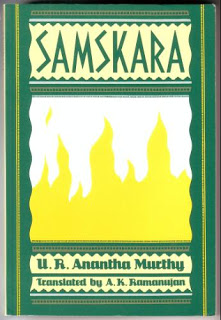
“Alive, Naranappa was an enemy; dead, a preventer of meals; as a corpse, a problem, a nuisance” (Murthy 3). The central issue of the book Samskara, by U. R. Anantha Murthy, revolves around the death of a Brahmin who broke all the rules and flaunted it. In Durvasapura, a village of supposedly orthodox Brahmin, Naranappa stood out as the exact opposite of everything a Brahmin should be. He was wild, partied, socialized and had sexual encounters with people outside of his caste, destroyed holy relics and ate sacred fish. In other words, he broke every taboo associated with being a Brahman. His behavior while alive seriously complicated the means of disposing of his body after death for all those around him. The fact that he died from plague and his corpse was a health hazard to the rest of the group seems to have gone completely unnoticed in this story. The focus, instead, is on the spiritual ramifications of dealing with Naranappa’s remains. Who is responsible for performing the rites, and should the rites be performed at all?
According to the leader of the Durvasapura Brahmin, Praneshacharya, the “Crest-Jewel of Vedic Learning,” a deceased Brahmin’s funeral rites should be performed by a relative or, in the absence of a relative, any Brahmin will do (Murthy 5-6). This would seem to solve the problem, since Naranappa has living relatives in the village. Unfortunately, he managed to alienate them all before dying. Naranappa and Garuda shared a common ancestor, but Garuda had quarreled with Naranappa’s father over ownership of an orchard. When Naranappa’s father died, Garuda attempted to gain possession of the orchard by receiving a ruling in his favor from a guru. Naranappa ignored the ruling and, according to Garuda, they swore they’d have nothing to do with each other for many generations after that. Lakshmana, Naranappa’s other relative, is married to the sister of Naranappa’s deceased wife. Lakshmana argues that Naranappa’s abandonment of the woman, and her subsequent insanity and death are things that he just cannot condone (Murthy 7). So, there are no relatives willing to perform the funeral rites. This causes the responsibility to shift to the Brahmin community as a whole.
Rather than create an easy opportunity to get Naranappa’s funeral rites done, this does nothing to solve the problem. Naranappa’s behavior has caused him to become polluted in the eyes of the Brahmin. Having anything to do with him would cause them to become polluted and lower their social and spiritual standing in society. According to Jonathan Haidt:
Hinduism very explicitly places all creatures onto a vertical dimension, running from the gods above, to the demons below. People rise and fall on this vertical dimension based on the degree to which they behave like gods or demons in this life. [1]
For high caste Hindus, proper behavior is regulated by The Laws of Manu. It tells them how to avoid becoming polluted and part of avoiding pollution is avoiding people who are lower on the vertical dimension, those who are impure. This is made evident at the very beginning of Samskara, when Praneshacharya mentally debates whether or not to answer the door for Chandri, since even speaking to her would pollute him and he’d have to wash again before dinner (Murthy 2). If speaking to someone from a lesser caste causes pollution, then certainly handling the dead body of a Brahmin who spit in the eye of Brahminism would be excessively polluting.
The Brahmin in Durvasapura are aware of the risks of pollution involved with performing funeral rites for Naranappa, and rather than take on that burden, they are intent on finding a way to avoid it, even at the cost of slightly tarnishing their Brahminism. Obviously, performing the funeral rites would be the greater evil, and the more polluting option. With that in mind, one of the Brahmin, Dasa, proposes that they ask the Bramin of Parijatapura to perform the funeral rites, on the grounds that they were friends with Naranappa and shared meals together (Murthy 12-13). This is important, because a person wouldn’t eat meals with someone that they consider polluting. Unfortunately for the Durvasapura Brahmin, the Parijatapura Brahmin understand the precariousness of their social standing and are unwilling to perform the rites. Praneshacharya says that “friendship is as strong a bond as blood,” but obviously the fear of pollution is the stronger force in society (Murthy 13).
With Naranappa’s body still lying unattended and no one volunteering to take responsibility for the funeral rites, the question of his status as a Brahmin is raised, perhaps in the hopes of pushing him off onto a lower caste. If Naranappa were declared to not be a Brahman, then it wouldn’t be required that a Brahmin perform his rites. Naranappa managed to break all the rules. He drank liquor, ate meat, socialized with Muslims, engaged in sexual relations with low caste women and destroyed sacred objects and animals. He completely threw out the concept of purity and pollution and even made remarks like, “If I were still a Brahmin…,” that indicate he clearly considered himself to be outside of the Brahmin caste (Murthy 23). But, was it enough to remove him from the caste system in the eyes of the greater Indian community? There is some social mobility in the caste system, in moving from one to the other, but is it possible to be removed from the Brahmin caste posthumously? According to Praneshacharya:
…he may have rejected brahminhood, but brahminhood never left him. No one ever excommunicated him officially. He didn’t die an outcaste; so he remains a brahmin in his death. Only another brahmin has any right to touch his body. (Murthy 9)
So, this brings things back around to the original problem. Naranappa died a Brahmin and must be given rites as a Brahmin, but because he’s extremely polluted, no one wants to perform them.
Despite the fact that Praneshacharya is a Crest-Jewel of Vedic Learning, he is unable to come to a conclusion regarding the disposal of Naranappa’s body, which is all the while rotting and literally polluting the entire agrahara with plague and a horrible stench. Without debating the reasons for Praneshacharya’s inability to make a decision, there are several options that were available to him, most of which he was aware of, and all of which he should have been aware of.
The first solution is one that is introduced at the beginning of the story, when the Brahmin first gather to discuss the funeral rites. Praneshacharya says:
Garuda said: an oath stands between him and Naranappa. Yet the Books of Law have ways of absolving such oaths—you can perform a rite of absolution, give away a cow, make a pilgrimage. But this is an expensive matter and I’ve no right to ask anyone to spend his money. (Murthy 9)
Immediately after saying this, Chandri offered up the gold that Naranappa had given her to pay for the expenses of the funeral rites. Why did Praneshacharya not state that the gold should be used to absolve the oath, as well as perform the rite? It would have remedied the situation immediately, and since the gold was freely given for that express purpose, then there was no harm in it, only inconvenience to Garuda. Would it have been polluting? Perhaps, but on the other hand, if Praneshacharya had given the advice, then Garuda could have rested easy in the knowledge that the best learned person in the community had told him it was right.
Another option available to Praneshacharya would have been to take the gold and perform the rites himself. As the head of the community, Praneshacharya is ultimately responsible for the well-being of all the agrahara’s inhabitants. To leave a rotting corpse lying unattended, spreading disease, while people bicker over fine points of doctrine is wholly irresponsible. Despite the pollution, he should have made the sacrifice for the greater good of the community. To balance out the pollution of performing the rites, he would have restored the normal flow of life in the agrahara, including the worship. Surely that counts as good. Additionally, he could have donated the rest of the gold to a temple.
Outside the context of the story, the translator indicates in the afterword that as a Crest-Jewel of Vedic Learning the answer to the problem should have been obvious to Praneshacharya. The translator says that the answer to the problem is found in a text called the Dharmasindhu. He says that “certain simple ritual modifications and offerings would have solved the problem, as the guru of Dharmasthala clearly suggests” (Murthy 145). In the story, Chandri’s gold made the funds that would likely be necessary for such ritual modifications available to Praneshacharya. Why didn’t he know about the Dharmasindhu? Well, the most likely answer is that Samskara wouldn’t have made for a very good story if he had known how to solve the problem before it began. Besides, the real conflict of Samskara isn’t so much about the inability to find a solution to performing the funeral rites for Naranappa as it is about a conflict between traditional religion and modern life, but that is not the topic of this essay.
In the sort of situation presented by the story, some amount of pollution was unavoidable. Praneshacharya should have realized this right from the start, and instead of trying to find a perfect way to solve the problem, he should instead have been looking for the least polluting solution. Resolving the problem would have saved the agrahara from the stench and complete disruption of their lives. It’s hard to believe that none of the villagers knew the danger of having a plague-killed corpse sitting in their village. Removing the body would have likely saved the lives of some of the brahmin as well. Taken together with providing the brahmin a way to resume their prayers, the pollution caused by performing the funeral rites would likely have been balanced out, whether the person that performed them was Praneshacharya or another brahmin.
[1] J. Haidt’s work is on a single web page. As such, no page numbers are available.
Works Cited
Lies My Teacher Told Me, An Excellent Call To Action
Lies My Teacher Told Me is a book that doesn’t try to correct everything wrong with our history, as portrayed in textbooks, but one that gives examples and then challenges the reader to take that information and use it in the future to find real truth in what we’re fed by public education institutions. The book encourages people to think about what they’re being told, why they’re being told it, and to consider how and when it was presented. It also offers a few intellectual tools for interpreting the information we’re presented with today, and how to understand why our history is relevant to our current situation. For example, why do so many people in the world hate the US? Is it because we’re just so damn good, like our textbooks would have us believe? Or is it because of actions in the past that are morally ambiguous at best, or completely contrary to the ideas our nation was founded on at worst?
One of the biggest problems Mr. Loewen presents, in regards to textbooks, is that they’re meaningless jumbles of facts, put together by a mass of authors (sometimes not even the ones on the covers). That jumble of meaningless factoids turn into a tome of confusing rubbish that leaves the potential learner entirely dissatisfied. While reading the book I kept thinking back to when I learned American history in high school. Honestly, it didn’t take long, because I don’t even remember learning American history in high school. This supports the information he presented which says that most students won’t even remember what they learned, mostly because of the way the information is presented. Mr. Loewen consistently reinforces the idea that history should be taught as a causal structure, both to make it interesting and to make it relevant. I completely agree. Up until recently I had no interest in history, because all I remember of what I was taught, in a middle school class that I only remember vaguely, was that it was horribly boring. We were presented with lots of names and dates and place names that we had to remember, and not much else. There was no content. There were no real people or real actions behind the factoids. We never focused on the ‘why’ of the situations, or the human aspect. Instead, we were forced to memorize these factoids and regurgitate them onto paper for tests. What does that teach me about history? That it’s boring and irrelevant to what I’m doing today, that the actions of the past and the people responsible for them don’t matter, and that it has no bearing on what I might do in the future. Nothing could be further from the truth. After taking a personal interest in history and learning on my own, I find history to be incredibly interesting. The things I read about are often situations that still occur today, or explain current problems. Not everyone takes a personal interest in history, though. Not everyone gets beyond that meaningless factoid stage and really tries to think about the ‘why’. They memorize, they regurgitate, and then they forget. That’s why high school history textbooks are a problem. They turn people off to history, leaving them without a firm foundation to stand on in when trying to forge a better future.
Another problem with textbooks that Mr. Loewen presents is the affect they have on maintaining the status quo, both on a personal, state, and national level. He goes into some detail about the textbook adoption process and how that process is affected. For example, Southern states have more often than not tried to make sure the textbooks that reach their classrooms are not overly negative in terms of the Civil War or slavery. Textbooks as a whole leave out information on Native Americans, the European diseases that left them decimated, or the forced relocations. Textbooks also continue to teach the primitive vs. advanced society theory, which has been debunked by recent research. High school history textbooks also perpetuate the idea of constant progress, even though the resurgence of racism against blacks during Reconstruction obviously was a step in the wrong direction. Textbooks try to avoid mentioning social class, religion, or anything that might be offensive. Who isn’t offended by something? History isn’t all peach blossoms and pleasant views. The truth is more important. We can’t learn from history if we’re only taught history that makes us feel good about ourselves, or that won’t offend anybody. Mr. Loewen argues that new work in fields like anthropology and sociology should be introduced into history textbooks to better inform students about how our history has affected who they are. Again, I agree. History as a set of facts is meaningless, especially when it’s a list of biased facts that don’t tell the whole story. History as a set of facts is also boring.
I think the biggest lesson that I can take from Mr. Loewen’s book is that any information, whether from a history textbook or a news article or a book, should be treated with caution, if not suspicion. Remembering who wrote it, when it was written and what was important to people at the time, what was important to the author and if it’s trying to push an agenda, all these things can help in keeping the information in context. When in doubt, consult primary sources to find the truth, or at least something closer to the truth. We’re all biased, one way or another, and the meaning of history is a matter of interpretation. For example, we can easily say that the US entered the Vietnam War, but why we entered the war and whether it was justified is a matter of opinion that can be supported only by finding facts and then forming them into a coherent argument.
History is a fascinating subject if you allow it to be. Real history isn’t the same as the meaningless factoids that you’ll find in a history textbook. It’s alive, it’s vivid, it’s emotional and it’s relevant to today. Besides teaching me some things about our history that I didn’t know (because I wasn’t taught properly), Mr. Loewen’s book taught me how to better study history.
Why I Love My Kindle, And Why I Don’t
Last year in October, I was given a Kindle 3 by my aunt in return for doing what turned out to be a LOT of yard work. Well, a lot more than I expected anyway. It’d been quite a few years since I’d lived anywhere that required yard work, so I wasn’t able to judge it properly.
Since then, I’ve used my Kindle fairly regularly. Whenever I commute here in the city, I keep it with me so I can spend my time doing something constructive, instead of staring blankly at the wall like so many of my fellow commuters. I’ve come to rely on it for entertainment, something I was reminded of today when I realized I left the house with a dead battery. My commute is about an hour both ways, so … ya, I was bored. There’s no cell phone signal in the subways here, so that meant I really had nothing to do but stare at the walls.
The Kindle 3 is light, very easy on the eyes, and makes reading fun again, especially since there’s so much available for free, but some recent events have caused me to see a few shortcomings.
The first problem is that there are still plenty of books being published that don’t have Kindle versions. Even worse, some books are published and the price of the Kindle version is higher than the price of the physical book. I understand that there are some costs that can’t be negated by simply producing a book as an e-text, but there should never be a time when an eBook costs anything near what the physical book does, since you’re cutting out the cost of the paper, printing and distribution. It’s obscene. An insult even.
The kicker that made me write this post, though, was a visit to Barnes & Noble at Union Square. I’ve been going there frequently looking for particular versions of books I need for classes I’m taking at CCNY. I don’t know what it is about physical books, but every time I go in there I find myself wanting to hold and touch them, and maybe just ‘adopt’ them all and bring them home. The cover art is something that can’t be reproduced well on a Kindle, or any eReader. You can’t touch it. You just can’t appreciate it the same way. I’m reminded of something my art history teacher said in class yesterday. He was talking about how people go to an art museum and instead of stopping to appreciate the art, they take a picture and move on quickly. He said that if that’s what you’re going to do, you might as well have just looked the images up on Google. It’s not the same experience. It’s also not the same experience as holding the book in your hands, or putting it on your shelf when you’re done with it. I suppose that desire to collect books is something that not everyone has, but I like to see my books sitting on a shelf, so I can be reminded of how good they are and maybe pick them up and leaf through them to my favorite parts again. Speaking of that, it’s really hard to scan through books on a Kindle, going back to re-examine material you read the a few days ago.
My conclusion is that a Kindle is still an awesome device that will encourage more people to read more often, myself included, but it has drawbacks. I think my Kindle is best suited for ‘light’ reading. You know, those books that you read purely for entertainment, the ones that you’re not worried about looking at again, because when you’re done with a Kindle book it gets lost in the list of available books on the device. For those books that I consider my favorites, or anything heavier that might require thought and retrospection, the books that I would want to flip back and forth through to better understand the ideas being expressed, a physical book can’t be beat.

