Now, I don’t really care all that much about ‘high fashion’ or brands, but this caught my eye because the first time I’d ever heard of Mango, or it’s MNG line of clothes, was in Singapore, where it’s apparently very desirable. Singapore in general is very fashion conscious and the malls are filled with high end boutiques.
I developed a particular distaste for Mango, not because of how the clothes look (I’ve never even been in the store, but the stuff in the online JCPenney catalog looks nice), but because we lived with a roommate during our first year in Singapore that talked about the brand non-stop. I’m sure you know the type of person I’m talking about. She wasn’t happy unless she was telling you about how great and fashionable Mango (or some other brand) is, and about how many items she has, like I gave a damn. It got to the point that when we’d pass a Mango store in the mall, either myself or my wife would say, “Look! It’s Mango!” The reply would usually be, “Fuck Mango.” Like I said, not because the brand is necessarily bad, but because we were tired of hearing about it and associated it with a bitch we didn’t like.
Anyway, in Singapore, and I presume other parts of Asia, Mango is a very desirable brand. If you have Mango stuff, you’re cool. I suppose that’s just not the case in the US, though. Maybe it just never caught on the same way it did in Singapore? Mango has a few stores here and there in NYC and on the West Coast, but I just don’t get that same ‘exclusive’ feel that I did before, knowing that Mango is carried at department store now.
Regardless, if you’re from Asia and you were wondering how to get Mango clothes in the US, you can get it from your nearest JCPenney now, or just order directly from the JCPenney online catalog.
(Note: This post is not sponsored by Mango in any way.)
As a not avid but long time smoker, something I enjoy about foreign airports is that their assholes aren’t so tightened by political stupidity that they’ve banned smoking rooms. I understand that non-smokers don’t want to inhale smoke, but I also think it’s wrong to punish smokers, or inconvenience them, for doing something that isn’t illegal. Singapore’s Changi Airport has smoking rooms. Japan’s Narita Airport has smoking rooms. Germany’s Frankfurt Airport has smoking rooms. NAIA in the Philippines doesn’t have a smoking room, but the Philippines tries to emulate all the laws the US passes, and that airport just sucks anyway, so it doesn’t count.
On a long-haul flight from Manila in the Philippines to New York City, that stop at Narita is a small blessing if you’re a smoker. I’ve gone through there twice, in different areas each time, and in both instances a smoking room was conveniently placed for people on short or long layovers.
The smoking rooms are completely closed in with tinted glass windows and doors that you open by pushing on a pad on the door, located where a handle would normally be. Inside is a vending machine, lots of benches, a television, cigarette butt receptacles / ashtrays and even a stand with car-style lighters for people who forgot those or couldn’t get their lighter through security at their point of origin.
When I sat down in the smoking room it had a really relaxing atmosphere. There was an assorted crowd inside that fluctuated constantly as people rushed in and rushed out to head to their gates. I saw Japanese businessmen talking in clipped tones, likely about some upcoming project, convention or deal. I saw airline attendants, Japanese and otherwise, enjoying their breaks. There were plenty of travelers, mostly Asian, lounging with dazed looks on their faces.
While there, a traveler that looked like he was from the Middle East was trying to give away a meal voucher he had. He asked me if I had time ‘til my next flight and told me about the voucher, asking if I wanted it. I only had a few minutes left by that point so I declined. It was odd, but he went around almost the whole room before running into someone that would take it from him. It’s possible that everyone had a connecting flight coming up shortly, but I think it’s more likely that most people just won’t take something free, because scams are so prevalent. No one wants to get suckered.
Narita as a whole is a very modern, attractive airport that reminded me of Changi and the airport in Kuala Lumpur. My only complaint about the place is that it didn’t have free wi-fi throughout the terminal, though I did find a wi-fi kiosk sponsored by Google. The catch was that after registering to use the service, you were presented with an advertisement encouraging you to download the latest version of Google’s browser, Chrome.
Leaving Narita and arriving at JFK in New York was like leaving a posh neighborhood and stepping into the projects. JFK even smells funny, but from what I’ve been told it’s common knowledge that the place is a dump in serious need of remodeling. One of the most interesting thing about Narita, though, are the toilets. Have a look for yourself:
These types of toilets are common in Japan. The one pictured above had a heated toilet seat and a sprayer that you could use to clean your backside. It also had a blow dryer that would dry your backside after it was sprayed clean. Even if I’d needed to use them, I don’t think I would, since it was a public toilet. I spent about five minutes looking at the toilet bowl from different angles, trying to figure out where the spray and blow drying would come from, but I gave up. If I ever have a chance to stay in a hotel in Japan, I might give it a try. Or France. I hear they’re used there too.
Passing through Narita is, overall, a pleasant experience with a clean environment, satisfactory amenities and interesting people watching opportunities.
This is another post about Marble, the cat I brought with me to New York City and gave to my mom. She’s done quite a bit of traveling and this last trip was hard on her, because she was in the plane for so long, but now she’s adjusting quite nicely. She seems to not mind being in an apartment or mind the noise of the city. Like one of my friends said, she’s a city girl at heart. She grew up in Singapore after all.
She’s still in that ‘adjustment’ period when it comes to my mom’s cat. They haven’t quite become friends yet. Marble doesn’t seem to want anything to do with him, but he’s been really aggressive and we have to keep an eye on him constantly. It seems like every time we turn our backs he’s trying to go after her. I’m sure that will stop after a while, but he’s been the lone king of this apartment for over a year, since his older brother passed away from old age. It’s typical cat behavior, not wanting to concede territory to another cat, but it still seems bizarre, because in human terms it would be like a retiree beating up a 10 year old child brought into his house by a relative. Marble is barely over a year old, so she’s still a young cat.
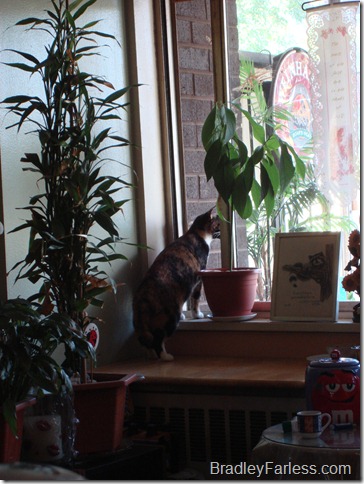
To that end, she’s taken to staying high up, where that big fat cat can’t reach her. She stays on an armchair next to me, or sits on the shelf over the radiator by the window. She really enjoys that spot because it lets her look out onto the street below. Sometimes she goes onto the balcony and sits on the freezer too.
So far I haven’t done much in the city except random errands, but I’ll definitely start posting some stuff soon. Tomorrow I want to write a bit about the flight from Manila to New York and Narita airport in Tokyo. To end this post, though, I’ll leave you with a not so good photo of the beast of a cat that my mom already had:
Now use the following photo for a size comparison:
Dapper, the cat on the left, is about the same size as Marble.
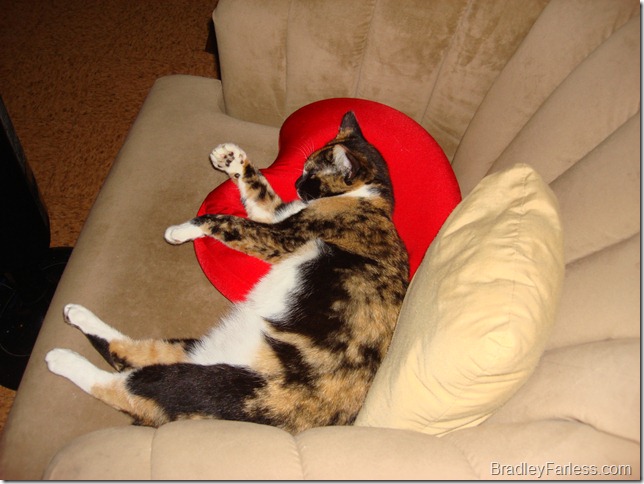
Meet Marble. Marble was born in Singapore, has lived in the Philippines and is sleeping in an armchair in Manhattan, New York City, in the above picture. She’s an international cat and probably has more Sky Miles than most human beings. She’s also a lucky cat, having started out her life as a stray under a building near the train station in Pasir Ris, Singapore. Now she lives a life of relative luxury on the other side of the world with canned food every day, lots of attention and love and a safe environment.
So, how did she get here? Well, it’s a long story, but first we exported her from Singapore to the Philippines and then when it was time to move on, we exported her again from the Philippines to the US. (If you want to read about how to get your cats from Singapore the Philippines, click here.) Compared to the process of getting Marble from Singapore the Philippines, bringing her to the US was relatively painless.
U.S. Requirements:
Just to give you an idea, the requirements set forth by the CDC (Center for Disease Control, which regulates animal imports) for bringing your pet cat into the US are that the cat has to be in apparent good health and, depending on the state of entry, updated on rabies shots. That’s it. Here’s the exact quote from the CDC’s page on cat importation:
A general certificate of health is not required by CDC for entry of pet cats into the United States, although some airlines or states may require them. However, pet cats are subject to inspection at ports of entry and may be denied entry into the United States if they have evidence of an infectious disease that can be transmitted to humans. If a cat appears to be ill, further examination by a licensed veterinarian at the owner’s expense might be required at the port of entry.
Cats are not required to have proof of rabies vaccination for importation into the United States. However, some states require vaccination of cats for rabies, so it is a good idea to check with state and local health authorities at your final destination.
All pet cats arriving in the state of Hawaii and the territory of Guam, even from the U.S. mainland, are subject to locally imposed quarantine requirements.
Philippines Bureau of Animal Industry – Image provided by commenter Lou Cep (1/26/2017)
So, here’s a step-by-step for what you’ll need to get your pet cat out of the Philippines:
When you book your flight, do it with a live person and inform them that you’ll be taking a pet cat with you on the flight. This is necessary, because not all planes are equipped to carry live animals. The fee for carrying pet cats is 200 USD each, flat rate. You pay this later. I’m not aware of any limit to the number of cats you can bring at one time, but I’m sure there is one.
Within 10 days of your flight, take your cat to a vet and have her updated on all shots. Depending on what state you go to, your cat may need a rabies shot. Also, regardless of US requirements, the BAI staff asked to see proof of rabies vaccination. Get your cat the other shots he or she should have anyway, because it’s just healthier that way and will help your cat avoid disease and live longer. Depending on what vet you use, costs may vary. Our cat had her rabies shot in Singapore in May, so it was still valid. Her feline leukopenia booster was 750 pesos.
Request a Veterinary Health Certificate. You may need to explain what this is and what it’s for and what it needs to say. The vet we went to didn’t seem to know, which isn’t surprising. Cats aren’t popular pets in the Philippines and I imagine exporting them to other countries by owners is rare. We paid 500 pesos for our Health Certificate at Our Lady of Assumption Dog and Cat Clinic – Antipolo:
Contact Person: Oscar Macenas
Address: Joren Building, Circumferential Road, Marville Park Subdivision, Antipolo, Rizal
Contact Numbers: (02) 697-1896, (02) 697-3378
Accreditation: Philippine Animal Hospital Association (PAHA)
Take your Veterinary Health Certificate (within 3 days of issue!!!) and your cat’s shot record, showing the valid rabies vaccination, to the BAI building on Visaya’s Avenue in Quezon City, Manila. Please note that BAI will only consider your veterinary health certificate valid for three days after issue. You must bring it to them within that timeframe. They’ll process your combo export permit/government health certificate in an hour or less. Take the form they give you and go around to the back of that building (to the left as you exit the door). Go into the building there on your left (there’s only one) and up to the 3rd floor to the records unit. They’ll put a ‘dry seal’ (raised notary seal) on your export permit. All of this is free. The forms you receive from the BAI will be valid for 10 days. (Confirmation that the veterinary health certificate is still only valid for 3 days after being issued and updated information on the length of time that the BAI documents are valid provided by commenter Lou Cep 1/26/2017).
Contact Person: Virgie Tiong or Maynard Lagmy
Address: National Veterinary Quarantine Services, Bureau of Animal Industry, Visayas Avenue, Diliman, Quezon City, Manila
UPDATE (1/15/2017): BAI now has a Facebook page with up-to-date contact information in the About section. Click Here.
When you get to the airport, check in as usual at Delta’s ticket counter. They’ll ask to see the documentation, make photocopies, and collect your pet there after you make your payment of 200 USD, which can be made in cash or by credit card. Delta doesn’t accept carry on pets on international flights.
Collect your pet in the baggage claim area at your destination airport.
Timeline for Rabies Vaccination (Updated 4/20/2017):
An animal can be considered immunized within 28 days after initial vaccination, when a peak rabies virus antibody titer is reached. An animal is considered currently vaccinated and immunized if the initial vaccination was administered at least 28 days previously or booster vaccinations have been administered in accordance with recommendations. Because a rapid anamnestic response is expected, an animal is considered currently vaccinated immediately after a booster vaccination.
So, what does that mean? If your pet is receiving its initial rabies vaccination, the pet won’t be considered inoculated until 28 days have passed. If your pet is receiving a booster shot, the CDC says the inoculation is considered valid immediately.
When I went through the export process, I remember there being some confusion about how much time had to pass between the vaccination and the export permit being issued. My cats had all been previously vaccinated and the vaccination was still considered valid.
Some rabies vaccinations are valid for one year, while others are valid for three. It depends on the type of vaccine used. Please check with your veterinarian to determine whether or not your pet(s’) vaccination against rabies is still valid. Please get the vaccination at least 30 days before your trip.
During the Flight:
You won’t see your pet during the flight at all, even if you have a layover. What comfort you will have comes in the form of little cards:
These cards come off of a form that is stuck to the side of your pet cat’s carrier. You’ll be given one by a flight attendant prior to the plane leaving the gate area. If you have a layover, you’ll be given another one before the plane takes off again. My flight was from Manila to Tokyo to New York, so I received two of them. The fact that it comes from the sticker form stuck to the carrier at the check in counter is what gives you the assurance that your pet is in fact on the plane.
If you’re wondering how a cat holds up under a plane for 20 hours, I would tell you that it depends on your cat’s temperament. Each cat is different and some are more skittish than others, but Marble was just fine. She was a little nervous and hid under the blanket I put in there for her, but that was about it. Please do leave a blanket in the carrier. Despite being air conditioned, the plane gets cold. My advice to anyone, though, is to not drug your cat prior to the flight. Besides the fact that it’s not healthy for the cat, if he or she looks dopey or messed up on arrival you may wind up with your cat being quarantined to make sure it’s not sick with some disease.
On Arrival at JFK International in New York City:
If you’re flying this exact route, you can collect your cat in JFK’s baggage claim area. Just past the baggage carousels, there is a locked door with a keypad. Above it, there is a light with a yellow cover. When a pet shows up on a flight, it’s taken to this room and the warning light is turned on to alert the owner that the cat (or dog) is available for pick-up. When I picked up my cat I wasn’t required to show any documentation at all, because Delta had copies that were likely handed over when the cat was unloaded.
I hope this guide gives you some insight into the process of getting your cat from the Philippines to the US! Below is a map showing the location of the BAI office on Visaya’s Avenue. If you have any questions, don’t hesitate to ask and I will answer to the best of my ability.
On my recent return to the US from the Philippines, I had to find a hotel in Manila to stay in for the night because it’s impractical to commute from Antipolo to make a 7:30 AM flight. Even if there was public transit at that time of the morning, it definitely wouldn’t be safe, especially when carrying a bunch of bags, so I booked a room at New Horizons hotel in Manila.
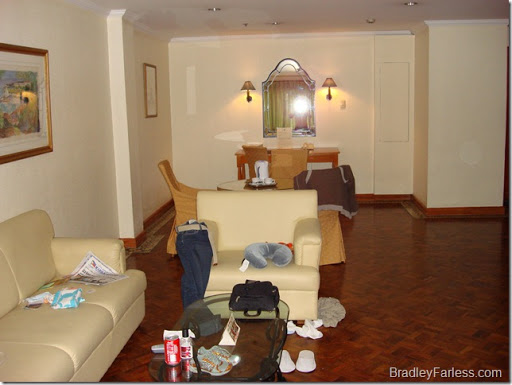
This hallway goes to the bedroom, which I forgot to take a photo of. It is about the same size as the living room area as seen in the 3rd photo.
My wife and I have stayed in New Horizons before in 2008 so it was a natural choice. We enjoyed the service on our last visit, so we wanted to go back again. The first time we were there we got the Deluxe Suite which was as big or bigger than some apartments we’ve lived in. The rate was really good on that too, only 85 USD* per night. This time, though, we were only going to be in the hotel for about 14 hours, so it just didn’t make sense to go all out on a spacious room. Instead, we got their ‘Superior’ room, which is the smallest one and goes for 60 USD* per night. Even though it’s their smallest, it was still really spacious. It was way better than what I’d expected.
I reserved a room online and made the required 10% deposit. When we checked in I was a bit surprised but the girl at the desk knew that I’d stayed there in 2008. When you check in, you pay up front rather than after. I don’t think I’ve ever stayed in a hotel where you pay after. Instead of offering me my change, the girl asked if it would be alright to hold the balance at the desk until we left, to be used against any items we took from the mini bar. I didn’t care too much and we did wind up raiding the mini bar. The drinks in there are actually well priced and they were really cold.
Don’t mind my underwear. I swear I wasn’t naked while taking these photos!
Cigarette smoke ruins so many good photos…
The bathroom in this room is set up the same way as the bathroom in the Deluxe Suite. It’s spacious, comfortable and the water runs warm, but not really hot.
As you can see from the last photo above, we had our cat with us. It’s not normally allowed, but I worked out an exception with the manager prior to booking by asking politely and agreeing to pay any damages she might cause. We kept an eye on her and she was a good girl. Thankfully she didn’t go nuts on that fake leather couch.
Like I said, the room was comfortable. The air conditioning got good and cold. The room service was decent and well priced and the cable TV was fun. If you’re considering staying at this place, it’s well worth it, and it’s close to an MRT line. You can walk out of the hotel and be in the train station in about 15 minutes, counting the time it takes to get your ticket. It’s a few short stops from Megamall and there are restaurants all around it. Despite being right along EDSA (a highway) the rooms are quiet at night. Broadband Internet was optional for the room as well.
They did us a good favor by letting us have Marble there overnight and the place is nice anyway, so we’ll definitely be using them again in the future. I’m planning on making more trips to the Philippines to visit my wife until she’s ready to follow me to the US.
*Note: The rates are showing up at 5 dollars more than they were when I checked them last week. I’m not sure if that’s a permanent increase or not, but it may have something to do with the fact that they’re in the process of renovating the rooms. The room we stayed in this time wasn’t renovated yet.
This artfully rendered version of Pegasus, the mythological flying horse, was created by students (I imagine the art majors) from the University of Santo Tomas and is on display in Gateway mall in Cubao, Manila.
I thought it would be fitting to post this today, as a scheduled post, since I’ll be flying myself, likely somewhere above Alaska or the nearby Pacific Ocean when this goes live.
Fare the well, Philippines. I’ll write a longer post about my final impressions of the Philippines later.
Do people actually do this in any other country? I’ve never heard of it before. Is it strictly a Catholic thing?
In the image above, you can see a group of people gathered around a new vehicle. The man in the white top and black pants is a priest, probably from the nearby Our Lady of Peace Cathedral, which is a popular pilgrimage destination for people who are about to embark on trips.
I’m not sure if there’s a process to this, if different parts of the vehicle are blessed at different times and I just stumbled across them as they were getting to the engine, or if having the hood raised and the engine running is just the standard way of having a vehicle blessed.
As weird as this seems, it makes sense in a way, and makes sense that they’d come to the Cathedral that’s known as a place for travelers to receive blessings to have it done.
If you stumbled across this post looking for information about how to get your car blessed at the Cathedral, click this link and then scroll to the bottom of the post to see a picture of the sign showing the hours for car blessings, as well as contact numbers.
My wife once told me that Christmas comes early in the Philippines. She didn’t mean that the date it’s celebrated is any different than any other place, but just that people get into the Christmas spirit earlier than usual.
Where I’m from, the shopping spirit hits a bit early, but that real Christmas spirit doesn’t seem to catch on until at least the day after Thanksgiving. Obviously, there is no Thanksgiving in the Philippines and while Halloween (trick-or-treating) is celebrated in some posh villages, Christmas is something that most every Filipino gets behind quickly and early. I think it’s probably because it’s associated with the birth of Christ, and the Philippines has the highest population of Catholics of any country in the world. It may also have something to do with the poor conditions in the country. I’m sure a lot of families are looking for an excuse to feel cheerful about something.
As early as last week, we’ve been hearing Christmas songs playing on the speaker systems in some of the malls. I even saw Christmas decorations for sale already, including plastic trees.
My wife says the rule of thumb in the Philippines is that if the month ends in “-ber”, then people will start looking forward to Christmas and set up decorations, some of which will remain up until February, if not all year round.
Getting Marble’s export permit was a bit difficult, but not because of the process itself. It was getting there that was annoying. Before we headed down to the BAI, we had to stop by the vet to pick up her health certificate. The vet didn’t have a printer in the office so we couldn’t get it on the spot. The problem with that is that the vet is sort of out of the way when it comes to getting transportation to Manila from Antipolo. It is on the road that leads out of town though, so instead of backtracking to the center of town to get an air conditioned FX (a passenger SUV that’s been converted for public transportation) we walked out to the curb and flagged down a Jeepney instead. Thankfully, it was overcast and kinda cool with the breeze since the windows stay open in the passenger area except when it’s raining. Unfortunately, that also meant we got dusty and had black boogers later.
After a tricycle to the vet, a jeepney to Manila, the train to Quezon Ave and then 2 more Jeepney’s to Visaya Avenue by the Quezon Memorial, we finally arrived at our destination.
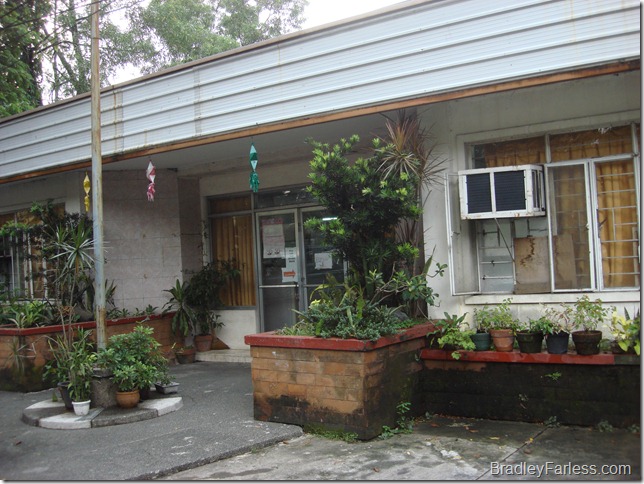
The Bureau of Animal Industry, National Veterinary Quarantine Services building.
After seeing the AVA’s offices in the Ministry of National Development building in Singapore, I was a bit underwhelmed by the appearance of the building, but I suppose it’s no worse than some of the building’s I’ve seen used as government offices in the US.
Despite the appearance of this place, the people inside were very efficient and very friendly. The e-mail I’d received from one of the people that works there said the wait time for the export permit was about an hour, but I had everything I needed and was out the door in about 20 minutes. I did have to go around the back of the building to get a dry notary seal stamped into the form, but that only added another 10 minutes, most of which was walking.
Vet health certificate, BAI health certificate and export permit, plus shot records.
The best part of it was that I got the export permit and they converted the veterinary health certificate to a government health certificate (which I didn’t expect), all for the low, low price of free. That’s surprising. The import permit was 650 PHP (about 15 USD). The export permit fee and the fee for the government health certificate in Singapore were 50 SGD (about 38 USD) apiece. I guess that’s how they paid for that big fancy building.
With this out of the way, the only thing left to do with Marble is to stick her in a carrier and show up at the airport with her. I do have to find a hotel that will let me stay there with her in Manila for the night before the flight though. It’s at 7:30 in the morning and it’s impossible to make the commute to Manila at 3:30 AM (it’s 2 hours one way, roughly).
UPDATE (2016): BAI Philippines has a Facebook page with updated contact information available. Click here.
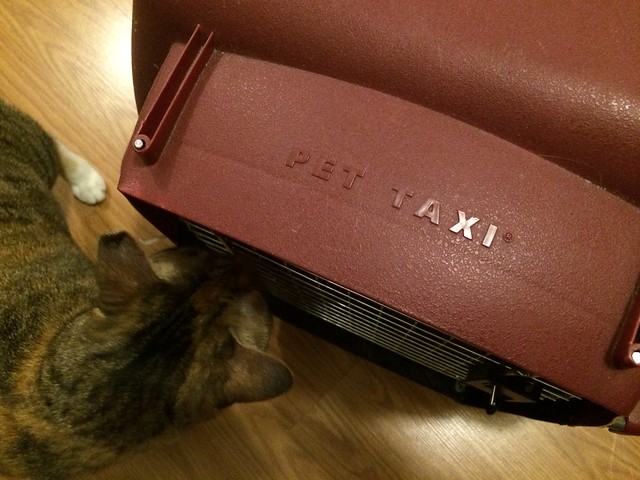
Update (2017): This is a Flickr slideshow of pictures of the cat carrier my wife used in 2011 to bring two cats from the Philippines to New York City. Please note the bolts that were added to the carrier after-market. Make sure you do that. Also, zip-ties were added at the built-in latch points to further secure the carrier. I would bring zip-ties to the airport so that you can secure the door after the airport personnel are satisfied that they don’t have to open the door. Include a bowl for water and food. Ask that your pet be provided with water. Put blankets in the carrier so your pet(s) can stay warm.
Most importantly, keep this as your second or last option. Check with your airline to see if you can bring your pet in the cabin with you in a smaller pet carrier. Check with your airline for permission and/or requirements and fees.