Spring Kyushu Fair

These are pictures from the Spring Kyushu Fair held in late March to early April of this year in Singapore.  This is what I meant about being agitated about not having a Japan blog, because I should have posted them then.  This is a bit dated, but I thought it was worth sharing anyway!

Singapore (Random) - 413

The fair’s banner was hanging in the center section of the Tampines Mall.  Tampines Mall is set up as round levels with an open center.

Singapore (Random) - 414 

This is the view from above, from I think the third floor.  The fair was set up in the middle of the mall and was jam packed with people every single day.

Singapore (Random) - 415

I was shocked at how expensive these arus melons from Miyazaki were.  If you look at the blue text on the sign you can see that 49 SGD was already the marked down price from their usual 60 SGD.  I think we went on the last day of the fair.  I tried to do a little research on the melon but there’s little available, through Google anyway.  What I did find says that the arus melon is considered “The King of Japanese Fruits” and is highly sought after as a gift for its fragrance, beautifully netted skin and great taste.

Singapore (Random) - 416

There was a booth selling selections of fine tea.  I kinda wish I’d bought some now that I look at the photo.

Singapore (Random) - 417

Singapore (Random) - 418

Photos of the crowds and some of the booths.

Singapore (Random) - 419

A lot of the booths were doing cooking on the spot, like this booth, where a girl was preparing takoyaki balls.

Singapore (Random) - 420

And what Japan fair would be complete without a booth selling sake?  The sake he was holding was actually really, really good and I wanted a bottle of it but he had already sold out.  He didn’t mind letting me have a few shots from the sample bottle though, which was pretty cool of him.  We wound up getting a sparkling rose sake for my wife, but got so busy with getting ready for our trip to the Philippines at the beginning of May that we we gave it away as a gift instead.

I’m looking forward to visiting another Japan-related Fair.  Hopefully there’ll be one in Manila sometime soon!

Using Geisha Imagery To Sell Modern Products

The following image is of a soap that appears to be popular in the Philippines, where most women (and quite a few of them men) are obsessed with whitening their skin and maintaining a fair complexion.  The image of a painted geisha face very effectively communicates the idea of a fair complexion and the purpose of the soap.

DSC04776

It also puts across the idea that by using the soap you will be sophisticated, artistic and elite, which are all qualities possessed by true Japanese geisha.  Contrary to what most people believe, the highest class of geisha do not sell sex but are instead entertainers who sell their skills with instruments, gaming and conversation to high class clientele like politicians and wealthy businessmen.

The Manananggal Demon, A Filipino Superstition

This morning I saw something bizarre going on up the street.  The men of a family were holding machetes and were busy chopping the branches off trees in their yard and shaving them down.

DSC05210

My father-in-law was outside and when I asked him what was going on, he said that they thought they saw a manananggal last night.  He then told me that the manananggal is a demon that comes in the form of a good looking woman with wings.  When it flies, the torso separates from the legs at the abdomen, so basically it’s like a half of a woman flying around bare-chested.

Like western vampires, the manananggal avoids light and garlic.  Additionally, they don’t much care for salt, daggers, vinegar, spices, or the tail of a stingray which has been fashioned into a whip.  Also like vampires, the manananggal likes blood, but prefers to use a proboscis tongue to suck the heart of a fetus still in the womb.  Not quite as watered down as Edward Cullen is it?

There used to be images of manananggal and aswang here, but I had to remove them because they’re apparently too shocking for Google and they were counted as Google Adsense policy violations.

I’m not sure where cutting trees down comes in, but perhaps they wanted to reduce the amount of places that the manananggal could hide, so they could better see it coming.  Either way, it’s an interesting superstition with a lot of parallels to Western superstitions.  It’s just odd to see people so actively taking measures against it.  Most superstitions in the West are only believed by children.

Update: February 25, 2019
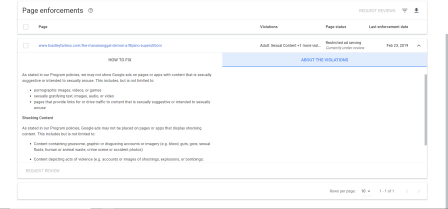
A screenshot of Google's policy enforcement violation list for this page.
A screenshot of Google’s policy enforcement violation list for this page.

Who knew a drawn image of a mythological creature could be a violation of Google’s Adsense policies? I wonder if the same restriction is applied to images of Sirens or Medusa?

But what’s really odd about the violation is that it suggests that someone would be sexually aroused by the upper torso of a woman with bat wings, or that the manananggal is intended to be sexually seductive when, in fact, it’s meant to be horrific and terrifying. Maybe some people are into that sort of thing, but intent has to count for more than one person’s perception or we’d never be able to say or do anything about anything.

That being said, the images were kind of shocking, which is a violation of Google’s Adsense policy apparently. But, again, it’s a mythological creature that’s supposed to be scary. How can a topic of this sort not be ok? I don’t get it. We’re not allowed to have scary stuff next to Google Ads? It’s history and it’s folklore and it has a purpose and should be talked about and depicted and remembered.

But, what are you going to do? One person has a problem and reports your page so you have to make changes. So, the images are censored heavily now. Hopefully, the censorship is heavy enough to be ok with Google’s review team.

Update: April 3, 2020

I came back and removed the images entirely. The page was reported again for “shocking content”. I can only assume that’s the images, because God forbid history and folklore should be considered too shocking to be monetized.

Rapists on the Rooves

DSC05206

Not quite what you were expecting, is it?

I don’t know the name of those cats, but we call the black and white one Rapist #1 and the orange one Rapist #2.  It was actually my sister-in-law that came up with those names.

There are a few female cats in the house here.  Common knowledge about spaying to control breeding isn’t quite as common here as it is in other parts of the world, so none of them have been ‘fixed’.  Also, the way the houses are constructed here often leaves openings where gates have been installed rather than doors, so it’s pretty easy for male cats to make their way into a house.

The first time I saw them I wasn’t sure why they were there.  I had to ask if my in-laws had picked up new cats, but that’s when they told me that they’re the rapists that are always getting the house cats pregnant.

So, I’ve been trying to take measures to keep them out.  I put mesh over the gates by the kitchen and I try to keep the doors closed, but since there’s a big wall in the backyard, people often leave the back gate open anyway.  So, I’m constantly shooing them out.  Or throwing slippers at them to get them to run.

Making things even more complicated is the fact that there’s an old female cat living here.  Rapist #2 looks just like her, except for the balls.  I’ve gotten to where I can tell them apart on first glance, but at first I had to double check to see if it was the rapist or Glory, the orange cat that lives here.

Eventually, I want to get the cats in this house spayed.  There are even free ‘spay days’, or so I’ve heard.  That’ll have to wait though.  First off, I want to get a steady income before worrying about transporting these cats into the city for spaying.  Second, two of them are taking care of kittens and one of them might be pregnant again.

Getting kittens adopted out is hard work…

Typical Treatment of Family Members Returning From Overseas

I’m sure not every American’s experience is the same, but when I go home to visit family, events usually play out in pretty much the same fashion.  I’m sure most people would recognize this as their typical experience as well.  You call ahead to let them know you’re coming home.  When you arrive, you can see that the house has been cleaned.  Your family will welcome you and tell you to go ahead and get comfortable.  A room and bed have been prepared for your arrival and after you put away your luggage you get something to drink, maybe something to eat, and then you join your relatives in the den (or living room) to trade stories and talk about whatever interests you.  Typically you’re treated to dinner, maybe even more than once depending on how many family members live in the area.

Well, that’s about how it goes for me.  I know from lots of experience.  I spent quite a few years away from home while in the Army and I’m away from home now.  Before that, when I was still a kid, my dad was in the military as well.  So, coming home for visits is something I’ve been doing all of my life.  It’s always an exciting time, when I can look forward to getting some good quality rest and relaxation.  In other words, when you come home to visit, the visit is all about you and making you welcome and comfortable.  Your family wants to make sure you enjoy your stay.

Before I go on, I want to say that what follows isn’t necessarily my experience.  This is just a typical behavior for Filipinos.  I count myself lucky.  I have a great set of in-laws.  One of my brother-in-laws even flew up from the southern islands to spend a little time with me before we left on a previous trip.

A common habit of Filipinos, when greeting a returning family member, especially one that comes from abroad is almost completely opposite that of the American way of doing things.  Where the American return home is all about making the visitor comfortable, the Filipino return home is all about making the family comfortable.  Like I said, this is most often the case when that family member is returning from an overseas location where they’ve been living.

Upon arrival, there may be a place set up for that family member to sleep.  However, the responsibility of filling the fridge will fall on the guest.  Depending on the length of stay, other financial burdens may be placed on the guest, such as utility bills.  Beyond this, the family will expect hand-outs, usually in the form of cash or gifts, from the guest.  In the local language, Tagalog, it’s called ‘pasalubong’, a gift given when returning home.  It doesn’t just apply to this situation though.  It’s often the case that parents will bring home a snack or candy for children when returning from work.  That counts too, but in this case the pasalubong is more of an expectation than a gift.  If that expectation isn’t met, tension is immediately created.  If the guest doesn’t step up to cover bills or other expenses, such as purchasing new household items, then family members immediately assume that the guest is stingy and is holding out on them.  This is because Filipinos almost all believe that if a person is overseas then they’re living the good life and have plenty of money to burn.  Those of us that live in those other countries, Filipino migrant workers, or those that have traveled extensively likely know otherwise, but that is a common misconception in the Philippines.  Also, the poorer the family, the more they expect from their returning relative.

This habit of sponging off of returning overseas workers isn’t restricted to family members.  There are people who will make it a point to call up friends who have returned from overseas, to ‘catch up’, and will then impose on that friend to treat them to lunch at an expensive restaurant.  This isn’t just a guess.  I’ve heard first-hand accounts of this happening from various people, as well as second-hand accounts.

The result of this is a lot of hard feelings between family members and returning visitors.  Returning family members may feel unduly put upon, especially if their salary overseas is just enough to keep them living a moderate lifestyle while putting a bit in the bank to invest in their own future.  Family members on the other hand, due to ignorance, may wind up feeling snubbed or abandoned.

As a consequence, I’ve heard of quite a few Filipinos that don’t inform their family members that they’re coming back to the Philippines when they return for vacation.  They don’t want to feel saddled with financial responsibilities on their vacations and instead get a hotel room and just hang out with friends, shop, relax and have fun, which is really what a vacation should be all about.

Over time, I’m sure this problem will be remedied through education and experience, but that’s probably a long time in coming.  For now, most Filipinos believe that a person living overseas has plenty of wealth that should be spread around when they come to visit.

Carabao Chicharon

Since moving overseas I’ve made it a point to try to be more adventurous in what I eat.  There are certain things that I still can’t bring myself to try, like balot, but I’ve just added something new to my list of snacked-on animals: carabao.  This is sort of cheating, because it wasn’t a carabao steak or anything like that, but it was still a carabao product.

CHICHA-RABAO

What I had was carabao chicharon.  Chicharon is a Tagalog word, borrowed from Spanish, that is the same thing as pork rinds or pork cracklins (sp?) in the US.

It tasted great!  Better than the other kinds I’ve had before, and as far as this type of food goes, it’s supposedly more healthy.

It was served with a vinegar and minced garlic dip which really made it taste great.

How I Got a 1 Year Visa For Free in the Philippines

When I entered the Philippines on June 1st I entered with a tourist visa stamp with the intention of filing for a resident visa and possibly extensions to hold me over until it was approved.  When we went to the Bureau of Immigration satellite office in Makati, however, we were told that filing for a resident visa can take up to 3 months.  Extensions might not cut it and it would be costly, so we asked for advice.  The lady at the office asked us if we were married and if we’d entered the country together along with a copy of our marriage contract.  We said we had, so she asked us why we hadn’t availed of the ‘balikbayan’ privelege.

We had no clue what a balikbayan visa was.  We hadn’t seen anything about it on the Bureau of Immigration site while researching visas.  It might be there, but since it’s so unusual a phrase, I might have overlooked it.  She told us that since my wife had been out of the country for over a year and was an OFW (Overseas Foreign Worker), I, as her spouse, qualified for a 1 year balikbayan visa.  She said that we should have approached the immigration counter at NAIA together when we first arrived and I would have received the visa with no problem.  Oh, and I’m not sure how this works but the balikbayan visa isn’t actually a visa.  I don’t know what you would call it.  Also, the best part is that it’s completely free.

Here are the exact requirements to qualify:

  1. Former Philippine citizens (including Filipinos who have become naturalized U.S. citizens, and citizens of the Bahamas, Bermuda and other countries within the jurisdiction of the Embassy of Washington, D.C.); Also eligible are Filipino citizens living overseas. A typical situation is that the Filipino visitor to the Philippines is not yet a foreign citizen, but he or she has an immigration card from a foreign nation [such as a “green card” in the USA].
  2. Foreign spouses and minor foreign unmarried children of Filipinos and former Filipino citizens.

Since we didn’t get the visa at the airport, we had to take a few extra steps.  We wound up having to make a trip to the main office of the Bureau of Immigration in Intramuros, an area of Manila that used to be home to the Spaniards during the colonial period.  Once there we approached the information desk and stated our case.  The clerk at the desk told us to proceed to the Immigration Regulation division on the 3rd floor where we again stated our case to the Immigration Officer who helped us.

Since we didn’t follow the steps appropriately, it was within the discretion of the Immigration Officer to tell us to leave the country and then return to get the balikbayan visa, but we were polite and had our documents ready so she was more than happy to help us out.  She had us fill out a form requesting the change and then made a notation on my passport visa page, amending the tourist 21 day visa stamp to a balikbayan visa.

DSC05203

So, now I can stay in the Philippines for up to 1 year at no charge, which gives me more than ample time to apply for the resident visa at my convenience.  Living in the Philippines comes with a cascading torrent of fees, but for once the system worked in our favor without costing us a few thousand pesos.

If you’re planning on coming to the Philippines and you qualify for this, save yourself some time and get it done right at the airport.  Just remember that you have to arrive together, approach the desk together, have your passports (obviously) and your valid marriage contract.  If however, you’re already here and didn’t know about this, hopefully this post will give you an idea of how to get it amended.

Good luck!

The iPad 3G is for sale in Manila, but WTF?

While we were out in Manila last night at Megamall we wandered into the electronics area to find some speakers for my laptop.  Some of the ‘specially priced’ movies we’ve been picking up have low volume so we needed something to give it a bit of a boost.  While we were there we saw this in the window:

IMG_0096

The iPad3G is a pretty neat item.  I personally have no desire to get one.  I still think of it as nothing more than a giant iPod Touch.  Plus, it doesn’t really match up with life in the Philippines.  Walking around with something like that in your hand would make you an impressive… target.  Ya.  People would see that and that incident where the guy got his fingers ripped off while his iPad was being stolen would seem tame by comparison.

Anyway, what prompted me to take the photo was the price tag.  The iPad isn’t being sold here officially, that I know of anyway, so the hand-imported ones are selling for higher than what they should.  The price on that iPad is 59,950 PHP, or approximately 1,290 USD.  Electronics in the Philippines typically carry a higher price tag.  I think they’re highly taxed by the government, but this is just over the top.

The next ‘toy’ that I shell out money for will probably be the iPhone 5 next year, if even that.  I’ve had to rearrange my priorities since coming here and I can think of plenty of other things I could spend that money on.  My trusty iPhone 3G will just have to keep chugging along for a few more years.

Squatters in Manila

Something I noticed on my first visit to the Philippines two years ago was that people seem to live anywhere there’s room enough to set up shelter.  I thought that there must be no sort of zoning regulations or building codes, both of which would prevent this sort of thing in the US.  I still don’t know if there are building codes and zoning regulations in the Philippines, but I know why there are houses everywhere.  People just do what they want to do and because so many of them do it, it’s too costly for the government to try to stop it; they just ignore it instead.  This has led to a class of people who are locally called ‘squatters’, at least in English.

Squatters are people who don’t own the land they’re living on.  They have no legal agreement, tenancy or title, or anything of the sort.  They just see an area that looks like a good spot for a house (or in some cases just a ramshackle shelter) and they start building with whatever they have the means to afford or acquire.

No area is off-limits to squatters, in their own minds at least.  If there’s a 10 feet of ledge along the top of a sharp ridge by the road, they’ll build on it.  If there’s a space under a bridge, they’ll build on it.  If there’s an empty lot near a major mall that’s not being patrolled regularly, they’ll build on it.

What you wind up with, at least in Manila itself, is something that looks like this:

DSC05160

I don’t remember the name of the area where I took this photo.  It’s where two major train lines intersect and you pass between them using a covered walkway.  One of the protective grills was missing so it gave me the perfect spot to take a photo.  The squatters homes are made of pretty much anything they can find and put to use.

The most bizarre thing about squatters is that they have electricity.  Some of them even have air conditioners and they usually have running water too.  In the interests of earning money, the utility companies in Manila have done installations to provide them with their basic needs, further legitimizing their claims to their homes, and the land they sit on.  Imagine being a politician and trying to shut down all of the areas like this in Manila.  Imagine the public outcry over the ‘inhumanity’ of it.  So, despite the fact that these people don’t own the land, it’s not likely they’ll be removed any time soon.

Fort Santiago, Intramuros, Manila, Philippines

DSC05056

The Intramuros area of Manila is actually pretty big.  There are still sections of the original wall wall running through the city, complete with rusty cannons and stone guardhouses, which people can still walk on.  These areas aren’t maintained well, though they’re kept relatively clean.  The inner area of the wall seems to have been converted into mostly tertiary schools, souvenir shops, restaurants and a few businesses.  We didn’t wander the walls or the greater Intramuros area during this trip; we went straight to Fort Santiago.

DSC05086

Fort Santiago is the site of the oldest military compound in the Philippines and has been attacked, destroyed, rebuilt and used by the Spaniards, Filipinos, British, Americans and the Japanese during various wars and occupations.  It’s purpose has been both noble and terrible as a site for national defense and the scene of a major massacre.  Currently, the area is in varying states of repair, with some areas looking well manicured and others crumbling with every gust of wind.  You can see where some structures have been shored up with improved technology over the centuries, like a few steel braces and beams we saw on the original red brick Spanish military barracks which was originally built in 1593.

DSC05060

DSC05061

DSC05149

Before entering Fort Santiago proper, there is a well manicured area that must have been rebuilt to give you a sense of what the area looked like in its prime, under Spanish control.  It’s really quite nice.  There are also a few cafes and gift shops in this area, as well as a partially restored warehouse that was used for storing goods brought in off ships.

DSC05074

DSC05079

There are still a few ugly ducklings around that need some attention and restoration, but I saw plenty of construction material positioned alongside and in front of them, so at some point these should be fixed up nicely.  I’m especially curious as to what the second building was for.  It looks like a residence.  A rough guess is that it belonged to the owner of the shipping warehouse across the plaza.  Some of the chips on the walls look like they were caused by bullets though, so perhaps at some point a group of soldiers tried to use it for a makeshift defense.

DSC05084

DSC05083

To enter Fort Santiago proper, you have to cross a moat using the original bridge.

DSC05088

DSC05089

Flanking both sides of the gate are relief carvings of what look like Spanish soldiers.  They’ve both been heavily damaged, perhaps through intentional defacing by angry Filipinos who resented Spanish rule.

DSC05090

These red brick ruins are all that’s left of the barracks built by the original Spanish soldiers in 1593.  During the American period they were used by military officers and their families.  The building was destroyed during World War II.

DSC05112

DSC05117

The two holes in the first image, and a few others like it, were placed along the waterfront area of the fort, by the Pasig River.  When we first saw them my wife said they looked like places for holding prisoners.  I looked down in one and saw that it had a tunnel that led back into the fort so I guessed that it was a powder and munitions storage area.  Turns out we were both right.

DSC05120

The Spaniards originally used the area as storage vaults for munitions and powder, but it was too damp to suit their needs.  They built a new storage area further away from the river and turned it into a dungeon for prisoners.  This area would later be used by the Japanese to imprison and torture Filipino and American guerrillas, civilians and POWs.

Just past that sign I’m standing in front of in that picture there’s an opening that leads down into the lower level.  It was locked up.  I’m guessing it was damaged during the Ondoy disaster last year and hasn’t been reopened to the public yet, which is a shame because it would have been very cool to get a first-hand look at something with so much historical significance.  I’ll have to find out who to annoy into reopening the area.

Since I couldn’t go in, I stuck my arm down through the opening and took a few pictures with my camera.  When I got home later and transferred the images to my laptop, this is what I saw:

DSC05121

Notice anything odd about that image?  Here are two more that I took from different angles:

DSC05122

DSC05123

That’s just a tad bit creepy right?  I think it must be a statue, because later I saw bronze statues through an opening in another closed off area, but those were all one solid color.  This one has different colored clothing on and a more natural looking skin tone.  The area is creepy anyway, because the Japanese massacred 600 people in there at the end of the war:

DSC05128

DSC05129

The whole Fort has a pretty heavy atmosphere.  A lot of lives were lost in that small area and during the majority of its existence it has been used as a stronghold for a foreign military on Filipino soil.  As we walked through I couldn’t help but imagine the way things must have been in the past, what the soldiers must have done, both good and bad, or how the Filipinos felt when they saw the walls.  I spent some time in the US military so I wasn’t imagining ‘glorious battle’.  I was just wondering at the daily routines.  What did they eat?  Where did they eat?  I wondered how they’d adjusted to the heat and if they ever flicked cigarette butts over the wall into the river.  I wondered where they used the toilet.  The simple stuff that often gets overlooked in action movies.

Fort Santiago is well worth a visit and I’m looking forward to going again when more areas are open to the public.  Besides the dungeons, the actual building Jose Rizal (the Philippines national hero) was imprisoned in as well as a walkway down by the river were blocked to the public.  I still think it must be due to last year’s Ondoy storm damage so I’ll keep my fingers crossed for a reopening sometime in the next few years.

Note: In this post I deliberately avoided talking about Jose Rizal, though his presence in the fort does play a large part in the nation’s history.  The reasons for that are that I don’t know enough about him to discuss him yet and I focused on the areas that interested me or had significance to me as an American.  The fort has a very nice Jose Rizal museum which you can take a look at if you have an interest in that aspect of Filipino history.  I’ll be posting about Jose Rizal in the future when I’ve heard about and read up on him more.