Poor Viewing Areas For 4th of July 2012 Fireworks in New York City

Years ago, the fireworks show on July 4th used to be held on the East River.  I remember going there and standing on the elevated highway.  The view was amazing!  It was also real close to where my mother’s apartment is.  If we wanted to, we could have just gone to the roof, but going to the river and watching it with the crowd was a lot more exciting.

This was my wife’s first 4th of July and I wanted to make sure we got a chance to see some fireworks.  I was excited too.  The websites and news reports I’d seen said that 40,000 fireworks were going to be shot off, total.  I imagine that includes the ones that don’t really go up and pop, but look like they’re spraying upwards from the boat.  Anyway, it sounded like it was going to be awesome, so we planned to spend the day out in the city and end the day with fireworks.

The Pond at Central Park
The Pond at Central Park (Yes, “The Pond”)

We did a little shopping and then bought some water before walking through the lower portion of Central Park and heading over to the river.  We were in high spirits until we saw the way the crowds were being managed for fireworks viewing.  To be blunt, it was done in an obscenely stupid way that left me with the impression that the city didn’t care if the average resident or tourist could see what was going on; it was set up to make everything as convenient as possible for VIPs who paid upwards of 200 dollars for private parties on the piers and in the park that runs along the riverfront.  You know, that area where people normally jog.

The 'view' at 59th Street
The ‘view’ at 59th Street. The viewing area was placed behind the row of trees that divides the highway, instead of on the side closer to the river, and behind the pier structure which blocks the skyline.

We started out at 59th street.  To get down to the river, you have to go through a checkpoint on the previous block where your bags are searched.  Then you can go down to highway.  The problem with the 59th street area is that the pier is built up into a huge two story structure and there is absolutely no view.  While we stood there, dumbfounded by the fact that it seemed like people were intentionally being herded into the worst viewing areas, I could hear a DJ saying, “Ya! Put your hands together!  VIPs!” coming from somewhere beyond the trees and high building in front of us, likely from one of the piers.

Somewhere around 56th Street
Somewhere around 56th Street. Shortly after this, we had to go back to 11th Avenue and reenter the viewing area through another checkpoint. Roads were blocked off for VIP access to the piers.

Also, the cops had different viewing areas sectioned off with barricades.  Instead of being able to walk down the highway, we had to go back up to 11th Avenue and walk down that way, then go through another checkpoint to get back down to the river to see if the viewing was any better.  At the second point, we wound up being behind the USS Intrepid and the row of trees.  There was practically no clear line of sight.

The Intrepid, blocking our view
The Intrepid, blocking our view.

When we tried to leave, the police tried to stop us.  One cop told us that going to the fireworks “is not just about seeing the fireworks; it’s the experience.”  I told him there’s no experience if we can’t see the fireworks.  What’s the point of spending the afternoon and evening in a crowd, looking at the butt end of an aircraft carrier?  When I argued with the guy, another cop told me that if we left, “That’s it, you won’t be able to come back in.”  Uhh?  What?  As we walked away, I heard him telling another woman that the fireworks are free, but the view might not be free if she wanted a good one.  The whole time, we could hear the thumping music of a VIP party coming from the riverfront.

Trees blocking our view.

We walked down a bit further but still couldn’t see.  Our view was blocked by trees.
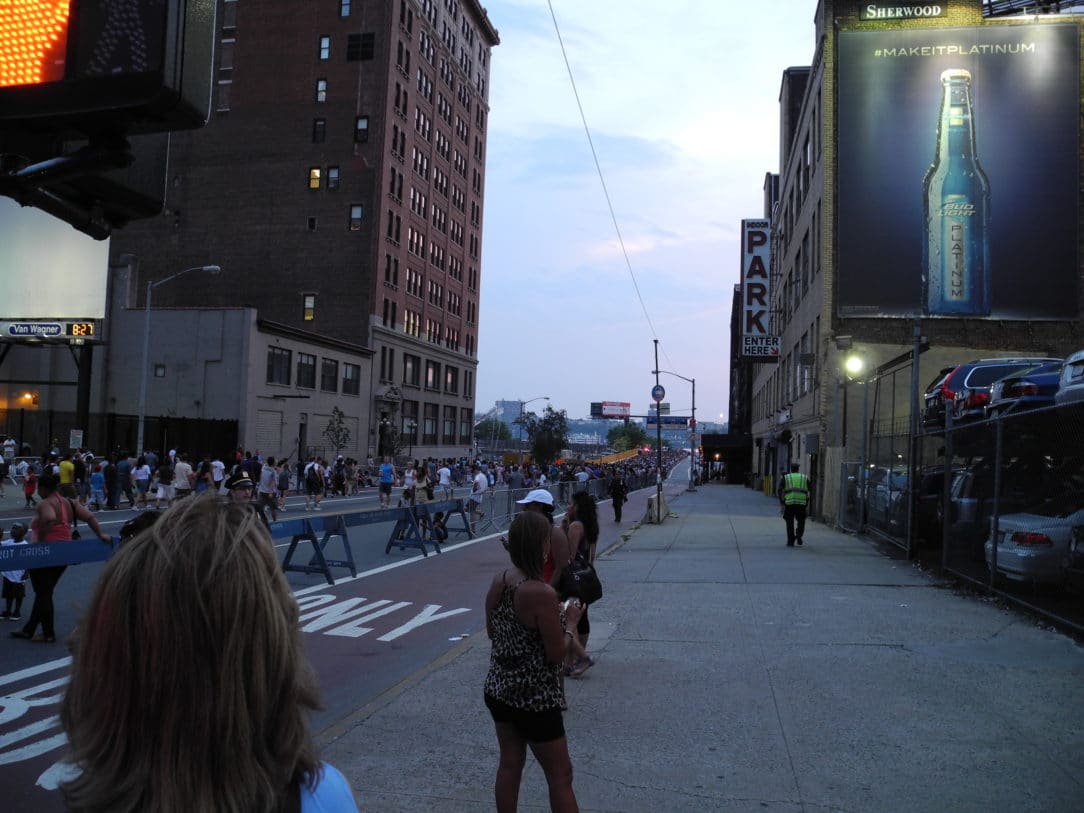
Crowds at 34th Street

We walked down to 34th street and saw the massive crowds.  We decided the whole thing wasn’t worth the trouble anymore, had something to eat, got some sundaes at the McDonald’s there and then stood in the street and waited for the fireworks to start.  We figured we’d just see what we could see and the rest we’d catch on YouTube later.  We weren’t the only ones with that idea.  As many people as we saw walking down to the river all day, until just before the fireworks started, just as many were walking back into Manhattan, annoyed and complaining about how the barricades were set up and how there wasn’t a good view anywhere.  Also, there were NO PORTABLE TOILETS.  There were thousands of people heading to the fireworks event, but we didn’t see a single portable toilet set up to accommodate people.  That seems like a gross oversight by the city government.

I think it was the better choice.  We’d have been annoyed if we’d stayed behind the Intrepid, or behind a line of trees that blocked our view.  As it was, I had to wonder what the city government was thinking saying the view would be good from 59th street down to 14th street.  From where we were standing on 34th and 10th Avenue, which is admittedly a narrow field of vision in terms of seeing the waterfront, it looked like we were seeing the north-most fireworks, because we didn’t see any flashes of light from further up the river.  I couldn’t help but wonder if the people at 59th street were able to see anything at all.  At least we saw some fireworks head on.

View of fireworks from 34th Street and 10th Avenue


View of fireworks from 34th Street and 10th Avenue 2

View of fireworks from 34th Street and 10th Avenue 3

If you’re reading this and thinking that it sounds like I’m doing nothing but whining, or that I’m hating on “VIPs” that are willing to shell out large sums of cash to stand on a pier, maybe I am.  There’s a reason for it though.  I remember being able to stand on an elevated highway with a clear, free, perfect view of the fireworks.  I heard the excuse for moving the fireworks to the Hudson River was because of concerns about the bridges that go over the East River, but I call bullshit.  It seems more likely to me that it was done to  give preference to people with money and create new opportunities for monetization of what’s supposed to be a national holiday.  The 4th of July is supposed to be about patriotism, pride and unity as Americans, but it has been warped into a business opportunity that emphasizes class struggle, not to mention the fact that it pisses off tourists that come here and are not be able to see anything.  That’s embarrassing.  Or at least it should be.

I’m not saying people should be able to stand on private piers for free; I’m saying the show was better done on the East River and should be moved back.  At the least, the people should be put on the side of the highway that’s closer to the river, rather than right behind a row of trees.  As it is now, the view of the fireworks from the ground is disappointing.  Very disappointing.  Unless you pay for a VIP ticket to stand on a pier or maybe go to New Jersey and view it from their shore, then it’s not even worth it.  You’d be more comfortable sitting at home and watching it on TV.

Burning Out Stress on the Running Track

East River Park Running Track

When I was living in Singapore, my wife and I would go jogging 3 times a week or more.  Even though it was hot over there all the time, even at night, it was exhilarating.  Besides being in good shape, every time we would run and hit our target, it gave us a sense of accomplishment.  Participating in the first Run350 event on Pulau Ubin Island and finishing the 5k in 31 minutes, despite the god-awful big hills on the course, was amazing!

Something I probably didn’t think too much about at the time but realize more now is that jogging is also a great way to burn stress.  Last semester was hell for me.  I took on way too many classes and had way too many assignments due.  I’m still sleeping almost 11 hours a day recovering from the lack of rest, especially over the last few weeks.

Despite the time crunch I was under, I still took time to jog.  Why?  Because it gave me an opportunity to stop thinking about due dates and complicated research questions for just an hour or two and gave me a sense of achievement and accomplishment when I met my running goal.  Every successfully completed run was a pat on the back that motivated me to not only keep running, but to get back to my classwork as well.

The bonus on top of it all?  It’s an opportunity for my wife and I to bond.  She runs too and we almost always run together.  This month is going to be a little different.  She’s working full time and I’m busting my ass to get my master’s degree as soon as possible, so I’m taking summer classes.  The summer class I have this month is at night so on Wednesdays we’ll have to run solo like I did yesterday.  It wasn’t as much fun, because I enjoy the competitiveness of running with my wife.  She’s almost as fast as I am, so she keeps me moving when I start to get lazy.

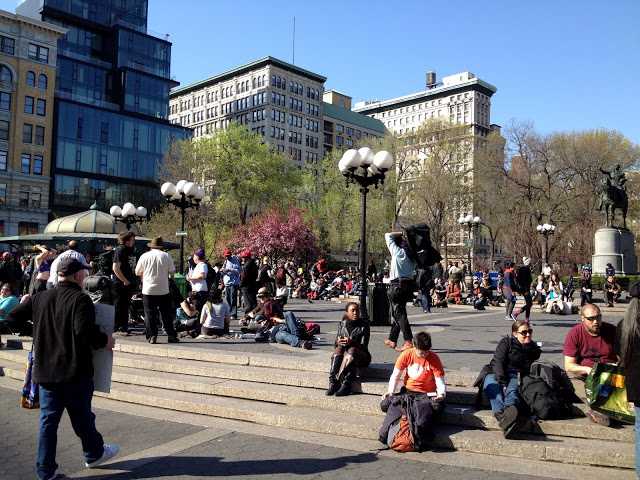
Occupy Union Square?

Yesterday I went to Petco at Union Square to pick up two 20 pound boxes of cat litter while they were on sale.  Carrying that cat litter was a pain in the ass because I couldn’t get a cab and had to take the bus, but that’s another story.

On the way to Petco, I noticed a lot of people standing around the 14th street side of Union Square with signs.  I’m not surprised.  It seems like there’s a protest there at least once a month or more.  There was a protest there over the Trayvon Martin incident, for example.

Union Square

I can only assume this group is protesting police brutality, but I didn’t stop to ask for specifics.  There was something about the way most of the people looked, the way they carried themselves, that screamed low class and potentially dangerous.  One guy looked homeless and the girl in the purple tube top (just to the right of the pink tree on the left of the photo) kept pulling her top up and down, like she was moments from stripping naked to add flavor to the protest.  I wondered if they were drunk or on drugs.  I know it’s not good to just throw a judgment out there based on how people look, but on the other hand, if you want to be taken seriously, you should look serious.

Union Square

The group of people protesting wasn’t actually that large.  It’s hard to tell from the photos where the protesters end and the normal Union Square crowd begins, but they mostly seemed to be huddled into one corner near that pagoda subway entrance.

Union Square

There were police hanging around and I had things to do so I just minded my own business and kept going.  The reason I wonder if these people are trying to ‘occupy’ Union Square is because I saw them there again today, including the guy that looks homeless.  He had a ruck sack with what looked like a yoga mat.  Maybe he slept on it?  Also, a few of them seemed to have luggage with them (right side in above photo).  The police were still there today too.

The Metropolitan Museum of Art: Trip 1

Man Sketching
Man sketching a statue in the Metropolitan Museum of Art in Manhattan, New York City, New York.
Over-the-shoulder of man sketching.
An over-the-shoulder picture of a man, his sketch, and his inspiration.

Last Saturday, my wife and I went to the Metropolitan Museum of Art. We had been putting it off because we’d been busy with going out to different places every day and we were wearing ourselves out and sleeping in.  It’s Winter holiday from school, and she’s not working yet, so we’re trying to do a lot and take it easy at the same time.  I’m not sure how well that’s going to work out for us.

Anyway, Saturday seemed like a great opportunity to both catch up on sleep and still spend a good chunk of time at the museum, since it is open until 9 PM on both Friday and Saturday.  We got there around 2 PM, after having a good brunch with my mom over at IHOP.  The place was packed, as usual, but not as busy as the last time I was there.  From what I’m seeing over the last few days of touring my wife around, the city’s tourist spots are a lot emptier during the winter.  For people who don’t like competing with crowds, that might be something to keep in mind.  It generally doesn’t snow here until after Christmas.  It’s just cold.  If I didn’t live here, I could deal with the cold to avoid the crowds that are usually packing every place of interest in the city.

Metropolitan Museum of Art Map Floor 1
The areas we were able to visit (highlighted by red boxes) in 5 hours. The Met is massive! Click here for an interactive map on the Met’s home page.

Anyhow, the Met is just as awesome as I remember it!  We didn’t get the chance to see everything in the museum, because it’s just too huge a building and their collection is just too massive.  Not that that’s a bad thing!  I’m looking forward to going back again.  Where that can become problematic, though, is with the entry fee.  The entry fee last Spring, when I went to the museum for some class projects was 20 dollars for an adult and 10 dollars for a student.  Now it’s 25 dollars for an adult.  Shocking, right?  The good thing about the pricing is that they’re “recommended,” meaning the prices can’t be enforced.  If you can swallow your pride you can give them 10 bucks per person and walk in.  You could give them a quarter per person and still get the clip-on Met pin that guarantees your safe passage past the guards.  I gave 20 for myself and my wife, total.  I think it was fair, seeing as how we got there halfway through the day and would be making repeat trips throughout the year.

I have a feeling that high pricing is targeted at tourists who usually only go to the museum once on one day and then never see it again.  I certainly don’t think it’s meant for people like the gentleman in the photos above, who come into the museum to practice sketching.  I saw a lot of people doing that, young and old, and I think it’s awesome, because they’re in there, developing their talent in a productive way, instead of running the streets getting into trouble, or causing it.

Lucius Verus
Marble portrait bust of the co-emperor Lucius Verus, Roman, Antonine Period,
A.D. 161 – 169, on loan from the Louvre.

Like I said, we didn’t get to see everything.  The Met is really a two or three day affair and even then you could go back again and notice plenty that you missed.  We saw some of the Roman stuff, the Greek gallery, Oceanic gallery, Native American (South/Central/North) gallery, African gallery, and Egyptian gallery.  I’d spent quite a bit of time in the Greek gallery already and Egyptian art is covered in so many movies, documentaries and TV specials that I just couldn’t get into it, except for the Temple of Dendur.  That was really neat.  The part I liked best about it was the 19th century graffiti on its walls though:

Temple of Dendur 1

Temple of Dendur 2

Temple of Dendur 3

Temple of Dendur 4

Temple of Dendur 5

Temple of Dendur 6

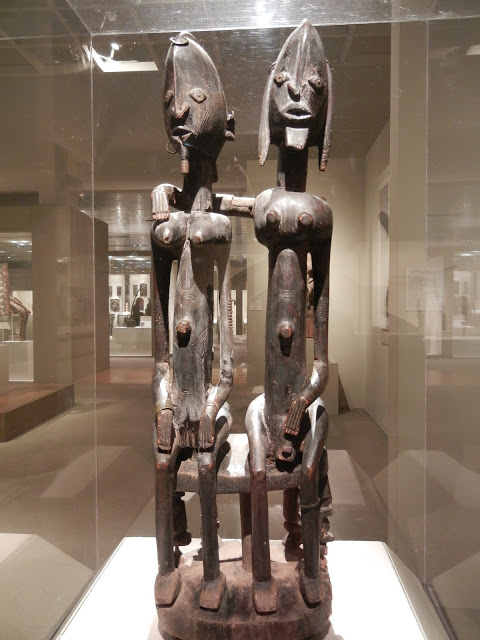
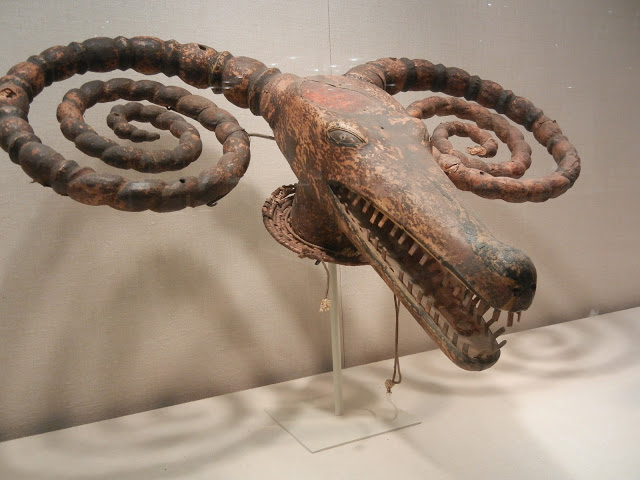
The galleries I enjoyed most were the ones that seemed to be the least populated by visitors, the African and Native American galleries. I imagine its because I’ve been exposed those types of art the least, but there’s something powerful about the imagery as well.

African Art

African Art

African Art

African Art

African Art

African Art

Native American Art

Native American Art

Native American Art

Native American Art

I’m looking forward to the opportunity to go back and see the rest of the Met, probably later this week, if we can squeeze it in.  I’m particularly interested in seeing the Medieval Art gallery and the Islamic Art gallery, which just opened recently.  Before leaving we quickly passed through the Met gift store and they’ve added Islamic art items to their selection.  It seems nice.

Click here for more photos (Google+ public photo gallery).

First Trip to the Bronx and Meeting Extended Family Again After 25 Years

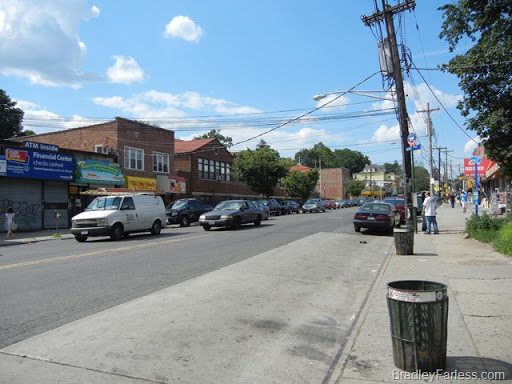
Outside the Dyer Avenue station in the Bronx.


Yesterday I went to a part of New York City that I’ve never seen before to see family members that I’d never met before (that I remember anyway).  I imagine most people in the US are in the same situation.  They know they have relatives in another part of the city, state or country, but they’ve never met them and may not ever meet them.  For me, these relatives are living in the Bronx.  Well, most of them anyway.  Some actually live just a few blocks from where I live in Manhattan, but I don’t know who they are.  For all I know, I’ve passed them in the street.  It’s weird to think about it that way right?

Outside the Dyer Avenue station in the Bronx.

A neighborhood in the Bronx.

The whole trip to the Bronx was a really interesting experience.  Like I said, I’d never been there.  I saw a side of the city I didn’t know existed.  It was sort of city and sort of not.  It’s more like suburbs, but not quite.  I can’t quite reconcile it to the impression I have of suburbs from cities like Atlanta.  It did remind me of some of the old, run down towns I’ve passed through in the South though.

Photos of a Southern town I drove through in 2008:

A small town in Alabama somewhere.

A small town in Alabama somewhere.

The overall impression I got of the area is that it’s mostly run down and dangerous, though I only saw a small part of the Bronx so that’s a generalization.  I’ve stricken it off my list of potential boroughs to live in.  Besides the fact that the area looks dangerous, it also requires a personal vehicle and all the expenses that come with one.  Who the hell would want to deal with the train problems between the Bronx and Manhattan if they had a choice?

Yeah, I have to just take a moment here to complain about the train problem.  There’s ongoing construction on the train lines heading into the Bronx.  When we went up there yesterday, we had to get off the train at 149th street, Grand Concourse (which isn’t very grand), and take a shuttle bus to 180th street, where we could get back on the train.  I’ve never taken a train straight to the Bronx, so I have no way of calculating exactly how much time we lost by having to take a shuttle bus, but let me just say that to get from 14th street and Avenue B to our relatives’ house in the Bronx took 2 hours and 45 minutes.  That’s absurd.  It wasn’t quite as bad on the way back, because there wasn’t as much traffic, but it still took just under 2 hours.  I’m sure it won’t be as bad when they finish the construction, but after having lived here for 9 months, I can reasonably assume that the construction will never stop.  There are always reroutes and delays.  It makes me long for the fast, safe and reliable train system in Singapore.

So, meeting extended and previously unknown family wasn’t as strange as I’d thought it would be.  I wasn’t sure what to expect, but the barbecue wound up having the same atmosphere as some I’ve attended in the Philippines.  I suppose that shouldn’t have been surprising, since my relatives on that side are all of Filipino descent.  Some of them remember seeing me as a kid, when I was about 5, but that was 25 years ago, so all of them were unfamiliar to me.  I couldn’t tell relative from friend of the family, so I did the best I could and mostly kept to myself, with the exception of a little socializing with my 2nd (or 3rd?) cousins to try to determine how exactly we were related.  The food was awesome and everyone was having a pretty good time, despite the heat and mosquitos.  In a way, it’s kind of nice to know that the family I have in the city extends beyond just the few relatives I previously knew about.  It gave me more of a sense of belonging and security.  I’m looking forward to going to future barbecues, with my wife in tow.  I have a feeling she’ll have a good time there.  Oh, I just remembered, there was no karaoke, so it wasn’t quite a Filipino barbecue!

Art Comparison: Qu’ran Manuscript and The Angel Gabriel

The following is the second paper I wrote for my Art History 100 class.  We were tasked with finding two art pieces in the Metropolitan Museum of Art in New York City and then writing a paper that compares and contrasts them based on form and content.  Our choices were restricted to certain art periods from specific locations, like French Gothic or Italian Renaissance.  I chose the following two pieces because I found them particularly interesting on a personal level, as well as being easy to write about.

I think I might have been a bit off the mark on fitting The Angel Gabriel to the Renaissance standard, but I won’t know for sure until September, when I can get in touch with the professor and see the paper.  It was due on the day of the final, so there’s no way for me to get it back and check it out.  I’ll update the grade received and any notes from the professor at some point, on the Essays page.

(Note: The images were not included in the paper that was turned in.  I added them here so readers that aren’t as familiar with art as my professor can get a better idea of what I’m talking about.)


Introduction and Location

The paper will be discussing the differences and similarities between two works: The Angel Gabriel and Qur’an Manuscript. The Angel Gabriel was created in approximately 1493, is attributed to Masseo Civitali and is believed to have originally been located in the oratory of Santa Maria dell’ Anunnziata in Lucca, Italy. The work is now located in gallery 500 on the first floor of the Metropolitan Museum of Art in the “European Sculpture and Decorative Arts” section. The Qur’an Manuscript was created in the early 14th century, by an anonymous artist in Iran or Iraq. The work is now located in a display case in gallery 203, on the Great Hall Balcony on the second floor of the Metropolitan Museum of Art.

Formal Aspect & Genre Descriptions

The Angel Gabriel, Sculpture, Metropolitan Museum of Art.

The Angel Gabriel is a Renaissance sculpture that is roughly life-sized. The sculpture is a painted and partially gilt terracotta statue. It appears to have been free standing on its original base, which is now broken. The statue is now anchored to a display base. The sculpture leans at an almost unnatural angle, covered in a draped garment that is smooth and flowing. The figure is naturalistically proportioned and detailed, though the face is idealized. On the back of the statue, there are two vertical slots where terracotta wings were probably inserted. Renaissance art was largely religious (Aston 105). Compared to the earlier Gothic style, Renaissance art focused more on the human aspect of the art subject. Where Gothic art was solemn and dignified, Renaissance works like The Angel Gabriel attempted to introduce tenderness and beauty into art without sacrificing the aura of divinity associated with religious figures (Aston 133). The introduction of a human element into the sculpture is apparent in the joyous expression on the face and in how the arms are crossed over the chest, as though the angel can barely contain the good news he is about to share. Rather than standing vertical, the angel is leaning forward towards the recipient of his news. Despite these included aspects of human emotion, the aura of the divine is still maintained through the idealized, androgynous face (angels have no gender), and the original presence of wings on its back.

Qu'ran Manuscript, 14th Century Iran or Iraq, Metropolitan Museum of Art

The Qur’an Manuscript is a non-illustrated manuscript folio and an example of Islamic art. The page on display is 34.9 x 27.3 centimeters and was made with ink, opaque watercolor and gold on paper. The page is primarily covered with naskh cursive text, but also contains decorative calligraphy and hand drawn vegetal and geometric images that are painted with gold. Islamic art as a whole is defined by a prohibition against making representations of living things, since it might create a temptation to commit idolatry (Evans 151). The resulting typical expression of Islamic art is mostly abstract, containing geometric patterns, references to vegetation and calligraphy. These elements were reflections of religious beliefs. The geometric patterns represent the perfection of Allah and the vegetation is a reference to paradise in the afterlife. Calligraphy also became a popular form of art, taking the place of images and being used to represent Allah. The main purpose of calligraphy was to appreciate the visual quality, rather than to read it. These elements are present in both secular and religious art, though secular art would not contain calligraphic quotations from the Qur’an.

Content

Theme

Both The Angel Gabriel and the Qu’ran Manuscript have a similar theme. Both works are the products of religious devotion. Gabriel is a prominent figure that is present in the Abrahamic religions of Judaism, Christianity and Islam. Stories about Gabriel appear in each religion’s holy texts. The Qur’an Manuscript is a handwritten and decorated page of the Qu’ran, the holy book of Islam. The difference between the two works is that while The Angel Gabriel represents a religious idea, it was mostly meant to be decorative, appearing in an oratory. The Qu’ran Manuscript, on the other hand, while being decorative was also meant to be functional, a holy book to read and learn from.

Depiction

The Angel Gabriel, Sculpture, Metropolitan Museum of Art.

The Angel Gabriel specifically depicts Gabriel, an angel, leaning forward, as if appearing to someone. The name Gabriel means “God is my strength” or “the strength of God” and he is known as The Great Communicator (Aquilina 69). Throughout the Bible, Gabriel appears to people to bring them news from God. In Daniel 8:15-17 he appears to Daniel to explain a vision to him. In Luke 1:16-17 he appears to Zechariah to tell him that he and his wife shall have a child and that his child, John the Baptist, will prepare the way for the Messiah. Later, in Luke 1:26-38, Gabriel appears to Mary, to tell her that she will be the mother of Jesus Christ, the son of God. According to the information placard on the sculpture’s display base, it is believed that The Angel Gabriel was originally part of a pair of statues which included the Virgin Mary. Together, they would have formed an Annunciation Group, which represents the moment when Gabriel shared the news of her divine pregnancy with her.

Qu'ran Manuscript, 14th Century Iran or Iraq, Metropolitan Museum of Art

The Qu’ran Manuscript is a page from the holy book of Islam, the Qu’ran. The top of the page contains a geometric, gold painted rectangular frame that contains decorative calligraphy which reads, “Surat Saud, Eighty Six Verses (Ayats), Mekka surat” (Hany), though Mr. Hany also noted that the surat actually has 88 verses. Just to the right of the rectangular frame is a drawing containing concentric circles around a vegetal image, probably of a flower, also in gold with a blue center. Additional matching representations of flowers, rosettes, are drawn throughout the text as markers between ayas, or verses. In the right margin are two decorative seals, one circular, one teardrop shaped, both in gold and surrounded by a blue outline. These seals contain kufic script in the center. The main text of the page is a cursive form of Arabic known as naskh, with recitation marks added in red ink. The text on the page on display is the last part of the 37th surah and the first 11 ayas of the 38th surah of the 23rd juz (part) of the Qu’ran, The Letter Saud, which was revealed to the Prophet Muhammad at Mecca. Preceding the beginning of the 1st aya in the 38th surah is the phrase, “In the name of Allah, the most gracious, the most merciful,” which is not part of the surah itself and precedes all of the surahs in the Qu’ran (Hany).

Purpose

The original purpose of The Angel Gabriel would have been to inspire believers and deepen their faith. Many people at the time the statue was created were illiterate, and learning about Christianity, outside of sermons given by clergy, was through observation of religious art. When looking at the sculpture of Gabriel, believers would have been reminded of the good news he shared with people in the Bible, and particularly with Mary. If The Angel Gabriel was originally paired with a statue of the Virgin Mary, then viewing them together would have reminded viewers of their hope of salvation through God’s grace and Jesus’ Christ’s death and resurrection on the cross. The Angel Gabriel was originally designed to be a decorative piece for casual observation and reflection and, though it is now located in a museum rather than a religious building, the effect is essentially the same. It causes the viewer to contemplate the meaning of Christianity and Gabriel’s role in the Bible.

The Qu’ran Manuscript was meant to be a functional copy of the Qu’ran, to be used by believers for study and recitation, as well as to inspire through the decorative artwork it contains. The Arabic text of the page, together with the rest of the text in the Qu’ran, is the physical representation of Allah through language (the written word) in the Islamic faith. The Qu’ran praises Allah and His creation, defines the relationship between Allah and the worshipper, explains the afterlife through eschatological texts and teaches Muslims how to practice their faith in everyday life. While the particular copy of the Qu’ran the page came from is no longer serving that purpose, the text of the Qu’ran has been copied, translated and distributed all over the world and continues to serve the function it was originally created for.

Presentation

The Angel Gabriel is presented in a small room with other Italian Renaissance pieces. The room is well lit, and Gabriel is the first work you notice as you walk into the room. The lighting brings out the remaining color from the original paint and gilding on the statue, giving the viewer an idea of what it might have originally looked like. Appreciation of how the piece was originally displayed would be helped by having a similar work of the Virgin Mary opposite Gabriel, though that is probably not possible due to limitations in the museum’s inventory. An alternative would be to have a digital rendering of what it might have looked like in place at the oratory displayed next to it, or on the display base. As it’s now displayed, Gabriel appears almost out of place in the room and it requires a lot of imagination to picture how it would have originally appeared.

The Qu’ran Manuscript is set in a glass display case along the wall of the Great Hall Balcony. The display case contains other Islamic works that represent highlights from the Department of Islamic Art. The works range in date from the seventh to the eighteenth century and include textiles, jewelry, pottery and other manuscript pages. Since the case shows a cross-section of art, the overall effect is a bit jarring, especially combined with the noise coming from the entry hall below the balcony and the strong smells coming from the balcony dining area. The benefit of being placed in that location is that it catches the eye of people walking by and the skylights and windows help to keep it well illuminated. It would be easier to appreciate this work in a smaller room with other Islamic manuscript pages from the same time period.

Works Cited

Aquilina, Mike. Angels of God: The Bible, The Church, And The Heavenly Hosts. Cincinnati: St. Anthony Messenger Press, 2009.

Aston, Margaret. The Renaissance Complete. London: Thames & Hudson Ltd., 1996.

Civitali, Masseo. The Angel Gabriel. Metropolitan Museum of Art, New York.

Evans, Gillian Rosemary. The Church in the Early Middle Ages: The I.B. Tauris History of the Christian Church. New York: I.B. Tauris & Co Ltd, 2007.

Hany, Islam. Translations and discussion of Qu’ran Manuscript and Qu’ran. Bradley J. Farless. 15 May 2011.

Unknown. Qu’ran Manuscript. Metropolitan Museum of Art, New York.


So, NYC Bus Drivers Only Stop When They Want To Now?

I went up to Target today with my mom to give her a hand with her bags.  On the way back, we got to 14th street just in time to see a bus pull off, so we walked from 2nd Avenue to 1st Avenue, and right as we got there a bus pulled into the stop.  My mom was tired, so we got on the bus and used our transfers.

About halfway between Avenue A and Avenue B, I pressed the strip to light up the ‘Stop Requested’ sign at the front of the bus.  Instead of slowing, the bus driver accelerated.  People yelled at him to stop, but he kept going anyway, right on past the bus stop.  I guess he just didn’t feel like stopping there tonight.

After everyone shouted at the driver to stop, and he ignored us, he got on the bus intercom and told everyone to hold still, because he was going to take our picture. Why was he taking our picture to start with? And why are buses equipped to take still photos of passengers in the first place? Isn’t video enough?  Does a bus driver have the authority to arbitrarily take photos of passengers?  And what systems are in place to prevent abuse?

The next stop was in a dark part of 14th street and would have left us having to cut through a back alley in the projects to get back to where we wanted to be, so we had to stay on the bus until it turned down Avenue D and stopped at 12th street.  That still left us having to cut through the projects, but at least the area was more lighted.  People have been shot and killed in that area fairly regularly over the last few years.

The driver wasn’t done being a jackass, either.  When he pulled into the stop at 12th street, he positioned the rear door so that a pole and a pile of snow were right in front of it.  Besides the fact that I was hauling a heavy cart out of the bus (which caused me to slip and almost fall on that snow, by the way), my mother has bad knees, so it created a very dangerous situation for her.  A guy in the bus was nice enough to hold the doors for my mom while I was struggling with the cart, since the bus driver tried to shut them on her while she was getting out.

We pay good money to ride these buses.  They’re constantly jacking the fare up.  Wouldn’t it be nice if they’d raised the level of courtesy and customer service they offer riders as well?  Or at least stop at designated bus stops when the ‘Stop Requested’ light is lit.

The NYC MTA bus that didn't bother to stop, even though the Stop Requested light was lit.

Luckily, there was a red light, so after getting out of the bus and onto the sidewalk, I took a photo of the back of the bus and then used the plate number and bus number to file a complaint with the MTA.  I wonder if I’ll even hear anything back on this?

Oh, and the kick in the ass of it all is that we wound up having to walk further than if we hadn’t gotten on the bus in the first place.