Drinking From A Bag

When you move abroad you expect to run into things that are different from what you’re accustomed to.  Things like the types of food you’ll find, the language, the customs, and the way people dress.

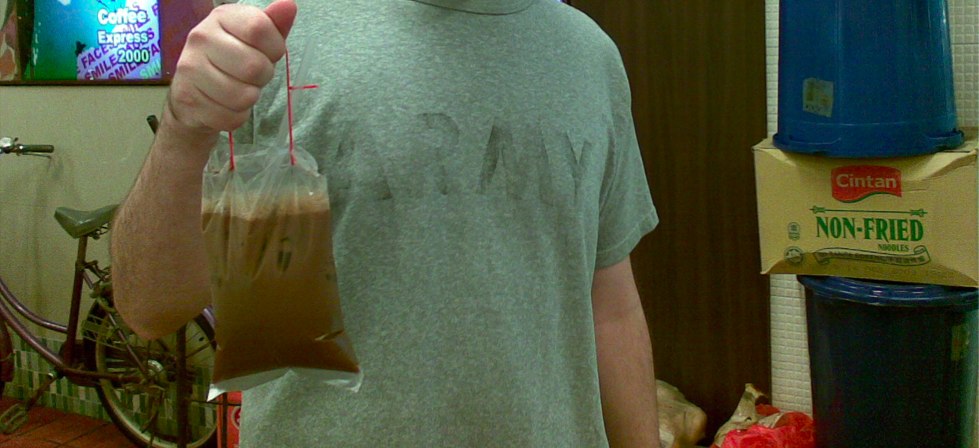
One thing I didn’t expect however is that “to go” drinks are usually given out in plastic bags.  The first time I saw this was in the Philippines in March of 2008, when I was visiting Margee’s family.  I thought it was really amusing.  The bags are mass produced and shops buy them to put the drinks in.  When you buy a drink, and say you want it “to go” they will open it and pour it into a bag, along with some ice.  Then they’ll drop a straw in, pull the drawstring tight and pass it over to you.

I asked my wife about this and she said it’s because it’s cheaper.  I didn’t get it.  I asked her, “In what way is it cheaper for them to have to hand out an additional plastic bag?”  So she told me that there are deposits on the bottles and cans.  If you get a drink and take the bottle or can with you, you have to pay for the deposit as well as the drink, and it’s inconvenient, or sometimes not possible, to return the container to get the deposit.  So, to avoid that, the stores pour the drinks in bags and handle the return of the containers themselves.

I later found the same to be true in Singapore at hawker centers.  When you get a drink to go, it’s most often poured into a plastic bag.  The hawker centers use the bags not only for drinks from cans or containers, but for the drinks they make themselves, like the local iced Kopi.  I imagine it’s cheaper for them to use the bags than to use paper cups.  I also imagine it’s more about being able to put ice in the drink than having something to do with a deposit in Singapore.

I’ve seen people carrying everything in these little bags: juice, soda, coffee, and even beer (in the Philippines).  It took a while to get used to, and it was a bit strange to carry one around myself, but I’ve become accustomed to it.

Oh, and one other thing about “to go” orders.  Here in Singapore it’s referred to as “take-away.”  When I first got here I would sometimes ask for something “to go” and the person taking my order would just give me a blank look and ask again if I wanted my order “for here” or “take-away.”  In the Philippines, it’s referred to as “take-out.”

Sometimes it’s small things like that, that remind you of how far from home you are.

Two Tiered Bicycle Stands

Everyone knows that in Asia, bicycles are used quite frequently as a means of transportation.  It’s even used in jokes occasionally, but it’s true.  People do use bikes quite a bit, for quite a few reasons, here in Singapore at least.  It’s cheaper, as opposed to buying, fueling, and maintaining a car.  It’s also smaller and easier to park or store.  In fact, there are some foldable bikes here that you can take on the buses with you.  That could be perfect for a family outing to a nice park that you want to bike through, but that’s too far away to bike to.  Plus, it’s a great way to get where you want to go and get some exercise at the same time.

The problem with having so many bike riders is that there’s rarely enough room to accommodate all of the parked bicycles, especially in major traffic hubs or around the malls.  For example, if you go to the Tampines MRT area, you’ll see bicycles jammed in at the bike racks, but you’ll also see bicycles chained to poles, fences, gates, or basically anything that’s stuck to the ground.  In some extreme cases you’ll find bicycles that aren’t chained to anything at all, but just have a chain through the wheel spokes instead, because there’s just no space available.

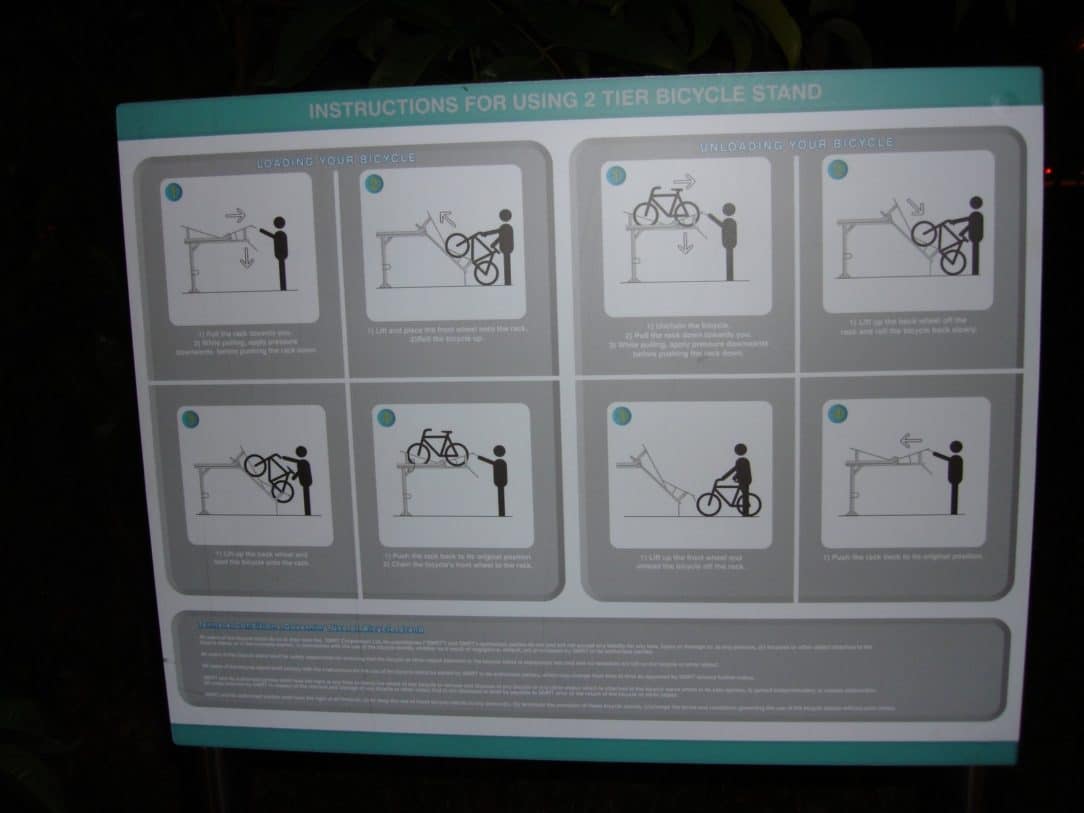
It all seemed crazy and amusing to me and I never really gave it any thought.  Apparently, someone did though.  At the Pasir Ris MRT station there are also bike racks, but the bike racks there are two tiered.  I guess they figured that if there wasn’t enough horizontal space to accommodate all of the bicycles, they could go vertical with them.  It looked like it worked well too.  There was more space to park bikes, and as a result, the area looked a lot nicer and neater, which seems to be something Singapore as a whole looks highly upon.

This isn’t the only measure I’ve seen to accommodate the bicycle riders in Singapore, but it’s definitely the neatest.  There are also bicycle only lanes that run parallel to sidewalks on most major roads, as well as Park Connectors that run between major parks in different regional areas.  Also, there is a wide path that follows the MRT tracks that seems to get used pretty heavily by cyclists.  I think I noticed a bicycle lane there as well.

Pasir Ris Park

My wife and I enjoy getting out of the house when possible, and we’re interested in finding new ways to get some exercise.  It was only natural that we would find ourselves in Pasir Ris Park sooner than later, considering how close it is to our house.

When I looked at the map of Singapore, Pasir Ris seemed to be such a big area.  I was sure that we would have to take a bus to get anywhere.  That doesn’t seem to be the case though.  We can walk to either of the two malls in Pasir Ris in about 15 minutes and there are two parks close to us.  One is the Pasir Ris Town Park, which is just around the corner.  We’re planning on checking it out in a few days.  The bigger one is Pasir Ris Park, the one that borders on the water.  That’s about a 25 to 30 minute walk from our house, but it’s well worth the trip.

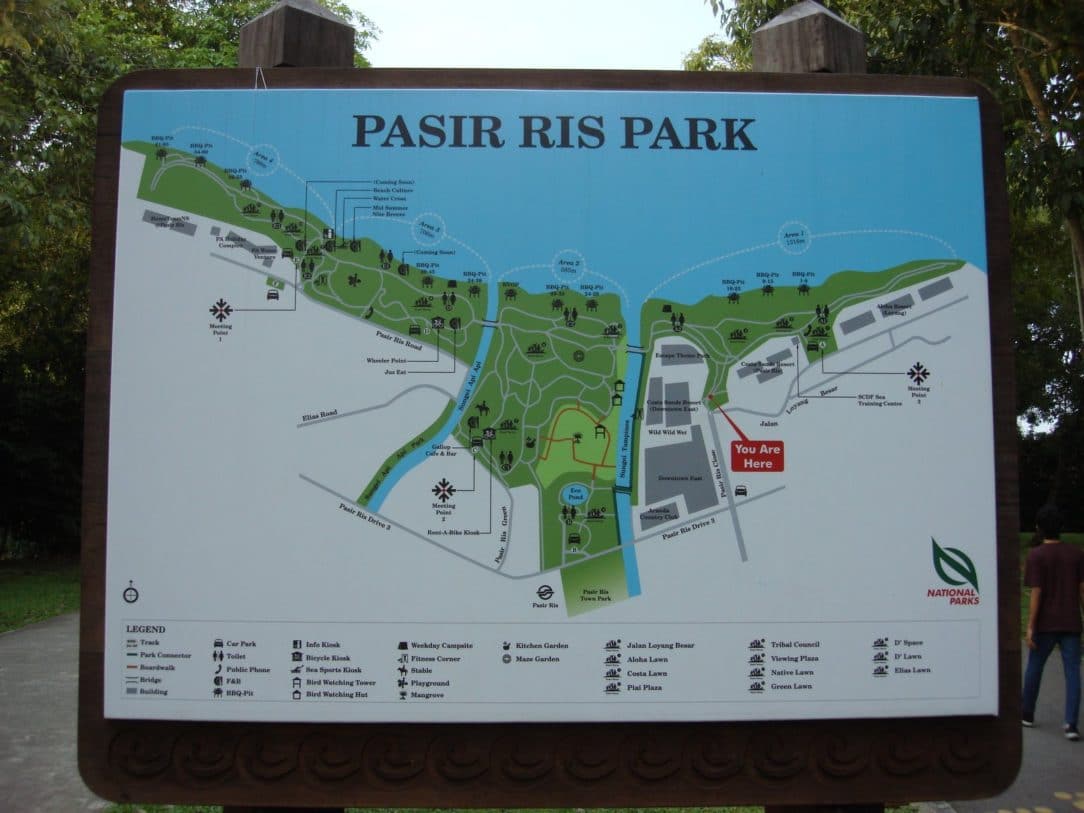
We entered the park through one of the larger walkways and we were greeted with the fantastic sign pictured at the top of the post.  We didn’t get to see everything, not by a long-shot, but we really got to stretch our legs.  Don’t let the map fool you!  It’s bigger than it looks!

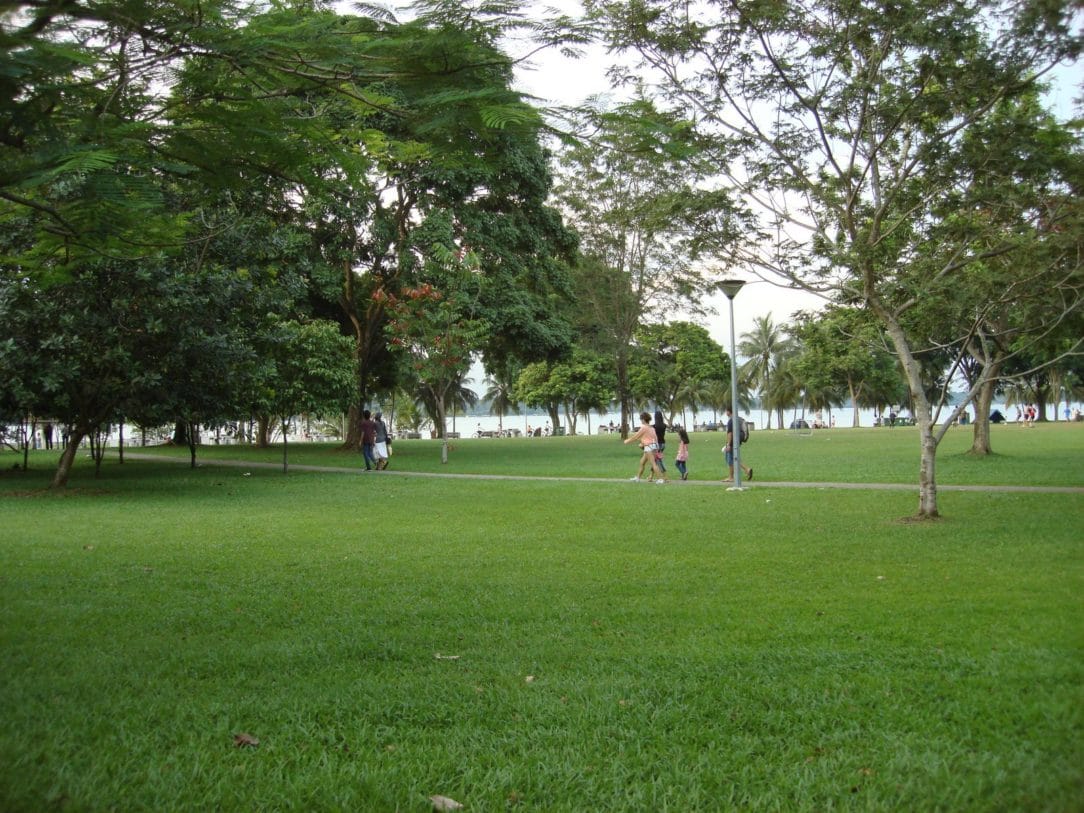
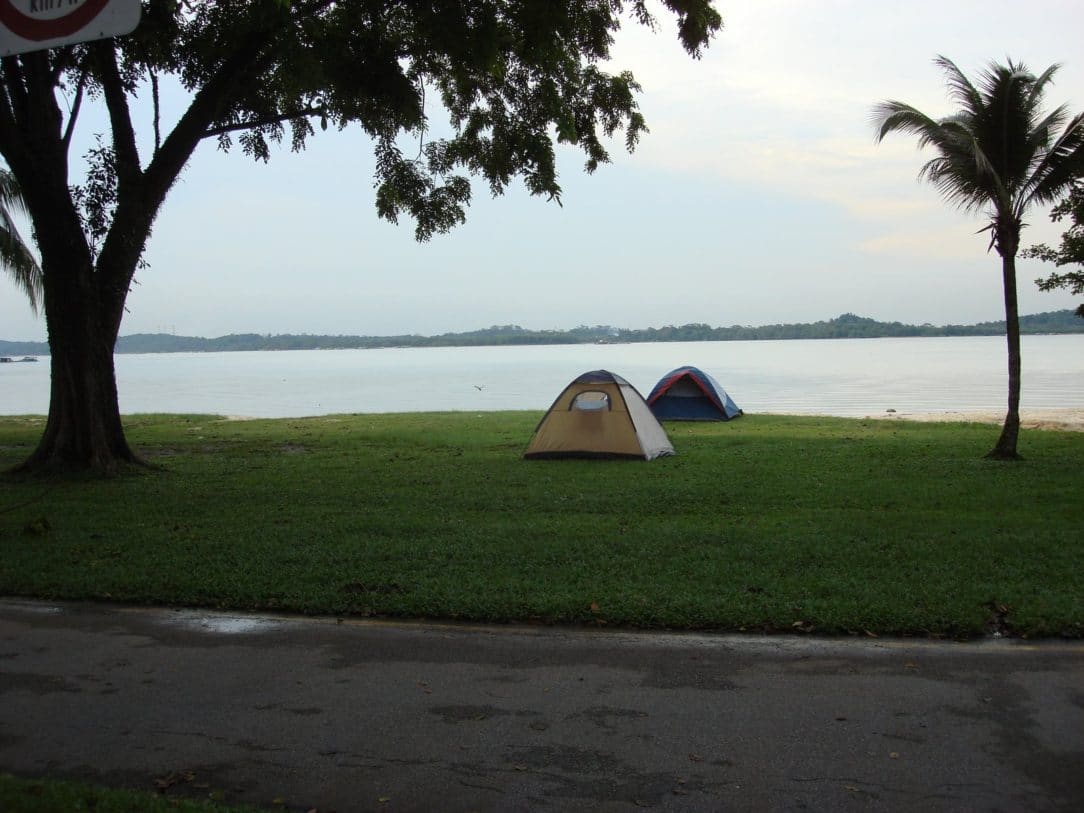
What stood out to me the most about the park wasn’t just it’s well manicured appearance, but how lively it was.  The place was packed with people, all engaged in their own activities.  I saw groups of friends rollerskating, couples walking under the trees or sitting on benches, joggers, bikers, people walking, kids playing, and even one football (soccer) game.  Oh, and there were campers and fishers too!  Everywhere I looked there were people, out having a good time!

It gave the place a very lively feel that made walking through it a joy, despite the heat.  In fact, my wife and I have decided that it will be our primary jogging location in Pasir Ris.  It looks like you could spend weeks going to the park to jog and rarely cross the same path, other than the main junctions where the bridges are.

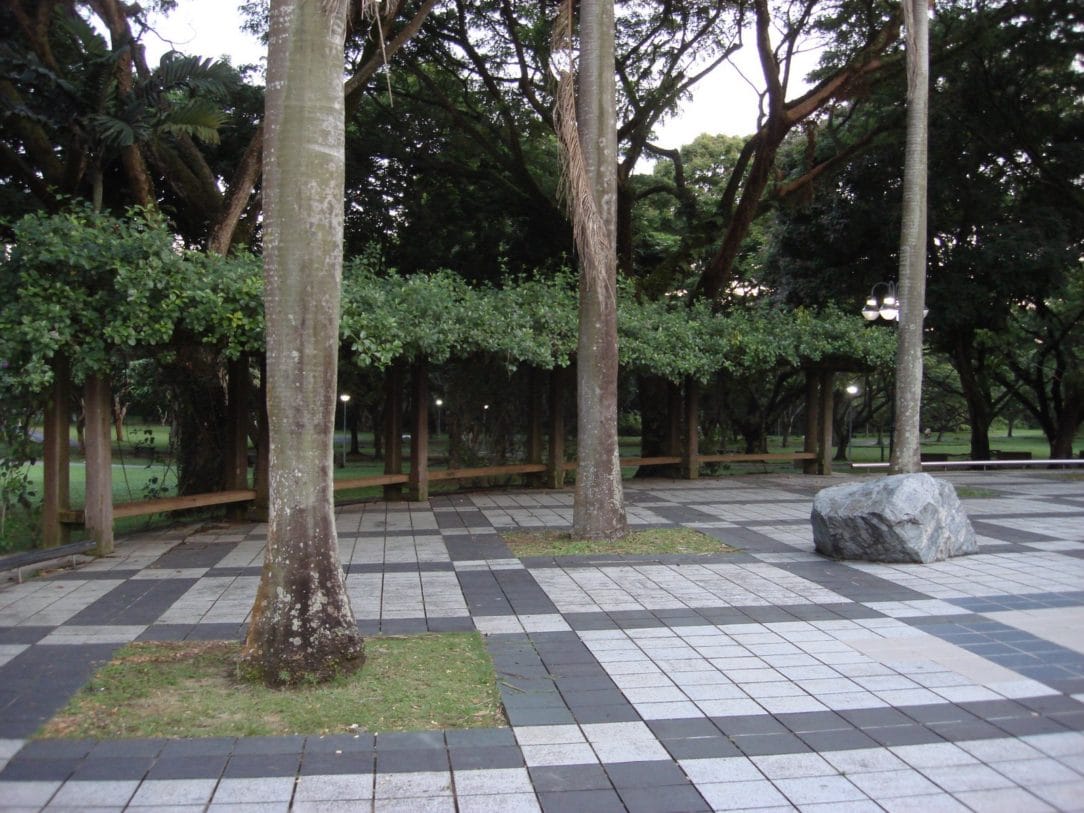
Below are some great photos I got of the park!

Downtown East Mall, Pasir Ris

[Edit: I found out later that the part of the mall that these photos is from is actually called E-Hub. Though I think it is part of Downtown East, there is half again as much mall as this that I completely missed. When I make an updated post I’ll leave a link here to it.]

My wife and decided to stop by the Downtown East mall on our walk around Pasir Ris.  It was sort of on the way, and we hadn’t been there yet, so, why not?

It looks like a great place.  As we came through the door we noticed a girl handing out free samples for premium yogurt.  I didn’t catch the name of the place, but the yogurt was nice.  It had toppings added onto it too that went along with the flavor.  It looked a bit pricey, but one of these days when I have money to burn I’ll probably get a cup to share with my wife.

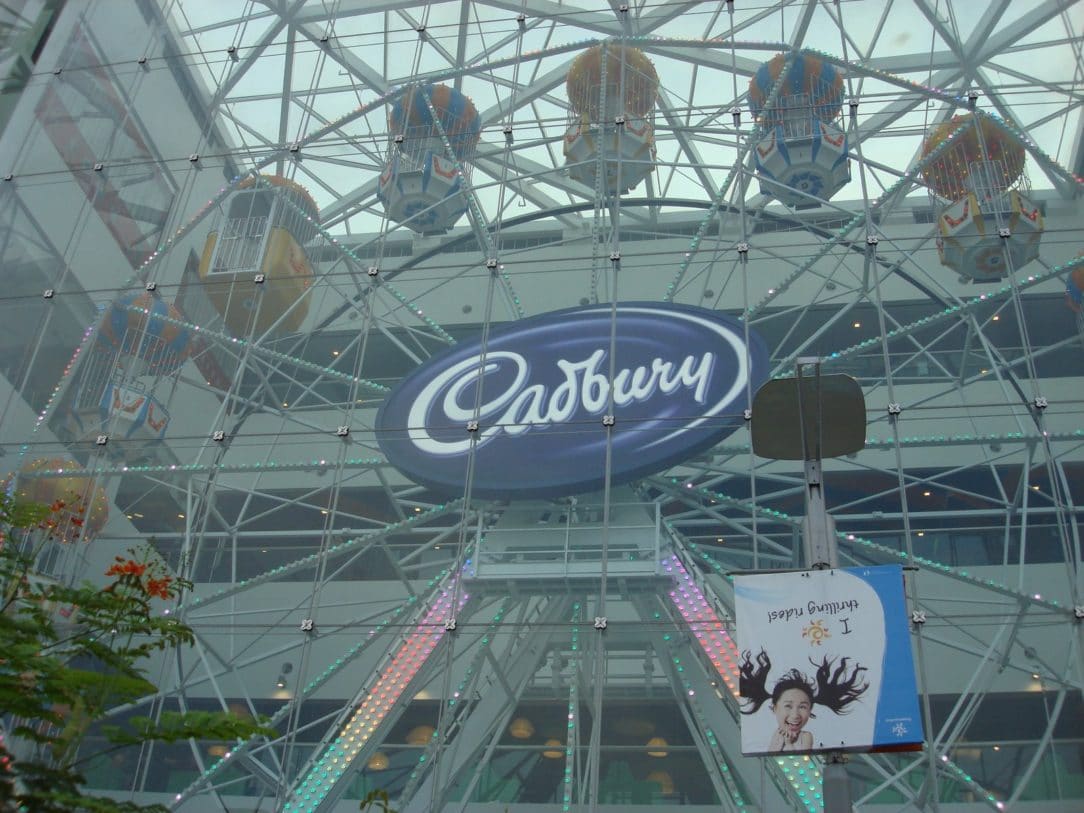
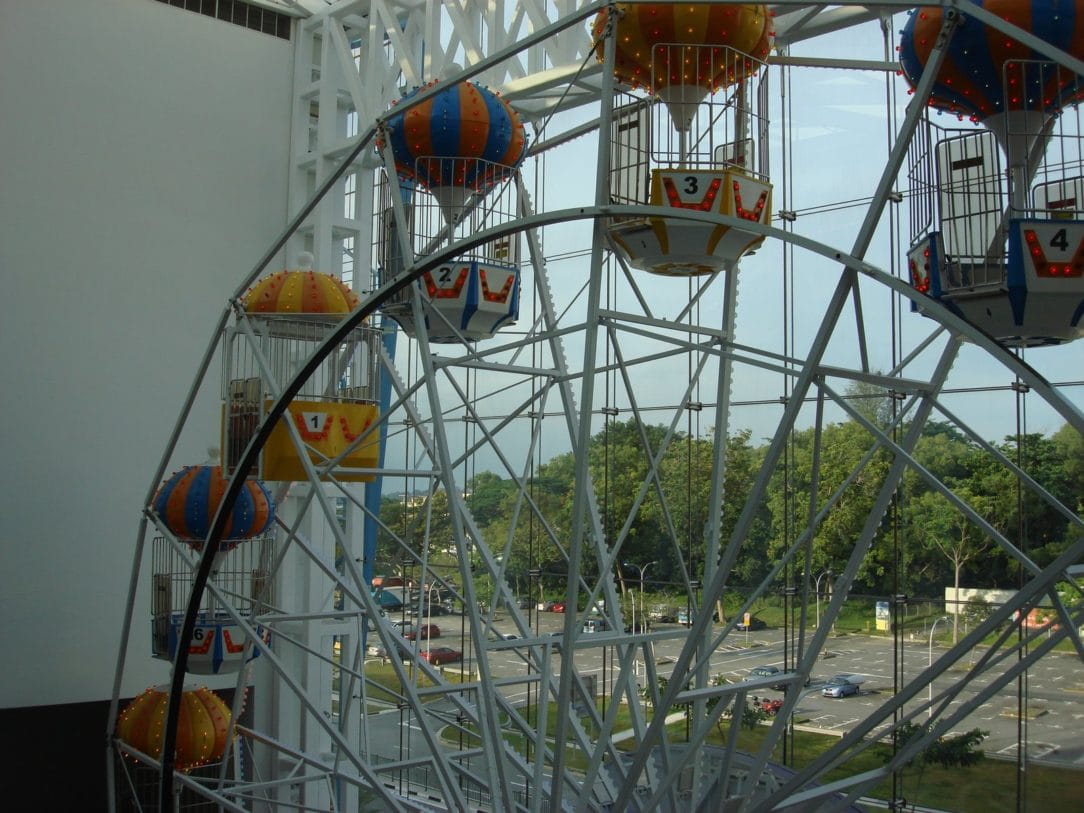
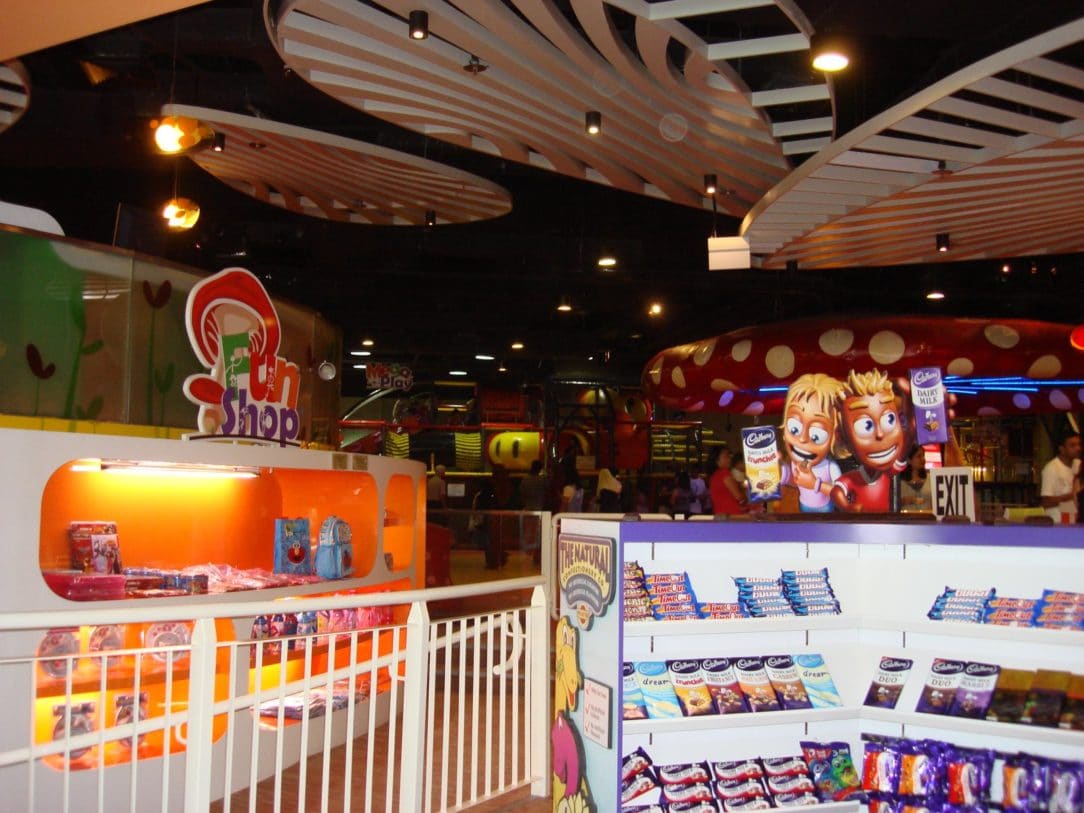
The mall as a whole seems to be tailored to young kids and teenagers.  I guess you could say it has a theme, including the types of stores in the mall.  It’s really not that big a place, as far as how many stores are inside it, but it does have quite a few restaurants and drink shops, plus an arcade, a type of paid playground for kids, an indoor Ferris wheel, some anime shops, and a movie theater.

I suppose the best part of it all is that the mall is only a 15 minute walk from where we live.

Bizarre Ritual With Snake and Incense

My wife and I were walking down the street in Pasir Ris, intent on exploring the area.  We spent most of last weekend moving our stuff, so there wasn’t much time to do anything special.

As we walked by these two guys, I heard a snapping sound, so I stopped to take a look at what was going on.  One of the guys was holding what looked to be a preserved cobra that had been turned into some sort of whip, with the head and hood and skin intact.  He would hold the snake over his head, as seen in the top picture, and then he would snap it out, to make the crack noise.  I also noticed that there was incense burning.

I imagine this is some sort of religious or remembrance ceremony, but it’s definitely one of the most bizarre things I’ve seen during my stay in Singapore.  Perhaps someone can shed some light on exactly what’s going on here?  I didn’t want to disturb them, as it might have been improper and rude.

Exercise Equipment For The Elderly

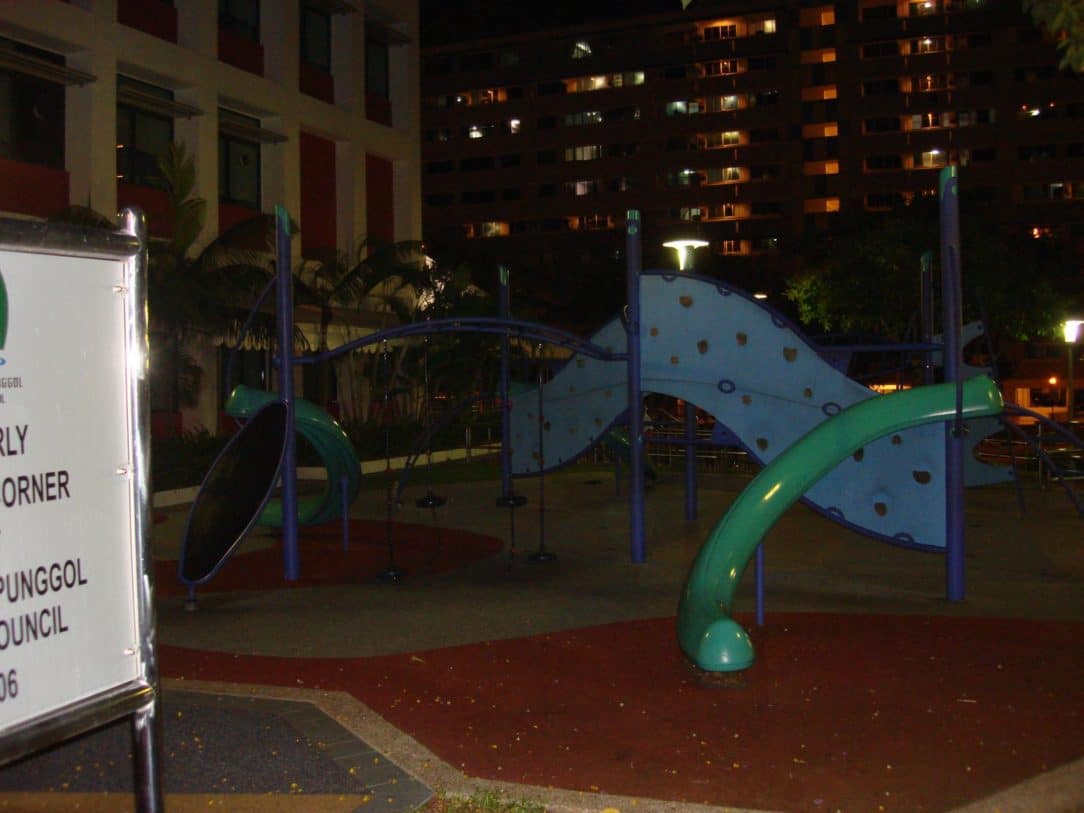
This is just something odd I saw while at the shopping center near my new place.  I was leaning against a rail while my wife was using the ATM, and I noticed this sign behind me.  I thought it was amusing so I snapped some photos.

Apparently, the children are supposed to hang out on the adjoining playground while the old people get their workout:

These workout areas and playgrounds are common in Singapore, but this is the first time I’d seen one that claimed to be specifically for old people.

Manpuku Restaurant, Tampines 1 Mall

A few weeks ago I was checking around the new mall in Tampines (Tampines 1) and I saw the entrance to a restaurant called Manpuku.  The entrance area was jam packed with people in line to get in and people ogling the items on display in the window:

I met up with my wife there during her lunch break and while we were walking around together we even got to see the mascot.  At the time we didn’t know what restaurant or store the mascot represented but it was fun anyways.

We both love to go out and eat, and we particularly love Japanese food, so we were excited about going to check this place out.  We finally made a visit to Manpuku today and it was great!

It wasn’t quite what I expected, in a good and interesting way.  As you get to the head of the line a greeter will ask you how many people are in your party and will then pass you a corresponding number of cards that look and act like credit cards.  The waiter will explain that as you walk around inside the restaurant, you pick different foods from the various stalls and the price of the item is charged to your assigned card.  At the end of your meal, you bring the card to the cashier by the exit and settle your bill.

That’s when I realized that Manpuku isn’t simply one restaurant.  It’s a collection of restaurants acting under one name, serving Japanese style food.  In fact, the place reminded me of a big, themed food court, though a very well appointed one.

Here are some photos we took inside Manpuku:

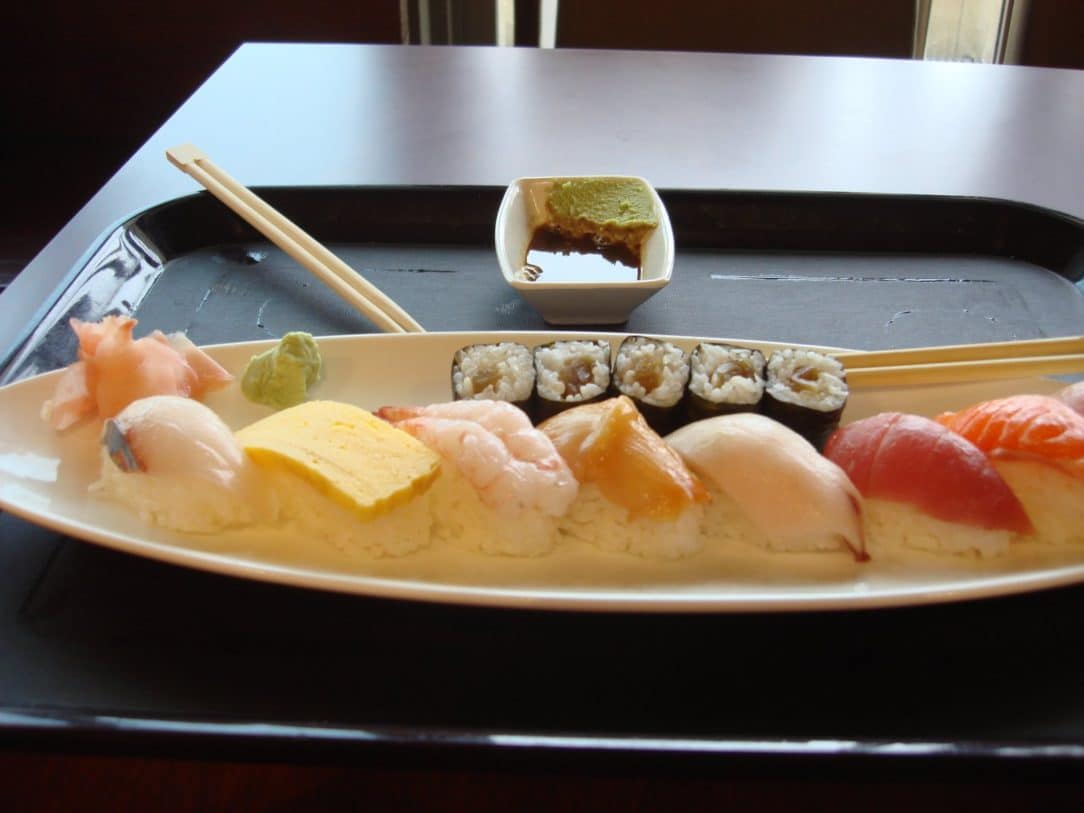
As you can see from the pictures, the interior of Manpuku is pretty big.  It sits at one end of the mall on the 3rd floor and stretches from front to back.  There are at least half a dozen different mini-restaurants inside, offering everything from skillet plates to sushi.

The prices have a wide range from a bit on the high side (a four piece sushi plate at 38 bucks) to the affordable (my pork okas was 9.90).  I saw quite a few dishes I want to try, and I’m looking forward to going back again.  For this trip, we wound up having a sushi set, a dish called pork okas, and a soup that my wife devoured and said was delicious.  I forgot to ask her what it was and she’s asleep now!  Just thinking about it is making me hungry again!

The above picture is the pork okas.  It has strips of pork along with cabbage, onions, and maybe a few other things cooked into an egg omelette.  It’s topped with four different sauces while it’s still on the grill, giving it a nice design that adds a visually pleasing aspect to the tasty dish.
Like I said, the place is great!  We’re looking forward to our next trip.
One special consideration for anyone planning to go there is that the place is busy.  Expect to wait for up to 15 to 20 minutes for your dish to be prepared, and, unless you’re lucky, another 5 to 10 minutes to get a drink.  A good workaround for this is having one person hold the table for you and designating someone else to order and pick-up their food for them.  That way you can leave your food at the table while making trips to get drinks, or other goodies, without having to worry about someone else helping themselves to what you’re going to pay for.

TAN’s Tu Tu Coconut Cake

Looking for something sweet to nibble on while you’re walking around Vivocity mall? Want a snack to enjoy while you’re sitting outside, enjoying the breeze and the wading pools? I really have to recommend that anyone who visits Vivocity stops by this stand and picks up some of these coconut cakes. They’re about the size of your palm and about half an inch thick. They’re made fresh as you wait, and they’re best when eaten warm. The outside is some sort of chewy dough and the inside is sweetened coconut shavings. It looks like it’s mixed with brown sugar, but it still maintains a mellow, even taste. I know, I know, I should’ve taken a photo of them, but we gobbled them down too fast!

If my recommendation isn’t enough, you can see in the picture above that her stall was featured in The Straits Times, which is the major newspaper for Singapore.

The last time we were at Vivocity, which I think was in September, we tried these coconut cakes on a whim. I mean, why not? You get four for only 2 SGD. They were incredible, and since then I’ve talked about them frequently, reminding my wife that the next time we’re there we should get more. Sure enough, almost right after arriving at the mall we made our way to this cart and snagged a little bag of four of them. We then found a cozy spot outside with a view of the water, got comfortable and enjoyed them.

The shop lady making our coconut cakes.

A cruise ship docked in front of the mall, and you can also see the Sentosa cable cars that go between Sentosa and the main island of Singapore.

National Geographic Store in Singapore

Last night my wife and I were at Vivocity mall at Harbourfront and we noticed that there was a new store, a National Geographic Store. In Singapore, there seems to be a specialty store for everything. I guess National Geographic is no exception.

We went ahead and went inside to check it out and we wound up having a lot of fun! Looking through the store was like looking through a museum where everything is for sale. I took photos of a few of the more interesting attractions/products:

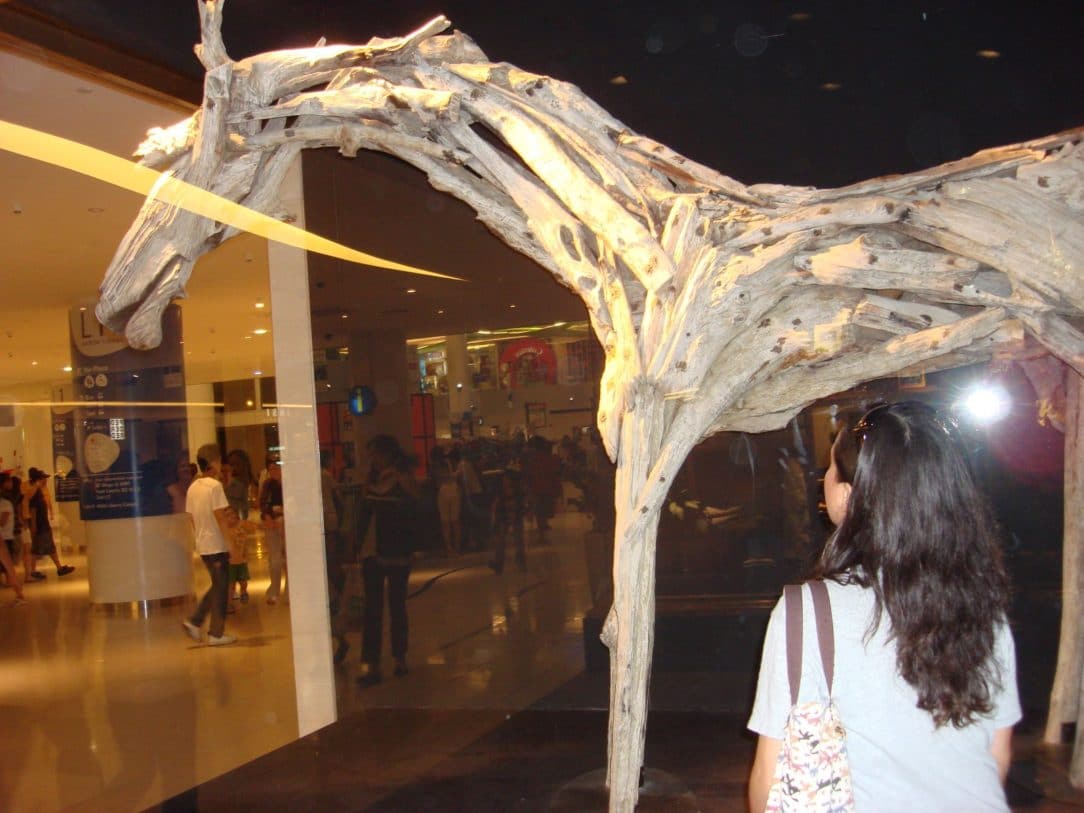
This thing greets you as you first come into the store. It’s pretty visible and is actually what caught our eye in the first place. When I saw it, the first thing that went through my head is stuff about pale horses and death. It’s a horse made of pieces of some type of old wood. I didn’t check the details on it but my wife said it’s selling for the low low price of only 9k SGD. I think I could build one myself for cheaper than that, but maybe it has some historical value?

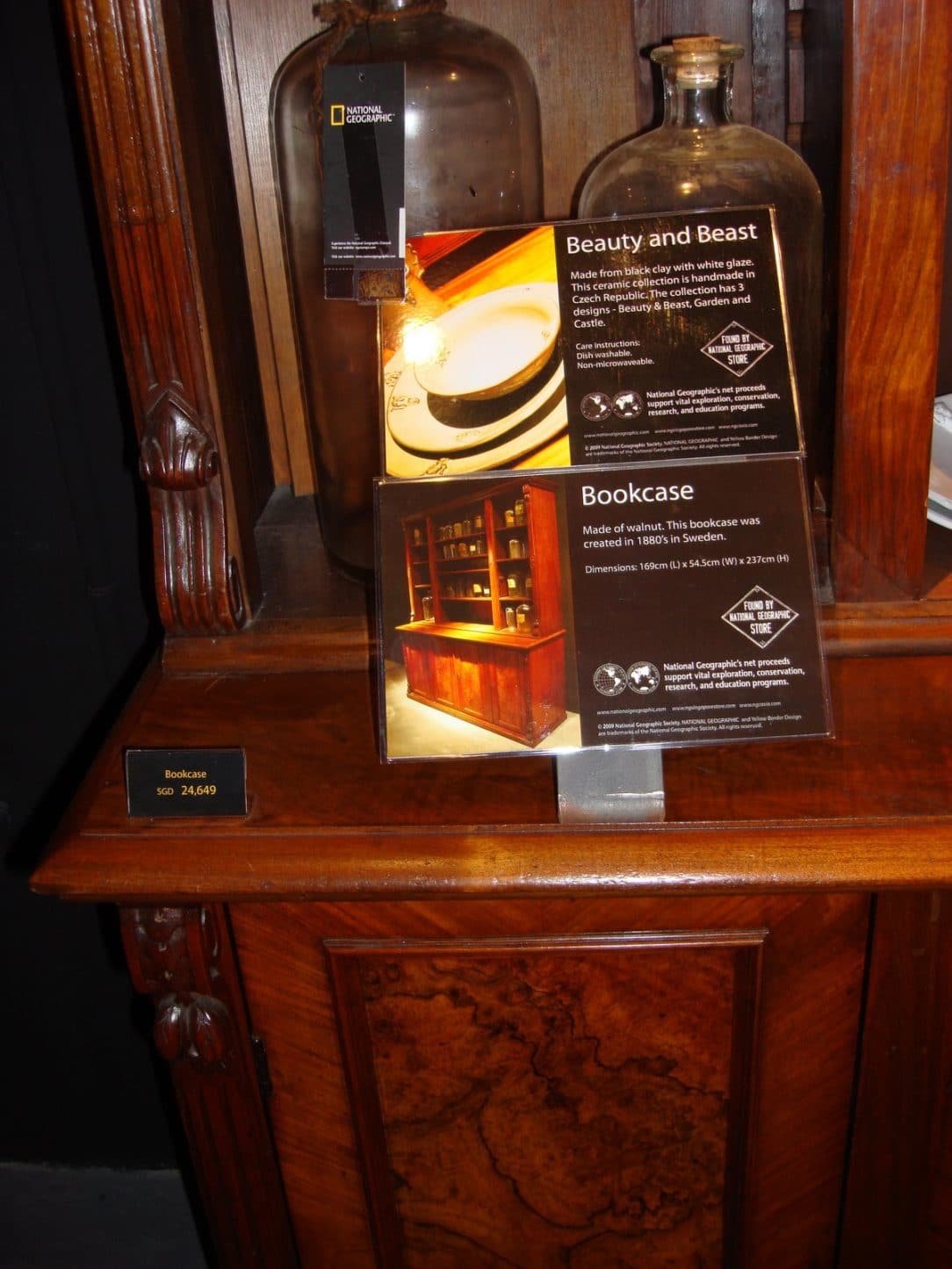
Next up was this bookcase that was apparently made in Sweden in the 1880s. I thought it was particularly interesting because one of the blogs I follow is written by a Swedish girl in China, Jonna Wibelius. Besides, I love books, and it would be nice to have a fancy bookcase to put them on. I don’t think I’d go this far though. The bookcase is selling for about 25k SGD.

Next I saw this really neat jewelry case. It’s 7k SGD. How’s that for a high end Valentine’s gift?

Though not the most expensive, this one was probably the oldest. It was the oldest one I saw anyways. The tag says it was made in the 900s in England, and it was selling for 21k SGD.

What I want to know is how anyone can afford to buy any of these things, especially with the current financial troubles. Maybe these items are just there for show, and are meant to amuse and attract customers more than anything. The store also carried framed prints and a large selection of wearable clothing (as opposed to costume type clothing as pictured below) and bags as well. Plus, there were some interesting notepads. I should’ve checked the price tags on the clothes and bags, but I’m sure it was all very expensive. I did look at the price of a little 3×5 inch “Expedition Notebook” and was disappointed to see it was 17.50 SGD. I would’ve bought it if it had been 6 to 7 dollars, but I can’t see paying more for an empty notepad than I would pay for an actual novel.

Also, the store of course had issues of National Geographic set up on displays everywhere. I used to have a huge collection of those magazines. They were old ones that my dad had in storage. I don’t even remember what happened to them now. I should’ve kept a closer eye on them. They might have been worth money some day.

Besides old furniture and clothes the store also featured two other unusual and interesting attractions. One was so interesting that I don’t even remember what was on the stands around it. An area of the floor was lit up by a projected image of sand. It had some sort of motion sensing technology built in that would display footprints when you walked across it. Also, seeminly at random, scorpions would pop up out of the sand, or out of your footprints, and skitter around. My wife and I weren’t the only ones that found it incredibly amusing. There was a little girl, maybe 6 or 7, that was going nuts trying to squash the scorpions. I recorded some of it. Sadly, I turned off the camera just before the little girl screamed, “Nasty! Nasty! These things are so nasty! GRRRRR!” It was hilarious!

The other attraction is a “cold chamber.” It wasn’t open when we went into the store, but for 1 SGD you can stand inside the chamber and experience -25 C (about -13 F) temperatures. The chamber has glass windows so everyone can watch, and, if you want to pay 5 SGD and submit a valid e-mail address, you can have your picture taken and sent to you as well. For some people in Singapore this might be a thrill because they’ve never experienced temperatures anywhere near that cold before. This is a tropical climate after all. For me, it would be a welcome relief to finally feel some real cold air. Even in the malls here the temperature is average, rather than the cool I’m used to. -13 F is a little extreme, but it would still be great!

So, even though we didn’t buy anything, we still got to have a lot of fun just browsing the store. Even if you don’t have 25k extra to spend on old furniture, I still recommend you at least poke your head in to look around.

The Not So Fragrant Fragrance Hotel

Last year when I first came to Singapore to visit, we had to find a place to stay short-term.  My first thought was hotels.  So, I got online and started searching around for where we could stay.  I didn’t mind spending a little money, but I figured we would be outside most of the time, so I didn’t want to spend so much on the hotel room.  I’d rather spend the money at the destination.  Looking through the internet for deals I came across a package for a flight and a few nights at a place called The Fragrance Hotel.  I asked my then fiance about it and she cracked up!

She told me right away that it would be a bad idea to stay at one of those hotels.  According to her, the Fragrance hotels aren’t very fragrant (cheesy right?).  She said someone she knew stayed in one for a few nights and it wasn’t very comfortable, clean, or hospitable.  On top of that, they have the reputation of being a hotel for one night stands and for hook-ups with prostitutes.  I was surprised, because the image I had of Singapore in my mind was a pristine one.  Singapore’s only reputation in the US is that it’s a place with hard laws and upright citizens, so the idea of a sleazy hotel where you take prostitutes didn’t occur to me.  Regardless, I quickly crossed it off my list.

Monday night I got to see one of the Fragrance hotels firsthand.  My wife and I went to the Geylang area to look at a place for rent.  I had never been there and we arrived just as it was getting dark.  Geylang is everything it’s rumored to be!  Geylang is the gritty underbelly of an otherwise polished Singapore.  The buildings are a montage of new and old, decrepit structures, some worse than shanties I’d seen in the Philippines.  Even so, there were people living in them.  There were newer structures here and there, but the further we got from the Aljunied area and the deeper we went into the Geylang area, the worse it got.

To clarify, when you travel to Geylang on public transit, the quickest way is to get off the train at the Aljunied station and then take a bus or a cab.  We were running late so we took a cab and as we entered Geylang proper I could see quite a few of what the area is most famous for: the Chinese hookers!  They were easy enough to pick out of the crowd and most were wearing cheap, slutty looking outfits and had hair dyed in unnaturally bright colors (for an Asian anyways). 

We weren’t too sure of where we were going and we wound up getting out of the cab a block short.  We didn’t mind though.  It gave us a chance to stretch our legs and get a feel for the neighborhood.  We called up the agent, got our bearings, and started walking towards the apartment building.  As we walked down Lorang 14 we soaked up the sleazy atmosphere, and, unfortunately, quite a few lungfuls of what smelled like stale sweat, rotting garbage and raw sewage.  It definitely wasn’t a very attractive place.  This is also where I got my first view of a Fragrance hotel, and where I took the photo above.

Once we reached the gate to the apartment complex we had to stand and wait a while, as the agent hadn’t arrived yet.  As we stood there waiting, more Chinese hookers passed in and out of the complex.  I don’t know what it is about hookers exactly, but they’re just so damn easy to pick out.  Maybe it’s because I’m so used to seeing decent folk around Singapore that they give off a negative vibe.  They have that cheap way about them.  They look cheap, smell cheap, and, even though I couldn’t understand what they were saying, even sounded cheap.

Regardless, it gave my wife and I one more thing to talk about while we waited to view the apartment.  We chatted about how much like the Philippines Geylang is, and about how it feels a bit dangerous there, like you’d have to watch your wallet and watch your back while you were out.  We talked about how the place seems more lively than Tampines, though not necessarily in a good way.  Geylang definitely has an exciting atmosphere to it, and it might be quite an adventure to live in a place like that after having lived in Tampines for a year.  Tampines is much quieter, and very upscale, especially for a “provincial” area.  I say provincial, but nearly all of Singapore is becoming built up into more of a city-type area.

The oddest and most out of place thing I saw while standing there waiting was a young girl, maybe 12, in a school uniform come through the gate at about 7:30pm.  She was alone and it seemed wrong given the surroundings.  If I had a kid I don’t think I would live in Geylang in the first place, and I definitely wouldn’t let him or her walk around alone after dark.  Not in that area.  It just doesn’t feel safe.

I suppose you could call it a bonus experience, but one other thing of note is that as we were walking to and from the apartment we were viewing we got to see a man sleeping on the floor of the hallway.  He was around 40 to 45, shirtless, shoeless, and probably passed-out drunk, sleeping first face down and then on his side on the hallway floor.  That, more than anything else, was our quality of life indicator for that part of Geylang.

I suppose it’s not what’s outside your door that counts though, so even with all of that ‘excitement’ just a few steps beyond the elevator, it wouldn’t be such a bad thing to live in Geylang.  If you maintain your home, it can still be comfortable, and given the area, the rent is a bit lower than usual as well.  Besides, there is one other thing Geylang is well known for, and that’s the food.  My wife and I both love to eat, and we’re tired of the choices available to us in Tampines, so the lure of fresh feeding grounds is a big one!