Response: Cem Behar’s “A Neighborhood in Ottoman Istanbul: Fruit Vendors and Civil Servants in Kasap Ilyas Mahalle”

In A Neighborhood in Ottoman Istanbul: Fruit Vendors and Civil Servants in Kasap Ilyas Mahalle, Cem Behar attempts to reconstruct the life of an Ottoman Istanbul neighborhood through the use of an exceptional collection of records that he claims are unique to Kasap Ilyas. The records he uses as a primary source for his reconstruction of the mahalle are the notebooks and records of the neighborhood’s imam and (later the) muhtar, which he supplements with data from the 1885 and 1907 censuses and Islamic court records from 1782 to 1924. Additionally, the author attempts to recreate the atmosphere of the neighborhood in the late Ottoman, early Republic period, by interviewing elderly residents of the modern neighborhood.

When considering the information used to create this account, one has to wonder how representative of Istanbul life in general it can possibly be. Behar is careful to point out that Kasap Ilyas’s history and circumstances are certainly unique, and while his findings cannot be used to generalize about Istanbul life, it can be used as a tool to essentially guess at what life in other parts of the city might have been like, given similar circumstances. How many other neighborhoods were there that could have replicated the situation in Kasap Ilyas, however? It does seem to have had many peculiarities, including the large public bath, the nearby wharf, and later the influx of a large population of immigrants from Arapkir. Certainly other parts of Istanbul must have had immigrant populations who were incorporated into society in a similar manner (claims of lost identity papers glossed over by local sponsorship), but how many other neighborhoods also had access to a wharf and warehouses, or to large gardens that provided work opportunities and properly accommodated a working class population? Certainly the elderly inhabitants of the modern neighborhood felt that there was something unique about their neighborhood when they bitterly complained about the destruction of the warehouses and the ‘upper mahalle’ as destroying something essential to their neighborhood.

The unique combination of people and resources (the wharf, gardens, and bath) created a sustainable neighborhood in a city where neighborhoods were routinely absorbed into neighboring mahalles. What I found most interesting about the structure of the neighborhoods, however, is both the diversity of economic classes and the living arrangements. Coming from a Western society, I took for granted that the division of neighborhoods by economic class was a universal occurrence. What factors influenced social norms in Istanbul that made it ok to live in socioeconomically diverse neighborhoods, with beggars living right next to mansions? What made Western society so different? Behar mentions that socioeconomic divisions of neighborhoods didn’t occur until the twentieth century, in response to Western influence. Was it really just as simple as people from similar ethnic and religious groups living together, as a priority over people of similar economic classes living together? Was this common in Islamic cities, or just Ottoman cities, or just in Anatolia? Regarding living arrangements, it was interesting to see that people would often list their business as their residence, but that speaks directly to the economic situation in the neighborhood.

Behar used the itinerant vending of fresh fruits as an example of an informal trade network and then used it to describe the difference between the common activities of recent immigrants from Arapkir to Kasap Ilyas and the more established Istanbulites who had stable businesses governed by regulations and guild organizations. He described an informal network as requiring little or no skill, no permit or license, and little to no startup costs. The only true requirement is that one have a customer base, which Behar describes as a “solid network of personal relations” (115). Behar’s point was probably to show what factors made Kasap Ilyas such an attractive point of entry to Istanbul for the Arapkir immigrants. The Arapkirlis had previously established a system of patronage through the retinue of a pasha who brought his household back to Kasap Ilyas. Alone, this would not have been enough, but because of the presence of the large vegetable gardens, like the Langa gardens, the Arapkirlis were able to incorporate themselves into the larger Istanbul economy through “entry-level” work. Certainly many maintained that lifestyle. Behar describes fathers and sons performing this work together, but Behar also describes other Arapkirlis using fruit vending as a starting point for upward mobility through civil service. I’m sure that there are many cities in many parts of the world that have experienced similar patterns of immigrant exploitation of a resource to establish an ethnically homogenous presence in a city where greater opportunities for social mobility are present. Considering the high rate of population turnover in the neighborhood, it is likely that not only the Arapkirlis were taking advantage of the neighborhood’s usefulness as a socioeconomic stepping stone.

One area of Behar’s work that I found problematic was his assumption of familiarity with foreign language terms. Of course, when writing this type of history, it would be fair to assume that the reader has some familiarity with ‘Islamic’ terms, but Behar’s text is liberally sprinkled with Latin phrases and words that have been borrowed from German. He places these phrases in Italics, signaling their rare usage, but then fails to give a definition. Admittedly, a reader could simply pick up a dictionary to learn the meaning on his own, but if Behar knew the usage of those phrases was problematic and put them in italics, he could have gone the extra mile and defined them at their first usage as well. There were also instances where he deliberately used a Latin word where an English word would have sufficed, like on page 40 where he uses nomenklatura instead of “nomenclature”. Given the context, it is unclear whether he is using the Latin term to replace the English term or if he is making a reference to different statuses within the elite classes of Communist bureaucracies. Another problematic use of language is on page 90, where Behar indicates that the ‘surname’ “binti Abdullah” is significant in connoting conversion to Islam, but does not explain why.

Overall, Cem Behar’s work does an outstanding job of using records to create an image of what Kasap Ilyas might have looked like over the course of Ottoman control of Istanbul. It helps the reader to understand the social and economic dynamics at play in the neighborhood and the city in general, as well as how neighborhoods operated internally.

Response: Norman Itzkowitz’s “Ottoman Empire and Islamic Tradition” and Leslie Pierce’s “The Imperial Harem”

In Ottoman Empire and Islamic Tradition, Norman Itzkowitz presents an account of the period traditionally considered to be the rise of the Ottoman Empire. His account is complex, explaining that the ghazis weren’t driven by a purely religious zeal for the conquering of new territories, though that was certainly a part of it, but also for economic and psychological reasons (11). He explains the process by which new areas were incorporated into the empire and ends his book with an explanation of the Ottoman world view at the height of their power, thinking little of Europe and only then as a backward place of no consequence, which Itzkowitz claims resulted in a feeling of complacency reinforced by the Islamic abhorrence for bid’a, or innovation (105-107).

In the reading, I was struck by the fact that much of the land the Ottomans gained in Europe was done through a long process of vassalage and annexation. Even more so, I was surprised to see that many lords offered their allegiance to the Ottomans willingly, as in the case when Stephen Dushan died (14). Obviously there were still wars, but when compared with other empire builders, the Ottoman’s methods come across as more gradual, purposeful and efficient. If local lords were convinced they wanted to be a part of the empire, then there wasn’t as much chance of them quickly rebelling, though according to Itzkowitz’s account, there were plenty of times when land and cities were reconquered multiple times. I also found it to be very telling of the status of corruption in local Balkan governments, that the Orthodox church peasants often preferred Ottoman rule to Christian rule because the taxes were more fair. Reading modern ideas back into Ottoman times, I’ve heard people say that it wasn’t good to be a religious minority in the Ottoman empire, because no matter how good they were treated, they were still considered second class citizens, and treated as such, but if that’s the case, then how much worse were they treated by their governments prior to becoming Ottoman citizens? And was it really a bad move?

I found it interesting that the fact that some families tried to safeguard their positions by converting their lands into waqfs, which the sultan Mohammed II then began confiscating anyway (29). It made me wonder if there were different tax codes relating to property that was in waqf status, and if this was an ancient form of tax evasion that the sultan became aware of and tried to stop. Also, the author characterized Suleiman the Magnificent’s anti-Hapsburg alliance with France in the early-mid 1500s as being in the “ghazi spirit” (34). Was this stated in some primary source document? Or is this the author applying the complicated idea of what ghaza is that he developed to describe behavior in the early Ottoman period to the ongoing conflict for political and territorial gain in the 1500s?

Itzkowitz mentions that the period during which Kosem and Turhan were competing for power was known as “The Sultanate of the Women,” but I think Leslie Pierce would disagree and argue that this period began with Hurrem, almost a hundred hears earlier in the 1520s. Hurrem gained Suleiman’s undivided attention, causing him to break with tradition and give her multiple sons, marry her and move her into his palace.

Pierce’s descriptions of how sexuality and reproduction were used for political purposes was extremely detailed and extremely informative regarding the evolution of the nature of succession practices in the Ottoman empire. I found it extremely interesting that sexual control was exerted not just over women, as is popularly depicted, but also over men, to render them politically insignificant. It’s easy to see an essentially captive male offspring as unthreatening, but I think it was a bad solution to the problem of creating stability, because the confinement seemed to weaken the Ottoman line physically and mentally and almost led to its collapse. It’s odd to think that the Ottoman empire was saved by the sexual ability of a mentally retarded man who was the last living Ottoman male.

Response: Donald Quataert’s “The Ottoman Empire, 1700-1922”

Donald Quataert’s book, The Ottoman Empire, 1700-1922 (New Approaches to European History), is an engaging overview that challenges popular (mis)conceptions about internal dynamics of the empire in regards to inter-communal relations and the role it played internationally. Throughout the text, Quataert takes care to place the Ottoman Empire in context, something which he seems to believe has been rarely done in past historical works, resulting in inflated claims of both power and weakness, as well as claims of undue cruelty both to its own citizens and its enemies. In short, while providing a good overview of the empire, Quataert also does an effective job in leveling the playing field so that the reader is able to understand that both the perceived negative and positive actions of the empire are not unique to the Ottoman Empire, cutting through caricatures to present a balanced view of history.

Having never read anything regarding the Ottoman Empire before, the text was very instructional. I was previously under the impression that the Ottoman Empire was a primarily Middle Eastern, Muslim empire that was organized along monarchical and religious lines. The information presented about the gradual shift in power from the sultan to the viziers/pashas and then to the Jannisaries was interesting. What sort of authority did the office of sultan still hold that it was maintained for the purposes of political legitimation? Why was there never an attempt to restructure the central government? Or was the sultan a political figurehead in a similar way to modern Prime Ministers and Presidents?

I was also very interested to find out that for a large portion of the empire’s existence, the vast majority of the population resided in the European provinces, making the empire more European than Middle Eastern. The fact that the Ottoman Empire expanded so far into southeastern Europe helps to explain the modern mistrust and fear of Turkey and, as the author says, the hesitance the European Union is displaying regarding Turkey’s application for membership. It’s a hesitancy and fear that’s a legacy of the Ottoman Empire’s initial military successes, but why does Turkey bear the legacy of that fear? Is there something about Turkey that makes it different from the other former Ottoman lands? The Ottoman’s central administration was located in Turkey, but in the formation of the modern Republic of Turkey, the Ottoman legacy was almost completely abolished. Is there some fear that Turkey might use the European Union to ascend economically and politically and once again pose a political threat to the European nations?

One thing that I wish had been better addressed in the text was the legal system in the Ottoman Empire. How heavily did it rely on religious law? How much was secular law? Was there a process where the ulema approved the laws, or was religious validation not required? Was religious law widely applied or was it limited to civil courts? Also, how heavily were communal religious courts used, and how often were there appeals to Islamic courts? What did sectarian (non-Muslim) courts use as a basis for law and are any of the law books they used still existent? Or were they more informal? The particulars of the law systems is probably a subject for a separate book, but the author didn’t seem to spend too much time discussing the court system in general, and the fact that non-Muslim citizens often appealed to the Islamic courts for ‘justice’ makes it a point of interest.

Overall, Donald Quataert’s book tackles a subject that, judging by his text, has often been unfairly maligned in popular media due to old biases and fears. His attempt to overcome those misconceptions are obvious throughout the text, where he constantly makes comparisons between the Ottoman Empire’s methods or actions and those of other contemporaneous political entities. The division of the book into sections that generally cover time periods, followed by chapters that address certain aspects of Ottoman society helps the reader to place the more detailed information into the greater framework of events. The Ottoman Empire: 1700-1922 is an excellent introduction to an important period of history.

Response: Cemal Kafadar’s “Between Two Worlds: The Construction of the Ottoman State”

Cemal Kafadar’s book, Between Two Worlds: The Construction of the Ottoman State, is an attempt to find a middle-ground between existing theories that paints a more realistic picture of a dynamic and fluid process that didn’t exist in polar opposites, as presented in the theories put forward by Herbert Gibbons, Paul Wittek and M. F. Koprulu. By that, I mean their theories seem to be presenting history in a way that supports a contemporaneous need to justify the superior role of one group or another, or a particular aspect of a group, rather than in a way that produces a realistic and sufficiently complex set of events. Cemal Kafadar recognizes this and, rather than producing another theory and trying to prove it, he attempts to reconcile the theories presented by Gibbons, Wittek and Koprulu into something that might better approximate the truth of the origins of the Ottoman state.

Kafadar tells us that very little written documentation exists from the foundational period of the Ottoman state, and what does exist is only useful up to a certain point because of the possibility of the text being altered to fit the author’s needs. According to Kafadar, it’s possible that the Ottomans didn’t know where they came from. When attempting to establish an empire, however, it’s important to have political legitimacy and creating a new historical narrative is one way to establish the right to rule. Attempts to establish that right are obvious in the creation of false lineages that allowed the Ottomans to trace their descent to Noah (Islamic legitimacy) and to the Oghuz Turks through the Kayi tribe (ethnic legitimacy?). Regardless of whether or not these lineages are accurate, knowing that they were important at the time as symbols of political legitimacy can help explain the problems the Ottomans were facing at the time. Why did they feel that they needed to shore up their right to rule at those particular times?

It was especially interesting to see the changing role of Islam and the gradual shift from a localized version of Islam to a more orthodox Sunni version of Islam. How important was Islam in the beginning of the Ottoman’s attempt to found a state? Did they even conceive of it as ‘gaza’ at the time? Or was it later legitimated as gaza by historians seeking to shore up the Ottoman’s Islamic credentials? Kafadar mentioned that religious identities at the time were very fluid and often Muslims would ally with Christians for the sake of raiding and battling rivals. It’s likely that the Ottomans also engaged in that practice. And, it’s also likely that they didn’t feel any less Muslim for doing so, given that they had Islamic titles, like “Champion of the Faith.” What made a good Muslim in that period? It’s probably not even possible to make that distinction today, but it’s interesting to see how much more cavalier the reality was, compared to the supposed Islamic norms.

Kafadar made a brief mention of the similarity between events in Anatolia and the events in the Iberian peninsula, where the remnants of the Umayyad dynasty were slowly being whittled down by the Catholics in the Reconquista. In that conflict, there were also Muslim mini-states that would ally with Christians against a rival Muslim mini-state, with the end result being that Ferdinand and Isabella expelled the last Muslims from the Iberian peninsula in 1492. The rulers of the Muslim mini-states in the Iberian peninsula had to know what would eventually happen to them, so why did they continue to ally with Christians? How important was religion to them, compared to politics and political power? In the same way, modern thinkers were probably reading too much into the religious aspect of the frontier warfare in Anatolia.

The literature concerning the frontier area is especially interesting in how it depicts the role of women. If Islam were a driving force in Turkish expansion in the area, then why were women depicted in roles that supposedly broke Islamic norms? Efromiya is depicted as a woman convert to Islam that battled alongside men she wasn’t related to, kept their company at night, and didn’t cover herself, and likely had a lover for a while before being married to him (Artuhi). Similarly, in the Book of Dede Korkut, Kan Turali sets out to look for a woman that is good at cutting the heads off of infidels, which isn’t a role traditionally filled by a Muslim woman, or at least not the way we think of a Muslim woman today. He eventually marries a Christian woman, Princess Saljan, who is presented as strong-willed and highly sexual (“she went weak at the knees, her cat miaowed, she slavered like a sick calf…[ and] said, ‘If only God Most High would put mercy into my father’s heart, if only he would fix a bride-price and give me to this man!’”, p 69). How do these stories fit into the actual history of the region? Are they complete fictions that only represent the general fantasies of men at the time for foreign women? Was this considered legitimate behavior in that time and place?

The only thing that could have made reading his book clearer and more readily understood would have been an introduction that spelled out their theories before Kafadar launched into his own interpretation of them and the events that surround the founding of the Ottoman state. Since there is as yet very little existing documentation from that period, the best we can do is make conjectures about the period and Kafadar does a good job in reducing Wittek, Gibbons, and Koprulu’s one dimensional theories into something more life-like and believable.

Holy Family Church’s Frozen Garden

On Sunday afternoon, my wife and I were by the United Nations to take advantage of a Groupon deal I got for the Indigo Indian Bistro on East 50th Street. We didn’t realize the place closed for a while after lunch and before dinner, so we found ourselves standing in the cold with an hour and a half to kill.

I thought about going to the United Nations for a tour, since we were right next to it, but it looked like it was closed too. There weren’t even flags up on the poles. So, we started walking around. First, we poked our heads in at the Japan Society to see if there was anything going on (and to warm up a bit), but they were just finishing up a New Year’s celebration for kids. Then we went next door to look in the Holy Family Church. The building is really weird looking from the outside.

Turns out it’s a Catholic church. It’s sort of nice inside. The giant Jesus on the wall above the priest leading the service was a little scary looking. It made me think about the conflict inherent in the concept of a trinity model of monotheism, and whether or not a distant and cold concept of God was being replaced by the warm and gentle spirit of a man, someone that people could understand and empathize with. That’s a subject for another post, though. I’ve been doing a lot of theological reading that I’ve been slowly digesting, mentally.

Sculpture of an angel (I think)

After warming up in the church foyer, we went back out to find our next opportunity for passing time. As we were walking away, I noticed a side path that led into a garden that was covered in snow and ice. We figured it was worth a few minutes to go in and look around.

Frozen waterfall in the Holy Family Church garden.

What really peaked my interest was the fact that the garden pool was covered in a layer of ice and snow, and so was the artificial waterfall. I don’t suppose there’s anything unusual about a waterfall icing over in winter, but it’s not something I really expected to see in the middle of Manhattan; not even an artificial one. So, I think the unexpectedness of seeing what I didn’t expect to see made it more worth seeing, if that makes any sense. I’ve also always enjoyed religious settings and architecture, of a certain type. The more solemn and thoughtful type. I’ve always thought religion should be a solemn, thoughtful and meaningful thing.


St. Paul’s Chapel and Cemetary next to the World Trade Center Site

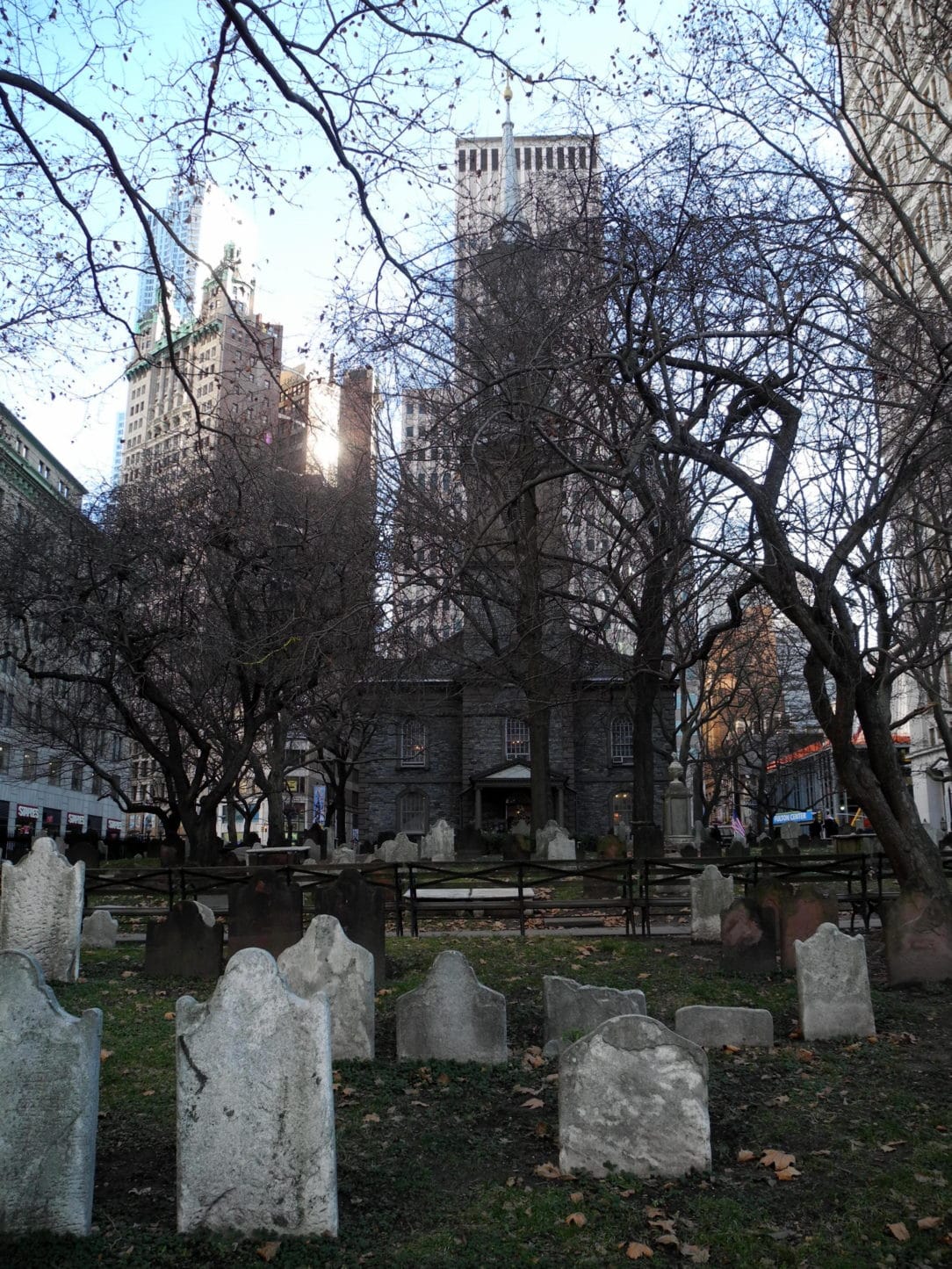
St. Paul's Chapel and Cemetary
St. Paul’s Chapel and Cemetery

Last Thursday my wife and I went downtown to the National September 11 Memorial site. To get to it, we had to walk past St. Paul’s Chapel and Cemetery and my wife was interested in having a look around, so we went in.  I’ve been there a few times before, but it was her first time. She remembered hearing about the chapel in the news and wanted to see it first-hand.

St. Paul's Cemetery
St. Paul’s Cemetery

We walked through the cemetery first. She was impressed by how old the headstones are. I am too. It’s weird to see gravestones still erect for people that died in the 1760s next to so many buildings of modern construction. It’s so out of place. It’s nice to see that the chapel and the cemetery survived and weren’t torn down to build something new, especially in considering the important role the chapel played during the September 11th tragedy, when rescue and aid workers used the sanctuary as a place to rest and recover for a few hours before going back out to look for survivors again.

Memorial to September 11 Victims in St. Paul's
Memorial to September 11 Victims in St. Paul’s
George Washington's Pew at St. Paul's
George Washington’s Pew at St. Paul’s
Oldest painted seal of the United States

When you walk through the chapel, it’s hard to not be touched by the memorials set up around the outer edge, artifacts left behind by people looking for loved ones mixed in with older stuff, like George Washington’s pew and what is touted as the oldest painting of the seal of the United States, which looks more like a turkey than an eagle, probably due to influence from Benjamin Franklin, who wanted the national bird to be the turkey. On a side note, it’s good that he didn’t get his way, or else what would we eat on Thanksgiving? It would be a federal crime to roast our turkeys!

Rosaries on wooden hands in St. Paul's Chapel
Rosaries on wooden hands in St. Paul’s Chapel
Rosaries on wooden hands at St. Paul's Chapel
Rosaries on wooden hands at St. Paul’s Chapel

Seriously, though, on my previous trip I never really stopped to considering and think about the people in the photos set up on the alters, or the stuff that was moved inside from where it used to be posted on the fences around the church. It’s hard to stand there and think about the people, on an individual level, that died there that day. It’s easy when you’ve only got this vague idea in your head of some 3000 people. It’s harder when you look at the photos and wonder what their life was like and who they left behind. Who cried for them? What were there final moments like? How has the event changed the lives and world views of those closest to them?

Police and Search and Rescue unit patches left behind as symbols of solidarity
Sanctuary of St. Paul's Chapel
Sanctuary of St. Paul’s Chapel

The informational plaques were nice. It helped tell the story of the place. It explained why there are no pews left in the center of the building, and where all the patches on the priest’s garment (I forget the actual name of it) came from.

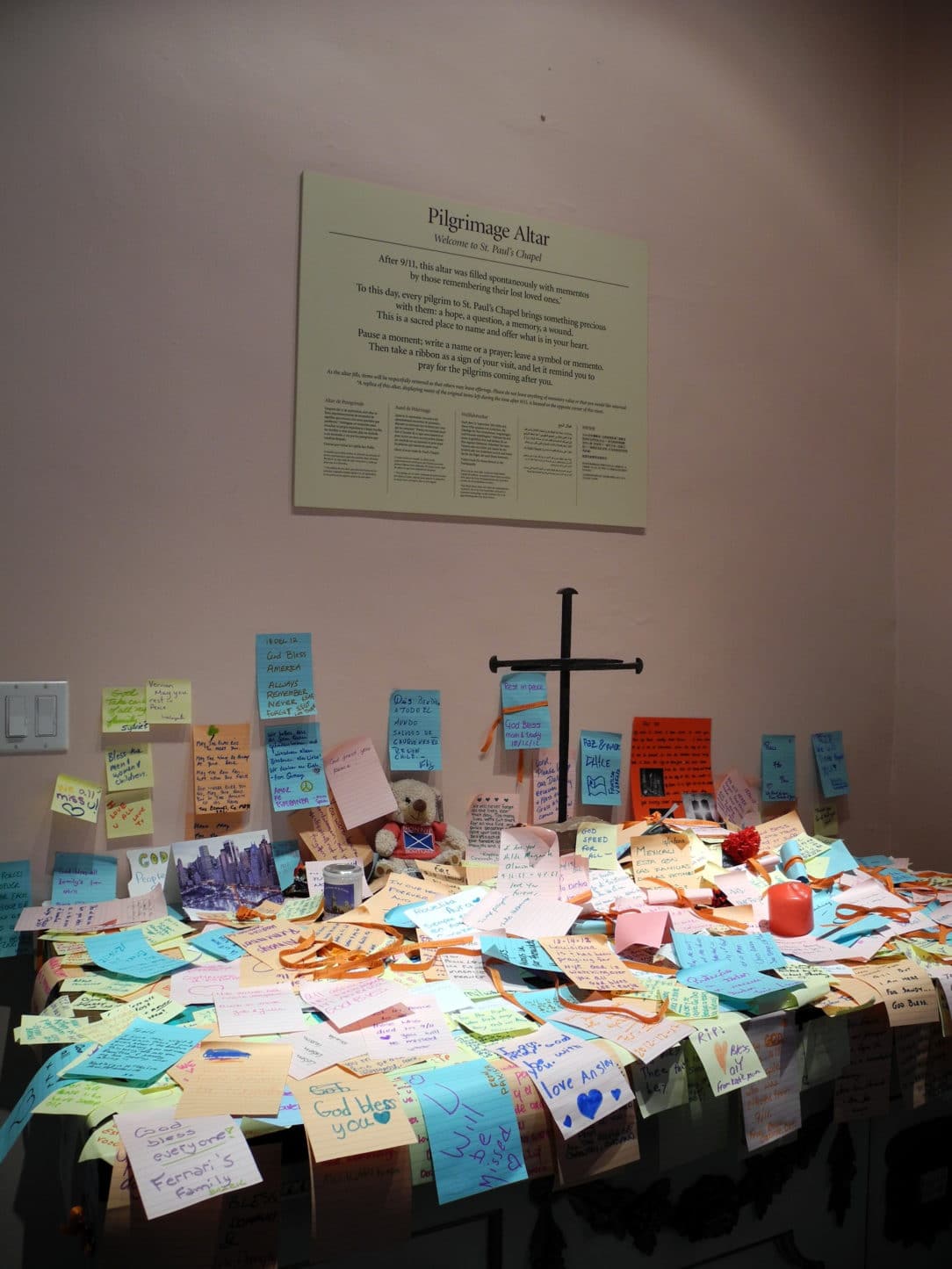
Pilgrimage Altar at St. Paul's Chapel
Pilgrimage Altar at St. Paul’s Chapel

I thought the “Pilgrimage Altar” was especially interesting. Is St. Paul’s a site of pilgrimage now? It’s hard to think of it that way, in the same category as Canterbury, Santiago de Compostela, or Jerusalem. But perhaps it is a place of pilgrimage in a broader sense of the word. People were encouraged to leave behind thoughts and prayers for those who perished at the nearby Trade Center site, which they did, covering the altar in notes.

St. Paul’s is an important site of remembrance that has surpassed its role as a Christian church. It is now a site of tourism and pilgrimage for people of all faiths or no faith, to remember the loss suffered by so many on that day, to contemplate how the world changed, and maybe to hope for something better in the future.

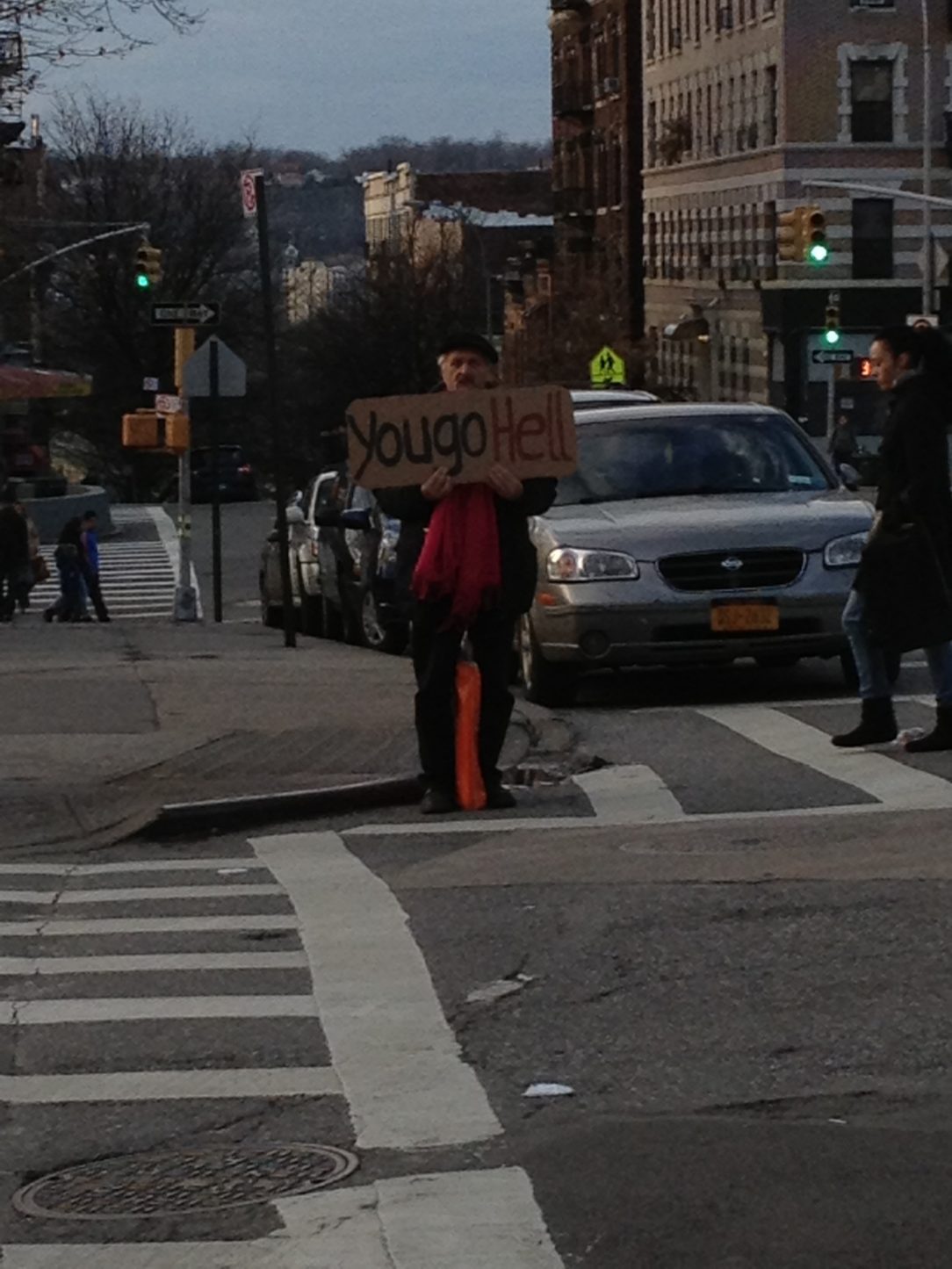
YougoHell

YougoHell
An old man holding a sign that reads “YougoHell”

Yesterday (Tuesday, December 12th), I was surprised to see this man standing on the corner of 137th Street and Hamilton Place in Harlem, Manhattan, just down the hill from the City College of New York CUNY and P.S. 325, a public elementary school.

When I walked up to the corner, a man standing by the vendor cart that’s usually there at the base of the hill selling drinks and snacks was screaming at this old guy, “No! You go to Hell!”  I couldn’t hear what the old man was saying clearly because I had headphones on, but I imagine he was saying, “No, you!” or something like that.  I don’t know if the guy was seriously offended by the old man’s sign, or if he was just doing it to agitate the old guy.

More than anything, I was wondering what happened that made this guy do this?  And who is his intended audience?  The only real foot traffic in the area that’s constant all day long is the flow of students to and from CCNY.  So, does he equate higher learning with sin?  And if he does, what higher learning it?  All of it, or just the social sciences and humanities?  And if he condemns all education, then … well, it would be ironic since he knows how to read and write, so I’m sure it’s something more specific than that.  It had to be personal though.  He wasn’t handing out literature like the religious dealers that peddle pamphlets using signs that threaten eternal torture.

He wasn’t there today.  At least, not when I walked through there.  I’d never seen him before, either.  I’m really not surprised.  This is New York City after all.  There’s always someone screaming about the apocalypse, screaming at someone, screaming at an imaginary person, etc. etc.  At least he had his pants on.

Islamism and “The Yacoubian Building”

The Yacoubian Building Book Cover

The following is a short essay I wrote about The Yacoubian Building for an undergraduate history course.

In Alaa al Aswany’s book, The Yacoubian Building, Islamism and Islamists are primarily presented through the point of view of the character Taha El Shazli, the son of a doorman who lives on the roof of the Yacoubian building.  As the story progresses, the rise of Islamism in Egypt is presented as being directly related to socioeconomic background, the lack of adequate economic opportunities and corruption present in government and society.

Taha’s family was of very modest means.  Despite this, Taha was very intelligent and was able to excel at his studies because of his desire to become a police officer, which he believed would allow him to advance in life and gain the respect and dignity that he lacked while growing up in the Yacoubian building.  As the son of a doorman, he was often ridiculed and looked down on by the other residents, which he was forced to put up with because he had no other option.  Taha was sure that he would be able to succeed in his endeavor because he believed firmly in God, prayed regularly and avoided major sins (Aswany, 20).

Taha almost reached his goal, but his socioeconomic status caused his application to be rejected.  Before attending the character interview, he had spoken to officers in his district who told him that because he had no rich and influential family members he would have to pay a bribe of 20,000-pounds to guarantee his acceptance into the police academy.  Taha wasn’t financially capable of paying a bribe of that amount and given his religious devotion, he probably wouldn’t have done it anyway.  Instead, he believed firmly in his abilities and hoped that his devotion to God would enable him to overcome that obstacle.

Unfortunately, the board wasn’t interviewing for ability or the marks of a good police officer.  They were only interested in the corrupt practices of giving out government positions to family members or people with the right amount of money.  Even though they were impressed by Taha’s answers, when it was discovered that his father was a “property guard,” he was dismissed.  This was Taha’s first taste of corruption, another in a long line of blows to his dignity, and a serious threat to his chances of ever having a respectable life.

Taha’s next attempt to push past the boundaries set by his socioeconomic background was his enrollment in the Faculty of Economics at Cairo University.  In his new surroundings, however, he still felt the sting of class divisions and was drawn towards other people who, like himself, came from humble backgrounds.  These people were more religiously observant and Taha finally felt like he’d met people that would allow him the respect and dignity he was seeking.  The level of respect and the sense of belonging he finally felt with this new group of people, student Islamists, made him far more open to radicalization.  He felt that he was valued.  He was brought into an inner circle and introduced to an influential and charismatic leader, Sheikh Shakir, which validated his need for respect and purpose.

The event that crystallized Taha’s emergence as not just an Islmaist, but a jihadi Islamist, was the trauma he experienced when arrested after a demonstration protesting Egypt’s involvement in the Gulf War.  Already having spent most of his life being bullied and pushed around because of circumstances out of his control, he was bullied, tortured and raped by the very government entity that he had at one time hoped to work for.  The corruption that prevented him from serving his country as a police officer now served to facilitate his torture and radicalization.  When Taha was finally released from prison, his dignity as a man and a human being was shattered.  His faith was shaken.  Through coaxing from his Islamist mentors, however, he was convinced that he could best recover through renewed devotion and military-style training, which Taha readily agreed to out of an intense need for both healing and revenge.

In the end, Taha became a “martyr,” dying in the process of taking revenge on the man who ordered his rape.  Because of Taha’s socioeconomic background, he had limited options to start with.  Because of the corruption in the police department (and the government office that denied his claim of unfairness) he was pushed down a path that led him to associate with Islamist oriented people of a similar background.  Further government corruption in the form of sanctioned torture and degradation in prison caused Taha to pass the tipping point.  While not all Egyptians may follow the same path to Islamism, Aswany’s message is clear:  the lack of opportunities open to people of all classes and the government’s enabling of and participation in corruption helped to create violent Islamists.

Islamist Political Thought in Egypt: al-Banna to Faraj

The following is a short essay I wrote for an undergraduate college class on the history of Islamist political thought:

On June 30th, 2012, Mohammed Mursi, a member of the Muslim Brotherhood founded by Hasan al-Banna in 1928, assumed office as the 5th president of Egypt.  In modern politics, the Muslim Brotherhood holds the highest offices of power in the state, but it began as a small movement in the port city of Suez with a membership of seven.  Today, the Muslim Brotherhood expresses the culmination of decades of Islamist thought and is a diverse movement with members who champion women’s rights and push for greater integration with Christians and other minorities, as well as more conservative, Salafist and Qutbist members.[i]

The shape and expression of Islamist thought has changed dramatically over the years, but the ideology expressed in the Muslim Brotherhood today has its foundation in the political writings of Hasan al-Banna, the man who founded the organization.  From an early age, Hasan al-Banna took a strident stance against the British presence in Egypt, Christian missionary activity, and behavior that was deemed un-Islamic.  Rather than pursue religious studies, al-Banna became a teacher and was posted at a school in the Suez Canal Zone, where he was appalled by what he saw as the dominance of materialism, secularism, and a trading of Islamic morals for Western decadence.  He was also repulsed by the sight of Egyptians being exploited for the economic benefit of foreign powers.[ii]

The problems Egyptian society faced in confronting Westernization and colonial exploitation weighed heavy on Hasan al-Banna’s mind and the only solution he felt was appropriate was a return to Islam.  In a letter al-Banna sent to heads of state and other influential people, he said, in regards to Islam: “If we take the nation along this path, we shall be able to obtain many benefits …  For then we will construct our lives on our own principles and fundamental assumptions, taking nothing from others.  Herein lie the highest ideals of social and existential independence, after political independence.”[iii]  From this, we can see that al-Banna rejected Westernization as a system of living, opting instead for Islam as a native, natural, superior and complete way of life.[iv]

Al-Banna left it to other thinkers to flesh out his ideas and focused instead on social welfare programs and expanding the Brotherhood’s membership.  However, al-Banna did firmly establish the concept of a dichotomy of Islam versus the “West,” attributing the decline of Muslim civilization to the wholesale adoption of Western values and social norms, and argued for a return to Islamic values as a solution to the social malaise being experienced in Egypt.  He presented Islam as an opportunity for Egyptians to throw off the shackles of second-class humanity and reclaim their former glory, the former glory of their Islamic heritage.  He also established the important concept of modernity and Islam not being mutually exclusive.  A civilization does not have to be “Westernized,” or secularized, in order to be modern.  A civilization can be Islamic and modern as well:  technologically advanced, socially progressive, but still retaining the values, beliefs, and social norms that make Muslims and Islamic civilization distinct.

While some of al-Banna’s writing emphasizes the rejection of pacific forms of jihad in favor of armed conflict with unbelievers, al-Banna was pragmatic, conciliatory and willing to compromise.  For example, while he disapproved of the Egyptian political system, he participated in elections.[v]  Other Islamists that followed al-Banna were less forgiving.  For example, Sayyid Qutb was decidedly more in favor of violent jihad, earning himself the nickname “The Philosopher of Islamic Terror.”[vi]

Sayyid Qutb was born in Upper Egypt in 1906 and, like al-Banna, began his career as a teacher.  He also adhered to al-Banna’s ideology of Islam being the correct path for Egyptians to follow in order to regain their power as a civilization and joined the Muslim Brotherhood.  Where Qutb differed was in his stridency and his message of Islam being the only correct lifestyle in any part of the world where Muslims live.  He was firmly against any system that gave legislative authority to man and, unlike al-Banna, did not compromise in his ideology.  He wrote that “submission to God alone is a universal message which all mankind must either accept or be at peace with.  It [a legal framework] must not place any impediment to this message, in the form of a political system or material power.”[vii]

He also believed that establishing this legal framework required more than “verbal advocacy of Islam,” because “the problem is that the people in power who have usurped God’s authority on earth will not relinquish their power at the mere explanation and advocacy of the true faith.”[viii]  Qutb did not believe in idly sitting by and hoping that Islam would become dominant in the world of its own accord.  He believed that Muslims have an obligation to actualize proper Islamic governance through action.  He wrote, “… knowledge is for action… the Qur’an was not revealed to be a book of intellectual enjoyment, or a book of literature or art, fables or history… Rather, it was revealed to be a way of life, a pure mode of being from Allah.”[ix]  Combined with Qutb’s idea of a single, true version of Islam, this concept of bringing about God’s law on earth through action contributed to the rise of violent jihad.

Building on Sayyid Qutb’s ideology, Muhammad ‘Abd al-Salam Faraj advocated the jihad of the sword as the only legitimate interpretation of jihad, dismissing the greater jihad of internal struggle against sin as a fabrication meant to pacify the Muslim masses.[x]  Like Qutb, Faraj saw (Western) modernity as a condition of moral bankruptcy, and as an infection that was destroying the ummah from within.[xi]  In 1981, using his reworked definition of jihad, Faraj published a collection of justifications for violent jihad against un-Islamic rulers in a pamphlet called al-Farida al-Gha’iba (The Absent Duty).  A few months later, the militant group that Faraj belonged to, Jama’at al-Jihad, planned and executed an assassination of President Anwar Sadat, a secular leader intent on rapid modernization.

The debate over Islam and how it relates to government in Egypt continued into the 1990s, with two opposing views being presented by Yusuf al-Qaradawi in Min fiqh al-dawla fi’l-Islam and ‘Umar ‘Abd al-Rahman in The Present Rulers and Islam: Are They Muslim or Not?  Qaradawi argued that democracy is compatible with Islam and wrote that “A call for democracy does not necessitate a rejection of God’s sovereignty over human beings.”[xii]  He explains that Islam contains elements of democracy and uses role of an imam as an example.  He says that an undesirable prayer leader may be removed, which is a precedent for the removing of an undesirable governmental leader, which in turn is an expression of democracy.  The people select who will rule over them.  Qaradawi argues that democracy is the best form of government for Muslims and it shouldn’t be rejected simply because it originated outside of Islam.  It should be incorporated, with useful elements being retained and the rest being discarded.[xiii]

‘Abd al-Rahman, on the other hand, advocated the rejection of any ruler that was not in full compliance with the concept of Islamic governance as expressed by Sayyid Qutb, even to the point of causing civil war.  He wrote that fitna (civil war), though a serious issue in the Muslim ummah, is preferable to being ruled by an un-Islamic ruler, and that “We would not, in fact, consider the resulting social discord [from eliminating an un-Islamic ruler] to be fitna at all; rather we would regard it as a struggle for reform because its ultimate aim would be the elevation of the Truth, the uprooting of corruption, and the reaffirmation of Islam.”[xiv]  For al-Rahman, whether or not to use violence is not a question, but rather a necessity, against any form of rule that is not compliant with the shariah and places legislative authority in the hands of man.  The removal of the leader should be immediate, or the people will be just as guilty of shirk as the leader.

Islamist thought in Egypt has branched out into a number of different schools of thought, from extremists who advocate violent jihad and a return to the fundamentals to those who try to reconcile Islam with democracy.  The common thread that holds them all together is their belief that the future lies in the Quran and man’s obedience to Islam and God’s law as a way to reestablish the power and dignity of Muslims.  With the recent political upheaval in Egypt and the coming to power of a Muslim Brotherhood member, Islamists may finally have the opportunity to realize some of their ideals.  Mohammed Mursi’s ascension to Egypt’s presidency is a remarkable event and Hasan al-Banna’s surving brother, Gamal al-Banna, believes the election would have pleased his brother, because “it was God’s will.”[xv]


[i]. “How Muslim Brotherhood went from 7 members to Egypt’s presidency,” June 29, 2012, http://www.mcclatchydc.com/2012/06/29/154443/how-muslim-brotherhood-went-from.html.

[ii]. Roxanne L. Euben and Muhammad Qasim Zaman, Princeton Readings in Islamist Thought: Texts and Contexts from al-Banna to Bin Laden (Princeton: Princeton University Press, 2009), 50.

[iii]. Euben and Zaman, Princeton Readings in Islamist Thought, 58.

[iv]. Ibid.

[v]. Ibid., 52-53.

[vi]. Ibid., 129.

[vii]. Ibid., 146.

[viii]. Ibid., 147.

[ix]. Ibid., 141.

[x]. Ibid., 323.

[xi]. Ibid., 322.

[xii]. Ibid., 238.

[xiii]. Ibid., 230-245.

[xiv]. Ibid., 350.

[xv]. “How Muslim Brotherhood went from 7 members to Egypt’s presidency.”

Bibliography

Euben, Roxanne L., and Muhammad Qasim Zaman, . Princeton Readings in Islamist Thought: Texts and Contexts from al-Banna to Bin Laden. Princeton: Princeton University Press, 2009.

Youssef, Nancy A. “How Muslim Brotherhood went from 7 members to Egypt’s presidency.” McClatchy: Truth to Power. June 29, 2012. http://www.mcclatchydc.com/2012/06/29/154443/how-muslim-brotherhood-went-from.html (accessed October 10, 2012).


The “Muslim” Halloween Costume

Man dressed as a "Muslim" for Halloween.
Man dressed as a “Muslim” for Halloween.

Somewhere around Sheepshead Bay, a guy and his friends got on.  The guy was wearing traditional Arab Muslim clothing.  Or at least, sort of.  He had the kufi (?, long shirt), brimless cap, cotton pants and the sandals, but he wasn’t wearing them quite right.  The cap was way too small for him and the pants were rolled up, but not to above the ankles.  I don’t imagine he was too concerned about the details, but if you’re going to be a jackass, you might as well do it right.

He was laughing and joking with his friends and passing around a bottle of vodka on the train.  I heard them mocking the burqa, and commenting that the man’s female companion should have dressed up like a whore.  I heard the guy yell, “Kill the white people!  Kill, kill, kill, kill them all! [laughing] … Kill, kill, kill, kill…”  Another time, he said, “I’ve got a bomb!  Hit the deck!”

The situation was absurd to the point of being slightly surreal.  At what point does it become ok to turn free speech into hate speech, to degrade and disrespect an entire culture, just because you don’t agree with some elements of that culture?  And by elements, I mean some segments of the society, not elements that pervade the whole.  Violence perpetrated by Islamist groups is a problem, yes, but there are violent fools in every culture and we don’t claim them as representative and use them as justification for generalized insults.

Some things are funny and some things aren’t.  Just because we possess freedom of speech in the United States doesn’t mean we should toss the concept of appropriateness out the window and ‘say’ whatever we want.  We should still have some self-moderation and not generate what is essentially racist hate speech because we’re too stupid to understand the more complex realities in other parts of the world, and too lazy to find out.

Hey bro, I hope no one urinates in your beer tonight, but you deserve it.