
Al-Andalus: From Convivencia to Limpieza de Sangre

The Rock of Gibraltar, the name of which is derived from
the Arabic Jabal Tariq, “Mount of Tariq,” in honor of
Tariq ibn Ziyad, the Berber Muslim conqueror
of ancient Iberia, and essentially the founder of al-Andalus.

In 711 CE, a force of Berber Muslims under the command of Tariq ibn Ziyad landed on the southern shores of the Iberian Peninsula and engaged in a campaign of rapid conquest that culminated in the displacement of Visigoth rule in all but the northernmost parts of Iberia.  The Visigoth controlled areas in the north later served as the launching point for the Reconquista, the ‘taking back’ of the Iberian peninsula from the Muslim invaders.  Muslim rule in Iberia officially ended with the surrender of the Emirate of Granada to King Ferdinand II of Aragon and Queen Isabella I of Castile in 1492, but for nearly eight-hundred years Muslims retained governance over at least a portion of the peninsula and created a glowing civilization that set an example that unfortunately would not be followed.

Ferdinand and Isabella; Image from:
Convent of the Augustinian Nuns, Avila

Under Islamic rule, the Iberian Peninsula was marked by a level of religious toleration that was unheard of at the time and Muslims, Jews and Christians lived together in relative peace.  There were tensions between the groups, and instances where violence seemed unavoidable, but by and large, the people of al-Andalus not only held their diverse nation together, they caused it to blossom into a society that still draws admiration today for its level of comparative advancement and toleration.  Toleration for ethnic diversity and religious differences were the keys to success for al-Andalus, but after Granada fell in 1492 and the Reconquista was complete, one of the first actions taken by the Christian monarchs, Ferdinand and Isabella, was to decree the expulsion of the Jews.  That was the same year the monarchs decided to fund Christopher Columbus’ voyage to what he hoped would be Asia.  Ferdinand and Isabella wasted no time in establishing themselves as a powerful monarchy, but the example of intolerance they set was in direct contradiction to the legacy that had been left to them by Islamic Spain.


The Muslim’s initial conquest of the peninsula met with little resistance, largely due to the fact that the Visigoth rulers had managed to alienate their supporters (Lowney 31 – 32).  The Iberians willingly submitted to the Muslims, since they were no harsher than the Visigoths had been.  In the case of the Jews, Muslim rule was a vast improvement (Lea 1).  The Jews were highly oppressed under the Visigoth rulers, who “forbade Jews from marrying Christians or owning Christian slaves, proscribed circumcision, outlawed observance of Jewish holy days, and ultimately offered Jews the stark choice of conversion, exile, or slavery” (Lowney 29).  It also helped that the Muslims offered their newly conquered subjects favorable surrender treaties, such as the treaty offered to the Christian Prince Theodomir of Murcia, which says:

The latter [Theodomir] receives peace and the promise, under the guarantee of Allah and of his Prophet, that there will not be any change in his situation nor in that of his people; that his right of sovereignty will not be contested; that his subjects will not be injured nor reduced to captivity; nor separated from their children nor their wives; that they will not be disturbed in the practice of their religion; that their churches will not be burned, nor despoiled of the objects of the cult found in them… (Lowney 38)

The tolerant treaties the Muslims offered their defeated opponents was in keeping with the traditions of the Qur’an and helped set the stage for later peaceful relations between the three faiths in Islamic Spain.


In Islam, Jews and Christians are known as ′Ahl al-Kitāb, People of the Book who are protected, albeit with a second-class status.  This protection, known as dhimmitude, is based on surah 29, aya 46 of the Qur’an, which says, “And dispute ye not with the People of the Book… but say, ‘We believe in the revelation which has come down to us and in that which came down to you; our God and your God is One’” (Lowney 38).  Non-Muslim subjects of Muslim regimes were considered to be autonomous but dependent groups who were responsible for organizing their own internal affairs, including social, religious and communal matters.  These minorities had leaders, appointed by the Muslim rulers, who were responsible for their group’s “ecclesiastical matters, internal disputes, and fines and taxes” (Lapidus 265).  The leaders of these minority groups had such a level of independence that in legal cases involving two members of the same faith, their judges could inflict the death penalty without consulting the Muslim rulers (Khadduri, Liebesny and Jackson 340).  So, Jews and Christians under Muslim rule had the ability to continue to practice and develop their faith, as well as practice their own legal system, within some limits.


The ability of subject faiths to practice their legal system had some restrictions.  When cases involved serious crimes that constituted a threat to public order, Islamic law always took precedence.  These included crimes such as murder, theft, or highway robbery (Khadduri et al., 340).  There were also problems with how non-Muslims and Muslims related to each other legally.  In legal cases that involved Muslims or a member of another subject faith, dhimmis were required to appear in Shari’ah courts, which took precedence over Christian or Jewish law.  Appearing in Muslim courts was likely problematic for dhimmis, since their testimony was considered invalid under Shari’ah law, though exceptions were probably made in cases involving two members of subject religions, as qadis(Islamic judges) would need some form of information to settle a lawsuit or legal case.  Another issue faced by dhimmis was that there were lesser penalties involved for a Muslim guilty of committing a crime against a dhimmi (Khadduri et al., 337).  Dhimmis also could not inherit from a Muslim, based on the Qur’anic rule which says, “God will by no means make a way for the unbelievers over the believers” and a hadith which says, “The Muslim will not inherit from the unbeliever nor the unbeliever from the Muslim” (Khadduri et al., 343).  So, a dhimmi was fully protected as a subject of the Muslim state, but suffered from certain drawbacks that relegated him to the status of a second-class citizen (Bennett 163).  However unbalanced, dhimmitude offered the Jews and Christians of al-Andalus legal recourse and protection under the law.  It gave them a legal place in the society, creating a state of convivencia, a coexistence where Muslims, Jews and Christians worked and lived together, if not as equals then at least as fellow citizens of the same nation (Rosser-Owen 77).


The status of dhimmis as being legal members of the state is part of Islamic religious law, but “there was no Scriptural basis for the legal status of Jews and Muslims under Christian rule; they were subject to the whims of rulers, the prejudices of the populace and the objections of the clergy” (Boase 22).  It stands to reason that there were Muslims among the early invaders who would have preferred cultural and religious homogeneity, as the later Reconquista Christian Spaniards would, but in the case of the Muslims, religious law dictated that they must respect dhimmis, at least insofar as the law dictated.  This religious legal requirement that offered Jews and Christians a place in Islamic society, which didn’t have a counterpart in their own societies, must have created a feeling of stability, safety and most importantly, belonging.


A sense of nationhood, of common standing with their fellow countrymen, could have inspired them to excel, and al-Andalus certainly excelled in many areas.  The mix of cultures stimulated the intellectual pursuits of academics that produced advanced knowledge of mathematics, medicine, spirituality, astronomy, philosophy, and theology, and gave birth to some of the greatest thinkers of the age, such as the Jewish kabbalist Moses de Leon, the Sufi mystic Ibn Arabi, the Jewish Moses Maimonides and the Muslim Averroes (Lowney 8 – 9).  The common thread that held the people of al-Andalus together and produced such remarkable figures as those mentioned above wasn’t ethnicity or religion; it was toleration for the beliefs of others and a commitment to Andalusian society as a whole, based on a sense of belonging and nationhood.


There were people who rejected the idea of Islamic rule or any form of nationhood under the power of another religion.  A good example is that of Eulogius, a traveling cleric from Córdoba.  In approximately 850 CE, Eulogius discovered one of the earliest Latin copies of a version of the biography of the prophet Muhammad in the monastery of Leyre near Pamplona in northern Spain.  The biography is titled simply, Istoria de Mahomet and, unfortunately, is an example of “the repositories of misconceptions about Islam that would be drawn upon over and over again by Christians trying to explain, or more appropriately, explain away the success of Islam” (Wolf 89).  Eulogius didn’t use it just to explain away the success of Islam.  He used the text to create a political movement, an early form of peaceful disobedience, to challenge established Muslim rule through a series of martyrdoms in the hopes of inciting a popular Christian revolt.


Shortly after Eulogius returned to Córdoba, a steady procession of Christians approached Muslim qadis and denounced the prophet Muhammad, eager to become martyrs:  “Now hand down the sentence, multiply your cruelty, be kindled with complete fury in vengeance for your prophet.  We profess Christ to be truly God and your prophet to be a precursor of antichrist” (Lowney 58).  These denunciations resulted in the execution of the offenders.  Over the course of a decade, approximately fifty Christians were killed executed.  Shortly after Eulogius’ death, the number of offenses and executions petered out, which paints him as the likely ringleader (Lowney 59).
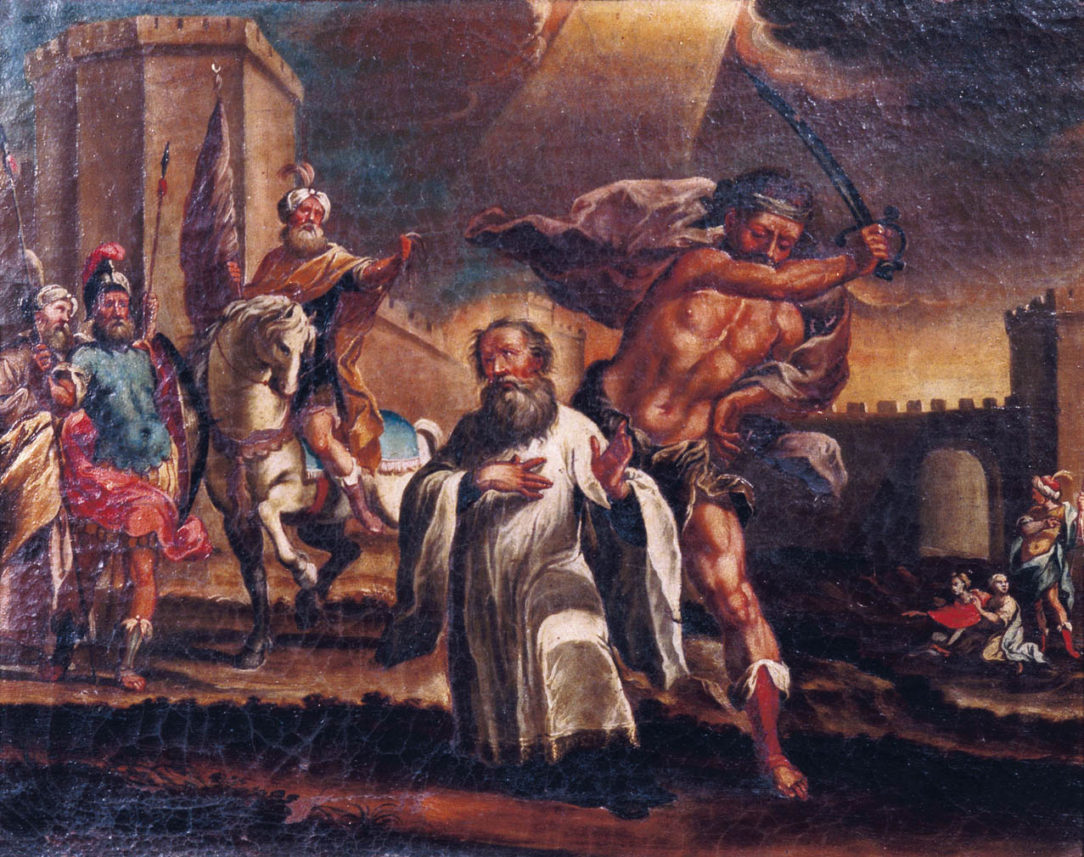
Eulogius, later canonized by the Catholic church, suffering execution for following in the footsteps of
the other Cordoban martyrs and being executed for intentionally blaspheming the Prophet Muhammad.


A notable point in the incidents of deliberate martyrdom was the lack of reaction from the public.  The executions failed to have the effect that Eulogius had hoped for.  The martyrs enjoyed support from distant monastic communities, where most of the martyrs were from, but in Córdoba itself, the opinion was little better than mixed.  According to Kenneth Wolf, the Christians who rejected the martyrs’ actions had assumed a new perspective of Islam as a different, but valid version of their own faith.  Wolf says that Christians adopted this idea from the Muslims, who in turn accepted the Christians as “monotheists and recipients of a revealed law” (Wolf 93).  In other words, they had assimilated the idea implied by dhimmitude, that all three religions worship the same God, with some differences.


Just 150 years into Islamic rule in Iberia, the people had come to accept and respect one another.  That may sound odd, considering the fact that Christians were being executed for blaspheming a religious figure, but consider the words of a Muslim court official who tried to persuade Eulogius into recanting his defamation of the prophet Muhammad:

If stupid and idiotic individuals have been carried away to such lamentable ruin, what is it that compels you…to commit yourself to this deadly ruin, suppressing the natural love of life?  Hear me, I beseech you, I beg you, lest you fall headlong to destruction.  Say something in this the hour of your need, so that afterward you may be able to practice your faith.” (Lowney 59)

The implication in this statement is that the court officials were following the letter of the law for the sake of maintaining the legal system, as well as for the sake of preserving the respectability of Islam, but even by the year 859, when Eulogius was executed, Andalusian Muslims in general had probably developed a strong sense of tolerance for the Christians and the Jews who worshipped the same God as them.  This sense of community may have been based on physical proximity and a sense of belonging to a certain physical location, rather than being drawn purely along theological lines.  The reality of people struggling to survive and coming to rely on the people around them sometimes gets lost in religious debate.


The medieval history of Spain shows little evidence of any conflicts being based solely on either race or religion (Lea 1).  Four-hundred and fifty years after Eulogius, as territory changed hands during the Reconquista, the people continued to coexist peacefully with their neighbors.  Rather than a stark black and white, the reality of conflict on the Iberian Peninsula was far more complex.  Alliances were often made between Christians and Muslims for the sake of pursuing similar goals, or for some gain.  For example, the thirteenth-century Christian king Alfonso X used religious rhetoric when it suited his self-interests and ignored it for the same reasons.  He was an avid supporter of Jewish translators in his court because of the wisdom they could make available to his subjects, but at the same time he mandated a death sentence for any Christian who was “so unfortunate as” to convert to Judaism (Lowney 10).  Additionally, he waged war against a Muslim kingdom only to later create an alliance with them for the purpose of waging war against a rebellious son.  His actions weren’t indicative of a monolithic Christianity versus a monolithic Islam; these were the actions of a man engaged in maintaining and building the prosperity of his own kingdom using whatever means he had available to him.  Race and religion were not factors in his decisions, which is a testament to the integration of Jews, Christians and Muslims into one cohesive Andalusian society.


As Muslim control in al-Andalus came to its conclusion in 1492, they left behind a society of three fully integrated faiths that had developed a unique character unlike any other place in the world.  Tolerance for religious diversity in al-Andalus did not, of course, meet modern standards, but it was a major advancement for its day that would lead a Christian nun from Europe named Hroswitha of Gandersheim to call Córdoba, the capital of the Ummayad Islamic Caliphate of al-Andalus, the “Ornament of the World” (Shedinger 81).  From the initial conquest in 711 to the surrender of Granada, relations between the three monotheistic faiths continually developed until al-Andalus was transformed into an integrated society where religion stopped playing a major part in the average affairs of rulers, except as a political tool.

The Alhambra palace at Granada.

Despite the success of convivencia, a multicultural and integrated al-Andalus, the Catholic Monarchs King Ferdinand II and Queen Isabella I took a radically different approach to religion and society: limieza de sangre, purity of blood.  After they completed their conquest of the Iberian Peninsula, they undertook a program that would ensure the eventual religious homogeneity of the Iberian Peninsula.  In 1492, immediately after the fall of Granada, they decreed the conversion, expulsion or execution of the Jews.  In 1502, a similar proclamation was made regarding Muslims.  Out of necessity, many chose to be baptized.  These two groups, known respectively as conversosand moriscos, continued to secretly practice the rituals of their own faiths while maintaining the outward appearance of Catholic Christianity until they were eventually weeded out through the institution of the Inquisition and a final expulsion in 1609 by decree of King Philip III.

The Court of Lions at Alhambra palace.

In the face of a long history of a successful and integrated culture, what was the purpose of Ferdinand and Isabella’s deviation from a model that had proven to be successful?  It is possible that Ferdinand and Isabella’s decision to expel the Jews and Muslims was merely a continuation of the evolution of religion in the peninsula: they were using it as a political tool.  Ferdinand and Isabella may have felt that, as Christians, their loyalties lay firmly with Europe and the rest of Christendom.  As rulers of a territory that had been part of the Islamic world for centuries, they may have felt that drastic measures were necessary to change public opinion of Spain.  Even today, 500 years after the expulsion of the Muslims and Jews, Spain is an off-color patch in the greater European fabric, with obvious reminders of its Islamic past buried in the architecture, art, and even the language.  Given how firmly Islamic culture was entrenched in Iberia, Ferdinand and Isabella may have felt that it would take drastic actions to change public perception of Spain in Europe, hence the expulsions or forced conversions of the Jews and Muslims.  It would also explain their petition to the Pope for the title “Catholic Monarchs.”  The total effect of expulsions and the gaining of a title affirming the Catholicism of the monarchy would have firmly put Spain in the European camp.  The definite causes of Ferdinand and Isabella’s change in policy would be an interesting topic for further research, but the level of tolerance and cooperation between religious groups in al-Andalus is a lesson that many parts of the world could still learn from today.

Works Cited

<!–[if supportFields]> BIBLIOGRAPHY <![endif]–>Bennett, Clinton. Muslims and modernity: an introduction to the issues and debates. London: Continuum International Publishing Group, 2005.
Boase, Roger. “The Muslim Expulsion From Spain.” History Today 52.4 (2002): 21-28.
Khadduri, Majid, Herbert J. Liebesny and Robert H. Jackson. Origin and Development of Islamic Law. Clark: The Lawbook Exchange, Ltd., 2010.
Lapidus, Ira M. A History of Islamic Societies. 2nd. New York: Cambridge University Press, 2002.
Lea, Henry Charles. The Moriscos of Spain: Their Conversion and Expulsion. Philadelphia: Lea Brothers & Co., 1901.
Lowney, Chris. A Vanished World: Muslims, Christians and Jews in Medieval Spain. New York: Oxford University Press, Inc., 2006.
Rosser-Owen, Mariam. Islamic Arts From Spain. London: V & A Publishing, 2010.
Shedinger, Robert F. Was Jesus a Muslim?: questioning categories in the study of religion. Minneapolis: Fortress Press, 2009.
Wolf, Kenneth B. “The Earliest Latin Lives of Muhammad.” Gervers, Michael, Ramzi Jibran Bikhazi and Pontifical Institute of Mediaeval Studies. Conversion and continuity: indigenous Christian communities in Islamic lands eighth to eighteenth centuries. Vol. 9. Toronto: Pontifical Institute of Mediaeval Studies, 1990. 89 – 102.


Note: This was a research paper turned in for a 100-level college course.  It received an A+, and the note: “A lively and interesting paper.”  I imagine it was checked more for consistency, style and obvious errors rather than having any deep fact checking done.  I would have liked a few more weeks to research and fine tune it, but I think it turned out well enough for the time I put into it, considering it’s a paper for an entry level course.

Faith and Unity: The ‘Ummah’ as the New Kinship Group

The Quran and prayer beads.

In approximately 610 CE, a man named Muhammad ibn Abdallah went to a cave in the hills above Mecca to meditate, as he was accustomed to do. There, he had a powerful religious experience and began reciting verses of what would become known as the Quran, the holy book of Islam. While reciting the surahs of the Quran in Mecca, the Prophet Muhammad would find both converts and enemies. His message would inspire both devotion and enmity. The Quran appealed to people for its beauty and its insistence on returning to principles of equity, but this would place the Prophet in confrontation with his tribe and create tension between converts and their families. The conflict between the new Muslims and the Meccan community escalated to a point that it caused the Prophet to commit the Muslim community to something unthinkable by contemporary standards: an emigration based not on blood ties, but on communal faith and unity. This event was so significant that it would become known as the Hijra and set the date for the first year of the Islamic calendar in 622 CE.

In pre-Islamic Arabian society, status, position and even personal well-being were all based on membership in kinship groups. Society was divided into a series of (usually[1]) blood-related groups organized in a hierarchical structure. The family group was the smallest organizational unit and was subordinate to a clan, which in turn was subordinate to a tribe. In these kinship groups, there was essentially no individual identity.[2] A man was a member of his family, clan and tribe. All acts between individual members of tribes assumed collective responsibility, sometimes leading to vendettas where the victim’s tribe would seek redress against any member of the offending party’s tribe.[3] This created situations in which a person was victimized based on the actions of another member of the tribe, though it wasn’t seen as wrong, because honor and responsibility were attributed to the group, rather than the individual. The more powerful the tribe one belonged to, the surer one could be that their family would be safe and prosperous.

In Muhammad: A Prophet For Our Time, Karen Armstrong details the loyalty of a man to his tribe using a quote from a Ghazziyya poet: “I am of Ghazziyya. If she be in error, I will be in error; and if Ghazziya be guided right, I will go with her.”[4] Tribal loyalties were so important that even if a man’s tribesman was in the wrong, he was obliged to help him for the sake of tribal solidarity. The concept of tribal solidarity would be both a boon and a problem for the Prophet Muhammad. Religion was not unknown to pre-Islamic Arab society, but it was tied to individual kinship groups. Each tribe had a deity, represented by an idol in the Ka’aba at Mecca, which was already an established pilgrimage site. Loyalty to the tribe also included loyalty to the tribal deity. This presented two problems to the success of the Prophet’s message. Converting to Islam meant forsaking the tribal deity and betraying the tribe, a violation of the tribal solidarity that is evidenced by the quote from the Ghazziya poet. More practically, the Prophet Muhammad’s message was an attack on the economic structure of Mecca, which relied on annual pilgrimages to the Ka’aba to remain viable. If people stopped worshipping the idols then they would no longer have a reason to visit Mecca. The Quraysh, the Prophet’s own tribe, would lose their source of income. In one stroke, the Prophet was insulting the tribe’s sense of community and attacking the economic foundation its prosperity depended on. The Quraysh were obligated to persecute the fledgling Muslim community.

The Prophet Muhammad’s attack on Meccan social norms was met first with resistance and then with violence, including a narrowly avoided assassination attempt. The Muslims initially benefited from the protection of the Prophet Muhammad’s uncle, Abu Talib, who was the head of the Banu Hashim, a respected clan in the Quraysh tribe. However, after his uncle died, the Prophet and his followers were left to fend for themselves, leaving them in a difficult position where they were open to violent retaliation from the Qurayshi families who felt both threatened and insulted by a perceived theft of family member loyalties.

This dilemma was resolved by a revolutionary idea, built on the foundation of the message that the Prophet preached in Mecca. The Muslims abandoned the idea of kinship groups based on blood and instead formed a new ‘tribe’ based on faith, known as the ummah. Membership in the ummah (as well as being a Muslim) required no family relation, no social status, and no prerequisite level of income; it only required acceptance of Allah as the one true God and of Muhammad as his Messenger. The ummah was a new community that offered the Muslims the protection and security they had previously received from their kinship groups.[5] The moment that defined the creation of this community is the Hijra, the emigration of Muslims to Yathrib. Prior to this, the Muslims had still considered themselves to be members of their own families, just with a different set of beliefs. Breaking away from their families and creating a new community based on faith rather than blood was an incredible social innovation, and clearly marks the birth of the Muslim community as an independent and functional social system, as well as a system of belief.

Eventually, the ummah would encompass all of Arabia, creating a new problem that challenged the traditional means of supplementing tribal income: raiding, which was known as ghazu. In times of scarcity, tribes would launch raids against each other to capture camels, cattle or slaves. Raids were carried out with precision and care, to prevent injuries or deaths that might result in blood fueds. These raids were an accepted fact of life and were not in any way morally reprehensible. They were instead a necessary means of redistributing wealth in an area of the world where there was often not enough to go around.[6] Unfortunately, this tradition conflicted with the new Muslim morality as defined by the Quran and the Prophet. Surah 3, ayah 103 of the Quran says, “Hold fast to God’s rope all together; do not split into factions. Remember God’s favour to you: you were enemies and then He brought your hearts together and you became brothers by His grace: you were about to fall into a pit of Fire and He saved you from it…”[7] Also, in his book, A History of the Arab Peoples, Hourani says that when the Prophet Muhammad made his last visit to Mecca in 632, he gave a speech and said, “…know that every Muslim is a Muslim’s brother, and that the Muslims are brethren.” He said that violence between Muslims should be avoided and old blood debts should be forgotten.[8]

As essentially members of one tribe, the ummah would have to reassess their society and find a new means of supporting themselves. Internal conflicts were no longer permitted under Islam, so the Arabs instead spread outward, taking their culture and religion with them. The outward spread of Arabs into the Middle East began as raiding parties in Syria and Palestine in the 630s,[9] but soon developed into full scale battle with the Byzantine and Sassanian Empires. The conquering Arabs would be victorious, creating a vast Islamic empire. The leap from pre-Islamic Bedouin society to Islamic Imperialism would again fundamentally alter Arab society.

Because of the principles of unity found in the Quran, the nomadic peoples of Arabia created a new social identity that revolved around faith. This was a clear break from the past and returned a sense of equity to the Muslim community. However, this new unity came with new problems. The Arabs had to find a new economic model to sustain their society. The Arabs solved this problem using traditional tactics. Since the tribe was replaced by the ummah, the push outward into the Middle East was a continuation of the tradition of ghazu, simply on a larger scale. Intentionally or not, a relatively simple people from the Arabian Peninsula quickly became a world power that would greatly influence world history, and continues to influence world history.


[1] On page 38 of The Great Arab Conquests, Kennedy states that membership in a tribe might increase or decrease based on the tribe’s level of success. New arrivals would claim that they “must have been in some way part of that kin all along,” maintaining the façade of biological kinship groups.
[2] Lapidus, page 13.
[3] Lapidus, pages 12.
[4] Muhammad: A Prophet For Our Time, pages 12 – 14.
[5] Kennedy, page 38.
[6] Muhammad: A Prophet For Our Time, page 11.
[7] The Qur’an; M.A.S. Abdel Haleem translation; Oxford World’s Classics version.
[8] Hourani, page 19.
[9] Kennedy, page 70.

Bibliography:

Armstrong, K. (2007). Muhammad: A Prophet For Our Time. New York: HarperCollins.
Armstrong, K. (2009). Islam: A Short History. London: Phoenix Press.
The Qur’an. (2010). (M. A. Haleem, Trans.) New York: Oxford University Press.
Hourani, A. (1991). A History Of The Arab Peoples. Cambridge: Belknap Press of Harvard University Press.
Kennedy, H. (2008). The Great Arab Conquests: How The Spread of Islam Changed The World We Live In. Philadelphia: Ca Capo Press.
Lapidus, I. M. (2002). A History of Islamic Societies (2nd ed.). New York: Cambridge University Press.
Note:
 
This was a paper written for a college course titled “Middle East Under Islam.”  The final grade was 15/15, 100%.

Alabama Attempts to Usher in a New Dark Age

Officials in Bay Minette, Alabama delayed a new program that would allow some nonviolent offenders to choose church over jail after a civil liberties group objected.

The “Operation Restore Our Community” initiative was slated to begin this week, but the southwest Alabama city’s legal team will take another look after the American Civil Liberties Union sent a cease-and-desist letter Monday.

via Reuters

What were they thinking?  The officials in Bay Minette, I mean.

I saw a small article about this tucked into a corner of an issue of the NY Daily News a few days ago and decided to look up more information about it online.  The Daily article didn’t mention anything about the ACLU or a protest; it was just all glowing and positive, and I couldn’t help but wonder if the reporter had suddenly forgotten about the separation of church and state provision in the US Constitution.

Reading the Daily article, I was mentally transported back to a time (a.k.a. the Dark Ages) when the Church presided over the sentencing and punishment/rehabilitation of criminals.  I thought we’d covered this ground already and gotten past it with that whole Enlightenment thing that happened in Europe.  The founding fathers of this country didn’t introduce the separation of church and state into the Constitution on a whim.

The officials mentioned in the article are trying to hide the obvious, that this is a drive to get criminals on the ‘right path’ by converting them to Christianity through extended exposure.  They’re instead claiming the weekly ‘check-ins’ are just for the purpose of accountability, and to access community based resources to help them fix their lives.

I wonder if such a thinly veiled excuse to get people into local churches will stand up in court?  I wouldn’t be surprised, since people can win lawsuits over spilled hot coffee, but I can’t believe that anyone would have thought that this would be OK, or that it would be true to the principles that this country stands for.  I’m not against churches.  I’m not against Christians practicing religion, but when you give someone an option of going to jail or going to church for a year, it’s not really a choice at all.  It’s more like a European telling natives in a newly ‘discovered’ land that they can either convert or be sold into slavery, or perhaps killed.  Freedom under a new religion will be preferable to a loss of liberty for most people.

There are reasons why church and state are separated in this country.  The US is diverse.  There are people of all faiths here and people who choose not to have any faith at all.  It’s one of our freedoms, and we should never be forced to choose between going to church or going to jail, even if the person in question is guilty of a crime.  A secular law system requires secular consequences.

The Power of Religious Texts in History

This is something I wrote for a World Civilizations: Pre-History to 1500 (101) class.  The task was to pick a piece of literature, from religious texts to epic poems to economic records found at archaeological sites, and then describe how that work affected history.  I suppose you could say I took the easy way out and chose to write about the Bible and how it has affected history.  If you’re curious, this paper received an A.  Footnotes will be appended to the bottom of the post, along with the bibliography.

bible1

(Image via godisforreal.wordpress.com)

Literature has always played an important role in recorded history. It is a method of preservation of the moment. It captures the ideas, the problems, the aspirations and dreams of a society and, when read from a historical perspective it can offer an open window into the world of the writer. No form of literature has as much impact on history as religious texts. Perhaps the most influential religious work of all time, the Bible[1] has impacted the lives of countless people throughout history. In this paper, the impact of the Bible will be briefly explored to demonstrate the importance it has played in shaping, stabilizing, and sometimes disrupting society.

When Christianity first appeared in the Middle East it was a revolutionary movement with no specific set of religious texts. Various gospels and epistles were being circulated, but there was no accepted canon of scripture until perhaps the late 4th century AD.[2] The result of this is that there was a wide array of Christian sects, all with varying beliefs. There was no structure to the religion, which could cause confusion about what was and wasn’t ‘true’. Through the work of early church figures, like Bishop Athanasius of Alexandria, that changed. Bishop Athanasius worked to consolidate which scriptures would be regarded as canonical and which were, according to him, heretical.[3] Coming at about the same time that Theodosius I declared Catholic Christianity as the official and only permissible religion of the Roman Empire (380 AD), this acted as a strong unifying force that would have an enduring effect on history, European history most especially. The Catholic Church claimed its authority based on the newly standardized canon gospel of Matthew, citing chapter 16, verse 18, which says, “And I say also unto thee, That thou art Peter, and upon this rock I will build my church; and the gates of hell shall not prevail against it,” as the source of its legitimacy.[4] The acceptance of the canonicity of the gospel, what we know as the Bible today, is what allowed the Catholic Church to hold power over the people, as well as to stamp out opposition. The Church also used its divine authority to control the rulers of the people throughout Europe up until the French Revolution of 1789-99. With the Bible as its basis, the Papacy of the Catholic Church bestowed divine authority on the monarchies of the developing European nations, allowing for the formation of governments and modern nation states. Most of the countries in Europe today exist due to monarchical legitimization by the Catholic Church, which derived its religious authority from the Bible. These nations have played major roles in the development of the rest of the world and, in most cases, continue to be major world powers today. These nations that are shaping the world today were themselves shaped by Christianity and the Bible.

In addition to shaping nations, Christianity has played a role in creating social stability through Christian morality and Christian value based legal systems. Mircea Eliade wrote that “The manifestation of the sacred ontologically founds the world. In the homogenous and infinite expanse, in which no point of reference is possible and hence no orientation can be established, the hierophany[5] reveals an absolute fixed point, a center.” Or, in other words, religion creates a stable center for people to start from, a check to balance their view of the world and define their existence. The religion revealed through the Bible served this purpose for Christians. The Bible affects the lives of those who read and believe in it by influencing them to conform to a lifestyle that is in accordance to its teachings. John 14:6[6] tells believers that Jesus said, “I am the way, the truth, and the life: no man cometh unto the Father, but by me.” It is impossible to come to Jesus without repentance and living according to the teachings of the Bible. Getting into Heaven is a strong incentive to develop and maintain a Christian, Biblical lifestyle, which regulated everything from birth (baptism) to marriage (holy vows) to death (Christian funeral rites), and most things in between. As mentioned earlier, this belief in the Bible and Biblical living created the monarchies and modern nations which, along with creating common customs, stabilized society, but it also went a step further in creating social stability through later legal systems. The values established by Christianity were converted into the foundations of Western legal systems. Christian values have persisted in our Western legal systems and institutions up until the modern time. John Jay, the first Chief Justice of the United States (1789-95) once wrote in a letter that “The Bible is the best of all Books, for it is the Word of God, and teaches us the way to be happy in this world and the next. Continue therefore to read it, and to regulate your life by its precepts.”[7] While not expressed outright in the US Constitution or legal system, the values that Americans inherited from Christianity have influenced and continue to influence the workings of government. A good modern example is the current debate on the legality of homosexual marriage, which is undeniably being opposed on wholly religious grounds.

Using the same example, the Bible has been so influential that it has also caused disruptions in societies throughout history, including Christian societies and modern societies. As a sacred text, the meaning of the words it contains is open to constant interpretation based on who reads it. Those interpretations haven’t always had a positive effect. During the 11th, 12th and 13th centuries, the Roman Catholic Church used its Biblical authority to declare religious wars on neighboring nations. The effects of the Crusades continue to be felt today by Islamist terrorists using the concept of Crusades as a justification for violent and lethal actions against Western, ‘Christian’ nations. The Bible has also been used as a justification for the violent suppression of minorities throughout history. Well known examples are the Medieval Inquisitions, the Spanish Inquisition and the Salem Witch Trials. The Bible has been used to oppress women through selective quotation and reading out of context, with 1 Corinthians 14:34-35 being a prime example:

“Let your women keep silence in the churches: for it is not permitted unto them to speak; but they are commanded to be under obedience as also saith the law. And if they will learn anything, let them ask their husbands at home: for it is a shame for women to speak in the church.”[8]

The Bible was used to justify slavery in the United States, either arguing its morality through the omission of its condemnation in the Bible or by making a broad claim that God created slavery and so it must be good, as Jefferson Davis, the President of the Confederate States of America did. He said, “Slavery was established by the decree of Almighty God…. It is sanctioned in the Bible, in both Testaments, from Genesis to Revelation…. It has existed in all ages, has been found among the people of the highest civilization, and in the nations of the highest proficiency in the arts.”[9] Today, the Bible is used as a source of justification for the suppression of the right to equality that homosexuals should enjoy under the secular government in the United States. It is still used by fringe groups to support destructive beliefs. The Bible is just as strong a force for disruption of society as it is for good.

Throughout history, the Bible has been used extensively to justify both positive and negative actions. It has been used to stabilize and homogenize society. It has been used as the basis for customs, holidays, and the building of nations. It has also been used to destroy enemies, suppress minorities and justify violence. Without a doubt, the Bible is an epic piece of religious literature that has had a profound effect on our world, exemplifying the power of the written word to influence history.


[1] The general concept of a canonical written Bible as accepted by branches of Christianity, without considering the differences between accepted canon and apocryphal works in various traditions.

[2] According to the Columbia Apologetics Toolkit, adapted from the materials of Professor Paul Hahn of the University of St. Thomas, Houston, Texas.

[3] According to the National Geographic special, The Gospel of Judas.

[4] King James Version

[5] Mircea Eliade defines “hierophany” as the sum of its etymological content, “something sacred shows itself to us.”

[6] The Book of John, Chapter 14, Verse 6 of the King James Version of the Bible.

[7] John Jay to Peter Jay, April 8, 1784.

[8] King James Version.

[9] From the antebellum slavery debates in America, quoted in a book by Mason Lowance.

Bibliography

National Geographic: The Gospel of Judas. Directed by James Barrat. Performed by Peter Coyote. 2006.

“Development of the Biblical Canon.” Columbia: Apologetics Toolkit. 1995. http://www.columbia.edu/cu/augustine/a/canon.html (accessed July 9, 2011).

Eliade, Mircea. The Sacred and The Profane: The Nature of Religion. Orlando: Harcourt, Inc., 1959.

Hutson, James H. The Founders on Religion: A Book of Quotations. Princeton University Press, 2007.

Lowance, Mason I. A house divided: the antebellum slavery debates in America, 1776-1865. Princeton Univeristy Press, 2003.

Thomas Nelson Bibles. The Holy Bible; Containing the Old and New Testaments; Authorized King James Version. Nashville: Thomas Nelson, Inc., 2001.


Egyptian-American Muslim Girl Gets Grilled on Polygamy By Hispanic Woman

“Hey, are you Egyptian?”  I was standing at a table on the side of the post office, filling out a shipping label, when a Hispanic woman walked up and asked the girl next to me that question.  I glanced over at the girl and saw she had Middle Eastern features and she was wearing a hijab (the head scarf, if you’re not familiar with the word).  Oddly enough, the woman had guessed right.  The girl replied that she was half Egyptian and was born in the US.

“You’re a Muslim right?”  At this point, I was considering moving to another part of the post office, because I was expecting this Hispanic woman to go nuts and start haranguing this girl for being a Muslim, which she obviously was, since she was wearing a hijab.  New York City has a reputation for being filled with lunatics and you really never know if you’re talking to one until it’s too late.  The girl looked a little hesitant, but again she answered yes.

‘Here it comes,’ I thought.  But, instead of what I was expecting, the Hispanic woman asked, “What do you think about marrying more than one woman?  If you were married to a man, would you be ok with him marrying a woman in another country?”

“No, I wouldn’t be ok with that.”

“Ok, because I know Muslims believe in marrying more than one wife.”

“Well, not all Muslims do that,” the girl replied.  “That’s mostly something that happened a long time ago, because it’s too hard to handle more than one wife, since the guy has to take care of them equally.  It’s a lot of trouble, but I wouldn’t do it myself.”

“Oh, well you’re mostly American since you were born here, but do you know if Egyptians do that?”  I imagine she was trying to fish for another answer, perhaps to justify the problem she was about to lay out to this girl.

“Well, yes, but I just don’t think it’s ok and I don’t think many people would do that.”

“My husband was here, and he married me, but then he went back to Egypt and he married another woman.  If you were the other woman and you knew the man was married, would you do that?  Would you marry a man that was already married?  What kind of woman does such a thing?”

The above conversation is paraphrased, of course.  I don’t remember exactly what they said to each other, but it went along those lines.  At that point, I stopped following the conversation completely because I was just about done with filling out my shipping label and sealing the envelope, but the Hispanic woman kept pressing this girl about why her husband, who had been deported, would find a new wife in Egypt instead of being faithful to her.  The girl told her it sounds like a personal problem.  She was probably trying to separate the issue from religion, before it devolved into something ugly.  She told the woman that if she wasn’t satisfied with the situation she should divorce her husband, but the Hispanic woman told her something about losing benefits.

Then I walked away to get my postage for my envelope.

I wonder if that happens often?  I doubt that girl expected to have a conversation quite as bizarre as that when she put on her hijab that morning and left her house.

Art Comparison: Qu’ran Manuscript and The Angel Gabriel

The following is the second paper I wrote for my Art History 100 class.  We were tasked with finding two art pieces in the Metropolitan Museum of Art in New York City and then writing a paper that compares and contrasts them based on form and content.  Our choices were restricted to certain art periods from specific locations, like French Gothic or Italian Renaissance.  I chose the following two pieces because I found them particularly interesting on a personal level, as well as being easy to write about.

I think I might have been a bit off the mark on fitting The Angel Gabriel to the Renaissance standard, but I won’t know for sure until September, when I can get in touch with the professor and see the paper.  It was due on the day of the final, so there’s no way for me to get it back and check it out.  I’ll update the grade received and any notes from the professor at some point, on the Essays page.

(Note: The images were not included in the paper that was turned in.  I added them here so readers that aren’t as familiar with art as my professor can get a better idea of what I’m talking about.)


Introduction and Location

The paper will be discussing the differences and similarities between two works: The Angel Gabriel and Qur’an Manuscript. The Angel Gabriel was created in approximately 1493, is attributed to Masseo Civitali and is believed to have originally been located in the oratory of Santa Maria dell’ Anunnziata in Lucca, Italy. The work is now located in gallery 500 on the first floor of the Metropolitan Museum of Art in the “European Sculpture and Decorative Arts” section. The Qur’an Manuscript was created in the early 14th century, by an anonymous artist in Iran or Iraq. The work is now located in a display case in gallery 203, on the Great Hall Balcony on the second floor of the Metropolitan Museum of Art.

Formal Aspect & Genre Descriptions

The Angel Gabriel, Sculpture, Metropolitan Museum of Art.

The Angel Gabriel is a Renaissance sculpture that is roughly life-sized. The sculpture is a painted and partially gilt terracotta statue. It appears to have been free standing on its original base, which is now broken. The statue is now anchored to a display base. The sculpture leans at an almost unnatural angle, covered in a draped garment that is smooth and flowing. The figure is naturalistically proportioned and detailed, though the face is idealized. On the back of the statue, there are two vertical slots where terracotta wings were probably inserted. Renaissance art was largely religious (Aston 105). Compared to the earlier Gothic style, Renaissance art focused more on the human aspect of the art subject. Where Gothic art was solemn and dignified, Renaissance works like The Angel Gabriel attempted to introduce tenderness and beauty into art without sacrificing the aura of divinity associated with religious figures (Aston 133). The introduction of a human element into the sculpture is apparent in the joyous expression on the face and in how the arms are crossed over the chest, as though the angel can barely contain the good news he is about to share. Rather than standing vertical, the angel is leaning forward towards the recipient of his news. Despite these included aspects of human emotion, the aura of the divine is still maintained through the idealized, androgynous face (angels have no gender), and the original presence of wings on its back.

Qu'ran Manuscript, 14th Century Iran or Iraq, Metropolitan Museum of Art

The Qur’an Manuscript is a non-illustrated manuscript folio and an example of Islamic art. The page on display is 34.9 x 27.3 centimeters and was made with ink, opaque watercolor and gold on paper. The page is primarily covered with naskh cursive text, but also contains decorative calligraphy and hand drawn vegetal and geometric images that are painted with gold. Islamic art as a whole is defined by a prohibition against making representations of living things, since it might create a temptation to commit idolatry (Evans 151). The resulting typical expression of Islamic art is mostly abstract, containing geometric patterns, references to vegetation and calligraphy. These elements were reflections of religious beliefs. The geometric patterns represent the perfection of Allah and the vegetation is a reference to paradise in the afterlife. Calligraphy also became a popular form of art, taking the place of images and being used to represent Allah. The main purpose of calligraphy was to appreciate the visual quality, rather than to read it. These elements are present in both secular and religious art, though secular art would not contain calligraphic quotations from the Qur’an.

Content

Theme

Both The Angel Gabriel and the Qu’ran Manuscript have a similar theme. Both works are the products of religious devotion. Gabriel is a prominent figure that is present in the Abrahamic religions of Judaism, Christianity and Islam. Stories about Gabriel appear in each religion’s holy texts. The Qur’an Manuscript is a handwritten and decorated page of the Qu’ran, the holy book of Islam. The difference between the two works is that while The Angel Gabriel represents a religious idea, it was mostly meant to be decorative, appearing in an oratory. The Qu’ran Manuscript, on the other hand, while being decorative was also meant to be functional, a holy book to read and learn from.

Depiction

The Angel Gabriel, Sculpture, Metropolitan Museum of Art.

The Angel Gabriel specifically depicts Gabriel, an angel, leaning forward, as if appearing to someone. The name Gabriel means “God is my strength” or “the strength of God” and he is known as The Great Communicator (Aquilina 69). Throughout the Bible, Gabriel appears to people to bring them news from God. In Daniel 8:15-17 he appears to Daniel to explain a vision to him. In Luke 1:16-17 he appears to Zechariah to tell him that he and his wife shall have a child and that his child, John the Baptist, will prepare the way for the Messiah. Later, in Luke 1:26-38, Gabriel appears to Mary, to tell her that she will be the mother of Jesus Christ, the son of God. According to the information placard on the sculpture’s display base, it is believed that The Angel Gabriel was originally part of a pair of statues which included the Virgin Mary. Together, they would have formed an Annunciation Group, which represents the moment when Gabriel shared the news of her divine pregnancy with her.

Qu'ran Manuscript, 14th Century Iran or Iraq, Metropolitan Museum of Art

The Qu’ran Manuscript is a page from the holy book of Islam, the Qu’ran. The top of the page contains a geometric, gold painted rectangular frame that contains decorative calligraphy which reads, “Surat Saud, Eighty Six Verses (Ayats), Mekka surat” (Hany), though Mr. Hany also noted that the surat actually has 88 verses. Just to the right of the rectangular frame is a drawing containing concentric circles around a vegetal image, probably of a flower, also in gold with a blue center. Additional matching representations of flowers, rosettes, are drawn throughout the text as markers between ayas, or verses. In the right margin are two decorative seals, one circular, one teardrop shaped, both in gold and surrounded by a blue outline. These seals contain kufic script in the center. The main text of the page is a cursive form of Arabic known as naskh, with recitation marks added in red ink. The text on the page on display is the last part of the 37th surah and the first 11 ayas of the 38th surah of the 23rd juz (part) of the Qu’ran, The Letter Saud, which was revealed to the Prophet Muhammad at Mecca. Preceding the beginning of the 1st aya in the 38th surah is the phrase, “In the name of Allah, the most gracious, the most merciful,” which is not part of the surah itself and precedes all of the surahs in the Qu’ran (Hany).

Purpose

The original purpose of The Angel Gabriel would have been to inspire believers and deepen their faith. Many people at the time the statue was created were illiterate, and learning about Christianity, outside of sermons given by clergy, was through observation of religious art. When looking at the sculpture of Gabriel, believers would have been reminded of the good news he shared with people in the Bible, and particularly with Mary. If The Angel Gabriel was originally paired with a statue of the Virgin Mary, then viewing them together would have reminded viewers of their hope of salvation through God’s grace and Jesus’ Christ’s death and resurrection on the cross. The Angel Gabriel was originally designed to be a decorative piece for casual observation and reflection and, though it is now located in a museum rather than a religious building, the effect is essentially the same. It causes the viewer to contemplate the meaning of Christianity and Gabriel’s role in the Bible.

The Qu’ran Manuscript was meant to be a functional copy of the Qu’ran, to be used by believers for study and recitation, as well as to inspire through the decorative artwork it contains. The Arabic text of the page, together with the rest of the text in the Qu’ran, is the physical representation of Allah through language (the written word) in the Islamic faith. The Qu’ran praises Allah and His creation, defines the relationship between Allah and the worshipper, explains the afterlife through eschatological texts and teaches Muslims how to practice their faith in everyday life. While the particular copy of the Qu’ran the page came from is no longer serving that purpose, the text of the Qu’ran has been copied, translated and distributed all over the world and continues to serve the function it was originally created for.

Presentation

The Angel Gabriel is presented in a small room with other Italian Renaissance pieces. The room is well lit, and Gabriel is the first work you notice as you walk into the room. The lighting brings out the remaining color from the original paint and gilding on the statue, giving the viewer an idea of what it might have originally looked like. Appreciation of how the piece was originally displayed would be helped by having a similar work of the Virgin Mary opposite Gabriel, though that is probably not possible due to limitations in the museum’s inventory. An alternative would be to have a digital rendering of what it might have looked like in place at the oratory displayed next to it, or on the display base. As it’s now displayed, Gabriel appears almost out of place in the room and it requires a lot of imagination to picture how it would have originally appeared.

The Qu’ran Manuscript is set in a glass display case along the wall of the Great Hall Balcony. The display case contains other Islamic works that represent highlights from the Department of Islamic Art. The works range in date from the seventh to the eighteenth century and include textiles, jewelry, pottery and other manuscript pages. Since the case shows a cross-section of art, the overall effect is a bit jarring, especially combined with the noise coming from the entry hall below the balcony and the strong smells coming from the balcony dining area. The benefit of being placed in that location is that it catches the eye of people walking by and the skylights and windows help to keep it well illuminated. It would be easier to appreciate this work in a smaller room with other Islamic manuscript pages from the same time period.

Works Cited

Aquilina, Mike. Angels of God: The Bible, The Church, And The Heavenly Hosts. Cincinnati: St. Anthony Messenger Press, 2009.

Aston, Margaret. The Renaissance Complete. London: Thames & Hudson Ltd., 1996.

Civitali, Masseo. The Angel Gabriel. Metropolitan Museum of Art, New York.

Evans, Gillian Rosemary. The Church in the Early Middle Ages: The I.B. Tauris History of the Christian Church. New York: I.B. Tauris & Co Ltd, 2007.

Hany, Islam. Translations and discussion of Qu’ran Manuscript and Qu’ran. Bradley J. Farless. 15 May 2011.

Unknown. Qu’ran Manuscript. Metropolitan Museum of Art, New York.


A Celebration of Buddha and Asian Culture

Last Sunday, on my way to the Barnes & Noble by Union Square, I was passing through the park and saw an event celebrating Buddhism called The Lotus Lantern Festival.

Lotus Lantern Festiva, Union Square, 2011.

A Buddha statue at the Lotus Lantern Festival, Union Square, 2011.

Buddhist statue with an elephant and Buddha.

I’m not really clear on the significance of the above statue, but people would step up to it, bow, and then use the dipper (you can just see the handle protruding from the bowl above the elephant) to scoop water from the bowl and pour it over the head of what I assume, by the lotus he’s standing on and the extended earlobes, to be a representation of Buddha.

A woman singing at the Lotus Lantern Festival, Union Square, 2011.

When I first walked up, a woman was singing. I don’t know what it was, or what it was about, because I missed the intro, but it sounded interesting, so I hung around for a while to see what else might happen.  After she sang, there was a demonstration of a traditional Korean dance.  I forget exactly what was said about it, but it was a celebratory dance related to successful agriculture, I think.

After I watched that, I walked through the park and just as I was getting to the other side, I started to hear Japanese pop music.  When I turned the corner, I saw there was a stage, with a live performance by a girl named Reni.

Reni onstage at the Annual Asian Culture celebration at Union Square, 2011.

On one side of the park was the solemnity of Buddhism, and on the other side of the park was Japanese pop culture, complete with cosplay and peace signs.  Weird combination.  Anyhow, I recorded one of her songs…

And then moved on past her booth…

Annual Asian Culture celebration at Union Square, 2011.

The Reni booth at the Annual Asian Culture celebration at Union Square, 2011.

…and happened to catch the tail end of a Chinese dragon dance and a martial arts display.


A martial arts display at Union Square Park during the Annual Asian Culture celebration, 2011.

I think it was called Wishun but I could be mistaken.

Japanese flag hanging in Union Square Park during the Annual Asian Culture Celebration, 2011.

I’m already looking forward to what I might see at the park this coming weekend.

The Real Villain of Easter

Dyed Easter Eggs in a basket with fake grass.

If you were thinking that the giant companies that monetize a spiritual holiday to capitalize on people’s faith are the real villains of Easter, then you’re right, but not quite what I was going for.  Really, though, do we need to commercialize everything?  It reminds me of something I learned in my Art History class a few weeks ago.  You know all those Buddha statues you see everywhere?  Buddha didn’t want that.  He taught a philosophy, but people turned it into a religion and deified him, and now little images and sculptures of Buddha are sold for profit.  Monetized, just like every other major religion in the world.

Jesus being detained by two Roman centurions, while a Jewish priest looks on. (Times Square Church Easter Production, 2011)

What I wanted to talk about is Judas Iscariot.  I went with my mom to church this morning and they had an Easter production, showing the classic Easter story of Jesus being betrayed and crucified.  But, was Judas Iscariot really a bad guy?  You might say that he is, since he betrayed Jesus and sold him out for 30 pieces of silver, but what I want you to ask yourself is this:  did he have a choice?  If God knows everything that we’ll ever do, then do we really have free will to make our own choices?  That’s the argument of predestination, that we can’t have free will because God already knows what we’re going to do.  By that argument, God already knows, before we were ever born, whether we’ll be damned or saved, whether we’ll believe or not, and, really, it makes you wonder why we even have time on Earth if the outcome is already known.  Why not skip to the end game?  Are we really here just to experience life outside the presence of God, so that we’ll appreciate it later?  Is that the point?

Anyway, if God knew Judas would betray Jesus, then why did God not change the circumstances so that Judas would not have to go through that traumatic experience?  In addition to being all-knowing, God is all-powerful, so certainly he could change something, even if it was predetermined.  The answer is simple:  someone had to be the scapegoat.  If God ordained a set of events (the coming of a Messiah and the resurrection), then he also had to set in motion the events that would lead up to that event.  That includes putting Judas on course to betray Jesus to the Jewish priests for crucifixion.  It was part of God’s plan.  So, how can you hold Judas responsible for doing what culminated in Jesus’ crucifixion and resurrection, which means the Salvation of all believers?  In fact, we should be thanking Judas, because without him playing his part, the event wouldn’t have happened the way God knew/wanted/said it would.  Or should we, since he may have had no choice?

On the other hand, if human action is somehow exempt from God’s omniscience, and Judas acted of his own free will in betraying Jesus, then you still have to wonder why he did it?  Who really turns out their boss (who walked on water, raised the dead, healed sicknesses, etc.) for a measly 30 pieces of silver?  Is it not possible that Jesus put him up to it?  That Jesus pulled him to the side and let him know that he had a plan for him, and that Judas made the sacrifice to be forever known as the betrayer of Jesus, for the sake of bringing about the resurrection?  Maybe that version of events didn’t make the final cut of what we now know as the Bible.

If you’re not aware, the Bible as we know it today was not compiled until hundreds of years after the actual events recorded, and even today, what is and isn’t “canonical” depends on which branch of Christianity you adhere to.  In addition, new documents are constantly surfacing that were written during the time period of Jesus and the Apostles.

Anyway, these are just some things I was thinking about today while watching the Easter production.  I’m sure I could spend a lifetime studying documents and commentaries without coming to any definite conclusions, but that doesn’t mean these aren’t ideas worth thinking about.

Banning the Burqa: Good or Bad?

Women wearing the niqab.

No, these are not female ninjas.  (Image from: MuslimVoices.org)

It seems like I’ve been hearing more and more about Islam over the last few weeks.  The 28th of March through the 3rd of April was Islamic Awareness Week.  There were posters set up in various parts of the CCNY campus with quotes from the Koran on them.  During the same week in an art history class, we happened to cover Islamic art and did a brief overview of the beginnings and major points of Islam.  Then the French law banning the burqa came into effect and wound up as a point of discussion in an introductory anthropology course I’m taking.  Islam is a fascinating religion that, due to American media, and media in general, it’s generally painted in a bad light.  I don’t want to go into that here, but I will say that news media is all about ratings, so, just like your favorite TV show, the goal is to be as sensational as possible to retain repeat viewers.  After seeing some of the news reports on the law passed in France, I had a few questions that came to mind, and after thinking about it for a while, I realized that there was a better solution than what the French legislature came up with.

The first thing that came to my mind is how politically correct we all are, here in the Western world.  Would things play out differently, I wonder, if groups of Western women immigrated to Saudi Arabia and were protesting the proscribed manner of dress (niqab)?  Isn’t respecting the laws and culture of the country you go to a basic courtesy, even when simply visiting?  What more, for an immigrant that has been granted the right to live in another country?  To me, it simply feels arrogant to expect a country to realign its culture and values to suit the sensitivities of an immigrant population.  Within the sovereign borders of the country of France, why should the native citizens strive to protect any culture, any heritage, but their own?  If the culture and society don’t align with that of the immigrant’s, then wouldn’t it be easier for the immigrant to have not immigrated there in the first place?  Or to re-immigrate? I also wondered why this problem is being argued as both one of religion and one of culture.  There are people who say the wearing of the niqab is a cultural development in certain Arabic cultures, and that Islam has been twisted and used as a weapon to enforce this method of

I also wondered why this problem is being argued as both one of religion and one of culture.  There are people who say the wearing of the niqab is a cultural development in certain Arabic cultures, and that Islam has been twisted and used as a weapon to enforce this method of dress on women.  A Pakistani Muslim woman I go to class with here in New York affirmed that the niqab is a cultural development.  She wears a head scarf, but no face covering, and I doubt she would ever put on a niqab.  I’ve met plenty of Muslims while traveling and living in Southeast Asia, and they don’t wear niqabs.  Does that mean they’re all ‘bad’ Muslims?  Of course not, because the niqab isn’t a religious requirement for Muslims any more than wearing an ankle-length dress is a Christian requirement for Western women.  Wearing the niqab is a choice, based on cultural traditions.  That being the case, the French ban on niqabs is not an attack on the Islamic religion.  It’s an attack on the cultural practices of a segment of the Arab immigrant population.

I also couldn’t help but wonder how these women immigrated to France in the first place.  At some point, they would have had to have provided travel documents and immigration documents with photos, and to verify that they are in fact the person in the photo.  If they were willing to remove the niqab for immigration, why are they not willing to keep it off, or transition to a head scarf (like the majority of Muslim women wear) to better assimilate into their new society?  I’m not saying they should, I’m just asking why there’s a contradiction.  Also, how can a person expect to get a driver’s license without having their photo on it, and without verifying their face on request by a police officer?

From an American perspective, I think these women have a right to dress however they want to, so long as it does not create a safety hazard for themselves or others.  So, where is a good middle ground?  Perhaps the better course of action would have been to require the removal of the niqab only upon entrance to public buildings (schools, hospitals, courts, welfare offices, etc.), while entering public transportation that requires photo identification, while driving since it limits the field of vision, and the upon the reasonable request of a police officer or other official when required for identification purposes.  Isn’t that the main problem here?  That wearing the niqab prevents proper identification?  Take it a step further.  When proper identification requires removal of the niqab, remove the woman to a private room and have her identity verified by a single female officer/official.  Simple right?  I understand that this can cause some logistical problems in providing female employees at all of these locations, but this is just a suggestion that I’m sure would be better received than a blanket ban.

The blanket ban, whether people consider the niqab religious or simply a cultural development, seems like an extreme measure that suppresses a person’s right to self-expression.  Like any immigrant, a Muslim immigrant will import their culture along with themselves, and while it’s important to define what isn’t acceptable, like outlawing shariah law in a secular nation, it’s also important to allow people to express themselves since it is a foundational value of any Western democratic nation.  I’m all for passing laws to protect people, but only when those laws are reasonable, and this French burqa ban, to me, seems like overkill.

Culture Clash: Small-Town American vs. Somalian Immigrant Culture

This is a paper I wrote for my 100 level Anthropology class.  It deals primarily with an incident that occurred in Lewiston, Maine, between the residents and a massive influx of Muslim Somali immigrant refugees, and the reactions of both sides.  The paper was written along specific guidelines, as well as from an anthropological and cultural perspective.  The purpose of the paper is not to debate whether or not it was ‘right’ for the Somalis to be in the town, or to have been admitted to the country.  It was, instead, to discuss how culture affects relations between people from different areas, what cultural concepts are being demonstrated, and possible accommodations or solutions that could be offered.

The specific guidelines for the essay are as follows:

1. Review the video on migration above. [Migration: A Profile of the US]

2. Read article “Mixed Welcome…” … and

3. Answer the following questions in your paper:

  • Explain how aspects like migration, religion, food, dress, language, & religious holidays are cultural.
  • How are these cultural elements different in Somali culture than they are in small-town American culture?
  • What is important to know about these cultural elements, as they apply to Somali culture?
  • What do the Somali immigrants and the local Lewiston residents probably have in common?
  • What could local American government institutions, schools, and residents do to make accommodations for—and be sensitive toward—the cross-cultural differences?
  • How does this experience of cross-cultural contact illustrate what we’ve learned about cultural knowledge, individual behavior, and the process of cultural change?

Additionally, the paper was to be written in APA style (which I hope I got right) with at least 5 different references for material covered in the course to date.  I’ve included the references at the end of the post, so that the in-text citations make sense, and so a potential reader can find more information or verify the information I’ve presented in case they’re doing their own research for a paper.  I’ve also added some images to make this long stretch of text a bit more visually appealing.

Please keep in mind that this paper was written based only on the information given, rather than on any more recent events in Lewiston.

If you have any questions about the paper, please feel free to contact me or leave a comment.


Culture Clash: Small-Town American vs. Somalian Immigrant Culture

America is a great melting pot of cultures, but sometimes, cultures don’t want to be melted. To be more specific, there are sometimes groups of people who immigrate to the United States, but don’t want to assimilate into American culture. They bring their culture with them and then create isolated pockets of their own cultures within the greater American society. This isn’t an issue that only comes from immigrants. There are groups in the United States who have been here for generations that we all accept, like the Amish, who do not embrace modern American culture. Perhaps the reason we don’t mind having these insular groups in the United States is because they are, in fact, insular. They don’t try to impose their beliefs on the established order. In the case of the Amish, many of the beliefs and practices are still similar enough to our own that we can, if not accept them, understand them.

Problems arise when two very different cultures attempt to interact with each without trying to understand or make accommodation for each other first. Each group makes demands of the other group, oftentimes without being willing to compromise in any way. This paper will be discussing the ways in which culture and the misunderstanding of it have led to culture clashes between Somali immigrants in Lewiston, Maine and the local, small-town American population already living there (Belluck, 2002).

What is Culture?
 

st_corporate_culture
Before trying to understand how cultural differences have led to misunderstandings between immigrant populations and the local, receiving populations, it will be helpful to understand just what culture is. The popular idea of culture is that it’s a desirable trait you can somehow acquire by attending a certain number of plays, visiting art galleries, or by going to classy concerts (Ember, Ember, & Peregrine, 2010). The reality is that culture is a difficult concept to nail down (Townsend, 2011) and an exact definition has been debated by anthropologists, with entire books being dedicated to the subject (White J. J., May/June 1998). The earliest definition of culture stated that it is “[t]hat complex whole which includes knowledge, belief, art, law, morals, custom, and any other capabilities and habits acquired by man as a member of society” (White E. B., 1871). This is a very inclusive definition, which leads you to believe that almost every aspect of daily life is cultural, and it is. Waking up in the morning and having a cup of coffee is cultural. Using an alarm clock to get out of bed at a set time is cultural. Driving your car to work every day is cultural. Going to church on Sunday is also cultural. Culture is everything we’ve been trained to do by the external sources that surround us (parents, television, education, radio, etc.), that allow us to function as well-integrated members of our societies.

So then, what is a society? And how do we define what cultural traits belongs to a society? A society is (Ember et al., 2010) “a group of people who occupy a particular territory and speak a common language not generally understood by neighboring peoples” (p. 224). These territories may or may not correspond to existing countries, which is the case with the Somali, who have populations in Somalia, Djibouti, Kenya, and Ethiopia (Shurgin, 2006). For a behavior to be considered a cultural trait of a particular society it must be a widely held belief or practice that is commonly found amongst the population (Ember et al., 2010). Using this information, it can readily be accepted that aspects of a society that are shared and practiced by the majority of a people are elements of that society’s distinct culture. This can include their choice of clothing, the types of food they eat, their language(s), holidays, and even beliefs. In regards to the Somali in Lewiston, even their migration can be seen as a result of culture. “Push and pull” (Migration: A Profile of the US, 2009) cultural factors in the country being emigrated from and the receiving country can act as powerful motivators to cause a migration. For example, the climate of war and conflict in Somalia, caused by the cultural tradition of clan loyalty is a strong push factor for emigration, whereas the relatively open, accepting, and peaceful society within the United States (caused by our culturally derived judicial and governmental systems) can be a strong pull factor, making it a desirable destination for immigrants.

So, culture is a powerful influence that affects almost every aspect of our lives. We grow up believing that the way we do things, our culture, is the normal way of doing things, and when we’re confronted with foreign cultures, especially those that are radically different from our own, it creates tension, and sometimes fear. However, it also challenges us to expand our view of the world and recognize how we’re different from other people, and how we’re the same. We have to allow for the fact that people are going to be different based on where they’re from, and because of these differences they may not see even the simplest aspects of life the same way we do. The tensions in Lewiston are caused by a failure to adequately understand other peoples’ cultures, both on the part of the Somali and the indigenous residents. One example is the mayor sending a letter to the Somali community, written in English, when most of the Somali don’t understand English. On the other hand, you could say that the Somali reaction to the letter was overly violent, because they immediately assumed it was an attack, instead of understanding the local economic situation and thinking of how their intrusion in the local culture has affected the original residents (Belluck, 2002).

These differences between cultures have become much more prominent in the media lately, specifically between what you could call Muslim culture and American culture, due to the United States’ military actions in the Middle East over the last decade. Because of these conflicts, Muslims in general are branded as the enemy. This idea of Muslims being the enemy has been well seated in the United States, and it is with this outlook that the Lewiston residents encountered and came into conflict with the obviously Muslim-influenced culture of the Somali immigrants.

Cultural Differences and Similarities:
 
Somali Immigrants vs. Lewiston Natives
 

Beginning to recognize differences between the culture of the Somali immigrants and the native culture of the Lewiston residents would help to shed light on the problem, and perhaps present solutions. The Somali come from a country on the Horn of Africa, which is predominantly Muslim. Many of the elements of their culture are borrowed from nearby Arab countries. Some of their practices may be seen as primitive or strange to Americans, but the culture of the Somali immigrants is simply a result of where they were born.

Somali immigrant workers.

 
(Image from: The Two Malcontents)

An important thing to understand about the Somali is that their culture and daily habits are heavily influenced by their religion, Islam, even to the point of their legal system being based on sharia (Islamic) law (Culture of Somalia, 2011). Despite President Obama’s recent announcement that the United States is not a Christian nation, the United States has been heavily influenced by the ideas and morals presented by the Bible. Many of our laws are based on Christian ideas and many of the great changes in our society, such as the end to slavery, were partially argued on the grounds that it violated the religious principles of Christianity (Gilson, 2009). It would be more accurate to say that the United States is a secular nation with Christian values. It’s easy to see how conflicts could arise between a Christian/secularist culture and a culture that is heavily influenced by Islam, especially since most Somalis hold their Muslim beliefs and practices in the highest regard.

The Somali’s adherence to Islam has had a profound effect on their culture. In terms of clothing, most Somali dress in adherence to Islamic principles. Men must wear clothing that covers them from neck to knee, and women must be covered from neck to ankle in non-form-fitting clothing. Married women may additionally wear a head scarf and/or a shawl (Culture of Somalia, 2011). The clothing they wear is sometimes based on region, sometimes adopted from neighboring Arab countries, but is almost always designed for a hot, arid climate and is in compliance with Islamic ideology. Most Somali speak the Somali language, but are illiterate. However, because of the influence of Islam, many Somali can speak and write Arabic, which is the language of the Qur’an. The Somali practice Muslim holidays, such as Ramadan, the month of fasting to celebrate the revelation of the Qur’an; Id al-Fitr; the First of Muharram, when an angel shakes the tree of life and death; Maulid an-Nabi (a celebration of Muhammad’s birth); and Id al-Adha, which commemorates the story of Abraham and his son Ishmael (Shurgin, 2006).

photo_lg_somalia

 
(Photograph by Kevin Fleming/CORBIS)

Other aspects of Somali culture are influenced by the region they come from. In addition to the clothing being adapted to hot, arid climates, the environment has affected their social structure and diet. Many Somali still live off the land as nomads and herders. Their diet consists mainly of cereals and grains, with few vegetables or meats. Due to adherence to Islam, alcohol and pork are not consumed. Milk, tea, coffee and water are the consumed drinks. Due to their nomadic lifestyle, a division of labor based on gender and age has been created, and people tend to live in multi-generational households. They also value interdependence and commonly have large families (Culture of Somalia, 2011).

By comparison, US society is very different. The most commonly recognized and observed holidays are secular or Christian. Individualism is highly valued in society, with children being shooed out the door as soon as possible. Families are typically small, with 2-3 children, rather than the 6+ in Somali families. Alcohol is consumed in great quantities, and a meal is not considered complete without meat, including pork at breakfast. The literacy rate in the US is high due to standardized education and people generally dress according to fashion, rather than a strict religious ideology. One of the greatest differences, though, is the separation of church and state. The Somali culture is incredibly Muslim, and as stated before, even their laws are drawn from their Islamic faith. Despite earlier Christian influences, our government is increasingly enforcing the separation of religion and government from public institutions. Private companies also try to enforce rules against actively promoting or practicing religion in the workplace. This active attempt to remove religion from daily life seems quite natural to Americans, because it’s a principle that the country was founded on. Religion has its place, and US society has determined that place to be outside of public areas. To a Somali Muslim, however, it may be seen as an attack on the Muslim faith, particularly since they require allowances for prayer times throughout the day, as well as facilities for performing ablutions before prayer (Mohammed, 2009). The denial of these facilities for those actions may be seen as a proper separation of church and state, but to a Muslim who is unaware of that cultural trend it may feel targeted.

Despite vast differences in culture, the Somali and the Lewiston residents both have things in common. Both groups have pride in their culture and are trying to do the best they can with the opportunities they’ve been given. Both groups hope for a better future for themselves and their families. Both groups likely value having a peaceful, happy town to live in, where they don’t have to be afraid of physical violence or racially motivated attacks. Both groups are likely hoping for a peaceful resolution that will allow for coexistence. At the time of the writing of Belluck’s article (2002), they also had one more thing in common. They failed to try to understand each other before reacting to the situation they found themselves in.

Accommodation and Cultural Change
 

Regardless of whether or not it is ‘right’ for the Somali immigrants to settle in Lewiston, or to have been admitted into the United States, it has already happened, and rather than create tension and possibly incite violence, this is an opportunity for these groups to learn about each other and possibly find a common ground to work from. For the residents of Lewiston, the only way for these two groups to come to grips with each other is through dialogue. This dialogue could be opened through town hall meetings. The local government could hold these meetings to address concerns in the town that everyone, including the immigrants, could voice their opinion on. The feeling of working together produced by these meetings would start building a sense of community. Additionally, qualified speakers could be brought in to talk about important cultural aspects of both Somali Muslim and American culture. Another possibility for Lewiston is that they could insert short, commercial-like infomercials into normal commercials that give a brief description of Somali Muslim cultural aspects, like why they wear burkas or why they pray five times a day. In the future, though, steps could be taken by the US government to prevent this type of situation from occurring in the first place.

somali-refugees-lewiston-IN04-wide-horizontal

Robert F. Bukaty / AP
Somali women and children in downtown Lewiston, Me.

When such large and foreign populations are introduced into American society, certain steps could be taken to ensure successful integration. The key to that success is education. It’s hard to predict where large groups of immigrants will attempt to settle, so the best solution for educating locals would be to introduce anthropological and cultural perspectives classes into secondary education as a mandatory requirement on a national level. The United States doesn’t exist alone, and understanding the world around us is beneficial for more reasons than just getting along with potential immigrants. As for the immigrants, mandatory and extended education about American culture, prior to being admitted into the general population, would likely go a long way towards accelerating their assimilation into society, or at the least, help them understand the people they’ll be interacting with. If the Somali immigrants in Lewiston had been taught about the role women play in our society, they wouldn’t have reacted the way they did to female employees (Belluck, 2002). Another helpful accommodation the government could make would be to provide English lessons for refugee immigrants that are admitted to the country. If the government is going to introduce groups of foreigners into US society, it should take responsibility for its actions and make sure these people are well equipped to, at the least, communicate with other Americans on a basic level. It is irresponsible to simply turn them loose in the US and expect them to become successful members of society. These refugee immigrants should also be evaluated for potential job skills, and if none are found, they should be trained. Again, it is irresponsible to simply release these people into American society, where they will invariably wind up living off the welfare system in perpetuity.

There are many things institutions, such as schools, could do to accommodate Muslim Somali immigrants, but the question to be asked is should they? As previously stated, the separation of church and state has rendered the practice of religion in public schools, for example, impossible except for the most private and innocuous of activities, such as praying silently (to yourself) over your meal at lunch time. If these sorts of restrictions have been placed on religion in public institutions, based on a Constitutional Amendment, should we make allowances for immigrant religions just for the sake of appeasement? Should we create a double standard where one religious group is excluded and another is permitted as much freedom as they want? Part of living in the United States is adhering to the local culture, which includes the local laws regulating what is acceptable in public institutions. If that means that religious traditions have to be slightly modified to fit the current situation, then it wouldn’t be the first time it has happened. Rather than ask what the government can do for them, they should ask what they can do for the government. Performing ablutions in a school’s gym showers would be perfectly fine, but allowing Muslim students to miss class time for religious practices would be unfair to the other religious groups that are denied similar privileges, as well as be detrimental to their education, since they would be missing instruction. If an accommodation for Muslims to practice religion in the schools is made, then that same accommodation should be afforded to people of all religions. If that were the case, then the solution would be simple. The school day could be extended by half an hour to 45 minutes, with a period of ‘free time’ beginning at noon. This would allow immigrant Muslim students to go to the gym showers to perform ablutions, conduct prayers in a designated location, and then return to class without missing out on anything. It would give students of other faiths time to have religious meetings, or to hang out with friends, or even to do homework. Another advantage would be that the practice of having a break between classes would start acclimating students to the educational atmosphere present in most colleges. In short, for a religious accommodation in a public institution, such as a school, it should be an ‘all-or-nothing’ policy that includes everyone.

somali_blog1

 
(Photo from ISEDSolutions (Institute For Social And Economic Development))

The experience of the Somali immigrants in Lewiston and the reactions of the locals (noted in Belluck’s article (2002)) illustrate some of the basic concepts of culture and cultural change. We, as individuals, are all products of our social and physical environments, meaning we are all shaped by the culture around us. The way we interpret the world around us depends as much on culture as it does our educations and economic abilities. Because the Somali’s grew up in their Muslim dominated African culture, they had certain expectations of what liberties they should have, what ‘place’ women should be in, and they also had certain expectations of what to believe in terms of ‘white people’. When the mayor of Lewiston presented them with his letter, they immediately assumed they were being put upon by an “ill-informed leader who is bent towards bigotry” (Belluck, 2002). They assumed that because he was white, his intentions toward them were racist, based simply on the color of his skin. In this instance, the mayor’s skin color acted as a “floating signifier” (Jhally, 1997), conferring certain expectations in regards to his behavior, and the behavior of the other white townspeople. The mayor’s letter was made based on the townspeople’s own interpretation of what “them people” (Belluck, 2002) did or did not understand about American culture, economics and the situation of the town. It was an assumption of the Somali’s level of intelligence, based on the fact that they’re from a third world country and have immigrated to the United States. The integration of the Somali immigrants into the Lewiston population also gives us a clear example of acculturation. Based on Belluck’s article (2002), we can see that the Somali immigrants did what most Americans do when confronted with a social problem: they turned to the media to gain attention for their situation and swing popular opinion in their favor. If that isn’t American, nothing is. You could also say that the Somali have adopted the “American Dream”, migrating from place to place within the US to try to find a better life for both themselves and their children, even going so far as to dream of having “a house by the beach one day” (Belluck, 2002).

Conclusion
 

Culture is a powerful factor that influences our lives in ways that most of us never even begin to guess. It affects our outlook on life and can cause us to come into conflict with people of other cultures due to differences and a lack of education. The Lewiston residents and the Somali immigrants to Lewiston found that out the hard way, by allowing conflict to occur, rather than initiating discussions to learn about each other and overcome differences and challenges as a unified group. These sorts of problems could be greatly alleviated by an aggressive education campaign among American secondary students and incoming refugee immigrants. Additionally, greater freedoms could be allowed to people in institutional settings for the accommodation of religious practices, so long as those practices do not interfere with the actual purpose of the institution and the implemented policies are unilaterally applied. The case of the Somali immigrants in Lewiston serves as a great example of the importance of understanding culture and how it works, or doesn’t work, for us in the real world, as well as showing us the beginnings of cultural acculturation of immigrants. The process of understanding and reaching common ground between groups with such different backgrounds will never be an easy one, but with proper education and respect it will be possible.

References

Migration: A Profile of the US. (2009). Retrieved April 2, 2011, from Pearson: myanthrolab: http://media.pearsoncmg.com/ph/hss/SSA_SHARED_MEDIA_1/anthropology/video/Migration_Profile_of_US.html
Culture of Somalia. (2011, January 18). Retrieved April 3, 2011, from Wikipedia: http://en.wikipedia.org/wiki/Culture_of_Somalia
Belluck, P. (2002, October 16). Mixed Welcome as Somalis Settle in a Maine City. Retrieved April 2, 2011, from The New York Times: http://www.nytimes.com/learning/teachers/featured_articles/20021016wednesday.html
Ember, C. R., Ember, M., & Peregrine, P. N. (2010). Anthropology. Prentice Hall.
Gilson, T. (2009, August 12). Christianity and the Abolitionsist Movement. Retrieved April 3, 2011, from Thinking Christian: http://www.thinkingchristian.net/2009/08/christianity-and-the-abolitionist-movement/
Jhally, S. (Director). (1997). Stuart Hall – Race, The Floating Signifier [Motion Picture].
Mohammed, H. (2009, June 3). The Somali Culture and Beliefs. Retrieved April 2, 2011, from The Somali Cultural Association: http://www.somalicultural.org/history/the-somali-culture-and-beliefs
Shurgin, A. H. (2006). Culture of Somalia. Retrieved April 2, 2011, from Countries and Their Cultures: http://www.everyculture.com/Sa-Th/Somalia.html
Townsend, C. (2011, March 30). Class Lecture. New York City, New York, USA.
White, E. B. (1871). Primitive Culture. London: John Murray Publisher.

White, J. J. (May/June 1998). Helping students deal with cultural differences. Social Studies, 107.