Another example of artwork on the side of the popular Philippines mode of transportation, the jeepney. This one is called the Lovely Lady. It’s also worth noting that the running board has the phrase “To God be the Glory” painted onto it. The Philippines is the most Catholic country in the world, with around 60 million active practitioners last I read. It’s very common to find religious references everywhere you go.
Jeepneys are a popular form of transportation in the Philippines and most owners customize them to suit their tastes and to attract passengers. This Jeepney has a Fantasy Ladies theme that reminds me of Japanese RPG video games. Maybe the characters actually are from a video game?
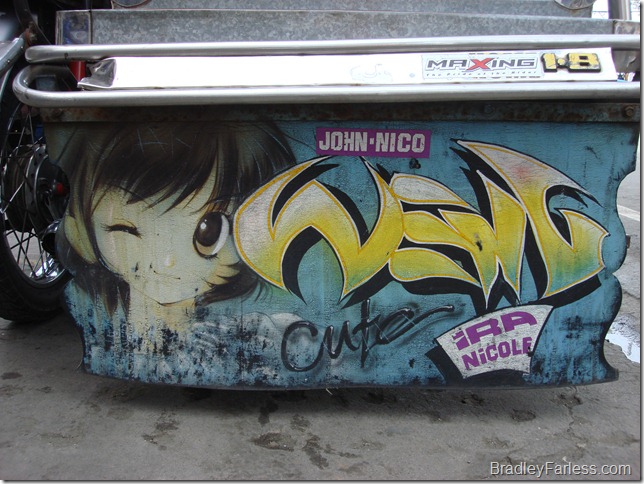
Anime style decoration on a Philippines tricycle.
I also saw this tricycle today and thought the art on the back was pretty neat. We know someone whose nickname is Weng. We’re going to send her a copy of this photo too.
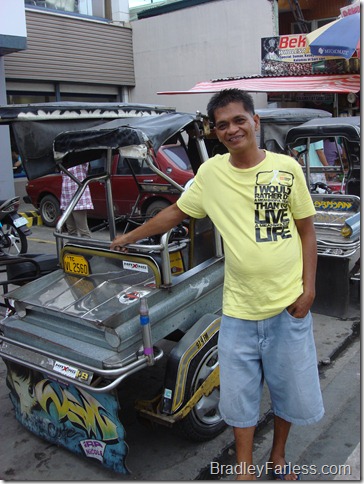
Filipino tricycle driver.
The driver of the tricycle was really excited that I was taking a photo of his vehicle. Well, maybe his friends were the ones that were more excited. They insisted that he pose for a photo of him and the tricycle together.
I really enjoy how creative people get with the designs on the public transportation here. Hopefully I can get a few more good photos of examples before I leave.
Have you ever had one of those moments where you’re about 99.9% sure something very unfortunate and painful is about to happen to you and your mouth is flushed with a weird metallic taste?
On our way home from Manila a few days ago, we happened to take a taxi from Makati to Galleria where we were planning on getting an FX to Antipolo. Well, Galleria was supposed to be our destination, but we didn’t quite make it there.
Makati is one of those weird places in Manila where it’s hard to get a ride. I don’t mind using a Jeepney or an FX for transportation. It can be dangerous, but sometimes it’s fun and it’s definitely an affordable alternative until I can pick up a personal vehicle. However, none were available, at least not going the way we wanted them to. It has to do with the work shifts in Makati. FXs and Jeepney’s heading to residential areas don’t leave until certain times. Outside of those hours you’re mostly out of luck. The only option is to take a taxi or a bus and my wife isn’t too fond of the buses. The buses in the Philippines aren’t city owned and operated like in most places. Every bus is a private operator, or perhaps part of a small group of private operators. It can be really dangerous to get on those because it’s packed full of people, every one of which could potentially have a gun and bad intentions. At least on the smaller vehicles you can see everyone to size them up and you’ll notice it if they’re acting weird.
So, we flagged down a taxi and got in. We were immediately assaulted by an odor of stale sweat, mold and that weird smell that your car can get if you smoke in it while it’s raining. It was enough to dry my throat and make me want to sniff my armpit for relief. Then I noticed that the guy was texting while driving. That’s not the brightest idea in any situation, but doing it in Manila traffic is like playing Russian roulette. He also didn’t seem to care for what he was receiving in reply to his messages. He started to get irate, and his driving became worse than it already was.
Typical Manila traffic is ugly. People edge in and see if the car next to them will yield the lane. People ride the lines dividing lanes until they figure out which lane is moving faster. People will use the shoulder or the sidewalk. Sometimes there are people in the highway. Don’t know why. There just are. That can all lead to some seriously bad traffic and an upsetting experience, but our driver seemed to have a death wish.
What person in their right mind tries to take on a bus with a taxi? He didn’t do it once, or even twice, but probably 5 times. The last time, a bus was riding the line to our right and another bus was riding the line to the left. The bus on the left began to merge into the lane we were in, ahead of us, but the taxi driver decided he didn’t like that and gunned the engine and wedged the taxi in between the two buses. At the last moment the bus pulled back and started honking its horn.
That’s when I saw my own potential death and got that weird metallic taste in my mouth. We told the driver to take us to Megamall instead, since it was a lot closer and we didn’t want to be in the cab anymore. He started arguing that he couldn’t drop us off at Megamall, that it wasn’t allowed. I don’t know what he was thinking, that we were stupid or something probably, but after that, we just got out of the cab at the next red light, threw a few pesos at him and left him there yelling after us like an idiot. The driver was playing with our lives and then acted offended and tried to trick us into staying in the cab to get more money from us. Something I find quite often is that people in the Philippines will try to lie to you when money is involved, even if all they can come up with is a lie that a 10 year old could see through.
Riding a taxi can sometimes be the only way to get around in the Philippines, but unlike most countries, there seem to be no standards enforced in terms of safe driving. Or common sense in this case. We could and probably will call the number on the side of the cab, but I doubt anything will actually happen to the guy because of it. He’ll likely continue driving until he has either killed himself, or his passengers, or both. I’ve heard some bad stories about taxi drivers in New York City, but I don’t remember hearing any where the driver was trying to muscle buses out of their lanes or about drivers almost hitting barricades while trying to take an off ramp at the last moment.
Keep that in mind if you plan on taking a taxi in Manila. The only good ones I’ve found are the airport taxis, and even they try to rip you off if you’re from overseas, regardless of what the sign at the airport taxi queue says.
If you’re going to be in Manila for any length of time, it’s probably best to get your own vehicle. Used ones can be purchased at reasonable prices and then resold when (or if) you decide to leave.
Note: Most recently updated with new information on June 17, 2021. I very much hope that this proves to be a useful resource for anyone trying to get their pets out of Singapore and/or into the Philippines. Please keep in mind that a lot of the information is dated, but I’ve provided links to updated government websites where possible. Thankfully, a lot of the paperwork on the Philippines side can be done online through forms now, instead of having to contact actual people by email.
The process of importing cats from Singapore to the Philippines can seem like a lot of trouble, and it gave us a headache trying to figure out what is, and isn’t, necessary. The embassy website for the Philippines and the website for BAI (when it’s even up) even had some contradicting information. So, I’m writing this guide in the hopes that other people will benefit from my experience.
Picking an Airline
This is one of the most obvious things, but I thought it was worth mentioning because if you’re planning on taking pets from Singapore to the Philippines you only have two options: Singapore Airlines or Philippine Airlines. The budget carriers don’t allow pets at all.
With both Singapore Airlines and Philippine Airlines, pets are transported in the belly of the plane as cargo. Pets aren’t allowed in the cabin (in 2010, not sure about now). Don’t worry. My cats unfortunately went through hell prior to take-off, but they made it through just fine and are relaxing on my bed while I type this.
The real decision here comes down to how much money you want to spend. Both airlines will get you to the Philippines. Both airlines will carry your pets. Philippine Airlines is quite a bit cheaper, though.
Picking your Carrier
That’s not my cat at the top of the photo. He’s a cat that lived in our building on the 6th floor somewhere, but came downstairs during the day to lounge around and people-watch. He was checking out my cats, who were in the carriers, just prior to our boarding a taxi for the airport.
When you take your cats on a plane, an IATA certified carrier is required. We used the Ferplast Atlas Deluxe 20 Open Top to ensure that our cats had proper ventilation during the trip. Check out any of Pet Lover’s Centre’s many locations for a wide variety of carriers. Be sure to ask if the carrier is IATA approved before buying it though or you may be disappointed later.
Vaccinations
Before starting the export process, you’ll need to make sure your cats have been immunized. They don’t need to have been immunized more than once, so if they don’t have a booster shot that’s ok. When we imported our 3 cats to the Philippines, they had all received their first shots less than a month prior to the flight date. The shot you’ll have to get them is the standard 4-in-1 shot, which contains vaccines for feline rhinotracheitis, calici, panleukopenia, and chlamydia psittaci. There is no specific time frame for when, in relation to your flight, these shots have to be received by your cats. You just have to have them current.
One thing I would like to suggest is that before you head to your nearest vet, do some calling around. Prices vary quite a bit in Singapore for the same veterinary services. You can use the Singapore Veterinary Association site’s list of clinics as a good starting point to find a certified vet for your needs. We lived in the East area of Singapore and found Clinic for Pets to have the cheapest rate on vaccinations, and Mount Pleasant Animal Medical Centre (Bedok) Pte Ltd to have the best rate on the rabies vaccinations and Health Certificates. (More on that later in the post).
Philippines Pet Import Permit
Update (June 17, 2021):
Important update : pets being imported into the Philippines now require microchips. For more information, please see the Philippines Embassy in Singapore’s information page by clicking here: Bringing Pets to the Philippines
Update (March 12, 2019):
I’ve been made aware that requesting an import permit, or import clearance, from the BAI is now done through the BAI web portal (link updated 6/17/2021).
Detailed instructions on how to do this are found in the PDF below, which was created by BAI:
Within 60 days prior to your flight you’ll have to request, either in writing or by e-mail, an import permit from the Bureau of Animal Industry (BAI). The BAI website has been down recently for upgrading and the email address that is listed on the Singapore embassy website is incorrect. We were actually told (after a month of waiting) that the email address listed there is not used and won’t return an invalid email address message to your inbox. To actually get a message to BAI via email you have to use the following email address: quarantine_bai@yahoo.com [Commenter “Allem” alerted me to the fact that the previous email address is no longer valid, and recommended the following: baiquarantine@hotmail.com]. The point of contact at that email address is either Maynard Lagmay or Virgie Tesoro, both of which were very helpful in sending us our import permit.
The written request for the import permit is very informal. Just write a standard business letter requesting the permit. Include the following details about your pets:
The permit is usually mailed I think, but due to our circumstances (the incorrect email address) they helped us out by scanning and e-mailing the import permit to us. When you get it, it should look like this:
Republic of the Philippines Veterinary Quarantine Clearance to Import Dogs and Cats
The import permit will be valid for 60 days you don’t have to worry about making any payment until you land in the Philippines. As you can see from the example permit above, you’ll be charged 350 PHP on arrival if you have 2 cats or less, or 650 PHP if you have two cats or more.
Singapore Pet Export Permit
Update (June 17, 2021):
A checklist is now available from Singapore’s Animal & Veterinary Services, which can be found by clicking here: Preparing to Leave Singapore.
Detailed instructions from Singapore’s Animal & Veterinary Services on how to apply for the export permit:
Within 30 days prior to your flight, you’ll have to request an export permit from Singapore’s AVA (no longer exists as of 2019) AVS (Animal & Veterinary Services), which will cost you 50 SGD (in 2010 with multiple cats allowed on one permit).
This export permit is independent of the Veterinary Health Certificate and you request it (and should request it) prior to getting your Health Certificates done. Getting the export permit is as simple as filling out an online form, which you can get started on by clicking this link (link updated June 17, 2021).
Information below in this section is probably all outdated at this point:
Once the page loads, scroll down until you see this:
As indicated in the image above, pick the situation that applies to you. Both options will lead to the same form, but if you’re not a foreigner you’ll have to enter your SingPass to proceed. Getting a SingPass is as simple as going to the CPF Building in Tampines. It takes about 5 minutes and you’ll leave with the SingPass in your hand.
Either way, you’ll be presented with a disclaimer that you’ll have to agree to and then you can begin filling out the form. The form is simple but it can be confusing at times. The same form is used for all situations, as well as importing and exporting, so the key is to just fill out the sections that apply to you and your situation.
Here’s an example on the first page of the form:
On the first page, as an individual exporting personal pets, the bottom details don’t apply. Don’t enter anything into the fields at the bottom of the form will fail in the end. The best thing to remember is that just because it has a red asterisk, it doesn’t mean you have to fill it out if that box doesn’t apply to you.
In the end, you should be presented with a confirmation page (step 7) that looks something like this:
The following day, you can go back to that first page where the green links are and click on “Enquire on my Application’s Status Now”, or just click here. You’ll be required to give the Application Number from the Submission Page, which comes after the Confirmation Page above, so be sure to write that down. It’ll be a long number that starts with a letter, like this one:
In the following screen you’ll be able to see if your permit is processing, approved or denied. Once it’s approved, payment is simple. You follow the link at the beginning of this post to go back to the AVA page with the green links and this time click on “Pay for my New Licence now”, or just click here. The payment is handled by a third party, but the payment should credit instantly. It did for me! They accept NETS and MasterCard. I can’t remember if I saw a Visa logo or not.
After making your payment you’ll be directed to a page where you can download your Export permit for printing.
Health Certificates & Rabies Vaccination
When you’re 7 days out from your flight, you’ll have to take the final steps to ensure your cats are ready to go.
One thing you’ll have to consider is whether or not to get your pet a rabies vaccination. This is one of the points where I got a bit confused, because some sources I read said it was required, and others didn’t. I played it safe and got my cats their rabies vaccinations. Technically, I don’t think it’s required because rabies has been eradicated in Singapore. However, there are rabies in the Philippines and if I was going to put this much effort into bringing them with me, I didn’t want them to get sick and die after arriving safely. The rabies vaccinations cost me 48 SGD apiece.
To get our Health Certificate, we went to Mount Pleasant Animal Medical Centre in Bedok. The vet will inspect your cat to make sure they don’t have any weird bumps, open wounds, or signs of any infectious diseases. If they appear to be in good shape, she’ll authorize the counter clerk to print up a health certificate, which she’ll sign.
Before she does that, ask her to apply Frontline to your cats and have it annotated on the health certificate. One of the requirements for importing pets into the Philippines is proof that they’ve been treated for parasites. I actually forgot to have her administer dewormer and annotate that as well, but we had some on hand to administer to the cats when we landed at NAIA, in case they asked.
Your journey isn’t over quite yet!
Update (June 17, 2021): The Philippines Embassy in Singapore’s website now reads:
Obtain a Veterinary Health Certificate issued by a private veterinarian by bringing your pet to any AVA-licensed veterinarian for examination.
So, it seems that you no longer need a certificate issued by the AVS (new AVA), but just one issued by an AVS-licensed veterinarian. I would double-check with the Philippines Embassy or by contacting the BAI directly to be sure. Or, you could play it safe and just apply for the AVS Veterinary Certificate.
Importing pets to the Philippines from Singapore requires an AVA Veterinary Health Certificate, which is 23 dollars per certificate (with multiple cats allowed on one certificate). Once you have your regular health certificates, you need to scan them and then head back to the AVA’s site to request the AVA certificate (link updated June 17, 2021). Click that link, scroll down and you’ll see the following:
Filling out this form is similar to filling out the export request form. It also offers the same method of payment. There’s just one catch. You have to pick this one up in person. The AVA Veterinary Health Certificate comes with a special watermark that only certain printers can properly reproduce. An average printer will print the form, but it will have a watermark that says “copy copy copy” in a ring, instead of the proper image. The airline you choose and Customs in the Philippines will require the original.
At some point while filling out this form you’ll see a check box that you either select or de-select to indicate that you’ll pick it up in person.
When you’re ready to go pick up your form, head to the Tanjong Pagar MRT station (EW15 on the Green Line). Exit towards Maxwell Road and you’ll find yourself at an intersection with Maxwell Road crossing just in front of you. Cross the small street just to the left of the MRT exit and follow Maxwell Road. After about one block you’ll see the Ministry of National Development across the street, with a pedestrian crossing leading right to the front doors.
Go up to the second floor, hang a right at the information desk and you’ll walk right into the office. You should leave with a form that looks like this:
Note that the watermark says “copy”, since this is a scanned copy of the original. Pretty cool how it does that!
Presenting Your Paperwork To The Airline Travel Office
No later than two days prior to your flight, you’ll have to present your completed documents to the airline office for validation. I’m not sure if Singapore Airlines has the same stipulation, but this was required by Philippine Airlines. The documents I was required to show were the Import Permit, Export Permit and the AVA Veterinary Health Certificate. The guy also asked me the weight of the cats and the dimensions and the weight of the carriers I was using. Be sure to have that information on hand. I had to waste a lot of time looking up the carrier dimensions and weight on my iPhone because I wasn’t prepared.
After the guy looks over your documents he’ll fax them to the airline office in the airport. Once that’s done you’ll be good to go.
The Philippine Airlines office I went to is located at Parklane Shopping Mall, which is close to Dhoby Ghaut MRT station:
It’s not too hard to find. There’s a Singapore Arts school on the corner of Orchard and Selegie. You just turn up the road and then look for this facade:
The entrance is located between the DBS sign and the McDonald’s sign there on the left. When you enter the mall go down the first hallway on the right and it should be the 2nd or 3rd storefront on your right. They close at 5 PM.
Changi Airport
Once you’ve presented your documents to the airline office, you can kick back and relax. The next thing you have to do with your cats is get them ready for their trip on the day of the flight.
When you arrive at the airport and get in line to check-in, an attendant will likely usher you into the Business Class line for prompt handling of your cats. Since the documents are faxed in ahead of you, they’ll be watching for you. The clerk will weigh your cats and perform your usual check-in process, but before giving you your boarding pass you’ll have to go to the excess baggage counter to pay for your cats trip. The rate was 20.50 per kilo when we traveled on May 6th, 2010 and we paid 330 SGD total for three cats and carriers. Once you’ve paid the excess baggage fee you’ll receive your boarding pass and your cats will be wheeled away on a trolley. They won’t be placed on the conveyor belts.
After this, it’s a typical flight.
NAIA
When you get to NAIA, you’ll probably rush off the plane like we did to catch up to your cats. We got through immigration and customs pretty quickly, but they were already waiting for us at the baggage claim area. The paperwork process at NAIA is extremely painless. They even came out to the claim area to take our paperwork and payment from us. Our cats were never put in a quarantine area and they didn’t make us cart them over to the desk. Everyone seemed really amused to see them.
We paid our 650 PHP and then all 5 of us walked out into the bright Filipino sunshine to start the next chapter in our lives as residents of the Philippines!
Conclusion
Exporting your cat(s) from Singapore to the Philippines can be a long, complicated and very expensive process but it’s also very rewarding. I think we spent upwards of 1200 SGD (including vaccination fees). I encourage anyone who has pets to take them with you when you leave Singapore. Cats aren’t emotionless beasts that should be tossed out on the street after you’re done ‘using’ them. After two years of cat ownership I know that each one of my cats has a very different personality and that each one reacts differently to different situations. If we’re gone for a while, they show that they missed us when we come back. A cat will ‘feel’ it if you abandon it in the street, the same way any other member of the family would. Love them, protect them, and definitely take them with you and they’ll be your faithful companions for many years.
In 2008 I had the opportunity to fly on Singapore Airlines and earlier this week I flew on Philippine Airlines. I spent two years living in Singapore and am moving on to the Philippines, so I figured it’d be in keeping with this blog to do a comparison of the services offered by both airlines. I’ll also be reposting this on my Philippines blog, Everything But Balot.
Singapore Airlines:
When I first flew to Singapore in June of 2008, I had some choices to make. One was which airline I was going to take. I made that decision the simplest way. I took the one that was cheapest. When you’re flying from the US to Singapore, the cost of the ticket can be pretty steep, especially if you’re flying during the summer, so the price point was my major choosing point.
Somehow, Singapore Airlines wound up being the best priced fare at roughly 1400 USD for a one way ticket from New York City, with one layover in Frankfurt, Germany. I have no idea how this happened, but I’m glad it did.
To put it simply, Singapore Airlines is the best flight experience I’ve EVER had. I think it completely enhanced the experience that I got onboard with absolutely no expectations or any knowledge of the airline. With it being the cheapest ticket, I’d assumed it was some sort of low class airline that would get me where I wanted to go, but not necessarily in style.
I was wrong. Singapore Airlines is all about comfort and relaxation while in flight, even if you’re in the economy section. I had a good seat too. I’d booked early and chosen my seat, so I wound up on the aisle. Someone begged me to switch with them, so they could sit next to their spouse, but I declined. Their seat was dead center of the plain, with two seats on either side. I have long legs, so I need the extra space, especially on a 22 hour flight.
Shortly after getting on the plane I was handed a package by a stewardess. I don’t remember if it was prior to take-off or just after the plane leveled out, but it doesn’t really matter. I got it right away and it was a fantastic goodie bag! It had slippers, a toothbrush, toothpaste, and I think some soap in it. Right about then I knew I’d lucked up and gotten a good deal, but it only got better.
A little while later, a stewardess came down the aisle and asked me if I’d like to have a glass of champagne. Of course I accepted her offer and then got lost in the menus on the touch-screen TV on the back of the chair in front of me. Oh, and I’d put on my comfy slippers by then too. The TV on the back of the chair was loaded with on-demand movies, TV shows, music and even a few basic games. It kept me thoroughly entertained for the duration of the flight.
The meals I was served were top notch. It was better than some of the things I’d eaten in restaurants. The one meal that still stands out in my mind is the steak dinner I was served. The meat was tender and it was real, rather than being some chopped and reformed meat patty. The vegetables were still crisp.
Between meals there was a steady flow of drinks and snacks, and most importantly, the stewardesses were very prompt and kept their eyes on the passengers to make sure everyone was as comfortable as possible. I could really tell that I was a valued customer, even if I wasn’t in first class.
If I ever make a long-haul flight from Asia to Europe, or back to the US, it will definitely be with Singapore Airlines.
Philippine Airlines
My trip on Philippine Airlines left a lot to be desired. I flew from Singapore to Manila, in the Philippines. It’s a pretty short flight, but even so I expected there to be a level of service offered in exchange for the premium price we paid to fly with their airline over Jetstar, or an even lower priced budget airline. That wasn’t the case, at all. I won’t go into the disaster with my cats here, but do take the time to read it, as that may have affected my opinion. I’ll try to stick to specific examples here.
When we first approached the boarding area, I was expecting to see a large, shiny plane waiting for us. Instead, the plane looked a bit small and old. I kept my hopes up for the interior, but was let down on boarding. The seats were a bit cramped, there was no TV in the back of the chairs, and everything looked really old and worn down. If it weren’t for the uniforms the stewardesses were wearing, it could’ve been a Tiger Airways plane. Not that I have anything against Tiger Airways. I’m just saying that you get what you pay for, and I paid for more than that.
I want to talk specifically about the entertainment services offered. The TVs weren’t in the backs of the chairs, with each person having their own individual screen to suit their taste, but there were drop-down TVs. Each one was set to serve about 3 rows. The screens were small, but they were ok. The movie selection wasn’t bad either. They picked The Tooth Fairy, which I really enjoyed watching the first time around. I got excited and plugged in the complimentary headphones provided by a stewardess. I then found out that I couldn’t change the channel or the value through my armrest. Also, each headphone was playing something from a different channel. I had crappy music in one ear and even crappier music in the other ear. So, I took off the headphones and just looked at the screen for a while.
When the movie started, the stewardesses were distributing meals from their cart. The food was actually pretty good. I had a chicken dish that actually hit the spot, especially since it was accompanied by a Red Ribbon brownie. Red Ribbon is a baking chain in the Philippines that really does it right. I love getting cakes and other goodies from them.
Unfortunately, that’s as far as I can go with the compliments.
After the meal, I think we sat there for about 40 minutes with our empty trays, waiting for a stewardess to come by to collect them. My wife had to use the restroom and couldn’t wait any longer, so we wound up stacking everything together into one tray that I could hold so she could climb out. In the process, we spilled ice water in her lap and on her chair. About 10 minutes later a stewardess finally came by to take the trays, and instead of offering me service, she told me I needed to put everything back on the individual trays before she would take it. Then she moved on and I had to yell at her to get her to come back and take the damn trays I’d put back in order. She should’ve taken the trays and done the work herself. If she’d been more timely in her job it wouldn’t have been necessary to put them like that in the first place.
Also, during the entire flight the cabin felt stuffy and warm. I’m not sure if the air conditioning wasn’t working right, or if they just weren’t running it as often to save on fuel, but it was disappointing. You know how you always think you’ll need a blanket on an airplane because it’s nice and cold? I was wearing flip-flops, shorts and a t-shirt and I was still warm.
I spent the rest of the flight furiously updating and arranging my e-book library on my laptop, looking forward to getting off the plane. Instead of being a great experience like Singapore Airlines was, Philippine Airlines made the trip feel like a chore. I don’t understand why I paid more for their tickets. I get better service on Jetstar and the rates are a lot cheaper.
To top it off, when the plane landed it almost veered off the runway. Not sure what that was about, but it seemed a fitting end to an uncomfortable flight.
Conclusion:
I suppose I already said it above, but from now on it’ll be Singapore Airlines only for long-haul flights, if my budget permits of course! Other than that, I’d rather take Jetstar than Philippine Airlines again.
Last weekend (the weekend of the 5th – 7th), we went to Kuala Lumpur and over the last week I’ve been posting about stuff that we saw while we were up there. We weren’t in KL for very long and we’d intended to try to make the most of our time to go see Putrajaya and the museums and art galleries if possible.
We got there on Friday afternoon and dropped our bags at the hostel. We stayed at Hostel Cosmopolitan again. It’s by no means fancy, but it’s cozy, it’s got cats (which my wife enjoys) and it’s close to the monorail and good food. Thankfully, that weird smell was gone from the air conditioner this time!
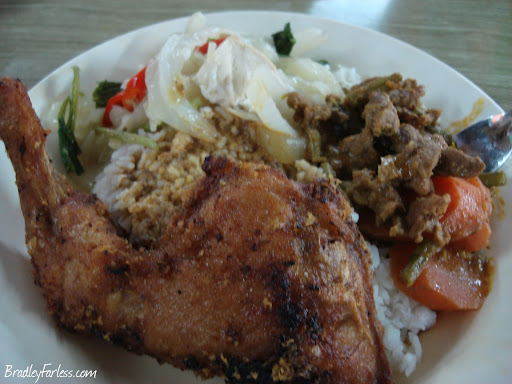
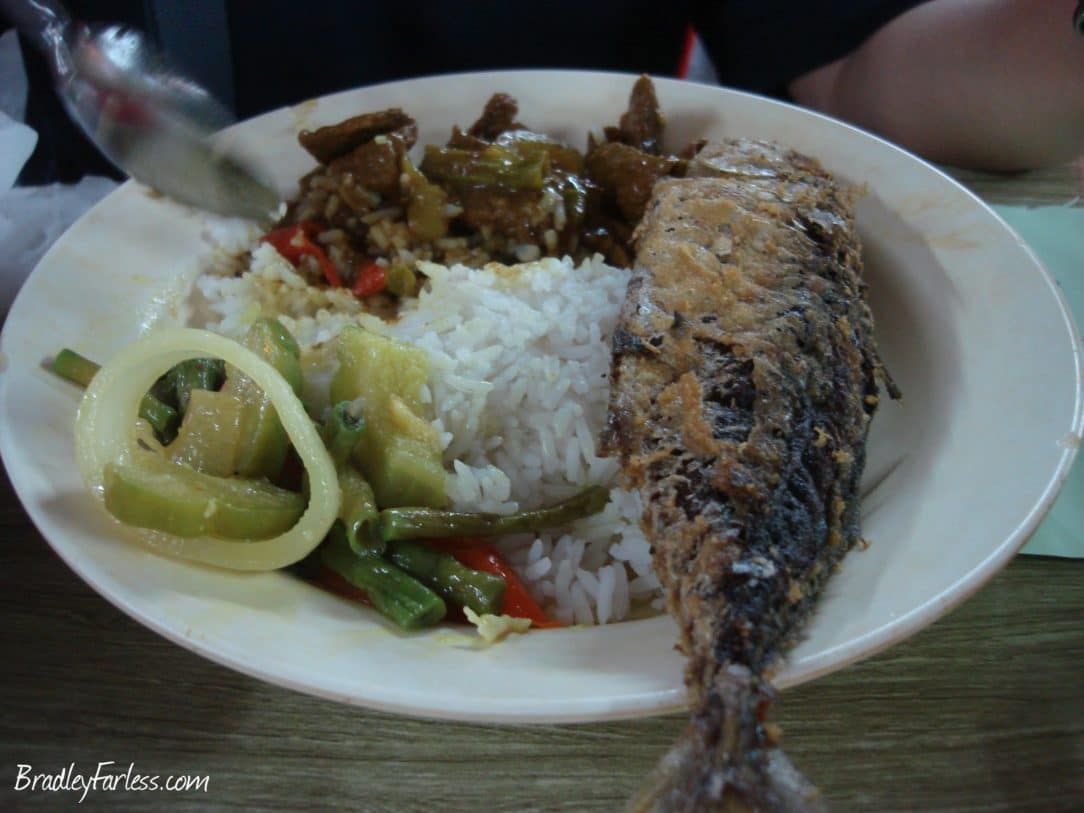
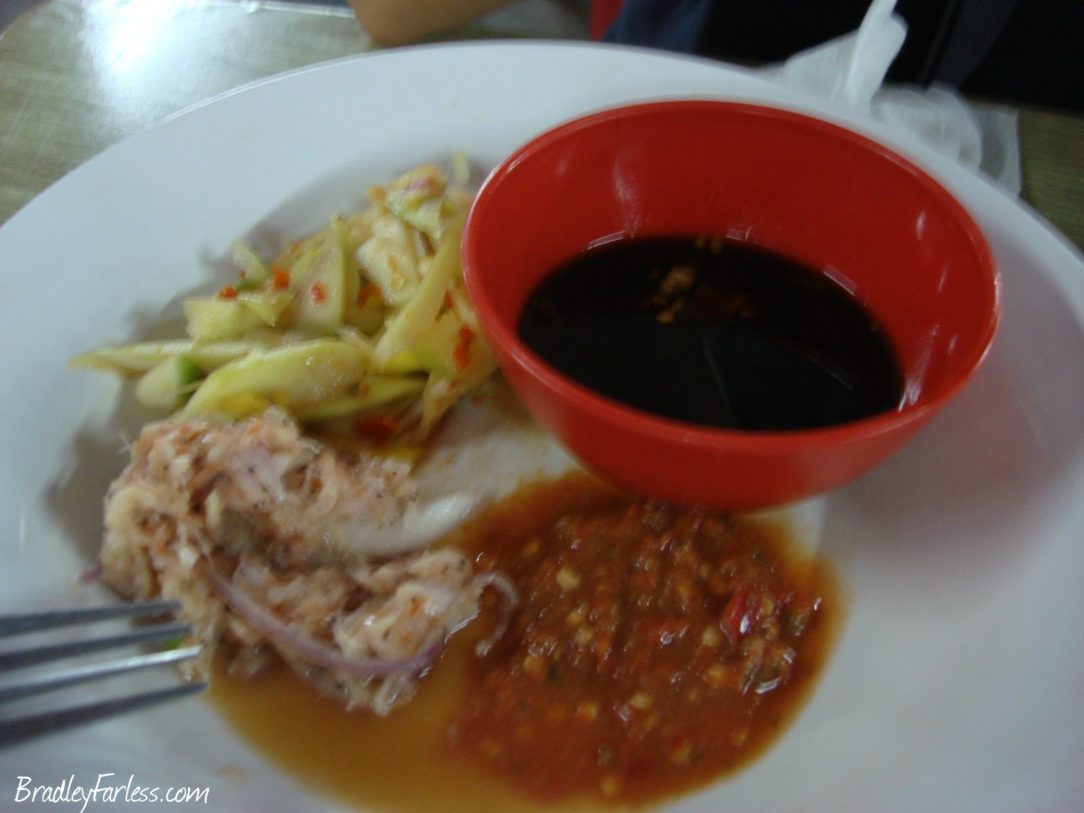
The first thing we had to take care of was stuffing our faces. We’ve been keeping an eye on what we eat lately but since we were sort of on vacation we decided to pig out. We went to an eatery in Kampung Baru that we enjoyed the last time we were in Kuala Lumpur. It didn’t disappoint!
Another thing I really love about this place is that all that food in the photos, plus two large soft drinks, only cost 19.40 RM, which is 8.00 SGD or 5.65 USD. That’s a real deal! The same meal in Singapore would’ve cost about 14 SGD I think.
Friday night was spent being lazy, watching TV and reading. We went to bed at a decent hour though because we’d planned on getting some sightseeing done on Saturday.
Well, as Saturday morning rolled around, dragging ourselves out of bed was very, very difficult. And after eating breakfast we sat down in the common room area to watch TV, read and surf the net. Well, my wife got distracted with a John Grisham book she found on the shelf and I was absorbed in Google Reader until I dozed off for about an hour. Ya, the couch was pretty comfortable!
Anyway, by the time we managed to get washed up and get out of the hostel the only thing we could think about was getting something to eat, and that’s when we went to KLCC and California Pizza Kitchen. We sat around in Kinokuniya bookstore until around 8 PM, took some night photos of the Petronas Towers, and then headed back to the hostel.
We continued being lazy, enjoying the TV until the wee hours of the morning. Heck, we even watched one of the audition episodes of the latest American Idol season. It was really fun watching people get up there and embarrass themselves!
Our last day was short. It wasn’t really a day since we spent most of it sleeping in and then traveling to the airport. Everything went smoothly though with no problems so I’m glad about that.
All in all, we didn’t really do much of anything at all except eat. That’s fine by me. Sometimes you have to just relax and let your body and mind rest. Besides, we’ve seen quite a bit of Kuala Lumpur in previous trips.
Anyhow, it was nice to get back home in Singapore. There’s really no place like home, regardless of how much you enjoy the place you go to visit.
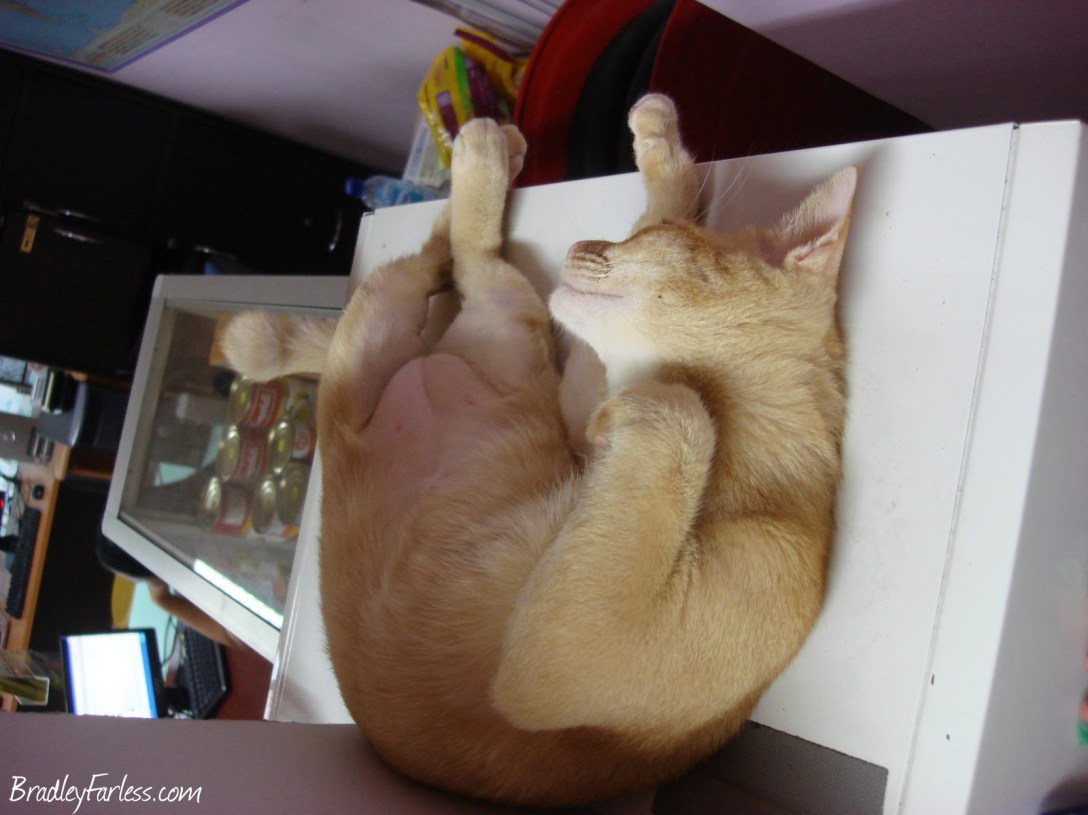
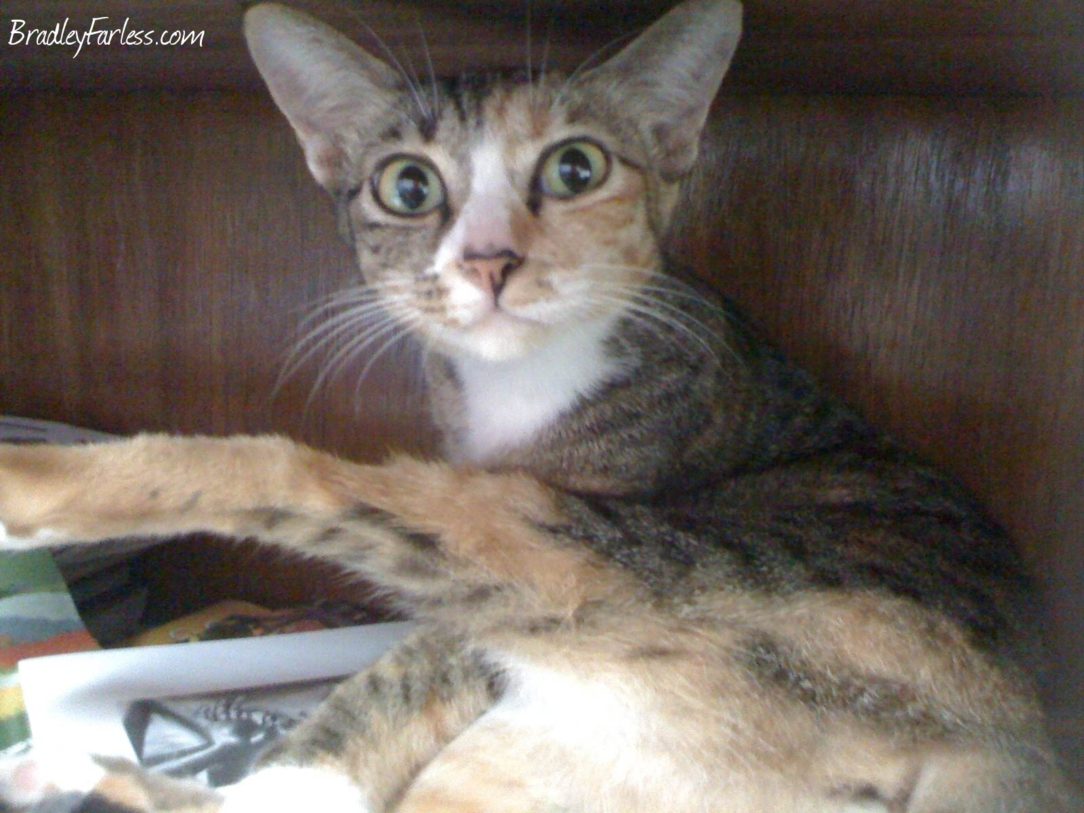
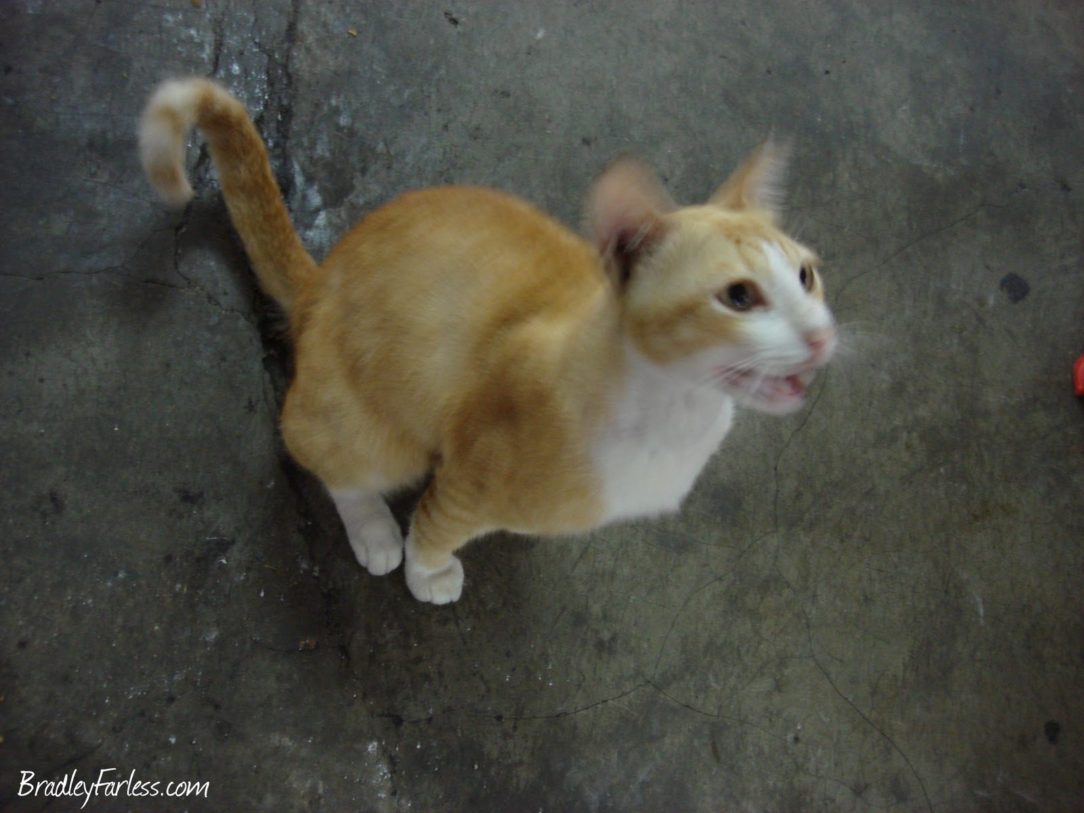
These are just some of the cats we saw while we were in Kuala Lumpur.
This is Mr. Jinja. He’s a cat at Hostel Cosmopolitan.
This is Whinny, Mr. Jinja’s friend. She also lives in Hostel Cosmopolitan.
This cat was hanging out in an eating area in Kampung Baru, begging for scraps. I gave it some chicken.
This girl was working at a satay stall we stopped at for a late meal. In fact, we got there just before they were closing. As they started packing up, cats started showing up. I was wondering what was going on until the girl working at the stall pulled out a bag of cat food to feed them. She seemed really excited to see the cats, and she had a good laugh when my wife ran over to watch them and had her photo taken with them.
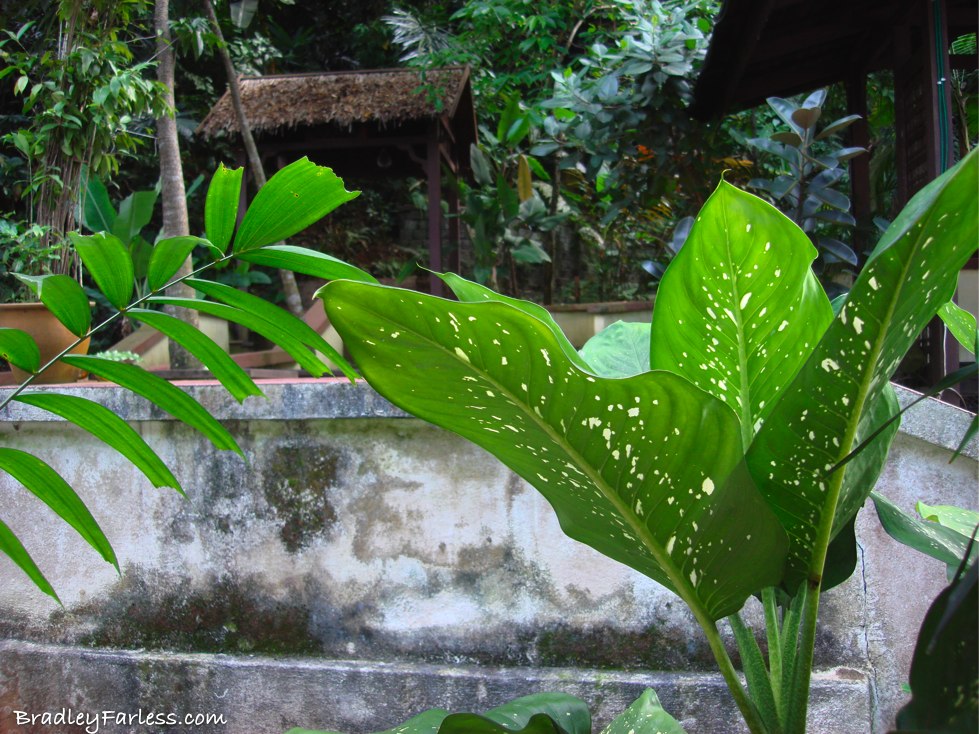
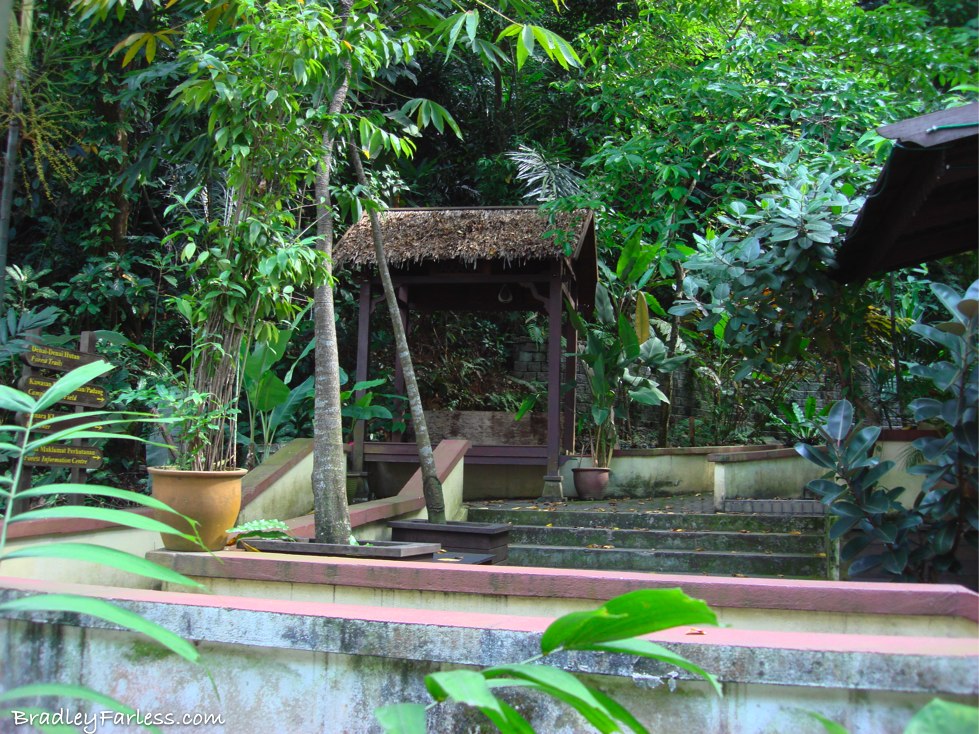
This area is located along the path between the Bukit Nanas monorail station and the Dang Wangi train station.
It looked really nice so I stopped to take a few photos. I forgot to take a picture of the name of the building that was adjacent to this outdoor area, but it had something to do with Malaysian timber, and it was also the place where I saw the Pinis Gobel boat.
I was a little surprised to see that the path for the interchange was above ground. I’ve gotten spoiled in Singapore where the interchange is all underground and you use tunnels to get to the other line if you have to. I like that better because then I don’t have to deal with the sun and the lack of air conditioning.
Anyhow, part of the trip to between the lines includes going over a major road. There’s a pedestrian bridge. Unfortunately, the escalator on that bridge is broken and it appears to have been that way for a long time. None of the pedestrian bridges I’ve seen in Singapore, except maybe one on Orchard Road, have escalators so we just used the stairs. Apparently, the average Malaysian doesn’t want to deal with that though because everyone else walked out into the road and then used a spot where the center barrier had been broken down to get through.
I’m kinda surprised that these people want to run in traffic, but I remember seeing them doing it in Chow Kit where the traffic is a lot heavier. They’re pretty brave, considering what a fast moving vehicle can do to the human body.
Anyhow, we were happy to notice this on the transit map this time around. The last time we went from KLCC to Chow Kit we went all the way to KL Sentral. Taking this walk from one line to the other saves a lot of time and RM.
In addition to a train system, Kuala Lumpur has a monorail system. It’s fun to ride, but it’s really slow in comparison to a train, which makes me wonder why they bothered to build it at all. I suppose the answer is that the distance between the stops is so short that having a train run that route wouldn’t make sense. Also, the route is very curvy.
The stations are almost identical to train stations. You have to get in line and buy your ticket, then you insert the ticket into the turn-style, wait for it to pop up from the center of the machine and grab it as you walk through.
The ticketing system that Kuala Lumpur uses for its trains and monorail is absolutely ridiculous. The lines of people waiting to buy a ticket are sometimes incredibly long to the point that they block other pedestrians trying to use the sidewalks outside the station. They need to get with the times and do what Singapore does and just use a prepaid transit card. It’s much, much more efficient.
Anyhow, you go up to the platform, wait for the monorail to show up and then go about your business.
The monorail cars themselves are nice. There’s plenty of seating and space to stand. It also has a lot of windows so you can see the area around you. When the monorail takes a sharp turn, the track and the whole monorail tilts, which is a little unnerving. Better than walking or taking the cab though.
Some interesting things to note are that the train platforms don’t have what I like to call “dummy doors” around the tracks. There is a waist-high railing, but they expect people to use common sense when it comes to standing to close to openings where the monorail doors open. I guess they don’t have any issues with people trying to leap in front of the monorail to kill themselves. The actual train stations, on the other hand, which are underground, do have the extra doors. I think that’s more for keeping the air conditioning in the station than anything else. New York City should follow that example. It gets hotter than Satan’s anus in those train stations in the summer.
There are signs on the platforms warning you to be wary of pickpockets. As the monorail train approaches people have a tendency to push towards the openings where the doors will open. When people start packing close together like that, it’s a great opportunity for people to get pickpocketed.
I know that from personal experience. Some little punk ass kid tried to pick my pocket while I was waiting for the monorail this past trip. He was wearing a coat draped over his shoulders to hide the fact that his opposite hand was reaching from under the edge of the coat to try to get into my pocket. Tough luck for the bastard that I’m not an oblivious idiot… and that I wore shorts with pockets that button.
I knew something was up with the kid because when I moved he kept moving up next to me. When I felt the tug at my pocket I pushed him away from me. He should feel glad that I didn’t accidentally push him in front of the monorail while trying to get him away from me. Even if the monorail hadn’t hit him it’s a long way down to the ground.
So, ya, keep an eye on your belongings while you’re there. Most of KL is pretty safe looking, but so is Singapore and people are getting stabbed in broad daylight here now.
This was our third visit to Kuala Lumpur but we’d never seen the Petronas Towers lit up at night. We stayed in the mall below it late, browsing the book store, so when we were leaving we stopped by to snap a few photos.
This was taken from the back side of the mall where the fountain is.
And this is just a random tree that rings the fountain. It has some strange looking fruit on it.













 Bradley's Old Fashioned Weblog