Sent Off In Style

Remember how I said in an earlier post that Filipinos will use a motorbike for just about anything?

Well, when my wife and I flew back out of the Philippines, we had to leave through Clark Air Base, since that’s where we arrived at. We spent most of our stay in Antipolo and had to commute back to Pampanga for our flight. The original plan was to leave Antipolo the day before, spend the night in Pampanga and then head back to the airport the next day. We just couldn’t bring ourselves to leave Antipolo though, so we wound up leaving the morning of our flight.

Our trip back to Pampanga was a bit hectic. We stopped by my brother-in-law’s restaurant to have a meal first and then we headed to Manila. Before leaving Manila we had to stop by POEA. That’s the Philippine Overseas Employment Administration, or in other words, another place to get slammed by senseless fees. We had a bit of baggage with us, so my wife deposited me at the nearest Starbucks, told me to have a coffee and surf the net on my laptop and then disappeared for a while. I think she knew I would have fun surfing the net on my own laptop for the first time in 8 days and she probably didn’t want me in the POEA. If I were there, they might have tried to hit her with more fees, just because, and then I would get pissed off, and it would have led to me making a scene and being aggravated for the rest of the day.

After that we had to find our way to a bus terminal. So, we jumped in a cab. Unfortunately, the cab deposited us at a bus terminal that only had routes going in the opposite direction from where we wanted to go, so we had to do some walking. It was hot that day, and we wound up being a little toasted by the sun while we trudged up the street. Luckily, a bus going to Pampanga happened to be stopped on the side of the road, trying to pull in more passengers before it hit the highway. We hopped on and relaxed.

By this time, we were counting the hours. We weren’t sure we were going to make it on time. The bus was kind of puttering around too, stopping everywhere to find more passengers and we started to get nervous, but once we hit the highway this guy’s foot turned to lead. He laid on the horn and tailgated people to get them out of his way and we reached Angeles City in a short 55 minutes.

Now, it was time for another headache. When we got off at Angeles City we realized we didn’t remember exactly how to get back to my father-in-law’s house so we could get the rest of our baggage and freshen up a bit. After a furious texting session, we finally gave up on outside help and took our chances. We hopped onto a Jeepney that deposited us at what looked like a Jeepney terminal. Then we just asked around until someone pointed us in the right direction. The ride on the 2nd Jeepney was a bit long, and we were nervous because we weren’t sure we were going the right way, but eventually we saw things that looked familiar and we got off in the right place. A short tricycle ride later and we were at my father-in-law’s house.

So, the hard part should be over right? Well, not quite. The yard is walled and the gate was locked. My father-in-law wasn’t answering his phone, so we wound up leaning up against the wall by the house, yelling for him. We knew he was there, since the house’s windows were open and the gate was locked from the inside. I was about to look for a place to climb the wall when we heard him call out from inside the house that he was coming. Turns out he caught a cold and was laid up in bed, passed out.

Once we got in we packed our things together and then took showers. Yup! Showers! We got to enjoy the first pay-off of fronting the money to have the water connection hooked up! The water was cool, which was refreshing on a hot day. I prefer hot showers usually, but anything is preferable to dragging water in from the well and washing out of a bucket. In Asia, “central” anything is rare. As in, there’s no central A/C. There’s no need for central heating of course. Also, there’s no central water heater. The only place you usually get hot water is in the showers, and that’s only if you spend extra cash on a wall mounted water heating unit.

So, after we freshened up, we began our journey to the airport at Clark Air Base, accompanied by my father-in-law, who wanted to see us off. My mother-in-law was still on her way from Manila and said she would catch up with us at the airport. So, how did we get from the house in Pampanga to Clark? Here’s where the motorbike comes in. Part of our trip was on a modified motorbike that had a frame built around it, including a passenger area/cargo area in the back. I was amused, and impressed, by the owner’s ingenuity.

On the trip, I had the pleasure of seeing this pigs riding in the sidecar of another motorbike (which I also showed in Part 9).

The ride in the modified motorbike was fun, but it was incredibly slow. By the time it dropped us off outside the main gate to Clark Air Base, I was almost sure we’d rode all the way back to Antipolo. Outside the gate, we had one more Jeepney ride to go before we made it to the terminal.

We went ahead and checked in as soon as we got there. We arrived at 7:30 PM, and check-in had started at 7:00 PM. Afterward, we came back out and talked for a while and waited around for my wife’s mom. She must have gotten hung up in traffic though, because at 7:55 PM we gave up and went inside to finish the check in process and move to the departure gate area. We didn’t want to risk missing our flight. We wound up saying our goodbyes to her over the phone. She arrived at the terminal at about 8:05 PM, but by then we’d already gone through immigration.

Corruption in the Philippines

I was told that in the Philippines, making money depends on how inventive you are, and how entreprenuerial you can be.  The average salary in the Philippines doesn’t count for much when converted to almost any other foreign currency, and most salaries in the Philippines don’t count for much there either.  This is especially true in the provincial areas, where an average salary might be 7,000 – 12,000 PHP (144 USD – 248 USD) per month.

Even the police and military in the Philippines receive low wages and have to do extra jobs on the side just to get by.  To me, this seems detrimental to the overall health of the nation, especially in regards to the military and police.  If the people who are meant to protect you can’t concentrate on their jobs because they’re so poor, they’ll either become ineffective or they’ll exploit their position, leading to corruption.

It’s no secret that the Philippines already has problems with corruption. The Philippines should be listed as an example of political corruption in encyclopedias, as it’s almost become a tradition for politicians in power to screw over the citizens. According to agencies like Transparency International, and Filipinos, the current president, Gloria Arroyo, is considered to be the most corrupt president in the history of the country. So, where do you lay the blame? The people who elected her? Well, maybe in a country like the US, where there are actually checks and balances and a somewhat fair election, but Gloria openly admitted to cheating during the 2004 election to win the presidency.

So, was the corruption in the Philippines evident even to me? Sure it was. The poor quality of public works like roads, phone and water services, the low quality of life, the rampant inflation between my first visit a year ago and this visit, and fees, fees, and more fees. Did you know you even have to pay a fee just to leave the country? It applies to tourists and Philippine nationals alike, except it’s higher for foreigners, because like I said before, all foreigners are rich in the eyes of Filipinos. They like to call it a “Terminal Usage Fee” and it comes up to something like 16 USD. What’s this fee going to? It’s certainly not going towards improving the terminals I’ve used there. That’s for damn sure. Again, I’d like to point you back to a prior post I made about NAIA, in Manila, here. For my wife, the fee is only 100 pesos (about 2 USD) but to get the paperwork done she has to travel to an office in Manila and sit around for an hour or more. On top of that they regularly charge Filipinos who work overseas exorbitant fees for something called the Overseas Workers Welfare Administrations, and Filipinos are required to upkeep their domestic Philhealth healthcare, even though they’re abroad and don’t need it. It’s all just ridiculous. When I left the US, I wasn’t required to pay extra fees. I’m not required to join an organization just because I left the country and have plans of working abroad. In fact, my foreign earned revenue won’t even be taxed up to a certain point (which is pretty high).

The Philippines is a country with a lot of potential that will never be realized as long as people like Arroyo sit in office, embezzling money from the people for the purposes of self-enrichment (and not the good kind like learning a second language either) and self-aggrandizement. It’s almost disgusting to look at. In fact, it’s almost like watching a large group of schoolyard bullies fight for authority, not realizing that there’s so much more beyond the schoolyard fence.

Montage of Poverty and Upscale Construction

While we were commuting back and forth through the Philippines I noticed something that I haven’t seen anywhere else.  The Philippines is like a montage of poverty, middle class, and upper-class establishments and homes.

What I mean is that in, say, the US, you have neighborhoods that are well-to-do.  The houses are all very nice.  Then you have middle class neighborhoods, lower class neighborhoods, and poverty level neighborhoods.  In the commercial areas, everything is fairly well put together.  Everything has a sort of continuity to it.  You see what you expect to see for the area of town you’re in.  Maybe it has something to do with zoning, or with developers buying large plots of land.  I don’t know.

In the Philippines, however, there doesn’t seem to be any kind of zoning.  There doesn’t seem to be any sort of building code either.  You might be standing in front of a popular mall that’s as modern and attractive as any mall in the US or Singapore, but right next to it, or across the street, are buildings that look like they were constructed entirely of plywood and sheet metal.  You could be standing in front of a McDonalds, but when you look down the alley next to it, you see shanties that would make the Red Cross cringe for the lack of quality of life.  It’s an incredibly jarring experience.

This seems to be common to almost every part of the Philippines.  The old and the new, the ultra-poor and the ultra-posh, set up right next to each other.  You can even see this in the housing areas, such as they are.  You might have a nicely built home right next to a house that even bums wouldn’t want to live in, in the US.  From what I can see, as long as the land is yours, you can put whatever you want to on it, of whatever quality you want.  There was one instance where I wondered about whether or not the homes were built legally.  We were riding a bus on the highway between Angeles City and Manila.  The portion of the highway we were on was raised about two stories above the ground.  I’m not sure why it was raised, except maybe that there were quite a few little streams passing below the road.  What caught my attention is that people who were farming the land had set up their houses below the road, in the shade it created.  Maybe laws are different in the Philippines, but I assumed that doing something like that would be considered unsafe and illegal.

There are areas where land developers seem to be trying to build a more modern type of sub-division.  One in particular comes to mind, near the housing area where my wife’s family lives in Antipolo.  It’s walled off, gated, and the houses inside have a modern construction to them.  Just outside the wall, though, is the normal eye-jarring experience.  I’ve also seen posh, walled and gated apartment complexes situated in the middle of an area that looks like a slum.

On my next trip I’ll try to take a few pictures to add to this post as examples.

Standing Out Like A Sore Thumb

When you’re a white guy and you’re in the Philippines you’re something like a superstar.  It feels like you’re being followed around by the paparazzi or something.  This isn’t really the case in the Manila area, well not so much anyways, but out in the provincial areas, everyone takes a look at you.

I get the feeling that in the Philippines people who live in the provincial areas don’t travel too much, so they probably don’t see foreigners very often.  When I was walking around the Pampanga area people would sometimes plainly stare.

There was an instance where I was riding on a Jeepney with my wife and my father-in-law.  Two Filipinas were sitting across from us at opposite ends of the bench.  Every time I looked their way they were eyeing me.  One of them had a distasteful or maybe a hateful look on her face.  Maybe she had something against me being there, or maybe the look was aimed at my wife, who’s also a Filipina.  The other one looked like she was hoping I would come talk to her.  When the latter one got off the Jeepney and walked past us, she gave me a funny looking smile, like she was trying to be cute.  I thought it was even more strange, because she didn’t seem to care that my wife was sitting there with me.  It’s not as if I was trying to hide my ring or anything.  My wife told me that it’s normal.  Just the fact that you’re from another country makes you extra attractive in the Philippines and she says a lot of the girls there are very unscrupulous when it comes to married men.

Other times the stares weren’t quite so pleasant.  When we were traveling from Porac to Antipolo I was carrying my laptop in a bag.  Quite a few people looked me up and down like they were sizing me up and contemplating what might be in my bag and whether or not it might be worthwhile to try to rob me.  My wife says that a lot of Filipinos have the mentality that all foreigners in the Philippines must be rich.

That mentality definitely has its downsides.  Everywhere you go people call out “Hey mister! Hey mister!” to you, trying to get you to purchase something from their stall or something they’re carrying around.  Like I mentioned in a previous post, it’s like having a cloud of mosquitoes buzzing around you all the time.

Being a foreigner in the Philippines has its ups and downs.  Sometimes you feel like a superstar.  Other times you wish you could just blend in and enjoy the scenery without being bothered.

Weird Animals in the Philippines

The last few times I was in the Philippines I didn’t really notice anything but ants and mosquitoes. We had quite a bit of excitement this time around though, with giant spiders and snakes. Here are some photos:

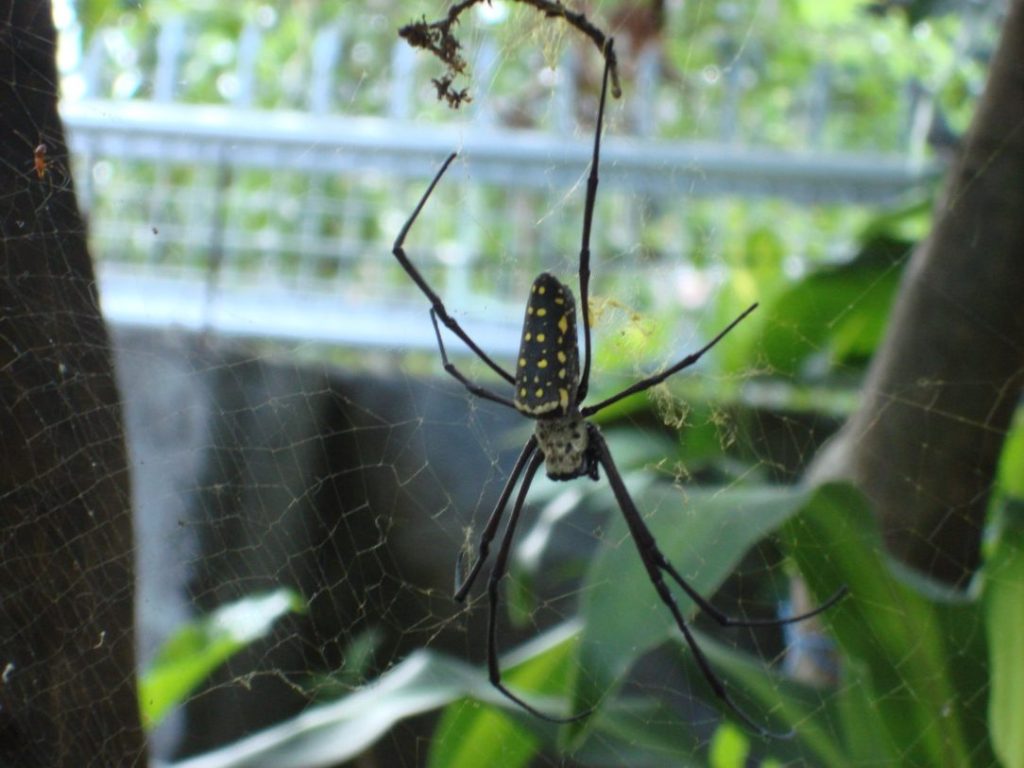
Golden Orb Weaver
Golden Orb Weaver

This ugly bastard is about the size of your average wallet, including the legs. I’m no expert on spiders, so I don’t know what breed it is, but I read somewhere that things that have bright colors are usually poisonous, and this spider has yellow dots on its back. It has a big web in the front yard at my father-in-law’s house. It was there when we arrived in the Philippines on the 25th and it was there when we stopped by before leaving on the 5th of March. As far as I can tell, it never moved. There were quite a few smaller spiders in the web around it too, so assume they are its offspring.

Cane Spider
Cane Spider

The first night we were in Antipolo we opened the bathroom to find this thing waiting for us. It didn’t seem to want us in there, because it started advancing on us. Armed with a stick and a slipper we managed to beat it into submission… well, to death. It’s a bit easier to get perspective on this one than the first. The bulb on the ceiling there is about twice the size of the average lamp lightbulb. Also, you can see that the spider could hug the shower curtain rod with room to spare.

I didn’t get a picture of it but we saw a second one in the kitchen on the night I was having my birthday party. It was hanging out by the back door, which was open for some ventilation. No one but me seemed to mind that it was there. What was even more creepy about the second one is that it was carrying an egg sac. “Arachnophobia” anyone?

Squashed Cane Spider

Here’s a picture of a third one, or possibly the one with the egg sac that didn’t get killed, after I beat it to death on the floor of the bedroom. It came out from behind the dresser and tried to hide behind the curtain, but I spotted it. By this point I was really keeping an eye out for them. It didn’t stand a chance.

These things might be common in the Philippines, but I don’t really like the idea of sharing a living space with them. The next time we’re there, I think I’ll front the money to have them all dealt with by an exterminator.

Snake Hanging Out
Snake Hanging Out

We were walking through my wife’s old neighborhood in Antipolo when we saw a big group of students from the nearby De La Salle school gathered together looking at something. I guess this snake must be a python because it didn’t seem to be biting anyone, even when one of the kids picked it up and started chasing his friends with it. Keep in mind that this neighborhood doesn’t have many houses with window screens. Imagine waking up with this guy in bed with you.

Bonus:

3 Pigs Riding a Motorcycle

I got lucky and got this photo on the ride to the airport. I’ve never seen anything like it before, or even considered doing something like it. Filipinos will use a motorcycle for damn near anything I guess.

Beggars In The Philippines

Beggars are a pretty common sight in the Philippines, but not all of them are what they seem.

In the U.S. there’s a running joke that some bums are just bums part-time to make some extra money. When they’re done they go home to wash up for the night and get ready for work in the morning. My wife tells me that in the Philippines there are professional beggars.

It was pretty easy to pick out the people that were actually having a hard time there. In front of the Nepo mall in Angeles City there was a man sitting on the ground, begging for change. The guy was really old, really browned, really wrinkled, and really skinny, to the point that he looked like he might starve to death at any moment. We happened to have an extra cheeseburger on us (we’d bought some stuff from Jollibee to sneak into the movie theater; we don’t keep cheeseburgers in our pockets usually) and passed one off to him. His reaction was a bit odd. He looked at it, sniffed it, and then eyed us, as if he wasn’t sure it was really safe to eat. I couldn’t tell if they guy hadn’t seen a wrapped burger in so long he’d forgotten what it was, or if he was accustomed to people handing him garbage as a cruel joke.

On the other hand, there was a little girl at the bus station in Angeles City that was really annoying. Looking at her you could see she was well fed. Her clothes were a bit worn out looking, but not the ratty type you would expect to see on someone so poor they had to beg. As soon as she saw me she ran over to me and started begging for money, but it wasn’t just that. She started grabbing at me and grabbing at my bag. If her hand had found its way into my bag I’m sure she would have tried to run with whatever she got her dirty little paws on. Telling her no didn’t seem to work. It took having my wife tell her to get lost in Tagalog for her to finally give up. It seemed to startle her and she fled. She must have had a short memory though, because a few days later we passed through that same station and she tried her trick again. This time I didn’t even bother to stop. My wife turned to tell her to get lost again but when she realized the girl wasn’t there anymore we kept walking. I remember the kid sort of bouncing off my hip. I’m not sure if she wound up on her ass or kept her balance, but I don’t really feel bad about it, surprisingly, even though she couldn’t be more than 8 years old.

I guess by that point I became numbed to the people trying to rip me off and they stopped registering as ‘people.’ If you visit the Philippines you’ll have a better understanding of what I mean, but imagine having a cloud of mosquitos buzzing around your head whenever you’re in the street, but instead of biting you, they talk: “Bzzzzzzz hey mister bzzzz buy buy buy bzzz cheap bzzz good deal bzzz mister mister!”

That wasn’t the only time a little girl tried to hit me up for money in the Philippines. It seems like little girls, the cute ones at least, are the weapon of choice for Filipinos looking to make extra money off of foreigners and foolish locals. Child exploitation anyone?

In March of last year I was sitting with my wife at Gloria Jeans coffee at the Galleria mall in Manila, watching the traffic and the rain when a little girl walked up to the table. This was my first experience with this, though I’d been warned. At least this kid was trying to offer something in return. She had a handful of fake flowers that she was trying to sell for an insanely inflated price. I told her I wasn’t interested, and tried to shoo her away, but she played dumb and kept insisting. This was the first time I had to be rescued by my wife, who told her to get lost in Tagalog. I need to find a way to get rid of them myself, because my wife might not always be nearby when they launch their attack. I suppose I could just whack them in the head and tell them to leave me alone, but that might land me in jail.

This last trip, just after I plowed through the grabby little girl at the train station (and checked all my belongings) my wife and I sat down in a Jollibee and had lunch. While we were there I saw a dirty looking boy outside the window, lying down on the pavement in the shade. I asked my wife what was up with him, and she told me that he’s another fake beggar, but one that uses a different tactic. Instead of being energetic and grabby, like the little girls, they try to appear forlorn and destitute.

It all reminded me of a story she told me about how my former boss handed out money to beggars while he was visiting the Philippines and wound up getting lectured by his wife (a Filipina) about letting himself get suckered. Maybe I’m just a bastard, but I’ve decided to not take the time to try to figure out if they’re genuine or not. Unless it’s obvious, like the guy in front of the Nepo mall, I’ll just ignore them all.

It’s hard enough to hold onto your Pesos in the Philippines without letting yourself be done in by fake beggars. Keep that in mind if you ever go to the Philippines for a visit.

Public Transportation In The Philippines


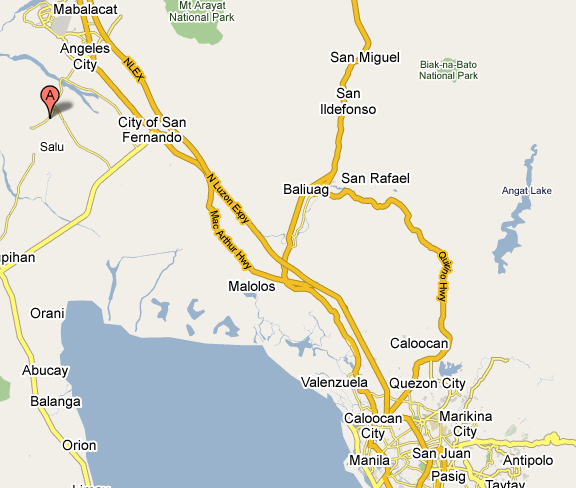
(The “A” is Porac in Pampanga Province. Antipolo is in the bottom right, East of Manila.)

After spending 3 days in Pampanga with my wife’s dad and mom it was time to get a few of our things together and head to Antipolo to visit her brothers. We were able to travel light because my wife still has clothes there in Antipolo and there’s an attic full of her brothers’ old clothes that I can fit into. It’s a good thing too, because it’s just not practical to try to commute in the Philippines with a lot of bulky bags or luggage.

Commuting in the Philippines can be an adventure by itself. It’s time consuming, tiring, exciting, and a bit dangerous too, especially at night. The Philippines doesn’t have any standardized form of public transportation like most other countries I’ve been in. The public transportation is all managed by private companies, or sometimes by individuals. Even the buses aren’t always part of an organization. This makes things a bit tricky. Different groups providing the same transport service may try to charge different rates. Or, the vehicle you get into might not really be a cab. You just never know there. So, when you’re in the Philippines and it’s time to go somewhere, don’t let your guard down. Even for locals it can be dangerous. My wife told me a story about how the vehicle she was in was robbed one night on her way home from work. Add to that the fact that most Filipinos think that all foreigners are rich (and that you would somehow have your whole fortune in your back pocket) and you really have to keep your eyes open.

The only exception to that is the train system in Manila. I had the distinct pleasure of riding one the first time I visited the Philippines. It was jam packed with people.  Well, at least it didn’t smell bad.  Despite the trains being standardized, that doesn’t make them safe. It just means the trains are all owned by the government.

There are a few other things to keep in mind. Just like anywhere else, the crime rate goes up after dark, and in 2004 the Philippines had the highest rate of homicides in the world (read that in a Guinness World Records book at a book store in Manila). Also, some forms of transportation don’t move until all of the seats are filled, unless you want to pay for the empty seats yourself. Plus, public transport in the Philippines generally isn’t as comfortable as what you may be used to if you’re from a “first world” nation. The vehicle operators will try to pack in as many people as they can to make the most money possible per trip.

Even if you’re not riding in a public transport vehicle you need to be careful while walking. Until just recently there weren’t any designated no-stopping areas for any of the public conveyances. They usually pull over to the curb, but they’ll do it anywhere, so when you’re walking around, stay away from the curbs and try not to walk in the road, unless everyone else is doing it too of course. There are now areas in Manila where buses are prohibited from entered the right two lanes, but Filipinos have a habit of not obeying traffic laws. That includes the operators of these public conveyances. I witnessed it first-hand on a bus I was on during this last trip.

So, here’s a rundown on the different types of public transport you might find. Some of them have pictures. The tricycle has video. Most of the pictures were done at night, unfortunately. The next time I’m in the Philippines I’ll try to get more pictures to update this post.

1) The Tricycle

The tricycle is actually a motorcycle with a sidecar attached. The sidecar is covered on the top and the front and two people are meant to squeeze into it. Also, two people are expected to ride side-saddle behind the driver; one on the passenger seat and one on the cargo rack, for a total of four passengers and one driver. Depending on where you are and how far you’re going you can expect to pay about 20 PHP per head. As long as you’re in the sidecar, a ride on this thing can be a blast, but if you wind up sitting on the cargo rack behind the driver, you might wind up with a sore ass… or, oddly, the urge to take a crap.

2) The FX

The FX got its name from the vehicle model that’s usually used, the Tamara FX. I’m not sure what company makes it but it’s an SUV type vehicle. It has two bucket seats in the front, with a spot in the middle for another passenger. Behind that is a bench seat and in the back are two bench seats that face inwards. This vehicle is meant to hold 8 passengers comfortably, but in the interests of making more money, 10 people are squeezed into it. Two passengers sit in the front with the driver. Four passengers are crammed together on the second bench seat, and in the back two people sit on each inwards facing bench seat.

FXs run a standard route. In the Manila area they typically come from an outlying town to an FX pick-up/drop-off point in Manila. The FX will make stops along the route for passengers to get off, or, if flagged down, for passengers to get on. You can usually find an FX stand at the major malls in Manila. They’re regularly used and at peak hours (like evening rush hour) there are usually long lines to get on them. I think in some cases they’re the only way for some people to get home.

You can expect to pay about 45 to 50 PHP for your FX ride. Oh, and one other thing… the FX usually has air conditioning, which is rare for public transportation in the Philippines.

3) The Jeepney

The Jeepney is one of the most interesting forms of transportation in the Philippines. It’s probably also the most uncomfortable. A Jeepney is interesting because it’s a big stainless steel truck that’s decorated to the owner’s taste. These decorations are typically centered on a religious, pop star, political, or anime theme. Some of them are plain and some of them are wild.

A Jeepney has two bucket seats in the front. One is for the driver of course, and one is for the passenger. The back of the truck is covered and has two long bench seats that face inwards. Along each side are sliding windows that are open for ventilation. Jeepneys usually travel a standard route as well. I haven’t quite figured out if they stay in one town or go between them, but it’s an interesting ride and it’s fairly cheap at about 17 PHP per head.

4. The Bus

Like I said before, the buses in the Philippines aren’t standardized and run by the city or federal government. They’re all privatized. There are buses that run local routes, just in the city, and there are buses that go long distances. The buses I saw in Manila that were just local looked pretty run down. They had open windows (no air conditioning), were loud, and were always packed. The buses that go long distances to the provinces, like the one my wife and I took from Angeles City to Manila, are nicer. They’re bigger, still in good repair, have air conditioning, and some even have television or radio to keep you occupied during the trip. They’re also pretty fast. The drivers are running their routes for money, not just for a job, so they like to get through as fast as possible so they can pick up more passengers.

You can hop on a local city bus almost anywhere along the route it travels. The provincial buses typically have stations set up where you can get on and off. It’s like a bus terminal. The provincial buses are usually owned by an organization, like Victory Liner or Jacliner (sp?). In Angeles City the station serviced quite a few groups of buses, but in Manila they all seemed to have their own terminal.

Depending on where you get on the bus you might be buying your ticket beforehand at the terminal counter, or you might be paying for it after the bus gets underway. A guy will come down the aisle, ask you where you’re going and hand you tickets when you pay. I couldn’t figure out how to read the tickets, but my wife looked them over before paying so there must be some system to it. One thing you can expect if you’re riding a provincial bus is for vendors to come onto the bus at terminals to try to sell things like drinks or peanuts.

I only rode a local Manila bus one time during my first visit. It was during the day and it was an interesting experience. It must not be very safe on those buses though because after that my wife didn’t want to get on another one, and she would know better, since she grew up commuting in the area.

5. The Train

The only trains I had a look at were in Manila. The stations are a real mess. More like a disaster actually. I don’t know what these people are thinking. There is no turnstyle for prepaid transit cards or coins. Every single time you want to board a train you have to get in line to buy a ticket at a ticket counter. Then you have to get in line to go through a security check where the contents of any bags you’re carrying are checked. Once you get through with these pleasantries you go to the train platform. The one time I rode the train it was so packed you didn’t have to hold onto anything to stay standing during the ride. I also had to fight to get off the train. I literally grabbed the top of the door frame and pulled myself forcefully out of the car, because no one wanted to move and risk being left behind by the train. There wasn’t room inside the train for people to shift around so you could get out.

I have no idea how far the trains go, or how many areas they service. I don’t recommend using them at all. It’s too much time, too much effort, and too much of an opportunity to get pick-pocketed.

6. Taxis

There is a wide variety of taxis to choose from in the Manila area. Some are old pieces of junk that don’t even have air conditioning. Some look like they’re almoost brand new. My wife says the MGE cabs are good. There are also some blue taxis that seemed nice. I think they serviced NAIA (the airport in Manila).

Taxi drivers are supposed to use the meter for every trip, or at least the MGE ones are, but haggling over a flat rate fare is common as well. This is one of those times where you really need a local you know and trust to tell you whether or not your flat rate is actually a good deal. The taxi drivers generally won’t hesitate to rip you off. Some of them drive like crap too. Don’t hesitate to cut your ride short and get out if the driving is too bad. There are more than enough taxis available on the roads, especially if you’re a foreigner. Even if I’m just walking down the street in Manila and happen to be close to the curb, taxi drivers start pulling over. I think it’s part of the “foreigners must have money to waste” mentality. If I’m a foreigner and I’m on the street I must be looking for a taxi, because foreigners wouldn’t walk anywhere since they’re loaded, right? Hmmm.

Bonus: Motorbikes

This isn’t public transportation but I thought it was worth mentioning. Lots of Filipinos use motorbikes to get around, rather than cars. The gas is cheaper, you can squeeze through the traffic and get home faster, and they’re cheaper than cars. Traffic is a nightmare in Manila during rush hours and I’ve seen people on motorcycles drive between lanes or even on the sidewalks or shoulders of the road to beat the crowd. It’s got its advantages, but with the way people drive in the Philippines, I wouldn’t want to ride one. For instance, there aren’t any stop signs or traffic lights in Antipolo. You just hope the other guy stops.


Lots of Cats, and Some Dogs Too!

My wife really really loves cats. She loves all sorts of pets, but she has a particular weakness for cats.  From what I can tell, she always had cats of her own when she lived in the Philippines and now we have cats in Singapore.

I know where my wife got her love of cats from now: her dad. On my last few trips to the Philippines we didn’t have the time to go to Pampanga to visit her parents at their apartment. We only saw her family’s house in Antipolo, in Rizal province. That’s not to say they don’t have pets there, because they do. There are quite a few cats running around and there are even two dogs as well. That’s different though, because the cats all belong to different members of her family. It doesn’t seem unusual for a person to have one or two cats.

On the other hand, the only person that really lives out of the apartment in Porac, Pampanga is my father-in-law. My mother-in-law is there sometimes, but she usually lives out of her free apartment next to the school where she teaches. So, all of the animals there can be attributed to him. Walking through the yard and the apartments there is like walking through an animal shelter.

The first animals you’ll notice are the three dogs in the yard. One of them is named Happy (the brownish one) and one of the others is named Mayumi (one of the white ones). I can’t recall the name of the other white dog, and I couldn’t tell them apart anyways. Once you get past the dogs and into the apartments you’ll find cats everywhere.

The apartments don’t have air conditioning, so the windows are open all the time. Surprisingly, they’re not screened in either. This is going a bit off topic, but I never understood why window screens aren’t in common usage in Singapore or the Philippines. With high levels of mosquito borne illnesses, like dengue for example, which can be fatal, you’d think window screens would be in high demand. That doesn’t appear to be the case though. Anyways, like I was saying, the windows are always open and they aren’t screened so the cats go in and out at their leisure. They seem to get along well enough with the dogs too, so you might see the cats hanging out in the yard. There must have been about 11 cats and kittens running around. I only took pictures of a few of them.

One cat in particular caught my attention. Her name is Samsung. She’s incredibly friendly and purrs so hard she nearly chokes herself when you put her on your lap and pet her. What’s especially strange about this cat, though, is that when you pet her, she crawls up towards your shoulder, starts kneading against you, and then starts licking/sucking/slobbering on your shirt. My father-in-law says it’s because he found her when she was really young and she never had the chance to do much nursing. When he took her in, he kept her wrapped up in blankets and she would try to nurse on the blankets when she was hungry. Apparently she never lost the habit. Great cat, but you can’t hold her when you’re wearing a nice, clean shirt that you want to go out in, or you’ll wind up having spots of cat drool on yourself.

Another interesting cat is named Jumong. I called her Captain Hook because she only has one eye. According to my father-in-law, some kid in the neighborhood shot out her other eye with a pellet gun.

Pumping Well Water

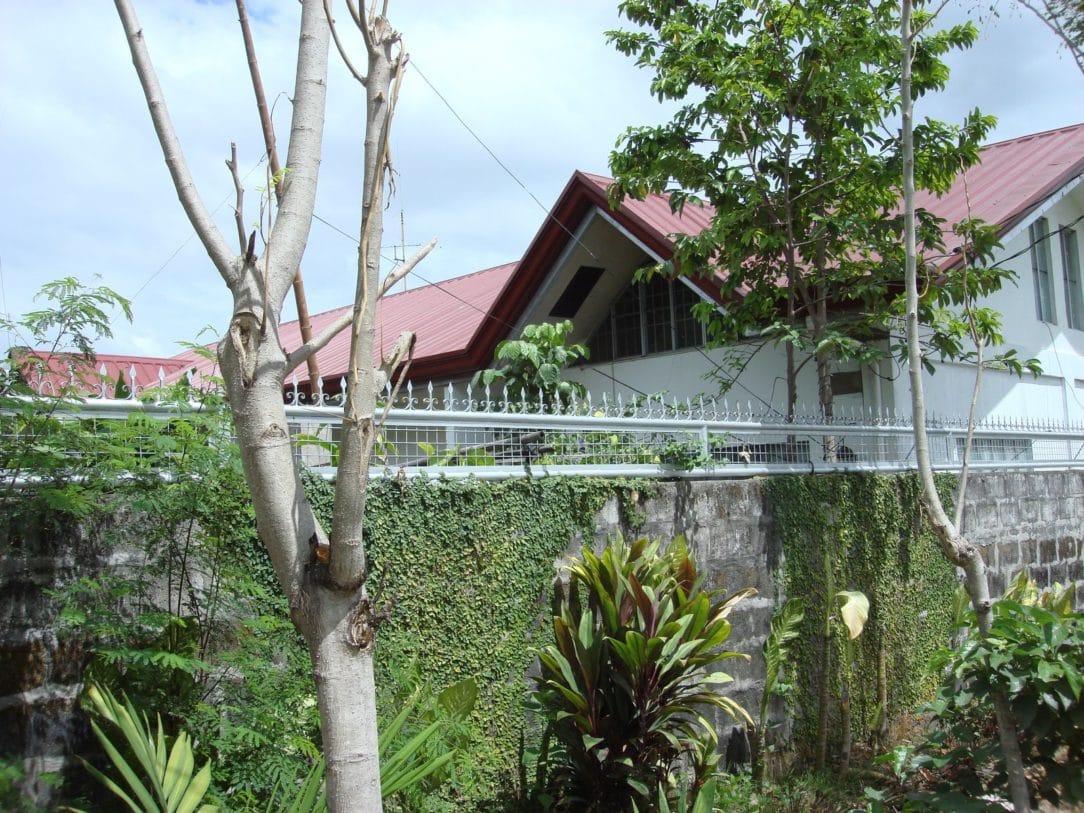
My wife’s parents have a set of apartments in Porac, in Pampanga province. It’s a medium sized building on a pretty good sized lot that has four separate apartments built into it. Each unit seems a bit small. The two middle units could comfortably house 2 people at most, and the end units 3 each, since they have a second floor.

Apparently, construction goes pretty slow in the Philippines. The building has been receiving off and on attention over the last 4 years or so and it still needs some finishing touches. It’s a matter of money. You can’t build when you don’t have the capital. The interiors need more insulation, plywood to cover the bare steel beams in the ceilings, and some renovations to the bathrooms and kitchen areas. Still, they have potential and when they’re complete they should be pretty nice.

Even though they’re not complete, my father-in-law has been living out of one of the 2 story apartments. It’s comfortable enough, but up until we got there it didn’t have running water. That was kind of a shock to me. How do you live in a place for four years without running water, when all you have to do is pay a few thousand pesos to have the water company come hook it up? If I were going to live out of a house, even one that wasn’t completely done, the first thing I’d do is get the water hooked up. Well, maybe the second. It would need electricity too. For the past 4 years, my father-in-law had been using a well in the front yard to pump water into buckets to carry into the house or to do laundry with. Maybe it’s a matter of perspective, or how you grew up, but running water seems like a basic necessity to me.

We only stayed in the house for 3 days before traveling to Antipolo, in Rizal Province, to visit with my wife’s brothers, but those three days were a real pain when it came to doing anything that needed water. Cooking, bathing, laundry… it all took twice as long and four times as much effort as we were used to. So, by the end of our second day there, we decided to front the money (about 3000 PHP or 60 USD) and have the water hooked up, not just for our sake, but for my father-in-law’s sake. He’s not getting any younger and hauling buckets of water is something best left to younger people. Younger than me or my wife too, apparently, because it was exhausting.

The situation reminded me of stories my grandmother used to tell me about having to haul water from a well when she was a kid. I think she said her family’s well was located at the bottom of a hill too, which was much worse than what we had to deal with. The well in front of the apartments was only 15 feet away and on level ground. I used to brush off her stories as something amusing to laugh about, but now I have a greater appreciation for the effort involved in using a well for a water source.

Arriving in the Philippines

Arriving in the Philippines was a much better experience for us this time. We flew into Clark Airbase in Pampanga province. The airport is small. There isn’t even an enclosed walkway from the plane to the terminal. You have to do it the old old fashioned way and walk down a flight of portable stairs onto the tarmac and then walk to the terminal.

Coming down those stairs reminded me of the flights I’ve taken into military bases in Kuwait and the US, like Hunter Army Airfield in Georgia, Biggs Army Air Field in Texas, Balad in Iraq, and the landing area for military flights at Kuwait International, near Camp Wolf. I don’t think that last one had any special name. It’s not really surprising that the disembarking process at Clark reminded me of those places, though, because Clark Air Base used to be a US Air Force installation. The buildings all had that cheap US military look and feel to them, but at least they were clean and in good repair, which is more than I can say for NAIA in Manila. That place is a dump. (Can you feel the love?)

It didn’t take long before I was reminded that I was in fact in the Philippines again. Before I had even made it past the exit doors I was assaulted by a barrage of “Hey, sir! Hey, sir! Taxi sir?!” Sometimes there’s so many of them, or they’re so insistent, that it’s hard to ignore them, but ignoring them is generally what I try to do. One thing I’ve discovered about the Philippines from past trips is that if you’re a foreigner, you will be ripped off if you don’t have a local to do your shopping for you. That doesn’t apply to major stores or franchise-type grocery stores, because they have set prices, but any stall or stand in the street is likely to try to stick you for extra cash. Filipinos have the mentality that if you’re from overseas you must have money to waste. One example of that I can give is a guy that tried to charge me 50 PHP for a pack of Marlboros, when the 7-11 around the corner was only charging 38. Who’s that guy trying to fool?

Leaving Clark Airbase was an event in itself. My wife’s parents met us at the exit area for the airport and after the formalities we moved around to the side of the building to try to get a taxi to their house in Porac, Pampanga province. At any airport you’re likely to get ripped off on cab fare, but I was shocked at the price. We weren’t even going that far from the airport, but the driver wanted 650 PHP (only 13.36 USD but very very high for the Philippines). My wife’s mom tried to haggle with the taxi coordinator, but it wasn’t working. Even so, she kept badgering the poor guy until the cab actually arrived. Neither one of them wanted to budge and in the end we wound up paying the full 650 PHP. At least the taxi justified the price. It was the size of a Jeepney, but closed in like an FX, and the air conditioning was cold. There was plenty of room for everyone and our luggage too.

The ride fromt he airport to my in-law’s house was a lot different from riding from NAIA to their house in Antipolo. Pampanga is a provincial area, so it had more of a country feel to it. Also, it looked a lot more poor than areas closer to Manila, but it wasn’t as bad as I thought it would be. We went through part of Angeles City and it reminded me of a big Antipolo.

The apartment we stayed at is in a residential area in Porac. I think the neighborhood is called Santa Cruz. The nearest city area is Angeles City. It has a mall, a movie theater, McDonald’s, Jollibee, and the typical convenience stores, food stalls, and general goods stores. Also, there are plenty of street vendors selling everything from fruit to whole roasted chickens.