I recorded this video while walking down the main staircase from the 2nd Floor to the Main Lobby. The light is pretty dim and going down the stairs makes it shaky. I figured it would be a good way to test the phone’s ability to record video in low light. It didn’t perform very well. The video is shaky and grainy. Hopefully it performs better in bright light situations.
After quite a few years of reliable use, my iPhone 5S finally broke down on me. There were some odd scratches or particles inside the camera mechanism in the phone that caused large blotches to appear in all of my pictures. It was really annoying because I love using my phone camera while I’m out.
A picture of my wall, showing the dark blotches from damage to the camera.
I did some research online and the problem seems to be caused by dust or impact damage to the camera lens. My iPhone wasn’t new, by any means. It had suffered more than a few drops and it was out of warranty. Regardless, Apple won’t repair damage to the camera in-store. People who had this issue were given new phones instead if they were within the warranty period. Even if Apple did repair damaged camera mechanisms, I wonder if it would have been worth it? A brand new iPhone 5S is $99 on Virgin Mobile. The repair might have been as much or more.
Not quite ready to spend a lot of money on a new phone, I tried carrying around an actual camera with me for a while. Besides being extra weight, bulky, and more difficult to use (so many settings and stuff), it felt like I was whipping out and wielding a rotary phone. Mostly, it was just an awkward experience and the pictures the camera took weren’t that good anyway. Even the iPhone 5S did a better job. I wasn’t really surprised though. The camera I was trying to use as an alternative was a few years older than the 5S.
I finally caved and decided it was time to purchase a new phone. After much consideration, I decided to jump ship and switch to a Samsung Galaxy S7 running Android Nougat 7.0. I think what finally sold me on the device was the water and dust proofing (so I wouldn’t have the camera problem I had with the iPhone 5S) and the excellent camera. I’m also still butthurt about Apple’s decision to remove the headphone jack on the iPhone 7. I don’t think it was worth it to get a vibrating non-button home button. They’re giving less and asking for more than a viable competitor.
It took me about 10-12 hours to install and log into my favorite apps (or find alternatives in the Google Play Store), customize the launcher, set wallpapers, and just get comfortable with the device. But then I hit a snag. I realized I wasn’t receiving text messages that were sent to me by people using iPhones.
The Fix:
I did some research online to see how to get the problem fixed. I had a feeling it had something to do with iMessages, and I was right. The top search results recommended doing things like sending text messages to random numbers with a STOP command, but that didn’t seem to do anything. Also, the article was pretty old and dealt with a previous version of iOS.
I did some tinkering on my own and realized the solution in iOS 10 is pretty simple:
Simply toggle off iMessages in your Messages Settings menu.
On your iPhone, open Settings < Messages, and toggle off iMessage. If you have an iPad like I do, toggle off iMessage there as well. Also, in the next menu down, toggle off FaceTime.
Then you just have to wait. I managed to get this far at around 2 AM. By 8:30 am, I was receiving text messages from iPhone users again.
If you have an iPad, make sure to turn off iMessage there as well. Also disable FaceTime.
As far as the Samsung Galaxy S7 goes, it was worth it. It’s an awesome phone, especially coming from an iPhone 5S. I’m happy with the camera too. I haven’t had a lot of opportunities to test it yet, but so far I’m happy with how it performs. There are no filters on the photos below:
On the same day that I saw the Year of the Rooster exhibit at the Met, I also decided to take a look at the Arms & Armor of the Islamic World exhibit. Most of my undergrad studies focused on Middle Eastern history so it’s an area I’m generally interested in. Plus, I grew up reading sword and sorcery fantasy novels like the Dragonlance series of books, the Lord of the Rings, and Song of Ice and Fire, among others. The Wheel of Time series is also pretty good. Anyway, seeing arms and armor in person isn’t as dramatic as those stories, or watching Game of Thrones, but it’s pretty cool anyway. The Arms & Armor hall in the Met is one of my favorite exhibits. I was hoping the Arms & Armor of the Islamic World exhibit would be just as impressive.
Books on my “fantasy-epic” read shelf on Goodreads
It really wasn’t though.
//embedr.flickr.com/assets/client-code.jsThe exhibit consisted of a few items packed into one small room, along with a sign saying, “Oh by the way, there’s some other stuff scattered around the rest of the museum that generally falls into this category but we couldn’t be assed to actually put it all together into a coherent display for you, but wanted to get more people into the museum and get more money so we pretended to set up a full exhibit and put it on our website and brochures.” Or something along those lines.
Disappointment in the size and scattered nature of the special exhibit aside, I took great pleasure in examining what was actually there and in looking at the regular items on display.
Next time I head to the Met, I think I’ll go take another look at the Islamic Lands wing. I haven’t been there since shortly after I opened, in 2012 I think it was.
I spent 8 years in the Army. If I’d known better, I’d have joined the Air Force, like my dad did. And if I had joined the Air Force, being on an AC-130 gunship crew wouldn’t have been a bad gig. I wanted to do something meaningful, but I wound up spending most of my time loading and unloading trucks with a forklift or counting inventory. It wasn’t exactly fulfilling.
I was lured into the job by the promise that I would be working with computers. I enlisted back in 1998. Computers were still a new and amazing thing in my life, and probably most people’s lives, if they could even afford a computer and internet service. Windows 95 and America Online chat rooms were still sources of wonder and amazement.
Once I was enlisted and working in that field, I was unable to negotiate to move into a more interesting job when it came time for my reenlistment. Once you’re in an MOS (Military Occupational Specialty), you’re pretty much stuck, unless you want to move into a job with a low retention rate, like basic infantry. I’d like to think that if I had the Internet as it is today as a resource, with blogs and extensive forums, I would have made better choices.
These videos are pretty graphic. Please keep that in mind before watching.
The following video (when autoplay is enabled) is pretty interesting too:
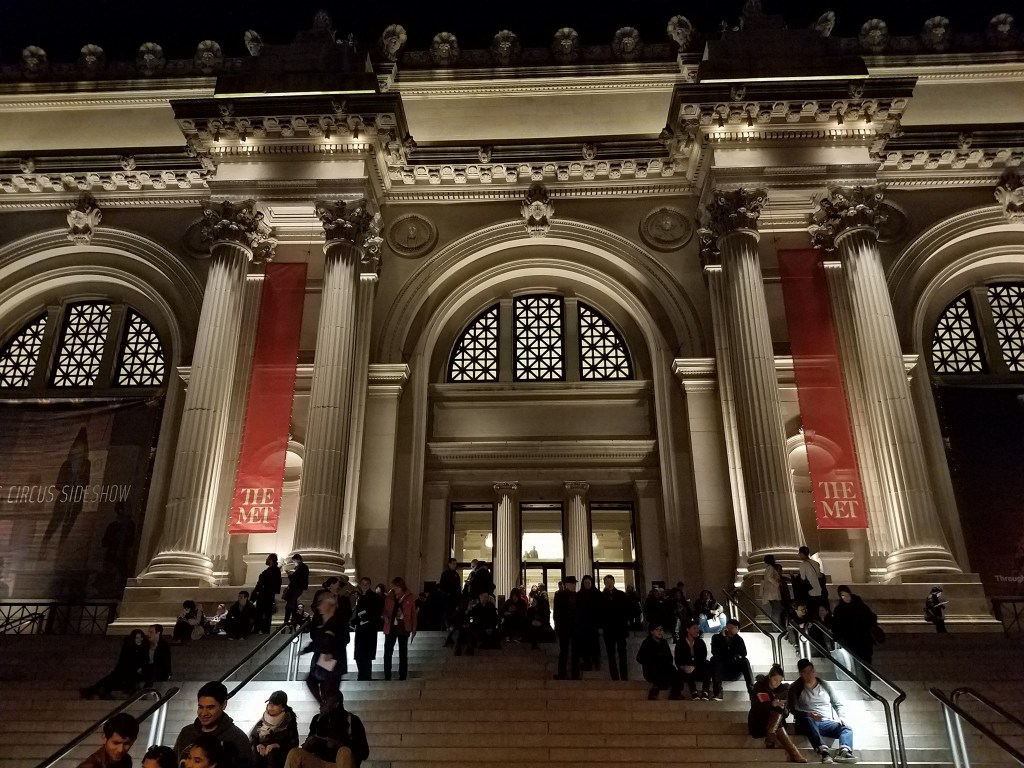
In the Chinese calendar, it’s the Year of the Rooster. I didn’t even realize that until I saw an exhibit listed to celebrate the Rooster in the Chinese galleries at the Metropolitan Museum of Art.
I tried to guess at how they could put together an entire gallery of roosters. Rows and rows of roosters, in all mediums. Oil paintings of roosters, clay statues of roosters, pottery with roosters on it. Big roosters, tiny roosters. In my imagination, it was glorious, so of course, I made it a point to go check it out.
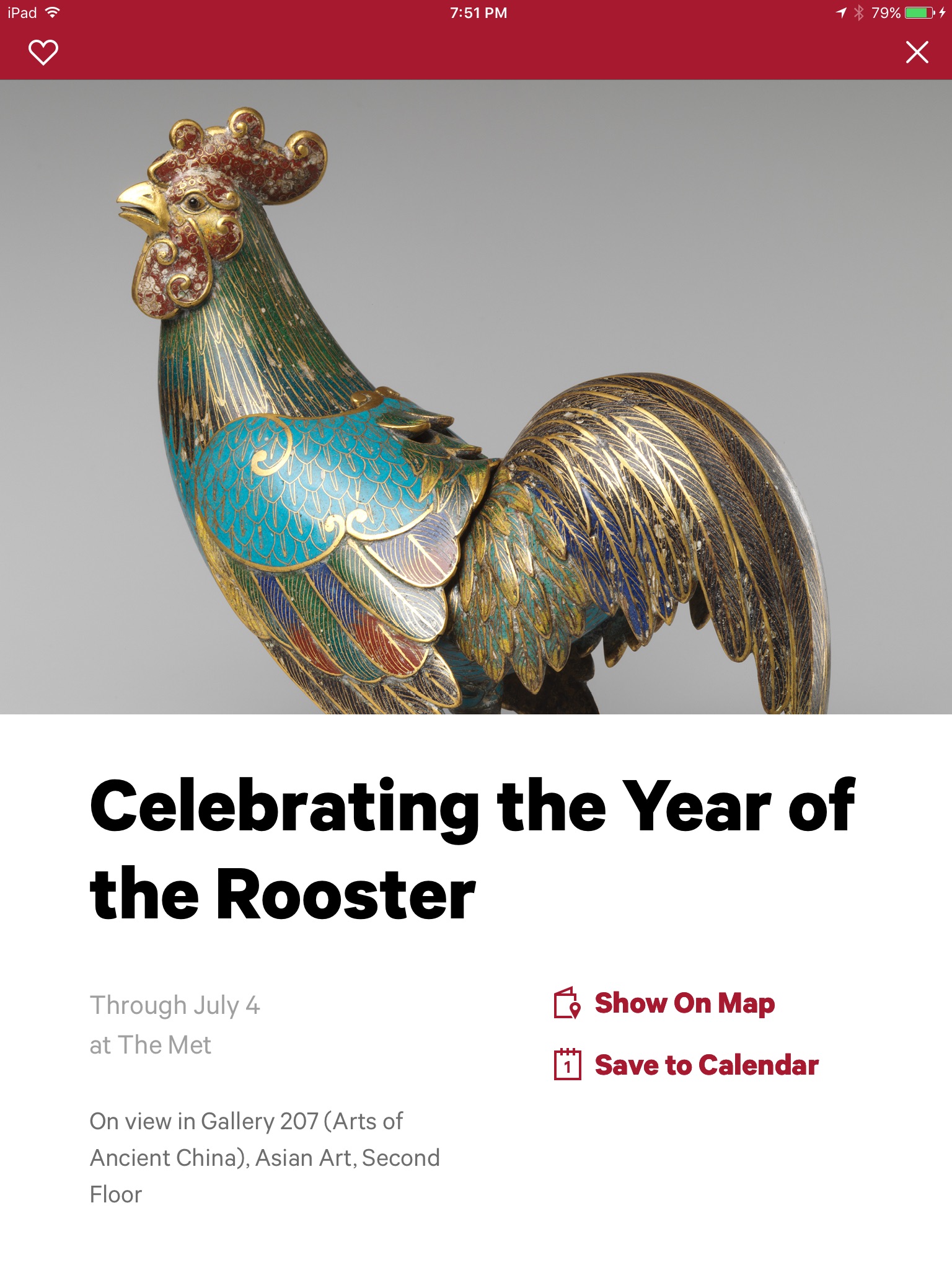
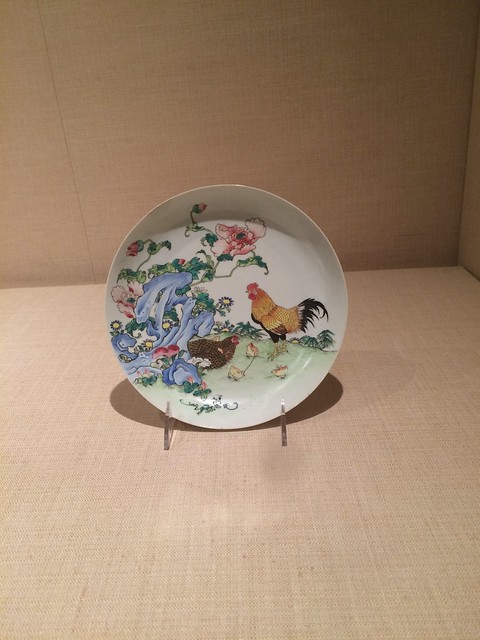
I had to ask for help finding the exhibit because I was standing where it was marked on the museum’s map, but I only saw one lonely rooster (pictured above). Unfortunately, that one lonely rooster was almost all there was to look at. There was also one wall display box with a few pieces of art in it and a wall placard explaining the significance of the Chinese zodiac animals.
When I think of an exhibit, I think of something substantial. I honestly felt like the advertisement was a bait and switch just to get people into the museum, which feels cheap and unworthy of the Metropolitan Museum of Art as an institution. Or maybe I’m just sad because I was hoping for something exciting or impressive. Something more. I guess I hold the museum to a higher standard because I hold it in such high regard.
//embedr.flickr.com/assets/client-code.jsAnyway, I did see some really old artifacts from China while walking back out of the Asian galleries that caught my interest. They were objects placed in burial chambers for royalty. They looked like buildings and servants and objects for service and entertainment. It’s a lot like what Pharaohs were buried with in Egypt. It’s odd how similar ideas were popping up all around the world in roughly the same time period. I was reminded of how the pyramids were built in Egypt, but that there were also pyramids being built in Central America. There are the remains of ziggurats in the Middle East, but there are also remains of similar structures on the ocean floor near Japan. I wonder how they’re all connected?
Also, turns out I was born in the year of the Rooster. Gong xi fa cai!
Of all the museums I’ve visited in New York City, the New York Transit Museum was the most fun, even though it’s also (so far) the smallest. The museum is designed in a way that allows for interaction with many of the exhibits. There was a whole class of children on a field trip playing with the turnstiles when I first got there. I think the museum staff was aiming for making the place a popular field-trip destination. Besides all of the interactive exhibits, there is also a cafeteria/classroom area.Just because it was set up for kids doesn’t mean it can’t be fun for adults too, though.
Students on a field trip trying out old subway turnstiles.
Just because it was set up for kids doesn’t mean it can’t be fun for adults too, though. On the first floor or first basement level, depending on how you look at it, there are old buses or portions of buses that you can walk into and sit in. The driver’s seats are accessible and you can have a friend take your photo through the windshield. The newer buses are definitely designed better. The driver’s seat and the angle of the pedals were much more comfortable than an older model I tried out, which required me to keep my leg elevated all the time to press the pedals. I have no idea how people actually drove those older buses all day. Their right legs must have been twice the size of their left legs.
The bottom floor of the basement is where all of the old train cars are. They had everything from A trains, supposedly mid-90s to 2010 (some of which I still see on the A line, not sure why it’s in the museum), to trains from the early 1900s. A lot of the train cars looked similar inside. Even some of the same advertisements spanned decades. It was interesting to see how the seat configurations changed over time. I also thought it was interesting to see ceiling or rotating fans in some of the older train cars. Once a year, New York City runs some of these older trains on the 7 line (I think).
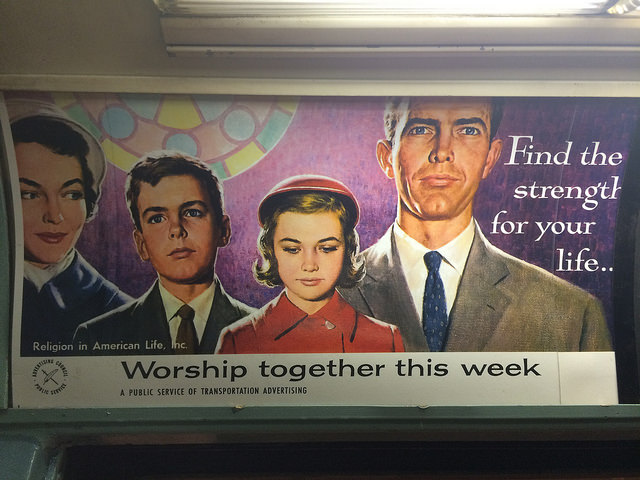
Vintage train advertisement.
What really interested me, though, were the old advertisements. I’d like to go back and just spend a few hours studying them. You can tell a lot about people during a certain time period based on the products they were buying and how the appeals made by advertisers were framed. It’s also just neat to see the artwork styles.
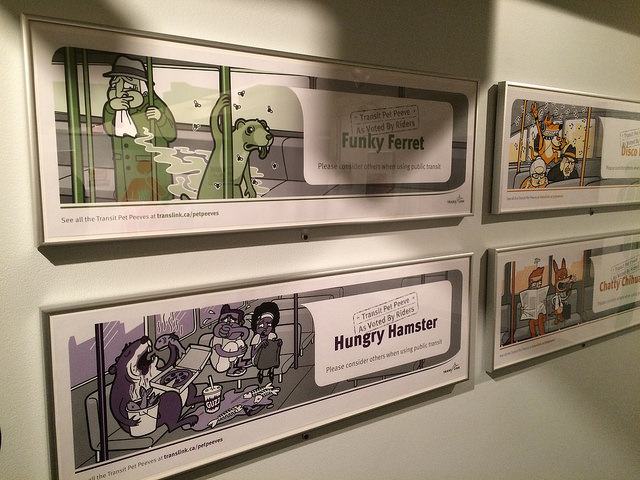
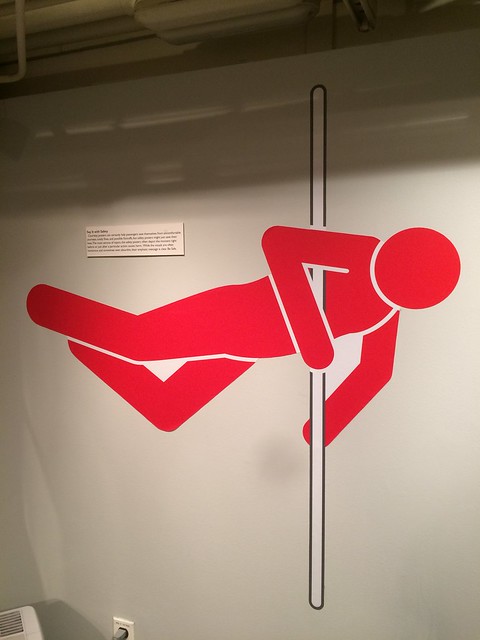
Signage meant to regulate passenger behavior.
More signage meant to regular passenger behavior.
Another awesome exhibit in the museum is of signs meant to regulate the behavior of passengers. The signs are from multiple transit systems around the world. Some of them are hilarious; all of them are necessary. Or at least, the ones for the New York transit system are necessary. I remember being shocked by how clean the trains and buses in Singapore were when I first moved there. The trains were so clean that sometimes people would sit on the floor, something that is totally out of the question in New York City trains. The buses in New York City are usually just as filthy as the trains. People litter everywhere here; they spit everywhere here. It’s a shame. The city would be so much nicer if people would take care of it, but they don’t. They just complain about how dirty the city is while contributing to the problem.
Anyhow, the New York Transit Museum is pretty awesome and I’ll definitely be going back at least one more time in the future. Take a look through the photo gallery below for more images of exhibits in the museum:
In August of last year, I was able to catch the Isaac Mizrahi exhibit at The Jewish Museum on 5th Avenue during its last weekend. The previous month, I’d gone to see the Manus x Machina exhibit at the Metropolitan Museum of Art, which was very impressive. Assuming I would see something just as beautiful and fascinating, I was pretty excited to catch the Mizrahi exhibit before it closed.
I was somewhat disappointed. I think it’s because my expectations were high after seeing what the Met had to offer. The dresses on display at the Met were impressive, intricate, attractive, and, for the most part, they were outfits that I could picture people wearing in real situations. Mizrahi’s outfits bordered on the impractical or the odd, the sort of things you see in runway fashion shows but would laugh about if you saw on an actual person in the street.
Then there were things like this:
Unusual outfits at the Isaac Mizrahi exhibit at the Jewish Museum in August, 2016
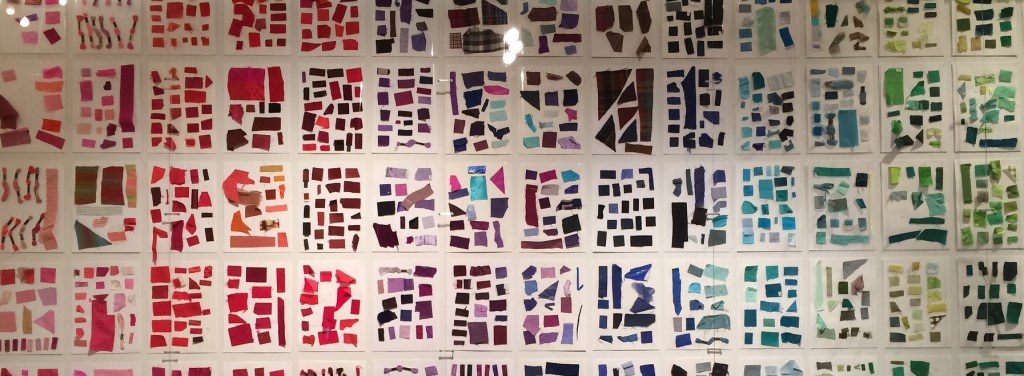
I was pretty put off by the whole experience. I found the most interesting parts of the exhibit to be the wall of cloth scraps in the featured image above and the chandeliers in the museum lobby. On the other hand, the exhibit made me re-evaluate my understanding of fashion. Does fashion need to be functional, or can it be art? Can it be both at the same time? Or one or the other?
//embedr.flickr.com/assets/client-code.jsI suppose clothing can be art, rather than something that’s worn regularly or even occasionally. Even so, Mizrahi’s work didn’t appeal to me, but that’s a matter of personal preference. He’s obviously very talented.
Listening to the news last weekend and last Monday, it sounded like disaster was imminent. Schools were shut down, public transit was suspended, and people were encouraged to remain at home if at all possible to avoid the life-threatening storm that was going to hit Monday night and continue through Tuesday.
Like most of the news commentators mentioned, the storm didn’t quite turn out as expected. I think I was listening to NPR when I heard an announcer mention the actual snow totals in New York City. He then made the comment, “Do you know what we call that in Chicago? Tuesday.” I laughed, remembering how I’d gone out on Tuesday to grab a few odds and ends for making tacos. There was a good bit of snow and the sidewalks were slippery, but it wasn’t that serious.
Snow accumulation on 176th Street in the Bronx, New York City.
The Bronx received more snow than anywhere else in the city at 8″ of accumulation. Watching from my living room window, I could see that the wind was pretty bad at times, but it wasn’t quite what I was expecting. I kept thinking about the blizzard in January of 2015 as a point of reference. The oddest thing about the day was how quiet it was. There was very little traffic, there weren’t many pedestrians, and the few trains that passed our station went by slowly and quietly, with no announcements. My apartment overlooks a train line. After living here for a year, I don’t really notice the sound of the trains, but I noticed when the sound stopped.
January 2015 Blizzard in Washington Heights:
//embedr.flickr.com/assets/client-code.jsWednesday was probably worse than Tuesday. The snow had partially melted because of sleet and rain and had frozen overnight on the sidewalks. The corners, where the pedestrian crossings are, were huge puddles of slush. Hopefully, this will be the last snow we see this year. I’m ready for spring.
A few weeks ago I was standing in Barnes & Noble, looking around to see if anything would catch my eye. I didn’t really want to buy anything because I have plenty of books that I haven’t read yet, but sometimes I go to B&N just to look around and get an idea of what’s popular or new. Sometimes I can’t resist and still walk out with a few new books to add to my collection.Anyway, I saw a section for books on New York City and I realized that despite majoring in History and working on an MA in history, I haven’t read or learned much about the history of New York City.
Anyway, I saw a section for books on New York City and I realized that despite majoring in History and working on an MA in history, I haven’t read or learned much about the history of New York City. The only two books that I know I’ve read are City of Women: Sex and Class in New York, 1789-1860, by Christine Stansell and City of Eros: New York City, Prostitution, and the Commercialization of Sex, 1790-1920, by Timothy J. Gilfoyle. I think I read them as part of an American economic history master’s course that was masquerading as a course on historiography and historical methodology. They were both excellent books, by the way.
Not knowing too much of anything about New York’s history struck me as odd since I live in New York City and half of my family has lived in New York City for multiple generations. At some point, I’m going to have to sit down and plow through a few good books on the subject, but my ignorance of the topic was the inspiration for my decision to visit the Museum of the City of New York on 5th Avenue.
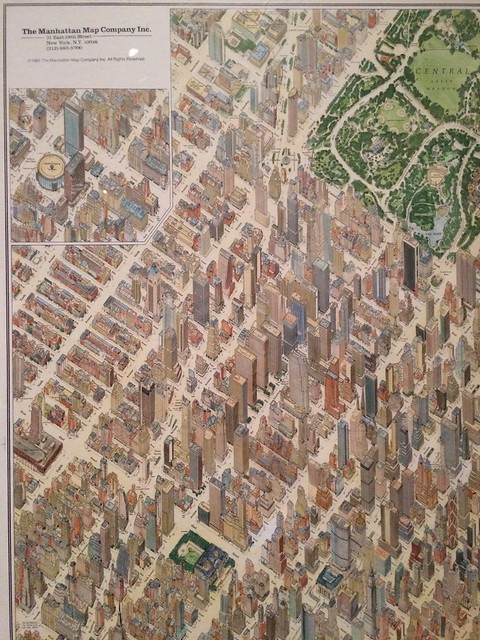
A 1985 map of Manhattan, by The Manhattan Map Company Inc.
The museum is not exceptionally large. I took the time to look at the special exhibit and read quite a few of the information placards in the galleries and still saw everything in about 3.5 hours, so it’s a great way to spend an afternoon without feeling rushed or having to go back again to see what you missed the first time through. Another bonus is that admission is free if you have a City University of New York student ID card.
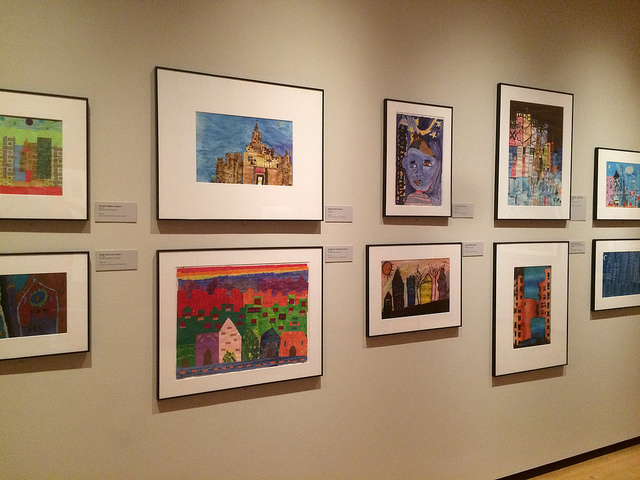
A selection of artwork by students of varying ages in New York City schools.
The building’s collection has a mix of art and artifacts. In some galleries, there are old maps of the city, detailed information on how zoning works, and models to show how buildings were designed to fit the space limitations created by whatever the current zoning laws were. Other galleries have artifacts from the early colonial period, including Native American artifacts. There are galleries describing protest movements and fashion trends. There is a small hall dedicated to Tiffany’s. There is a gallery of contemporary children’s art from city schools. The special exhibit when I visited was on gay New York and the history of the gay rights movement and gay lifestyle in the city.
A selection of Tiffany’s fans.
The galleries cover a lot of ground. Some exhibits felt out of place, like the Tiffany’s gallery and the Stettheimer Doll House, for example. The special exhibit on gay New York felt empty. There wasn’t enough on display to make the exhibit interesting. The children’s art exhibit was really fun but also really small. The museum should dedicate more space to current New York City art initiatives and to modern New York City. By that, I mean there should be something that showcases contemporary diversity beyond the scrolling Twitter feed display showing New Yorker’s criticizing Trump’s policies. It should be something positive, like an exhibit on interfaith initiatives, cultural festivals, street fairs, and festivals, for example. It would also be interesting to see an exhibit on historical landmarks in the city and the process for designating a site as a historic landmark.
A gallery of more photos from the museum:
//embedr.flickr.com/assets/client-code.jsI probably won’t visit this museum again. It was definitely worth the trip, but I didn’t see anything there that spoke to me, in the way that art at the Metropolitan Museum of Art does. This museum is more informative than awe-inspiring or inspirational.