YougoHell

YougoHell
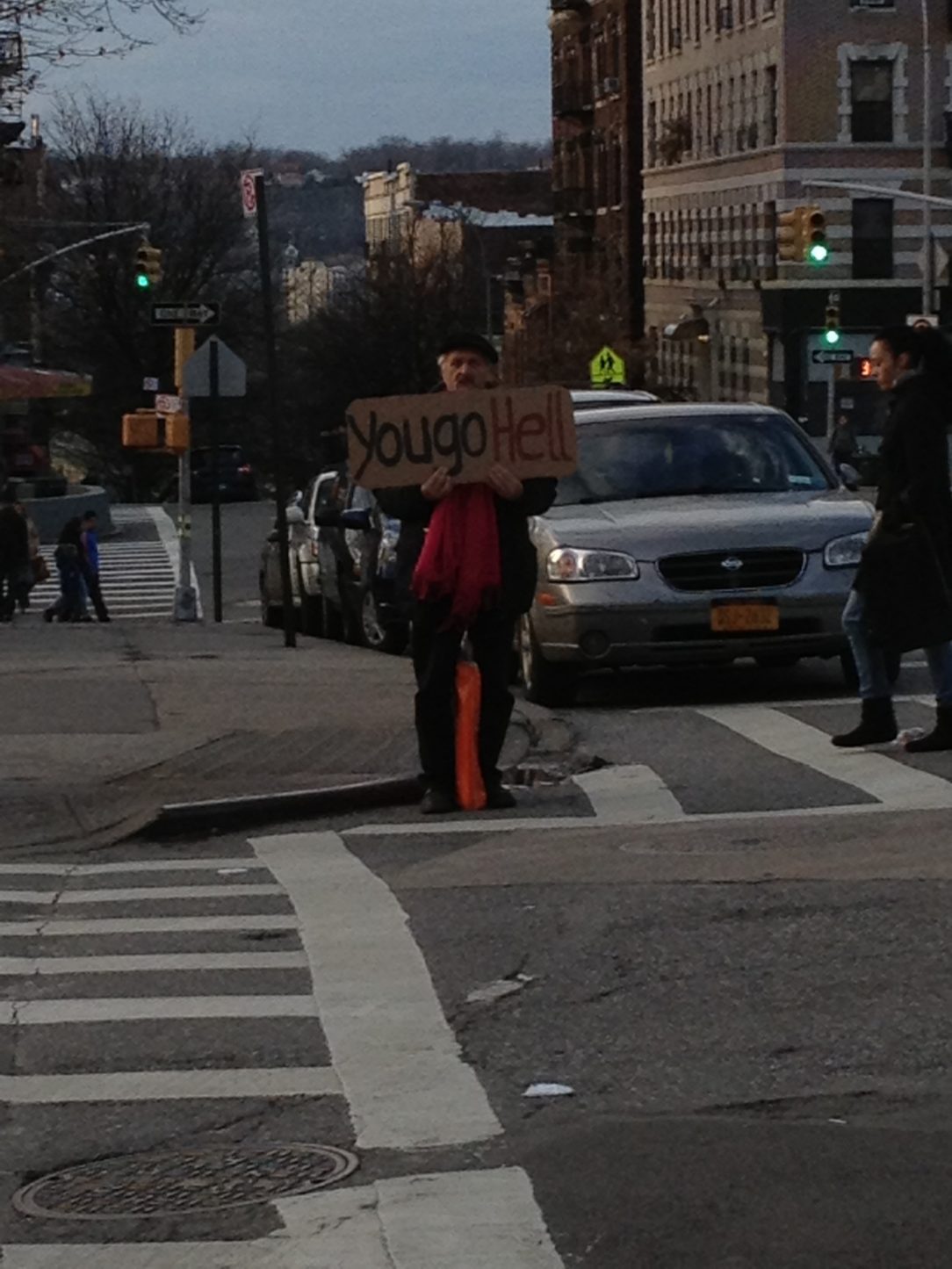
An old man holding a sign that reads “YougoHell”

Yesterday (Tuesday, December 12th), I was surprised to see this man standing on the corner of 137th Street and Hamilton Place in Harlem, Manhattan, just down the hill from the City College of New York CUNY and P.S. 325, a public elementary school.

When I walked up to the corner, a man standing by the vendor cart that’s usually there at the base of the hill selling drinks and snacks was screaming at this old guy, “No! You go to Hell!”  I couldn’t hear what the old man was saying clearly because I had headphones on, but I imagine he was saying, “No, you!” or something like that.  I don’t know if the guy was seriously offended by the old man’s sign, or if he was just doing it to agitate the old guy.

More than anything, I was wondering what happened that made this guy do this?  And who is his intended audience?  The only real foot traffic in the area that’s constant all day long is the flow of students to and from CCNY.  So, does he equate higher learning with sin?  And if he does, what higher learning it?  All of it, or just the social sciences and humanities?  And if he condemns all education, then … well, it would be ironic since he knows how to read and write, so I’m sure it’s something more specific than that.  It had to be personal though.  He wasn’t handing out literature like the religious dealers that peddle pamphlets using signs that threaten eternal torture.

He wasn’t there today.  At least, not when I walked through there.  I’d never seen him before, either.  I’m really not surprised.  This is New York City after all.  There’s always someone screaming about the apocalypse, screaming at someone, screaming at an imaginary person, etc. etc.  At least he had his pants on.

Islamism and “The Yacoubian Building”

The Yacoubian Building Book Cover

The following is a short essay I wrote about The Yacoubian Building for an undergraduate history course.

In Alaa al Aswany’s book, The Yacoubian Building, Islamism and Islamists are primarily presented through the point of view of the character Taha El Shazli, the son of a doorman who lives on the roof of the Yacoubian building.  As the story progresses, the rise of Islamism in Egypt is presented as being directly related to socioeconomic background, the lack of adequate economic opportunities and corruption present in government and society.

Taha’s family was of very modest means.  Despite this, Taha was very intelligent and was able to excel at his studies because of his desire to become a police officer, which he believed would allow him to advance in life and gain the respect and dignity that he lacked while growing up in the Yacoubian building.  As the son of a doorman, he was often ridiculed and looked down on by the other residents, which he was forced to put up with because he had no other option.  Taha was sure that he would be able to succeed in his endeavor because he believed firmly in God, prayed regularly and avoided major sins (Aswany, 20).

Taha almost reached his goal, but his socioeconomic status caused his application to be rejected.  Before attending the character interview, he had spoken to officers in his district who told him that because he had no rich and influential family members he would have to pay a bribe of 20,000-pounds to guarantee his acceptance into the police academy.  Taha wasn’t financially capable of paying a bribe of that amount and given his religious devotion, he probably wouldn’t have done it anyway.  Instead, he believed firmly in his abilities and hoped that his devotion to God would enable him to overcome that obstacle.

Unfortunately, the board wasn’t interviewing for ability or the marks of a good police officer.  They were only interested in the corrupt practices of giving out government positions to family members or people with the right amount of money.  Even though they were impressed by Taha’s answers, when it was discovered that his father was a “property guard,” he was dismissed.  This was Taha’s first taste of corruption, another in a long line of blows to his dignity, and a serious threat to his chances of ever having a respectable life.

Taha’s next attempt to push past the boundaries set by his socioeconomic background was his enrollment in the Faculty of Economics at Cairo University.  In his new surroundings, however, he still felt the sting of class divisions and was drawn towards other people who, like himself, came from humble backgrounds.  These people were more religiously observant and Taha finally felt like he’d met people that would allow him the respect and dignity he was seeking.  The level of respect and the sense of belonging he finally felt with this new group of people, student Islamists, made him far more open to radicalization.  He felt that he was valued.  He was brought into an inner circle and introduced to an influential and charismatic leader, Sheikh Shakir, which validated his need for respect and purpose.

The event that crystallized Taha’s emergence as not just an Islmaist, but a jihadi Islamist, was the trauma he experienced when arrested after a demonstration protesting Egypt’s involvement in the Gulf War.  Already having spent most of his life being bullied and pushed around because of circumstances out of his control, he was bullied, tortured and raped by the very government entity that he had at one time hoped to work for.  The corruption that prevented him from serving his country as a police officer now served to facilitate his torture and radicalization.  When Taha was finally released from prison, his dignity as a man and a human being was shattered.  His faith was shaken.  Through coaxing from his Islamist mentors, however, he was convinced that he could best recover through renewed devotion and military-style training, which Taha readily agreed to out of an intense need for both healing and revenge.

In the end, Taha became a “martyr,” dying in the process of taking revenge on the man who ordered his rape.  Because of Taha’s socioeconomic background, he had limited options to start with.  Because of the corruption in the police department (and the government office that denied his claim of unfairness) he was pushed down a path that led him to associate with Islamist oriented people of a similar background.  Further government corruption in the form of sanctioned torture and degradation in prison caused Taha to pass the tipping point.  While not all Egyptians may follow the same path to Islamism, Aswany’s message is clear:  the lack of opportunities open to people of all classes and the government’s enabling of and participation in corruption helped to create violent Islamists.

Islamist Political Thought in Egypt: al-Banna to Faraj

The following is a short essay I wrote for an undergraduate college class on the history of Islamist political thought:

On June 30th, 2012, Mohammed Mursi, a member of the Muslim Brotherhood founded by Hasan al-Banna in 1928, assumed office as the 5th president of Egypt.  In modern politics, the Muslim Brotherhood holds the highest offices of power in the state, but it began as a small movement in the port city of Suez with a membership of seven.  Today, the Muslim Brotherhood expresses the culmination of decades of Islamist thought and is a diverse movement with members who champion women’s rights and push for greater integration with Christians and other minorities, as well as more conservative, Salafist and Qutbist members.[i]

The shape and expression of Islamist thought has changed dramatically over the years, but the ideology expressed in the Muslim Brotherhood today has its foundation in the political writings of Hasan al-Banna, the man who founded the organization.  From an early age, Hasan al-Banna took a strident stance against the British presence in Egypt, Christian missionary activity, and behavior that was deemed un-Islamic.  Rather than pursue religious studies, al-Banna became a teacher and was posted at a school in the Suez Canal Zone, where he was appalled by what he saw as the dominance of materialism, secularism, and a trading of Islamic morals for Western decadence.  He was also repulsed by the sight of Egyptians being exploited for the economic benefit of foreign powers.[ii]

The problems Egyptian society faced in confronting Westernization and colonial exploitation weighed heavy on Hasan al-Banna’s mind and the only solution he felt was appropriate was a return to Islam.  In a letter al-Banna sent to heads of state and other influential people, he said, in regards to Islam: “If we take the nation along this path, we shall be able to obtain many benefits …  For then we will construct our lives on our own principles and fundamental assumptions, taking nothing from others.  Herein lie the highest ideals of social and existential independence, after political independence.”[iii]  From this, we can see that al-Banna rejected Westernization as a system of living, opting instead for Islam as a native, natural, superior and complete way of life.[iv]

Al-Banna left it to other thinkers to flesh out his ideas and focused instead on social welfare programs and expanding the Brotherhood’s membership.  However, al-Banna did firmly establish the concept of a dichotomy of Islam versus the “West,” attributing the decline of Muslim civilization to the wholesale adoption of Western values and social norms, and argued for a return to Islamic values as a solution to the social malaise being experienced in Egypt.  He presented Islam as an opportunity for Egyptians to throw off the shackles of second-class humanity and reclaim their former glory, the former glory of their Islamic heritage.  He also established the important concept of modernity and Islam not being mutually exclusive.  A civilization does not have to be “Westernized,” or secularized, in order to be modern.  A civilization can be Islamic and modern as well:  technologically advanced, socially progressive, but still retaining the values, beliefs, and social norms that make Muslims and Islamic civilization distinct.

While some of al-Banna’s writing emphasizes the rejection of pacific forms of jihad in favor of armed conflict with unbelievers, al-Banna was pragmatic, conciliatory and willing to compromise.  For example, while he disapproved of the Egyptian political system, he participated in elections.[v]  Other Islamists that followed al-Banna were less forgiving.  For example, Sayyid Qutb was decidedly more in favor of violent jihad, earning himself the nickname “The Philosopher of Islamic Terror.”[vi]

Sayyid Qutb was born in Upper Egypt in 1906 and, like al-Banna, began his career as a teacher.  He also adhered to al-Banna’s ideology of Islam being the correct path for Egyptians to follow in order to regain their power as a civilization and joined the Muslim Brotherhood.  Where Qutb differed was in his stridency and his message of Islam being the only correct lifestyle in any part of the world where Muslims live.  He was firmly against any system that gave legislative authority to man and, unlike al-Banna, did not compromise in his ideology.  He wrote that “submission to God alone is a universal message which all mankind must either accept or be at peace with.  It [a legal framework] must not place any impediment to this message, in the form of a political system or material power.”[vii]

He also believed that establishing this legal framework required more than “verbal advocacy of Islam,” because “the problem is that the people in power who have usurped God’s authority on earth will not relinquish their power at the mere explanation and advocacy of the true faith.”[viii]  Qutb did not believe in idly sitting by and hoping that Islam would become dominant in the world of its own accord.  He believed that Muslims have an obligation to actualize proper Islamic governance through action.  He wrote, “… knowledge is for action… the Qur’an was not revealed to be a book of intellectual enjoyment, or a book of literature or art, fables or history… Rather, it was revealed to be a way of life, a pure mode of being from Allah.”[ix]  Combined with Qutb’s idea of a single, true version of Islam, this concept of bringing about God’s law on earth through action contributed to the rise of violent jihad.

Building on Sayyid Qutb’s ideology, Muhammad ‘Abd al-Salam Faraj advocated the jihad of the sword as the only legitimate interpretation of jihad, dismissing the greater jihad of internal struggle against sin as a fabrication meant to pacify the Muslim masses.[x]  Like Qutb, Faraj saw (Western) modernity as a condition of moral bankruptcy, and as an infection that was destroying the ummah from within.[xi]  In 1981, using his reworked definition of jihad, Faraj published a collection of justifications for violent jihad against un-Islamic rulers in a pamphlet called al-Farida al-Gha’iba (The Absent Duty).  A few months later, the militant group that Faraj belonged to, Jama’at al-Jihad, planned and executed an assassination of President Anwar Sadat, a secular leader intent on rapid modernization.

The debate over Islam and how it relates to government in Egypt continued into the 1990s, with two opposing views being presented by Yusuf al-Qaradawi in Min fiqh al-dawla fi’l-Islam and ‘Umar ‘Abd al-Rahman in The Present Rulers and Islam: Are They Muslim or Not?  Qaradawi argued that democracy is compatible with Islam and wrote that “A call for democracy does not necessitate a rejection of God’s sovereignty over human beings.”[xii]  He explains that Islam contains elements of democracy and uses role of an imam as an example.  He says that an undesirable prayer leader may be removed, which is a precedent for the removing of an undesirable governmental leader, which in turn is an expression of democracy.  The people select who will rule over them.  Qaradawi argues that democracy is the best form of government for Muslims and it shouldn’t be rejected simply because it originated outside of Islam.  It should be incorporated, with useful elements being retained and the rest being discarded.[xiii]

‘Abd al-Rahman, on the other hand, advocated the rejection of any ruler that was not in full compliance with the concept of Islamic governance as expressed by Sayyid Qutb, even to the point of causing civil war.  He wrote that fitna (civil war), though a serious issue in the Muslim ummah, is preferable to being ruled by an un-Islamic ruler, and that “We would not, in fact, consider the resulting social discord [from eliminating an un-Islamic ruler] to be fitna at all; rather we would regard it as a struggle for reform because its ultimate aim would be the elevation of the Truth, the uprooting of corruption, and the reaffirmation of Islam.”[xiv]  For al-Rahman, whether or not to use violence is not a question, but rather a necessity, against any form of rule that is not compliant with the shariah and places legislative authority in the hands of man.  The removal of the leader should be immediate, or the people will be just as guilty of shirk as the leader.

Islamist thought in Egypt has branched out into a number of different schools of thought, from extremists who advocate violent jihad and a return to the fundamentals to those who try to reconcile Islam with democracy.  The common thread that holds them all together is their belief that the future lies in the Quran and man’s obedience to Islam and God’s law as a way to reestablish the power and dignity of Muslims.  With the recent political upheaval in Egypt and the coming to power of a Muslim Brotherhood member, Islamists may finally have the opportunity to realize some of their ideals.  Mohammed Mursi’s ascension to Egypt’s presidency is a remarkable event and Hasan al-Banna’s surving brother, Gamal al-Banna, believes the election would have pleased his brother, because “it was God’s will.”[xv]


[i]. “How Muslim Brotherhood went from 7 members to Egypt’s presidency,” June 29, 2012, http://www.mcclatchydc.com/2012/06/29/154443/how-muslim-brotherhood-went-from.html.

[ii]. Roxanne L. Euben and Muhammad Qasim Zaman, Princeton Readings in Islamist Thought: Texts and Contexts from al-Banna to Bin Laden (Princeton: Princeton University Press, 2009), 50.

[iii]. Euben and Zaman, Princeton Readings in Islamist Thought, 58.

[iv]. Ibid.

[v]. Ibid., 52-53.

[vi]. Ibid., 129.

[vii]. Ibid., 146.

[viii]. Ibid., 147.

[ix]. Ibid., 141.

[x]. Ibid., 323.

[xi]. Ibid., 322.

[xii]. Ibid., 238.

[xiii]. Ibid., 230-245.

[xiv]. Ibid., 350.

[xv]. “How Muslim Brotherhood went from 7 members to Egypt’s presidency.”

Bibliography

Euben, Roxanne L., and Muhammad Qasim Zaman, . Princeton Readings in Islamist Thought: Texts and Contexts from al-Banna to Bin Laden. Princeton: Princeton University Press, 2009.

Youssef, Nancy A. “How Muslim Brotherhood went from 7 members to Egypt’s presidency.” McClatchy: Truth to Power. June 29, 2012. http://www.mcclatchydc.com/2012/06/29/154443/how-muslim-brotherhood-went-from.html (accessed October 10, 2012).


Coney Island and Night of Horrors (Weekend before Sandy)

This post is long delayed. I meant to write it up and publish it on Monday, October 29th, but that night was the night Sandy flooded Lower Manhattan and caused our power to go out. By the time we got our electricity and internet back, I was scrambling to catch up on papers that needed to be written, reading for class (I use eBooks as much as possible) and generally in just getting life back into a rhythm. You know how it goes. Grocery shopping. Cleaning. Chores. Things just don’t do themselves, and when you spend all of your time trying to do the essentials, like finding food and water, things start to pile up. I really feel bad for the people that still don’t have power, even now.  But, that’s a story for another post.

A View of Coney Island from the Q Train

On the Saturday of the last weekend of October, my wife and I went to see the “Nights of Horror” event at Coney Island’s Luna Park. The attractions seemed to be themed primarily for teens, but we had a great time anyway. We walked around the neighborhood, looked at the boardwalk, rode some rides, and walked through the two mazes. I wonder how torn up this place was after the storm?

Poster for Coney Island's Nights of Horror
Poster for Coney Island’s Nights of Horror

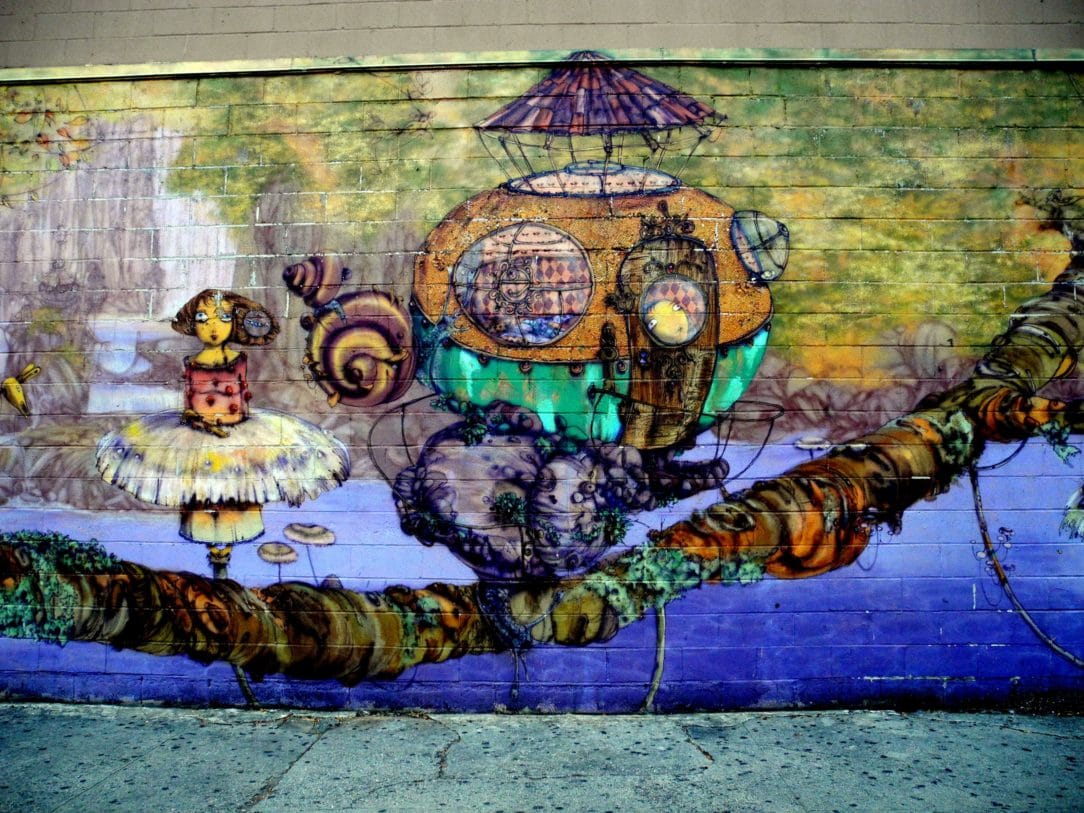
Right after getting off the Q train, we saw this mural:

Wall Mural by Coney Island Train Station 1

Wall Mural by Coney Island Train Station 3

Wall Mural by Coney Island Train Station 4

Wall Mural by Coney Island Train Station 7

I thought it was really surreal and cool so I took some photos of it and then enhanced the colors.  At the time I was taking the photos, I jokingly told my wife, “Just in case it gets washed away by the hurricane.”  I wonder if it’s still intact?  (Pictures of the rest of the mural is in the gallery at the bottom of the post.)

After having a junk food meal at McDonald’s, we walked down to the boardwalk to look around. I think I’d been there before, as a kid, but it’s been so long that I can’t be sure anymore. It was nice.

Nathan's on the Boardwalk
Nathan’s on the Boardwalk
A pier stretching out into the ocean from Coney Island's boardwalk area.
A pier stretching out into the ocean from Coney Island’s boardwalk area.

I’d like to go back and have a look around next summer. Hopefully by then the damage done to the area will have been repaired.

Car fatality at Luna Park Night of Horrors Entrance
Car ‘fatality’ at Luna Park Night of Horrors Entrance
Creepy Dead Chick With A Baby

Luna Park itself was done up pretty well. My favorite part of the whole themed event was the fact that they’d hired people to walk around in scary costumes and randomly scare people who weren’t paying attention. For example, they might get up behind you in line and lean in real close, and then scare you when you turned and found them right in your face. Or, you might be looking at a ride up in the air, and when you looked down, there’d be a person in costume standing right in front of you, staring at you. It was good fun.

Car coming down the track on The Tickler.

The rides were good. We only went on a few, both because we were running out of time and because we just didn’t have the guts to get on some of them. There was one where you rode in a thing that looked like an airplane. The whole ride was spinning and each airplane-car was also spinning on an arm that took the plane into sort of a barrel roll. We took it easy. We stuck with the Tickler, a roller-coaster that spins like  a top while going down the track, and the swing that takes you way up and spins you around real fast. We also rode a thing that was like a giant surfboard that went back and forth like it was on waves, while also spinning in circles. That one was sort of relaxing.

I made the mistake of forgetting to take my hat off while we were riding The Tickler. There’s one long drop on it and after exiting the ride and looking, I saw that my hat was one among many laying on the rocks below the tracks. I talked to a few employees, all of which said they couldn’t do anything about it and told me to talk to someone else. I was beginning to feel like I was going to have to leave my hat behind, but it was frustrating because it was just out of arm’s reach. My wife got tired of me being a punk and just grabbed a nearby broom, hooked my hat and gave it back to me. Maybe I’m too conditioned to follow the rules?  Maybe it’s a leftover from my military days.

The entrance to one of the haunted mazes.
The entrance to one of the haunted mazes. I can’t remember its name.
The 'gatekeeper' to the funhouse/haunted maze.
The ‘gatekeeper’ to the funhouse/haunted maze.

None of the rides seemed particularly Halloween-themed, but there were two Halloween mazes. One was called the Cudie Farm. I can’t remember what the other one was called, but they were both set up in a similar fashion and both were a lot of fun to walk through. My wife was a lot more startled than I was, but I think she was just enjoying the moment. More than anything, I was interesting in how well done the costume makeup was on the employees, given the scale of the park.

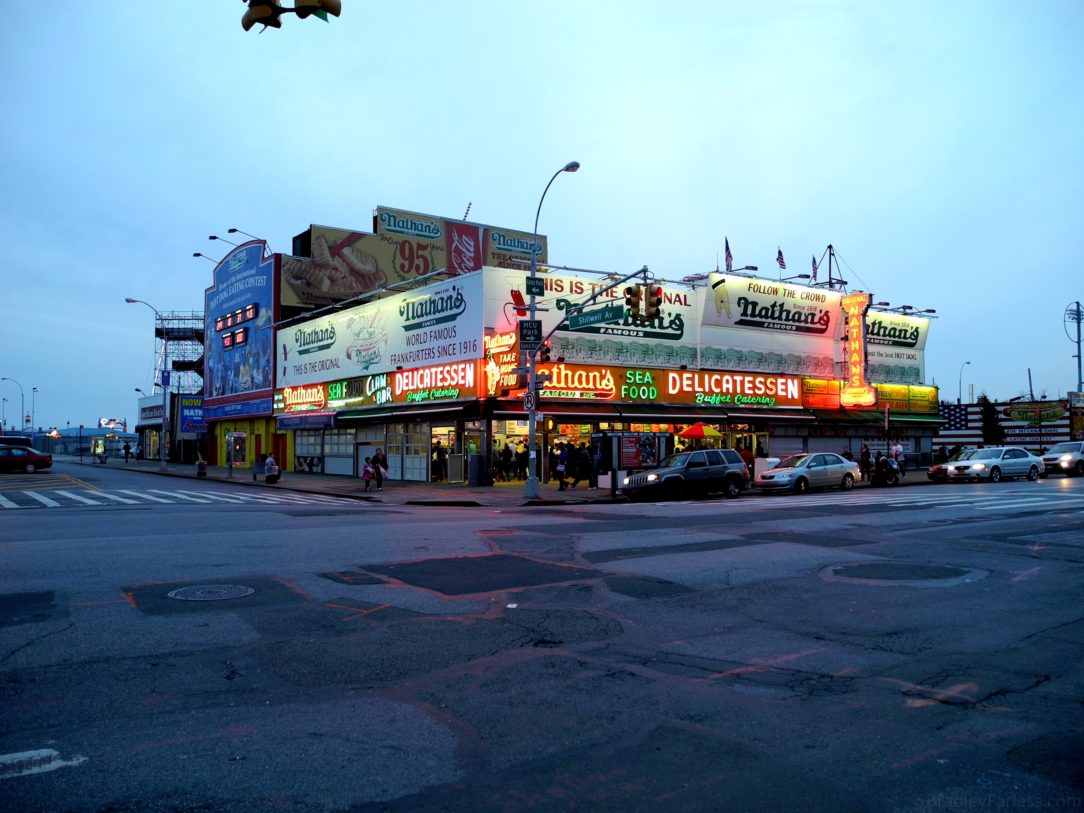
The original Nathan's Famous at Surf and Stillwell Avenues.
The original Nathan’s Famous at Surf and Stillwell Avenues.

When we finished going through the mazes, we decided it was time to leave, but no trip to Coney Island would be complete without stopping in at Nathan’s Famous (the original Nathan’s) on the corner of Surf and Stillwell Avenues. I was tempted by seafood dishes, but I decided to get what Nathan’s is Famous for: the all beef hot dog. So, I got my chili cheese dog; my wife got her chili dog, and we stood there in the street watching the people while enjoying the good food. It wasn’t boring. A man dressed like a gay stripper Super Mario walked by.

Shore Theater. The sign was damaged the following Monday by Hurricane Sandy.
Coney Island Train Station

But, then it was time to go home. Back to Manhattan. It felt disappointing. There was something comfortable about Coney Island. Maybe it was the lack of tall buildings. Maybe it was the atmosphere. Everything there felt more relaxed. We thought about how nice it would be to live in that area. Of course, we don’t think it would be that great to live there now, considering the recent catastrophe, but the place just has a really good vibe to it that I can’t describe. It’s casual in the way the Metropolitan Museum of Art isn’t. We’re really looking forward to going back.

The following gallery includes additional images of Coney Island and Luna Park:

Ripped Books

I’d like to take some time later to write a long post about my experiences over the past week in Lower Manhattan in the wake of Hurricane Sandy, but I want to mention something I saw today that made me realize that some things in New York City never change.

When I was on my way home, I saw an older man pushing shopping cart down the street. He stopped by the trash can, peered in, and then reached into a box in his cart.  He pulled out a book, looked around as if he were making sure no one was watching him, and then ripped the front and back cover off the book and tossed it in the trash can.  He then reached into his box and pulled out another book.  At this point, he saw me watching him and turned away from me and hid clutched the book to his chest.  He looked over his shoulder at me and then ripped the covers off the book.  He tossed the remains of the book into the trash can along with the first one and then hurriedly crossed the street, where he peered briefly into the trash can on the corner before moving on, presumably to find more suitable trash cans to receive his defaced books.

I had stopped to watch this guy, so I’d missed the light to cross in the direction I was going.  When I did cross over to the other corner, I found a man in dirty, rumpled clothing singing to a pile of dirty clothes in a shopping cart.

Last week, Lower Manhattan was very dark and the streets were relatively deserted.  Thinking about it now, I don’t remember seeing anyone … weird… out there.  Not weird by NYC standards anyway.  But now, the power is back and the crazies are out again.  Some things just don’t change.

The “Muslim” Halloween Costume

Man dressed as a "Muslim" for Halloween.
Man dressed as a “Muslim” for Halloween.

Somewhere around Sheepshead Bay, a guy and his friends got on.  The guy was wearing traditional Arab Muslim clothing.  Or at least, sort of.  He had the kufi (?, long shirt), brimless cap, cotton pants and the sandals, but he wasn’t wearing them quite right.  The cap was way too small for him and the pants were rolled up, but not to above the ankles.  I don’t imagine he was too concerned about the details, but if you’re going to be a jackass, you might as well do it right.

He was laughing and joking with his friends and passing around a bottle of vodka on the train.  I heard them mocking the burqa, and commenting that the man’s female companion should have dressed up like a whore.  I heard the guy yell, “Kill the white people!  Kill, kill, kill, kill them all! [laughing] … Kill, kill, kill, kill…”  Another time, he said, “I’ve got a bomb!  Hit the deck!”

The situation was absurd to the point of being slightly surreal.  At what point does it become ok to turn free speech into hate speech, to degrade and disrespect an entire culture, just because you don’t agree with some elements of that culture?  And by elements, I mean some segments of the society, not elements that pervade the whole.  Violence perpetrated by Islamist groups is a problem, yes, but there are violent fools in every culture and we don’t claim them as representative and use them as justification for generalized insults.

Some things are funny and some things aren’t.  Just because we possess freedom of speech in the United States doesn’t mean we should toss the concept of appropriateness out the window and ‘say’ whatever we want.  We should still have some self-moderation and not generate what is essentially racist hate speech because we’re too stupid to understand the more complex realities in other parts of the world, and too lazy to find out.

Hey bro, I hope no one urinates in your beer tonight, but you deserve it.

NYC BMW Has Hood Crushed By Construction Backhoe

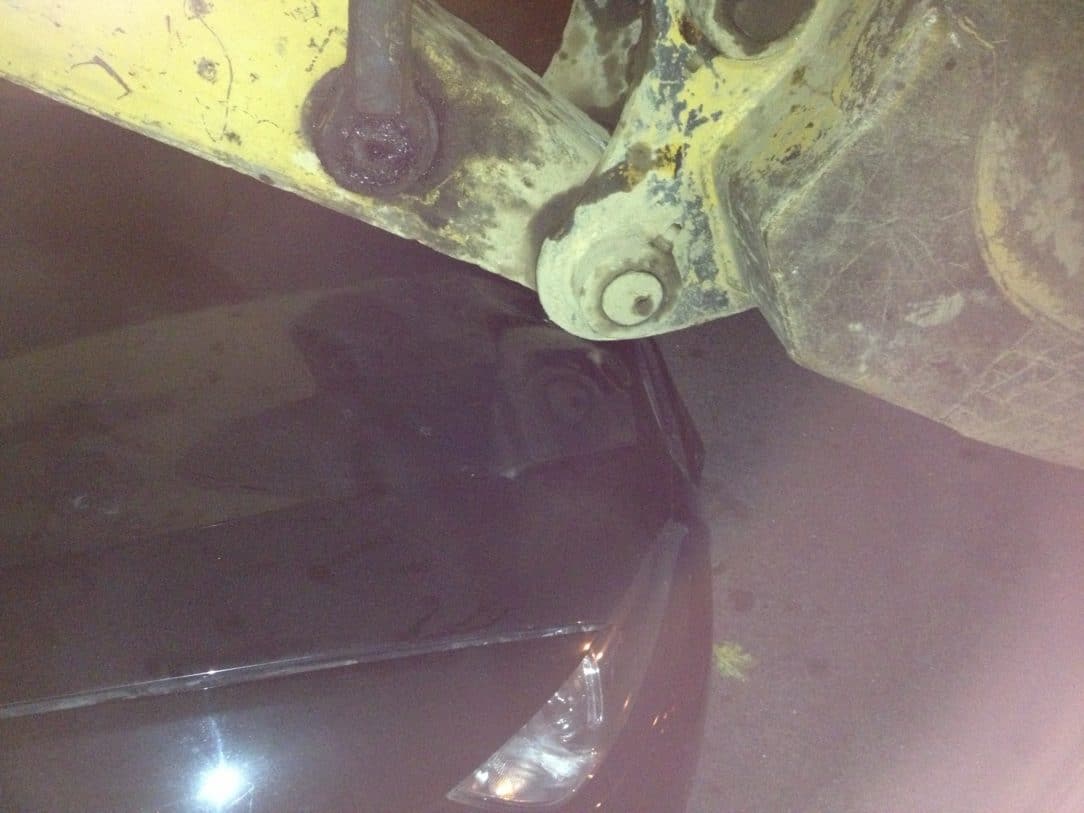
After a fine dinner at Pinche Taqueria, my wife and I were walking down Bleeker Street (between Lafayette and Bowery) and, well… this:

BMW with backhoe crushing hood
BMW with backhoe crushing hood.

I had to stop to make sure I was seeing it right, and sure enough, the hood of the car is being smashed in by the backhoe.

Close up of backhoe resting on (aka smashing) BMW hood.

I suppose seeing me standing there taking photos was drawing attention, because by the time I left, there was a crowd of people looking at the car, people peering out of apartment windows, lots of laughing, lots of joking, and people calling “shotgun” on who gets to post this to Reddit first.

A number of questions come to mind.  Whose car is this?  Why did the person driving the backhoe do this?  Was it intentional?  Did the BMW driver piss off the backhoe operator?  Was it stupidity?  When will the lawsuit drop and who’s going to pay for this?

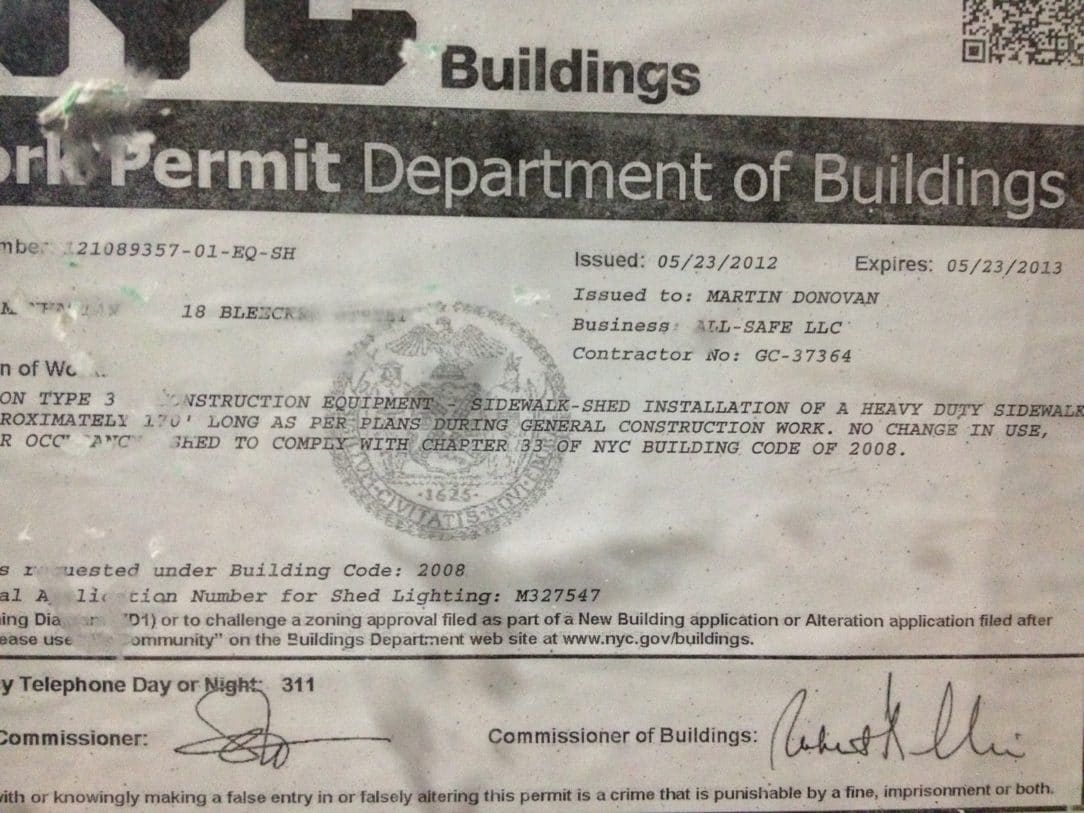
Work Permit at construction site for BMW with hood crushed by backhoe.

Regardless of whether this makes the NYC news or not (I’m sure there will be too many stories about Honey Boo Boo or something equally stupid to show this), I’m sure the driver of the construction vehicle will be fired, but the work permits were applied for by a guy named Martin Donovan, so I guess he’ll be held ultimately responsible for footing the bill.  (Update 2: Noticed that both vehicles were parked illegally in a spot that has no parking b/t 7 am and 7 pm, Mon – Fri.  Makes the question of legal responsibility for the damage a little more muddy, doesn’t it?)

Vehicle information and more photos in the gallery:

Update:

Found this photo on Reddit of the car earlier today, before the backhoe dropped onto the hood.

The BMW, before the backhoe dropped.

Excuse Me. Have you seen these droids?

Stormtrooper Mask at Toys R Us
Have you seen any droids around here lately?

The missus and I have been so busy over the last few weeks that it seems like we’ve hardly had a moment to just sit down and stare relax.  I think about it sometimes.  Just going out to the park, sitting down and watching people walk by, watching the squirrels, and enjoying the sights and sounds of the city.  I think fondly about the time we spent wandering around in the Metropolitan Museum of Art.  But then, I start thinking about the long list of things that just have to get done, and I put aside thoughts of having fun and relaxing for another day.  Except for last Saturday.

Last Saturday, we decided that we needed some time to just relax and have fun, so we went to Times Square, stuffed ourselves with the all-you-can-eat shrimp dinner at Red Lobster and then spent about two hours wandering around in the Toys ‘R Us store, also in Times Square.

It was a lot of fun!  Some of the toys were pretty cool, like some Hex Bug things I saw.  If I had the time and space, I wouldn’t mind setting up one of those tracks myself.  Some of the toys also sparked some good conversations, where my wife and I reminisced about the toys we had as kids and how they’ve changed.

I’ve always enjoyed games, puzzles and video games.  That was a great way to spend the afternoon.

As for the picture above of me in the Stormtrooper mask, well, I put it on and asked a store employee if he’d seen any droids in the area.  He said it was funny, but his eyes weren’t laughing.  They should have been laughing.  No, seriously though, he didn’t seem as amused by my lame joke as I was.  That’s ok, though.  The joke was more for me anyway.

The 2012 Manila Flood

Back in 2009, Typhoon Ketsana, known locally in the Philippines as ‘Ondoy’, dropped a lot of water on Manila in a short amount of time and caused extensive flooding.  I remember there was a lot of public concern outside of the Philippines for the well-being of the people, not just in the Philippines but in the other countries affected.  A lot of sympathy was shown.  I think there were even international donations sent to the Philippines.

Manila Flooding 1

Manila is just recovering from another bout of flooding.  Over the last week or so, Manila and surrounding provinces were covered by flood waters, affecting about 2.4 million and killing 65 (as of writing) in what was described as the worst flooding since Ondoy.  I only found out because I’m still subscribed to the US Embassy newsletter for the embassy in Manila, and the offices were shut down for quite a few days because of heavy flooding on Roxas Boulevard.

I was struck by the contrast between this flood and the last, when almost everyone seemed to know what was going on.  It could be that I was biased, of course, since I was in Asia at the time and news probably tends to give more coverage to local big events, but my wife, who is from the Philippines, didn’t even know there was any flooding until long after it started.  I knew first, because of the embassy newsletter.  I assumed she knew.  I assumed she’d seen it in the news, but I guess it just wasn’t in the news.

I was wondering why there is so much less coverage this time.  I think there are two reasons: it doesn’t sell and no one cares.  With the action in Syria and the Olympics, who has time to talk about flooding in a third world country?  It’s not like the massive flooding in 2009 that affected multiple countries.  And of course, there’s the feeling that Filipinos just didn’t learn.

The flooding was caused the first time around through a lack of proper drainage and littering.  There was so much garbage in the streets, in the rivers, jammed into the drains and drainage ditches that the water couldn’t pass through adequately, making a bad situation a lot worse, so now that Manila is flooding again, you can’t help but feel that they didn’t learn their lesson from last time.  When I say that no one cares, I don’t mean that no one is concerned about the hardships that people face in that sort of situation; I mean that people find it harder to pity people who are suffering from self-inflicted tragedies.

Filipina girl crouches on cement pillar to avoid flood waters
Filipina child crouches on cement pillar to avoid flood waters.

And there are tragedies.  A few years ago I visited my sister-in-law’s house for her daughter’s birthday and I remembering thinking how lovely the house was.  Now it looks like this:

Flooded kitchen at a home in Pasig City

It’s going to take a lot for people to rebuild their lives and their homes again.  Where does a person even begin in their cleanup efforts?  I can’t imagine how much work it’ll be for people to fix their houses and businesses again.  Hopefully, this time, the hardships suffered will make people think harder before dropping trash on the ground, and make them push harder for their government to take real steps toward improving drainage in and around the city.

Not that this is anything but sort of related, but I thought the image below is worth sharing.  I found it on a bulletin board, claiming it’s from the recent flooding in the Philippines.

Under the Sea
Filipina dressed as Ariel, making the best of recent street flooding. “Under the sea… under the sea…”

World Wide Open

Cocktail Munchies at the Waldorf=Astoria in New York City

Earlier tonight, my wife and I met up with a friend of hers that she hadn’t seen in about 15 years at the Waldorf=Astoria.  While we waited on her friend to get back from her day of sight-seeing, we walked around the hotel looking at the stuff behind glass in and around the main lobby.  The hotel is almost like a mini-museum. I was especially interested in the old ledger from 1915 they had on display.

When her friend arrived, we exchanged gifts, she introduced us to her family, and we sat down for cocktails and to trade stories.  She’s living in Japan and listening to her stories about working there and living there revived my interest in the country and my desire to travel.  She was telling me about how easy it is to get a job teaching English there.  The salary isn’t that bad either, compared to what I might make here teaching full time in a college.  I’m not opposed to moving again.  Japan would be a fascinating place to live and with a master’s degree under a TESL certification under my belt, I could probably get my foot in the door there without too much trouble, according to her.

More than anything, the conversation my wife and I had with her friend reminded me of how un-tied down I am to living in any one place for a long period of time.  I suppose that’s a result of growing up in a military family and being in the military myself; I just don’t really feel like I belong to any one place.  How do you even say you have a hometown, or say where you’re ‘from’ when you’ve never lived in one place for more than about 5 or 6 years?  Or maybe I’m just not used to staying in one place for long, since I’ve never done it.

Either way, New York City is a great place, but I’m open to leaving, given the right circumstances.  Whether that move would be to Japan or somewhere else remains to be seen, but after living in NYC, there aren’t many places that would be a step up in terms of excitement and things to do.

Oh, and after a great conversation and some really great cocktails at the Peacock Alley in the Waldorf=Astoria, my wife and I had our first celebrity sighting on our way home.  We stepped out of the hotel and turned down the street to go to Grand Central.  About a block down from the hotel, I was talking to my wife when I looked up and saw the actor from Terra Nova.  Then my mind quickly jumped and I was thinking, ‘Hey, he was in Avatar too.’  Then he passed us and I turned to look back.  He looked over his shoulder, as if he were wondering if we were going to stop him and hit him up for photos, etc., but we kept going and so did he.  Then I said to my wife, “That guy is an actor.”  Who, she wondered.  I actually didn’t know his real name.  I just remember him as Commander Taylor from Terra Nova, which, for some stupid reason, was canceled.  His name is Stephen Lang.  From the way he strutted down the sidewalk, I bet he’s a pretty cool dude.