In my Speech Foundations class today we did an interesting class project. We were put into groups and we had to come up with a list of what we thought were common virtues that we thought were important as a group. When all of the groups were done, the lists were put on the board. Then the professor circled all of the themes, the virtues that showed up in most of the lists. What stood out was that people in the class value family, friends, religious tolerance, honesty and loyalty (to friends and family).
The professor said that this simple class project is an interesting way for her to judge society as a whole, since the things that are listed change over time. She said she’s been doing this same class project every semester since she started teaching, and she looks like she’s in her early 60s, so I imagine that goes back quite a ways.
She said that when she first started teaching, money was at the top of every list. Students were very concerned with money, both having it and making lots of it. Interestingly enough, the only list on the board that contained ‘money’ was from a group of people who were all first generation immigrants. I imagine it has to do with perceived financial capacity. Our economy may be faltering, but people are still generally taken care of, whereas people from other countries might not have those same safety nets, or might have family back home that they’re concerned about.
The next thing she pointed out was that most groups didn’t place family and friends on the list prior to September 11th, 2001. She said that ‘religious tolerance’ and similar ideas started showing up shortly after that. Her theory on the addition of family and friends is that after people died in an attack here in the US, it made people realize that they might not actually see their family or friends later. Something could happen, so people started to value those ideas more, and perhaps their friends and families too.
I think the appearance of religious tolerance on these lists comes from the deluge of information people are exposed to now, in light of the war with Middle Eastern countries. This conflict has been portrayed as a clash of civilizations and more often as a clash between religions. To combat rampant fear of every ‘other’, ideas of religious tolerance, especially towards Muslims, has become prominent in everything from TV to classrooms.
The point of the exercise was to demonstrate what type of audience the class is. It’s a Speech class, and the most important part of writing a speech is knowing who your speech is intended for.
Being a Singaporean cat, Marble hasn’t had the opportunity to celebrate any American holidays until she immigrated to the US this year.
It was with great excitement that she oversaw the grilling operations at my mom’s place.
Yup! This is what she was waiting for! Shrimp and chicken. =)
She had her own bowl. That’s one of the shrimp that was set aside for her. She really does enjoy shrimp and chicken. She’s not too big on pork though.
Since moving to the US, this cat has really been spoiled. She eats plenty of scraps from the table. She’s come a long way from living in a potted plant on the side of the road in Singapore.
On Friday, I came across packages of Archway cookies in the A&P on 14th street. I’d heard they were out of business and had given up on ever having my favorite oatmeal cookies again, so I was really excited to see them up for sale. I was so excited that I wrote a blog post about it that happened to get the attention of one of the people in their PR department:
Hello!
My name is Katey Clark and I work for the PR agency of record for Archway cookies. I found your blog entry from last week and just wanted to write to say hello!
Archway has been back on store shelves since December 2009, and just last month came out with three new varieties, Shortbread, Triple Chocolate and Peanut Butter. After a vote on Facebook last week, it was almost determined that our Rocky Road cookie would come back for a limited time in 2012! (Frosty Orange was a very close second place, so we hope to bring that back for a limited time as well).
I obviously took them up on their offer of free cookies. Who wouldn’t? I didn’t specify any flavor in particular, so it’ll be a surprise. It’s really neat to see Archway taking an active interest in user feedback via blogs and rewarding that feedback with gifts of the cookies that Archway fans love.
I don’t remember the first time I had Archway cookies, but I really really love the plain oatmeal flavored ones. They were, and probably still are, my dad’s favorite cookies too. That’s how I first tried them. Sometime after getting back to the US last year, I found out that Archway had gone out of business and I was really upset by it. It sounds ridiculous to get upset over cookies, but they’re just that good!
I searched around to see if any stores still had packages of the plain oatmeal cookies in stock, but I didn’t have any luck. Today on my way home I stopped in A&P on 14th street and saw Archway cookies on the shelf. They didn’t have plain oatmeal, so I got the ones pictured above instead. On the way out, I stopped to talk to the store manager and he told me that Weiz had bought them and was distributing the cookies again. I asked him if he could get in some of the plain oatmeal cookies and he said he would talk to the distributor about getting some.
“Hey, are you Egyptian?” I was standing at a table on the side of the post office, filling out a shipping label, when a Hispanic woman walked up and asked the girl next to me that question. I glanced over at the girl and saw she had Middle Eastern features and she was wearing a hijab (the head scarf, if you’re not familiar with the word). Oddly enough, the woman had guessed right. The girl replied that she was half Egyptian and was born in the US.
“You’re a Muslim right?” At this point, I was considering moving to another part of the post office, because I was expecting this Hispanic woman to go nuts and start haranguing this girl for being a Muslim, which she obviously was, since she was wearing a hijab. New York City has a reputation for being filled with lunatics and you really never know if you’re talking to one until it’s too late. The girl looked a little hesitant, but again she answered yes.
‘Here it comes,’ I thought. But, instead of what I was expecting, the Hispanic woman asked, “What do you think about marrying more than one woman? If you were married to a man, would you be ok with him marrying a woman in another country?”
“No, I wouldn’t be ok with that.”
“Ok, because I know Muslims believe in marrying more than one wife.”
“Well, not all Muslims do that,” the girl replied. “That’s mostly something that happened a long time ago, because it’s too hard to handle more than one wife, since the guy has to take care of them equally. It’s a lot of trouble, but I wouldn’t do it myself.”
“Oh, well you’re mostly American since you were born here, but do you know if Egyptians do that?” I imagine she was trying to fish for another answer, perhaps to justify the problem she was about to lay out to this girl.
“Well, yes, but I just don’t think it’s ok and I don’t think many people would do that.”
“My husband was here, and he married me, but then he went back to Egypt and he married another woman. If you were the other woman and you knew the man was married, would you do that? Would you marry a man that was already married? What kind of woman does such a thing?”
The above conversation is paraphrased, of course. I don’t remember exactly what they said to each other, but it went along those lines. At that point, I stopped following the conversation completely because I was just about done with filling out my shipping label and sealing the envelope, but the Hispanic woman kept pressing this girl about why her husband, who had been deported, would find a new wife in Egypt instead of being faithful to her. The girl told her it sounds like a personal problem. She was probably trying to separate the issue from religion, before it devolved into something ugly. She told the woman that if she wasn’t satisfied with the situation she should divorce her husband, but the Hispanic woman told her something about losing benefits.
Then I walked away to get my postage for my envelope.
I wonder if that happens often? I doubt that girl expected to have a conversation quite as bizarre as that when she put on her hijab that morning and left her house.
The following is the second paper I wrote for my Art History 100 class. We were tasked with finding two art pieces in the Metropolitan Museum of Art in New York City and then writing a paper that compares and contrasts them based on form and content. Our choices were restricted to certain art periods from specific locations, like French Gothic or Italian Renaissance. I chose the following two pieces because I found them particularly interesting on a personal level, as well as being easy to write about.
I think I might have been a bit off the mark on fitting The Angel Gabriel to the Renaissance standard, but I won’t know for sure until September, when I can get in touch with the professor and see the paper. It was due on the day of the final, so there’s no way for me to get it back and check it out. I’ll update the grade received and any notes from the professor at some point, on the Essays page.
(Note: The images were not included in the paper that was turned in. I added them here so readers that aren’t as familiar with art as my professor can get a better idea of what I’m talking about.)
Introduction and Location
The paper will be discussing the differences and similarities between two works: The Angel Gabriel and Qur’an Manuscript. The Angel Gabriel was created in approximately 1493, is attributed to Masseo Civitali and is believed to have originally been located in the oratory of Santa Maria dell’ Anunnziata in Lucca, Italy. The work is now located in gallery 500 on the first floor of the Metropolitan Museum of Art in the “European Sculpture and Decorative Arts” section. The Qur’an Manuscript was created in the early 14th century, by an anonymous artist in Iran or Iraq. The work is now located in a display case in gallery 203, on the Great Hall Balcony on the second floor of the Metropolitan Museum of Art.
Formal Aspect & Genre Descriptions
The Angel Gabriel is a Renaissance sculpture that is roughly life-sized. The sculpture is a painted and partially gilt terracotta statue. It appears to have been free standing on its original base, which is now broken. The statue is now anchored to a display base. The sculpture leans at an almost unnatural angle, covered in a draped garment that is smooth and flowing. The figure is naturalistically proportioned and detailed, though the face is idealized. On the back of the statue, there are two vertical slots where terracotta wings were probably inserted. Renaissance art was largely religious (Aston 105). Compared to the earlier Gothic style, Renaissance art focused more on the human aspect of the art subject. Where Gothic art was solemn and dignified, Renaissance works like The Angel Gabriel attempted to introduce tenderness and beauty into art without sacrificing the aura of divinity associated with religious figures (Aston 133). The introduction of a human element into the sculpture is apparent in the joyous expression on the face and in how the arms are crossed over the chest, as though the angel can barely contain the good news he is about to share. Rather than standing vertical, the angel is leaning forward towards the recipient of his news. Despite these included aspects of human emotion, the aura of the divine is still maintained through the idealized, androgynous face (angels have no gender), and the original presence of wings on its back.
The Qur’an Manuscript is a non-illustrated manuscript folio and an example of Islamic art. The page on display is 34.9 x 27.3 centimeters and was made with ink, opaque watercolor and gold on paper. The page is primarily covered with naskh cursive text, but also contains decorative calligraphy and hand drawn vegetal and geometric images that are painted with gold. Islamic art as a whole is defined by a prohibition against making representations of living things, since it might create a temptation to commit idolatry (Evans 151). The resulting typical expression of Islamic art is mostly abstract, containing geometric patterns, references to vegetation and calligraphy. These elements were reflections of religious beliefs. The geometric patterns represent the perfection of Allah and the vegetation is a reference to paradise in the afterlife. Calligraphy also became a popular form of art, taking the place of images and being used to represent Allah. The main purpose of calligraphy was to appreciate the visual quality, rather than to read it. These elements are present in both secular and religious art, though secular art would not contain calligraphic quotations from the Qur’an.
Content
Theme
Both The Angel Gabriel and the Qu’ran Manuscript have a similar theme. Both works are the products of religious devotion. Gabriel is a prominent figure that is present in the Abrahamic religions of Judaism, Christianity and Islam. Stories about Gabriel appear in each religion’s holy texts. The Qur’an Manuscript is a handwritten and decorated page of the Qu’ran, the holy book of Islam. The difference between the two works is that while The Angel Gabriel represents a religious idea, it was mostly meant to be decorative, appearing in an oratory. The Qu’ran Manuscript, on the other hand, while being decorative was also meant to be functional, a holy book to read and learn from.
Depiction
The Angel Gabriel specifically depicts Gabriel, an angel, leaning forward, as if appearing to someone. The name Gabriel means “God is my strength” or “the strength of God” and he is known as The Great Communicator (Aquilina 69). Throughout the Bible, Gabriel appears to people to bring them news from God. In Daniel 8:15-17 he appears to Daniel to explain a vision to him. In Luke 1:16-17 he appears to Zechariah to tell him that he and his wife shall have a child and that his child, John the Baptist, will prepare the way for the Messiah. Later, in Luke 1:26-38, Gabriel appears to Mary, to tell her that she will be the mother of Jesus Christ, the son of God. According to the information placard on the sculpture’s display base, it is believed that The Angel Gabriel was originally part of a pair of statues which included the Virgin Mary. Together, they would have formed an Annunciation Group, which represents the moment when Gabriel shared the news of her divine pregnancy with her.
The Qu’ran Manuscript is a page from the holy book of Islam, the Qu’ran. The top of the page contains a geometric, gold painted rectangular frame that contains decorative calligraphy which reads, “Surat Saud, Eighty Six Verses (Ayats), Mekka surat” (Hany), though Mr. Hany also noted that the surat actually has 88 verses. Just to the right of the rectangular frame is a drawing containing concentric circles around a vegetal image, probably of a flower, also in gold with a blue center. Additional matching representations of flowers, rosettes, are drawn throughout the text as markers between ayas, or verses. In the right margin are two decorative seals, one circular, one teardrop shaped, both in gold and surrounded by a blue outline. These seals contain kufic script in the center. The main text of the page is a cursive form of Arabic known as naskh, with recitation marks added in red ink. The text on the page on display is the last part of the 37th surah and the first 11 ayas of the 38th surah of the 23rd juz (part) of the Qu’ran, The Letter Saud, which was revealed to the Prophet Muhammad at Mecca. Preceding the beginning of the 1st aya in the 38th surah is the phrase, “In the name of Allah, the most gracious, the most merciful,” which is not part of the surah itself and precedes all of the surahs in the Qu’ran (Hany).
Purpose
The original purpose of The Angel Gabriel would have been to inspire believers and deepen their faith. Many people at the time the statue was created were illiterate, and learning about Christianity, outside of sermons given by clergy, was through observation of religious art. When looking at the sculpture of Gabriel, believers would have been reminded of the good news he shared with people in the Bible, and particularly with Mary. If The Angel Gabriel was originally paired with a statue of the Virgin Mary, then viewing them together would have reminded viewers of their hope of salvation through God’s grace and Jesus’ Christ’s death and resurrection on the cross. The Angel Gabriel was originally designed to be a decorative piece for casual observation and reflection and, though it is now located in a museum rather than a religious building, the effect is essentially the same. It causes the viewer to contemplate the meaning of Christianity and Gabriel’s role in the Bible.
The Qu’ran Manuscript was meant to be a functional copy of the Qu’ran, to be used by believers for study and recitation, as well as to inspire through the decorative artwork it contains. The Arabic text of the page, together with the rest of the text in the Qu’ran, is the physical representation of Allah through language (the written word) in the Islamic faith. The Qu’ran praises Allah and His creation, defines the relationship between Allah and the worshipper, explains the afterlife through eschatological texts and teaches Muslims how to practice their faith in everyday life. While the particular copy of the Qu’ran the page came from is no longer serving that purpose, the text of the Qu’ran has been copied, translated and distributed all over the world and continues to serve the function it was originally created for.
Presentation
The Angel Gabriel is presented in a small room with other Italian Renaissance pieces. The room is well lit, and Gabriel is the first work you notice as you walk into the room. The lighting brings out the remaining color from the original paint and gilding on the statue, giving the viewer an idea of what it might have originally looked like. Appreciation of how the piece was originally displayed would be helped by having a similar work of the Virgin Mary opposite Gabriel, though that is probably not possible due to limitations in the museum’s inventory. An alternative would be to have a digital rendering of what it might have looked like in place at the oratory displayed next to it, or on the display base. As it’s now displayed, Gabriel appears almost out of place in the room and it requires a lot of imagination to picture how it would have originally appeared.
The Qu’ran Manuscript is set in a glass display case along the wall of the Great Hall Balcony. The display case contains other Islamic works that represent highlights from the Department of Islamic Art. The works range in date from the seventh to the eighteenth century and include textiles, jewelry, pottery and other manuscript pages. Since the case shows a cross-section of art, the overall effect is a bit jarring, especially combined with the noise coming from the entry hall below the balcony and the strong smells coming from the balcony dining area. The benefit of being placed in that location is that it catches the eye of people walking by and the skylights and windows help to keep it well illuminated. It would be easier to appreciate this work in a smaller room with other Islamic manuscript pages from the same time period.
Works Cited
Aquilina, Mike. Angels of God: The Bible, The Church, And The Heavenly Hosts. Cincinnati: St. Anthony Messenger Press, 2009.
The acceptable areas for smoking just got a lot narrow, but I can’t really argue with this. I mean, I still smoke, though I’m planning on getting around to quitting sometime soon, but even so, I can’t be upset about this. People that don’t smoke have a right to not inhale second hand smoke. That’s the whole point of not smoking right? Still, it’s gonna be kind of sad that I can’t lean back on a park bench and enjoy a cigarette while watching all the people pass by anymore.
This reminds me of something I was told by a guy in Japan. I don’t remember who it was now, but he was saying that in Japan, they banned smoking outdoors, but not indoors. He said the reasoning is that it’s all about choice. If you’re a non-smoker, you can choose to not go into a smoking establishment, but you can’t choose to not walk outside. So, you ban smoking outdoors, but leave smoking indoors up to the establishment owner. To me, that makes a lot more sense.
Given the Japanese stance on smoking, it makes me wonder how much freedom and choice we really have in this country. Smoking isn’t illegal, but pretty soon it might be illegal to smoke anywhere. I remember hearing a story a few months ago about a housing development where people were complaining that they could smell the smoke from neighboring units. Would it be fair to ban smoking in an entire apartment building? I can imagine a no smoking policy for new tenants, but could you really ask people to move out if they don’t stop smoking?
Note: The following is the second and last paper I wrote for my World Humanities 1 class. It deals with the issue of fate vs. free will in Oedipus the King, Macbeth, and the creation story of Genesis. Please keep in mind that in regards to Genesis, this was written from a literary perspective and only using the information found in the first two chapters. The paper has been edited slightly to look better as a blog post.
Introduction
Some of the earliest artwork that’s been found, like the cave paintings at Lascaux in France and the Venus of Willendorf, indicates that man has had an interest in the supernatural since before recorded history. Archaeological evidence shows intentional burial of the dead with objects needed in the afterlife as much as sixty-thousand years ago and evidence also exists of the universality of religion in historic and modern times (Ember, Ember and Peregrine 446). This preoccupation with religion has led to the development of complex belief systems throughout history, from the Greek pantheon of gods in ancient Greece to the monotheistic faiths of Judaism, Christianity and Islam, which are based on the Jewish Talmud and Torah.
Starting with Herodotus in the fifth century B.C., scholars, theologians, historians and philosophers have speculated about religion. This speculation has sometimes taken the form of literature, such as the creation story in the book of Genesis, Sophocles’ Oedipus the King and Shakespeare’s Macbeth. These stories present situations that place man at odds with the supernatural. They pose the question of whether or not man has any control over his own life. Does man have free will, or is he driven by fate to success or failure? Each of the three stories gives us a similar, but different possible answer.
Adam and Eve Were Doomed to Fail
Adam and Eve stained glass window.
The book of Genesis is a Jewish religious text, later recognized by both Christians and Muslims, that tells the story of creation. In Genesis, God creates the world and then places man in that world as the pinnacle of His creation. From man, God creates woman and they live together in a paradise on Earth called the Garden of Eden. God also chooses to place the tree of the knowledge of good and evil in the Garden of Eden. He tells Adam and Eve that they can enjoy the rest of the garden as much as they want, but they may not eat from that specific tree. Despite this warning, Eve does eventually eat the fruit of the tree and Adam joins her, causing them to be cast out of the garden.
Is it Adam and Eve’s fate to commit this sin, or do they have free will to avoid temptation? When God creates Adam and Eve, they are created without any concept of right or wrong. They have no concept of morality, because morality requires knowledge of right and wrong, or good and evil. When God places the tree of the knowledge of good and evil in the Garden of Eden, he is setting Adam and Eve up for failure. Despite his instruction to Adam and Eve to not eat from the tree, they cannot be reasonably expected to follow this instruction, since they do not know that disobeying it is wrong.
God also allows evil to come into the garden, in the form of a talking snake, to tempt Eve into doing what God says shouldn’t be done. Even when Eve decides to eat from the tree, she does not do it out of a conscious act of disobeying. She does it because the tree is pretty and the fruit looks tasty: “And when the woman saw that the tree was good for food, and that it was pleasant to the eyes … she took of the fruit thereof…” (King James Version, Gen. 3:6).
God could have placed the tree of the knowledge of good and evil anywhere in creation, but He chooses to place it in the Garden of Eden, where He also places man. God then tells Adam and Eve that they may not eat from the tree, but does not give them the mental capacity to understand that following His command is the right thing to do. God then allows the snake to tempt Eve. One could reasonably assume that an omniscient, all powerful God did these things for the sole purpose of ensuring that Adam and Eve would sin and fall from grace. Adam and Eve never had a choice in the matter.
In Oedipus the King, Sophocles presents a tale showing that a foretold fate can be prevented, but is sometimes brought about by one’s own hands. The story revolves around two key prophecies from Apollo, one given to Laius and one given to Oedipus. Relating the story to Oedipus, Jocasta tells him that the oracle “declared that doom would strike [Laius] down at the hands of a son, / our son, to be born of our own flesh and blood” (Fagles 201). When Oedipus visits the oracle, he is told: “You are fated to couple with your mother, you will bring / a breed of children into the light no man can bear to see– / you will kill your father, the one who gave you life!” (Fagles 205).
Both of these prophecies set in motion chains of events that lead to their fulfilment, but not because of fate or an inability to change the future. Laius and Oedipus both make conscious choices, of their own free wills, to act, or not act, on these prophecies, influencing the final outcomes. After hearing the prophecy, Laius could have acted in other ways that would have prevented its fulfilment. Laius could have killed Oedipus himself, or he could have raised him. If he had killed Oedipus outright, the prophecy would have had no chance of coming true. If he had raised Oedipus in Thebes, the boy would have either grown up to love him, or at the least he’d know who his son is. Knowing who his son is would have allowed him to keep an eye on him. Instead, Laius sends the baby Oedipus into the mountains with a shepherd, to die from exposure.
Instead of being left to die, Oedipus is given away and becomes the adopted son of the King and Queen of Corinth, where he in turn grows up and receives his own prophecy. When Oedipus hears this prophecy, he makes a conscious choice to leave Corinth, to avoid killing the people he believes are his parents. However, he also makes a choice to not heed the remainder of the prophecy. When trying to escape from an unpleasant fate, shouldn’t one take into consideration the whole prophecy? It’s true that he believes his parents are Polybus and Merope, the King and Queen of Corinth, but considering the stipulations of the prophecy, he could have chosen to avoid killing or marrying anyone in the future.
When Oedipus encounters a rude traveller on the road, instead of choosing to avoid trouble and run away, he attacks and kills the man, who turns out to be his biological father. When presented with an opportunity to marry, he takes it and unwittingly marries his mother, rather than remembering the prophecy and abstaining from marriage altogether. Through their own actions and their own choices, Laius and Oedipus both fulfil the prophecies they are given.
It’s All in the Journey, Because the End Doesn’t Change
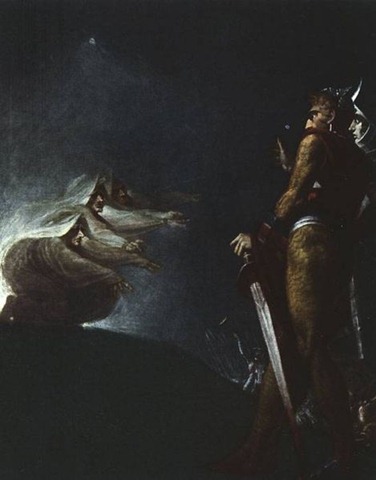
Macbeth and Banquo with the three witches.
In Shakespeare’s Macbeth, we are presented with yet another way to view fate. While returning from battle, Macbeth and Banquo encounter three witches along the road that present Macbeth with two prophecies. The witches hail Macbeth as Thane of Glamis, which he is. They then hail him as Thane of Cawdor, which confuses him since there is already a Thane of Cawdor. Finally, they hail him as “…Macbeth, that shalt be king hereafter!” (Orgel 9). Shortly after the witches disappear, Macbeth finds out that he has been named the Thane of Cawdor. The witches do not tell him when these prophecies will come true and whether or not it is a deception on their part, Macbeth takes his immediate naming of Thane of Cawdor as a cue to act to ensure the fulfilment of the third prophecy.
At this point, Macbeth begins to control how he will bring about his own fate. Macbeth and his wife conspire to kill the current king, Duncan, and after succeeding, Macbeth is placed in power. He attains the kingship and his prophecy is fulfilled. However, because of the way Macbeth chooses to reach his prophesied destiny, his reward is short lived, violent and ends in tragedy. If Macbeth had chosen to wait for the prophecy to fulfil itself, he may have been a much older man when he was named king, but the transition would have likely been more peaceful and he might have even sat on the throne longer. In Macbeth, fate is absolute, but how Macbeth attains his fate is optional.
(Image of Macbeth and Banquo with the witches from Wikipedia)
Conclusion
These three works of literature each present a different view of how man is subject to fate. Is man locked into his fate with no chance to escape, like Adam and Eve in the Genesis creation story? Can man avoid fate altogether by acting on prophecy and making the proper choices, as evidenced by Oedipus the King? Or is our fate absolute, with only the way we get there left to our discretion, as in Macbeth? As long as man continues to believe in the supernatural, questions about man’s relationship with the divine will continue to be debated, because there is no way to definitively prove that any particular view is correct.
References
Ember, Carol R., Melvin R. Ember and Peter N. Peregrine. Anthropology: Thirteenth Edition. Upper Saddle River: Prentice Hall, 2010.
Fagles, Robert. The Three Theban Plays: Antigone, Oedipus the King, Oedipus at Colonus. London: Penguin Books Ltd, 1984.
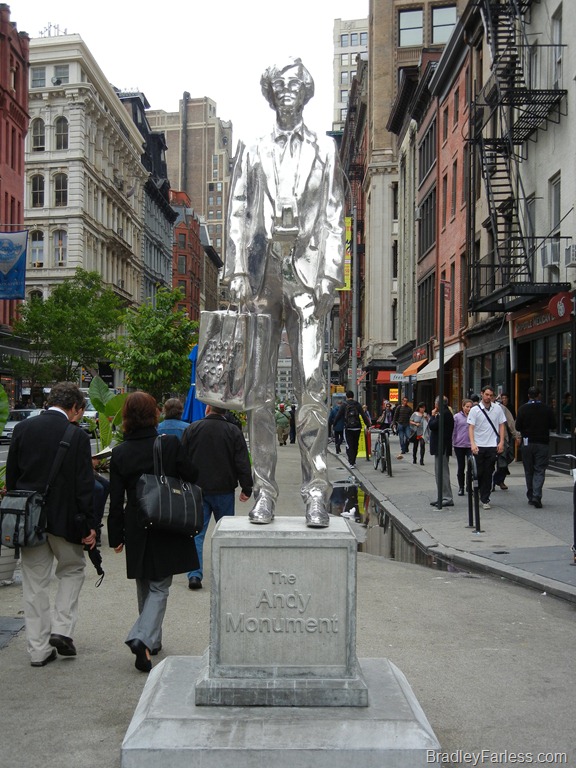
Andy Warhol, born Andrew Warhola, Jr., was an American painter, printmaker and filmmaker and a leading figure in the pop art movement. His monument stands at the Northwest corner of Union Square outside Petco. I’m not going to pretend to know anything about Andy Warhol, but his wikipedia entry says one of his paintings sold for 100 million dollars, so it has to be pretty good stuff. I can’t say I like the statue though, or the building that sits adjacent to Union Square on Broadway that I was told he designed. If you’re wondering, the bag in his hand says, “medium brown bag,” which is a reference to Bloomingdales. Their shopping bags are brown paper bags that have ‘big’, ‘medium’ and I think ‘small’ “brown bag” printed on the sides.
I went up to the food court at the Newport Centre Mall for the first time last weekend. I saw some old favorites that I hadn’t been to since before I left the US for Kuwait in 2007 and I was pretty sure I was going to wind up eating at Sarku Japan. It’s not real Japanese food, but it tastes pretty good. Then I saw a place called A Taste of India: Authentic Indian Cuisine. I went over and they were handing out free samples of chicken. It tasted pretty good, but I wasn’t really convinced. Then I saw that they had chicken biryani, and I wondered if it was anything like the nasi briyani I’d had in Singapore. I asked for a sample and while it wasn’t exactly the same, it was really close and really good. It was really spicy too!
I wound up getting a bowl of it, with spicy curry on top. It doesn’t look too appealing in this photo, but most of the foods I ate in Asia tasted better than they looked anyway.
Something about the restaurant was kind of jarring. They all seemed to be first generation immigrants, judging by their accents, possibly from the same family. The way they were working the crowd and cajoling people into taking samples and then buying food from them reminded me of street vendors in the Asian countries I’d visited. They could have just as easily been on a street in Kuala Lumpur or a food court in Singapore. The weird part is that they were all wearing cheesy looking, brightly colored, standard uniforms. I guess it was something about the authentic taste of the food and the authentic behavior of the employees clashing with the American franchise store and uniform designs that threw me off. I suppose it doesn’t matter though. I paid for good food and that’s what I got.