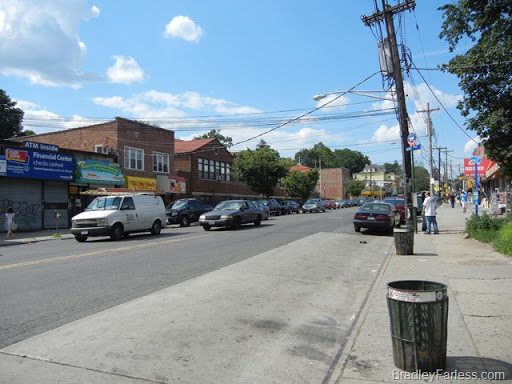
After getting off the bus, I turned the corner and started walking up the street towards my mom’s apartment building. Just after turning the corner, I saw the woman that lives next door to my mom. She stopped for some reason and turned around and when she saw me she threw up her hands and made a weird noise. She’s deaf and doesn’t speak, at least not intelligibly, so I went past her and kept going. I wasn’t trying to be rude, but I just didn’t know what she wanted or if she was even attempting to communicate with me. She suddenly rushed past me and kept looking over her shoulders, making a ‘no no no’ gesture with her finger in front of her face while mumbling. She rushed off at full speed to the building where my mom’s apartment building is. Some of the people in my mom’s apartment building are disabled, so I didn’t think much of it.
I entered the lobby just in time to see the elevator door close. The door on the second elevator was opening though, so I got on and rode up to my mom’s floor. When I stepped out into the hallway I could hear her making a lot of noise. I looked, and my mom’s apartment door was open. She was gesturing wildly and making plenty of loud noises that neither my mom or I could understand. I walked down the hallway and when she saw me she got even more agitated. So, I stood there with my mom trying to figure out what her issue is.
Through a combination of hand gestures and her very strained attempt to say the word “following”, we finally concluded that she is freaking out because she thinks I’m always following her. The fact that there is only one way to get to my mom’s apartment from the bus stop, only one set of elevators and only one hallway that goes to my mom’s apartment, which is right next to hers, seems to have totally gone over her head. The fact that we’re bound to run into each other in those areas, seeing as how we’re typically going to be heading for that same floor and two adjacent doors in the hallway, well that seems to have gone over her head too. She’s outright convinced that I’m stalking her and that I’m out to get her.
I’d noticed previously that she would always rush into the elevator and close the door before I could get to it, or if I got in the elevator she would wait for another one rather than ride in the elevator car with me. I never really put it together, but the idea that I’m following her around intentionally is ludicrous. It never ceases to amaze me, the kind of fantasies people can create for themselves and live in. Of all of the women in the street, why would I choose to, as she seems to be implying, stalk a late 40s, overweight, deaf woman that lives next door to my mom? Besides the fact that I’m married, I’m really not interested in old disabled women. Even if I were a stalker, as she seems to think I am, well, it’s summer in NYC. There are plenty of better looking women to be following around.
I just hope that this woman doesn’t completely flip out, because there’s no way this will be the last time she’ll see me going in and out of the building.
There were plenty of people at Union Square yesterday with tables set up, trying to make a buck off of their artwork. Two artists were using a method of making art that you can’t really buy and take home, though. One guy was making a trail of faces on the pavement and another made a flower pattern out of chalk dust.
Felix Morelo, drawing a Trail of Faces.
I had seen Felix Morelo’s artwork before, last Fall I think. I’d almost forgotten about it and I don’t know why I didn’t take any photos of the faces, because the work he did then was a lot better than what I saw yesterday.
What he does is he gets himself a bag of chalk and a crate to sit on. He draws a face, moves back, draws another face, etc. etc. What he winds up with is a Trail of Faces, with each face a bit different from the others. It doesn’t sound like much, until you look down the long line of faces and realize the sheer quantity of his work. Quantity isn’t the same as quality, but overall I think it was worthwhile to stop and admire.
Right next to the Trail of Faces I saw a flower design made out of chalk dust. I don’t know the story behind this. I’d never seen it before, but there was a pail sitting nearby for money donations. The bags on the ground around the design are full of chalk dust of different colors.
It’s nice to see something going on in the park. After a quick burst of activity in the Spring, things have really died off, but I’m not really surprised. It’s getting hot out there!
This is a writing assignment I did for a World Civ 100 class I’m currently taking. Expect more regular updates soon.
The question:
First you should summarize the article, then give your thoughts about it and tell how it might be useful in our class and to the scholarly world in general. You can certainly include negative andpositive thoughts about the article.
The Chicago Assyrian Dictionary: Opening a New Door on History
After 90 years of effort on the part of the Oriental Institute at the University of Chicago, a project titled the Chicago Assyrian Dictionary has finally been completed. This 21 volume dictionary compiles the definitions and usage explanations of words from the ancient Mesopotamian language, including its Babylonian and Assyrian dialects. This monumental achievement has opened a new door for all scholars interested in researching the Mesopotamian people and their culture.
According to a New York Times article published online (footnote was inserted here), this dictionary covers the language as it was used from roughly 2500 B.C. to 100 A.D. The project was initially started by Dr. James Henry Breasted in 1921, but didn’t make too much progress until after World War II, when the project was reorganized. The first volume of the set was published in 1956, with 20 following volumes being published over a 55 year period under the editorship of A. Leo Oppenheim, Erica Reiner and Dr. Martha Roth, the current dean of humanities at the University of Chicago. The dictionary is comprehensive, covering word usage and nuances, as well as cultural material available that relates to the word being defined.
The best way to understand any culture is by examining primary sources. The best primary source is a set of written records, but those records are meaningless if a scholar cannot completely understand the language. By unlocking the Assyrian language and making it accessible to scholars everywhere, the team at the University of Chicago has opened a door to new and hopefully more insightful studies of the Mesopotamian civilizations. Having a reviewed and reputable resource to draw from, scholars can now make better informed translations of the material they’re working with, whether it is a cuneiform tablet of a contract, or a literary work. The effort the team made in defining the nuances and various usages of the word, rather than giving simple definitions, added immense value to the work as a whole. The meaning of a text can sometimes change drastically based on a misinterpretation of one word. With a new standard to build from, scholars and translators can hopefully render the Assyrian language into English with greater efficiency and accuracy. Additionally, currently existing translations can now be vetted against this dictionary to check for accuracy.
This accomplishment can also greatly benefit classroom study. A common misconception among people today is that people from ancient civilizations were inherently less intelligent than modern people. By presenting examples of the Assyrian language (from entries in the Chicago University’s Assyrian Dictionary) to students today, a professor could demonstrate the complexity and depth not only of their language, but of their society as a whole. When discussing literature from Mesopotamia, the professor could introduce printouts of key terms from the work for classroom study so that students will have a greater understanding of the social constructs present in the work. As Gil Stein, the director of Chicago University’s Oriental Institute said in the New York Times article, this dictionary “is an indispensable research tool for any scholar anywhere who seeks to explore the written record of the Mesopotamian civilization.”
The compilation and publication of the Assyrian Dictionary by the University of Chicago will have a lasting and profound impact on the study of Mesopotamia. It is a vital and robust tool that can be used by professionals and scholars to make more accurate translations of the Assyrian language. For students, the dictionary will be an excellent tool for expanding their knowledge of the Mesopotamian world and ancient civilizations in general. The Assyrian Dictionary is a work of immense value that sheds new light on an ancient civilization and it will be used as a basis for research and study far into the future.
Yesterday I went to a part of New York City that I’ve never seen before to see family members that I’d never met before (that I remember anyway). I imagine most people in the US are in the same situation. They know they have relatives in another part of the city, state or country, but they’ve never met them and may not ever meet them. For me, these relatives are living in the Bronx. Well, most of them anyway. Some actually live just a few blocks from where I live in Manhattan, but I don’t know who they are. For all I know, I’ve passed them in the street. It’s weird to think about it that way right?
The whole trip to the Bronx was a really interesting experience. Like I said, I’d never been there. I saw a side of the city I didn’t know existed. It was sort of city and sort of not. It’s more like suburbs, but not quite. I can’t quite reconcile it to the impression I have of suburbs from cities like Atlanta. It did remind me of some of the old, run down towns I’ve passed through in the South though.
Photos of a Southern town I drove through in 2008:
The overall impression I got of the area is that it’s mostly run down and dangerous, though I only saw a small part of the Bronx so that’s a generalization. I’ve stricken it off my list of potential boroughs to live in. Besides the fact that the area looks dangerous, it also requires a personal vehicle and all the expenses that come with one. Who the hell would want to deal with the train problems between the Bronx and Manhattan if they had a choice?
Yeah, I have to just take a moment here to complain about the train problem. There’s ongoing construction on the train lines heading into the Bronx. When we went up there yesterday, we had to get off the train at 149th street, Grand Concourse (which isn’t very grand), and take a shuttle bus to 180th street, where we could get back on the train. I’ve never taken a train straight to the Bronx, so I have no way of calculating exactly how much time we lost by having to take a shuttle bus, but let me just say that to get from 14th street and Avenue B to our relatives’ house in the Bronx took 2 hours and 45 minutes. That’s absurd. It wasn’t quite as bad on the way back, because there wasn’t as much traffic, but it still took just under 2 hours. I’m sure it won’t be as bad when they finish the construction, but after having lived here for 9 months, I can reasonably assume that the construction will never stop. There are always reroutes and delays. It makes me long for the fast, safe and reliable train system in Singapore.
So, meeting extended and previously unknown family wasn’t as strange as I’d thought it would be. I wasn’t sure what to expect, but the barbecue wound up having the same atmosphere as some I’ve attended in the Philippines. I suppose that shouldn’t have been surprising, since my relatives on that side are all of Filipino descent. Some of them remember seeing me as a kid, when I was about 5, but that was 25 years ago, so all of them were unfamiliar to me. I couldn’t tell relative from friend of the family, so I did the best I could and mostly kept to myself, with the exception of a little socializing with my 2nd (or 3rd?) cousins to try to determine how exactly we were related. The food was awesome and everyone was having a pretty good time, despite the heat and mosquitos. In a way, it’s kind of nice to know that the family I have in the city extends beyond just the few relatives I previously knew about. It gave me more of a sense of belonging and security. I’m looking forward to going to future barbecues, with my wife in tow. I have a feeling she’ll have a good time there. Oh, I just remembered, there was no karaoke, so it wasn’t quite a Filipino barbecue!
I’m not sure how many times I’ve walked past this and thought I just saw two air conditioning units hanging from windows, which is not an uncommon site. I even thought that maybe it was just pigeons sitting on a ledge that was part of an air conditioning mount. So, I zoomed in with my camera, took a photo, and what do you know? It’s not an air conditioner at all. It’s a pigeon coop.
Somehow, I doubt this is legal, but what I really want to know is why is it pigeons? I mean, are they eating them? Eating pigeon eggs? And, is this where the next strain of bird flu is going to start?
Today is kind of a tough day for me. Three years ago, my wife and I got married in Singapore. I still remember walking down the street, holding her hand for the first time as husband and wife. I loved her then, with all of my heart, and now, after three years, I love her even more.
The reason today is tough, though, is because we aren’t together on our anniversary for the first time. A year ago, we celebrated this special day in Manila in the Philippines. The year before that, we celebrated in Singapore. This year, we’re separated by thousands of miles, and it really just sucks the joy out of the occasion. That’s not to say I’m not thankful for another anniversary, another year of having my wife in my life.
She’s an amazing woman. She’s my source of inspiration, my constant companion, and a source of motivation. She’s dedicated, passionate, sweet and kind. She’s a great cook. She’s full of great ideas and fun to talk to. She’s patient. She’s practical. She’s damn good looking too! She’s really the best I could have hoped for and everything I need.
I won’t try to sum up everything she means to me in a blog post, but I want to say that I love her more and more with each passing day. I can’t imagine life without her, and nothing brings me greater joy than knowing that soon we’ll be having coffee and sharing stories, going out and living our lives, together again.
The following is a main outline for a speech I wrote for my Speech Foundations class. The information presented is true and includes a works cited section at the end of the blog post. However, the information was presented in a fictional setting, with myself as a Professor of History at UGA speaking at the Jazz Education Network annual conference, which is a real conference. Three other people presented speeches on the social impact of Jazz, besides myself. The first person talked about the birth of Jazz in New Orleans. The second person talked about the Harlem Renaissance. I gave my speech, and then the last person spoke about how Jazz has spread to other countries, and about how it’s empowering. The purpose of the assignment was to determine our ability to give an informative speech, but I’m glad I had the opportunity to do this research and presentation. It gave me a new appreciation of Jazz music.
At the top of the speech text I’ve embedded the PowerPoint slides I used during my presentation. Cues for changing the slides are in the text. I hope you enjoy reading this as much as I enjoyed learning and speaking about it.
Title: The Effects of “Strange Fruit”
Speaker: Professor of US History, University of Georgia
Specific Purpose: Recognizing the cultural influence of Strange Fruit, a Jazz song, at the third annual Jazz Education Network (JEN) conference.
Thesis Statement: The Jazz song, Strange Fruit, played an important role in raising public awareness regarding the horrors of lynching and the necessity of ensuring civil rights.
I. Introduction
1) Attention Getter: In 2009, a group of Caucasian and Latino firemen sued New Haven, Connecticut, for racial discrimination when a promotion test was thrown out, simply because no African Americans were able to pass (Tedford). The fight to find equality between the races is far from over, but these days conflicts are usually resolved in court. That wasn’t always the case. There was a time when the answer to race conflict usually ended with a public lynching. (slide 2)
2) Establishment of Ethos: As a professor of American history, I have been studying and teaching civil rights issues and how they have affected US History for almost 10 years. What I’ve discovered is that…
3) Thematic Statement: … Jazz music, through Billie Holiday’s rendition of “Strange Fruit”, played a significant role in raising public awareness of civil rights issues.
4) Preview of Main Points:
a) Despite efforts and progress made during Reconstruction, racism increased dramatically, to the point it became publically acceptable and a source of pride among Caucasians.
b) Racial tensions were running so high that Billie Holiday didn’t even want to sing “Strange Fruit” initially, but after agreeing, it became a huge success.
c) Billie Holiday’s song, “Strange Fruit”, became an important reminder to the public of the horrors of lynching and a reminder to African Americans of what they were fighting against.
(Transition: (Open image of lynching). To get an idea of the social climate when “Strange Fruit” was first sung, let’s take a look at this photo of a lynching.)
II. Body
1) If you look at this photo, you can see how widespread and publically acceptable it was to lynch African Americans during the years following Reconstruction. If you look closely, (point to man pointing at bodies) you can see that for many people, it was even a source of pride. This man definitely wants his peers to know he approves of what’s being done. After the Reconstruction Era, race relations quickly degraded. Gone With the Wind, first published in 1936 and often considered one of the best books ever written (Loewen 144), even “suggests that slavery was an ideal social structure whose passing is to be lamented” (Loewen 137). (slide 3) A passage from that book reads: “The former field hands found themselves suddenly elevated to the seats of the mighty. There they conducted themselves as creatures of small intelligence might naturally be expected to do. Like monkeys or small children turned loose among treasured objects whose value is beyond their comprehension, they ran wild – either from perverse pleasure in destruction or simply because of their ignorance” (Loewen 144). (slide 4, I added this after writing the speech, at the last minute, and spoke about how lynching was so publically acceptable that it developed into an industry like modern day tourism) With so much positive social reinforcement for keeping blacks in their ‘place’, is it any wonder that whites engaged in lynching or that they were in fact proud of their participation, even posing in lynching photos like this one?
2) A picture very much like the one above prompted Abel Meeropol, a Jewish schoolteacher from the Bronx, to write “Strange Fruit”, which was originally a poem (Strange Fruit: The Film). (Pass out lyrics to class). Billie Holiday was first approached to sing the song while working at an establishment called Café Society. When she read the lyrics, she was reluctant to commit to singing it. (slide 5, emphasize the climate of fear in the late 30s) She later said, “I was scared that people would hate it” (White 49-50). The café manager, Barney Josephson, insisted that she perform the song and turned it into a dramatic production. When she sang, all service would stop and the lights would be turned off, with only a spotlight on Billie’s face. Josephson said, “People had to remember Strange Fruit, get their insides burned with it” (White 50). People did remember it.
3) “Strange Fruit” climbed to #16 (Kolodzey) on the US Billboard Chart and, according to a PBS documentary, “made it impossible for white Americans and politicians to continue to ignore the Southern campaign of racist terror” (Strange Fruit: The Film). According to Caryl Phillips, who wrote a stage play called “Strange Fruit”, based on themes in Billie Holiday’s song, “Those who heard “Strange Fruit” in the late 30s were shocked, for the true barbarity of southern violence was generally only discussed in black newspapers. To be introduced to such realities by a song was unprecedented…” (Phillips). What was truly revolutionary about this song was that it broke the traditional role of the café singer, which was to entertain (Phillips). Instead, Billie Holiday was able to use this song to promote an idea to her audience, to educate them and leave them unable, as PBS said, to ignore the problems of racism. Because of its high popularity, “Strange Fruit” is credited with a major role in increasing Caucasian social awareness of the fledgling civil rights movement (Kolodzey). When she performed the song for an African American audience at the Apollo, the end of her song was followed by a moment of heavy silence and then a rustling noise as 2000 African American patrons collectively sighed, perhaps after mentally reliving horrors in their minds that they had themselves witnessed (White 55). To Billie herself, the song came to symbolize “all the cruelties, all the deaths, from the quick snap of the neck to the slow dying from all kinds of starvation” (White 55).
(Transition: You’ve heard about the social atmosphere during the 1930s. You’ve heard about how the song was created and initially introduced to the public. You’ve heard about the impact it had on American culture. Now, I’d like to give you an opportunity to hear the song for yourself. )
(Slide 6, Play video. Note: Video doesn’t work in the embedded slideshow, so I’ve inserted it below)
III. Conclusion
1) (slide 7) Music is powerful. Billie Holiday’s use of “Strange Fruit” to excite the public imagination regarding the horrors of lynching and the need for equality prove that. In an atmosphere of fear, she was brave enough to sing it. Because of her passion, she turned it into a powerful call to action that affected Caucasian Americans across the country.
2) So, when you think of Billie Holiday, don’t just remember her for being an entertainer. Remember her for using Jazz music as a platform for promoting the necessity of one of the greatest accomplishments in our nation’s history, the establishment of civil rights.
Works Cited
Kolodzey, Jody. “Stranger Than Fiction.” 24 March 2003. In These Times. 17 June 2011 .
Loewen, James W. Lies My Teacher Told Me: Everything Your American History Textbook Got Wrong. New York: Touchstone, 2007.
Phillips, Caryl. “Blood at the root.” 18 August 2007. Guardian.co.uk. 17 June 2011 .
“Strange Fruit: The Film.” n.d. PBS: Independent Lens. 17 June 2011 .
Tedford, Deborah. Ruling on Firefighters Tests Tensions In New Haven. 1 July 2009. 15 June 2011 .
White, John. Billie Holiday: Her Life & Times. New York: Universe Books, 1987.
When I signed up for the Speech Foundations class I’m taking right now, I assumed it would be lame. It’s a whole semester worth of one class packed into one month. I thought there would be a lot of work, a lot of speaking, and… I mean just what can you really do in a speech class that’s interesting?
Well, thankfully I was wrong. The way the Professor runs the class, with multiple group and class activities, seeing each other for 2.5 hours a day, we all got to know each other pretty quickly and I find myself looking forward to going. Every day the professor has a different set of activities for us, which often call on individuals in the class to put forward personal opinions which in turn stimulates a debate. Thankfully it’s all polite debate. Thankfully the class has a wide range of opinions, which keeps things interesting. The time goes by pretty quickly.
Somehow, we seem to find ourselves discussing religion quite a bit. I think it’s because we have Christians, Jews and Muslims all in the class together. It’s turning into a real learning opportunity. I learned from a Jewish girl that it’s not kosher to eat a cheeseburger, because it’s like bathing a dead baby cow (the meat) in the mother’s milk (the cheese), which, when you think about it, is pretty gruesome. I got to tell a guy from Turkey that the US wasn’t the first nation to import slaves. I met a guy whose grandmother escaped from the Nazis during WWII. I met a guy from Morocco. I met a girl that sings Jazz and is studying music.
I think what I like most about the class, though, is that it’s turning out to be a great place where we can all get together and bounce ideas around, from the history of Jazz to the treatment of women in Islam, and it’s all cool. No one freaks out. Not yet at least. I think I’ll actually be sad when this class ends, the same way I was a little disappointed when my World Humanities and Art History classes ended last semester. I’m looking forward to taking World Civ next month though. That should be pretty cool.
Anyway, expect a nifty update about how Jazz influenced the civil rights movement in the US in the next few days. It’s part of a group presentation project I’m working on for my ‘informative’ speech. For my ‘ceremonial’ speech, I wrote a fictional speech by Creon, celebrating the 5th anniversary of Thebes being liberated from the Sphinx. I’m considering posting that too.
Lies My Teacher Told Me is a book that doesn’t try to correct everything wrong with our history, as portrayed in textbooks, but one that gives examples and then challenges the reader to take that information and use it in the future to find real truth in what we’re fed by public education institutions. The book encourages people to think about what they’re being told, why they’re being told it, and to consider how and when it was presented. It also offers a few intellectual tools for interpreting the information we’re presented with today, and how to understand why our history is relevant to our current situation. For example, why do so many people in the world hate the US? Is it because we’re just so damn good, like our textbooks would have us believe? Or is it because of actions in the past that are morally ambiguous at best, or completely contrary to the ideas our nation was founded on at worst?
One of the biggest problems Mr. Loewen presents, in regards to textbooks, is that they’re meaningless jumbles of facts, put together by a mass of authors (sometimes not even the ones on the covers). That jumble of meaningless factoids turn into a tome of confusing rubbish that leaves the potential learner entirely dissatisfied. While reading the book I kept thinking back to when I learned American history in high school. Honestly, it didn’t take long, because I don’t even remember learning American history in high school. This supports the information he presented which says that most students won’t even remember what they learned, mostly because of the way the information is presented. Mr. Loewen consistently reinforces the idea that history should be taught as a causal structure, both to make it interesting and to make it relevant. I completely agree. Up until recently I had no interest in history, because all I remember of what I was taught, in a middle school class that I only remember vaguely, was that it was horribly boring. We were presented with lots of names and dates and place names that we had to remember, and not much else. There was no content. There were no real people or real actions behind the factoids. We never focused on the ‘why’ of the situations, or the human aspect. Instead, we were forced to memorize these factoids and regurgitate them onto paper for tests. What does that teach me about history? That it’s boring and irrelevant to what I’m doing today, that the actions of the past and the people responsible for them don’t matter, and that it has no bearing on what I might do in the future. Nothing could be further from the truth. After taking a personal interest in history and learning on my own, I find history to be incredibly interesting. The things I read about are often situations that still occur today, or explain current problems. Not everyone takes a personal interest in history, though. Not everyone gets beyond that meaningless factoid stage and really tries to think about the ‘why’. They memorize, they regurgitate, and then they forget. That’s why high school history textbooks are a problem. They turn people off to history, leaving them without a firm foundation to stand on in when trying to forge a better future.
Another problem with textbooks that Mr. Loewen presents is the affect they have on maintaining the status quo, both on a personal, state, and national level. He goes into some detail about the textbook adoption process and how that process is affected. For example, Southern states have more often than not tried to make sure the textbooks that reach their classrooms are not overly negative in terms of the Civil War or slavery. Textbooks as a whole leave out information on Native Americans, the European diseases that left them decimated, or the forced relocations. Textbooks also continue to teach the primitive vs. advanced society theory, which has been debunked by recent research. High school history textbooks also perpetuate the idea of constant progress, even though the resurgence of racism against blacks during Reconstruction obviously was a step in the wrong direction. Textbooks try to avoid mentioning social class, religion, or anything that might be offensive. Who isn’t offended by something? History isn’t all peach blossoms and pleasant views. The truth is more important. We can’t learn from history if we’re only taught history that makes us feel good about ourselves, or that won’t offend anybody. Mr. Loewen argues that new work in fields like anthropology and sociology should be introduced into history textbooks to better inform students about how our history has affected who they are. Again, I agree. History as a set of facts is meaningless, especially when it’s a list of biased facts that don’t tell the whole story. History as a set of facts is also boring.
I think the biggest lesson that I can take from Mr. Loewen’s book is that any information, whether from a history textbook or a news article or a book, should be treated with caution, if not suspicion. Remembering who wrote it, when it was written and what was important to people at the time, what was important to the author and if it’s trying to push an agenda, all these things can help in keeping the information in context. When in doubt, consult primary sources to find the truth, or at least something closer to the truth. We’re all biased, one way or another, and the meaning of history is a matter of interpretation. For example, we can easily say that the US entered the Vietnam War, but why we entered the war and whether it was justified is a matter of opinion that can be supported only by finding facts and then forming them into a coherent argument.
History is a fascinating subject if you allow it to be. Real history isn’t the same as the meaningless factoids that you’ll find in a history textbook. It’s alive, it’s vivid, it’s emotional and it’s relevant to today. Besides teaching me some things about our history that I didn’t know (because I wasn’t taught properly), Mr. Loewen’s book taught me how to better study history.
I’m one of those people that’s terribly unlucky when it comes to games of chance like the lotto or drawings for giveaways. So, I was really skeptical, but hopeful, when an Archway rep responded to my earlier post about Archway cookies. I mean, you never know who you’re talking to on the Internet right? I was sort of thinking it might be a scam. The PR rep said she was delighted to hear about my love for Archway cookies and offered to send me some.
Within a few days of responding to her email, not one, but four packages of cookies arrived in a Fed-Ex box. Three of them are new flavors, and I’m very much looking forward to cracking them open and trying them (still eating through the ones I bought before!). After oatmeal, peanut butter cookies are probably my second favorite, and there was a package of them in the box. If Archway made them as good as the oatmeal cookies, they should be awesome!
Thanks again Archway! You’ll always have a place in my cookie jar.