New Semester, New Books

A stack of some of my college books for Fall Semester.

Fall Semester started yesterday.  I didn’t have much of a break, since I took courses over the Summer, but two and a half weeks off seemed long enough to me.  I spent most of that time rotting my brain with video games.  I haven’t sat around playing video games for hours on end in years and it was great!  Besides a game called Vindictus (by Nexon) that I’ve been playing casually since around March, I started using ‘Steam’ (My Profile) and played Team Fortress 2, Left For Dead 2, and Borderlands, among others.  Hopefully I’ll still have a little time to hack up zombies and make bandits’ heads explode with a shotgun, but considering how thick some of the books are, I’m glad I have one of those nifty book lights that clips on, because I foresee a lot of late night reading.

Some good news is, I finally decided what I want to do and declared my major as History.  I still have to figure out what particular area of history I want to focus on, though I’m leaning towards Islamic or Medieval History.  I’m also considering doing a double major since a history major only requires 11 courses (33 credit hours) out of the total of 120 credit hours required to get a BA. 

This semester I’m going to be taking two history courses that will count towards my major:  Middle East Under Islam and Traditional Civilizations of India.  The books in the picture above are for those two courses.

I’m also taking a 6 credit course involving English and Writing.  It’s called ‘Our City’ and focuses on literary perspectives on New York City.  I live here, so why not?  It might help me discover some of the history behind New York City.  Also, it fills a requirement.  I’d rather have taken a course that covers dystopian literature, but it wasn’t available and I want to get that requirement out of the way.

I also wanted to mention that Hurricane Irene is affecting the school systems here in NYC, obviously.  I got an SMS, an email and three phone calls from the CUNY alert system letting me know that CCNY will be closed today, tomorrow, and possibly Monday.  I don’t really care that the school is closed today or tomorrow.  In fact, it might not even be bad if it’s closed on Monday, since the first day of a class is usually a ‘get to know each other’ kind of thing.

Hurricane Irene has New Yorkers panicking.  By now, all mass transit will have shut down, including the airports and Amtrak.  There are mandatory evacuation zones and they may even cut power to prevent the power grid from being annihilated by salt water inundation.  I also looked at a map and discovered that the block my apartment building is on is just inside an evacuation zone.  The evacuation zone area cuts inland only for my block.  I don’t know how to feel about that, but if the block south of me and the one north of me aren’t in an evacuation zone, then WTF?  I can see them from the window and could hit them if I threw a stone.  They’re also on the same level as this building, altitude-wise.  I think I’ll stay put.

Back to Boka: Delicious Fried Chicken

A half-half plate of spicy and teriyaki wings at Boka: Bon Chon, NYC.

Last May I went to a restaurant called Boka: Bon Chon on St Mark’s place in Manhattan.  I wanted to take my mom out for something nice for Mother’s Day and she’d never had Korean food so it seemed like a good choice.  We were both very satisfied with the food we ate, and after hearing back from some people that the fried chicken there is really awesome, we decided we’d go back to try it out at some point.

We finally did manage to get back there and try the fried chicken at the end of last month and it is amazing!  We only ordered a small plate because we weren’t sure if we’d like it or not.  Now I wish we’d just gotten a big plate of the fried chicken and nothing else.  Just looking at the picture is making my mouth water.  The skin of the chicken was crispy and tasty and the meat wasn’t oily.  I could sit down and eat a bucket of the stuff.  Well, maybe not the spicy fried chicken.  The spicy fried chicken has a real kick to it.  I can’t figure out which I like more.  I think I actually prefer the spicy kind, but I probably couldn’t eat as much of it as the other.

Fried dumplings from Boka: Bon Chon, NYC.

We also got a plate of fried dumplings.  They were crispy and looked nice, but the inside was a bit mushy.  Maybe that’s the way they’re supposed to be.  I don’t know, but my mom didn’t care for them too much.

A 'box lunch' from Boka: Bon Chon, NYC.

We also ordered this.  I don’t recall the name of it now, but it’s a spicy chicken ‘box lunch’.  I was surprised when they brought it out, because the tray looks just like trays used at Korean restaurants in Singapore.  I’m not sure if it’s still there, but I specifically remember there was a Korean restaurant that used these trays in the basement level of the Cineliesure (?) Mall in the Orchard Road area.

We figured that between the chicken, the dumplings and the ‘box lunch’, we’d have more than enough to eat for two people, and we did wind up bringing some of the chicken and dumplings home as leftovers (which disappeared quickly that same night).  It was pretty filling, especially since we were eating it all with white rice.

In the future, when I go to Boka: Bon Chon, the fried chicken will always be one of my choices.  Maybe the best option would be to get a large order of the fried chicken and another dish (like a bowl of bibimbap) and then ask for smaller plates and share the meal.

The Mortality of Man, As Expressed in the Odyssey and The Epic of Gilgamesh

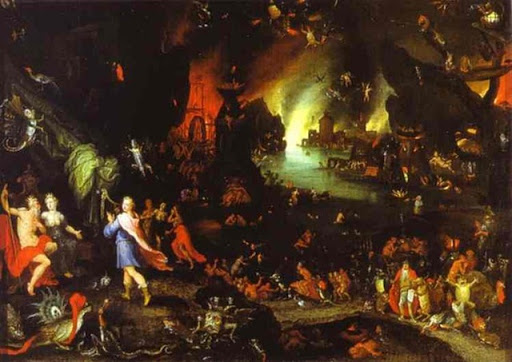
Underworld

(Orpheus in the Greek underworld.  On the left, Hades and Persephone are seated on their thrones.  Orpheus is attempting to win his wife’s freedom from the underworld through his beautiful music.)

The final paper that I wrote for ‘World Civilizations: Pre-History to 1500’ dealt with the concept of man’s mortality in the Odyssey and The Epic of Gilgamesh, two examples of epic literature from ancient history.  The Odyssey as we know it today was written down in roughly 700 BC and The Epic of Gilgamesh was composed sometime around 3000 BC.  Today, people look to medical science and wonder if or when immortality will be achieved.  A few hundred years ago, people were questing after the Fountain of Youth (which has a parallel in The Epic of Gilgamesh).  Before that, people looked to magic or grants of eternal life from the gods.  It’s amazing how some aspects of what it means to be human don’t change.  If you’re not a student doing research, this might be dry reading!  Footnotes are at the bottom, along with a bibliography.  The paper was graded and received an A.


The Epic of Gilgamesh, which dates back to approximately 3000 BC, is a story that originated in the Mesopotamian area. It has survived to the present in the form of stone tablets and fragments of stone tablets which are being excavated from the ruins of abandoned cities in the modern Middle East.[1] These tablets have been translated by linguists from their various languages and compiled into a readable story by N. K. Sandars. The Odyssey, a Greek tale, was composed and written down in roughly 700 BC[2], but the stories it contains are believed to date from the beginning of the 12th century BC[3]. Prior to being written down, these stories were transmitted from generation to generation orally by professional bards. There is some speculation as to who composed the version used today, but authorship is generally attributed to Homer. Despite the large amount of time that passed between the writing of The Epic of Gilgamesh and the Odyssey, the stories share many similarities, including an underlying theme of the mortality of man and what it means to die.

Both stories clearly define man’s distinction from the gods, in that men are mortal while the gods are not. In the second chapter of N. K. Sandar’s translation of The Epic of Gilgamesh, titled “The Forest Journey”, Enkidu and Gilgamesh are sitting together and discussing a dream that Gilgamesh has. Enkidu interprets his dream, telling Gilgamesh that “The father of the gods has given you kingship, such is your destiny, everlasting life is not your destiny.”[4] Gilgamesh later agrees by saying, “Where is the man who can clamber to heaven? Only the gods live for ever with glorious Shamash, but as for us men, our days are numbered, our occupations are a breath of wind.”[5] Gilgamesh recognizes the fact that man has a limited life span on earth and that only the gods have power over immortality. This sentiment is echoed by Penelope in the Odyssey when she tells Odysseus that “Men’s lives are short.”[6] Man’s mortality is also expressed in Odysseus’ encounter with Calypso. When Hermes informs Calypso that she is required by Zeus to send Odysseus on his way, she tells Odysseus that he “need grieve no more; [he] need not feel [his] life consumed”[7] there on her island. This demonstrates that man’s time is finite and that it will eventually be consumed and extinguished. She entreats him to stay with her forever and offers him immortality, reminding him that there is a clear difference between them and that without her intervention he will eventually die. She also asks him if his mortal wife, Penelope, can compare to her, an immortal goddess. In his reply, Odysseus affirms that death and old age are unknown to the gods, while at some point Penelope will grow old and die, as all mortals do.[8] In both The Epic of Gilgamesh and the Odyssey, every man knows that he must eventually die, but there are loopholes. With the assistance of the gods, life can be extended. If Odysseus stays with Calypso, he can be immortal in the sense that he lives forever, but if he leaves, he will age again. This is not true immortality. It is an extension of life. The gods cannot change the fate of man. They can merely delay it. In The Epic of Gilgamesh, Utnapishtim is said to be immortal, but his residence seems to be restricted to the island he lives on, presumably because that is where the plant that restores youth grows. One can infer that he is not truly immortal, but gains a modicum of immortality by remaining young through eating the plant, which may be a gift to him from the gods. True immortality is the realm of the gods, and while man may aspire to live forever, he cannot escape his mortality.

The only ‘immortality’ left to men is created and maintained in the memories of others through performing glorious and heroic deeds that will be spoken of, hopefully, for all time. It is with this in mind that Gilgamesh encourages Enkidu to accompany him to the Cedar Forest to do battle with Humbaba. Prior to leaving, Gilgamesh prays to Shamash for permission to enter the Cedar Forest, and in the course of explaining his desire, he again reiterates the idea that man cannot live forever and that he has to establish his name in another way. He tells Shamash, “I have looked over the wall and I see the bodies floating on the river, and that will be my lot also. Indeed I know it is so, for whoever is tallest among men cannot reach the heavens, and the greatest cannot encompass the earth.” He goes on to say that he will “set up [his] name where the names of famous men are written; and where no man’s name is written [he] will raise a monument to the gods.” He wants his name “stamped on brick.”[9] He wants glory and he wants to be remembered. He even welcomes the idea of falling in battle to Humbaba, believing that having his name linked to a great battle will ensure immortality in the memories of men. He tells Enkidu during their journey together to the forest that if they fall, they will “leave an enduring name.”[10] Of course, Gilgamesh does not wish for death, perhaps because that would prevent him from finding further glory, but if he dies, then he wants to die in a way that will ensure his name his remembered. The sister story to the Odyssey, the Illiad, says much about finding glory (‘kleos’) and a glorious death, but the Odyssey has no real parallel with this theme, since it is primarily a ‘nostos’ story, a story of homecoming. The only instance in the Odyssey where Odysseus could be said to be seeking glory is during his encounter with the Cyclops, Polyphemus. During this adventure, Odysseus and his men narrowly avoid being wholly slaughtered by the Cyclops, and while escaping on their ship, Odysseus says, “Kyklops, / if ever mortal man inquire / how you were put to shame and blinded, tell him / Odysseus, raider of cities, took your eye: / Laertes’ son, whose home’s on Ithaka!”[11] Because of the nature of the Odyssey as a ‘nostos’ story, a tale of homecoming and the tragedies of war, this act of glory-seeking is set up as the cause of all of Odysseus’ later problems. Humility, or at least the good sense to make a quick escape, would have had him pulling off quietly from the land of the Cyclops, but instead he taunts him, gives his name away, and thus reveals himself to Polyphemus’ father, Poseidon. Poseidon, enraged at Odysseus, takes actions that prevent him from reaching home, dragging out his return to Ithaka into a 10 year long ordeal that he barely survives. The Epic of Gilgamesh places a lot of emphasis on the necessity of seeking glory for one’s name. The Odyssey takes the opposite approach. In the Odyssey, Odysseus’ act of glory-seeking is the cause of the deaths of his whole crew and it is what prevents him from going home to his wife and son directly after the war. The suitors in his house, the suffering and mental anguish of his wife and son, his own suffering, all are a result of seeking glory. So, the Odyssey leaves the reader with the impression that glory alone isn’t enough, which is a theme that The Epic of Gilgamesh transitions to in the later stories.

Gilgamesh’s attitude towards death changes drastically after the encounter with the Bull of Heaven. Ishtar is offended by Gilgamesh and Enkidu and convinces the other gods that one of them must die. This fate falls on Enkidu and rather than dying gloriously in battle, he dies from sickness. Even worse, it is a prolonged sickness that leaves Gilgamesh traumatized. He realizes that “misery comes at last to the healthy man, the end of life is sorrow.”[12] Enkidu’s vision of the underworld, where even great men like kings and princes are reduced to bird-men that eat dust and clay, terrifies Gilgamesh. After Enkidu dies, he cries out, “Despair is in my heart. What my brother is now, that shall I be when I am dead.”[13] Gilgamesh sees that despite the great adventures they had together, Enkidu’s death is still final and a memory of past glories is not enough. Enkidu is still condemned to sit forever in the house of the dead. Gilgamesh suffers because his brother has been taken from him, but also because he does not want to share the same fate. He wants to live. He realizes that a glorious death is still death, but rather than accept it, he sets out to find immortality. This attitude towards death has a direct parallel in the Odyssey, expressed through Odysseus’ accumulating grief at seeing the ravaged state of the shades in Hades.[14] It reminds him of how final death is. In the shade of Elpenor, he sees that death comes to every man, great and small. In the shade of Agamemnon, he sees that death claims the great. In the shade of his mother, he feels his own impending death personally, as well as a more profound sense of loss at the memories and time with family he missed out on by leaving home in search of glory.[15] Even the shades of great heroes like Achilles and Heracles wind up in the realm of the dead, suffering the same fate as all men. They are separated from life and the people they love, as Gilgamesh finds himself separated from Enkidu. Achilles sums it up best, when he tells Odysseus that glory counts for nothing after death, that it is “better… to break sod as a farm hand / for some poor country man, on iron rations, / than lord it over all the exhausted dead.”[16] This is a lesson for Odysseus that he should enjoy every part of life while he can, before he dies, because after death glory means nothing, especially to the dead. Unlike Gilgamesh, he accepts it. After many trials and travels, Gilgamesh encounters his own shade of Achilles, in the form of a woman that lives in the garden of the gods named Siduri. She gives Gilgamesh advice that echoes Achilles’ statement. When she inquires as to why he has traveled so far, he tells her that he is searching for a way to live forever. She replies:

“Gilgamesh, where are you hurrying to? You will never find that life for which you are looking. When the gods created man they allotted to him death, but life they retained in their own keeping. As for you, Gilgamesh, fill your belly with good things; day and night, night and day, dance and be merry, feast and rejoice.”

Siduri tries to get Gilgamesh to see that his quest is futile and encourages him to enjoy the life he has left in him. Man cannot avoid death and there is no amount of glory that can change the fact that after death, a man will sit in the house of the dead, alongside kings and commoners. The important thing to do is to enjoy the world of the living while one still has life, which is a lesson that Odysseus learned by speaking to the shades of fallen friends and family. Life is more important than glory.

Prior to speaking to the shades in Hades, Odysseus was still living for adventure. The experience, especially of seeing his mother, whom he tried and failed to hug, twice, reminded him of how short life is, and what it really means to die. The Epic of Gilgamesh’s parallel for the Odyssey’s shades can be found in Gilgamesh’s encounter with Utnapishtim. Gilgamesh attempts to convince Utnapishtim to give him the secret to living forever by passing a test, which is itself a reminder of how ridiculous it is for a man to want to live forever. Unable to pass this test, Utnapishtim sends Gilgamesh home, but makes sure to reinforce his point through two more examples. Utnapishtim gives Gilgamesh a set of clothes to wear on his return journey that will not wear out or show signs of aging. This is a reminder to Gilgamesh that even simple objects will outlive a man. One last spur to drive the point home is the plant that Utnapishtim tells Gilgamesh about. It is a plant that will restore a man’s youth to him. Gilgamesh is successful in obtaining the plant, but before he returns with it to Uruk, or is able to use it himself, it is snatched away from him by a snake, reminding him that life is fleeting and cannot be held on to by man. Immortality is for the gods alone.

Despite being written by people from two different cultures, over one thousand years apart, the continuity of ideas regarding the afterlife presented in both works remains remarkably similar. In both The Epic of Gilgamesh and the Odyssey, the heroes admit outright that they know that immortality is reserved to the gods. In both stories, there are examples of opportunities to extend one’s life, perhaps to a semblance of immortality, but this is an exception, rather than a rule, and is not true immortality. Man has a fate and that fate is to eventually die. Only the gods live forever. In both stories, there is an obvious fear of being forgotten, and to avoid being forgotten, men go out seeking glory, to ensure that their names are remembered. Both stories, though, remind man that the best part of living is being alive and that glory counts for nothing after death. Even glorious heroes wind up in Hades or the house of the dead yearning for the living while the living yearn for the dead. What both of these stories try to impart to readers is that glory isn’t as good as it’s made out to be. Life is amazing and should be cherished by filling our bellies with good things, by dancing, being merry, feasting and rejoicing, because being alive and spending time with loved ones is worth more than lording it over all of the exhausted dead.


[1] Introduction by N. K. Sandars, Penguin Classics edition of The Epic of Gilgamesh.

[2] Page 3, “Date of Composition” section of Stanley P. Baldwin’s CliffsNotes on The Odyssey.

[3] Researchers have used astronomical events depicted in the Odyssey to determine that Odysseus slaughtered the suitors in his home on April 16th, 1178 BC.

[4] Page 70, The Epic of Gilgamesh, N. K. Sandars.

[5] Page 71, The Epic of Gilgamesh, N. K. Sandars.

[6] Book XIX, Line 386, Fitzgerald translation of the Odyssey.

[7] Book V, Lines 169 – 170, Fitzgerald translation of the Odyssey.

[8] Book V, Lines 212 – 228, Fitzgerald translation of the Odyssey.

[9] The previous three quotes are from page 72, The Epic of Gilgamesh, N. K. Sandars.

[10] Page 77, The Epic of Gilgamesh, N. K. Sandars.

[11] Book IX, Lines 548- 552, Fitzgerald translation of the Odyssey.

[12] Page 93, The Epic of Gilgamesh, N. K. Sandars.

[13] Page 97, The Epic of Gilgamesh, N. K. Sandars.

[14] In “Singers, heroes, and gods in the Odyssey”, Segal reaches this conclusion through the formulaic repetition of the line “When I saw him I wept and pitied him in my heart”, said by Odysseus, upon seeing the shades of Elpenor, his mother and Agamemnon. Page 41.

[15] Segal, Page 42.

[16] Book XI, Lines 579 – 581, Fitzgerald translation of the Odyssey.


Bibliography

Baldwin, Stanley P. CliffsNotes on Homer’s The Odyssey. John Wiley and Sons, 2000.

Fizgerald, Robert. The Odyssey. New York: Farrar, Straus and Giroux, Inc., 1998.

Maugh II, Thomas H. “Astronomers hit a homer with ‘Odyssey’.” Los Angeles Times. June 24, 2008. http://articles.latimes.com/2008/jun/24/science/sci-odyssey24 (accessed July 29, 2011).

Sandars, N. K. The Epic of Gilgamesh. New York: Penguin Classics, 1972.

Segal, Charles. Singers, heroes, and gods in the Odyssey. Cornell University Press, 2001.

<

p style=”line-height:22pt;margin:0;” class=”MsoNormal”> 

National Night Out (Against Crime) 2011

Well, it happened yesterday so this isn’t so much a post about looking forward to observing it as it is about, “Oh look. Llamas and donkeys. Why are those in Campos Plaza?”

Farm animals in New York City.

Farm animals in New York City.

Farm animals in New York City.

Farm animals in New York City.

Farm animals in New York City.

This immediately reminded me of a joke I heard about Singaporeans.  A teacher (in Singapore, with Singaporean students) asks her young students (think, 8 years old) to draw pictures of farm animals.  So, the students happily sit around drawing for awhile and then present their work to the teacher.  One boy walks up and proudly shows her his drawing of a chicken, and it looks really good, except the chicken he draws has no feathers on it.  She asks him why he drew the chicken without feathers, and he asks, “Chickens have feathers?”

This is funny, but I completely understand the reality behind the joke.  In a place like Singapore, which is highly metropolitan, it would be very rare for kids to see any chickens other than the plucked and cooked ones hanging on hooks at the hawker centers.  Even when I lived in Georgia, I would get excited at seeing horses or cows or other farm animals.

A hawker center in Tampines, Singapore.

Anyway, when I was heading home yesterday, I smelled animals and I saw a lot of people in the square between a set of buildings so I went to investigate and these guys in the photos above were the first thing that pulled my attention.  It was fun!

National Night Out Against Crime 2011, New York City.

National Night Out Against Crime 2011, New York City.

I didn’t investigate all of the booths, but the one to the right in the second picture above had face painting, which is why the line was so long.  I imagine the table on the left in the above picture had something to do with distributing literature regarding crime prevention, since it was manned by NYPD officers.

US Army Recruiters at National Night Out Against Crime 2011, New York City.

I was, of course, drawn to the set up in the photo above.  I was curious to see what the recruiters were up to, having been in the Army myself.  I wound up spending about half an hour chatting with Sergeant First Class Chen.  He’s a pretty nice guy.  We traded a few stories.  I told him about my time in service and he talked mostly about the benefits and stability of joining the Army Reserves after leaving Active Duty, but that’s his job after all.  We did talk a bit about some of the things that make you say, ‘WTF?’ while you’re in service.  It was nice to reminisce for a while, about the time I spent in the military.  It wasn’t all good, but it definitely wasn’t all bad either.

It was a pretty nice event overall, and it was good to see something positive taking place in the square for a change.  The area is known for violence and drug related shootings.  Ironically, the ‘Night Out Against Crime’ booths started shutting down and wrapping up as the sun set.

The Limelight Market

The Limelight Market, New York City

The Limelight Market, New York City

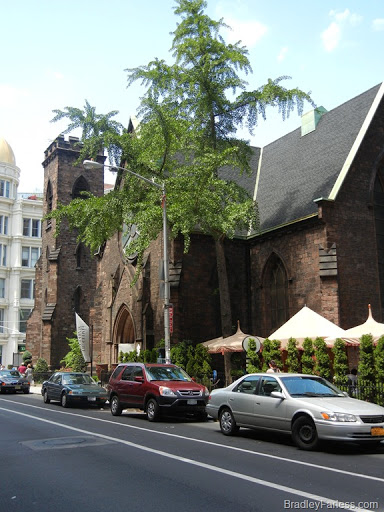
The Limelight Market, located at the corner of 6th Avenue and 20th Street, is a pretty interesting place, but mostly because of the building it occupies.  As you can tell from the exterior, this building used to be a church.  When you get inside, you’ll see that the chapel has been converted into a series of small stores.

A yogurt shop, inside the Limelight Market, New York City.

This is a yogurt shop.  I didn’t try any, but there was a constant stream of people going to the counter, so it must be pretty good.  Around the corner to the right is Jezalin’s, where I got the kopi luwak arabica.

Inside the Limelight Market, New York City.

Turn around the other way and you see one of the boutiques.  I didn’t pay much attention to what was being sold in the boutiques.  It all looked a little too pricey and useless for my taste.  Through the door in the back there I think there was a pizza restaurant.

Inside the Limelight Market, New York City.

If, from where I was standing in the previous picture, you were to walk forward and go to the left you’d wind up in this area, which looks like it used to be the main sanctuary.  You can walk up onto the second level using stairs hidden away on the sides.  There were more display cases up there and what looked to be a coffee bar that had shut down.  I have a feeling the rent in this place is pretty high, which might be why Jezalin’s was trying to drum up more business by offering the Groupon discount on their kopi luwak.

Stained glass window in the Limelight Market, New York City.

I couldn’t get a straight on shot of the stained glass window because the area was blocked off by a register and some merchandise.  There were smaller stained glass windows in some of the stairwells, but they weren’t completely viewable.  The railing they’d built into the original structure to support the second level and the stairs blocked the windows partially.

Like I said, this isn’t the type of place I’d shop at for myself.  I’ll probably go back just to look around again, and maybe to get another cup of that coffee.  For me, the real fun was waiting outside:

The Rescue Rover, parked outside the Limelight Market.

I love when I see these vehicles, because it’s an opportunity to go inside and play with cats!

Rescued cat, looking for a new home.

Rescued cat, looking for a new home.

I wish I could take them all home…

A 30 Dollar Cup of Pre-Digested Coffee

Kopi Luwak Arabica

What you’re looking at is 30 dollars in a cup, believe it or not.  This is Kopi Luwak Arabica.  Why is it so expensive? Well…

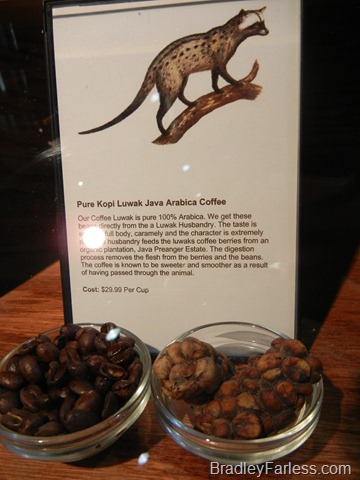
Pure Kopi Luwak Java Arabica Coffee

It’s all in the digestion… or production… process.  You see, this coffee is made from beans that have been previously digested and crapped out by an Asian palm civet.  In the picture above you can see an example of the coffee beans prior to cleaning and roasting, and the finished product on the left.  The cost of the animal husbandry and the long process of securing the digested beans is what makes the coffee so expensive.

Jezalin's New York in Limelight Market

When I lived in Singapore I’d heard about this coffee.  It’s mostly produced in Indonesia.  I never did take the time to try it out while I was there, and of course I wasn’t about to spend 30 dollars on a cup of coffee here in the US, so I was happy to see a Groupon pop up for a 20 dollar discount at Jezalin’s, which is where I had my first kopi luwak experience.

Jezalin's New York in Limelight Market

Jezalin's New York in Limelight Market

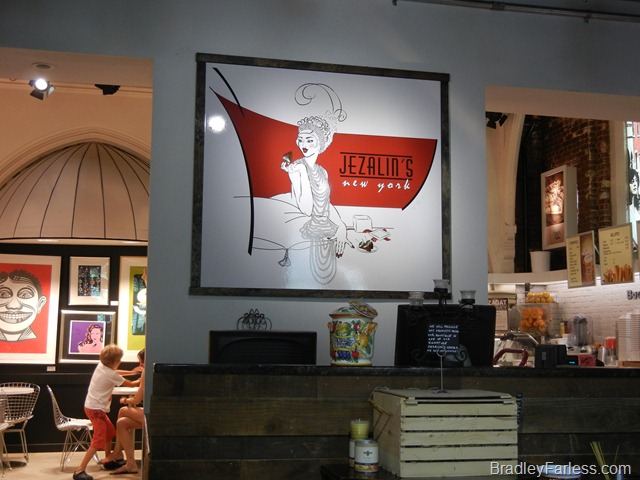
Like the rest of the Limelight Market (corner of 6th Avenue and 20th Street in Manhattan), Jezalin’s has a really nice, classy atmosphere.  When I got my cup of coffee, the girl behind the counter (also visible in the picture above) came over and showed me the display and explained the process.  I was already familiar with where the coffee comes from, but it was fun to listen to her talk about it.

So, was it worth it?  It was definitely worth the 10 bucks I wound up paying.  The kopi luwak tastes like coffee, but it has a thicker taste to it.  It’s not as strong as coffee.  It has a more mellow, earthy (poopy?) taste to it.  Oddly enough, I felt like taking a nap after finishing it off.  At 30 bucks a cup, it’s not going to replace my morning cup of coffee, but it was a pleasant experience overall, and I’ll definitely convince my wife to try some.

The Power of Religious Texts in History

This is something I wrote for a World Civilizations: Pre-History to 1500 (101) class.  The task was to pick a piece of literature, from religious texts to epic poems to economic records found at archaeological sites, and then describe how that work affected history.  I suppose you could say I took the easy way out and chose to write about the Bible and how it has affected history.  If you’re curious, this paper received an A.  Footnotes will be appended to the bottom of the post, along with the bibliography.

bible1

(Image via godisforreal.wordpress.com)

Literature has always played an important role in recorded history. It is a method of preservation of the moment. It captures the ideas, the problems, the aspirations and dreams of a society and, when read from a historical perspective it can offer an open window into the world of the writer. No form of literature has as much impact on history as religious texts. Perhaps the most influential religious work of all time, the Bible[1] has impacted the lives of countless people throughout history. In this paper, the impact of the Bible will be briefly explored to demonstrate the importance it has played in shaping, stabilizing, and sometimes disrupting society.

When Christianity first appeared in the Middle East it was a revolutionary movement with no specific set of religious texts. Various gospels and epistles were being circulated, but there was no accepted canon of scripture until perhaps the late 4th century AD.[2] The result of this is that there was a wide array of Christian sects, all with varying beliefs. There was no structure to the religion, which could cause confusion about what was and wasn’t ‘true’. Through the work of early church figures, like Bishop Athanasius of Alexandria, that changed. Bishop Athanasius worked to consolidate which scriptures would be regarded as canonical and which were, according to him, heretical.[3] Coming at about the same time that Theodosius I declared Catholic Christianity as the official and only permissible religion of the Roman Empire (380 AD), this acted as a strong unifying force that would have an enduring effect on history, European history most especially. The Catholic Church claimed its authority based on the newly standardized canon gospel of Matthew, citing chapter 16, verse 18, which says, “And I say also unto thee, That thou art Peter, and upon this rock I will build my church; and the gates of hell shall not prevail against it,” as the source of its legitimacy.[4] The acceptance of the canonicity of the gospel, what we know as the Bible today, is what allowed the Catholic Church to hold power over the people, as well as to stamp out opposition. The Church also used its divine authority to control the rulers of the people throughout Europe up until the French Revolution of 1789-99. With the Bible as its basis, the Papacy of the Catholic Church bestowed divine authority on the monarchies of the developing European nations, allowing for the formation of governments and modern nation states. Most of the countries in Europe today exist due to monarchical legitimization by the Catholic Church, which derived its religious authority from the Bible. These nations have played major roles in the development of the rest of the world and, in most cases, continue to be major world powers today. These nations that are shaping the world today were themselves shaped by Christianity and the Bible.

In addition to shaping nations, Christianity has played a role in creating social stability through Christian morality and Christian value based legal systems. Mircea Eliade wrote that “The manifestation of the sacred ontologically founds the world. In the homogenous and infinite expanse, in which no point of reference is possible and hence no orientation can be established, the hierophany[5] reveals an absolute fixed point, a center.” Or, in other words, religion creates a stable center for people to start from, a check to balance their view of the world and define their existence. The religion revealed through the Bible served this purpose for Christians. The Bible affects the lives of those who read and believe in it by influencing them to conform to a lifestyle that is in accordance to its teachings. John 14:6[6] tells believers that Jesus said, “I am the way, the truth, and the life: no man cometh unto the Father, but by me.” It is impossible to come to Jesus without repentance and living according to the teachings of the Bible. Getting into Heaven is a strong incentive to develop and maintain a Christian, Biblical lifestyle, which regulated everything from birth (baptism) to marriage (holy vows) to death (Christian funeral rites), and most things in between. As mentioned earlier, this belief in the Bible and Biblical living created the monarchies and modern nations which, along with creating common customs, stabilized society, but it also went a step further in creating social stability through later legal systems. The values established by Christianity were converted into the foundations of Western legal systems. Christian values have persisted in our Western legal systems and institutions up until the modern time. John Jay, the first Chief Justice of the United States (1789-95) once wrote in a letter that “The Bible is the best of all Books, for it is the Word of God, and teaches us the way to be happy in this world and the next. Continue therefore to read it, and to regulate your life by its precepts.”[7] While not expressed outright in the US Constitution or legal system, the values that Americans inherited from Christianity have influenced and continue to influence the workings of government. A good modern example is the current debate on the legality of homosexual marriage, which is undeniably being opposed on wholly religious grounds.

Using the same example, the Bible has been so influential that it has also caused disruptions in societies throughout history, including Christian societies and modern societies. As a sacred text, the meaning of the words it contains is open to constant interpretation based on who reads it. Those interpretations haven’t always had a positive effect. During the 11th, 12th and 13th centuries, the Roman Catholic Church used its Biblical authority to declare religious wars on neighboring nations. The effects of the Crusades continue to be felt today by Islamist terrorists using the concept of Crusades as a justification for violent and lethal actions against Western, ‘Christian’ nations. The Bible has also been used as a justification for the violent suppression of minorities throughout history. Well known examples are the Medieval Inquisitions, the Spanish Inquisition and the Salem Witch Trials. The Bible has been used to oppress women through selective quotation and reading out of context, with 1 Corinthians 14:34-35 being a prime example:

“Let your women keep silence in the churches: for it is not permitted unto them to speak; but they are commanded to be under obedience as also saith the law. And if they will learn anything, let them ask their husbands at home: for it is a shame for women to speak in the church.”[8]

The Bible was used to justify slavery in the United States, either arguing its morality through the omission of its condemnation in the Bible or by making a broad claim that God created slavery and so it must be good, as Jefferson Davis, the President of the Confederate States of America did. He said, “Slavery was established by the decree of Almighty God…. It is sanctioned in the Bible, in both Testaments, from Genesis to Revelation…. It has existed in all ages, has been found among the people of the highest civilization, and in the nations of the highest proficiency in the arts.”[9] Today, the Bible is used as a source of justification for the suppression of the right to equality that homosexuals should enjoy under the secular government in the United States. It is still used by fringe groups to support destructive beliefs. The Bible is just as strong a force for disruption of society as it is for good.

Throughout history, the Bible has been used extensively to justify both positive and negative actions. It has been used to stabilize and homogenize society. It has been used as the basis for customs, holidays, and the building of nations. It has also been used to destroy enemies, suppress minorities and justify violence. Without a doubt, the Bible is an epic piece of religious literature that has had a profound effect on our world, exemplifying the power of the written word to influence history.


[1] The general concept of a canonical written Bible as accepted by branches of Christianity, without considering the differences between accepted canon and apocryphal works in various traditions.

[2] According to the Columbia Apologetics Toolkit, adapted from the materials of Professor Paul Hahn of the University of St. Thomas, Houston, Texas.

[3] According to the National Geographic special, The Gospel of Judas.

[4] King James Version

[5] Mircea Eliade defines “hierophany” as the sum of its etymological content, “something sacred shows itself to us.”

[6] The Book of John, Chapter 14, Verse 6 of the King James Version of the Bible.

[7] John Jay to Peter Jay, April 8, 1784.

[8] King James Version.

[9] From the antebellum slavery debates in America, quoted in a book by Mason Lowance.

Bibliography

National Geographic: The Gospel of Judas. Directed by James Barrat. Performed by Peter Coyote. 2006.

“Development of the Biblical Canon.” Columbia: Apologetics Toolkit. 1995. http://www.columbia.edu/cu/augustine/a/canon.html (accessed July 9, 2011).

Eliade, Mircea. The Sacred and The Profane: The Nature of Religion. Orlando: Harcourt, Inc., 1959.

Hutson, James H. The Founders on Religion: A Book of Quotations. Princeton University Press, 2007.

Lowance, Mason I. A house divided: the antebellum slavery debates in America, 1776-1865. Princeton Univeristy Press, 2003.

Thomas Nelson Bibles. The Holy Bible; Containing the Old and New Testaments; Authorized King James Version. Nashville: Thomas Nelson, Inc., 2001.


I am now a stalker, says the crazy neighbor.

After getting off the bus, I turned the corner and started walking up the street towards my mom’s apartment building.  Just after turning the corner, I saw the woman that lives next door to my mom.  She stopped for some reason and turned around and when she saw me she threw up her hands and made a weird noise.  She’s deaf and doesn’t speak, at least not intelligibly, so I went past her and kept going.  I wasn’t trying to be rude, but I just didn’t know what she wanted or if she was even attempting to communicate with me.  She suddenly rushed past me and kept looking over her shoulders, making a ‘no no no’ gesture with her finger in front of her face while mumbling.  She rushed off at full speed to the building where my mom’s apartment building is.  Some of the people in my mom’s apartment building are disabled, so I didn’t think much of it.

I entered the lobby just in time to see the elevator door close.  The door on the second elevator was opening though, so I got on and rode up to my mom’s floor.  When I stepped out into the hallway I could hear her making a lot of noise.  I looked, and my mom’s apartment door was open.  She was gesturing wildly and making plenty of loud noises that neither my mom or I could understand.  I walked down the hallway and when she saw me she got even more agitated.  So, I stood there with my mom trying to figure out what her issue is.

Through a combination of hand gestures and her very strained attempt to say the word “following”, we finally concluded that she is freaking out because she thinks I’m always following her.  The fact that there is only one way to get to my mom’s apartment from the bus stop, only one set of elevators and only one hallway that goes to my mom’s apartment, which is right next to hers, seems to have totally gone over her head.  The fact that we’re bound to run into each other in those areas, seeing as how we’re typically going to be heading for that same floor and two adjacent doors in the hallway, well that seems to have gone over her head too.  She’s outright convinced that I’m stalking her and that I’m out to get her.

I’d noticed previously that she would always rush into the elevator and close the door before I could get to it, or if I got in the elevator she would wait for another one rather than ride in the elevator car with me.  I never really put it together, but the idea that I’m following her around intentionally is ludicrous.  It never ceases to amaze me, the kind of fantasies people can create for themselves and live in.  Of all of the women in the street, why would I choose to, as she seems to be implying, stalk a late 40s, overweight, deaf woman that lives next door to my mom?  Besides the fact that I’m married, I’m really not interested in old disabled women.  Even if I were a stalker, as she seems to think I am, well, it’s summer in NYC.  There are plenty of better looking women to be following around.

I just hope that this woman doesn’t completely flip out, because there’s no way this will be the last time she’ll see me going in and out of the building.

Trail of Faces and a Chalk Dust Flower

There were plenty of people at Union Square yesterday with tables set up, trying to make a buck off of their artwork.  Two artists were using a method of making art that you can’t really buy and take home, though.  One guy was making a trail of faces on the pavement and another made a flower pattern out of chalk dust.

Felix Morelo, drawing a Trail of Faces.

I had seen Felix Morelo’s artwork before, last Fall I think.  I’d almost forgotten about it and I don’t know why I didn’t take any photos of the faces, because the work he did then was a lot better than what I saw yesterday.

What he does is he gets himself a bag of chalk and a crate to sit on.  He draws a face, moves back, draws another face, etc. etc.  What he winds up with is a Trail of Faces, with each face a bit different from the others.  It doesn’t sound like much, until you look down the long line of faces and realize the sheer quantity of his work.  Quantity isn’t the same as quality, but overall I think it was worthwhile to stop and admire.

Right next to the Trail of Faces I saw a flower design made out of chalk dust.  I don’t know the story behind this.  I’d never seen it before, but there was a pail sitting nearby for money donations.  The bags on the ground around the design are full of chalk dust of different colors.

It’s nice to see something going on in the park.  After a quick burst of activity in the Spring, things have really died off, but I’m not really surprised.  It’s getting hot out there!

The Chicago Assyrian Dictionary: Opening a New Door on History

This is a writing assignment I did for a World Civ 100 class I’m currently taking.  Expect more regular updates soon.

The question:

First you should summarize the article, then give your thoughts about it and tell how it might be useful in our class and to the scholarly world in general. You can certainly include negative andpositive thoughts about the article.

The article:  After 90 Years, A Dictionary of an Ancient World (NYTimes)

My response:

The Chicago Assyrian Dictionary: Opening a New Door on History

After 90 years of effort on the part of the Oriental Institute at the University of Chicago, a project titled the Chicago Assyrian Dictionary has finally been completed. This 21 volume dictionary compiles the definitions and usage explanations of words from the ancient Mesopotamian language, including its Babylonian and Assyrian dialects. This monumental achievement has opened a new door for all scholars interested in researching the Mesopotamian people and their culture.

According to a New York Times article published online (footnote was inserted here), this dictionary covers the language as it was used from roughly 2500 B.C. to 100 A.D. The project was initially started by Dr. James Henry Breasted in 1921, but didn’t make too much progress until after World War II, when the project was reorganized. The first volume of the set was published in 1956, with 20 following volumes being published over a 55 year period under the editorship of A. Leo Oppenheim, Erica Reiner and Dr. Martha Roth, the current dean of humanities at the University of Chicago. The dictionary is comprehensive, covering word usage and nuances, as well as cultural material available that relates to the word being defined.

The best way to understand any culture is by examining primary sources. The best primary source is a set of written records, but those records are meaningless if a scholar cannot completely understand the language. By unlocking the Assyrian language and making it accessible to scholars everywhere, the team at the University of Chicago has opened a door to new and hopefully more insightful studies of the Mesopotamian civilizations. Having a reviewed and reputable resource to draw from, scholars can now make better informed translations of the material they’re working with, whether it is a cuneiform tablet of a contract, or a literary work. The effort the team made in defining the nuances and various usages of the word, rather than giving simple definitions, added immense value to the work as a whole. The meaning of a text can sometimes change drastically based on a misinterpretation of one word. With a new standard to build from, scholars and translators can hopefully render the Assyrian language into English with greater efficiency and accuracy. Additionally, currently existing translations can now be vetted against this dictionary to check for accuracy.

This accomplishment can also greatly benefit classroom study. A common misconception among people today is that people from ancient civilizations were inherently less intelligent than modern people. By presenting examples of the Assyrian language (from entries in the Chicago University’s Assyrian Dictionary) to students today, a professor could demonstrate the complexity and depth not only of their language, but of their society as a whole. When discussing literature from Mesopotamia, the professor could introduce printouts of key terms from the work for classroom study so that students will have a greater understanding of the social constructs present in the work. As Gil Stein, the director of Chicago University’s Oriental Institute said in the New York Times article, this dictionary “is an indispensable research tool for any scholar anywhere who seeks to explore the written record of the Mesopotamian civilization.”

The compilation and publication of the Assyrian Dictionary by the University of Chicago will have a lasting and profound impact on the study of Mesopotamia. It is a vital and robust tool that can be used by professionals and scholars to make more accurate translations of the Assyrian language. For students, the dictionary will be an excellent tool for expanding their knowledge of the Mesopotamian world and ancient civilizations in general. The Assyrian Dictionary is a work of immense value that sheds new light on an ancient civilization and it will be used as a basis for research and study far into the future.

Bibliography

Wilford, John Noble. “After 90 Years, a Dictionary of an Ancient World.” The New York Times: Science. June 6, 2011. http://www.nytimes.com/2011/06/07/science/07dictionary.html (accessed July 7, 2011).

This paper received an A, but I don’t think it was graded too critically.