59th Street-Facing Entrance to the Central Park Zoo
Yesterday my wife and I went to the Central Park Zoo. Going to the zoo is something of a tradition for me. Whenever I used to come to New York City to visit family, I’d always make it a point to go see the Central Park Zoo and the American Museum of Natural History. I have photos of me as a little kid and then again as a teenager in front of the blue whale in the AMNH. I also have a fond memory of the giant ant farm in the Central Park Zoo. It inspired me to get a smaller version and keep it on my desk at home.
Ants in the Philippines, stealing cat food.
While living in Asia with my wife, I learned to hate ants. They got into everything and there was no way to kill them all or keep them out. They even did night time raids on the pet’s food bowls, carrying whole pieces of cat food up the wall and out of the house through the ceiling. Still, that didn’t stop me from wanting to share the excitement of a giant ant farm, and the memory of me being there as a kid, with my wife when we went to the zoo yesterday.
One of the chambers in the Central Park Zoo ant habitat. All that’s left are a few corpses.
Unfortunately, we were disappointed. All that was left of the amazing, huge colony were a few dead ants. I spoke to one of the people that works there and she said the colony’s queen had died and they were having trouble replacing her. She said it had something to do with the government making importation of a new queen difficult. She also said they no longer had an “ant person” and would need to hire someone.
The nasty hissing cockroaches that are living in the ant farm, since all the ants are gone.
The habitat isn’t completely abandoned. While peering this way and that, looking for ants, I realized I was staring at a bunch of hissing cockroaches. Disgusting things. I hope whatever issues the zoo is having get worked out soon, because I’d much rather see the ants. I wish I’d had an opportunity to get some good photos of that colony before it died out.
The trip to the zoo wasn’t all disappointment. I’ll post more tomorrow.
While walking through Central Park today on the path that parallels 59th Street, we ran into a wedding ceremony by the Duck Pond. Even though it’s winter and also the middle of the week, there was a surprising number of people in the park today.
As this wedding ceremony concluded and the bride and groom kissed, a few people that were watching from over the park wall, on the 59th Street sidewalk, cheered and whistled, which is why the bride looks so amused in the last photo.
I should have known better, but while my wife and I were out today, I managed to get us stuck in a tourist trap. We were in Times Square, waiting to meet up with family for lunch at Olive Garden and I saw a person dressed up as a Smurf, so I asked my wife if she wanted her picture taken. She thought it would be fun, so we walked over, took the photo and started to walk away when the smurf-person stopped us and held up a bag. I looked inside and saw some dollar bills, so I dropped a dollar in. I started to turn away, but then the smurf demanded not just one, but two dollars.
Later, as we were sitting inside the Olive Garden, I saw Scammer Smurf and his little friends congregating outside, scheming together and preying on tourists and other unwary pedestrians.
I think I fell for this because the last time I was in Times Square I had my photo taken with a person dressed as an M&M in front of the M&M store without being harassed for money. Like I said, though, I should have known.
I guess the moral of this story is: While in New York City, beware of cartoon characters carrying bags and posing for photos.
A friend of mine came across this documentary and passed along the link. I’m studying Middle Eastern history as my major, so he thought it would be relevant to my interests. It’s 79 minutes and the audio gets steadily further and further out of sync with the video, but hey, it’s free, and it’s worth the information you’ll glean from it.
What I saw in this video is nothing more than what I expected. I have little faith in the US government anymore. I mean, seriously. They can’t fix our economy. They can’t stop giving tax breaks to huge corporations. They can’t take care of Americans. They can’t do anything but blow up other countries to hide their own deficiencies. It also bothers me how caught up most people are in glorifying war and the military in this country. I think Americans are losing sight of what this country is supposed to be about. War isn’t a destination. War was a means of achieving a free society where people have inviolable rights. All people. Not just the ones we like. War is not glorious, and just because someone is from another country, they don’t lose their human rights. They’re still human beings. Why would we take someone for whom we have no evidence of wrongdoing and then treat them worse than we treat serial murderers, rapists and child molesters in the US?
I can understand the situation that was created in these prisons and it’s completely absurd to blame the front-line soldiers. In the military, there’s a whole other culture, distinct from regular American culture, and there’s a separate legal system and even a different way of thinking about things. For the most part, you do what you’re told, even when things start to spiral into the absurd, because that’s what you get trained to do: follow orders. When soldiers question orders, they’re reprimanded, disciplined and sometimes humiliated in front of their peers. They can lose pay, rank or status. So, there’s a lot of pressure to just follow orders, and I’m sure first-hand experience with public humiliation makes it easier to take the first step towards severe humiliation of prisoners whom your told have no rights and are something less than human.
So, things just get done because that’s what was ordered, and because everyone else is doing it. What I’m describing is just based on what I remember from my experiences in non-combat units. I can’t imagine the added pressures involved in dealing with people that you’re told are enemy combatants. This whole situation seems like something Stephen King would have cooked up for a horror novel, rather than reality. In the end, though, the unit commander should be ultimately responsible for the actions of the unit, both good and bad. A common saying in the Army is that “shit rolls downhill,” meaning from the top of the chain-of-command to the bottom, but it should also roll back up when something goes wrong like this.
Instead of trying to find ways to justify unwarranted violence and illegal torture, our politicians should be finding ways to stop blowing up other countries, defend our own, and fix our financial issues.
The Rock of Gibraltar, the name of which is derived from
the Arabic Jabal Tariq, “Mount of Tariq,” in honor of
Tariq ibn Ziyad, the Berber Muslim conqueror
of ancient Iberia, and essentially the founder of al-Andalus.
In 711 CE, a force of Berber Muslims under the command of Tariq ibn Ziyad landed on the southern shores of the Iberian Peninsula and engaged in a campaign of rapid conquest that culminated in the displacement of Visigoth rule in all but the northernmost parts of Iberia. The Visigoth controlled areas in the north later served as the launching point for the Reconquista, the ‘taking back’ of the Iberian peninsula from the Muslim invaders. Muslim rule in Iberia officially ended with the surrender of the Emirate of Granada to King Ferdinand II of Aragon and Queen Isabella I of Castile in 1492, but for nearly eight-hundred years Muslims retained governance over at least a portion of the peninsula and created a glowing civilization that set an example that unfortunately would not be followed.
Ferdinand and Isabella; Image from:
Convent of the Augustinian Nuns, Avila
Under Islamic rule, the Iberian Peninsula was marked by a level of religious toleration that was unheard of at the time and Muslims, Jews and Christians lived together in relative peace. There were tensions between the groups, and instances where violence seemed unavoidable, but by and large, the people of al-Andalus not only held their diverse nation together, they caused it to blossom into a society that still draws admiration today for its level of comparative advancement and toleration. Toleration for ethnic diversity and religious differences were the keys to success for al-Andalus, but after Granada fell in 1492 and the Reconquista was complete, one of the first actions taken by the Christian monarchs, Ferdinand and Isabella, was to decree the expulsion of the Jews. That was the same year the monarchs decided to fund Christopher Columbus’ voyage to what he hoped would be Asia. Ferdinand and Isabella wasted no time in establishing themselves as a powerful monarchy, but the example of intolerance they set was in direct contradiction to the legacy that had been left to them by Islamic Spain.
The Muslim’s initial conquest of the peninsula met with little resistance, largely due to the fact that the Visigoth rulers had managed to alienate their supporters (Lowney 31 – 32). The Iberians willingly submitted to the Muslims, since they were no harsher than the Visigoths had been. In the case of the Jews, Muslim rule was a vast improvement (Lea 1). The Jews were highly oppressed under the Visigoth rulers, who “forbade Jews from marrying Christians or owning Christian slaves, proscribed circumcision, outlawed observance of Jewish holy days, and ultimately offered Jews the stark choice of conversion, exile, or slavery” (Lowney 29). It also helped that the Muslims offered their newly conquered subjects favorable surrender treaties, such as the treaty offered to the Christian Prince Theodomir of Murcia, which says:
The latter [Theodomir] receives peace and the promise, under the guarantee of Allah and of his Prophet, that there will not be any change in his situation nor in that of his people; that his right of sovereignty will not be contested; that his subjects will not be injured nor reduced to captivity; nor separated from their children nor their wives; that they will not be disturbed in the practice of their religion; that their churches will not be burned, nor despoiled of the objects of the cult found in them… (Lowney 38)
The tolerant treaties the Muslims offered their defeated opponents was in keeping with the traditions of the Qur’an and helped set the stage for later peaceful relations between the three faiths in Islamic Spain.
In Islam, Jews and Christians are known as ′Ahl al-Kitāb, People of the Book who are protected, albeit with a second-class status. This protection, known as dhimmitude, is based on surah 29, aya 46 of the Qur’an, which says, “And dispute ye not with the People of the Book… but say, ‘We believe in the revelation which has come down to us and in that which came down to you; our God and your God is One’” (Lowney 38). Non-Muslim subjects of Muslim regimes were considered to be autonomous but dependent groups who were responsible for organizing their own internal affairs, including social, religious and communal matters. These minorities had leaders, appointed by the Muslim rulers, who were responsible for their group’s “ecclesiastical matters, internal disputes, and fines and taxes” (Lapidus 265). The leaders of these minority groups had such a level of independence that in legal cases involving two members of the same faith, their judges could inflict the death penalty without consulting the Muslim rulers (Khadduri, Liebesny and Jackson 340). So, Jews and Christians under Muslim rule had the ability to continue to practice and develop their faith, as well as practice their own legal system, within some limits.
The ability of subject faiths to practice their legal system had some restrictions. When cases involved serious crimes that constituted a threat to public order, Islamic law always took precedence. These included crimes such as murder, theft, or highway robbery (Khadduri et al., 340). There were also problems with how non-Muslims and Muslims related to each other legally. In legal cases that involved Muslims or a member of another subject faith, dhimmis were required to appear in Shari’ah courts, which took precedence over Christian or Jewish law. Appearing in Muslim courts was likely problematic for dhimmis, since their testimony was considered invalid under Shari’ah law, though exceptions were probably made in cases involving two members of subject religions, as qadis(Islamic judges) would need some form of information to settle a lawsuit or legal case. Another issue faced by dhimmis was that there were lesser penalties involved for a Muslim guilty of committing a crime against a dhimmi (Khadduri et al., 337). Dhimmis also could not inherit from a Muslim, based on the Qur’anic rule which says, “God will by no means make a way for the unbelievers over the believers” and a hadith which says, “The Muslim will not inherit from the unbeliever nor the unbeliever from the Muslim” (Khadduri et al., 343). So, a dhimmi was fully protected as a subject of the Muslim state, but suffered from certain drawbacks that relegated him to the status of a second-class citizen (Bennett 163). However unbalanced, dhimmitude offered the Jews and Christians of al-Andalus legal recourse and protection under the law. It gave them a legal place in the society, creating a state of convivencia, a coexistence where Muslims, Jews and Christians worked and lived together, if not as equals then at least as fellow citizens of the same nation (Rosser-Owen 77).
The status of dhimmis as being legal members of the state is part of Islamic religious law, but “there was no Scriptural basis for the legal status of Jews and Muslims under Christian rule; they were subject to the whims of rulers, the prejudices of the populace and the objections of the clergy” (Boase 22). It stands to reason that there were Muslims among the early invaders who would have preferred cultural and religious homogeneity, as the later Reconquista Christian Spaniards would, but in the case of the Muslims, religious law dictated that they must respect dhimmis, at least insofar as the law dictated. This religious legal requirement that offered Jews and Christians a place in Islamic society, which didn’t have a counterpart in their own societies, must have created a feeling of stability, safety and most importantly, belonging.
A sense of nationhood, of common standing with their fellow countrymen, could have inspired them to excel, and al-Andalus certainly excelled in many areas. The mix of cultures stimulated the intellectual pursuits of academics that produced advanced knowledge of mathematics, medicine, spirituality, astronomy, philosophy, and theology, and gave birth to some of the greatest thinkers of the age, such as the Jewish kabbalist Moses de Leon, the Sufi mystic Ibn Arabi, the Jewish Moses Maimonides and the Muslim Averroes (Lowney 8 – 9). The common thread that held the people of al-Andalus together and produced such remarkable figures as those mentioned above wasn’t ethnicity or religion; it was toleration for the beliefs of others and a commitment to Andalusian society as a whole, based on a sense of belonging and nationhood.
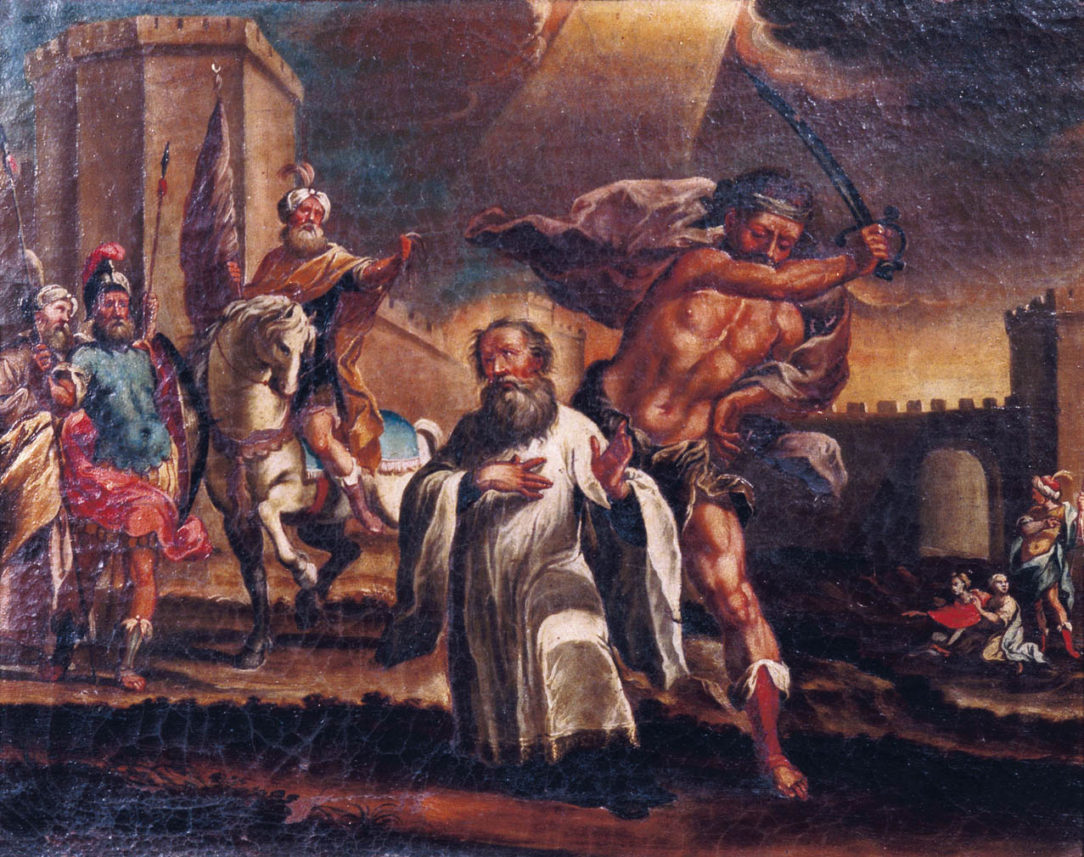
There were people who rejected the idea of Islamic rule or any form of nationhood under the power of another religion. A good example is that of Eulogius, a traveling cleric from Córdoba. In approximately 850 CE, Eulogius discovered one of the earliest Latin copies of a version of the biography of the prophet Muhammad in the monastery of Leyre near Pamplona in northern Spain. The biography is titled simply, Istoria de Mahomet and, unfortunately, is an example of “the repositories of misconceptions about Islam that would be drawn upon over and over again by Christians trying to explain, or more appropriately, explain away the success of Islam” (Wolf 89). Eulogius didn’t use it just to explain away the success of Islam. He used the text to create a political movement, an early form of peaceful disobedience, to challenge established Muslim rule through a series of martyrdoms in the hopes of inciting a popular Christian revolt.
Shortly after Eulogius returned to Córdoba, a steady procession of Christians approached Muslim qadisand denounced the prophet Muhammad, eager to become martyrs: “Now hand down the sentence, multiply your cruelty, be kindled with complete fury in vengeance for your prophet. We profess Christ to be truly God and your prophet to be a precursor of antichrist” (Lowney 58). These denunciations resulted in the execution of the offenders. Over the course of a decade, approximately fifty Christians were killed executed. Shortly after Eulogius’ death, the number of offenses and executions petered out, which paints him as the likely ringleader (Lowney 59).
Eulogius, later canonized by the Catholic church, suffering execution for following in the footsteps of
the other Cordoban martyrs and being executed for intentionally blaspheming the Prophet Muhammad.
A notable point in the incidents of deliberate martyrdom was the lack of reaction from the public. The executions failed to have the effect that Eulogius had hoped for. The martyrs enjoyed support from distant monastic communities, where most of the martyrs were from, but in Córdoba itself, the opinion was little better than mixed. According to Kenneth Wolf, the Christians who rejected the martyrs’ actions had assumed a new perspective of Islam as a different, but valid version of their own faith. Wolf says that Christians adopted this idea from the Muslims, who in turn accepted the Christians as “monotheists and recipients of a revealed law” (Wolf 93). In other words, they had assimilated the idea implied by dhimmitude, that all three religions worship the same God, with some differences.
Just 150 years into Islamic rule in Iberia, the people had come to accept and respect one another. That may sound odd, considering the fact that Christians were being executed for blaspheming a religious figure, but consider the words of a Muslim court official who tried to persuade Eulogius into recanting his defamation of the prophet Muhammad:
If stupid and idiotic individuals have been carried away to such lamentable ruin, what is it that compels you…to commit yourself to this deadly ruin, suppressing the natural love of life? Hear me, I beseech you, I beg you, lest you fall headlong to destruction. Say something in this the hour of your need, so that afterward you may be able to practice your faith.” (Lowney 59)
The implication in this statement is that the court officials were following the letter of the law for the sake of maintaining the legal system, as well as for the sake of preserving the respectability of Islam, but even by the year 859, when Eulogius was executed, Andalusian Muslims in general had probably developed a strong sense of tolerance for the Christians and the Jews who worshipped the same God as them. This sense of community may have been based on physical proximity and a sense of belonging to a certain physical location, rather than being drawn purely along theological lines. The reality of people struggling to survive and coming to rely on the people around them sometimes gets lost in religious debate.
The medieval history of Spain shows little evidence of any conflicts being based solely on either race or religion (Lea 1). Four-hundred and fifty years after Eulogius, as territory changed hands during the Reconquista, the people continued to coexist peacefully with their neighbors. Rather than a stark black and white, the reality of conflict on the Iberian Peninsula was far more complex. Alliances were often made between Christians and Muslims for the sake of pursuing similar goals, or for some gain. For example, the thirteenth-century Christian king Alfonso X used religious rhetoric when it suited his self-interests and ignored it for the same reasons. He was an avid supporter of Jewish translators in his court because of the wisdom they could make available to his subjects, but at the same time he mandated a death sentence for any Christian who was “so unfortunate as” to convert to Judaism (Lowney 10). Additionally, he waged war against a Muslim kingdom only to later create an alliance with them for the purpose of waging war against a rebellious son. His actions weren’t indicative of a monolithic Christianity versus a monolithic Islam; these were the actions of a man engaged in maintaining and building the prosperity of his own kingdom using whatever means he had available to him. Race and religion were not factors in his decisions, which is a testament to the integration of Jews, Christians and Muslims into one cohesive Andalusian society.
As Muslim control in al-Andalus came to its conclusion in 1492, they left behind a society of three fully integrated faiths that had developed a unique character unlike any other place in the world. Tolerance for religious diversity in al-Andalus did not, of course, meet modern standards, but it was a major advancement for its day that would lead a Christian nun from Europe named Hroswitha of Gandersheim to call Córdoba, the capital of the Ummayad Islamic Caliphate of al-Andalus, the “Ornament of the World” (Shedinger 81). From the initial conquest in 711 to the surrender of Granada, relations between the three monotheistic faiths continually developed until al-Andalus was transformed into an integrated society where religion stopped playing a major part in the average affairs of rulers, except as a political tool.
The Alhambra palace at Granada.
Despite the success of convivencia, a multicultural and integrated al-Andalus, the Catholic Monarchs King Ferdinand II and Queen Isabella I took a radically different approach to religion and society: limieza de sangre, purity of blood. After they completed their conquest of the Iberian Peninsula, they undertook a program that would ensure the eventual religious homogeneity of the Iberian Peninsula. In 1492, immediately after the fall of Granada, they decreed the conversion, expulsion or execution of the Jews. In 1502, a similar proclamation was made regarding Muslims. Out of necessity, many chose to be baptized. These two groups, known respectively as conversosand moriscos, continued to secretly practice the rituals of their own faiths while maintaining the outward appearance of Catholic Christianity until they were eventually weeded out through the institution of the Inquisition and a final expulsion in 1609 by decree of King Philip III.
The Court of Lions at Alhambra palace.
In the face of a long history of a successful and integrated culture, what was the purpose of Ferdinand and Isabella’s deviation from a model that had proven to be successful? It is possible that Ferdinand and Isabella’s decision to expel the Jews and Muslims was merely a continuation of the evolution of religion in the peninsula: they were using it as a political tool. Ferdinand and Isabella may have felt that, as Christians, their loyalties lay firmly with Europe and the rest of Christendom. As rulers of a territory that had been part of the Islamic world for centuries, they may have felt that drastic measures were necessary to change public opinion of Spain. Even today, 500 years after the expulsion of the Muslims and Jews, Spain is an off-color patch in the greater European fabric, with obvious reminders of its Islamic past buried in the architecture, art, and even the language. Given how firmly Islamic culture was entrenched in Iberia, Ferdinand and Isabella may have felt that it would take drastic actions to change public perception of Spain in Europe, hence the expulsions or forced conversions of the Jews and Muslims. It would also explain their petition to the Pope for the title “Catholic Monarchs.” The total effect of expulsions and the gaining of a title affirming the Catholicism of the monarchy would have firmly put Spain in the European camp. The definite causes of Ferdinand and Isabella’s change in policy would be an interesting topic for further research, but the level of tolerance and cooperation between religious groups in al-Andalus is a lesson that many parts of the world could still learn from today.
Works Cited
<!–[if supportFields]> BIBLIOGRAPHY <![endif]–>Bennett, Clinton. Muslims and modernity: an introduction to the issues and debates. London: Continuum International Publishing Group, 2005.
Boase, Roger. “The Muslim Expulsion From Spain.” History Today 52.4 (2002): 21-28.
Khadduri, Majid, Herbert J. Liebesny and Robert H. Jackson. Origin and Development of Islamic Law. Clark: The Lawbook Exchange, Ltd., 2010.
Lapidus, Ira M. A History of Islamic Societies. 2nd. New York: Cambridge University Press, 2002.
Lea, Henry Charles. The Moriscos of Spain: Their Conversion and Expulsion. Philadelphia: Lea Brothers & Co., 1901.
Lowney, Chris. A Vanished World: Muslims, Christians and Jews in Medieval Spain. New York: Oxford University Press, Inc., 2006.
Rosser-Owen, Mariam. Islamic Arts From Spain. London: V & A Publishing, 2010.
Shedinger, Robert F. Was Jesus a Muslim?: questioning categories in the study of religion. Minneapolis: Fortress Press, 2009.
Wolf, Kenneth B. “The Earliest Latin Lives of Muhammad.” Gervers, Michael, Ramzi Jibran Bikhazi and Pontifical Institute of Mediaeval Studies. Conversion and continuity: indigenous Christian communities in Islamic lands eighth to eighteenth centuries. Vol. 9. Toronto: Pontifical Institute of Mediaeval Studies, 1990. 89 – 102.
Note: This was a research paper turned in for a 100-level college course. It received an A+, and the note: “A lively and interesting paper.” I imagine it was checked more for consistency, style and obvious errors rather than having any deep fact checking done. I would have liked a few more weeks to research and fine tune it, but I think it turned out well enough for the time I put into it, considering it’s a paper for an entry level course.
In 1664, Jean-Baptiste Colbert sent a letter to the King of France, Louis XIV, to appeal for economic reforms that would bring greater prosperity to the French people. This letter, now known as “Memorandum on Trade, 1664,” reveals the depths of the problems France faced, and Colbert’s desperation to find solutions. While writing his letter, Colbert understood that economic issues were not something the king would likely be interested in. Instead of simply listing France’s deficiencies, he presented his arguments in a way that made the economic problems of France a personal reflection of King Louis XIV’s ability to rule.
Colbert opened his letter by writing that solving the country’s economic problems would not provide the king with any immediate benefit. In fact, solving the economic problems would come at a cost. Colbert writes that reforms would require: “Your Majesty’s sacrifice of two things so dear and important to kings-one, the time that [Your Majesty] could use for his amusements or other pleasanter matters, the other, his revenue….”[1] Colbert appears to believe that the king would have little interest in receiving his message or parting with his usual revenue, so the challenge he faces is in getting and then keeping the king’s attention, as well as persuading him to act on the economic reforms he proposes. To do this, Colbert writes, “Your Majesty will find it disagreeable to hear [trade] discussed often.” This implies that the king will continue to be reminded of the economic problems, if not by Colbert then from others, and that the issues must be addressed, rather than ignored.
The previous two quotes raise the question of what Colbert thought about nobles in general. He seems to imply that all nobles want to do is have fun and make money, which is supported by the tone of the letter and the constant emotional appeals to keep the king’s attention. This could be construed as an insult to the king’s ability or intelligence, but Colbert either felt secure enough in his position or secure enough in his belief that the king would not catch the implications that he left the phrases in his letter. It is also possible that Colbert’s statements are simply an accurate reflection of society at the time and the king’s focus on leisure and the acquisition of wealth were seen as legitimate pastimes. That would better explain how Colbert was able to get away with what today might be considered insulting. It would also explain why Colbert had to make an effort to appeal to the king’s emotions, rather than to his intellect through factual reports.
King Louis XIV
After getting the king’s attention, Colbert had to find a way to maintain his interest and make the king care about the problems enough to inconvenience himself, especially since the reforms would cause him to lose revenue in the short term. Colbert’s first tactic was to make the king feel personally responsible for the economic hardships the people were facing. He writes, “…it will be well to examine in detail the condition to which trade was reduced when His Majesty took the government into his own hands.” He also writes that the manufacture of many different types of items and textiles in France “are almost entirely ruined.” At this point, Colbert first mentions the Dutch and Dutch dominance of maritime shipping. This serves a double purpose. First, it mitigates Colbert’s accusations of the king’s fiscal incompetence: the Dutch are to blame for the crisis, not the king. Secondly, it further stirs up the king’s emotions by detailing how another nation has achieved dominance over France. This is an appeal to the king’s nationalistic pride, and pride in his own sovereignty. Colbert may also have written it in the hopes that it would engage the king’s competitive spirit and give him a reason to support his economic reforms. If the king were less interested in modern day ideas of governmental responsibility, and more interested in personal accomplishment, turning the issue into a personal competition with the Dutch would be an effective way of gaining the king’s support in making economic reforms.
Colbert made sure to include the potential rewards for economic success in his letter. That reward is money, which according to Colbert’s earlier statement, is one of the two most important things to kings. This tells the king that, though he will have to make a short-term sacrifice, he can expect greater long-term gains. Colbert did not directly state that the king would personally receive large sums of money from the nation’s economic success. Colbert instead writes of the “greatness and power of the State,” which at the time was also a reflection of the greatness and power of the monarch. He first writes, “returns in money… is the only aim of trade and the sole means of increasing the greatness and power of this State.” Later in his letter he writes that only “the abundance of money in a State makes the difference in its greatness and power.” Finally, he writes that any increase in the number of French ships will proportionally increase the “greatness and power of the State,” which means the money generated by trade through shipping will greatly benefit the French state.
Why would the king care about the money being brought into the French economy? In describing the way in which the Dutch have dominated maritime trade, Colbert writes that the Dutch pay both import and export duties when bringing goods into their ports, so the implication is that maritime trade creates a new opportunity for taxation, which would satisfy the king’s desire for greater personal revenues. At the same time, Colbert writes that by improving the condition of the French economy, he will “increase the veneration and respect of his subjects and the admiration of foreigners.” In other words, the king can have his cake and eat it too: he will receive more taxes and be loved more. Colbert may have been hoping that the king would also be concerned about the character of the legacy he would leave behind in the national memory.
In his letter to King Louis XIV, Colbert walks a fine line between accusation and flattery. Colbert establishes the king’s responsibility for the economy and, through a series of emotional appeals, hopes to influence him into making positive reforms. The method Colbert uses to accomplish his task is unusual by today’s standards, but may be a reflection of the accepted reality of nobility during Colbert’s day. Appealing to a monarch in 1664 was an extremely complex process, without the protections of law or governmental regulation that is taken for granted today. It was not only necessary to state the facts, but to make personal appeals for the monarch to make the correct choice for his people, while simultaneously avoiding too heavy an implication of personal fault, since the final responsibility of all governmental decisions rested in the monarchy.
[1] This quote and following quotes are from the webpage, “Jean-Baptiste Colbert (1619-1683): Memorandum on Trade, 1664,” part of Fordham University’s Modern History Sourcebook.
Note: This was an essay written for a college English class. It received an A for content and A for composition.
The text being analyzed:
Sire, it pleases Your Majesty to give some hours of his attention to the establishment, or rather the re-establishment of trade in his kingdom. This is a matter that purely concerns the welfare of his subjects but that cannot procure Your Majesty any advantage except for the future, after it has brought abundance and riches among his people. On the contrary, [the subject of trade] being unattractive in itself, Your Majesty will find it disagreeable to hear it discussed often, and, moreover, [efforts to re-establish) it will even lead to a decrease in current revenues. [For all these reasons] it is certain, Sire, that through Your Majesty’s sacrifice of two things so dear and important to kings-one, the time that [Your Majesty] could use for his amusements or other pleasanter matters, the other, his revenue-[Your Majesty] by these unexampled proofs of his love for his people will infinitely increase the veneration and respect of his subjects and the admiration of foreigners.
Having discussed the reasons for and against the King’s making efforts to reestablish trade, it will be well to examine in detail the condition to which trade was reduced when His Majesty took the government into his own hands [ 166 1 J.
As for internal trade and trade between [French] ports:
The manufacture of cloths and serges and other textiles of this kind, paper goods, ironware, silks, linens, soaps, and generally all other manufactures were and are almost entirely ruined.
The Dutch have inhibited them all and bring us these same manufactures, drawing from us in exchange the commodities they want for their own consumption and re-export. If these manufactures were well re-established, not only would we have enough for our own needs, so that the Dutch would have to pay us in cash for the commodities they desire, but we would even have enough to send abroad, which would also bring us returns in money-and that, in one word, is the only aim of trade and the sole means of increasing the greatness and power of this State.
As for trade by sea, whether among French ports or with foreign countries, it is certain that, even for the former, since in all French ports together only two hundred to three hundred ships belong to the subjects of the King, the Dutch draw from the kingdom every year, according to an exact accounting that has been made, four million UvresI for this carrying trade, which they take away in commodities. Since they absolutely need these commodities, they would be obliged to pay us this money in cash if we had enough ships for our own carrying trade.
***
As for foreign trade:
It is certain that except for a few ships from Marseilles that go to the Levant [the eastern Mediterranean], maritime trade in the kingdom does not exist, to the point that for the French West Indies one-hundred-fifty Dutch vessels take care of all the trade, carry there the foodstuffs that grow in Germany and the goods manufactured by themselves, and carry back sugar, tobacco, dyestuffs, which they [the Dutch] take home, where they pay customs duty on entry, have [the commodities] processed, pay export duties, and bring them back to us; and ‘the value of these goods amounts to two million Uvres every year, in return for which they take away what they need of our manufactures. Instead, if we ran our own West Indies trade, they would be obliged to bring us these two million in hard cash.
Having summarized the condition of domestic and foreign trade, it will perhaps not be inappropriate to say a few words about the advantages of trade.
I believe everyone will easily agree to this principle, that only the abundance of money in a State makes the difference in its greatness and power.
***
Aside from the advantages that the entry of a greater quantity of cash into the kingdom will produce, it is certain that, thanks to the manufactures, a million people who now languish in idleness will be able to earn a living. An equally considerable number will earn their living by navigation and in the seaports.
The almost infinite increase in the number of [French] ships will multiply to the same degree the greatness and power of the State.
These, in my opinion, are the goals that should be the aim of the King’s efforts and of his goodness and love for his people.
The means proposed for reaching these goals are:
To make His Majesty’s resolution known to all by a decree of the Council ton Commerce] meeting in the presence of His Majesty, publicized by circular letters.
***
To revive all the regulations in the kingdom for the re-establishment of manufactures.
To examine all import and export duties, and exempt raw materials and [domestic] manufactures ….
Annually to spend a considerable sum for the re-establishment of manufactures and for the good of trade, according to resolutions that will be taken in Council.
Similarly for navigation, to pay rewards to all those persons who buy or build new ships or who undertake long-distance voyages.
Source:
Jean-Baptiste Colbert, Lettres, Instructions et Memoires de Colbert, vol. 2, ed. P. Clement (Paris: Librairie Imperiale, 1863), pp. 263, 268-71. Translated by Ruth Kleinman in Core Four Sourcebook
The following is an analysis of a letter written to the king of Portugal by Pero Vas de Caminha, relating the ‘discovery’ of Brazil. The majority of the full text of the letter this is based on can be found here, though the book isn’t in the public domain, so two pages of it are missing from the Google Books preview. Also, there is no preview in Google Books for “Portuguese Voyages: 1498-1663,” the source I used for the letter, so the link above goes to another book that also contains the document. In the book linked to above, the letter is the first chapter. I mention this, because the page numbers in the text below won’t correspond to the page numbers in the linked book.
…
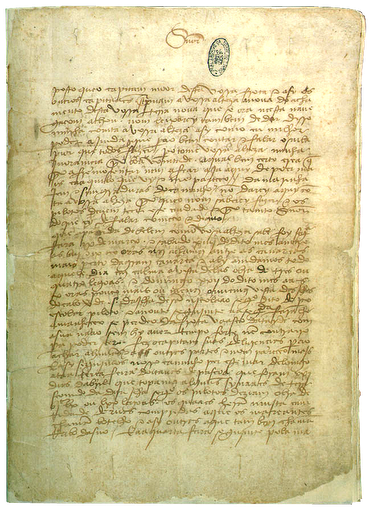
Scan of the letter Caminha sent to the king of Portugal, Manuel I. Source: Wikipedia.
After spending some time in the newly discovered land of Brazil, which the Portuguese named the “Land of the True Cross,” a professional scribe named Pero Vas de Caminha submitted a letter to the king of Portugal, titled “The Discovery of Brazil.” The letter is dated 1 May, 1500, and presents itself as an informative piece meant solely to relate what Caminha saw to the king. In the introductory paragraph, Caminha humbly introduces himself and makes light of his ability to write. However, a footnote added when the letter was added to the anthology Portuguese Voyages: 1498-1663 (edited by Charles David Ley), lets the reader know that Caminha is a highly trained and professional scribe. So, it is therefore unlikely that he wrote without a purpose, simply repeating what he saw as he claims. After careful reading, the letter appears to be a finely crafted piece of persuasive writing that gives the king every reason he needs to order the colonization of the newly discovered area.
One of the greatest challenges of colonization is local resistance or outright war. Caminha knows this and continually reminds the king that the natives are not aggressive. He does this by slowly revealing over the course of his letter how easy it is to train the local population. His evidence is how quickly they teach the locals to lay down their bows and eventually leave them behind when the Portuguese come ashore to gather supplies, explore, or conduct religious services. The first time Caminha mentions this is when he says that a crewmember, Nicolau Coelho, went ashore and indicated that the natives should put down their bows, which they did (42). This is repeated during each encounter with the natives until they put down their bows before being asked to, “as we had taught them to do” (50). Later, the natives don’t bring bows at all, unless it’s for the purpose of trading them for European items. Caminha’s purpose here is to show that the natives are easily trainable and easily disarmed without the need for violence. Caminha also tells the king that he thinks it would be best to conciliate with and pacify the people rather than use force against them (49). This introduces the king to the idea that he could colonize the land without having to commit many men, making it a low cost venture.
After demonstrating that the natives are not violent, Caminha demonstrates how likely they are to assimilate into Portuguese culture and society as a subject population. He tackles this in a number of different ways. He plays on the king’s desire to convert people to Christianity by emphasizing how easy it would be to bring the natives into the Christian fold. After watching the natives participate in a Mass, he writes to the king, “My opinion and every one’s opinion is that these people lack nothing to become completely Christian except understanding us, for they accepted as we do all they saw us do… they would all be persuaded and converted as Your Majesty desires” (58). He excuses their differences, such as nakedness and body paint, as innocence and incomprehension of European modesty and emphasizes that they could easily accept European values of morality, if given the chance. Caminha made sure to note that many natives attended the mass, even without being able to understand the language, and that afterwards, one man seemed to be trying to explain to others what was going on (57). He must have felt this demonstrated a readiness on the part of the natives to believe in Christianity, which would facilitate integration into a Portuguese empire. The added incentive in this situation is that in addition to aiding assimilation, the conversion of a whole population to Christianity would bring great prestige to Portugal in the eyes of its European neighbors. Caminha goes on by telling the king that the natives have a poor diet of mostly roots and seeds, but took quite readily to European foods, “especially cold boiled ham and rice” (53, 55). He goes on to say that he believes they would come to enjoy wine as well (55). The last bit of evidence he offers for the possibility of easy assimilation is the fact that the natives already live a semi-sedentary life, as evidenced by the “hamlet of nine or ten houses” (53). A sedentary population is more easily managed and tracked than a nomadic one, and a sedentary lifestyle lends itself to agriculture, the possibility of which Caminha also hints at.
Caminha repetitively describes the land as being rich in resources and specifically mentions that it would be good for agriculture. He tells the king, “The country is so well-favoured that if it were rightly cultivated it would yield everything, because of its waters” (59). Immediately after this, he tells the king that he should think first and foremost about ensuring the salvation of the people, but his intent is probably to leave the king with the idea that Portugal’s economy could benefit greatly from introducing agriculture to the natives. Caminha has already told the king there are no native crops to speak of, so he presents an opportunity for immediate returns by stating twice that the land is already rich in dates which he describes as both good and fine (51, 56). He also indicates that the land could be a great source of timber. He says, “The number, size, and thickness of these trees and the variety of their foliage beggars calculation” (56). Timber was an important resource to secure for the building of ships and permanent settlements.
Caminha also spends quite a bit of time in his letter detailing the amount of trade between the Portuguese and the natives. He focuses mostly on the trade of bows and arrows and exotic birds, though he does mention beads as well. It seems as though he’s trying to convince the king that even if the land isn’t cultivated, a lucrative trade can be established with the natives for bows, arrows, birds, and possibly the timber mentioned before. He tells the king that the natives trade their bows and arrows for “hats and linen caps and whatever else we could give them” (50). He also says, “our men exchanged some varvels and other small things of little value… for some very large and beautiful red parrots and two small green ones, some caps of green feathers, and a cloth of many colours, also of feathers, a rather beautiful kind of material…” From these quotes, Caminha apparently places greater value on the items being received by the sailors than what they’re giving up in trade. When mentioned in a letter to the king of Portugal, it hints at the possibility of establishing a trade network that is not only lucrative, but almost exploitative, since the natives did not possess the same standard of value as the Europeans. Caminha probably believed that as long as both parties were satisfied, there was no harm in it, and it could greatly benefit Portugal. One thing that Caminha seemed especially interested in was the potential presence of silver and gold in the discovered land. Unfortunately, he was never able to determine if any existed, but perhaps to add to the king’s interest, he related a story in which the natives seemed to indicate that gold and silver could be found there (44-45).
Caminha gives a good deal of attention to describing how physically fit the natives are. He says that they are “healthy and vigorous” and compares them to wildlife, which gives the impression of a strong and robust people (52 – 55). He tells the king that they enjoy engaging in physical activities, like dancing, and demonstrated an interest in acrobatics (51). To demonstrate how hard-working the natives are, Caminha relates a story about them helping the Portuguese load logs onto a ship. The natives turned the work into a sport and enjoyed themselves, vying with the Portuguese to see who could load the most wood (54). This matters because a population that is healthy and hard-working is productive and adds another reason for the king of Portugal to colonize the land.
The intention of this letter seems less likely to be about informing the king of what Caminha saw in the discovered land and more about presenting the king with options. Caminha gives the king a description of the type of people living in the land and gives a description of positive attributes that would make them good citizens, or at the least good workers. Caminha then tells the king what the land is worth, listing off timber, potential cultivation, a potential for precious metals, and exotic animals. He seems more inclined to utilizing the land for cultivation with the natives as a local work force, given their physical attributes. He probably reasons that if the locals are introduced to agriculture and a monetary system, they could become a large taxable population for the small country of Portugal. However, if the king doesn’t feel like making that sort of investment in time and manpower, he assures the king of the value of the land either through trade or as a temperate, friendly way station for travelers. The amount of timber he describes could easily be used to build and establish a trading outpost. Either way, Caminha seems to be very sure that Brazil is worth colonizing, and that his information is valuable, given his personal request to the king at the end of his letter, lending weight to the idea that his letter is more than just a daily journal.
Note: This essay was graded with an A for content and an A for composition.
It’s looking like a mini-blizzard out there. I didn’t expect to see this in October! I do remember it being so cold we had to bundle up tight for Trick-or-Treating when I was a kid though, back in the 80s, and that was in Maryland. Maybe this isn’t so unusual after all. Maybe it’s more like things going back to the way they were before. Regardless, it’s snowing, and it’s getting me in the Christmas spirit before we’ve even gotten past Halloween.
It’s not supposed to stick, thankfully. I can do without piles of snow on the roads for a few more weeks at least. I’m planning on moving to a new apartment and I have absolutely no experience driving in snow. Hurricanes, yes. Snow, no.
In approximately 610 CE, a man named Muhammad ibn Abdallah went to a cave in the hills above Mecca to meditate, as he was accustomed to do. There, he had a powerful religious experience and began reciting verses of what would become known as the Quran, the holy book of Islam. While reciting the surahs of the Quran in Mecca, the Prophet Muhammad would find both converts and enemies. His message would inspire both devotion and enmity. The Quran appealed to people for its beauty and its insistence on returning to principles of equity, but this would place the Prophet in confrontation with his tribe and create tension between converts and their families. The conflict between the new Muslims and the Meccan community escalated to a point that it caused the Prophet to commit the Muslim community to something unthinkable by contemporary standards: an emigration based not on blood ties, but on communal faith and unity. This event was so significant that it would become known as the Hijra and set the date for the first year of the Islamic calendar in 622 CE.
In pre-Islamic Arabian society, status, position and even personal well-being were all based on membership in kinship groups. Society was divided into a series of (usually[1]) blood-related groups organized in a hierarchical structure. The family group was the smallest organizational unit and was subordinate to a clan, which in turn was subordinate to a tribe. In these kinship groups, there was essentially no individual identity.[2] A man was a member of his family, clan and tribe. All acts between individual members of tribes assumed collective responsibility, sometimes leading to vendettas where the victim’s tribe would seek redress against any member of the offending party’s tribe.[3] This created situations in which a person was victimized based on the actions of another member of the tribe, though it wasn’t seen as wrong, because honor and responsibility were attributed to the group, rather than the individual. The more powerful the tribe one belonged to, the surer one could be that their family would be safe and prosperous.
In Muhammad: A Prophet For Our Time, Karen Armstrong details the loyalty of a man to his tribe using a quote from a Ghazziyya poet: “I am of Ghazziyya. If she be in error, I will be in error; and if Ghazziya be guided right, I will go with her.”[4] Tribal loyalties were so important that even if a man’s tribesman was in the wrong, he was obliged to help him for the sake of tribal solidarity. The concept of tribal solidarity would be both a boon and a problem for the Prophet Muhammad. Religion was not unknown to pre-Islamic Arab society, but it was tied to individual kinship groups. Each tribe had a deity, represented by an idol in the Ka’aba at Mecca, which was already an established pilgrimage site. Loyalty to the tribe also included loyalty to the tribal deity. This presented two problems to the success of the Prophet’s message. Converting to Islam meant forsaking the tribal deity and betraying the tribe, a violation of the tribal solidarity that is evidenced by the quote from the Ghazziya poet. More practically, the Prophet Muhammad’s message was an attack on the economic structure of Mecca, which relied on annual pilgrimages to the Ka’aba to remain viable. If people stopped worshipping the idols then they would no longer have a reason to visit Mecca. The Quraysh, the Prophet’s own tribe, would lose their source of income. In one stroke, the Prophet was insulting the tribe’s sense of community and attacking the economic foundation its prosperity depended on. The Quraysh were obligated to persecute the fledgling Muslim community.
The Prophet Muhammad’s attack on Meccan social norms was met first with resistance and then with violence, including a narrowly avoided assassination attempt. The Muslims initially benefited from the protection of the Prophet Muhammad’s uncle, Abu Talib, who was the head of the Banu Hashim, a respected clan in the Quraysh tribe. However, after his uncle died, the Prophet and his followers were left to fend for themselves, leaving them in a difficult position where they were open to violent retaliation from the Qurayshi families who felt both threatened and insulted by a perceived theft of family member loyalties.
This dilemma was resolved by a revolutionary idea, built on the foundation of the message that the Prophet preached in Mecca. The Muslims abandoned the idea of kinship groups based on blood and instead formed a new ‘tribe’ based on faith, known as the ummah. Membership in the ummah (as well as being a Muslim) required no family relation, no social status, and no prerequisite level of income; it only required acceptance of Allah as the one true God and of Muhammad as his Messenger. The ummah was a new community that offered the Muslims the protection and security they had previously received from their kinship groups.[5] The moment that defined the creation of this community is the Hijra, the emigration of Muslims to Yathrib. Prior to this, the Muslims had still considered themselves to be members of their own families, just with a different set of beliefs. Breaking away from their families and creating a new community based on faith rather than blood was an incredible social innovation, and clearly marks the birth of the Muslim community as an independent and functional social system, as well as a system of belief.
Eventually, the ummah would encompass all of Arabia, creating a new problem that challenged the traditional means of supplementing tribal income: raiding, which was known as ghazu. In times of scarcity, tribes would launch raids against each other to capture camels, cattle or slaves. Raids were carried out with precision and care, to prevent injuries or deaths that might result in blood fueds. These raids were an accepted fact of life and were not in any way morally reprehensible. They were instead a necessary means of redistributing wealth in an area of the world where there was often not enough to go around.[6] Unfortunately, this tradition conflicted with the new Muslim morality as defined by the Quran and the Prophet. Surah 3, ayah 103 of the Quran says, “Hold fast to God’s rope all together; do not split into factions. Remember God’s favour to you: you were enemies and then He brought your hearts together and you became brothers by His grace: you were about to fall into a pit of Fire and He saved you from it…”[7] Also, in his book, A History of the Arab Peoples, Hourani says that when the Prophet Muhammad made his last visit to Mecca in 632, he gave a speech and said, “…know that every Muslim is a Muslim’s brother, and that the Muslims are brethren.” He said that violence between Muslims should be avoided and old blood debts should be forgotten.[8]
As essentially members of one tribe, the ummah would have to reassess their society and find a new means of supporting themselves. Internal conflicts were no longer permitted under Islam, so the Arabs instead spread outward, taking their culture and religion with them. The outward spread of Arabs into the Middle East began as raiding parties in Syria and Palestine in the 630s,[9] but soon developed into full scale battle with the Byzantine and Sassanian Empires. The conquering Arabs would be victorious, creating a vast Islamic empire. The leap from pre-Islamic Bedouin society to Islamic Imperialism would again fundamentally alter Arab society.
Because of the principles of unity found in the Quran, the nomadic peoples of Arabia created a new social identity that revolved around faith. This was a clear break from the past and returned a sense of equity to the Muslim community. However, this new unity came with new problems. The Arabs had to find a new economic model to sustain their society. The Arabs solved this problem using traditional tactics. Since the tribe was replaced by the ummah, the push outward into the Middle East was a continuation of the tradition of ghazu, simply on a larger scale. Intentionally or not, a relatively simple people from the Arabian Peninsula quickly became a world power that would greatly influence world history, and continues to influence world history.
[1] On page 38 of The Great Arab Conquests, Kennedy states that membership in a tribe might increase or decrease based on the tribe’s level of success. New arrivals would claim that they “must have been in some way part of that kin all along,” maintaining the façade of biological kinship groups. [2] Lapidus, page 13. [3] Lapidus, pages 12. [4]Muhammad: A Prophet For Our Time, pages 12 – 14. [5] Kennedy, page 38. [6]Muhammad: A Prophet For Our Time, page 11. [7] The Qur’an; M.A.S. Abdel Haleem translation; Oxford World’s Classics version. [8] Hourani, page 19. [9] Kennedy, page 70.
Bibliography:
Armstrong, K. (2007). Muhammad: A Prophet For Our Time. New York: HarperCollins.
Armstrong, K. (2009). Islam: A Short History. London: Phoenix Press.
The Qur’an. (2010). (M. A. Haleem, Trans.) New York: Oxford University Press.
Hourani, A. (1991). A History Of The Arab Peoples. Cambridge: Belknap Press of Harvard University Press.
Kennedy, H. (2008). The Great Arab Conquests: How The Spread of Islam Changed The World We Live In. Philadelphia: Ca Capo Press.
Lapidus, I. M. (2002). A History of Islamic Societies (2nd ed.). New York: Cambridge University Press.
Note:
This was a paper written for a college course titled “Middle East Under Islam.” The final grade was 15/15, 100%.
If you’ve never heard of Hannah Arendt, well, I wouldn’t be all that surprised. I’d never heard of her and her writing is very, very dense. Quite a few weeks ago I was given a writing assignment, to write an analysis of a piece of writing. We had a set of options, and I thought I wanted a challenge. I guess I was feeling brave that day, or maybe I just really wanted to try to figure out what it is that Hannah Arendt was trying to say in Chapter 5 of The Human Condition. Her ideas, once you can figure them out, or at least make an interpretation of them, are pretty fascinating. I just don’t care for the density of the language. I’ve always been more inclined to use clear, direct language. Even then, I swear people misunderstand what I’m trying to say half the time. But, everyone interprets things differently.
Anyway, by the time I got through my paper, I realized that what I’d done wasn’t an analysis; it was more of an exploratory writing where I wrote out my understanding of what she said, rather than discussing how she said it. There’s a fine difference, and I suppose I wouldn’t have realized it without all the great instruction I’m getting in the class I’m taking. I was a little anxious to see what my grade would be, and sure enough, it wasn’t an A like I was used to. Also, it had the comment I expected, that it was too much summary. I also got a comment about being a little “long-winded” in some areas. Between the composition grade and the content grade I wound up with a B. Lowest grade so far, but hey, I decided to try to challenge myself, and it was definitely a learning experience.
Anyhow, if you’re trying to get an idea about what Hannah Arendt is talking about in Chapter 5 of The Human Condition, I hope this helps!
Prisoners of Others’ Perceptions
In “Action”, the fifth chapter of the book, The Human Condition, Hannah Arendt analyzes the relationship between action and what it means to be human. She leads the reader through a progression of logic that leaves one with the conclusion that man is ultimately subject to the interpretations of others. What a person attempts to do in life passes through the filter of other people’s personal interpretations, producing reactions that may vary widely from what was intended. Essentially, man is a prisoner to the realities imposed on him by others.
Hannah Arendt bases her argument on the conflict between the indefinable ‘who’ and the sea of other ‘who’s that exist in human society. Who are you talking to? Hannah Arendt begins to answer this question by telling us how speech and action relate to the revelation of man’s unique character to others. She tells us that humanity is a paradox of plurality and that, through speech and action, individuals distinguish themselves and become distinct, revealing the ‘who’ behind the what. She goes as far as to say that to a unique individual, no one existed before he did, because they had not revealed themselves through speech and action. Each person perceives the world differently and an individual’s reality is only as large as what he or she perceives. A person that the individual hasn’t met doesn’t exist in that individual’s mind. When that unknown person intrudes on the individual’s reality through speech and action, they become real in the mind of the person experiencing them. The ‘new’ person begins to define who they are, rather than what they are. The act of revelation transitions the person from being an abstract ‘other’, another body in the sea of unknown bodies in the greater world around the individual, to being a ‘who’, another distinct individual. So, the author tells us that speech and action are a necessary part of the human experience, because they define us in the eyes of others.
But do speech and action really express who a person is, or simply what a person is? Hannah Arendt tells us that “in acting and speaking, men show who they are, revealing their unique personal identities,” but she goes on to say that “the moment we want to say who somebody is, our very vocabulary leads us astray into saying what he is.” Is it possible for a person to communicate who they are without being able to express it? The author tells us it is more likely that the ‘who’ remains hidden to the individual, but is clear to others. However, this ‘who’ that is clear to others is not the same ‘who’ that the individual wishes to express. There is a disconnection between what the person wants to express about themselves and what is perceived, perhaps because of the inability of language to express accurately who man is, rather than what man is. “He’s a kind man.” “She’s a devoted wife.” “This guy is well traveled.” These phrases express what the person is: kind, devoted, a traveler. They do not tell us who the person is. In other words, the essence of a person cannot be captured in language. The moment the individual opens his or her mouth to express themselves, they literally lose something in translation. The author indicates that the true self is something that is beyond expression, something that transcends speech, perhaps in the same way that the soul transcends definition. Hannah Arendt affirms this idea by saying that it is impossible to solidify in words “the living essence of the person as it shows itself in the flux of action and speech.” If the ‘who’ of a person cannot be quantified through language, then it is not possible to transmit the essence of that person beyond the self. If language cannot express who a person really is, then perhaps a person never really knows who they are, having no way to articulate it. Failing to articulate who they are, the people in close contact with that individual may glimpse a deeper truth about who the person is through experience of action combined with speech, but they could never verbally relay that information to another party. The essence of the person would be lost in the language, devolving into descriptions of ‘what’, instead of ‘who’.
She elaborates on this concept by discussing how the individual functions in relation to the people he interacts with, and how those people interpret the individual. She compares a person’s social relations to a web, where each movement (speech and action) a person makes causes the web to shake. In Hannah Arendt’s own words, “The disclosure of the “who” through speech, and the setting of a new beginning through action, always fall into an already existing web where their immediate consequences can be felt.” What are those consequences? Each person in the web of social relations is impacted by the movement, but it is felt differently depending on where in the web the person experiencing the movement is sitting. In the same way, a person’s speech and actions are interpreted differently by each person that experiences them, since each person is in turn a distinct individual that forms ideas and opinions based on personal experience. So, a person can make him or herself known to others through speech and action, but the exact interpretation of the ‘who’ is limited by the perceptions of those he interacts with. This is in addition to the already defined problem of using language to express ones self.
Hannah Arendt sums up this complex idea by telling us that “nobody is the author or producer of his own life story. … The results of action and speech … reveal an agent … but this agent is not an author or producer.” Though a man may act and speak with the best of intentions, his identity is subject to the interpretations of others. Those who know him personally may have a greater understanding of the ‘who’ behind the ‘what’, but they still interpret him through their own understanding. The truth that the individual projects is not the truth that is received by those he interacts with, and the legacy he leaves behind is one that will constantly be interpreted by others. The beauty of this argument is that while it makes man a prisoner in his own mind, revealing that man is so flawed that he cannot even express his true self to others, it also attests to man’s transcendence. Man is something so noble it is beyond his ability to even describe himself.
Citing ancient and respected thinkers like Plato and St. Augustine, as well as more recent medical research, Hannah Arendt has presented an argument that challenges a basic idea of freedom: that a person can choose to be the person he or she wants to be. She tells us that our freedom is limited, because we aren’t the ones that interpret what our speech and actions mean. Though we may be free to think and act, we are not at liberty to enforce how we are viewed by those around us.