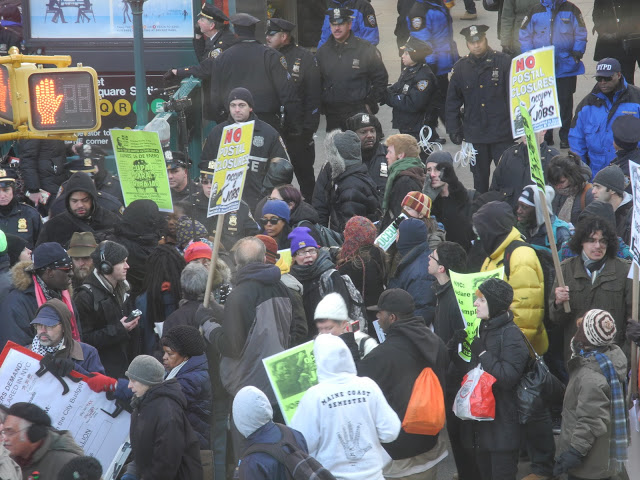
NYPD Overkill: More Police than Protesters

What ever happened to the Occupy movement?  Reports about the activities of the group used to be on television on a daily basis.  Did people lose interest after the eviction from Zuccoti Park?  Was that the end of the high drama that could keep viewers coming back to tune in to the news reports?

Or did the Occupy movement kill itself off?  The Occupy movement’s most touted feature could also have led to its own downfall.  Without a single leader to unify the movement and the ideology, the movement was just a static mob occupying nothing but time and space, but presenting no social change or even a unified list of demands that I ever remember hearing about.

Without a leader, everything was voted on by the entire group.  That sounds good in theory, but fails in implementation, which is why the US is a representative democracy and not a direct democracy (which is what they were implementing in Zuccoti Park).  A quick search of the web shows a recent Wall Street Journal article that talks about the Occupy movement and their current financial woes.  It also mentions that issues are being decided by a General Assembly now, so maybe problems associated with a lack of leadership became apparent even to them.  Or, maybe the problem was that when large sums of money started being handled, it required some sort of leadership and accountability.

Either way, when I think about all of the important movements in history, there have always been figureheads for movements, charismatic leaders that drew attention and promoted the desires of the masses.  South Africa and India had Gandhi.  The Civil Rights movement had MLK.  Who does the Occupy movement have that can present a unified ideology and a unified front, that can actually form a coherent ideology and set of demands to place before the US government and the people?  It’s fine to have a lot of issues under one roof, but without some set of concrete plans or desires, the whole movement begins to feel like a waste of time, and no one likes having their time wasted.

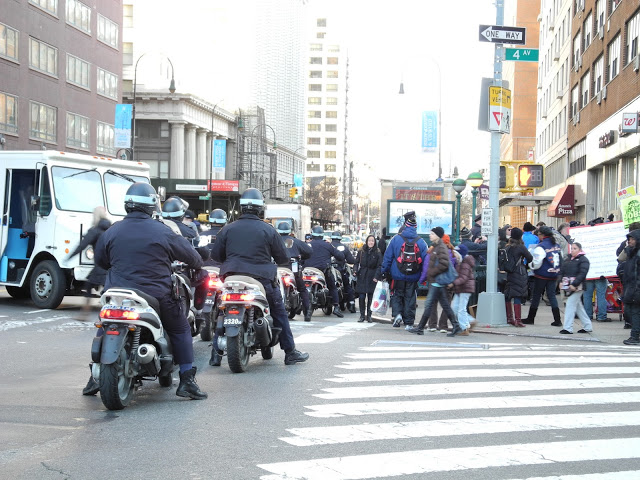
Soap boxing aside, I happened to run into a group of protesters on Monday at Union Square.  The group seemed tiny compared to what I remember seeing on the news and the only thing that really made the moment memorable was the absurd ratio of police officers to protesters.  In fact, I think there might have been more police present than there were protesters.  Perhaps it wasn’t without reason, since there was some commotion that caused a lot of them to run into the crowd before they even crossed the street into Union Square, but I can’t help but feel that more than anything, the police presence was exaggerated and a waste of tax payer money.

Unmarked police car.
Unmarked police car. It wasn’t the only one in the area.

Large group of police at Union Square

Large group of police at Union Square 2

Two rows of motorcycle cops

Small group of protesters being herded by the huge showing of police in the area

Group of protesters at Union Square

Police following a group of protesters at Union Square

Maybe they expected more people to be there?  It’s always better to be over-prepared than under-prepared, but … they even had half a dozen of those little Interceptors lined up waiting, as well as additional units stationed around the park…

Mini police cruisers.

Samskara: How To Bury An Un-Brahminical Brahmin

The following is a book review I had to write for a history course titled, “Traditional Civilizations of India.”  The book is fictional, but deals with issues that helped to explain and give a starting point for research into the Vedic religion of India.  Essentially, a very un-religious person dies in a very religious village, and no one knows quite what to do with him.  The book focuses on the conflict between religious obligations and temptation and how to navigate between the two to do what’s right.  In the end, it leads to a spiritual awakening for the main character, going out into the world and seeing first-hand how the people actually live, which is somewhat reminiscent of what happened to Siddhārtha Gautama, the Buddha.  I have no idea what my grade was for this paper, because it was turned in on the last day of class, but my final grade for the course was an A+.
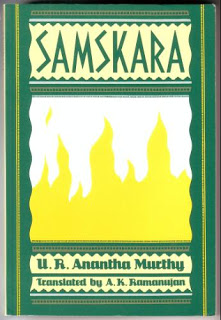
 

Samskara book cover.

“Alive, Naranappa was an enemy; dead, a preventer of meals; as a corpse, a problem, a nuisance” (Murthy 3).  The central issue of the book Samskara, by U. R. Anantha Murthy, revolves around the death of a Brahmin who broke all the rules and flaunted it.  In Durvasapura, a village of supposedly orthodox Brahmin, Naranappa stood out as the exact opposite of everything a Brahmin should be.  He was wild, partied, socialized and had sexual encounters with people outside of his caste, destroyed holy relics and ate sacred fish.  In other words, he broke every taboo associated with being a Brahman.  His behavior while alive seriously complicated the means of disposing of his body after death for all those around him.  The fact that he died from plague and his corpse was a health hazard to the rest of the group seems to have gone completely unnoticed in this story.  The focus, instead, is on the spiritual ramifications of dealing with Naranappa’s remains.  Who is responsible for performing the rites, and should the rites be performed at all?

According to the leader of the Durvasapura Brahmin, Praneshacharya, the “Crest-Jewel of Vedic Learning,” a deceased Brahmin’s funeral rites should be performed by a relative or, in the absence of a relative, any Brahmin will do (Murthy 5-6).  This would seem to solve the problem, since Naranappa has living relatives in the village.  Unfortunately, he managed to alienate them all before dying.  Naranappa and Garuda shared a common ancestor, but Garuda had quarreled with Naranappa’s father over ownership of an orchard.  When Naranappa’s father died, Garuda attempted to gain possession of the orchard by receiving a ruling in his favor from a guru.  Naranappa ignored the ruling and, according to Garuda, they swore they’d have nothing to do with each other for many generations after that.  Lakshmana, Naranappa’s other relative, is married to the sister of Naranappa’s deceased wife.  Lakshmana argues that Naranappa’s abandonment of the woman, and her subsequent insanity and death are things that he just cannot condone (Murthy 7).  So, there are no relatives willing to perform the funeral rites.  This causes the responsibility to shift to the Brahmin community as a whole.

Rather than create an easy opportunity to get Naranappa’s funeral rites done, this does nothing to solve the problem.  Naranappa’s behavior has caused him to become polluted in the eyes of the Brahmin.  Having anything to do with him would cause them to become polluted and lower their social and spiritual standing in society.  According to Jonathan Haidt:

Hinduism very explicitly places all creatures onto a vertical dimension, running from the gods above, to the demons below.  People rise and fall on this vertical dimension based on the degree to which they behave like gods or demons in this life. [1]

For high caste Hindus, proper behavior is regulated by The Laws of Manu.  It tells them how to avoid becoming polluted and part of avoiding pollution is avoiding people who are lower on the vertical dimension, those who are impure.  This is made evident at the very beginning of Samskara, when Praneshacharya mentally debates whether or not to answer the door for Chandri, since even speaking to her would pollute him and he’d have to wash again before dinner (Murthy 2).  If speaking to someone from a lesser caste causes pollution, then certainly handling the dead body of a Brahmin who spit in the eye of Brahminism would be excessively polluting.

The Brahmin in Durvasapura are aware of the risks of pollution involved with performing funeral rites for Naranappa, and rather than take on that burden, they are intent on finding a way to avoid it, even at the cost of slightly tarnishing their Brahminism.  Obviously, performing the funeral rites would be the greater evil, and the more polluting option.  With that in mind, one of the Brahmin, Dasa, proposes that they ask the Bramin of Parijatapura to perform the funeral rites, on the grounds that they were friends with Naranappa and shared meals together (Murthy 12-13).  This is important, because a person wouldn’t eat meals with someone that they consider polluting.  Unfortunately for the Durvasapura Brahmin, the Parijatapura Brahmin understand the precariousness of their social standing and are unwilling to perform the rites.  Praneshacharya says that “friendship is as strong a bond as blood,” but obviously the fear of pollution is the stronger force in society (Murthy 13).

With Naranappa’s body still lying unattended and no one volunteering to take responsibility for the funeral rites, the question of his status as a Brahmin is raised, perhaps in the hopes of pushing him off onto a lower caste.  If Naranappa were declared to not be a Brahman, then it wouldn’t be required that a Brahmin perform his rites.  Naranappa managed to break all the rules.  He drank liquor, ate meat, socialized with Muslims, engaged in sexual relations with low caste women and destroyed sacred objects and animals.  He completely threw out the concept of purity and pollution and even made remarks like, “If I were still a Brahmin…,” that indicate he clearly considered himself to be outside of the Brahmin caste (Murthy 23).  But, was it enough to remove him from the caste system in the eyes of the greater Indian community?  There is some social mobility in the caste system, in moving from one to the other, but is it possible to be removed from the Brahmin caste posthumously?  According to Praneshacharya:

…he may have rejected brahminhood, but brahminhood never left him.  No one ever excommunicated him officially.  He didn’t die an outcaste; so he remains a brahmin in his death.  Only another brahmin has any right to touch his body. (Murthy 9)

So, this brings things back around to the original problem.  Naranappa died a Brahmin and must be given rites as a Brahmin, but because he’s extremely polluted, no one wants to perform them.

Despite the fact that Praneshacharya is a Crest-Jewel of Vedic Learning, he is unable to come to a conclusion regarding the disposal of Naranappa’s body, which is all the while rotting and literally polluting the entire agrahara with plague and a horrible stench.  Without debating the reasons for Praneshacharya’s inability to make a decision, there are several options that were available to him, most of which he was aware of, and all of which he should have been aware of.

The first solution is one that is introduced at the beginning of the story, when the Brahmin first gather to discuss the funeral rites.  Praneshacharya says:

Garuda said: an oath stands between him and Naranappa.  Yet the Books of Law have ways of absolving such oaths—you can perform a rite of absolution, give away a cow, make a pilgrimage.  But this is an expensive matter and I’ve no right to ask anyone to spend his money. (Murthy 9)

Immediately after saying this, Chandri offered up the gold that Naranappa had given her to pay for the expenses of the funeral rites.  Why did Praneshacharya not state that the gold should be used to absolve the oath, as well as perform the rite?  It would have remedied the situation immediately, and since the gold was freely given for that express purpose, then there was no harm in it, only inconvenience to Garuda.  Would it have been polluting?  Perhaps, but on the other hand, if Praneshacharya had given the advice, then Garuda could have rested easy in the knowledge that the best learned person in the community had told him it was right.

Another option available to Praneshacharya would have been to take the gold and perform the rites himself.  As the head of the community, Praneshacharya is ultimately responsible for the well-being of all the agrahara’s inhabitants.  To leave a rotting corpse lying unattended, spreading disease, while people bicker over fine points of doctrine is wholly irresponsible.  Despite the pollution, he should have made the sacrifice for the greater good of the community.  To balance out the pollution of performing the rites, he would have restored the normal flow of life in the agrahara, including the worship.  Surely that counts as good.  Additionally, he could have donated the rest of the gold to a temple.

Outside the context of the story, the translator indicates in the afterword that as a Crest-Jewel of Vedic Learning the answer to the problem should have been obvious to Praneshacharya.  The translator says that the answer to the problem is found in a text called the Dharmasindhu.  He says that “certain simple ritual modifications and offerings would have solved the problem, as the guru of Dharmasthala clearly suggests” (Murthy 145).  In the story, Chandri’s gold made the funds that would likely be necessary for such ritual modifications available to Praneshacharya.  Why didn’t he know about the Dharmasindhu?  Well, the most likely answer is that Samskara wouldn’t have made for a very good story if he had known how to solve the problem before it began.  Besides, the real conflict of Samskara isn’t so much about the inability to find a solution to performing the funeral rites for Naranappa as it is about a conflict between traditional religion and modern life, but that is not the topic of this essay.

In the sort of situation presented by the story, some amount of pollution was unavoidable.  Praneshacharya should have realized this right from the start, and instead of trying to find a perfect way to solve the problem, he should instead have been looking for the least polluting solution.  Resolving the problem would have saved the agrahara from the stench and complete disruption of their lives.  It’s hard to believe that none of the villagers knew the danger of having a plague-killed corpse sitting in their village.  Removing the body would have likely saved the lives of some of the brahmin as well.  Taken together with providing the brahmin a way to resume their prayers, the pollution caused by performing the funeral rites would likely have been balanced out, whether the person that performed them was Praneshacharya or another brahmin.


[1] J. Haidt’s work is on a single web page.  As such, no page numbers are available.

Works Cited

Haidt, Jonathan. “Elevation and the positive psychology of morality.” 10 May 2001. University of Virginia: Faculty. Web. 13 November 2011.
Murthy, U.R. Anantha. Samskara: A Rite for a Dead Man. New York City: Oxford University Press, 1979. Print.

Veselka: Ukrainian Soulfood

Veselka's 1

In 2008, one of the last things I did before leaving the United States and moving to Asia was to have lunch with family at Veselka’s in the East Village.

I don’t remember too much about the visit, except that the pierogis were awesome.  They were so awesome, that I lamented the fact that pierogis weren’t available (at least that I ever saw) during my stay in Asia.  Maybe they were.  Maybe they were hiding on a menu in an overpriced boutique restaurant in an upscale mall somewhere.  Who knows?  Either way, I kept telling my wife about how good they are, pierogis I mean, and I was excited to take her to Veselka’s so she could experience them for herself.

 Veselka's 2

Veselka's 3

Needless to say, she was a bit overwhelmed.  When we got there, she just sat at the table, looking at her phone.  I asked her if she was going to choose what she wanted to eat, and she said, “Oh?  I thought we were having pierogis?”  I told her, “Of course we are, but you have to pick which kind of pierogis you want.”  Then she got excited!  There are plain potato, cheese, meat, spinach & cheese, sauerkraut & mushroom, sweet potato, and arugula and goat cheese.  There’s also the “boiled” or “fried” option to think about.  Veselka’s offers two pierogi plates: the big plate (7 pierogis) and the small plate (4 pierogis).  We both went with the big plate.  Might as well get what we went there for, right?  My wife tried one of each and with the exception of the sweet potato pierogi, which seemed to just not be consistent with the rest of the dish, she said they were all excellent.  I picked and chose but had one of everything but the sweet potato and meat pierogis.

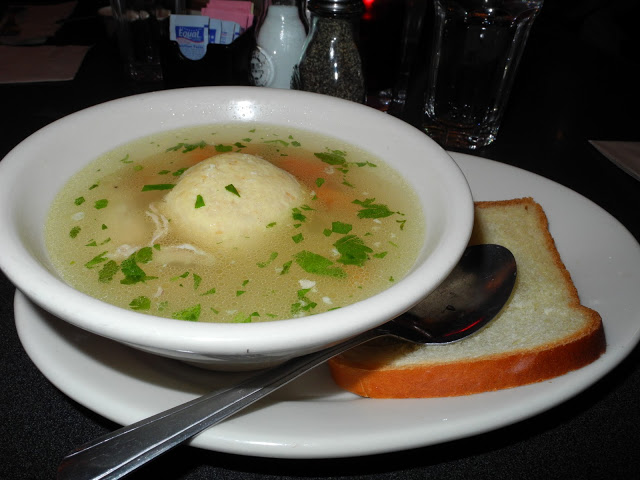
Matzah Ball Soup
Matzah Ball Soup
Ukrainian Borscht
Ukrainian Borscht
Fried pierogis
Fried pierogis.

Dessert board at Veselka's

We thought about having dessert, but after the pierogis and a bowl of soup each, we were full.  The best part is that the food is good quality, but priced to not break your bank.  You can take a look at the full menu by clicking here.

Also, I was happy to see that the murals on the walls in the dining area had been replaced with something more upbeat.  I found two old photos I took in 2006 of the wall murals:

 Old Veselka's Wall Mural 1

Old Veselka's Wall Mural 2

Somber looking aren’t they?

This is definitely better:

New Veselka's Wall Mural

Thanks again for the good food, Veselka’s!  We’ll be back.

Katz’s Delicatessen: Awesome Sandwiches, Well Worth It!

Katz's Delicatessen Facade

I have the vaguest recollection of eating at Katz’s Delicatessen as a kid.  The place has been open, in the spot, since 1888 and is frequently visited by famous people.  The walls inside are covered by pictures of notable diners, like Johnny Depp for instance.  Today my wife and I decided to go down there and give it a try.

Katz's Delicatessen Facade

Despite the hype, we were not prepared for the line we saw when we passed the end of the last block.  Both facades of the restaurant were covered by the lines of people.  The line going down Houston (on the right in the picture) was for take-out; the line going down Ludlow was for dine-in.  Like my wife said, “Thank God for smart-phones.”

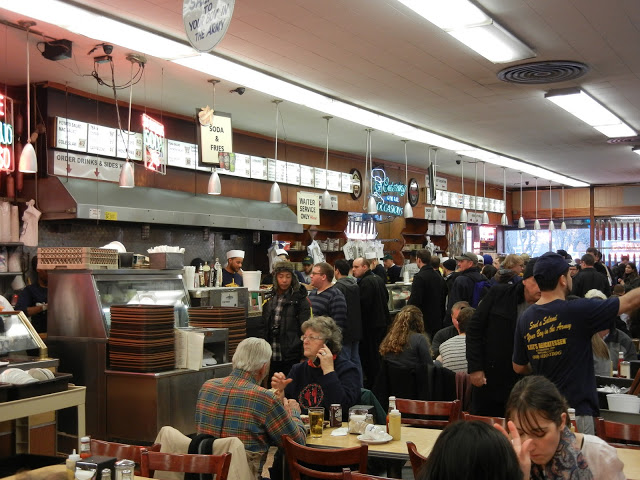
Katz's Delicatessen Interior

The wait wasn’t as bad as we thought it would be, but the line outside wasn’t a line for a table.  It was a line for another line.  Well, really it was for the set of lines where you line up to get your sandwich.  Also for the line where you line up to get a drink.  On one hand, the madness and the business of the set-up adds to the excitement of eating there.  On the other, it was very time consuming.  I suppose there isn’t a faster way to do it though.  Table service would likely take even longer.  My only real gripe was that there was just one guy at the soda/fries (and other extras) counter, which made that a really, really long wait to just get two cans of soda.

Katz's Delicatessen Pastrami Sandwiches

Complaints aside, the wait was worth it.  The food is awesome and you get a huge portion.  One sandwich is enough for two people, unless you’re starving to death.  I have half of the sandwich I ordered sitting on my table next to me, still waiting to be eaten.  I had to go ask for a sheet of wax paper so I could wrap it up to bring it home.  The prices aren’t that bad for what we got.  The sandwiches pictured above are pastrami on rye.  I think they were about 15.75 apiece.

Katz's Delicatessen Pastrami Sandwich

If you’re visiting New York City (or if you live here and just haven’t gone yet) and you’re doing the food tourism thing, pizza isn’t the only must-have while you’re here.  Definitely do stop by Katz’s.  It’s worth the time and money.  Oh, and one last thing: Dr. Brown’s root beer kicks ass!

Rockefeller Center Christmas Tree 2011

Rockefeller Center Christmas Tree 2011 - 1

After seeing the Radio City Music Hall Christmas Spectacular last Friday, my wife and I walked over to Rockefeller Center to take a look at the big Christmas tree.  It’s one of those iconic sights that you have to see to say you had the full Christmas tourist experience in the city.  We’re not tourists, but even still, it’s nice to get out and do the tourist thing.  It helps me appreciate the city more and take advantage of what it has to offer, before I suddenly find myself moving somewhere else.  That’s how it’s always been for me.  I keep putting things off and then before I know it, the opportunity has passed and I’ve moved on.  That’s how I wound up never seeing the Carlsbad Caverns, even though I lived in the area for two years.

Rockefeller Christmas Tree 2011 - 2

Anyway, the tree was looking a little wilted, but we did wait until the it had been up for more than a month to came take a look at it.  Next year, I want to take my wife around to see it when it’s still fresh.  She was very amused to see the ice skating rink just below the tree and had a lot of questions about it.  Maybe one of these days I can teach her how to ice skate, though I’m a bit rusty myself.

Rockefeller Center Skating Rink

The Christmas season is winding down.  In just a few days it’ll be the New Year.  Even worse (and better), classes start again on the 3rd.  It’s just one class, for Winter Session, but it’s 4 hours a day, 4 days a week for three weeks.  It should be interesting.  I just hope we can squeeze in a few more sightseeing stops before we run out of time.  We still have to make it back to the Met!  Hopefully we can do that this Friday, when the museum stays open later than normal.  I’d like to take her to the Guggenheim and the American Museum of Natural History too, if possible.

Rockefeller Center Christmas 2011 Angel Decoration

Radio City Music Hall Christmas Spectacular 2011

Radio City Music Hall 2011

Last Friday my wife and I went to see the Radio City Music Hall Christmas Spectacular, starring the Rockettes. It wound up being a really great experience and it was a great way to spend the Friday before Christmas weekend.

Radio City Rockettes - 2011 Christmas Spectacular - 1

I saw the show once before, in 2006, and I was amazed by just how much the show has improved since then. The most memorable moment for me from the previous show was the toy soldiers. I was in the Army at the time and I remember being impressed by just how precise their marching movements were. I was sitting in the first mezzanine so I had the advantage of watching the turns and wheels from above. I’d marched in more than a few parades and military ceremonies so I had personal experience for comparison and the Rockettes were definitely better at it than anyone I knew. They work harder at perfecting parade marching too, though.

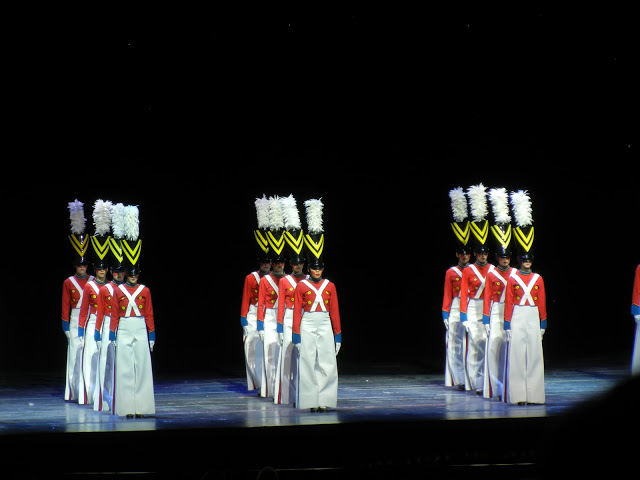
Radio City Rockettes - Christmas Spectacular 2011 - Toy Soldiers

This year, the toy soldier segment was just as much fun to watch, but we were sitting in the Orchestra, so the precision of the marching wasn’t as readily apparent. I almost wish I’d picked mezzanine seats instead! We were able to see the finale to the toy soldier portion just fine though:

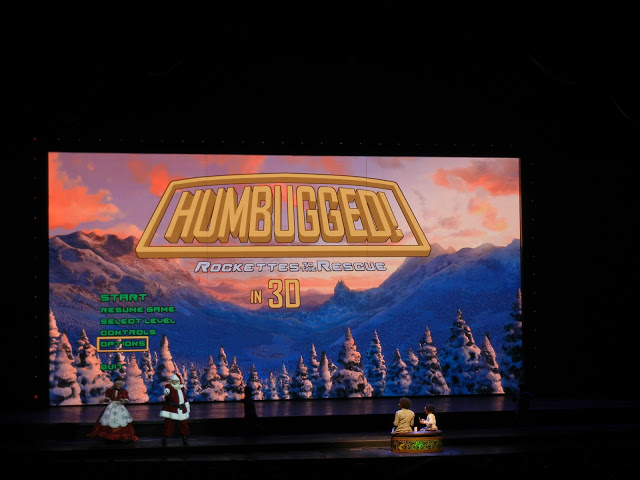
There were a lot of changes to the show. I think I remember seeing the dance with dozens of Santas in 2006, but this year there was a segment meant to imitate the Rockettes traveling through the city in a tour bus, a portion that simulated a video game and even some 3D stuff that was a lot of fun.

Radio City Rockettes - Christmas Spectacular 2011 - Humbugged in 3D

Overall, the show was a very fun and very memorable way for my wife to spend her first Christmas in New York City. We’re looking forward to going again in a few years.

For a full album of pictures (with descriptions) from the show, click here. The album is on Google+ and won’t require a sign in to view.

The Metropolitan Museum of Art: Trip 1

Man Sketching
Man sketching a statue in the Metropolitan Museum of Art in Manhattan, New York City, New York.
Over-the-shoulder of man sketching.
An over-the-shoulder picture of a man, his sketch, and his inspiration.

Last Saturday, my wife and I went to the Metropolitan Museum of Art. We had been putting it off because we’d been busy with going out to different places every day and we were wearing ourselves out and sleeping in.  It’s Winter holiday from school, and she’s not working yet, so we’re trying to do a lot and take it easy at the same time.  I’m not sure how well that’s going to work out for us.

Anyway, Saturday seemed like a great opportunity to both catch up on sleep and still spend a good chunk of time at the museum, since it is open until 9 PM on both Friday and Saturday.  We got there around 2 PM, after having a good brunch with my mom over at IHOP.  The place was packed, as usual, but not as busy as the last time I was there.  From what I’m seeing over the last few days of touring my wife around, the city’s tourist spots are a lot emptier during the winter.  For people who don’t like competing with crowds, that might be something to keep in mind.  It generally doesn’t snow here until after Christmas.  It’s just cold.  If I didn’t live here, I could deal with the cold to avoid the crowds that are usually packing every place of interest in the city.

Metropolitan Museum of Art Map Floor 1
The areas we were able to visit (highlighted by red boxes) in 5 hours. The Met is massive! Click here for an interactive map on the Met’s home page.

Anyhow, the Met is just as awesome as I remember it!  We didn’t get the chance to see everything in the museum, because it’s just too huge a building and their collection is just too massive.  Not that that’s a bad thing!  I’m looking forward to going back again.  Where that can become problematic, though, is with the entry fee.  The entry fee last Spring, when I went to the museum for some class projects was 20 dollars for an adult and 10 dollars for a student.  Now it’s 25 dollars for an adult.  Shocking, right?  The good thing about the pricing is that they’re “recommended,” meaning the prices can’t be enforced.  If you can swallow your pride you can give them 10 bucks per person and walk in.  You could give them a quarter per person and still get the clip-on Met pin that guarantees your safe passage past the guards.  I gave 20 for myself and my wife, total.  I think it was fair, seeing as how we got there halfway through the day and would be making repeat trips throughout the year.

I have a feeling that high pricing is targeted at tourists who usually only go to the museum once on one day and then never see it again.  I certainly don’t think it’s meant for people like the gentleman in the photos above, who come into the museum to practice sketching.  I saw a lot of people doing that, young and old, and I think it’s awesome, because they’re in there, developing their talent in a productive way, instead of running the streets getting into trouble, or causing it.

Lucius Verus
Marble portrait bust of the co-emperor Lucius Verus, Roman, Antonine Period,
A.D. 161 – 169, on loan from the Louvre.

Like I said, we didn’t get to see everything.  The Met is really a two or three day affair and even then you could go back again and notice plenty that you missed.  We saw some of the Roman stuff, the Greek gallery, Oceanic gallery, Native American (South/Central/North) gallery, African gallery, and Egyptian gallery.  I’d spent quite a bit of time in the Greek gallery already and Egyptian art is covered in so many movies, documentaries and TV specials that I just couldn’t get into it, except for the Temple of Dendur.  That was really neat.  The part I liked best about it was the 19th century graffiti on its walls though:

Temple of Dendur 1

Temple of Dendur 2

Temple of Dendur 3

Temple of Dendur 4

Temple of Dendur 5

Temple of Dendur 6

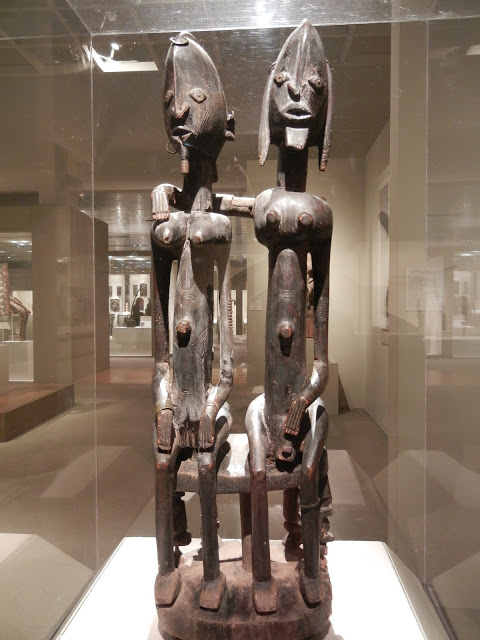
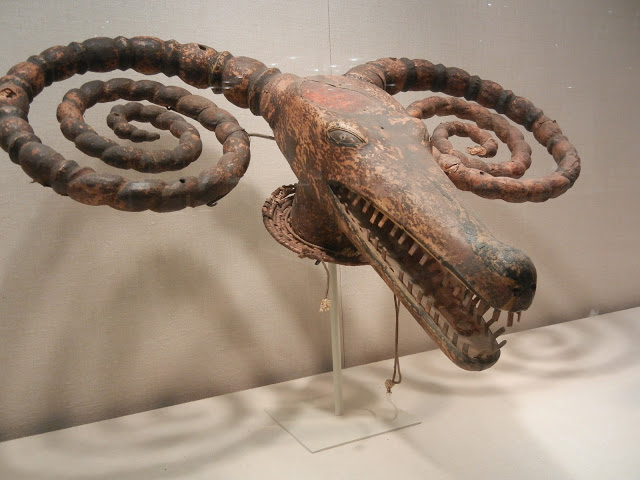
The galleries I enjoyed most were the ones that seemed to be the least populated by visitors, the African and Native American galleries. I imagine its because I’ve been exposed those types of art the least, but there’s something powerful about the imagery as well.

African Art

African Art

African Art

African Art

African Art

African Art

Native American Art

Native American Art

Native American Art

Native American Art

I’m looking forward to the opportunity to go back and see the rest of the Met, probably later this week, if we can squeeze it in.  I’m particularly interested in seeing the Medieval Art gallery and the Islamic Art gallery, which just opened recently.  Before leaving we quickly passed through the Met gift store and they’ve added Islamic art items to their selection.  It seems nice.

Click here for more photos (Google+ public photo gallery).

No More Ant Colony At The Central Park Zoo

59th Street-Facing Entrance to the Central Park Zoo

Yesterday my wife and I went to the Central Park Zoo.  Going to the zoo is something of a tradition for me.  Whenever I used to come to New York City to visit family, I’d always make it a point to go see the Central Park Zoo and the American Museum of Natural History.  I have photos of me as a little kid and then again as a teenager in front of the blue whale in the AMNH.  I also have a fond memory of the giant ant farm in the Central Park Zoo.  It inspired me to get a smaller version and keep it on my desk at home.

Ants in the Philippines, stealing cat food.

While living in Asia with my wife, I learned to hate ants.  They got into everything and there was no way to kill them all or keep them out.  They even did night time raids on the pet’s food bowls, carrying whole pieces of cat food up the wall and out of the house through the ceiling.  Still, that didn’t stop me from wanting to share the excitement of a giant ant farm, and the memory of me being there as a kid, with my wife when we went to the zoo yesterday.

One of the chambers in the Central Park Zoo ant habitat.  All that's left are a few corpses.
One of the chambers in the Central Park Zoo ant habitat. All that’s left are a few corpses.

Unfortunately, we were disappointed.  All that was left of the amazing, huge colony were a few dead ants.  I spoke to one of the people that works there and she said the colony’s queen had died and they were having trouble replacing her.  She said it had something to do with the government making importation of a new queen difficult.  She also said they no longer had an “ant person” and would need to hire someone.

The nasty hissing cockroaches that are living in the ant farm, since all the ants are gone.

The habitat isn’t completely abandoned.  While peering this way and that, looking for ants, I realized I was staring at a bunch of hissing cockroaches.  Disgusting things.  I hope whatever issues the zoo is having get worked out soon, because I’d much rather see the ants.  I wish I’d had an opportunity to get some good photos of that colony before it died out.

The trip to the zoo wasn’t all disappointment.  I’ll post more tomorrow.

A Central Park Wedding

While walking through Central Park today on the path that parallels 59th Street, we ran into a wedding ceremony by the Duck Pond.  Even though it’s winter and also the middle of the week, there was a surprising number of people in the park today.

As this wedding ceremony concluded and the bride and groom kissed, a few people that were watching from over the park wall, on the 59th Street sidewalk, cheered and whistled, which is why the bride looks so amused in the last photo.

http://maps.google.com/maps?f=q&source=s_q&hl=en&geocode=&q=the+pond,+central+park&aq=&sll=40.766282,-73.972331&sspn=0.005964,0.009978&vpsrc=6&ie=UTF8&hq=&hnear=The+Pond&ll=40.766014,-73.974004&spn=0.011929,0.019956&t=m&z=14&output=embed
View Larger Map

Scammer Smurf and Friends

I should have known better, but while my wife and I were out today, I managed to get us stuck in a tourist trap.  We were in Times Square, waiting to meet up with family for lunch at Olive Garden and I saw a person dressed up as a Smurf, so I asked my wife if she wanted her picture taken.  She thought it would be fun, so we walked over, took the photo and started to walk away when the smurf-person stopped us and held up a bag.  I looked inside and saw some dollar bills, so I dropped a dollar in.  I started to turn away, but then the smurf demanded not just one, but two dollars.

Later, as we were sitting inside the Olive Garden, I saw Scammer Smurf and his little friends congregating outside, scheming together and preying on tourists and other unwary pedestrians.

I think I fell for this because the last time I was in Times Square I had my photo taken with a person dressed as an M&M in front of the M&M store without being harassed for money.  Like I said, though, I should have known.

I guess the moral of this story is:  While in New York City, beware of cartoon characters carrying bags and posing for photos.