Boka Bon Chon & Wafels and dinges

Boka Bon Chon Fried Chicken

I just can’t get enough of those damn fried chicken wings and drumsticks!  I don’t know how they make them, but they come out so crispy and delicious that I don’t mind that the spicy ones are burning my face off.  I just keep eating them!  They also come in soy & garlic flavor, which is great.

Kim Chi Bi Bim Bob and Beef Bul Go Gi

I’ve been gradually getting my wife around to all of the places I want to show her here in NYC that I already know about and Boka Bon Chon finally came up on the list.  We were in the mood for something Asian and we were in the neighborhood, so we went on in.

Besides the wings, which are an absolute must if you ever go to this place, we got the kimchi bi bim bob and an order of beef bul go gi.  The servings are generous.  Maybe we were hungry, or it was just particularly good yesterday but we cleaned our plates and stripped the bones.

Waffles and Dinges Truck at Astor Place

Then we saw a food truck.  A bright yellow food truck with a delicious scent coming from it.  It turned out to be “Wafels and dinges,” which sells different types of waffles with a variety of toppings, including one called a “WMD” and, gross as it sounds to me, waffles with bacon or pulled pork.

Brussels waffle with chocolate and powdered sugar from Waffles & Dinges truck.

We were feeling the food we’d just eaten, so we got one and shared it.  It was incredibly good!  I’m looking forward to the next excuse we can find to eat at this food truck again.  =)

For a Sunday afternoon, this was a great meal.  I love NYC.

Occupy Union Square?

Yesterday I went to Petco at Union Square to pick up two 20 pound boxes of cat litter while they were on sale.  Carrying that cat litter was a pain in the ass because I couldn’t get a cab and had to take the bus, but that’s another story.

On the way to Petco, I noticed a lot of people standing around the 14th street side of Union Square with signs.  I’m not surprised.  It seems like there’s a protest there at least once a month or more.  There was a protest there over the Trayvon Martin incident, for example.

Union Square

I can only assume this group is protesting police brutality, but I didn’t stop to ask for specifics.  There was something about the way most of the people looked, the way they carried themselves, that screamed low class and potentially dangerous.  One guy looked homeless and the girl in the purple tube top (just to the right of the pink tree on the left of the photo) kept pulling her top up and down, like she was moments from stripping naked to add flavor to the protest.  I wondered if they were drunk or on drugs.  I know it’s not good to just throw a judgment out there based on how people look, but on the other hand, if you want to be taken seriously, you should look serious.

Union Square

The group of people protesting wasn’t actually that large.  It’s hard to tell from the photos where the protesters end and the normal Union Square crowd begins, but they mostly seemed to be huddled into one corner near that pagoda subway entrance.

Union Square

There were police hanging around and I had things to do so I just minded my own business and kept going.  The reason I wonder if these people are trying to ‘occupy’ Union Square is because I saw them there again today, including the guy that looks homeless.  He had a ruck sack with what looked like a yoga mat.  Maybe he slept on it?  Also, a few of them seemed to have luggage with them (right side in above photo).  The police were still there today too.

My Curry Experiment

A couple of years ago, when I was living in Singapore, I got over my fears of being poisoned by “the enemy” and tried some Indian Muslim food at a hawker center in Pasir Ris.  Indian food basically means curry.  There’s a lot of different types, but all the curry I had was delicious!  I finally got tired of reminiscing about how great the curry was and my wife and I decided to try our hand at making curry ourselves.

Curry Time

Curry Time

Curry Time

Curry Time

Curry Time

After a little trial and error we finally got it down right, using a recipe from a local Indian spice store as a guide.  It was a lot of fun and it’s great to know that we can throw together some curry whenever we want.  It’s amazing how many different types and how great a quantity of spices go into one meal.

I wonder how the first Europeans felt when they got to India and tried the local food?  I mean, obviously they loved it, or the spice trade wouldn’t be what it is today, but what I’m getting at is, were they surprised?  Shocked?  Amazed?  Or did they not like it at first and then it grew on them?  I suppose I’ll research that when I have time, but for now, I’ll just enjoy the goodness that India’s spices create.

Analysis of the The Tower of Babel – Historical Perspective

The following is a paper I wrote for a Jewish Studies class I’m taking called “History of God.”  The point of the paper was to examine a set of verses from the Old Testament from a historical perspective, discussing what the verses reveal about the people it describes, or that wrote it.  This paper relies heavily on the Documentary Hypothesis theory and the concept of Spiral Dynamics as put forth by Ken Wilber.

For clarity, the paper was graded by George KC Forman and  received an A-, as well as some notations about grammar and style corrections (which haven’t been made here).  The professor’s notes on the last page are:

So close! Ask yourself, what was happening in J’s Day? What’s his point. Yes, free will. But to what end? Kingdom has arisen; we now have cities and power in Levant. So free will is in service of Solomon’s reign. How might story fit with that people’s needs and worries? Why free will? Why portray the many languages? I’d given this story answers the need for cooperation, under aegis and king. Unite, it says, to gain power, etc. But good work. Where is this doc. hypoth. book? Sounds great! A-

Essay:

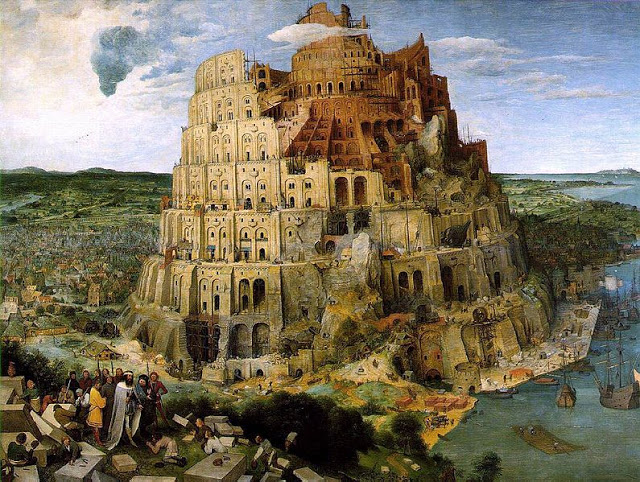
The Tower of Babel
The Tower of Babel

The story of the Tower of Babel, found in the Book of Genesis in the Bible, is fascinating and complicated and is open to many levels of interpretation, especially since it is a story that was probably not original when it was added to the Bible. What does it mean that the people were attempting to build a tower “that reaches into the sky”?[1] And what does God’s response indicate about the nature of the relationship between man and the divine? What can we learn about the needs and wants of that society by analyzing these verses?

The story of the division of human language isn’t unique to the Bible, but that in itself isn’t remarkable. Something as mystifying as why all men don’t speak the same language is a problem that people from various cultures would have tried to solve the best way they knew how: attributing it to an act of the divine, leaving modern readers with a variety of similar myths. Obvious parallels exist in the stories of the Enuma Elish, the building of Babylon’s ziggurat, and a Sumerian story that tells of a time when all people spoke the same language. The closest parallel is a Sumerian epic titled “Enmerkar and the Lord of Aratta.”[2] It starts out describing a time when man had no rival and everyone spoke the same language, but:

Enki…the leader of the gods
Changed the speech in their mouths
Brought contention into it,
Into the speech of man that (until then) had been one.[3]

Whether J came up with the story of the Tower of Babel or borrowed the tradition, its inclusion in the religious tradition of the Hebrews is still significant. It indicates clearly that people identified with the story and felt that it reflected their own relationship with God.

According to the Documentary Hypothesis, the stories of the Pentateuch were not written by one author, but rather four authors and then collated into a single work by a series of redactors. These sources are J (Jawhist/Yawhist; approx. 950 BCE), E (Elohist; approx. 850 BCE), D (Deutoronomist; approx. 600 BCE), P (Priestly source; approx. 500 BCE) and R (the Redactors / Editors). Developed by Biblical scholars in the 18th and 19th centuries, the Documentary Hypothesis uses linguistic cues and source criticism to try to explain the apparent contradictions and repetitions in the Pentateuch. The story of the Tower of Babel (Genesis 11:1-9) is generally attributed to the Jawhist source, making it one of the earliest written stories of the Bible, despite its placement. According to the Documentary Hypothesis, J’s writing focuses on the interaction between God and man’s free will.[4]

Understanding how J writes can be helpful when examining the Tower of Babel story as presented in the Bible and for determining what it might mean about the people it describes. One interpretation is that it’s an origin story for the existence of different languages and cultures in the world. The beginning of the story says, “At one time all the people of the world spoke the same language and used the same words.”[5] By the end of the story, God has confused their languages and caused them to be scattered all over the world. However, this story conflicts with an earlier account that says (emphasis added):

4The descendants of Javan were Elishah, Tarshish, Kittim, and Rodanim. 5Their descendants became the seafaring peoples that spread out to various lands, each identified by its own language, clan, and national identity.[6]

The earlier account already describes the creation of multiple languages and cultures, directly contradicting the later Tower of Babel account. Also, Genesis 11:1-2 implies that all of the people in the world traveled together in one group, which contradicts the earlier account of Cain and Abel. When Cain was banished, God put a mark on his head so no one else would kill him and he went to the land of Nod.[7] This implies that there were people in Nod already that Cain had to be fearful of and that people weren’t traveling together in one group.

This is where it helps to understand the Documentary Hypothesis, which explains that the account in Genesis 10 was added much later, by P (the Priestly source). However, it doesn’t explain the contradiction in the Cain and Abel story, which is also attributed to J.[8] Because the two stories by J are contradictory, the Tower of Babel story must have been included for a symbolic reason, rather than to record factual events in the sense that a history book records factual events. It wasn’t the content itself that was important. It was the message it carried. Approaching the Tower of Babel story from this perspective lends support to the idea that it was borrowed from another culture’s religious tradition. The tower mentioned in the story is probably borrowed from the ziggurat dedicated to Marduk in Babylon called Etemenanki. The plot of the story is probably borrowed from earlier stories, like the Sumerian epic mentioned earlier.[9] So, how can this story tell us anything about the Hebrews?

For the story to be included in the oral and later written tradition of the religion means that the people identified with it strongly. While it’s not possible to apply the details of the people in the story to the Hebrews exactly, it’s possible to analyze the text and draw conclusions about the relationship between man and God, as they saw it. Understanding that the story is symbolic and knowing that one of J’s common themes is the struggle between man’s free will and God, it’s also reasonable to believe that this story is about man’s exercise of free will and the limits of man’s authority over the world.

The Tower of Babel story is about power. Genesis 11:2 describes a tribal, migratory people passing through the Fertile Crescent into Mesopotamia and arriving at a place suitable for settling. Upon arriving, their first thought is to establish themselves in the region through a show of power. They decide to build up a city and a tower that will reach into the heavens. Because they are united, they are able to make quick progress in reaching their goal. However, God has another plan for mankind and takes an active role in the world to push man onto the path He’s chosen for them.

The dialogue attributed to God in Genesis 11:6 gives Him a very anthropomorphic, active and human personality. God appears to be either afraid of what man might accomplish or jealous that man is able to create something monumental, which is a type of action that should be reserved for Him. To stop man from completing the tower, and thereby demonstrating his power of the world, God goes down and “confuse[s] the people with different languages…[so] they won’t be able to understand each other.”[10] After their languages are confused, the people have no choice but to abandon the project. They migrate away from the Tower of Babel, probably sorted into language groups.

It is hard to look at this story and find a way to paint God in a positive light, other than to say that perhaps this was part of a larger design, such as ensuring the fulfillment of his earlier command to Adam and Eve to go forth and populate the Earth. Adam and Eve’s descendants could not accomplish that task if they all stayed in one city. However, I think the key phrase from this passage is in verse 6: “The people are united…. Nothing they set out to do will be impossible for them!” The author of the story perhaps believed that man could achieve anything he put his mind to through unity with his fellow men, with only an act of God being able to stop him. Communal action to support and increase the power of the group is a very tribal action. The inclusion of this story in the religious tradition of the Hebrews could have greatly reinforced the importance of group solidarity, as well as the concept of not transgressing what is sacred at the same time.

The story of the Tower of Babel in the Bible is one version of a larger body of stories that attempt to explain or describe the division of the human race into language and culture groups. The story is not unique to Genesis, but the unique adaptation of the story helps to reveal how the ancient Hebrews may have thought of God, and what they thought of man in relation to that power. It is clear that when this story was introduced into the religious tradition, God was a much more active and anthropomorphic being than He is today. Most importantly, the story describes man’s potential in the world, his ability to do the unbelievable through group solidarity and effort. Where man’s power ends and God’s begins is a boundary that is constantly being redefined, even in the modern age over issues of cloning, for example, but it’s also an ancient argument that has been expressed in one of the earliest portions of the Bible and will continue to be expressed and redefined by generations to come.


[1] Genesis 11:4.
[2] Jim Rovira, “Babel in Biblia.”
[3] Ibid.
[4] William Lyons, “Teaching the Documentary Hypothesis to Skeptical Students,” p. 134.
[5] Genesis 11:1.
[6] Ibid., 10:4-5.
[7] Ibid., 4:14-16
[8] Timothy R. Carmody, Reading the Bible, p. 40.
[9] Jona Lendering, “Etemenanki (The tower of Babel).”
[10] Genesis 11:7.

Works Cited

Carmody, Timothy R. Reading the Bible: A Study Guide. Mahwah: Paulist Press, 2004. Web.
Lendering, Jona. “Etemenanki (The tower of Babel).” n.d. Livius: Articles on Ancient History. Web. 09 March 2012.
life Application Study Bible: Personal Size Edition. 2nd. Carol Stream: Tyndale House Publishers, Inc., 2004. Print.
Lyons, William L. “Teaching the Documentary Hypothesis to Skeptical Students.” Roncace, Mark and Patrick Gray. Teaching the Bible: Practical Strategies for Classroom Instruction. Atlanta: Society of Biblical Literature, 2005. 133-134. Web.
Rovira, Jim. “Babel in Biblia: The Tower in Ancient Literature.” July 1998. Babel. Web. 09 March 2012. .

Ghandhi & Terrorism: Tackling the “Mad Idea”

With globalization being so popular an idea these days, we often seem to forget that nations do have sovereignty over their own territory.  That sovereignty comes with the ability to live in ways that don’t necessarily agree with our own values, expectations or religion and to create law systems that have a foundation on something other than a mirror of our (US) constitution.  One example that comes to mind right away is the shocked reaction that everyone had when Egyptians decided they wanted to replace Mubarak’s tyranny with a government based on Islamic values.

I mention sovereignty because it seems to me that most of the world’s problems come from unrealistic expectations that ones’ own way is not only the best way, but the only way.  If anyone doesn’t want our way, we use it as an excuse to force it on them for their own good while exploiting them for economic gain.  In India, that behavior led to a revolution that, thankfully, wound up being more peaceful than it would have been due to the hard work of a man named Mohandas Karamchand Gandhi, the Mahatma.  In the Middle East, Western meddling planted the seeds that would eventually grow into global terrorism on a grand scale.

Tying Gandhi’s philosophy of non-violent non-cooperation into modern day problems with terrorism was the focus of a class I took over Winter Session.  It was 3 weeks of class, 4 hours a day, 4 days a week, that culminated in an oral presentation and a 10 page paper after having read 3 books on Gandhi’s philosophy and 1 on the rise of religious terrorism.  It was difficult, but educational.  Looking at the paper now, I wish I’d had more time to directly compare Gandhi’s goals with bin Laden’s goals, and to compare their use of religion as a tool to achieve an end.  Instead, I tried to explain the mentality of religious violence and how meeting that violence with more violence only perpetuates the cycle and, even worse, justifies and empowers the terrorist ideology of hatred.  In a way, meeting violence with violence is cooperating with the terrorists, and after you read this you might have a better understanding of why.

[Sources and footnotes are listed at the bottom.]

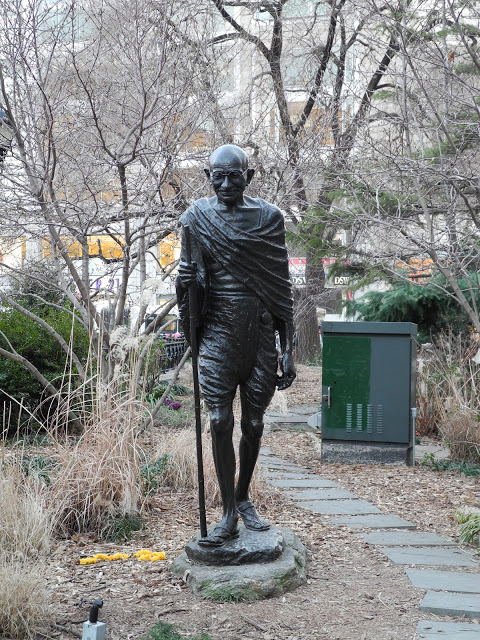
The Gandhi Memorial Statue in Union Square, New York City

On August 15, 1947, India acquired independence from the British Empire. The country’s road to freedom was paved not with violence, but with Satyagraha, a method of non-violent non-cooperation employed and promulgated by Mohandas Karamchand Gandhi, the Indian Mahatma (Great Soul) who expanded on this unique style of civil disobedience in South Africa.[1] The word Satyagraha is a Sanskrit composite formed from satya and agraha. Satya implies love and agraha firmness, which is synonymous with force in terms of the force born of “Truth and Love or Non-Violence…”[2] Gandhi didn’t claim to have invented Satyagraha. Rather, he just named it. Gandhi was certain of the existence of Satyagraha prior to his use of it by the very fact that the world still lived on, despite the constant warfare. He cited Satyagraha as the force that amiably dissolves the quarrels of millions of families daily and emphasized that the only reason it’s not mentioned in history books is because history itself is a record of the disruptions of Satyagraha, or ahimsa, which is the natural course of nature.[3]

Mahatma Gandhi successfully used Satyagraha to fight for Indian rights in South Africa. He used it again to win independence from the British Empire for India. Dr. Martin Luther King adapted Gandhi’s ideology to his own movement and successfully fought for equal rights for African Americans. Without using weapons, Gandhi’s Satyagraha has been proven to work. So, does that mean it has applications for today’s modern war on terrorism? And how would we go about making the changes necessary to effectively employ this force against the ‘enemy’ and bring about a peaceful resolution of conflicts?

Gandhi with a spinning wheel in India

Gandhi said, “…if we are Satyagrahis and offer Satyagraha, believing ourselves to be strong…we grow stronger and stronger every day.”[4] Satyagraha is an ideology of empowerment that places emphasis on maintaining the moral high ground through “self-help, self-sacrifice and faith in God…”[5] Naturally, this is something one must do oneself for it to work properly, which is why Gandhi said that Satyagraha is for self-help and declined the assistance of foreigners in fighting for India’s freedom, except insomuch as he wanted their attention and sympathy.

Gandhi believed that the process of Satyagraha could only happen if one maintained a total absence of violence, both in one’s actions and one’s thoughts. For Gandhi, a “struggle could be forceful…but it could not be violent,” so willing self-sacrifice played a key role in achieving one’s goal.[6] Through non-violent self-sacrifice a movement gains both public sympathy and the admiration and respect of the aggressor, eventually inducing a change of heart and an amiable resolution to conflicts.

Most importantly, by not using violence, Satyagraha creates solutions that break the cycle of violence. Gandhi said, “A non-co-operationist strives to compel attention and set an example not by his violence but by his unobtrusive humility.”[7] The moment violence is used the means become corrupted, which invariably leads to a corrupted end. Gandhi used this argument to counter the call for violent revolution against the British in India. He said that “by using similar means we can get only the same thing that [the British] got” and compared gaining morally pure rule through violence to planting weeds to grow roses.[8]

A violent response escalates the level of violence used. Gandhi believed that winning independence through violence would leave India just as bad off as it already was, because it would mean that violent people would be assuming control of the country.[9] He did agree that he would rather have bad home rule rather than suffer under a foreign master, but Gandhi’s goal was to achieve a free India that could initiate a new government with clean hands.[10] To do this, Gandhi believed that India had to break with modern secular Western society. He described the materialism of Western civilization as a sickness.[11] Britain’s industrialization, and all industrialization, relies on the exploitation of other countries. Engaging in industrialization would pollute India and India would become no better than the former masters’ whose yoke she had thrown off.[12]

1993 World Trade Center Bombers

According to Mark Juergensmeyer, the advent of modern Western society has devalued religious belief, replacing theology with secular morality and the Church with the nation state. Social identity has shifted from religious affiliation to national citizenship. Some religious activists believe that “secular society and modern nationalism can [not] provide the moral fiber that unites national communities or the ideological strength to sustain states buffeted by ethical, economic, and military failures.”[13]

In an interview with Mahmud Abouhalima, convicted of participating in the 1993 World Trade Center bombing, Mark Juergensmeyer asked him what it was that secular America was missing that caused it to not understand him and others like him. Abouhalima answered, “the soul of religion.”[14] He went on to compare secular life to an ink pen that was missing its ink. He said, “An ink pen, a pen worth two thousand dollars, gold and everything in it, it’s useless if there’s no ink in it. That’s the thing that gives life…”[15]

Western societies may see secularization as a positive process, a freeing of the population from archaic dogmas, but people like Abouhalima and even Gandhi were adamantly opposed to separating religion from life.[16] Without religion, Abouhalima would have no meaning in his life, and Gandhi would not have had the strength to free India. Thinking in those terms, any encroachment of Western society in the modern Middle East may be viewed by the locals as not only unbeneficial but harmful, and potentially as an attack on fundamental values and religion itself, which for Muslims constitutes a large portion of their everyday life and culture.[17] Gandhi believed that all change has to come from within to be lasting. It cannot be forced upon people, and attempting to use violence through sanctions that cause hardships or through rhetoric and demonizing will have no effect but to draw sympathy to the victimized, even if their cause is wrong.[18]

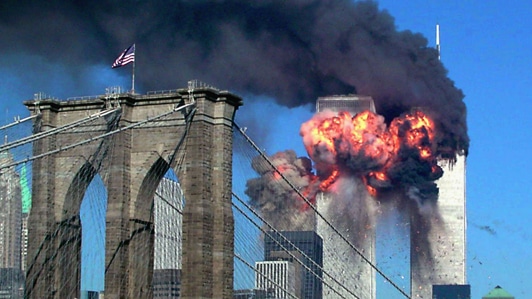
2001 attack and destruction of World Trade Center in New York City

In today’s War on Terror, responding to terrorism with acts of violence empowers the terrorists by cooperating with their ideology of hatred, by affirming that the secular West is indeed evil and intent on destroying the religion and culture of the average person. Mark Juergensmeyer wrote that “many secular political leaders have described [the War on Terror] as a war that must be won—not only to avenge savage acts as the destruction of New York’s World Trade Center, but also to allow civilization as the modern West has known it to survive.”[19] In a war between civilizations where the existence of each civilization’s future is at stake, only one can remain at the end of the conflict. The sort of rhetoric being used to promote the War on Terror is one of absolutes and only further justifies the teachings of terrorists: that the US must be defeated for Islam and Islamic culture to survive. The immediate response after the attacks on the World Trade Center in New York City was to launch a retaliatory attack, but has that attack actually solved anything? Did we not in fact validate the terrorists’ ideology of hatred by destroying the lives of the innocent along with the accused through long-term warfare?

Madanlal Dhingra
Madanlal Dhingra

In 1909, Madanlal Dhingra, an Indian student in England, assassinated Sir William Hutt Curzon Wyllie, a political aide to Lord George Hamilton, the Secretary of State for India. According to Sankar Ghose, “Winston Churchill regarded Dhingra’s last words “as the finest made in the name of patriotism…”[20] Gandhi had a completely different opinion of Dhingra: “It is not merely wine or bhang that makes one drunk, a mad idea can also do so… Dhingra was a patriot, but his love was blind. He gave his body in a wrong way, its ultimate result can only be mischevious.”[21] Gandhi, a man so religious that his last words after being shot by an assassin were “Hē Ram (Oh God),”[22] was absolutely opposed to violence in any form, for any objective, which makes it all the more surprising that terrorism today is most often tied to extreme religious views. In his own way, Gandhi was an extremist, but he was an extremist who used and advocated extremes of peace and love to achieve what he considered just ends. Today’s religious extremists are not so different from Gandhi, in that they go to extremes to ensure that their views are made known. In fact, Osama bin Laden’s goals were not that different from Gandhi’s.

In 1991, Iraqi forces invaded Kuwait, prompting a coalition force of Middle Eastern and Western nations (including the United States) to engage in military operations in defense of Kuwait. Military operations began on January 16th, 1991 with air and missile attacks on targets in both Kuwait and Iraq. After an unavoidable ground war, Iraqi forces were put into full retreat. On February 27th, 43 days later, President Bush declared a suspension of offensive combat. During the war, Saudi Arabia was used as a launching point for allied offensives against Iraq.[23] After the war ended, the US presence in Saudi Arabia remained, further outraging some religious conservatives that consider Saudi Arabia to be the holiest of Islamic lands, being home to both Mecca, where the Ka’aba resides, and Medina where the Prophet Muhammad established the first Muslim community. The Ka’aba is the center of the Muslim world. Muslims believe that the Ka’aba was built by Abraham and his son Ishmael. One of the five pillars of Islam is pilgrimage to Mecca, to circumambulate the Ka’aba.[24]

Osama bin Laden
Osama bin Laden

Among those angered by the continued presence of US troops on Saudi soil was Osama bin Laden, head of the Al Qaeda network. On August 3rd, 1995, he issued a message called “an Open Letter to King Fahd,” outlining grievances against the Saudi monarchy, notably calling for a guerilla campaign to drive U.S. forces out of Saudi Arabia. In July 10, 1996, a British newspaper (The Independent) quoted bin Laden as saying that Saudi Arabia had become an American colony. He also stated that the real enemy of the Saudi people is America. In August of 1996, bin Laden issued a document known as the “Declaration of War Against the Americans Who Occupy the Land of the Two Holy Mosques.” The two holy mosques he references are Mecca’s Ka’aba in Saudi Arabia, where US troops were stationed, and Al Aqsa in Jerusalem. Osama bin Laden considered Israel to be a US puppet regime, so fault for occupying Jerusalem was transferred to the United States. In a CNN interview in 1997, bin Laden began to solidify his message with demands that may sound familiar to anyone familiar with India’s struggle for independence from the British Empire. He said:

We declared jihad against the US government, because the US government is unjust, criminal and tyrannical. It has committed acts that are extremely unjust, hideous and criminal whether directly or through its support of the Israeli occupation…. For this and other acts of aggression and injustice, we have declared jihad against the US, because in our religion it is our duty to make jihad so that God’s word is the one exalted to the heights and so that we drive the Americans away from all Muslim countries…. The country of the Two Holy Places has in our religion a peculiarity of its own over the other Muslim countries. In our religion, it is not permissible for any non-Muslim to stay in our country.[25]

Almost a year later, he goes on to make the following demands:

For over seven years the United States has been occupying the lands of Islam in the holiest of places, the Arabian Peninsula, plundering its riches, dictating to its rulers, humiliating its people, terrorizing its neighbors, and turning its bases in the Peninsula into a spearhead through which to fight the neighboring Muslim peoples. We–with God’s help–call on every Muslim who believes in God and wishes to be rewarded to comply with God’s order to kill the Americans and plunder their money wherever and whenever they find it… in order to liberate the al-Aqsa Mosque and the holy mosque [Mecca] from their grip, and in order for their armies to move out of all the lands of Islam, defeated and unable to threaten any Muslim.[26]

Osama bin Laden and Mahatma Gandhi both had similar goals. Both felt oppressed by foreign powers who meddled in local affairs, to the detriment of the native populations, and in both cases as a result of something Gandhi warned of: the need to exploit other countries to support the industrialization of modern Western culture.

The implied conflict for the survival of civilizations and the perceived attack on religion causes some religious activists to use violence to try to bring attention to their stated goals. From Gandhi’s teachings, we know that he could have in no way supported the terrorism of today to attain independence from foreign oppression, but it is reasonable to believe that he would have empathized with Osama bin Laden’s goal.[27] When Gandhi condemned Dhingra, the Indian student who assassinated Sir Curzon Wyllie, he didn’t condemn his goal; he instead called him a patriot and condemned the means he used. This is where terrorists like Osama bin Laden differ from Gandhi, in the means they use to reach their ends. The results of the two methods have been drastically different. Where India gained the sympathy of the world and won her independence through Satyagraha, Osama bin Laden’s use of violence has escalated out of control. Osama bin Laden himself has met a foul end and the Middle East has not been freed of foreign influence.

Gandhi believed that violence created a cycle, saying “Who lives by the sword must perish by the sword, and if the Asiatic peoples take up the sword, they in their turn will succumb to a more powerful adversary.”[28] That teaching is just as applicable today as it was during his fight with the British. In 1998, when the US launched retaliatory missile strikes on Al Qaeda training camps in Afghanistan and Sudan, the attack “provoked a new round of terrorist bombing plots.”[29] The attacks also increased bin Laden’s image as an underdog and damaged the United States’ international reputation. In July of 2002, an Israeli plane bombed the home of Hamas leader Sheik Salah Shehada, wounding 140 people and killing 11 people, 7 of which were children. Another Hamas leader, Dr. Mahmoud al-Zahar, responded by opening up targeting of terrorist attacks to all Israelis, including women and children.[30] Violent actions only led to an escalation of the level of violence employed by each side. The only way to ‘win’ is by breaking the chain of violence. An example is the 1998 Omagh bombing by a fringe element called the “Real IRA”. The bombing occurred during peace talks that would stop the violence in Northern Ireland. Rather than retaliate with more acts of violence, the guilty parties were arrested and tried using the existing legal system.[31]

So, what is the solution for stopping violence in the Middle East today? Rather than dealing with the symptoms of terrorism, the violent actions, the US should instead tackle the source of the problem. Colin Powell, United States Secretary of State from 2001 to 2005 understood this and “spoke about the necessity of dealing with the social and economic grievances that fueled the anti-American disaffection in the Middle East and elsewhere as a way of undercutting al Qaeda support.”[32] Colin Powell was expressing an idea that Gandhi emphasized himself, in regards to responding to terrorism. Gandhi described Dhingra, the Indian student who assassinated Sir Curzon Wyllie as being like a drunkard, caught in a “mad idea.” It’s that mad idea that we need to tackle: the belief in the Middle East that the United States is incapable of good and morally unambiguous behavior.

The first step is to stop responding to violence with violence. Violent action only succeeds in causing the conflict to escalate. That’s not to say that nothing should be done in the face of violent terrorist attacks. Even Gandhi didn’t believe in inaction.[33] Gandhi believed that no one had a complete view of the truth and the very existence of a conflict was the proof. He believed that every conflict was an “encounter between differing “angles of vision” illuminating the same truth.”[34] The key, then, is to take the moral high ground and understand that a response of violence will be satisfying in the short term, but will yield no real results.

The second step to solving the problem would be to address the problem of public opinion of the United States in the Islamic countries. After many years of duplicitous behavior on the part of the United States, finding a way to positively engage the Islamic community may be difficult without inciting suspicion and distrust, so it would be a gradual progress, in much the same way that Satyagraha was a gradual progress. The first efforts would have to be in areas that are politically and religiously neutral, such as providing medical care, basic literacy education in English and Arabic, building homes for the homeless, and acting in advisory capacities for social programs that would address other needs of the country. It’s a small step, but small steps add up and 30 years of providing education to the poor will mean more to them than bombing their fields to smoke out suspected terrorists. Additionally, we could take the biggest step towards having a friendly relationship with Islamic countries by respecting their sovereignty and allowing the people to determine their own futures through their own elected governments. Additionally, we could remove the US troop presence from Islamic countries and allow the people to fight for and affect their own social reforms. That would mean more to them than having the reforms handed to them with the help of Westerners. As Gandhi said, lasting change has to come from within.

One of Gandhi’s favorite quotes from Tolstoy sums up this policy best:

…if we would but get off the backs of our neighbours the world would be quite all right without any further help from us. And if we can only serve our immediate neighbors by ceasing to prey upon them, the circle of unities thus grouped in the right fashion will ever grow in circumference till at last it is conterminous with that of the whole world.[35]


[1] M.K. Gandhi, Non-Violent Resistance (Satyagraha), Chapter 1, p. 3.
[2] Mahatma Gandhi, The Essential Gandhi, Chapter 6, p. 77.
[3] Ibid., p. 79.
[4] Ibid., p. 78.
[5] Ibid., p. 81.
[6] Mark Juergensmeyer, “Gandhi vs. Terrorism,” p. 4.
[7] M.K. Gandhi, Non-Violent Resistance (Satyagraha), Chapter 15, p. 59.
[8] Ibid., Chapter 4, p. 10.
[9] Mark Juergensmeyer, “Gandhi vs. Terrorism,” p. 4.
[10] Mahatma Gandhi, The Essential Gandhi, Chapter 7, p. 102.
[11] Mark Juergensmeyer, “Gandhi vs. Terrorism,” p. 4.
[12] Mahatma Gandhi, The Essential Gandhi, Chapter 22, p. 249.
[13] Ibid., Terror in the Mind of God, Chapter 11, p. 229.
[14] Ibid., Chapter 4, p. 70.
[15] Ibid.
[16] M.K. Gandhi, Non-Violent Resistance (Satyagraha), Chapter 171, pp. 364-365.
[17] “Introduction to Islam”, describes Islam as a comprehensive way of life.
[18] Mahatma Gandhi, The Essential Gandhi, Chapter 18, p. 220.
[19] Mark Juergensmeyer, Terror In The Mind of God, Chapter 11, p. 233.
[20] Sankar Ghose, Mahatma Gandhi, Chapter 10, p. 98.
[21] Ibid.
[22] “Gandhi’s last words not ‘Hey Ram’: book”.
[23] “1991 Gulf War chronology”.
[24] Rosemary Pennington, “What Is The Ka’aba?”.
[25] Osama bin Laden, “Osama bin Laden v. the U.S.”.
[26] Ibid.
[27] Mahatma Gandhi, The Essential Gandhi, Chapter 10, pp. 132-134.
[28] Ibid., Chapter 5, p. 71.
[29] Barbara Elias, “1998 Missile Strikes on Bin Laden May Have Backfired”.
[30] James Bennet, “A Hamas Chieftain Dies When Israelis Attack His Home”.
[31] Henry McDonald, “Four Real IRA leaders found liable for Omagh bombing”.
[32] Mark Juergensmeyer, Terror in the Mind of God, Chapter 11, p. 234.
[33] Mark Juergensmeyer, “Gandhi vs. Terrorism,” p. 4.
[34] Ibid., p. 3.
[35] M.K. Gandhi, Non-Violent Resistance (Satyagraha), Chapter 46, p. 112.


Works Cited

<!–[if supportFields]> BIBLIOGRAPHY <![endif]–>”1991 Gulf War chronology.” 3 September 1996. USA Today World. Web. 22 January 2012. .
Bennet, James. “A Hamas Chieftain Dies When Israelis Attack His Home.” 23 July 2002. The New York Times: World. Web. 23 January 2012. .
bin Laden, Osama. “Osama Bin Laden V. The U.S.: Edicts And Statements.” n.d. PBS Frontline. Web. 17 January 2012.
Elias, Barbara. “1998 Missile Strikes on Bin Laden May Have Backfired.” 20 August 2008. The George Washington University: The National Security Archive. Web. 22 January 2012.
Gandhi, M. K. Non-Violent Resistance (Satyagraha). New York: Dover Publications, 2001. Print.
Gandhi, Mahatma. The Essential Gandhi. New York: Vintage Spiritual Classics, 2002. Print.
“Gandhi’s last words not ‘Hey Ram’:book.” 29 January 2008. hindustantimes: news. Web. 22 January 2012. .
Ghose, Sankar. Mahatma Gandhi. Delhi: Allied Publishers, 1991. Print.
“Introduction to Islam.” 2000. islam.com. Web. 22 January 2012. .
Juergensmeyer, Mark. “Gandhi vs. Terrorism.” 2007. Mark Juergensmeyer: Global Studies, UCSB. Web. 16 January 2012. .
—. Terror in the Mind of God. Berkeley: University of California Press, 2003. Print.
McDonald, Henry. “Four Real IRA leaders found liable for Omagh bombing.” 8 June 2009. The Guardian. Web. 23 January 2012.
Pennington, Rosemary. “What Is The Ka’aba?” 22 October 2008. MuslimVoices.org. Web. 22 January 2012. .

Guatemalan Woman Attempts to Secure US Anchor Baby for Immigration

Anchor Baby
Anchor Baby

I just saw a report on ABC about a woman who claims that the US government stole her child.  She entered the country illegally, which is a felony and an insult to the national sovereignty of this country, and when she was caught, she was deemed to be an unfit mother for smuggling her child across international boundaries. In his 2008 decision, terminating Encarnacion’s parental rights, Circuit Court Judge David C. Dally wrote that the biological mother’s “lifestyle, that of smuggling herself into a country illegally and committing crimes in this country is not a lifestyle that can provide stability for a child…A child cannot be educated in this way, always in hiding or on the run.”

Her son was taken away from her and has been adopted out to a family that has had him for 5 years.  Now this illegal immigrant, Encarnacion Bail Romero, is trying to get her son back.  She’s trying to play the ‘broken family’ card to get sympathy from the American public.  She’s trying to get us to overlook the fact that she’s a convicted felon who disregarded the sovereignty of our nation by ignoring our legal immigration procedures.  She wants to use our own court system against us.

This excerpt from the article sums up my opinion fairly well:

“When parents break the law, they undertake a certain amount of risk that there are going to be consequences,” said Daniel Stein of FAIR, the Federation for American Immigration Reform.

“Anyone can feel for the torment that this poor woman is going through, recognizing that she doesn’t have the educational and the language capabilities to fully defend and vindicate her rights,” said Stein.

“Nevertheless, she knew she came to this country illegally, she knew she broke the law,” he told ABC News.

This illegal immigrant will get no sympathy from me.  If she didn’t want her family to be broken, she shouldn’t have broken federal laws.  We have borders for a reason.  We have immigration procedures for a reason.   It’s too late.  The ship has already sailed. If this kid (formerly called Carlos and now named Jamison) has been adopted out and with a new family for 5 years, she should let the boy enjoy his life, because she would be a stranger to him. What she wants to do would totally destroy this kid’s life, because he would be emotionally scarred forever.  I can’t imagine why she would imagine that fighting for custody of the kid would be in his best interest, since he doesn’t even know her and doesn’t speak Spanish (the biological mother speaks no English), unless of course she’s looking for an anchor that she can use to stay in the United States herself.

Original Story on ABC: “Adoption Battle Over 5-Year Old Boy Pits Missouri Couple Vs. Illegal Immigrant

Man At Astor Place Dancing With a Bra on His Head

Astor Place, Manhattan, New York City

Just another day in New York City’s Astor Place, right?

Man With A Bra on His Head at Astor Place

Wait?  Is that a guy with a bra on his head?

Man With A Bra on His Head Dancing at Astor Place

Why yes, yes it is.

Man With A Bra on His Head Dancing at Astor Place

Man With Bra on His Head Dancing at Astor Place


Man With Bra on His Head Dancing at Astor Place

This guy slowly took off his clothing while doing a very unusual dance that resembled a combination of a swimming, robot, and peek-a-boo dance.  I’m not sure why he needed to have a bra on his head to do it, but nothing about the whole routine made sense anyway.  He had a little guitar looking instrument with him, but never played it.  I only watched for about a minute, before going about my business.

As entertaining as this is, it’s a shame that he’s on the street and isn’t receiving the mental care that he really needs.  Given how much we pay in taxes every year, you’d think the government would be able to take care of the people in our society who really need it.  No one can tell me that they think this guy is just playing and should get a job, or that he isn’t suffering while we make light of his situation.  I really wish our government did more for people like him.

Gong Xi Fa Cai! NYC Chinatown 2012

Chinese New Year's at Chinatown, New York City

For the first time since I was a kid, I was able to check out the Chinese New Year celebration in New York City.  It didn’t quite live up to my memory, but I have a feeling that we missed the best part of it.  There was already confetti all over the ground.  Next year we’ll have to go check things out earlier in the day.  I must have gotten bad information about the start times of the events.

Dancing Dragon, Chinese New Year's 2012

We wandered around Chinatown for a while but didn’t see much.  At first, we only found one lonely dragon dancer.

Roosevelt Park, Chinese New Year's 2012

Then, we passed through the Roosevelt Park area.  There were some booths set up selling Chinese New Year decorations.  There was also a stage where performers were singing traditional Chinese songs.  I don’t understand Mandarin, so I have no idea what the songs meant, but it sounded pleasant.

Golden Lion Club Banners

We were about to leave Chinatown when we stumbled onto Mott Street.  It seems as though that’s where all the fun was.  The place was packed with crowds of people shooting off tubes of confetti and generally having a good time.

Dancing Dragon 2

Street full of confetti, Chinese New Year's 2012

Flying confetti, Chinese New Year's 2012

Little girl in a dragon costume

For more pictures, click here.

Like I said, I’m pretty sure we missed most of the festivities due to bad information, but it was still a lot of fun to go down to Chinatown and look around for a few hours.  We managed to get in some shopping while we were there too!

Hawkers: Southeast Asian Food in New York City

Hawkers, located between 2nd and 3rd Avenues on 14th Street in Manhattan, is a restaurant that serves Southeast Asian food.  I’ve passed by this place almost every day for over a year, but I’ve never gone in because I assumed it was just a bar, and judging from the layout, serving alcohol is its primary function.

Hawker's Bar

The restaurant seating is laid out as one long bar that covers the center of the space from front to back.  It’s simple, but functional.  The layout maximizes space, but sacrifices comfort.  The seats aren’t exactly something you’d want to spend a lot of time sitting on, so don’t plan on spending a lot of time enjoying your meal.

Small porcelain jar of warm sake and two metal shot cups

The food itself is excellent.

Satay and peanut sauce

The satay tasted authentic.  The peanut dip was a little off from what I remember, though it could just be a difference between recipes.  The only satay I have to compare this to was satay my wife and I ate in Singapore and Kuala Lumpur, Malaysia.  I’d go back to Hawkers just for this, if nothing else.  It’s simple, but satisfyingly tasty.

Green curry

The green curry was really, really spicy and completely awesome!

Popiah

The popiah was ok, but not something I’d order again.

Grilled eggplant lunchbox

My wife cleaned her plate, so I guess the grilled eggplant “lunchbox” must have been delicious!

The bill for what you see in the photos (including a gratuity they helpfully add to your bill for you) added up to about 74 dollars.  That’s a little on the high side for me for a two person meal, though it was quite a bit of food. In fact, it was too much food for two people.  The only reason we went with this option was because of a Groupon deal.  When we go back, we’re going to stick to the lunch menu, or whatever they have for smaller portions.

The last two things I’d like to mention about this place is that its empty in the photos because we went early on a Monday afternoon, and the service was really great.  The girl that served us is from Thailand and we chatted with her about our trip to Phuket, Thailand in 2008 I think it was.