 |
The Rock of Gibraltar, the name of which is derived from
the Arabic Jabal Tariq, “Mount of Tariq,” in honor of
Tariq ibn Ziyad, the Berber Muslim conqueror
of ancient Iberia, and essentially the founder of al-Andalus. |
In 711 CE, a force of Berber Muslims under the command of Tariq ibn Ziyad landed on the southern shores of the Iberian Peninsula and engaged in a campaign of rapid conquest that culminated in the displacement of Visigoth rule in all but the northernmost parts of Iberia. The Visigoth controlled areas in the north later served as the launching point for the Reconquista, the ‘taking back’ of the Iberian peninsula from the Muslim invaders. Muslim rule in Iberia officially ended with the surrender of the Emirate of Granada to King Ferdinand II of Aragon and Queen Isabella I of Castile in 1492, but for nearly eight-hundred years Muslims retained governance over at least a portion of the peninsula and created a glowing civilization that set an example that unfortunately would not be followed.
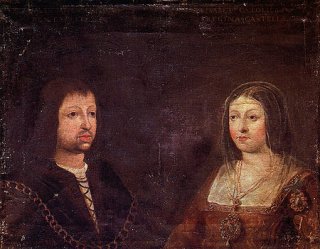 |
Ferdinand and Isabella; Image from:
Convent of the Augustinian Nuns, Avila |
Under Islamic rule, the Iberian Peninsula was marked by a level of religious toleration that was unheard of at the time and Muslims, Jews and Christians lived together in relative peace. There were tensions between the groups, and instances where violence seemed unavoidable, but by and large, the people of al-Andalus not only held their diverse nation together, they caused it to blossom into a society that still draws admiration today for its level of comparative advancement and toleration. Toleration for ethnic diversity and religious differences were the keys to success for al-Andalus, but after Granada fell in 1492 and the Reconquista was complete, one of the first actions taken by the Christian monarchs, Ferdinand and Isabella, was to decree the expulsion of the Jews. That was the same year the monarchs decided to fund Christopher Columbus’ voyage to what he hoped would be Asia. Ferdinand and Isabella wasted no time in establishing themselves as a powerful monarchy, but the example of intolerance they set was in direct contradiction to the legacy that had been left to them by Islamic Spain.
The Muslim’s initial conquest of the peninsula met with little resistance, largely due to the fact that the Visigoth rulers had managed to alienate their supporters (Lowney 31 – 32). The Iberians willingly submitted to the Muslims, since they were no harsher than the Visigoths had been. In the case of the Jews, Muslim rule was a vast improvement (Lea 1). The Jews were highly oppressed under the Visigoth rulers, who “forbade Jews from marrying Christians or owning Christian slaves, proscribed circumcision, outlawed observance of Jewish holy days, and ultimately offered Jews the stark choice of conversion, exile, or slavery” (Lowney 29). It also helped that the Muslims offered their newly conquered subjects favorable surrender treaties, such as the treaty offered to the Christian Prince Theodomir of Murcia, which says:
The latter [Theodomir] receives peace and the promise, under the guarantee of Allah and of his Prophet, that there will not be any change in his situation nor in that of his people; that his right of sovereignty will not be contested; that his subjects will not be injured nor reduced to captivity; nor separated from their children nor their wives; that they will not be disturbed in the practice of their religion; that their churches will not be burned, nor despoiled of the objects of the cult found in them… (Lowney 38)
The tolerant treaties the Muslims offered their defeated opponents was in keeping with the traditions of the Qur’an and helped set the stage for later peaceful relations between the three faiths in Islamic Spain.
In Islam, Jews and Christians are known as ′Ahl al-Kitāb, People of the Book who are protected, albeit with a second-class status. This protection, known as dhimmitude, is based on surah 29, aya 46 of the Qur’an, which says, “And dispute ye not with the People of the Book… but say, ‘We believe in the revelation which has come down to us and in that which came down to you; our God and your God is One’” (Lowney 38)
. Non-Muslim subjects of Muslim regimes were considered to be autonomous but dependent groups who were responsible for organizing their own internal affairs, including social, religious and communal matters. These minorities had leaders, appointed by the Muslim rulers, who were responsible for their group’s “ecclesiastical matters, internal disputes, and fines and taxes” (Lapidus 265)
. The leaders of these minority groups had such a level of independence that in legal cases involving two members of the same faith, their judges could inflict the death penalty without consulting the Muslim rulers (Khadduri, Liebesny and Jackson 340)
. So, Jews and Christians under Muslim rule had the ability to continue to practice and develop their faith, as well as practice their own legal system, within some limits.
The ability of subject faiths to practice their legal system had some restrictions. When cases involved serious crimes that constituted a threat to public order, Islamic law always took precedence. These included crimes such as murder, theft, or highway robbery (Khadduri et al., 340). There were also problems with how non-Muslims and Muslims related to each other legally. In legal cases that involved Muslims or a member of another subject faith, dhimmis were required to appear in Shari’ah courts, which took precedence over Christian or Jewish law. Appearing in Muslim courts was likely problematic for dhimmis, since their testimony was considered invalid under Shari’ah law, though exceptions were probably made in cases involving two members of subject religions, as qadis(Islamic judges) would need some form of information to settle a lawsuit or legal case. Another issue faced by dhimmis was that there were lesser penalties involved for a Muslim guilty of committing a crime against a dhimmi (Khadduri et al., 337). Dhimmis also could not inherit from a Muslim, based on the Qur’anic rule which says, “God will by no means make a way for the unbelievers over the believers” and a hadith which says, “The Muslim will not inherit from the unbeliever nor the unbeliever from the Muslim” (Khadduri et al., 343). So, a dhimmi was fully protected as a subject of the Muslim state, but suffered from certain drawbacks that relegated him to the status of a second-class citizen (Bennett 163)
. However unbalanced, dhimmitude offered the Jews and Christians of al-Andalus legal recourse and protection under the law. It gave them a legal place in the society, creating a state of convivencia, a coexistence where Muslims, Jews and Christians worked and lived together, if not as equals then at least as fellow citizens of the same nation (Rosser-Owen 77)
.
The status of dhimmis as being legal members of the state is part of Islamic religious law, but “there was no Scriptural basis for the legal status of Jews and Muslims under Christian rule; they were subject to the whims of rulers, the prejudices of the populace and the objections of the clergy” (Boase 22)
. It stands to reason that there were Muslims among the early invaders who would have preferred cultural and religious homogeneity, as the later Reconquista Christian Spaniards would, but in the case of the Muslims, religious law dictated that they must respect dhimmis, at least insofar as the law dictated. This religious legal requirement that offered Jews and Christians a place in Islamic society, which didn’t have a counterpart in their own societies, must have created a feeling of stability, safety and most importantly, belonging.
A sense of nationhood, of common standing with their fellow countrymen, could have inspired them to excel, and al-Andalus certainly excelled in many areas. The mix of cultures stimulated the intellectual pursuits of academics that produced advanced knowledge of mathematics, medicine, spirituality, astronomy, philosophy, and theology, and gave birth to some of the greatest thinkers of the age, such as the Jewish kabbalist Moses de Leon, the Sufi mystic Ibn Arabi, the Jewish Moses Maimonides and the Muslim Averroes (Lowney 8 – 9)
. The common thread that held the people of al-Andalus together and produced such remarkable figures as those mentioned above wasn’t ethnicity or religion; it was toleration for the beliefs of others and a commitment to Andalusian society as a whole, based on a sense of belonging and nationhood.
There were people who rejected the idea of Islamic rule or any form of nationhood under the power of another religion. A good example is that of Eulogius, a traveling cleric from Córdoba. In approximately 850 CE, Eulogius discovered one of the earliest Latin copies of a version of the biography of the prophet Muhammad in the monastery of Leyre near Pamplona in northern Spain. The biography is titled simply, Istoria de Mahomet and, unfortunately, is an example of “the repositories of misconceptions about Islam that would be drawn upon over and over again by Christians trying to explain, or more appropriately, explain away the success of Islam” (Wolf 89)
. Eulogius didn’t use it just to explain away the success of Islam. He used the text to create a political movement, an early form of peaceful disobedience, to challenge established Muslim rule through a series of martyrdoms in the hopes of inciting a popular Christian revolt.
Shortly after Eulogius returned to Córdoba, a steady procession of Christians approached Muslim qadis and denounced the prophet Muhammad, eager to become martyrs: “Now hand down the sentence, multiply your cruelty, be kindled with complete fury in vengeance for your prophet. We profess Christ to be truly God and your prophet to be a precursor of antichrist” (Lowney 58)
. These denunciations resulted in the execution of the offenders. Over the course of a decade, approximately fifty Christians were killed executed. Shortly after Eulogius’ death, the number of offenses and executions petered out, which paints him as the likely ringleader (Lowney 59)
.
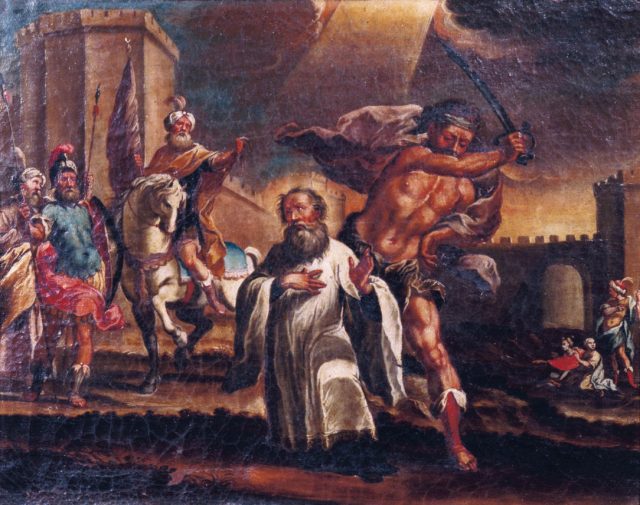 |
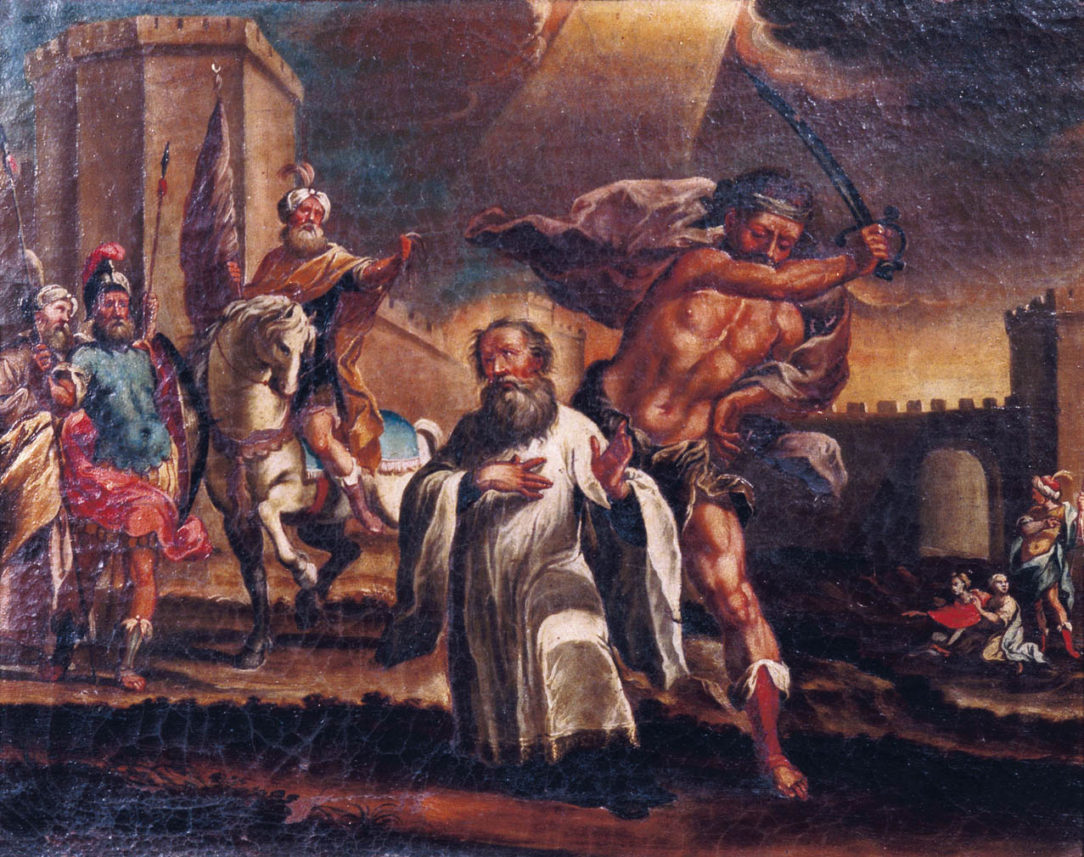
Eulogius, later canonized by the Catholic church, suffering execution for following in the footsteps of
the other Cordoban martyrs and being executed for intentionally blaspheming the Prophet Muhammad. |
A notable point in the incidents of deliberate martyrdom was the lack of reaction from the public. The executions failed to have the effect that Eulogius had hoped for. The martyrs enjoyed support from distant monastic communities, where most of the martyrs were from, but in Córdoba itself, the opinion was little better than mixed. According to Kenneth Wolf, the Christians who rejected the martyrs’ actions had assumed a new perspective of Islam as a different, but valid version of their own faith. Wolf says that Christians adopted this idea from the Muslims, who in turn accepted the Christians as “monotheists and recipients of a revealed law” (Wolf 93). In other words, they had assimilated the idea implied by dhimmitude, that all three religions worship the same God, with some differences.
Just 150 years into Islamic rule in Iberia, the people had come to accept and respect one another. That may sound odd, considering the fact that Christians were being executed for blaspheming a religious figure, but consider the words of a Muslim court official who tried to persuade Eulogius into recanting his defamation of the prophet Muhammad:
If stupid and idiotic individuals have been carried away to such lamentable ruin, what is it that compels you…to commit yourself to this deadly ruin, suppressing the natural love of life? Hear me, I beseech you, I beg you, lest you fall headlong to destruction. Say something in this the hour of your need, so that afterward you may be able to practice your faith.” (Lowney 59)
The implication in this statement is that the court officials were following the letter of the law for the sake of maintaining the legal system, as well as for the sake of preserving the respectability of Islam, but even by the year 859, when Eulogius was executed, Andalusian Muslims in general had probably developed a strong sense of tolerance for the Christians and the Jews who worshipped the same God as them. This sense of community may have been based on physical proximity and a sense of belonging to a certain physical location, rather than being drawn purely along theological lines. The reality of people struggling to survive and coming to rely on the people around them sometimes gets lost in religious debate.
The medieval history of Spain shows little evidence of any conflicts being based solely on either race or religion (Lea 1)
. Four-hundred and fifty years after Eulogius, as territory changed hands during the Reconquista, the people continued to coexist peacefully with their neighbors. Rather than a stark black and white, the reality of conflict on the Iberian Peninsula was far more complex. Alliances were often made between Christians and Muslims for the sake of pursuing similar goals, or for some gain. For example, the thirteenth-century Christian king Alfonso X used religious rhetoric when it suited his self-interests and ignored it for the same reasons. He was an avid supporter of Jewish translators in his court because of the wisdom they could make available to his subjects, but at the same time he mandated a death sentence for any Christian who was “so unfortunate as” to convert to Judaism (Lowney 10)
. Additionally, he waged war against a Muslim kingdom only to later create an alliance with them for the purpose of waging war against a rebellious son. His actions weren’t indicative of a monolithic Christianity versus a monolithic Islam; these were the actions of a man engaged in maintaining and building the prosperity of his own kingdom using whatever means he had available to him. Race and religion were not factors in his decisions, which is a testament to the integration of Jews, Christians and Muslims into one cohesive Andalusian society.
As Muslim control in al-Andalus came to its conclusion in 1492, they left behind a society of three fully integrated faiths that had developed a unique character unlike any other place in the world. Tolerance for religious diversity in al-Andalus did not, of course, meet modern standards, but it was a major advancement for its day that would lead a Christian nun from Europe named Hroswitha of Gandersheim to call Córdoba, the capital of the Ummayad Islamic Caliphate of al-Andalus, the “Ornament of the World” (Shedinger 81)
. From the initial conquest in 711 to the surrender of Granada, relations between the three monotheistic faiths continually developed until al-Andalus was transformed into an integrated society where religion stopped playing a major part in the average affairs of rulers, except as a political tool.
 |
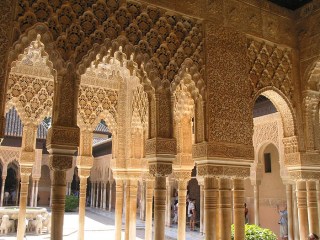
| The Alhambra palace at Granada. |
Despite the success of convivencia, a multicultural and integrated al-Andalus, the Catholic Monarchs King Ferdinand II and Queen Isabella I took a radically different approach to religion and society: limieza de sangre, purity of blood. After they completed their conquest of the Iberian Peninsula, they undertook a program that would ensure the eventual religious homogeneity of the Iberian Peninsula. In 1492, immediately after the fall of Granada, they decreed the conversion, expulsion or execution of the Jews. In 1502, a similar proclamation was made regarding Muslims. Out of necessity, many chose to be baptized. These two groups, known respectively as conversosand moriscos, continued to secretly practice the rituals of their own faiths while maintaining the outward appearance of Catholic Christianity until they were eventually weeded out through the institution of the Inquisition and a final expulsion in 1609 by decree of King Philip III.
 |
| The Court of Lions at Alhambra palace. |
In the face of a long history of a successful and integrated culture, what was the purpose of Ferdinand and Isabella’s deviation from a model that had proven to be successful? It is possible that Ferdinand and Isabella’s decision to expel the Jews and Muslims was merely a continuation of the evolution of religion in the peninsula: they were using it as a political tool. Ferdinand and Isabella may have felt that, as Christians, their loyalties lay firmly with Europe and the rest of Christendom. As rulers of a territory that had been part of the Islamic world for centuries, they may have felt that drastic measures were necessary to change public opinion of Spain. Even today, 500 years after the expulsion of the Muslims and Jews, Spain is an off-color patch in the greater European fabric, with obvious reminders of its Islamic past buried in the architecture, art, and even the language. Given how firmly Islamic culture was entrenched in Iberia, Ferdinand and Isabella may have felt that it would take drastic actions to change public perception of Spain in Europe, hence the expulsions or forced conversions of the Jews and Muslims. It would also explain their petition to the Pope for the title “Catholic Monarchs.” The total effect of expulsions and the gaining of a title affirming the Catholicism of the monarchy would have firmly put Spain in the European camp. The definite causes of Ferdinand and Isabella’s change in policy would be an interesting topic for further research, but the level of tolerance and cooperation between religious groups in al-Andalus is a lesson that many parts of the world could still learn from today.
Works Cited
<!–[if supportFields]> BIBLIOGRAPHY <![endif]–>Bennett, Clinton. Muslims and modernity: an introduction to the issues and debates. London: Continuum International Publishing Group, 2005.
Boase, Roger. “The Muslim Expulsion From Spain.” History Today 52.4 (2002): 21-28.
Khadduri, Majid, Herbert J. Liebesny and Robert H. Jackson. Origin and Development of Islamic Law. Clark: The Lawbook Exchange, Ltd., 2010.
Lapidus, Ira M. A History of Islamic Societies. 2nd. New York: Cambridge University Press, 2002.
Lea, Henry Charles. The Moriscos of Spain: Their Conversion and Expulsion. Philadelphia: Lea Brothers & Co., 1901.
Lowney, Chris. A Vanished World: Muslims, Christians and Jews in Medieval Spain. New York: Oxford University Press, Inc., 2006.
Rosser-Owen, Mariam. Islamic Arts From Spain. London: V & A Publishing, 2010.
Shedinger, Robert F. Was Jesus a Muslim?: questioning categories in the study of religion. Minneapolis: Fortress Press, 2009.
Wolf, Kenneth B. “The Earliest Latin Lives of Muhammad.” Gervers, Michael, Ramzi Jibran Bikhazi and Pontifical Institute of Mediaeval Studies. Conversion and continuity: indigenous Christian communities in Islamic lands eighth to eighteenth centuries. Vol. 9. Toronto: Pontifical Institute of Mediaeval Studies, 1990. 89 – 102.
Note: This was a research paper turned in for a 100-level college course. It received an A+, and the note: “A lively and interesting paper.” I imagine it was checked more for consistency, style and obvious errors rather than having any deep fact checking done. I would have liked a few more weeks to research and fine tune it, but I think it turned out well enough for the time I put into it, considering it’s a paper for an entry level course.




























 Bradley's Old Fashioned Weblog