Finally, Spring is Coming

Students outside of CCNY enjoying the warm weather.

It was so warm outside today that jackets were optional.  It got up to 73F.  It felt great!  It even felt nice to sweat in the sun again.  It was such a nice change from the icy weather we’ve had up until today (except for that one weird day a few weeks ago) that I didn’t even want to go inside.  I wanted to stay out and enjoy the sun.

Trees blooming at CCNY.

Too bad it’s supposed to rain for the next few days.  The temperature is going to drop back down into the high 50s.  I’m looking forward to the weather warming back up and staying up.  It gives me one less excuse to not start running again.  I kinda wish I’d never stopped, because getting going again is always a pain.

No One Wanted The Ugly Cupcakes

This one time, in 6th grade (around 1990), I brought some cupcakes to class.  Ya, this was back before schools started banning cupcakes and other sweets, and we weren’t fat back then either.  Not many of us anyway, but that’s beside the point.  I only vaguely remember why I brought those cupcakes to class, but I think it was part of an event, probably my birthday.  I’m pretty sure that back then, when a student had a birthday, they brought in goodies and we had some free time.  No one brought in poisoned food.  No one cried that they were being forced to eat cake instead of having study time, and no parents tried to sue the school district for encouraging obesity, because we all had common sense back then.  Not like today, where morons sue and win for spilling hot coffee on themselves.  Retarded crap like that makes a mockery of our justice system and our country.

Anyway, back to the story!  My mom made two batches of cupcakes and sent me to school with them.  One batch of cupcakes was ‘normal’, and one was ‘weird’.  The ‘normal’ batch of cupcakes were made of white cake and vanilla frosting.  The ‘weird’ cupcakes were strawberry cake with chocolate frosting.  They just didn’t look right, especially since I’m not a girl and people who are not girls shouldn’t have a pink cake, or cupcakes in this case, at their birthday.  It’s not manly.  The strawberry cake / chocolate frosting combination my mom used for those cupcakes is so unusual that I didn’t find a single result for it on a Google image search.  I found a lot of chocolate cake with strawberry frosting cupcakes, but not the other way around.

strawberry-cupcakes-ed

The cupcakes looked like the image above, but unattractive, and reversed, with pink cake and melty chocolate frosting on top, the kind you get from the grocery store that’s flavored, rather than the fluffed sugar crap you get on ‘fancy’ confections.  (This picture of lovely cupcakes is from the Sweet Indulgences Cakes blog.)

I remember thinking that if I had enough ‘normal’ cupcakes to go around, I would have hidden the other cupcakes.  That wasn’t the case, and when it came time to open the two tupperware containers to present the cupcakes to the class, I could immediately see the same reaction I had to the pink/chocolate cupcakes in the faces of the other boys in class, and in the faces of some of the girls as well.  A line formed, and as students walked past, they picked up a cupcake.  One of the first girls that went by picked up the pink/chocolate cupcake, but everyone else took the ‘normal’ cupcakes until they ran out.  The disappointment was obvious.

So, no one, except maybe for that first girl, wanted the ugly cupcakes, but since there was no choice, the kids at the end of the line had to take them.  I had to take one too, since I took what was left after everyone else had taken a share.  I know that’s sort of backwards from the usual practice of the birthday boy getting the first piece of cake, but that’s how it was.

The odd thing is that after biting into the cupcake, I realized that it tasted great!  I heard other students commenting on it as well, and then the burden of disappointment shifted to the people who had taken the ‘normal’, and ultimately more boring, cupcakes.

I’m sure that I didn’t think of this at the time, but I wonder if, on some subconscious level, this experience reinforced the idea that being adventurous and taking chances can pay off? I’ve taken a lot of chances, some which paid off and some which ended in disaster, but up to now, I don’t regret those choices, because I’ve seen and done things that a lot of people will never see or do.  To me, that’s special.  If I were more conservative and I were the type to always take the ‘normal’ cupcake, I wonder how boring my life could have been?

Don’t always take the ‘normal’ cupcake.  Take chances and enjoy life.

An 18 Year Old High School Student Got Hit By An Express Train Today At Union Square

18 year old student struck by train at Union Square, 14th street.
18 year old student struck by train at Union Square, 14th street. (Image from: DNAinfo.com)

This morning when I was rushing to CCNY for a morning World Humanities class, I saw police stringing yellow tape across the top of the stairs leading down to the 4 5 6 platform at Union Square.  I stopped for a moment and glanced down and all I could say was “shit”, and then I kept moving.  There was blood all over the platform, the area was packed with cops, and I thought I saw what looked like a few … pieces.

It was interesting, but something about the situation didn’t make me want to stop and take a picture.  Maybe it had something to do with the janitor at the top of the stairs, his bucket of water and reddish looking mop sitting next to him.  It just seemed so… surreal all of a sudden.  We all go through these train stations every day, ride the trains every day, and in a moment of carelessness, we can wind up as a stain on the floor getting mopped up by a underpaid janitor using a dirty mop.

Life is brief enough as it is, and I feel bad for the person who got hit by the train, which I later found out was an 18 year old teen on his way to school.  He’s laid up in a hospital now, in critical condition.  The area the accident took place is right at the mouth of the tunnel and the trains enter the stations moving pretty quickly, so realistically, the kid will be lucky if he only suffers brain damage.  His whole life is shot, probably because he stuck his head out to check and see if the train was coming.  Those stations are noisy and there are lots of trains passing through, so he couldn’t have known one was coming up the tunnel right when he poked his head out.  It’s still a case of bad judgment though.  A very unfortunate case.

On my way home, I walked past the same staircase, so I went down to look around.  As I did, a train pulled into the station, and the conductor leaned out and was looking at the floor, where in the image above you can see all the blood.  I wonder if he was the rear conductor on the train that struck the kid this morning?

The lesson I’m taking from this is that the train will come, whether or not we stick our heads out over the tracks to look for it.  I’ll keep doing what I normally do: stand in the center of the platform and read while waiting on the train.

Weird Emails–One of the Risks of Blogging

I meant to post this quite a while ago, but I kept getting distracted with school work and other things to blog about.  Back on the 11th of February, I wrote a post that was inspired by something we were discussing in my anthropology class, a possible connection between the ancient Egyptians and the Olmecs in Central America, as evidenced by similarities in their cultures.  On the 15th of March, someone left a comment on the blog post.  In the comment, it said to not reveal his information, which was in the comment, on my blog, so I deleted the comment.  Shortly after that I received an email through the blog’s email address, which is listed on the contact page.  This is what it said:

Weird email.

Dear Brad

  I was doing research on Olmec and seen your site and Sertima info. The only reason I am contacting you is that it will take young educated people like you to consider all the archeology Facts to reveal the Truth of ancient History to the world.

  I have been collecting artifacts for about 7yrs that will show absolute artifact Proof that the Egyptians and Olmecs have the same origins from a much older ancient advanced civilization that existed before Pangea when the continents were one Super continent. I know this sounds far fetched but please keep a open mind. The discovery I have made has been suppressed ignored and covered up by the authorities so for at least 3 yrs I have not contacted authorities or updated my site because they refused so many times to not examine NOT ONE ARTIFACT. They just say they are not artifacts!  I am sure of a cover up. So I have collected for the last 3 yrs in secret have and have learned incredible facts of the ancients.

  I did not know how to contact you except through your comment site! will you please take my contact to you off your site before someone acts as you to contact me.

  To make a long story short if you want to see some of the artifacts I have a old site and my opinions but a lot has changed since then. If you are interested contact me Michael Ellis  xxxx@xxxxxxx  I have far more than you will see on the website.

Thanks

Michael Ellis

This email is just weird on so many levels, the biggest one being the credibility of someone who would approach a subject this way (emails to random students who have no real say in the field concerned).  If his work were truly credible, it wouldn’t be getting ignored by these mysterious “authorities” in the first place.  If there’s anything I’ve learned from the anthropology class I’m taking, it’s that damn near any theory is entertained, with sufficient evidence, until proven invalid.  Besides that, if someone is doing this sort of research, which has to involve a lot of archaeological expertise, then you’d think they’d have enough computer sense to know the difference between a comment form and an email.  Not to mention that the level of education required would require someone to have a better command of grammar, punctuation and spelling.  The overall effect is that this person comes across as paranoid and delusional.

Also, I just wanted to point out that when the continents were one “Super continent” it was called “Pangea”, so it doesn’t make sense to say “before Pangea when the continents were one Super continent” because they both mean the same thing.

Communists at CCNY Protesting President Obama and US Action in Libya

Communist students at City College of New York protesting Obama and US action in Libya.

This was one of those moments where I stopped and did a double-take.  I mean, you read about Communists in the US, but the ‘evilness’ of Communism is so deeply ingrained in American society that you never really expect to see people putting their faces on the name.  This table was set up on the second floor of the North Academic Center building, by the library.  I didn’t stop to ask them questions, and I didn’t pick up their newspaper, but thinking about it later, I realized a college campus is not really that unusual a place to see this sort of thing.

Communist students at City College of New York protesting Obama and US action in Libya.

I wonder how this whole thing with Libya is going to play out?  I overheard something about impeachment on the news a day or two ago, but isn’t committing troops for up to 60 days the President’s prerogative?

When Is It Ok To Limit Free Speech?

Before you start reading this, let me give you some background information on why it was written.  I’m taking a 100 level (introductory) American Government and Politics course at CCNY.  We were given an assignment that involved writing a 5 to 6 page essay paper on one of three topics.  I chose the third topic:

3) John Stuart Mill argues that government must never censor its citizens, no matter what their opinion. Yet despite having a Bill of Rights, in the U.S. our civil liberties are subject to some limitations. Do you agree that our freedom of expression must sometimes be constricted? Why? To answer this question, you must 1) describe what the Founders wanted to achieve by adding a Bill of Rights to the Constitution, 2) detail the limitations that the Supreme Court has developed over time on either our freedom of speech OR religion, as well as their reasoning for these limitations, and 3) argue, in light of Mill’s theory, whether or not these limitation are legitimate.

Information that’s quoted in the essay is either linked to within the essay, or can be easily looked up, in the case of amendments.  The excerpt of John Stuart Mill’s “On Liberty” that was used to write this paper (as provided) is linked to at the bottom of the post.

Section titles have been added to make it clearer for reading on the web.

(If you came across this while researching for your own paper, please keep in mind that professor’s know how to use Google too, so don’t cut and paste my work and claim it as your own, unless you want to run the risk of being expelled for plagiarism.)


Introduction

The First Amendment of the Constitution of the United States reads, “Congress shall make no law […] abridging the freedom of speech”.  Freedom of speech is the ability for citizens to express ideas or opinions without fearing government retribution. Free speech is incredibly important, and powerful.  When there are public disturbances or revolts in other countries, free speech is often the first thing to be taken away from citizens, most often accomplished in modern times by shutting down the country’s Internet access and/or directly controlling information sources.  The First Amendment is one of the ten amendments that compose what is known as the Bill of Rights, and, since its adoption, has been one of the most contentious and well-known of the rights American citizens possess, often leading to Supreme Court cases which have determined the constitutionality of certain types of speech.  Despite the importance of free speech, many of these Supreme Court cases show a clear record of limiting of free speech, when it is in the best interests of the public at large.  To understand why the right to freedom of speech is important, but why it should sometimes be limited, it’s important to understand the origins of the Bill of Rights, to examine Supreme Court cases where the right to freedom of speech was at issue, and to balance it against John Stuart Mill’s ideas as expressed in his book, “On Liberty.”


Why Were The Bill of Rights Added and How Does It Relate To Free Speech?

The right to freedom of speech is not guaranteed in the Constitution.  It was a right, added later, by the Bill of Rights, which is a list of the first ten amendments, approved by Congress and ratified by the States.  The Bill of Rights itself was a compromise.  As the Constitution was originally written, the majority of the Founders believed that a Bill of Rights wasn’t necessary, or that it would be redundant, since the rights of individuals were protected by the state constitutions and, as in the case of James Wilson, that “the federal government could exercise only those powers that were expressly delegated to it-and those powers did not extend to violating individual liberties” (James Madison and the Bill of Rights, Jack N. Rackove: http://www.apsanet.org/imgtest/JamesMadison.pdf).  According to Jack N. Rackove, the director of the American Studies Program at Stanford University, James Madison in particular felt that a Bill of Rights was not only unnecessary, but dangerous.  Madison feared that by enumerating the rights of citizens, it would imply that other rights were not protected, or by improper wording, it would create loopholes that would allow for the violations of the very rights the amendments were meant to protect.  This is evident by his later proposal of what became the Ninth Amendment, which states: “The enumeration in the Constitution, of certain rights, shall not be construed to deny or disparage others retained by the people.”  This implies that common sense should be used when determining whether or not someone has an inherent right to do, say, or be protected from something not expressly mentioned in the Constitution or Bill of Rights, which could include protection from misuses of free speech.  It wasn’t until after the Constitutional Convention, when the states were in the process of ratification, that the necessity of a Bill of Rights became apparent.  One of the main arguments of the Anti-Federalists was that if the Federalists were really interested in protecting the rights of the citizens from a powerful national government, those rights would be enumerated and clearly defined (A More Perfect Union:  The Creation of the US Constitution (Introduction), Roger A. Bruns: http://www.archives.gov/exhibits/charters/constitution_history.html).  When it became obvious that ratification of the Constitution was in jeopardy, James Madison eventually gave in to popular opinion and peer pressure and admitted the need for a Bill of Rights.  Notably, Thomas Jefferson wrote Madison a letter in December of 1787, in which he said that a Bill of Rights is “what the people are entitled to against every government on earth”.  Madison began promising that after ratification (if elected to Congress) he would see to it that amendments were added to the Constitution that would be “the most satisfactory provisions for all essential rights,”(George Mason’s “Objections” and the Bill of Rights”, Robert A. Rutland: http://www.apsanet.org/imgtest/GeorgeMason.pdf) though he maintained that it was a “nauseous project” (Rakove).  As the Virginia Representative to the First Federal Congress, he drafted and proposed the amendments that became the Bill of Rights as we know them today.  From Madison’s strong objections to having a Bill of Rights in the first place, we can infer that when he was finally forced to write them, he took great care in what he selected as essential rights that every person should possess, and most people in the US today would likely agree that the right to free speech is one of, if not the, most important, because the ability to speak freely about all things, including politics, keeps the public informed regarding what our government is doing, both good and bad.  We couldn’t form a more perfect government without knowing knowing the imperfections of the then present government, and we can’t elect proper representatives today without having free access to information and the freedom to exchange ideas about their merits and deficiencies.  Given the then recent history of the country, it seems obvious that the desire for federally protected free speech was geared more towards freedom of political speech and expression, the peaceful exchanging of ideas without fear of retribution.  The founders of the country were generally well educated, and it would go beyond reason to assume that they’d want the First Amendment right to freedom of speech to imply that speech of a hurtful or obviously dangerous nature could be construed as Constitutionally protected under the Bill of Rights, and that line of thinking has been upheld by the Supreme Court in future generations.


Supreme Court Cases That Restricted Freedom of Speech

Supreme Court decisions have upheld the idea that free speech is important and protected, but that it sometimes must be restricted.  Schenk v. United States, 249 U.S. 47 (1919), is an important example of restricting free speech for the greater good of the country.  During World War 1, Charles Schenk distributed Socialist Party of America propaganda to potential military draftees, urging them to oppose the draft, since he felt it constituted a violation of the Thirteenth Amendment against involuntary servitude.  The court ruled against him, since his efforts created a situation that could undermine the safety of the country in a time of war.  In the unanimous opinion, Justice Oliver Wendell Holmes, Jr. wrote that “when a nation is at war many things that might be said in time of peace are such a hindrance to its effort that their utterance will not be endured so long as men fight, and that no Court could regard them as protected by any constitutional right.”  He went on to say that (emphasis added) “The most stringent protection of free speech would not protect a man in falsely shouting fire in a theatre and causing a panic.  […]  The question in every case is whether the words used are used in such circumstances and are of such a nature as to create a clear and present danger that they will bring about the substantive evils that Congress has a right to prevent.”  This set a precedent for judging when free speech is acceptable by whether or not it creates a clear and present danger to the public well-being.  In other words, it is partially the government’s responsibility to prevent the misuse of free speech, when it is clearly harmful or creates a dangerous situation.  Furthering that line of thinking is the outcome of Chaplinsky v. State of New Hampshire, 315 U.S. 568 (1942), which introduced the ‘fighting words’ doctrine, which limited free speech for the sake of social stability and preventing breaches of the peace.  In November of 1941, Walter Chaplinsky was arrested and charged under a New Hampshire law that makes it illegal to use intentionally offensive speech, directed at others, in a public place (chap. 378, para. 2 of the NH. Public Laws).  In the unanimous decision, Justice Frank Murphy indicated that there are some types of speech that fall outside of the first amendment’s federally protected right to free speech.  He wrote that “There are certain well-defined and narrowly limited classes of speech […].  These include the lewd and obscene, the profane, the libelous, and the insulting or “fighting” words those which by their very utterance inflict injury or tend to incite an immediate breach of the peace.  It has been well observed that such utterances are no essential part of any exposition of ideas, and are of such slight social value as a step to truth that any benefit that may be derived from them is clearly outweighed by the social interest in order and morality.”  This decision both promoted the limiting of free speech for the purpose of preserving social stability and preventing subsequent illegal activity, as well as supports the idea that free speech, as protected by the first amendment, is solely for the purpose of the exchange of ideas that contribute some value to society.  The Supreme Court case Yates v. United States, 354 U.S. 298 (1957) also helped define when free speech should be limited.  In this case 14 people, members of the Communist Party USA in California, were charged with violating the Smith Act, but they argued that simply advocating a change in government wasn’t the same as actively attempting to overthrow the government.  The Supreme Court ruled that the Smith Act did not prohibit “advocacy of forcible overthrow of the government as an abstract doctrine.”  In other words, it wasn’t a violation of the first amendment to advocate doctrines, but it would be a violation to use free speech to advocate immediate calls to violent action.  These three Supreme Court cases show a continuing theme of limiting freedom of speech when it is necessary for the prevention of harm to the general public, or in some cases, to the government, or both, and support the idea that free speech, as protected by the first amendment, has a certain limited scope and is open to restriction.


Balancing The Limitation of Free Speech With John Stuart Mill’s “On Liberty”

In his book, “On Liberty”, John Stuart Mill said that, in regards to the limiting of free speech, “The best government has no more title to it than the worst” (Mill, 22).  He goes on to say that “We can never be sure that the opinion we are endeavoring to stifle is a false opinion and if we were sure, stifling it would be an evil still” (Mill, 23).  Mill goes into great detail about how preventing free speech creates an assumption of infallibility, presuming that our idea is the only right one and is therefore the only one that should be heard.  He argues that, throughout history, ideas have been proposed, and that only through the test of discourse have any ideas been proven more correct than others, or that they are erroneous.  Mill says that wisdom can only be gained by defending a position against all comers, and that only after that defense of position can a man truly believe that his opinion is the correct one, even though he may at a later time be proven wrong by successive generations.  Throughout his work, however, we see that Mill is simply arguing for the free exchange of ideas.  At no point does he say (in the excerpt provided) that using free speech to create panic, injury, or danger is acceptable.  Based on his arguments in “On Liberty”, one could guess that he would consider such a use of free speech to be wholly criminal, and a perversion of what he argued so passionately for.


Closing

The creation of a Bill of Rights to accompany the US Constitution defined explicitly our right to free speech, guaranteed by the First Amendment.  However, nowhere in the First Amendment or elsewhere in the Constitution or the amendments does it say that we have the right to use free speech to endanger other people, the country, or to cause hurtful verbal injury to another person.  It can be inferred by examining the Constitution and Bill of Rights, considering the situation the Bill of Rights was written in, and other writings of the times what was actually meant by the term free speech and over the years successive Supreme Court cases have reinforced that idea.  It is safe to say that free speech has its limits, and those limits are well justified in being instituted.

Birthday Fun and Vintage 1981 Advertisements

So, today is my 30th birthday.  I guess that means I’m old now.  It’s one thing to be in your twenties, but when you’re in your thirties, well, I remember thinking that was really, really old when I was a teenager.  Somehow it doesn’t feel old now though, now that I’m the one pushing past 30.  I think I’ll write a different post about what I’ve learned about life over 30 years.  For now I just want to talk about the day.

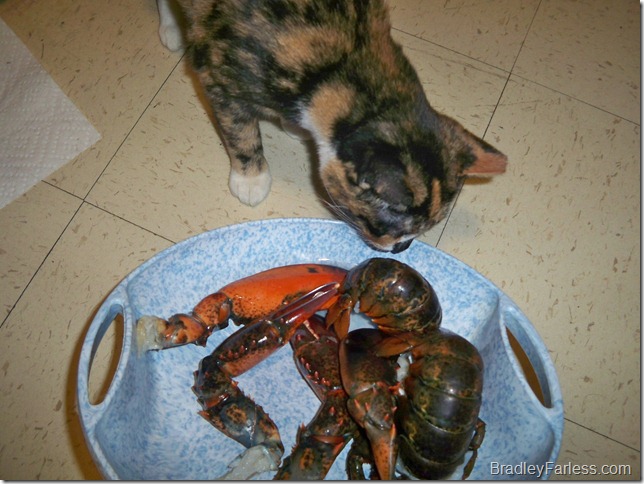
Marble checking out pieces of lobster.

This is the first time in years that my birthday hasn’t been on a weekday, so I didn’t have to go to any job or classes.  Instead, I went with my mom to Chinatown to buy lobster and shrimp for my birthday dinner.  Walking through Chinatown always brings back memories of Singapore, especially when I walk past the small restaurants and they have the ducks and chickens hanging in the windows, and I see people ordering cuts of meat over rice, like the “chicken rice” and “duck rice” in Singapore’s hawker centers.  The sounds, the sights, the smells, all very Chinese, obviously, and I couldn’t help but think of my wife, who isn’t here with me to celebrate my birthday this year.  We had a lot of good times together in Singapore, and I’m looking forward to when she’ll join me here so we can make more happy memories together.  Her absence damped my spirits.

Like I said, being 30 now means I’m old.  I got a card from my dad and the text says: [Front] “You’re 30!  You’re Mature!  You’re Responsible!” [Inside] “And To Teenagers Everywhere, You’re Old!”  So, in the spirit of that oldness, my mom gave me a booklet called “1981, Remember When…, A Nostalgic Look Back In Time”.  A lot of cool and interesting stuff happened in 1981.  There was an assassination attempt on President Ronald Reagan, a civil war started in El Salvador with many human rights abuses being committed by the US-backed government, Prince Charles and Lady Diana Spencer got married, and the US Department of Agriculture decided that ketchup counts as a vegetable (WTF?).  One of the best parts of the booklet, though, are the advertisements from 1981 that it includes.  I scanned some to share here:

1981 Meow Mix Print Ad
1981 PreSun Sunscreen Lotion Print Ad
1981 Sears Stereo-TV Sale Print Ad

This one is a little crazy, isn’t it?  In 1981, it cost 400 dollars to get a 19 inch color CRT TV.  Nowadays, when you can find a good sale, you can get a 32 inch 1080p flatscreen TV for 350 dollars.  With inflation, the difference is even higher!  And check out that slammin’ stereo.  That bad boy even played 8 track tapes!

1981 Sinclair ZX80 Print Ad.

Personal computers were just starting to become affordable.  This Sinclair ZX80 even ran BASIC, and according to the ad you could be writing complex programs in a week.  With confidence even!  The first computer I ever used was a Commodore 64.  I remember it loaded up in DOS, and through trial and error I figured out how to start the computer games we had for it, which ran on 5 inch floppies.  One was a Superman game that really pissed me off.  Anyway, the Nintendo was a lot better for gaming.

Anyway, my day was enjoyable, overall, but now the day is mostly over and I have some Anthropology homework that’s due by midnight!

Founded on God, or Founded on Freedom?

US-founding-fathers

Someone I know was complaining on Facebook that people are forgetting that the US was “built on God but we can’t even pray now.”  I’m taking a US Government and Politics class right now, so this is fresh in my mind, and I think that people are forgetting what the country was founded on.  It wasn’t founded on God.  The country wasn’t built on God.  In fact, there is no mention of God, Christ, or Christianity in the Constitution or the Bill of Rights, and there are reasons for that.

The only mentions of religion in the US Constitution and Bill of Rights are in Article 6, Clause 3, which says no religious test will be required to hold an government office, and in Amendment 1, which prevents the establishment of a national religion or government restriction of religious practices

Article 6, Clause 3 (emphasis added):

The Senators and Representatives before mentioned, and the Members of the several State Legislatures, and all executive and judicial Officers, both of the United States and of the several States, shall be bound by Oath or Affirmation, to support this Constitution; but no religious Test shall ever be required as a Qualification to any Office or public Trust under the United States.

Amendment 1 (emphasis added):

Congress shall make no law respecting an establishment of religion, or prohibiting the free exercise thereof; or abridging the freedom of speech, or of the press; or the right of the people peaceably to assemble, and to petition the Government for a redress of grievances.

Some of the foundering fathers were Protestant Christians for sure, and likely they didn’t expect the encroachment of non-Protestant Christian religions in US society, but they did see the necessity of ensuring that the government couldn’t make any decisions regarding religion, which I think includes not allowing the government to give any indication that it sponsors one religion over another.  The reason for this is that they were quite aware of the abuse of the system in England, where the English monarch was also the head of of the church.  This gave the government far too much power over people.  It’s better for people to be able to have the freedom to make their own choices in regard to religion, without having any one brand of religion forced down their throats by the government.

The Pledge of Allegiance was written in 1892. During a religious revival, “under God” was added in 1954, but, since that implies state sponsored religion, it’s a violation of the 1st Amendment and shouldn’t have been added in the first place.

God shouldn’t be mentioned in any government run institution and it shouldn’t be mandated by government that people are obligated to make oaths or pledges to or by God. That treads on ground the founding fathers implicitly said was outside the government purview, and denial of those powers is explicitly enumerated in the Constitution.  References to God shouldn’t be present in government buildings, courts, classrooms, or government offices, since it violates the Constitution.

The US wasn’t founded on God. It was founded on the principles of freedom and republican democracy.  However, I think our government is being too aggressive in telling students that they can not pray if they want to in a school. To me, that impedes practice of religion, since praying in school voluntarily isn’t hurting anyone, or implying sponsored religion. People should be free to worship, and the government should never imply that it sponsors a particular religion, but it also shouldn’t be preventing people from having an opportunity to pray, meditate, have an out-of-body experience, mentally prepare for the day, review notes, etc.

What’s Really Important on Valentine’s Day

A horse drawn carriage in New York City.

On the way home from class tonight, I passed a flower shop that still had quite a few nice bouquets of roses and other flowers set out.  Instead of making me smile, I frowned and kept on walking by.  It’s not that I have a problem with Valentine’s Day, since I love having an excuse to get my wife a gift, but this is another holiday I’m spending apart from her.  It’s not that I want to focus on the negative, but it’s hard to see these opportunities go by, knowing that it’s a holiday lost, that I didn’t get to spend with her.  There’ll be another Valentine’s Day next year; we’re both still young, but this one is passing us by without us being able to share it, together.

It’s strange how we become accustomed to certain things.  We get comfortable and assume that someone will always be there.  We begin to take things for granted.  It’s only when that person is absent that we realize just how big a part of our life they really are.  I love my wife, I always have, but now that we’re separated, especially today of all days, I realize just how much I rely on her and enjoy her company.  My wife is my inspiration, my motivation, and my joy in life.  Everything loses its luster when she’s not with me to share the experience.

Next year, we’ll be together for Valentine’s Day, and I’m looking forward to doing something extra cheesy, a walk through Central Park perhaps, or maybe we’ll do the touristy thing and ride in a horse drawn carriage.  Or maybe we’ll go exploring in the main New York Public Library.  Whatever it is we do, we’ll do it together, and being together will be the best gift of all.  That and a nice dinner.

One Week Into The Semester And…

I’m actually looking forward to going to class tomorrow.  When I was in high school I couldn’t wait to get done and get out.  Now, the fact that I’m spending my time learning about new and interesting stuff, and more or less getting paid to do it, is completely awesome.

The Campus

The CCNY campus is a lot better equipped and well maintained than I expected from a public school.  If you’re not familiar with it, City College of New York is part of the City University of New York system, but it’s all a public school, unlike NYU or Columbia.  It’s not perfect, of course.  One glaring example is the fact that the escalators don’t work between the 1st and 5th floors, but I suppose I could use the exercise.  It does have a really nice library, lots of computers for student use (not that I really need them since I bring my laptop) and wifi throughout the whole school (or at least in every building I’ve been in).  There’s even a gym and shower facility in Wingate Hall that has aerobic and weight machines and an indoor track.  That opens for use tomorrow, so I’m debating whether or not I should bring a workout outfit.

My Classes

My ‘History of the Visual Arts of the World’ is basically an Art History course, and it’s looking like it’s going to be far more interesting than what I’d thought.  I took the class because it’s a requirement, assuming I’d be studying particular artists, brush strokes and other boring crap like that, but it’s more like learning history through pictures, or sculptures as the case may be.  It also helps that the professor is interesting.  He has a weird, dry sense of humor that I can appreciate, and, oddly enough, he’s an Iraqi, which makes him even more interesting to me, since I served in Iraq on a combat deployment.

My Art History class ties in oddly well with my Anthropology class, since both are starting with things that happened in the past and moving forward into the present.  I keep noticing that we’re discussing one thing in Art History and then touching on the same subjects in Anthropology.  It’s a bit confusing, because I can’t remember which class some bit of information came from sometimes, especially since I take those two classes back-to-back on the same day.  Both professors encourage discussion and don’t jump down your throat if you give an incorrect or incomplete answer.  They guide you to the right answer and then move the discussion along.  That active engagement in the class helps the time to go by faster, and it also helps with retaining the information that was discussed in class.

I only have World Humanities 1 once a week, so I only have one class to judge the course by, but the professor seems like a really cool dude.  I was actually supposed to have gone twice by now, but I missed the first day because I hadn’t registered for the class yet.  I wasn’t alone though.  I’d say a good 40% of the class wasn’t there on the first day, by a show of hands, when the professor passed out copies of the syllabus.  We’re starting off with The Odyssey, by Homer, and so far in class we’ve talked about castration, eating children, baby gods popping out of heads, murder, war, and the differences between gods during those days and the gods that are commonly accepted today.  One girl in the class had a particularly hard time understanding the fact that Greek gods weren’t omniscient and omnipotent and kept asking questions, like she either has a hard time learning or wants to make sure she stands out.  The professor really seems to know the subject matter and how to make it interesting.  I’m pretty sure I’m going to enjoy this course.

My American Politics and Government class seems like the dud of the semester.  I can’t really be sure, since I’ve only sat through two lectures, and the first discussion group isn’t until Tuesday, but I wasn’t very impressed with how the material was covered during our second lecture.  The first lecture was just a discussion of the syllabus.  We were told to read four source documents and when I went into the lecture I was expecting to be amazed and given a new way to look at the material that would give me a better understanding of what it meant, and what the people that wrote it were thinking at the time.  I suppose my Art History and Anthropology professors set a high standard, and my experience in the PSC just didn’t measure up.  Instead of broadening my understanding of the material, the professor just restated what was already in the document, which I already knew, since I read the document before going to the class.  Oh well, they can’t all be winners, and there’s still time for this class to turn around.

Course Work Load

Again, kind of early to tell, but based on the first week, I think I’m going to have plenty to occupy my time.  There is a LOT of reading involved.  I’m having to set aside time to sit in the library and just study and read the textbooks and other documents where it’s quiet and I can concentrate.  I’m also a week behind on the Odyssey, since I wasn’t in class the first day and didn’t know what book we were covering first.  It doesn’t help that the professor wants us to use a particular version that was sold out in the campus bookstore, not available in the campus library, not available in the New York public library, and sold out at most Barnes & Noble locations.  I finally found a B&N in Greenwich Village that has just one copy left, so I put it on hold and I’ll pick it up tomorrow.  I’ll have to knock out 8 chapters of the book by Friday.  I think I can handle that.  I like to read anyway, and The Odyssey is an interesting story.

I’m hoping to find time in the week to still go out and exercise, either on the street or in the school’s gym, and still maintain my other hobbies like surfing the web and blogging.  This week was so packed that I hardly found time to post a blog entry.  Regardless, I’m going to make sure I study first and play later.

The Verdict

Overall, this is turning out to be a really positive experience.  I’m meeting new people, learning a lot of new things, and I’ll finally finish my bachelors and then move straight into a master’s degree.  Good times.