While my wife and I were walking down Orchard Road over the weekend we noticed that there was another new mall open. It amazes me how often a new mall opens in Singapore. I lived in Columbus, Georgia for a while and still have family there. We also used to go there to visit family when I was really young. From as early as I can remember up to today, there have only been 3 malls there. There was Columbus Square Mall. After that Peachtree Mall opened and after a while Columbus Square Mall shut down due to lack of business. A few years ago a new strip mall opened up. I can’t think of the name of it because I’ve only been there three times since then. It’s a horrible mall anyway. The store fronts are all outdoors. You can’t walk around and enjoy yourself and window shop because you’re either in the heat, cold or rain. That’s beside the point, but I’m pretty sure that design disaster is why Peachtree Mall is still open for business, instead of closing down like Columbus Square did.
Singapore on the other hand opens new malls constantly. In the year and a half that I’ve been here, four malls have opened: Tampines 1, Orchard Central, Orchard Ion and now 313 @ Somerset. Those are just the ones I know of. There have probably been more. Three of these new malls were designed beautifully. They’re fun to go to just for the sights and sounds. They’re interesting to explore. That’s good, because it entices people to come into the mall and then maybe see something they want to purchase.
313 @ Somerset isn’t one of those malls. It’s design is boring. Bland even. It’s an up and down mall with ugly carpeting and no imagination. It’s not without merits though. It sits on top of the Somerset MRT station, so it’s guaranteed to receive high traffic, at least on the ground floor. The restaurants there look great too. I saw a burger place I’m interested in trying out. There’s also Trattoria on the ground floor, which I’ll review tomorrow.
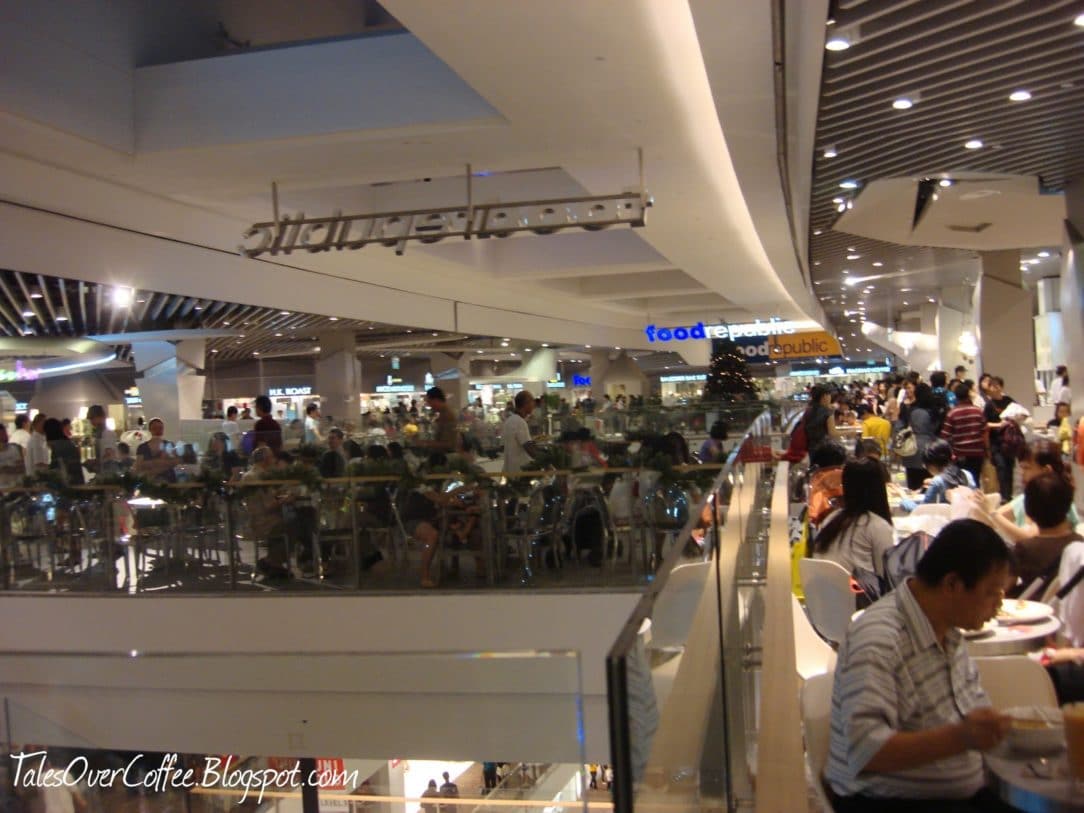
The food court on the top floor is huge, spacious-feeling and packed with food choices. It’s not as stunning as Ion’s food court, but it’s more appealing, since it feels more cozy, relaxed, and not as crowded. From now on we’ll be going there, rather than to Ion’s food court. Eating in Ion is a headache.
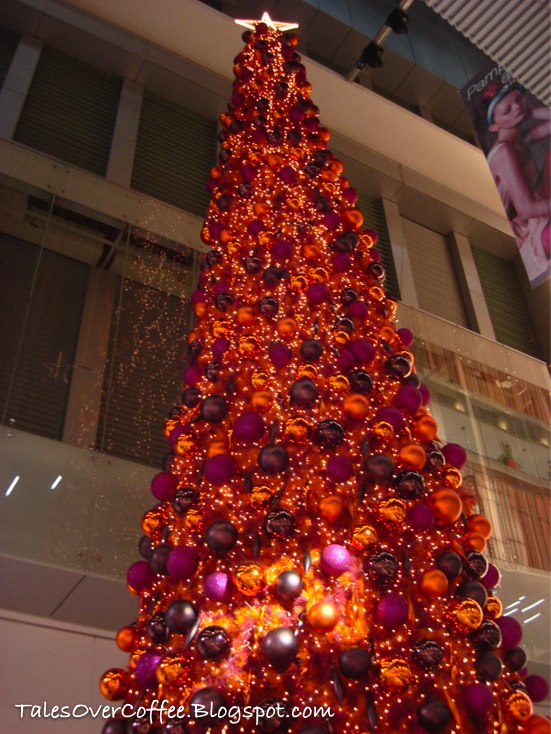
We did get to see something really surprising while we were in the food court. We were walking past their Christmas tree when I smelled something familiar. It was the sweet scent of evergreen. I stopped and walked up to the tree and then looked into the branches. They actually have a real evergreen tree up there! I leaned in close and took a deep breath. It reminded me of the woods in Georgia and of Christmases from when I was young. It was nostalgic I guess. I was the last thing I expected to find in the food court of 313 @ Somerset.
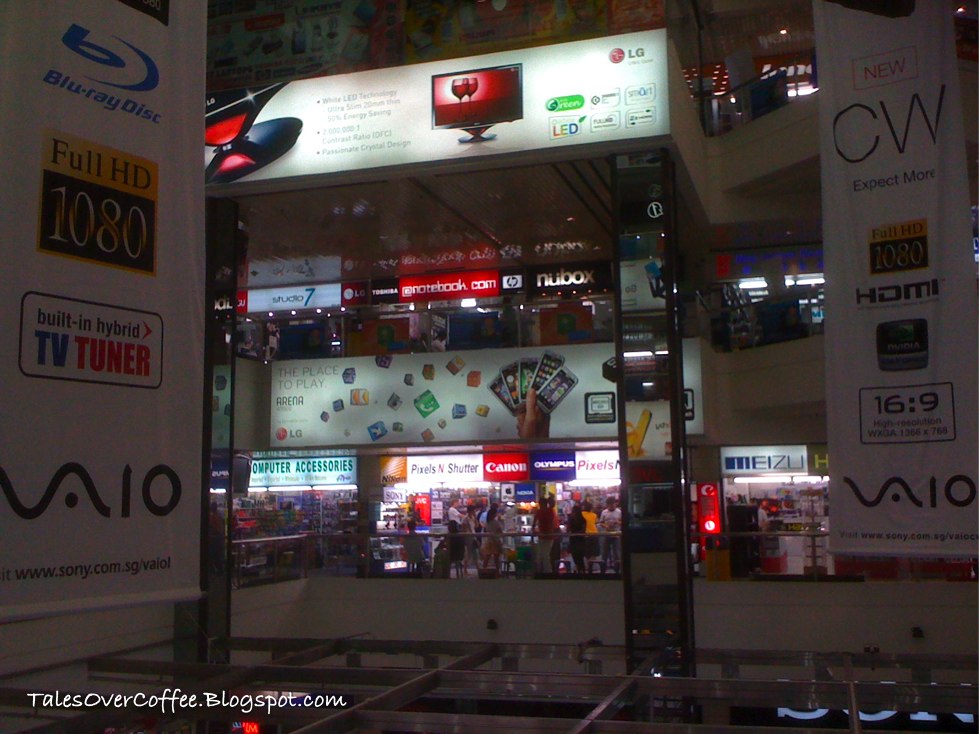
I have a love-hate relationship with Sim Lim. I love the place because it’s full of electronics and I love new gadgets. The place has decent retail prices and if you’re looking for replacement parts, it’s often the only place in Singapore that sells them for a reasonable price.
So, why do I hate going there? I hate going there because I can’t shop in peace. I’m the kind of guy that likes to take my time, examining the items on display, reading through the specifications, comparing and thinking about what the best deal is. I’m often not even there to make a purchase. I just like to see what’s out so I can have an idea of what’s a good deal when I want to make a purchase in the future.
The reason I can’t shop in peace in Sim Lim is because of the aggressive sales practices of the staff in the various stores. If you even look too long at something in the store while you’re out in the walkway area, a sales person runs out and asks you what you’re looking for, what brand, what price range, what what what what.
When you can make it into the store before being assaulted by a sales person, they’ll typically walk up and lean over your shoulder to see what you’re looking at. Then they’ll insult your intelligence by reading the specs of the laptop you’re looking at from the sticker that’s prominently displayed on the wrist wrest of the device. Thanks, but I can read. I’ve been doing it for a long time and I don’t need help reading stickers that are placed in a clearly visible position by the manufacturer.
Typically, when I walk into a store in Sim Lim I walk straight to the items that I’m interested in browsing. A sales person will walk up to me and ask me if they can help me with anything. I’ll quickly tell them, “No thank you. I’m just browsing for the moment.” I say it in a no-nonsense kind of way to make it clear that I’m not interested in being “helped”.
At this point, one of two things will happen. Either the sales person will take the hint, be polite and return to their sitting area, or they’ll just stand there. Uh. Hello? I just told you I don’t want your help! So, why do they do that? It’s like having a vulture crouching on my shoulder while I’m there. Even worse, they follow you around like they’re making sure you don’t try to steal something. After a few instances of this I started telling them that if I had any questions about anything, I would come to them. That didn’t work. They still followed, right to the edge of the store, which is where I would directly go if they wouldn’t leave me alone.
Some of them have no sense of personal space either. I had to ‘accidentally’ bump into one guy that was standing so close behind my wife he could’ve hugged her. That’s really not cool. Not at all.
Even if the sales person takes the hint and retreats, you’re still not guaranteed to be out of the woods, because that sales person has colleagues; colleagues that may not be paying attention to what’s going on. Here’s an example. I walked into a store and when I was approached by a sales person I told her I was quite alright and would let her know if I needed anything. She smiled and walked back to the sitting area. Less than a minute later I was approached by another sales person. Then another. Then another. I had to wave away four of them.
I really don’t know what the point of them hovering around me is. It just puts me on edge. It makes me feel like I can’t stay in one spot too long and make my own decision. When they don’t leave me alone, or even worse when they try to offer me a “special price six minutes only” I quickly turn and leave and go to the next store.
I don’t like being uncomfortable and I don’t like feeling pressured when I’m considering spending a large sum of money on an electronic device. I want to take my time and make sure that I’m picking an item that I’m going to like; not what the sales person tells me I’ll like.
I know this is a cultural difference, because I’ve seen the same behavior from sales people in the Philippines. It’s odd that this is the only place in Singapore (that I know of) that does this. Honestly, it makes me want to avoid Sim Lim if I can. It’s too bad more stores in Singapore don’t have web pages that show their specials and sales.
So, here’s what I recommend. If you’re a sales person and someone tells you they don’t want to be helped, hand them a flyer with your store’s current specials, tell them your name, thank them for visiting your store, and tell them that if they need anything you’ll be available (not waiting, because that sounds aggressive) in the back of the store. Also, label your products with prices and whatever specials come along with them, like free bags, etc. Mark brightly what’s on sale and put it near the front of the store. Make sure everything has tags detailing the devices capabilities. But don’t harass your customers! Let them browse in peace. If they have questions they’re not going to run away. They’ll ask.
In this sign you’ll see that explanations are made “pristine clear”, which is redundant. It doesn’t inspire much confidence in the teaching ability of the instructors at this education center if they can’t even get their sign right, especially since they’re supposed to be teaching English.
This reminds me of the Speak Good English movement that the government has been pushing. Singapore is a country that has tried to develop a mandatory bilingualism among its citizens. That’s a great goal, but some of my online reading suggests that the plan has backfired and resulted in a large number of Singaporeans that speak both English and Mandarin inadequately.
Speaking to locals can sometimes be a daunting experience. First you have to adjust to the accent. Then you have to occasionally jump the hurdles of grammar errors and mispronunciations. Compound that with the occasional local that addresses you with the local pidgin English (called Singlish) and it can be a verbal minefield that will leave you scratching your head and asking for a translator. I always excelled in English and Literature subjects in school but sometimes I have to ask someone I’m speaking with to repeat themselves a few times to figure out what they’re trying to say.
This problem was very much apparent when I went to SingTel last night. I showed up and got in line to have my plan upgraded to an iFlexi plan. You see, when I first got my iPhone from SingTel the iFlexi plans (which were tailored for the iPhone) were … lacking to say the least. They didn’t really offer any benefit at all. The data allowance was VERY low and it just wasn’t worth having. So I wound up selecting another plan and I just used the wireless@sg that’s available all over the island. Well, not everywhere, but it’s in most shopping centers, libraries, and public buildings. If you’re not familiar with it, wireless@sg is free wireless that’s available to anyone in Singapore with a local phone number.
The release of the iPhone to other carriers in Singapore created a quick round of competition between the three major mobile carriers to offer the best plan for the best value in regards to their iPhone offerings. Yay capitalism! Part of that competition called for an increase in the data allowance to 12 GB monthly all around. SingTel was previously only offering 500 MB per month on the low end iPhone plan. Now the 12 GB limit was across the board. SingTel also offered a 30 SGD cap on data usage beyond the 12 GB allowance. That was great, so I wanted to get on board with it.
I realize I could’ve just called in, but we were at the mall anyway and I thought it might be a better idea to just handle the problem in person. When I got in line a girl came up and asked me what she could help me with. I told her I wanted to upgrade my plan to take advantage of the new offerings in the iFlexi plans. She took down my mobile number and other details and then went to a counter. She came back after a few minutes and told me that I’m not eligible to upgrade my plan. After quite a bit of going back and forth with her I asked her to get someone that spoke better English to assist me. Shortly, the manager came back and we quickly resolved what it was I was trying to do and I was able to upgrade my plan to an iFlexi plan. I’m not quite sure why, but the girl thought I wanted to re-contract my iPhone. She was trying to tell me I wasn’t allowed to upgrade to a better, more expensive plan. That obviously makes no business sense so I knew she was missing the point.
It can be funny finding signs like the one pictured above, but living in Singapore has taught me how important it is to be able to communicate effectively and it makes me glad that the ‘international business language’ is my native language. I hear English is one of the hardest languages to learn, so good job to those that have mastered it as a second language.
One of the things I’ve always found curious about Singapore is that there are lots of ethnically Chinese people that have Western names. When I first found out about the Western style names I assumed that ethnic Chinese in Singapore had simply started using Western first names in place of Chinese first (or given) names, followed by their surname (ex: John Goh, Michelle Tan, Jimmy Lim, etc).
So, I was a bit confused when I found out that in Singapore, ethnic Chinese have a full Chinese name, but at some point choose an English name to use in addition to their Chinese name. It sounded a bit silly to me at first, like a bunch of kids at a sleep over picking fake names to role-play with, but I’ve found a few reasons as to why it may be done.
The practice is very common in modern China. The people there tend to choose an English first name for a variety of reasons. They might do it because they frequently have to do business with foreigners, and an English name is easier for them to pronounce and remember. They might do it as a way of expressing social status. Some do in fact choose an English name that embodies their dream or ambitions for the future. In China, it is believed that your name will affect your destiny. This practice has carried over to Hong Kong and Singapore.
I’m just making a guess here but I think the reason that Western names are so popular in Singapore among ethnic Chinese has to do with business reasons. Singapore is constantly maneuvering and positioning itself as a business hub, and more recently a technology and media hub, for this region of the world. As such it does quite a bit of communicating with foreign investors and main branches of MNCs that have set up regional offices here. So, for the sake of simplicity in regards to carrying out that business, I think people here choose English names to use in place of their Chinese names when in the work place.
If someone knows more about it than I do, please enlighten me in the comment section as I’d really love to know!
Also, I think it’s an interesting opportunity to be able to give yourself a name. In Western countries we’re given the only name we’ll ever have by our parents at birth. There is a way to legally change your name in the US, but who really does that? You risk insulting your family if you do. Sometimes our parents give us names that are really outdated, are in poor taste, or just make you say “WTF?”. Having the opportunity to choose your own name, based on your own hopes and interests is great!
This applies mostly to tables at hawkers, since you’re seated as usual in a “sit-down” restaurant by a host.
In a hawker center (take that to mean food court and kopitiam as well) there are a lot of people trying to eat and there usually aren’t enough tables to go around. In Singapore, it’s not uncommon to get your food, turn around, and then realize there’s no where to sit, especially at high traffic times during lunch and dinner hours. You might stand around for quite a few minutes looking for a spot for yourself and whoever might be with you. That can be really frustrating and sometimes you wind up eating with strangers, which doesn’t seem to faze locals, but was uncomfortable for me at first. In food courts in the US you eat at your own table with your own friends and family and that’s it. There aren’t any strangers buddying up next to you. It’s awkward and unwanted and depending on who you try it with you might get whacked in the head for your trouble.
Singaporeans have a solution for their dilemma. They call it “choping”. Basically, it’s a way of reserving a seat in advance. If you’re from the US, the term “dibs” is about the same. If you chope a table, you’re calling dibs on that table, though it’s taken a bit more seriously here. By the way, in Singapore “Dibs” are ice cream bon bon things.
I call dibs on these Dibs.
The way it’s typically done is by leaving a travel-sized packet of tissue on the table. If you’re wondering why people would all have tissue on them (other than women, who have everything under the sun in their bags), it turns out that at hawker centers it’s incredibly rare to be provided with a napkin to go along with your meal. The only place I know of that does it is a Western-style hawker stall called Amigos in Pasir Ris. So, if you’re a local and you’re going to the hawker you have tissue with you. You deposit this tissue onto the table to claim it as yours and then you go get your food. This practice ties in with Singapore being safe because in a lot of places if you left your tissue on the table (and it was obviously not used) it would disappear before you got back.
I’ve seen some posts on the internet about Singaporeans having a fit because foreigners don’t respect their “chope”. Luckily, most of them are smart enough to realize that choping is a local custom and the foreigners more than likely just didn’t know what the tissue was doing there, or thought it was tissue provided by the hawker. I recall sitting down at a table that had a packet of tissue on it once. I even pocketed the tissue. I guess some one ate their lunch in brooding silence that day. It wasn’t until I’d been in Singapore for about a year that I learned about choping.
Nowadays I think the practice is starting to fade out and is being replaced with a more familiar way of claiming a table. Someone from the group simply sits at the table and claims it while other people go get their food (and hopefully that person’s food as well). But, if you find yourself standing, looking out over a huge crowd of seated people, remember what the tissue on the table means!
Earlier today, from 5 to 7 PM Singapore was giving away free ‘tall’ sized drinks, but with a good-hearted catch. They weren’t just handing out free drinks because they felt generous, or to drum up business or publicity, it was to raise funds and awareness for the Salvation Army.
I went to the Tampines Starbucks at 5:30 PM and there was already a sizable line reaching back out the door. Starbucks was well prepared for the crowds with partitions set up and employees outside to keep the line under control. I decided to go eat dinner first, but when I came back at 6:30 PM the line was still wrapped around the back of the cafe.
Regardless, I wanted my chance to get a drink and offer a donation so I got in line. As I fell in at the back of the line a Starbucks employee asked me what I wanted and then handed me a paper with my order on it. I suppose that was their way of ensuring that they could effectively cut off the line when the promotion time was over. Shortly after that the line moved and I walked up to two Salvation Army workers with the traditional bell and pot. I made my donation and moved on.
Surprisingly, it didn’t take me long to get my drink, which wound up being a vanilla latte because they ran out of toffee nut, and I found a seat inside and watched the end of the event. The employees were surprisingly upbeat and excited, despite the overwhelming crowd. There looked to be about 20 of them there though so they weren’t overworked.
After the event was over they all posed for a group photo. Another person was there taking photos with a big DSLR. He seemed to know the employees so he probably worked for Starbucks as well.
I think this was a great way for Starbucks to help give back to the community in Singapore and I was more than happy to part with a few dollars, which would’ve been spent on coffee anyway.
Hawker centers in Singapore are basically food courts. I’ve had a few people argue with me that a hawker center indoors is actually a food court, but they have the same types of stalls and selections of food so I don’t see the point in differentiating the two. Coming from the US I initially considered them to be the ‘poor man’s’ choice of dining establishments, but experience has proven otherwise.
There are a lot of good sit down restaurants in Singapore, like Sakura and Seoul Garden, but the majority of what Singapore has to offer in terms of food comes from its hawker establishments. Hawker centers can have anywhere from a handful to dozens of stalls to choose from. You can get anything from ‘Western’ style food (typically fried chicken, steak, lamb and fish & chips) to mee goreng and roti prata. You won’t find much in the way of Italian food that I’ve seen, or anything Russian, etc. The choices seem to focus mostly on Asian cuisine, which only makes sense given that Singapore is in Asia.
Some of the best eating I’ve had has come from hawkers, like Hainanese Chicken Rice, which is one of Singapore’s signature dishes. You can also find chili crab in hawker centers, which is another local favorite. These hawker centers are like a door to experiencing Asian eating. I can’t even count the number of foods I’ve ‘discovered’ through eating at them. My latest discovery is a great mutton soup from a hawker stall at Bedok’s interchange. It’s incredible!
Indoor hawker centers do closely resemble what you’d see in the US in terms of set-up. The only major difference is that when you want drinks you have to go to a separate stall to order them, where in the US you would order your drink along with your food. The stall that serves drinks is also where you go for local desserts like pulut hitam or ice kachang (sp?), should you want to sample them. The outdoor hawker centers are typically covered, or partially covered, by a roof with fans. Most will also have a TV to cater to the beer drinking, football (a.k.a. soccer in the US) loving crowd. People do tend to gather together in the evenings here, especially the weekends, to watch TV and drink at the hawker centers, which is pretty cool.
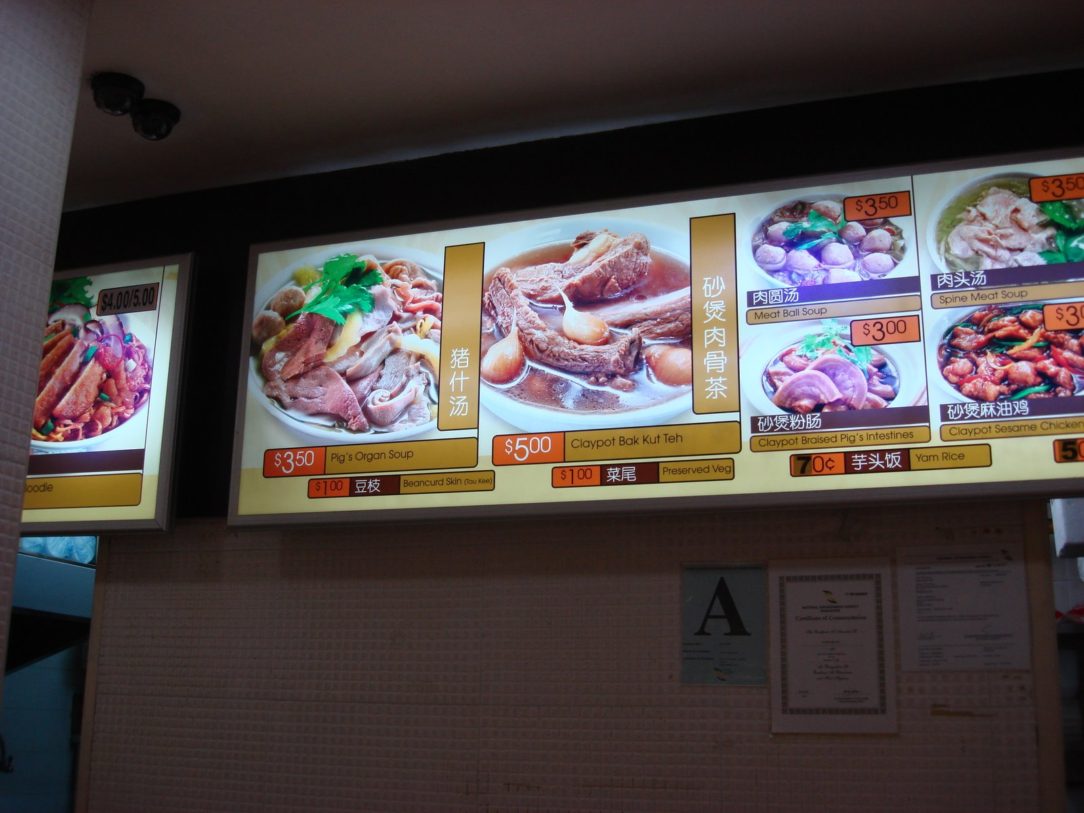
There are a few things you have to keep in mind when eating at a hawker center, as a foreigner. The first thing you need to know is to bring your own napkins! Hawker centers won’t provide you napkins, with few exceptions. Most food in Singapore is spicy too, so if you don’t come prepared you’ll wind up using your hand and pants / shirt to wipe away your sniffles. I’ll admit I’ve had to do that myself a few times and it’s not at all pleasant, and is a bit embarrassing. Another thing to keep in mind is that you’ll want to wash your hands somewhere else before-hand, or bring hand sanitizer. Not all hawkers have a restroom, and the ones that do are often not the best smelling or cleanest looking. That’s more the case with outdoor hawkers than indoor ones, because indoor hawkers are typically located in malls which have great restroom facilities. Also, most hawker stalls have pictures on billboard style menus to help customers with the ordering process. It helps in a lot of cases, but don’t let the pictures fool you. Sometimes the food is better than it looks. And well… sometimes it’s not.
During my first trip to Singapore in March of 2008 I avoided the hawker centers. Like I said before, I considered them to be the ‘poor man’s’ choice and assumed I would find better food in sit down restaurants. I was actually disappointed with my choices and wasn’t too impressed with the food offered in Singapore. Later, my wife told me to stop being so damn picky and to eat at the hawker and I’m glad I did.
In closing, if you come to Singapore don’t fall into the trap that I initially did. Don’t assume that price equates with quality or good taste when it comes to Singapore’s dining scene. If you come to Singapore and don’t try the hawker food you’re going to be missing out on most of the best of what Singapore has to offer.
Ok, just to get it out of the way, this isn’t my story. This is the maid’s story. I thought it was worth sharing because it highlights a problem that’s unique to Asia. For the sake of the story and her privacy we’ll call her Cookie. Ok, here we go:
Cookie was at the mall with one of the boys she looks after. They’d been having a good time at the arcade, but it was time to head home. It was starting to get dark out and it was close to dinner time. So, they walked down to the bus interchange and got in line.
While they were waiting in line, Cookie noticed that there was an old white guy in the line behind her. He looked to be in his mid-50s, was bald with scraggly white hairs around the sides of his head and a he had a rough, unshaved look. He also looked like he was smuggling a small pig in his shirt, the way his gut overhung his shorts. In other words the guy was pretty gross looking all around. Cookie didn’t pay him much attention, but every now and then she’d catch a glimpse of him out of the corner of her eye. He was watching her.
When the bus showed up, Cookie hurried herself and the boy onto it and they made their way to the center area, close to the exit door. The old white guy got on the bus with her and sat down where he could see her. During the short trip to her bus stop, Cookie noticed that the guy kept glancing over at her. She was starting to get uncomfortable with it so she was glad when they were able to get off the bus.
As she started walking down the sidewalk she looked over her shoulder and saw that the old white guy had also exited the bus at that stop. She started walking faster. She looked over her shoulder again and saw that the old man had matched her pace. She started walking even faster, but whenever she increased her pace so did the old man.
When she reached the bottom of the building where she lives she grabbed the boy’s hand and ran to the stairwell. She took the stairs quickly and then dashed down the hallway to her door. She could hear the old man running behind her, chasing her. For an old fat guy he was pretty quick on his feet.
When she got to her door she started fumbling for the key and finally got it out of her bag but she was so nervous she couldn’t get it into the lock. She heard steps approaching and knew the old man was right there, coming around the corner. She finally got the key in the lock and looked over her shoulder and…
The old man was right there behind her. She backed up against the door gate and asked him what he wanted. He reached in his pocket and quickly pulled out…
A piece of paper. With his phone number on it. He handed it to her and left.
Prostitution is one of the oldest professions in the world and one of the most enduring. It is probably the only profession that will remain the same throughout all of history as there will always be a supply and there will always be a demand. You can find prostitution anywhere you go, but in ultra-conservative Singapore, it took me by surprise to find out that prostitution is not illegal here.
Here’s a quote from the “2008 Human Rights Report: Singapore” as per the U.S. Department of State:
Prostitution itself is not illegal; however, public solicitation, living on the earnings of a prostitute, and maintaining a brothel are illegal. The authorities periodically carried out crackdowns on solicitation for prostitution and arrested and deported foreign prostitutes, particularly when their activities took place outside informally designated red-light areas. In practice police unofficially tolerated and monitored a limited number of brothels; prostitutes in such establishments were required to undergo periodic health checks and carry a health card.
(Note: The quote says ‘foreign prostitutes’ because the majority of prostitutes in Singapore are not locals. They are from the poorer surrounding countries and enter Singapore on a temporary visa, during which time they engage in prostitution to raise capital. They then return home and, I assume, repeat the cycle as necessary.) //pagead2.googlesyndication.com/pagead/js/adsbygoogle.js
Coming from the US, legalized prostitution is nothing new to me. It’s legal in Nevada and until earlier this year it was legal in Rhode Island. However, I grew up in a conservative family and spent most of my childhood in the South, which is commonly referred to as the Bible Belt. Until I was older and put more thought to the subject I viewed all prostitutes as inherently evil. I now know that most prostitution is done out of necessity. That doesn’t make it right in my eyes, just understandable.
I had always assumed that this sort of activity was illegal in Singapore. The laws are very strict here, including fines for eating or drinking on public transit and the outlawing of chewing gum. So, I can’t help but wonder why prostitution is legal. I see it as dangerous and morally reprehensible, but that could just be a cultural difference. When it comes right down to it, consensual prostitution doesn’t really hurt anybody, and given the prostitute’s circumstances it may be beneficial to her (or him) financially. The banning of prostitution in Singapore could be more detrimental than helpful to social order. Or another way to look at it would be that since it’s not a problem, there’s no reason to fix it.
Legality aside, there are three places in Singapore that are known for prostitution. I’ve mentioned most of them in passing in previous posts, but I’ll detail them here again.
The first place is the Geylang area. Singapore is divided up into town areas for political and governance reasons. Geylang is located in eastern Singapore along the East-West MRT Green Line. The MRT won’t drop you directly in Geylang. You have to get off at the Aljunied station and then catch a bus the rest of the way. It’s not a long ride. Geylang itself is a sort of seedy looking place. It’s an older part of town that’s a bit run down. A lot of the buildings look like they’ve been standing since before Singapore was Singapore. The best spots for finding prostitutes in Geylang is to look in the mostly dark alleys around Lorongs 10 thru 12. //pagead2.googlesyndication.com/pagead/js/adsbygoogle.js
The second place that’s fairly famous for prostitutes is Lucky Plaza. Lucky Plaza is a mall along Orchard Road that caters mostly to the needs of Filipino foreign workers and Permanent Residents. The mall contains shops that sell imported Filipino goods, remittance centers, Internet cafes, and Filipino restaurants. It also has a lot of Filipina prostitutes. If you click through on the link at the beginning of this paragraph there’s a photo of two of them in that post.
The last place is Orchard Towers, which is also known as the Four Floors of Whores. It’s located at the end of Orchard Road, next door to the Thai Embassy. My wife and I had heard rumors about the place but we’d never actually been there. So, when we were out enjoying this year’s Christmas decorations we figured, why not? We were close to it anyway. As I walked up to the building and peeked down the stairs I saw two girls hanging around in the hallway area. It was obvious what they were up to. My wife had looked around the corner of the mall and told me to come see. She said there was a whole bunch of them lined up back there. So, being the ass that I am, I turned on the video recording function of my camera and recorded as I walked down the side of the mall. How many prostitutes can you count in the video below?
There’s the girl all in white, the group sitting by the curb, and obviously the ‘couple’ against the wall who were negotiating a price as we walked by. The inside of the mall was even more packed. By the back entrance there was another group of them chatting as they waited for potential customers, as well as isolated pairs standing around. They always seemed to be in groups of two or larger, except when they were appeared to be negotiating. It was somehow exciting to see so many women engaged in an act that we considered wrong and criminal so blatantly plying their trade in an otherwise picturesque part of Singapore.
As we left the mall we speculated on whether or not President Obama would be put up at the hotel across the street, and what Michelle might think about it all. We also saw some of the girls that we’d seen standing around in or on the side of Orchard Towers moving up the road a bit and engaging potential customers. //pagead2.googlesyndication.com/pagead/js/adsbygoogle.js
Disclaimer: Please keep in mind that I don’t condone prostitution, nor am I posting this for the sake of directing people where to get paid sex. I’m just detailing an aspect of Singapore that I discovered while living here. What you do with this information is up to you. So, if you go to Orchard Towers, get paid sex and then find out you have black syphilis and can’t return to your country due to health reasons, don’t blame me alright?
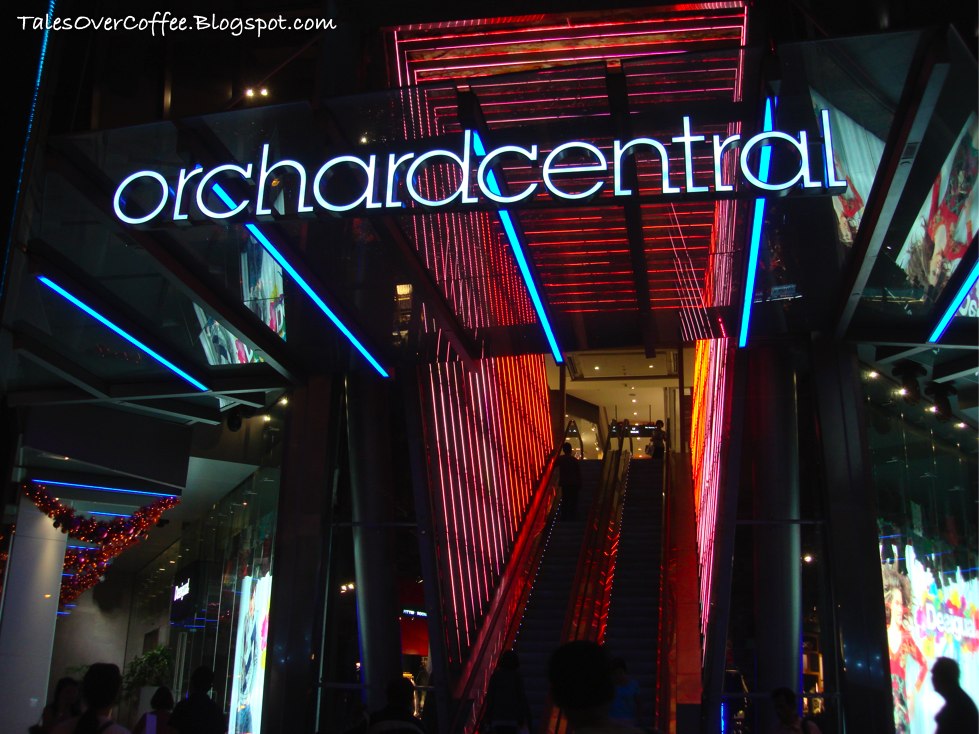
On Sunday night, as part of our tour along Orchard, my wife and I looked through Orchard Central. The lighted escalators on the end closer to Dhoby Ghaut Interchange kind drew us in. It had been quite a while since we’d gone in there. I visited it once right after it opened and my wife and I visited it together shortly after that. At the time I wasn’t too impressed, but I thought it might just be because the place had recently opened. It was more or less deserted of both people and stores. Most of the facades were still covered with ‘Coming Soon’ banners. In fact, it didn’t even have Wireless@SG set up inside at the time.
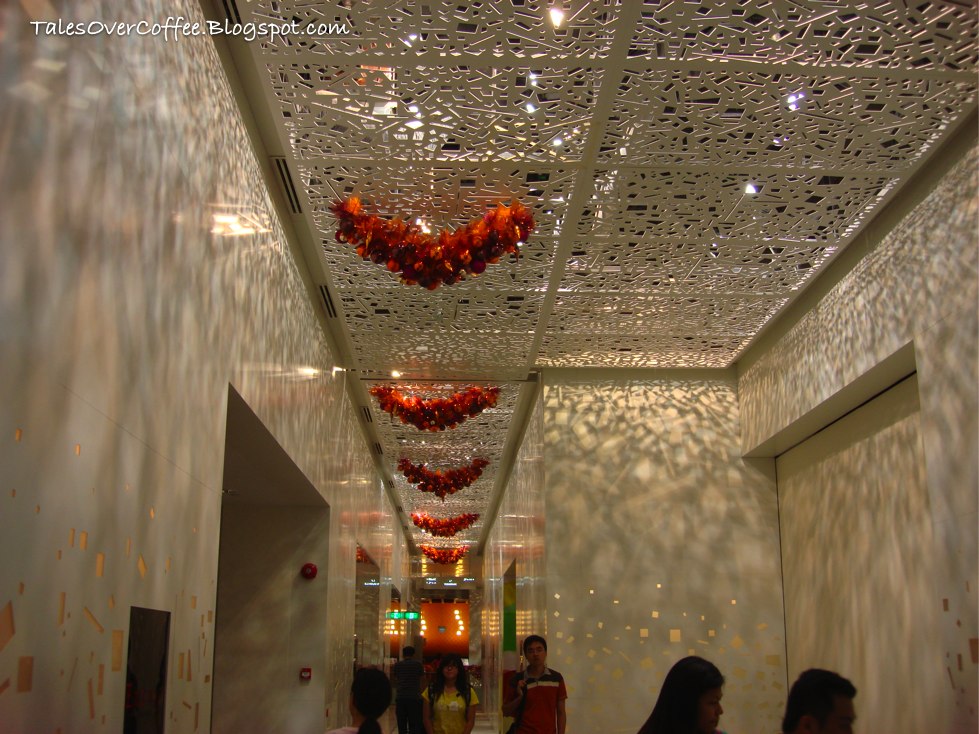
This time was a whole other story. The place was full of people. Almost ever retail space was open and ready for, if not doing, business. The best part of it all though was the look and feel of the mall. I’ve often said that there isn’t much, if anything, the US can learn from Singapore. Call it national pride. Call it arrogance. That’s just how I feel. However, one way I was wrong is in how Singapore is designing its new malls. I’ve often said before that Singapore does shopping right. The shopping experience has been refined into something close to an art form, especially when it comes to design and architecture. You only have to look at Ion, Orchard Central, and to some degree Vivocity to know that. More so with Orchard Central, since it draws the customer in and keeps them interested in staying, not through false sales or huge bins of promotions, but through a classy, well presented, fun to explore mall. And, as you walk through the mall you are of course presented with stores that you will wander into if the items for sale suit your taste. Malls in the US are bland by comparison and are a chore to go to, rather than an enjoyable experience.
Orchard Central seems like it was designed more for tourism than for actual sales. The place practically screams “Explore me!” The front of the building has escalators that cling to the face, so that as you go from the ground floor up to the top you have a clear view of the city around you. The view is stunning, to say the least, especially once you get yourself up onto the roof. The last time I went to Orchard Central, the top floors were still closed off. I managed to get some good shots of the city at the time, but it was nothing compared with the view I saw this time. To get onto the roof via the outside of the building you have to take a stairwell just down from where the last escalator leaves you. You can also reach the roof through the escalators and elevators inside.
The roof on Orchard Central wasn’t done as plainly and blandly as the roof on Tampines 1. I couldn’t see it too well because it was dark and poorly lit, but it has flagstones as paving for the majority of it, which makes for uneven footing but a more enjoyable experience. There are also small pools of water, vines, and a few lights mixed in. The railing around the edge is a glass wall with a metal frame that doesn’t inhibit the view of the surrounding area. You can see a LOT from up there, and the people down on the street seem very small. I haven’t been that high up in a building in a long time. It made me miss New York City.
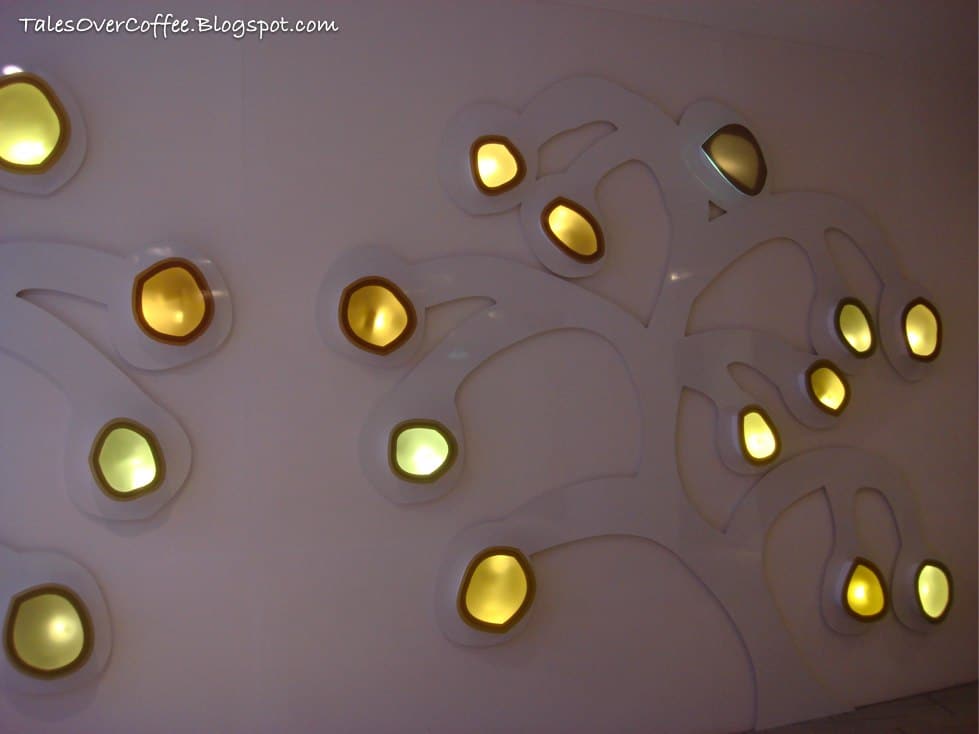
On our way back down through the building we noticed that different areas seem to have different themes. Various architectural tricks were used like having a ramped area with stores that are offset from the normal floor level to draw attention to them. There is also a giant wall inside that you can climb. I noted it last time but this time it seems functional, if unused.
I think we wandered through Orchard Central for more than an hour without seeing everything. We eventually had to head back down so we could get back to viewing the lights on Orchard Road. As we were heading down though we noticed that there are basement levels and took a quick detour to check them out. The first basement is pretty bland. It’s probably the most boring part of the mall. The stores are small and didn’t seem too interesting. There is a Mos Burger down there though, and another place right next to it. I think it was a Subway but I can’t remember for sure. The second basement level was really cool though. We couldn’t actually get down to it yet because it was still under construction but we were able to lean over the rail and peer around a bit. It looks like it’s going to be a lot of fun! The floor was done in tiled designs, there were false, old fashioned building fronts, wooden frames for stalls, and the whole thing seemed to be designed to resemble an outdoor town that you might have seen in old Mexico. If you’ve ever passed by the front of Orchard and noticed the flower pots and wondered why they don’t match the interior, this is why. They’ll match the second basement level.
I’m looking forward to going back to Orchard Central again, just to window shop and hang out. I want to see the view from the roof during the day. I also want to take some more time to look through the stores and find the good cafes and sitting areas. I hear the restaurant up towards the top called The Loft has some good food and a good view. Oh, and speaking of restaurants, the roof will sport some restaurants eventually too, but for now they’re under construction.














 Bradley's Old Fashioned Weblog