Broadway Street Fair, 14th Street to 8th Street

A street fair on Broadway near Union Square Park.

Today, Broadway was closed down from 14th Street, where Union Square is, down to 8th Street for a street fair.  The road was lined on both sides with stalls selling everything from costume jewelry to barbecue pulled pork.  There were even stalls set up by The New York Times, trying to get people to buy subscriptions, and a booth promoting Islam.  This is a story best told with pictures:

Costume jewelry for sale at a street fair in New York City.

This costume jewelry was laid out in a huge pile across a few tables.  It was on sale.  A closeout sale in fact.  Only $3.00 apiece.  Doesn’t seem like much of a sale to me.  I’m sure if you looked hard enough you could find this stuff for a dollar apiece.  It’s pretty to look at though, especially when it’s laid out together like it was.

Kettle Corn NYC.

Some $9.00 bags of kettle corn.  If you’ve never had kettle corn, it’s sweet.  It tastes awesome and smells great.

Shirts for sale at a street fair on Broadway in New York City.

Japanese balls.  Yum!

I stopped by this booth to look at what they had to offer.  The sign on the front of the table says that everything on the table is free.  The guy in the blue jacket on the right spoke fluent English and Spanish, and the Korans he’s putting down are translated into Spanish.  The Lower East Side has a lot of Hispanic families, so maybe that’s the demographic they were mostly prepared for.  I took a few of the flyers.  I’m sure they’ll make great reading material for the train.  The guy in the blue jacket seemed encouraged by my interest in the flyers and asked me what I know about Islam, so I started talking about dates, like Mohammad’s birth, death, the first revelation, etc.  I know these things, since I just learned about it in an Art History course and I’m taking a test over it tomorrow.  He asked me if I wanted to spend a few minutes learning about the basics of the Islamic faith.  I thanked him, but said no.  It’s not that it wouldn’t be interesting, but given recent events, I don’t want to hang around anything promoting Islam.  Some nutball might show up and do something violent.  Besides, I have a feeling he was going to tell me about the 5 pillars of the Islamic faith: Attestation (“There is no god but God, and Mohammad is his prophet.”), Alms, Prayer (5 times a day), the Hajj (pilgrimage to Mecca), and fasting during Ramadan.

Marrakesh: Moroccan Bazaar and Decor booth at a street fair on Broadway.

There were even Moroccan rugs!

Funnel cake stand.

And funnel cakes!  I love funnel cakes.  I didn’t get one though, because I was on my way to meet my mom for lunch.  It was Mother’s Day, and I didn’t want to spoil my appetite.

I saw a LOT more than just this street fair today, including some Asian cultural festivities, but I’ll save that for a post tomorrow, or the day after.  I hope you enjoyed the photos!

Man Jumps Over Six Women in Union Square, Manhattan

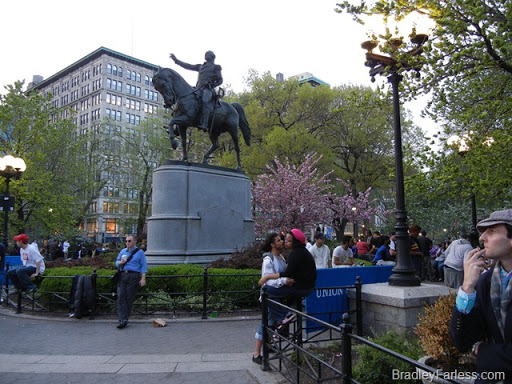
Crowd at Union Square, Manhattan, New York City.

I went up to the Metropolitan Museum of Art again today.  I’ll blog about that later.  For now, I want to show you what was going on at Union Square that cost me some of my museum time.  Like I keep saying, there’s always something going on there and when I was passing through, I saw a huge crowd gathered by the entrance to the subway, so I stopped to check it out.

Man in a leopard outfit jumping over a girl in Union Square.

This colorfully dressed guy had just jumped over the girl that’s standing behind him there, in the center of the open area.  I took this photo right as he was landing, though I meant for it to be him in the air over her.  This wasn’t impressive enough, so he decided to give us an even bigger show, which I recorded:

I was impressed.  I half expected him to land on the last girl, turning this otherwise exciting performance into a tragedy.  There are very few places in New York City that you can go without seeing some sort of live performance by a regular person looking to make some extra cash.  Some are bad, but some, like this one, are pretty damn good and worth the time to watch.  I try to keep some change in my pocket for when I see stuff like this, or when someone is playing music (on an instrument, not from a boombox) in the subway and it sounds good.

Union Square Park (Photos)

Union Square Park, facing south along University Place.

I haven’t tried to keep up with what days each market is held on, but there was an art market yesterday.  This is a photo of the cobbled area along the west side of the park where the stalls were set up, with people selling homemade artwork including oil on canvass, photography, sketches, etc. in various styles.  One day I might even buy something from here to decorate my apartment wall.  Maybe.  I remember hearing people haggling over a price for something that looked like it was about a foot square.  The starting price was 500.  Ouch.

Two men being interviewed on camera in Union Square.

I’m not sure what the interview was about, but the guy to the right in the photo was pretty animated while speaking.  Maybe this was part of a project being done by students at the New York Film Academy, which borders Union Square.

People sitting on a fountain in Union Square.

A group of interesting looking folks, sitting on the edge of a fountain in the southwest corner of Union Square.  On warm days, Union Square is packed with people who are just hanging out and enjoying the good weather, at least so far.  I wonder if that will change when the weather turns from warm and pleasant to hot and scorching, and the cement gets hot enough to sear your ass like a burger on a grill.

A group of people doing a large painting in Union Square.

There was a group of people working on this painting.  I think it had something to do with a project sponsored by Keds shoes.  The old man there was taking a photo, like I was doing, and then went right into the middle of things to ask what it was all about, or at least I assume that’s what he was doing.  That’s one of the good things about being old.  People are more forgiving when you do stuff like that.

Union Square Park, facing the Beth Israel Phillips Ambulatory Care Center.

Union Square Park, facing the Beth Israel Phillips Ambulatory Care Center.

Union Square is even more crowded on weekends.  This was a Thursday afternoon, around 5 PM.

People Hanging Out At Union Square

Union Square Park in Manhattan, New York City.

There’s almost always something going on at Union Square, and even when there isn’t, there are still crowds of people there.  The warmer the weather gets, the more people there are.  I imagine quite a few of them are NYU students from the nearby dorms, but there were also people hanging out on the grass, having lunch, reading, or just talking to friends on the benches.

Union Square Park in Manhattan, New York City.

Union Square Park in Manhattan, New York City.

Then, of course, there are tons of people passing through to get to the stores around the Square, and to get to the subway entrances scattered around the area.  Union Square is one of the major subway stations in New York City.

Subway entrance at Union Square, Manhattan, New York City.

I like to walk through the park just to see what kind of people are there.  You never know what you might come across in New York City, after all.

Barnes & Noble at Union Square, Manhattan, New York City.

Three of my favorite stores are situated alongside Union Square: Best Buy, Barnes & Noble and Petco.  I can spend hours just browsing in those stores, especially Barnes & Noble.  Barnes & Noble is like a museum of words.  I could spend a whole weekend just browsing the shelves.  It helps that they have a coffee shop inside (which is a bit expensive, but we can’t have everything right?) and they don’t run around throwing you out if you’ve been hanging around too long.

‘Green’ markets and holiday markets are regularly held in Union Square.  I’m looking forward to finding time to explore one.  I go through there every day, and I’ve seen them quite often, but I’ve never had time to just stop and look.

Finally, Spring is Coming

Students outside of CCNY enjoying the warm weather.

It was so warm outside today that jackets were optional.  It got up to 73F.  It felt great!  It even felt nice to sweat in the sun again.  It was such a nice change from the icy weather we’ve had up until today (except for that one weird day a few weeks ago) that I didn’t even want to go inside.  I wanted to stay out and enjoy the sun.

Trees blooming at CCNY.

Too bad it’s supposed to rain for the next few days.  The temperature is going to drop back down into the high 50s.  I’m looking forward to the weather warming back up and staying up.  It gives me one less excuse to not start running again.  I kinda wish I’d never stopped, because getting going again is always a pain.

The Japan Society and “Bye Bye Kitty!”

Yesterday I went to the Japan Society on 47th Street here in Manhattan.  They were having a Concert for Japan, with 100% of the proceeds going to the Japan Relief Fund.  I knew I wasn’t going to get there early enough to secure tickets for any of the shows, but the admission fee for the building was only 5 bucks, and it included full access, including the Bye Bye Kitty! art exhibit, which was my main reason for going there anyway.

The Japan Society in Manhattan, New York City.

When I showed up, they had speakers set up outside so you could hear the concert from the street.  It sounded pretty good, so I sat down on one of the benches across the street for a while and just enjoyed the tunes.

Food stalls in front of the Japan Society in Manhattan, New York City.

Then I noticed there were food stalls, so I had myself some takoyaki.

Takoyaki from the Japan Society in New York City.

Once I got inside I went to the area called the “J-Lounge”, and got a bottle of Pocari Sweat.  It’s better than it sounds!  It’s a sports drink, which is why the word “sweat” is included in the name, but the girl gave me a weird look when I asked for it.  I had to explain what it is to her, then I shared the story of my reaction when I first saw it in Singapore.  She agreed with me that if they really want to market the drink in English speaking markets, they should change the name.  The J-Lounge also had a big screen TV in it that was showing the concert on the lower level.

Interior of the Japan Society in New York City.

Interior of the Japan Society in New York City.

Well-wishes for Japan at the Japan Society.

After I finished the drink I went up to the art gallery.  The works were, for the most part, pretty impressive.  The one that catches your attention first, and most, is called Ash Color Mountains, by Makoto Aida:

Ash Color Mountains, by Makoto Aida.

Ash Color Mountains, by Makoto Aida. (Close-up)

The idea behind this is that he’s expressing his disgust with the conformism and lack of individualism of the gray-suited “salaryman”.

DSCN0177DSCN0178

Beautiful Flag, by Makoto Aida.  Left Panel.

From Aida’s War Picture Returns series, the first two images: Beautiful Flag.

Bye Bye Kitty! art at the Japan Society.

Bye Bye Kitty! art at the Japan Society.

These are just a few other images I enjoyed.

Bye Bye Kitty! art at the Japan Society.

And I’m not sure what this is supposed to be exactly, but it was interesting!  The ‘blood’ in the tubes was being pumped, and you could hear the motor and the suction sounds.  I don’t know if I’d want to come across this in the night.

Overall, it was a very pleasant experience and I’m looking forward to going back when they have future events.  It also has me interested in going back to the Metropolitan Museum of Art sometime soon, which is sure to happen, since I have another paper due for my Art History class!

An 18 Year Old High School Student Got Hit By An Express Train Today At Union Square

18 year old student struck by train at Union Square, 14th street.
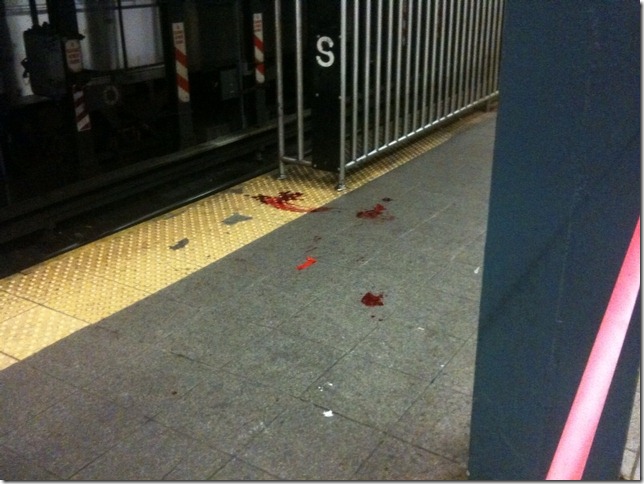
18 year old student struck by train at Union Square, 14th street. (Image from: DNAinfo.com)

This morning when I was rushing to CCNY for a morning World Humanities class, I saw police stringing yellow tape across the top of the stairs leading down to the 4 5 6 platform at Union Square.  I stopped for a moment and glanced down and all I could say was “shit”, and then I kept moving.  There was blood all over the platform, the area was packed with cops, and I thought I saw what looked like a few … pieces.

It was interesting, but something about the situation didn’t make me want to stop and take a picture.  Maybe it had something to do with the janitor at the top of the stairs, his bucket of water and reddish looking mop sitting next to him.  It just seemed so… surreal all of a sudden.  We all go through these train stations every day, ride the trains every day, and in a moment of carelessness, we can wind up as a stain on the floor getting mopped up by a underpaid janitor using a dirty mop.

Life is brief enough as it is, and I feel bad for the person who got hit by the train, which I later found out was an 18 year old teen on his way to school.  He’s laid up in a hospital now, in critical condition.  The area the accident took place is right at the mouth of the tunnel and the trains enter the stations moving pretty quickly, so realistically, the kid will be lucky if he only suffers brain damage.  His whole life is shot, probably because he stuck his head out to check and see if the train was coming.  Those stations are noisy and there are lots of trains passing through, so he couldn’t have known one was coming up the tunnel right when he poked his head out.  It’s still a case of bad judgment though.  A very unfortunate case.

On my way home, I walked past the same staircase, so I went down to look around.  As I did, a train pulled into the station, and the conductor leaned out and was looking at the floor, where in the image above you can see all the blood.  I wonder if he was the rear conductor on the train that struck the kid this morning?

The lesson I’m taking from this is that the train will come, whether or not we stick our heads out over the tracks to look for it.  I’ll keep doing what I normally do: stand in the center of the platform and read while waiting on the train.

“The Three-Headed Male Figure”—African Art (Kuyu)

You may remember last week I posted about the Metropolitan Museum of Art’s bizarre laptop policy.  This post is about the reason I was there.  I had to write an essay for my 100 level Art History class on either a Greek, Indian, Egyptian or Sub-Saharan African sculpture from the museum.  You’ll notice in the instructions below that it says we could write about paintings or architecture, but the professor told us to stick with sculptures in class.  It’s not a traditional essay, since there’s no real opening or closing paragraph, but these are the instructions we were given:

The paper (1 – 2 pages) should consist of four paragraphs.  It should be as follows:

Paragraph 1:  Identify the work briefly but adequately.  Start by stating that “the paper will be discussing the formal aspects and the museum presentation of the following piece”, then give the title of the work, name of artist if known –if unknown write anonymous—medium, country of origin and date.  Mention where it is located in the museum.

Paragraph 2:  Describe the work by writing a complete formal analysis.  In looking at the form you will consider the various aspects of form that are discussed in class, such as:  materials, size, texture, kind of shapes and lines, colors, light…etc.  A person who is not familiar with the pieces should get a clear idea of how they look through your description.

Paragraph 3:  Consider how the piece is exhibited (displayed).  That would include, the approximate size of the gallery (room), kind of light used in the gallery, the case where the piece is exhibited; if a painting, the way it is hung.  Mention the other objects in the room and their effect on your chosen piece.   In case you are working on an architectural piece such as a room, it will be within a larger gallery, consider its relation with its surroundings and what is displayed within it.  Do you think the display effects [sic] the piece and the visitor’s experience negatively or positively?  Explain.  If you were the curator, would you change the exhibit (display)? Yes, no, why?

Paragraph 4:  Suppose you’d like to do research on the piece.  What questions would you like to answer?  Write down any question for which an answer can’t be found by just looking at the piece.

So, those are the guidelines I was given to write this paper, and this is what I came up with:


Three-Headed Male Figure: Formal Aspects and Museum Presentation

The paper will be discussing the formal aspects and the museum presentation of the following piece: “Three-Headed Male Figure”. The work is a 19th century wood and pigment statue by an anonymous artist from the Kuyu peoples in the Congo Basin area of what is now the Republic of the Congo. The work is located on the ground floor of the Metropolitan Museum of Art in Manhattan, New York, in room 352 of the “Arts of Africa, Oceania, and the Americas” section.

The “Three-Headed Male Figure” is a free-standing, carved wood statue of a partially nude male figure. The statue is cylindrical and appears to be carved from one solid piece of wood. The figure is standing upright, in an erect, rigid posture. The statue’s feet are large and rounded, extending backward from the rear of the leg as far as they do forward. The legs are cylindrical and smooth and are disproportionately short compared to the rest of the body. The lower portions of the legs are covered by sets of raised carved wood lines that resemble simple torques. The arms are narrow and are carved flat against the torso, which is highly cylindrical and lacking in natural definition. The front and back of the torso are covered with an assortment of geometric patterns, as are the upper portions of the legs. A toggle shaped pattern covering the upper legs circles the whole form, but leaves the genitalia exposed in the front. The geometric patterns across the abdomen are mostly rounded, with shapes that include circles, curved lines similar to hills, and beaded areas which are also clustered in circles. The rear of the torso is covered in one pattern of lines with points that extend downward on each side of the spine. The patterns are carved from the same wood as the rest of the statue and are raised from the surface, in relief. They are carved deep enough to provide areas of shadow in the pattern, depending on how it is positioned in relation to a light source. The head of the statue is oblong and taller than natural. The cheeks and foreheads are covered with carved decorations. The features of the faces are carved deeply, with hard, strong lines. The faces are arranged so that one is pointed forward and the other two are angled backwards just behind each shoulder, with no gap between each face. Large portions of the statue were originally covered in white and red pigments. Some of those pigments still remain on the tops of the geometric designs on the upper legs and torso, as well as on portions of the faces.

The statue is positioned in a medium sized gallery room, which is filled with other African art pieces. The pieces are all contained in glass display cases which, in most cases, allow for viewing from all four sides. There are no external windows in the gallery and all of the lighting is artificial. Compared to the Greek and Roman gallery, the lighting is dim, with most of the light being focused on the individual pieces. The lower lighting in the room and the focus of the light sources on the pieces invites the viewer to more seriously consider the artwork on display. The positioning of the lighting also allows for the geometric patterns on the pieces to have areas of shadow, which adds to the viewing experience and gives the pieces more depth, emphasizing the three dimensional aspect of the sculptures. The “Three-Headed Male Figure” is positioned in the center of the rear portion of the room, in its own glass case, with multiple light sources illuminating the statue’s three faces. In addition to focusing the viewer’s attention on the pieces, the artificial lighting in the room protects the wood of the art pieces from sun damage and reduces the damage that could be done to the remaining pigments. The gallery the “Three-Headed Male Figure” is positioned in gives it context. The room is quiet, and the spotlight-style lighting greatly adds to the enjoyment of the viewing experience. The smaller pieces, which are grouped together in large display cases, are well positioned, but to improve the overall experience of viewing the sculptures and other large items in the room, benches could be added, so viewers could sit and reflect.

To better appreciate the “Three-Headed Male Figure”, it would be helpful to have a more thorough understanding of the piece’s background and use. African art is functional, so without understanding what it was used for, you can’t truly understand the significance of the art. To further that understanding, research into the traditions and culture of the Kuyu peoples, and other native peoples in the area, could lend insight into what the sculpture was used for. It would also be interesting to know who in the society made the piece: a professional, a priest, a family member, or the person (or persons) for whom the piece was intended to be used. Besides knowing how it was made and what it was used for, it would also be helpful to know how it was originally displayed in the community and whether or not the people that used it interacted with it, or if it was only viewed. Lastly, it would be worthwhile to find out if similar statues are still used by the native peoples of the region, or if the practice has died out completely.


The paper wound up being 2.5 pages, double spaced and in a 12 point font, which was also required.  The paper hasn’t been graded yet, but when it has, I’ll add that to the new “Essays (Graded)” page I added to this blog, which can be accessed from the tab bar under the header.

And now, the moment you’ve possibly been waiting for.  What does this “Three-Headed Male Figure” actually look like?  (Click on the images to see larger versions).

There’s a lot of fascinating stuff to look at in the Met, and I’m very much looking forward to my next trip there, where I can simply look and enjoy, without having to consider how to write a paper about the sculptures, though I think I will be able to appreciate them more, now that I have a better understanding of how these items are made and what they were used for.

Filipino Food in Lower East Manhattan–Johnny Air Mart

Johnny Air Mart on Avenue A, between 13th and 14th Street.

The name of the place is a little odd, but it makes sense.  This little store on Avenue A between 13th and 14th street carries Filipino goods, most of which I assume are shipped in by air.  It’s not a very large store, but it has a lot of the food products that I came to enjoy while living in the Philippines, and earlier by buying them at import stores in Singapore.

Since I’ve been back in New York City, I haven’t had the opportunity to really look around for a place to get Filipino foods, so I was happy, and surprised, to see that there is a shop just a few blocks from where I live, located in a spot I pass by almost every day.  I never saw it before because it’s halfway up the block, and I pass Avenue A on 14th street.

Some of the goods on the shelf at Johnny Air Mart.

Unfortunately, I couldn’t find my favorite flavor of Lucky Me noodles, Chilimansi, and they didn’t have the Calamansi flavored Century Tuna.  The owner was pretty friendly though.  He told me the Lucky Me Chilimansi is usually stocked but he’d run out, and that he’d never carried the Calamansi Century Tuna, but he’d check with his distributor to see if he could get some in.  They also had Sky Flakes, Ligo sardines, Milo, sinigang mix, the nasty shrimp paste my wife enjoys, and many other goodies.

Turon, purchased from Johnny Air Mart.

I didn’t stock up, but I did pick up some turon on the way out the door.  It’s tastier than it looks.  It’s a sweet dessert with a crusty outside and banana inside.  The shop owner warned me that it wasn’t exactly the same as the kind you get from the Philippines though, since it’s made fresh and the type of banana used isn’t quite the same.

I’m glad to see that Filipino foods will be readily available when I’m ready to do some cooking, or when my wife is.  I think it’ll help her to adjust, having some foods from home available.

The Metropolitan Museum of Art’s Bizarre Laptop Policy

The Metropolitan Museum of Art in New York City.

Sunday afternoon I went to the Met as part of an assignment from my Art History class.  I was supposed to go there, find a sculpture, either Greek, African, Indian, or Egyptian, and then write a 3 page paper detailing its form and presentation.  I had this wonderful plan in my head.  I would show up, find a sculpture, pull out my laptop, and write the paper on the spot, while looking at the piece.  I thought that would best enable me to write a good paper on the form, while looking at the form of the sculpture, there in person.  After writing the paper, or at least the first draft, I would pack my laptop back into my bag and look at the exhibits until it was time for the museum to close.  Unfortunately, things didn’t work out quite the way I’d hoped.

When I arrived at the Met, the place was packed, but that’s to be expected.  As soon as I went through the front doors, there was a security check point, also not unexpected.  When I opened my backpack for inspection and the guard started yelling “Laptop!  Laptop!  Laptop!” I was taken aback.  I half expected to be bum rushed by guards and moved to a secure inspection area.  I was shuffled off to the side, but under my own power.  I had to go to the security desk to get a yellow security exception form.  For a laptop.  I also had to open the laptop and turn it on, probably to prove that it’s a working laptop and not a shell packed with explosives.  I was fine with all this.  The Met houses an incredible amount of art of priceless value.  What bothered me, though, were the instructions I received afterward.
I was told that I had to carry my backpack in my hand.  Putting my backpack on my back was not permitted.  I can understand having my laptop checked to make sure it’s really a laptop.  I can tolerate having to carry an exception form and I can deal with having to present it on request to any security guard that asks to see it.  However, what possible purpose can it serve to require me to hold the backpack in my hand, as opposed to having it on my back?  Whether it’s in my hand or on my back, it’s still the same backpack.  Call me weak, but carrying a backpack in one hand that’s loaded down with books, notebooks, and a laptop gets heavy after a while, and switching it back and forth is a poor solution to just carrying it on my back.  It also keeps one of my hands full, which meant that I couldn’t properly hold my camera to take photos of anything.

Luckily, before I lost patience and just left, I found myself in the African art section looking at a wooden sculpture with three faces that I knew would be the perfect piece to write my paper on, which I’ll post later this week or next.  There were no benches to sit on, and after my treatment at the security desk I was worried that if I pulled out my laptop and actually turned it on and started using it, a flock of security guards would descend on me and demand I leave the museum, so I put my backpack down, took a dozen photos of the sculpture and then left the museum.

I wonder why they even bother to offer free wifi in the museum when they so obviously want to discourage anyone from bringing laptops?  I saw the available open network message pop up in my phone’s notification area when I was checking an email.  I can’t help but wonder if this nonsense of requiring people to carry bags that way was implemented to drive off students who were taking up space in the museum, writing papers, to make way for more tourists?

10 dollars (the recommended student donation for entry) pissed away for 45 minutes in the museum. Next time they’ll be lucky if I give them a dollar and a smile. Ya, I’ll be going back. How could you not? There’s a lot to see in there and the last time I went I was a little kid. I won’t be bringing my laptop with me though. That’s for sure.