The interior of the restaurant was comfortable and there was a small outdoor dining section next to the brownstone’s stairs.
Hummus, baba ganoush, and shakshuka with pita bread
This was in 2013 at the 9th Street location near Tompkins Square park in Lower Manhattan that no longer exists, which is a shame. It was a great place to get tasty, reasonably priced Middle Eastern food with fast access to a park to relax afterwards. I liked the vibes in that area as well. There are other locations, but the neighborhoods seem busier and less friendly.
The 9th street location closed quite a few years ago now and we also haven’t visited the neighborhood to eat out regularly in years. It seems like most of the places we enjoyed going to down there have closed or the quality has gone down and we’ve lost interest. I guess everything changes.
If you see someone being attacked and you step in to help them and you injure the attacker, the attacker will sue you and most of the time you’ll lose in the lawsuit.
If you see an injured person and try to help them and the person dies, the family will investigate you and sue you.
Why bother to help people?
Part of growing up is learning to respect other people. That’s something adults have to teach children. It’s obvious that it’s not happening though. And it’s obvious that something is being lost in our society by this idea that’s being promoted that it’s ok to let kids grow up thinking that disrespect, even to family members, is acceptable.
The only thing that matters is just them, the individual. Their reality, their perception, their “truth”. Their enjoyment. There’s no concept of responsibility to the community and other people.
Why are we building systems and social structures that privilege criminals over victims? That prizes selfishness and disrespect?
I see people complaining online, but you get the society you build. If you don’t like it, change the laws. Stop voting in the same dirtbag politicians. Stop making excuses for poor behavior, either your own or those of people around you.
Just got a random call from someone about Medicare benefits. I told her I’m not old enough. She asked me how old I am and I said 42. She hung up on me. It was probably a scam call, but all I can think about right now is the answer to the meaning of life, the universe, and everything.
Saga continues to delight and entertain. I really enjoy the author’s sense of humor and writing style and the art is excellent as well.
Monstress
The art isn’t elaborate like in Monstress by Marjorie Liu, but it’s clean, bright, and engaging and fits the tone of the story. The story also makes sense. Unlike in Monstress, which is bizarrely hard to keep up with. I think I got up to date with this series late last year but I won’t be reading any more. I think the main issue is that there are too many characters and a lot of them look alike.
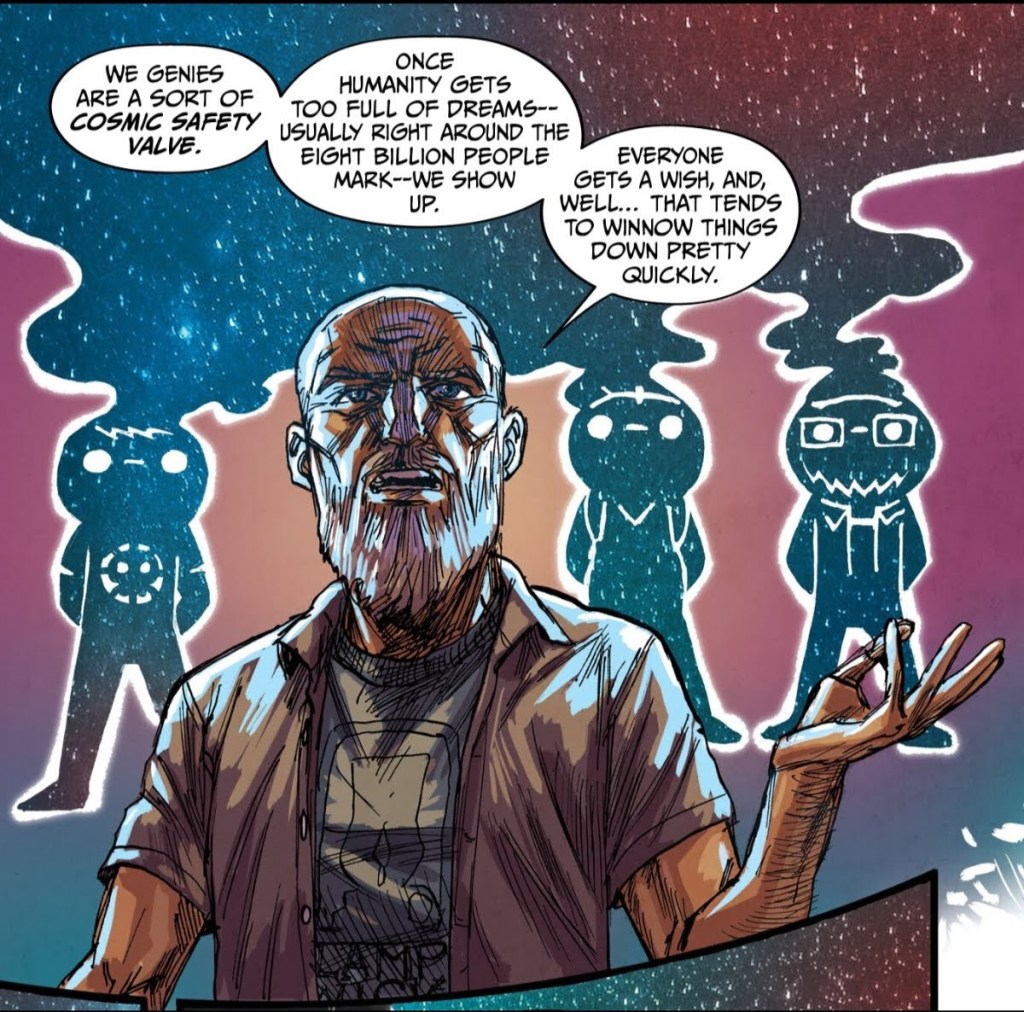
8 Billion Genies
I feel like 8 Billion Genies could have been as good as Saga but they tried to do too much in too few issues. There’s still one issue left, but covering 8 decades in 1 issue felt way too rushed. It’s still a brilliant concept and is well worth reading. The author didn’t include a lot of cheesy tropes and even in just 7 issues I started to care about the characters. I’m looking forward to reading the last issue, which should be out today.
Hopefully, this won’t be a once in a lifetime trip. It was incredible and overwhelming, honestly, but it was also a school study trip so it wasn’t an experience that I could share with my wife, which was a bit of a stumbling block to my full enjoyment of the sights and sounds of the country.
Visiting Israel was also a lot to process. I wanted time to think about the visit before I really wrote anything about it, and then I got busy and weeks became months and months became years. Now, it’s been 9 years since I was there, and I’m looking forward to going back if life permits.
Never forget that the universe is a single living organism possessed of one substance and one soul, holding all things suspended in a single consciousness and creating all things with a single purpose that they might work together spinning and weaving and knotting whatever comes to pass.
Marcus Aurelius
This is an interesting take on the nature of reality, because I wouldn’t expect to hear it from someone with Aurelius’s background. I guess I hadn’t put much thought into the idea of an afterlife from a Stoic point of view, because the philosophy predominantly addresses how to live in and enjoy the present.
What Aurelius is expressing is known as Pantheism, “the belief that God consists of everyone and everything. For example, a tree is God, a mountain is God, the universe is God, all people are God.” 1 It reminds me of the popular quote about how we are all the universe experiencing itself.
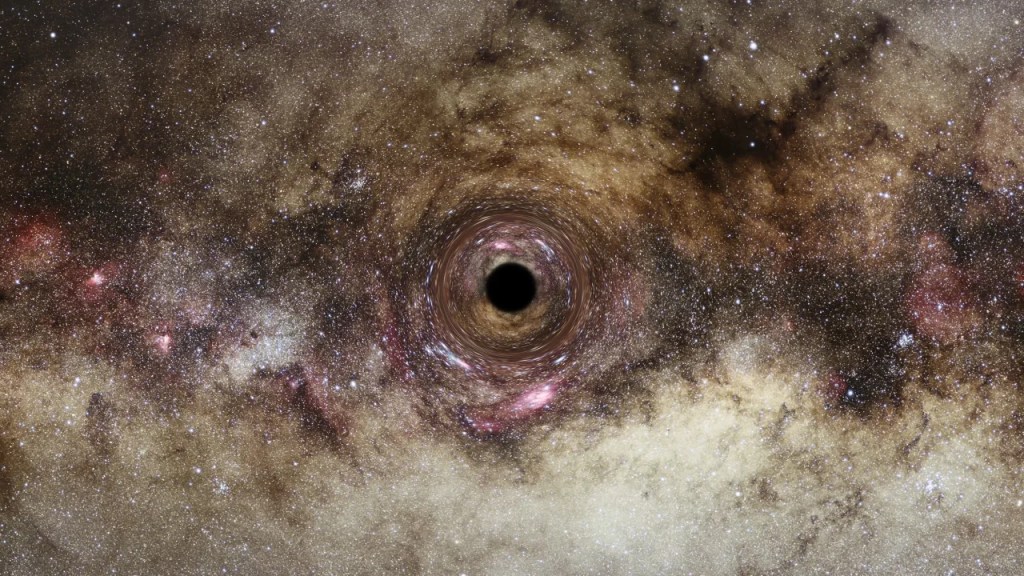
This is an artist’s impression of a black hole drifting through the Milky Way galaxy. 2
I’m also reminded of the fact that people are made up of smaller communities of creatures and systems that developed into humans over time, and then I think about the universe as a whole and wonder if the universe is some larger being, or part of a larger being. What if we’re actually just part of a digestive tract and black holes are how the energy we produce is passed on to the other systems of the larger organism? What if our universe is a marble in a sack of marbles? You never know.
But in terms of pantheism and how it was understood, that we are all manifestations of the divine or that some divine essence undergirds and flows through all existence, the idea seems to be common to some Buddhists, Hindus, and some forms of Christianity, like Unity, Christian Science, and Scientology. There is also some overlap between Stoicisms understanding of the soul returning to the Cosmic Fire and being reforged as a new soul and the Buddhist idea of the soul reaching Nirvana, escaping the cycle of rebirth and permanently reuniting with the divine essence. Early Christians believed in reincarnation as well, and the Christian idea was probably closer to the Stoic conception because in Buddhist reincarnation there is an expectation that souls retain something from previous lives, even if it’s just karma.
The concept of pantheism also has parallels with mainstream beliefs about Jesus being an expression of God in the physical realm. And of course, there’s the idea that God blew his breathe into humans to give us sentience, but humans carrying a divine spark is a bit different from the idea that all things are God.
Still, it’s interesting to see how ideas about divinity and existence develop over time, often overlapping, and have common themes between the past and present.
This post was written in February 2020 but I left it sitting as a draft until now. I’m trying to get more involved with my blog again so I’m going back through old drafts these days.
I was thinking about Buddhism and Stoicism and how these philosophies might apply to current events, and after reasoning it out, I came to some conclusions that make sense, but aren’t exactly comfortable. Essentially, I focused on the idea that it’s not possible to solve all suffering immediately, so a “middle way” should be found that allows for the most good while making progress towards better solutions. Or, in other words, accept reality while striving towards ideals.
I’ve done a fair amount of reading about both, and I know more about Buddhism than Stoicism, but I don’t claim to be an expert in either. I group them together, because a lot of the ideas in both philosophies tend to overlap.
Buddhism certainly talks about doing the least amount of harm possible, to limit the amount of negative karma that you carry with you into your next life, but when we’re talking about an issue like restricted immigration in the United States, or unrestricted immigration, I think you have to look at the levels of harm caused by both positions.
On the one hand, restricting immigration causes harm to those people who are denied entry, possibly, because they would be forced to face whatever drove them to migrate to the United States in the first place. On the other hand, unrestricted immigration to the United States would also cause harm, a greater harm, because the negative ramifications of that policy would be much greater.
As a nation, the United States doesn’t really have a cohesive national narrative or national myth that binds us all together. We are a nation of multiple groups of ethnicities and religions all competing with each other for limited resources within a system that promotes competition and allows for great suffering for those on the losing end of social and legal policies. Unrestricted immigration would add to the suffering of those on the bottom rungs of society by creating more competition for resources among “low-skill” laborers. Arguably, the scarcity of resources in the United States is artificial, but that issue would need to be corrected before, not after, adding more people to the population. The mere fact of the scarcity of resources being artificial wouldn’t change the fact that people would struggle to make ends meet and would suffer as a result of these policies being implemented in the wrong order.
Unrestricted immigration would also strengthen existing divisions within the nation, both political and cultural. The United States needs time to develop a national character and a common narrative that serves as the foundation for our aspirations and ideals as a nation. By adding a large amount of new immigrants to the population, the country weakens itself from within and guarantees that the population remains fractured and easily controlled by the government and its corporate backers.
A weakened United States could also have international ramifications. The United States currently serves as a buffer for many smaller nations in the world that would be invaded and essentially destroyed culturally and ethnically by other nations who are hungry for resources. China’s destruction of Tibet and their attempts to take over Africa is one example. Russia’s current desire (this post was written in February 2020 but not published until now) to invade Ukraine is another good example. You could say that the fact that these events have already happened or are happening now means a strong United States isn’t really a deterrent, but I would say it’s because the United States is already declining due to internal divisions that would only be exacerbated by essentially not having borders.
I’m not arguing for a unitary State like China, where there’s no such thing as a dissenting opinion that isn’t State-approved. I’m saying that we need to correct our current system to take care of the people that are already citizens and take the time to build a common national identity by limiting the amount of in-migration to a reasonable amount. I’m not naive enough to think that the United States government is some sort of bastion of goodness, but I think the existence of the United States acts as a barrier against greater suffering, so we need the United States to be united and strong.
In other words, I’m in favor of balance, of accepting the reality of the situation and understanding that we can’t stop all suffering, and the way to stop the most suffering is not always the most obvious choice.
March 2023 update: ironically, Canada is implementing stronger policies against illegal immigration to stop the flow of migrants into their country. I mention this, because for a long time, liberals in the United States pointed to Canada’s supposed laxer attitude towards immigration as a role model to be followed, ignoring the fact that even then Canada has a merit-based immigration system.
I think there should be limits and incumbent responsibilities for people who want to immigrate here. I don’t think it should be a free for all. For example, make immigrants serve in the military as a path to citizenship. You really want to be here? Show it. Serve the country. Even kindness has to have limits.
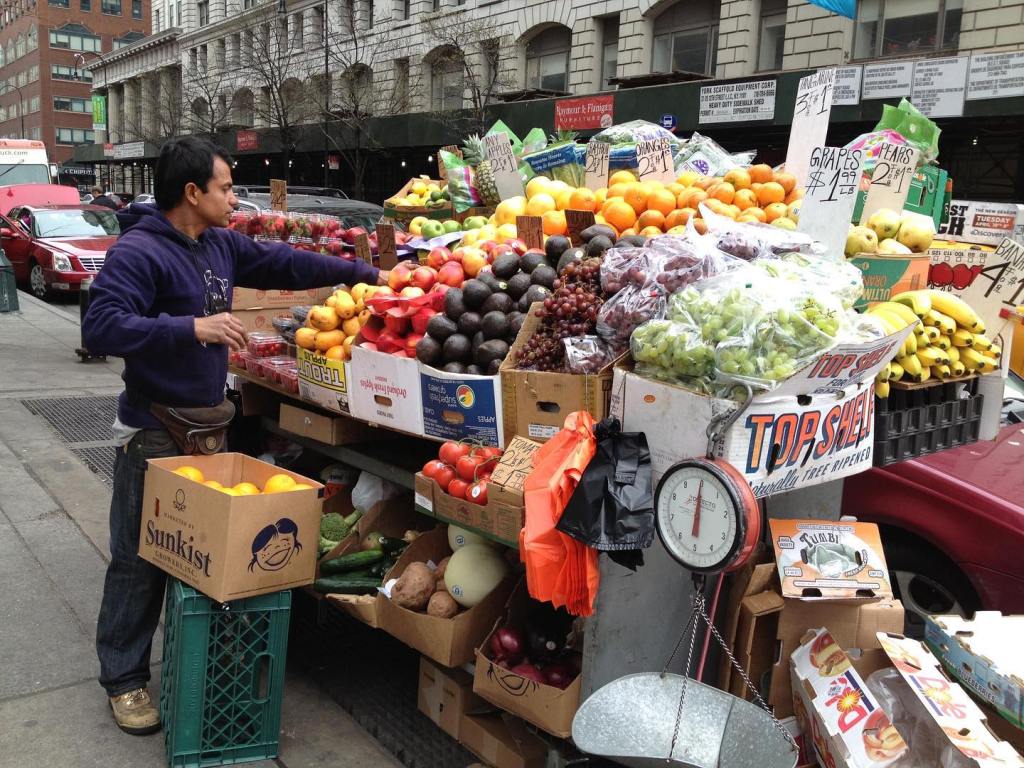
I don’t know if it’s the same guy, but the last time I passed through Union Square there was still a fruit vendor in the same location. This is right outside the Joe’s Pizza location, next to Trader Joe’s.
This was the first time the sun set on me while inside Iraq during the American invasion of the country in 2003. It was the moment I realized that “this shit is really happening” and it might be the first day of the last leg of my journey through life. Thankfully, it wasn’t.











 Bradley's Old Fashioned Weblog