Some photos from my trip to The Cloisters in Fort Tryon Park in January:
//embedr.flickr.com/assets/client-code.jsThe Cloisters is part of the Metropolitan Museum of Art. The building houses a collection of art from Medieval Europe. Because of that, most of the art depicts Christian religious stories and figures. It’s a pretty interesting collection that can be viewed in about 3 hours if you’re not stopping to read every information plaque in detail.
What stuck with me was the collection of reliquaries. It’s fascinating to think that people believed, and still believe, that being close to or touching the body part of a deceased person can confer some spiritual power or good fortune. I suppose it’s not too different from people buying souvenirs in Jerusalem today to bring back with them, or bringing dirt from Jerusalem, because people who were holy may have walked on it.I’m reminded of something I saw in the Church of the Holy Sepulchre in Jerusalem. Like The Cloisters, the Church of the Holy Sepulchre is a conglomeration of chapels that were joined together. They building covers the supposed sites of Jesus’s crucifixion and the tomb where his body was placed. There is also a stone at the foot of the hill where Jesus was supposedly crucified. Jesus’s body is said to have been brought down off the cross and placed on this stone.
The Church of the Holy Sepulchre in Jerusalem (March 2014)
I’m reminded of something I saw in the Church of the Holy Sepulchre in Jerusalem. Like The Cloisters, the Church of the Holy Sepulchre is a conglomeration of chapels that were joined together. They building covers the supposed sites of Jesus’s crucifixion and the tomb where his body was placed. There is also a stone at the foot of the hill where Jesus was supposedly crucified. Jesus’s body is said to have been brought down off the cross and placed on that stone. While I was there, women came in and poured oil onto the stone and then used a number of scarves to soak it back up. I assume they took those scarves home and distributed them to people who couldn’t make the trip and that they believed there had been some sort of transference of holiness from the stone to the scarves through the oil.
I didn’t take many photos on this trip because I’d been there before. The last time I visited The Cloisters was during the summer. I would definitely recommend visiting in warm weather. The open courtyards are much more enjoyable when there’s warm sunlight, cool breezes, and running fountains. I saw quite a few people sitting on benches and reading. There is also no herb garden during the winter, for obvious reasons.
Because The Cloisters is part of the Metropolitan Museum of Art, admission is donation based. There are suggested donations, but you can give a nickel and still be admitted to the museum.
Kondo is repetitive in some sections, but not in an irritating way. She reinforces the concepts she’s trying to convey by referencing them multiple times throughout the text. The way that the author refers to things in a house and houses themselves was confusing and a bit odd until I understood that this was a reflection of her Shinto beliefs regarding divine essences being present in all things. When she talks about things having energy or life or greeting your objects, that’s part of her religious belief, but it makes sense to take care of and to value and appreciate your belongings. The better you care for them, the longer they’ll last.
What did I get out of this book? It helped me to reevaluate the way that I surround myself with things. It helped me to think about my apartment as a place for living rather than for storing. Do I really need these old knick-knacks from 5 years ago? Do I even look at them? When did I see this pair of pants last? Should I hang onto this shirt because I spent money on it and haven’t used it much, or get rid of it because it isn’t something I enjoy wearing?
Kondo encourages her readers to treat the places they live as living spaces rather than as storage spaces. She wants people to understand that surrounding themselves with just those things that bring joy will improve their lives. She also thinks it can help provide direction for people’s lives because, when you pare down your possessions to what you really value, it can help you discover what you’re genuine interests are.
KonMari (as she is often called) made me think of what’s really important to me and inspired me to turn my living space into a place that I really enjoy being in. I don’t expect my screwdriver or every undershirt to spark joy in my life, but as much as possible I want to limit my possessions to just those things that I derive joy or inspiration from.
I subscribed to the Loot Crate service back when it started out. It was a fun diversion once a month. I wound up canceling the service after a few months though because I just stopped being impressed with the value of what I was getting for my money.I decided to give the service another shot around Halloween last year and it looks like they’ve really improved on the items they put in their boxes.
I decided to give the service another shot around Halloween last year and it looks like they’ve really improved on the items they put in their boxes. A lot of it is still stuff that I’m going to wind up either throwing or giving away, like the Pop! figures, but the books and t-shirts usually make up for that. The January 2017 box is an exception. I like everything that came out of it:
Action Comics #1 (1938) reprint
Ninja Turtles Raphael tiki mug
Captain America “The First Avenger” shield replica
“Jumpman” / Mario t-shirt (design in featured image above)
The boxes are still fairly hit-or-miss, but I guess that’s part of the thrill of opening one up. It’s like gambling or playing the lottery. Sometimes you get a jackpot and other times you wind up with Pop! figures on your shelf and no idea what to do with them. Loot Crate has other, theme specific, crates now that I’m probably going to look into. Maybe they’d fit my interests better, but this box was definitely a winner.
I meant to spend most of my break between semesters catching up on reading like I did last year, but we’re about a week out from the first day of class and I’ve only read through some volumes of the comic book series Grimm Fairy Tales. It’s not bad, but it’s also not the intellectually stimulating experience I want from a book. I picked them up as digital comics a few years ago and never got around to reading them. Maybe they were part of a Humble Bundle, I don’t know. It’s hard to resist the book Humble Bundles.
The story mode is good, but I enjoy the online play more, even though it leaves a lot to be desired in terms of load times. I also wish it had more of the story mode content, like items you can find and collect. One thing that did carry over is the trick jumps. Some of them are a headache to get right, mostly because you have to use the right vehicle and avoid killing yourself while pulling off the jumps, or you have to land in just the right spot to get credit for the jump. It’s fun, though. One of the more interesting ones to do are the jumps at the airport traffic circle off the billboards. I made the video below of the jumps, but I feel like I could probably pull off two backflips on the motorcycle before landing. I’m going to give it a shot.
A common refrain on message boards and in comment sections on the Internet is that Jews, Christians and most especially Muslims do not worship the same God. Is there any merit to this statement? All three religions are part of the Abrahamic tradition and find their roots in the ancient Hebrew faith. Modern Judaism developed after the fall of the Second Temple in 72 CE. Christianity as we know it today probably began with Paul’s teachings and solidified with the Council of Nicea in 325 CE, though it began as a Jewish movement around 30 CE. Islam, the newest (or oldest, depending on your religious perspective) of the three religions dates its beginning to approximately 610 CE and both draws and builds on Jewish and Christian religious traditions. All three religions share stories and in some cases texts. All three claim to be worshipping the God of the Patriarchs. All three also clearly conceive of God in different ways. Do we judge whether they worship the same God based on their own claims, or on their understandings of the nature of God?
A related video on the topic from YouTube:
In “The Perspective of at-Tawhid” (1983), Muhammad ‘Abdul Haq argues that there is a distinct difference between the monotheisms practiced by Jews, Christians, and Muslims. Writing from an Islamic perspective, the foundation of ‘Abdul Haq’s argument is the differing conceptions that Jews, Christians, and Muslims have about the unity (at-Tawhid) of God. He is critical of both Jews and Christians and believes that, because of their diverging religious traditions, they have an imperfect understanding of monotheism.
‘Abdul Haq argues that, while Islam places ultimate importance on the concept of the divine unity of God, both Judaism and Christianity are based on divine manifestation in history. He links the idea of monotheism in Judaism with the concept of ‘chosenness’ and the pact made at Mount Sinai. Because of this, he feels that it is impossible to disassociate the God of Judaism from the Jewish people as an ethnic group, making the conception of the Jewish God contingent on a historical event. Regarding Christianity, ‘Abdul Haq points out that everything revolves around the person of Jesus Christ and the events of his life, which also roots Christianity firmly into history.
The author believes Judaism and Christianity’s entrance into history is important because it differentiates them from Islam, which he claims has an absolute truth versus the formers’ relative truth. In other words, Islam sees God as being utterly transcendent and beyond our conception while both Judaism and Christianity place God in history, thereby restricting his essence. One could also argue that God sending Gabriel to reveal the Quran to Muhammad was an intervention in history. However, the difference is that in Judaism and Christianity, God Himself appears in history, while in Islam He works through an intermediary, Gabriel. The result is the same: an intervention in history, but the method is what sets Islam apart. Muslims see God as being beyond history, because entering history would necessarily restrict or limit his essence.[1]
He also states that Judaism monopolizes and nationalizes monotheism and prophecy.[2] This is not actually, true, however. While it was perhaps not always the case, modern Judaism does have a conception of God as being universal. This is not a new development, either. The Noahide Laws in Genesis, which are seven rules that apply to non-Jews, provide redemption for those who follow them. Essentially, it is a path to participation in monotheism without being Jewish. There is, of course, still a difference between inclusion in the covenant community and being a part of the Noahide community, but this still contradicts ‘Abdul Haq’s point.
Christanity, like Islam, has a universal message, but the author is still critical of the concept of the Trinity, which he bluntly states is not monotheism, regardless of how the explanation is framed.[3] Returning to the idea of God’s essence, he writes that “Judaism and Christianity have failed to evaluate the true worth of Divine Unity, the incommensurable nature of which signifies that there is no common measure between the finite and the Infinite.”[4] Breaking God down into parts is counter to Islam’s idea of God’s unity, which cannot be subdivided or contained.
Another way to look at the similarities and differences between the Abrahamic religions’ conceptions of God is by comparing their revelatory and mission structures. Martin Jaffee does this well in his article, “One God, One Revelation, One People: On the Symbolic Structure of Elective Monotheism” (2001). Jaffee engages with the symbolic structures of the Abrahamic religions to show that they are constructed in a way that brings them into almost inevitable conflict. He believes that their structural similarities, along with the decline in polytheism as a viable competing model of piety, explains what Jaffee calls their obsessive self-definition “over against” each other.[5]
Essentially, Jaffee looks at how the Abrahamic communities see themselves in relation to God and how they see their mission in history. For Israel, the “divine self-disclosure” comes in the form of human language via the Torah, a scriptural set of commandments passed down to man.[6] In Christianity, the divine self-disclosure comes in the form of Jesus’ historical life. This is distinct from Judaism, because it is not revelation transmitted in the form of human language. In Islam, the form of divine self-disclosure is textual, like it was in Judaism. The position that Islam takes on the previous two divine self-disclosures is that people altered the original texts and changed their meanings, which is what necessitated the third divine self-disclosure. Islam sees the Quran as a corrective that is meant to reestablish monotheism as universal and inviolable. This does not imply that Islam sees the Jewish and Christian views of God as the same or valid, however.
Writing in response to Jaffee, Yehezkel Landau attempts to bridge that gap in “God as Multiple Covenanter: Toward a Jewish Theology of Abrahamic Partnerships” (2015), an article that presents Christianity and Islam as legitimate, additional covenants between man and God. Landau asks, “[C]an monotheism be pluralistic, …that is, if God is One, how can different understandings of that Oneness be valid?”[7] Landau is attempting to present the God of the Torah as the same God worshipped in Christianity and Islam. He does this by finding a precedent in the Torah and then explains how Christianity and Islam fit into that existing pattern.
When people think of God’s covenant with Israel, the first thing that comes to mind is probably the covenant with Abram / Abraham that includes circumcision and a promise to make Abraham’s descendants plentiful. Landau argues instead that there are many covenants in the Torah that apply not only to Jews, but to all nations, starting with the covenant of the Sabbath. He notes that in Isaiah 56:1-7, Sabbath observance also applies to any stranger or foreigner that chooses to “join himself to the Eternal.”[8] The next covenant Landau reviews is the Noahide Covenant, which binds God, all human beings, and other living things on Earth. Lastly, Landau discusses the significance of the Abrahamic Covenant and Abraham’s role as the progenitor of both Israel and the Arabs, linking God’s covenant to Islam. The idea is, perhaps, to imply that part of God’s promise to Abraham is being carried out through the descendants of his son, Ishmael, as well as through Jacob / Israel.[9]
Landau casually dismisses non-Orthodox positions on religious pluralism, which is disappointing in a paper written to supposedly present a Jewish viewpoint. He simply states that they are more likely to be open to religious pluralism since they don’t follow halakha as strictly. It would have been more interesting and informative to see what the major Jewish denominational positions are, rather than having them dismissed out of hand, especially since most Jews are not Orthodox. In Landau’s defense, it is possible he believes his primary audience will be those who are not yet convinced and by his reasoning those people would tend to be Orthodox.
Another problem in Landau’s article is that he draws on the work of an Orthodox Rabbi named Irving Greenburg to tie Christianity into his argument of multiple covenants. Greenburg argues that covenant develops in stages. He specifically points out the change in Jewish practice after the destruction of Jerusalem and the Second Temple as an example of an unfolding covenant. Greenburg sees Christianity as a natural outgrowth of the Hebrew faith and as a part of God’s design.[10] This argument does not make sense. If Christianity is part of God’s plan, and Christianity’s goal is to convert everyone to Christianity, then Greenburg is essentially arguing that Judaism should disappear. Landau quotes Greenburg at length. In one of the quotes, Greenburg attempts to position Christians as part of the house of Israel with the common goal of defending a unified religious tradition and the state of Israel against Islam.[11] While Landau criticizes Greenburg for taking this stance, he fails to realize that this undermines Greenburg’s entire argument, which comes across as a veiled appeal to Christian Zionists to begin or maintain support for the state of Israel.
‘Abdul Haq, Jaffee and Landau each take up the issue of whether the three Abrahamic religions are worshipping the same God from different perspectives and each comes up with different answers. While ‘Abdul Haq never states outright whether he thinks the God of Judaism and Christianity are the same deity being worshipped in Islam, it seems likely that he would say they are not. He pointedly criticizes the Christian concept of the Trinity, which he feels is certainly not monotheism. He also contends that Jews are worshipping a restricted sense of God in the form of a tribal rather than universal deity, though this is not actually the case. Jaffee points out that while each group believes they have received a divine self-disclosure, that disclosure came in different forms. Judaism and Islam received textual revelations, while Christianity believes God revealed himself in the form of a human being. This points to a difference in each religion’s understanding of God based on their belief in how He disclosed Himself. Landau makes a strong attempt to reconcile these differences by arguing for an ongoing covenantal system in which God forms many, rather than one covenant, but his solution only approaches the problem from a Jewish theological perspective, ignoring the fact that reconciliation will require a combined approach. His argument regarding the inclusion of Christians in an extended covenant is also flawed because it is based on a questionable source.
Do these three faiths have the same God? That is debatable. All three traditions clearly stem from the same source, but is that the only qualifier for having the same deity? I would argue that there is more to be said for how a person conceives of God. Jews, Christians, and Muslims do not think of the same God when they imagine Him/It. On the other hand, how can Man conceive of the inconceivable? For Christians, this gap is bridged through God’s revelation as Jesus, but in Christian theology that is a manifestation or aspect of the Infinite rather than the Infinite itself. It would be just as reasonable to say that each religion understands and worships God in slightly different ways because Man can never totally comprehend God.
[5] Martin S. Jaffee, “One God, One Revelation, One People: On the Symbolic Structure of Elective Monotheism,” Journal of the American Academy of Religion 69.4 (2001): 756, accessed November 21, 2016, http://www.jstor.org/stable/1466340.
‘Abdul Haq, Muhammad. 1983. “The Perspective of at-Tawhid.” Islamic Studies (Islamic Research Institute, International Islamic University, Islamabad) 22 (3): 1-19. http://www.jstor.org/stable/20847235.
Jaffee, Martin S. 2001. “One God, One Revelation, One People: On the Symbolic Structure of Elective Monotheism.” Journal of the American Academy of Religion (Oxford University Press) 69 (4): 753-775. http://www.jstor.org/stable/1466340.
Landau, Yehezkel. 2015. “God as Multiple Covenanter: Toward a Jewish Theology of Abrahamic Partnerships.” Crosscurrents 57-79.
In episode nine of season four of South Park, titled “Do the Handicapped Go to Hell?”, we find out what Cartman’s favorite Psalm is. The episode starts with Stan, Cartman and Kenny sitting in church. Mr. Garrison is called up to the lectern to read his favorite Psalm. As Mr. Garrison begins to read, Cartman leans over his pew and tells Stan and Kenny his favorite Psalm is: “It’s a man’s obligation to stick his boneration in a woman’s separation. This sort of penetration will increase the population of the younger generation.”
Father Maxi, the church’s priest, catches the boys repeating this Psalm and delivers a fire-and-brimstone sermon to the congregation, criticizing the children for not going to Sunday school and the parents for not going to confession. Father Maxi’s depiction of Hell terrifies the kids and they wind up rushing off to Sunday school to learn how to avoid swimming in the lake of fire. They learn that they must go to confession and take Communion. Problems arise when they realize that Kyle is a Jew and is going to go to Hell and that Timmy, a mentally handicapped boy that can only say his name, is unable to give a confession, meaning that he will also wind up in Hell. The boys become increasingly terrified and rush to the church to confess. On the way, a bus strikes Kenny and he is apparently killed.
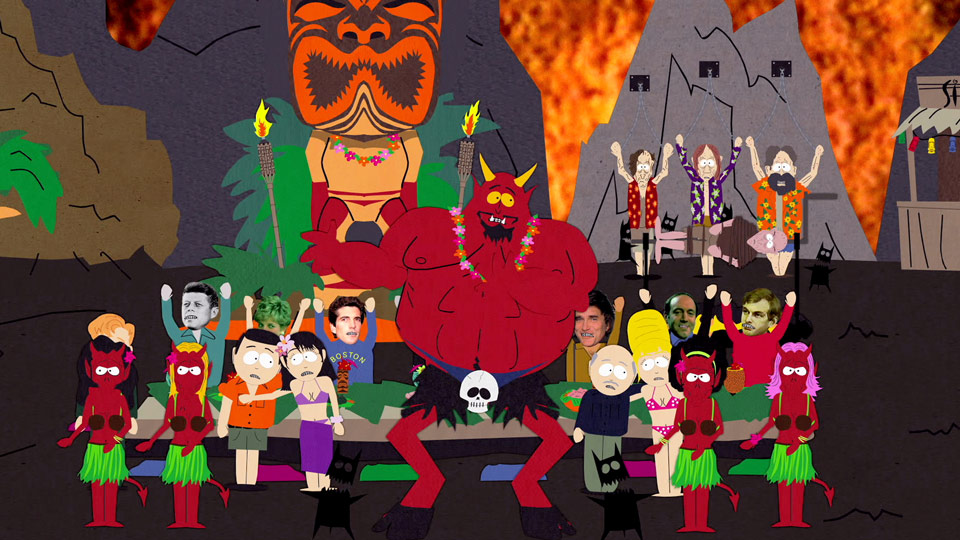
Meanwhile, in Hell, Satan is celebrating Luau Sunday with his friends, Conan O’Brien, Adolf Hitler, Jeffrey Dahmer, John F. Kennedy, John F. Kennedy Jr., Princess Diana Spencer, Michael Landon, Mao Tse-Tung, Gene Siskel, Allen Ginsberg, Jerry Garcia, Tiny Tim, Walter Matthau, Bob Hope, George Burns, Dean Martin and Frank Sinatra.
Kevin Kenny’s book, Diaspora: A Very Short Introduction, is part of a series of short introductions on a wide range of topics published by the Oxford University Press. As a very short introduction with just 109 pages of content, Kenny does his best to avoid becoming bogged down in historical details and instead focuses on elucidating the theoretical framework of diaspora itself. Kenny argues that the term diaspora has been used in so wide a variety of situations that it has begun to lose its utility as a tool of study. To combat this trend, Kenny tries to narrow the definition of diaspora by identifying three key attributes that diasporic groups possess: movement, connectivity, and return. He supports and expands on this framework for diaspora by analyzing a geographically diverse range of population movements.
Kenny’s conception of diaspora is heavily rooted in Jewish tradition. He traces the word diaspora back to its use in the Septuagint, a Greek translation of Hebrew scriptures from approximately 250 BCE. He argues that the Jewish understanding of diaspora, which was originally meant to convey the idea of spiritual estrangement from God, became conflated with galut, a Hebrew word which means physical exile (Kenny, 4-5). So, the Jews saw physical and spiritual exile from the land as being part of the same experience or process. Kenny positions this process of catastrophe, forced movement and a hope for redemption through return as the most useful structure of diaspora as a concept.
Is Kenny’s understanding of diaspora sound? Does it make sense to only apply the term diaspora if a migratory group’s situation conforms to the Jewish experience of exile and a hoped for divine redemption, or does that privilege Western understandings of history unnecessarily? One could argue that a word must have a set meaning, but the meanings of words have always changed over time. Also, for an academic study, it might make more sense to define a term in a way that does not rely on a specific set of religious ideas, especially if the goal is to make it generally applicable for groups of differing religious and cultural backgrounds. Because of how Kenny positions the idea of diaspora, at times it feels as if he is stretching the experience of the immigrant groups he examines to push them into the box he has built. He also fails to examine in any meaningful way the experiences of groups that would challenge his construction of diaspora. That may not be a fair critique for a very short introduction, but considering his conjecture that there are many opposing viewpoints of what constitutes a diaspora, including an example could have benefitted readers. Also, if Kenny is committed to the idea of scholars having the obligation to create a specific definition of diaspora and maintain it, why does he backpedal in his closing chapter by asking, “But if a given group chooses to define itself as a diaspora for its own purposes, who is the author of a short introduction to disagree? (Kenny, 109).
Kenny’s book is arranged thematically, rather than by group. He defines how he understands diaspora in chapter one and then spends the next three chapters expanding on the experiences of a handful of groups to elaborate on that definition. On the one hand, arranging his book this way makes it difficult to follow the individual experiences of the groups he reviews. In most cases, there are no chapter subheadings to orient the reader if they were interested in just one group’s experiences, making the reading experience potentially more laborious. Arranging his book thematically also leads to the repetition of information in some cases, which is space that could have been used for opposing views or the analysis of additional groups. On the other hand, organizing the book thematically allows the reader to clearly see the similarities between the experiences of the different groups, which better suits the author’s purpose of attempting to define diaspora.
Kenny’s first qualifier for a group to be a diaspora is an initial movement from a homeland. This movement must have a catastrophic element that creates a sense of imposed exile. Because of his concern for overextending the use of the word diaspora, Kenny is careful when discussing the history of the migration of different groups to differentiate between normal migration and a forced migration that creates a diaspora. His best example to support this idea is his discussion of the continuous migration of Irish to other countries over a period of hundreds of years, beginning in the 1700s. He points out that it was the potato blight in 1841to1855, which caused massive famine and a sudden, massive increase in the number of people migrating out of Ireland that was the defining moment in the creation of an Irish diaspora. The Irish who went abroad blamed England for their circumstances and for the deaths caused by the famine. They felt that England engineered the blight to eradicate them. This feeling of oppression created a sense of exile that reinforced their identity as a diasporic community. He also shows how the Jewish diasporic community suffered a catastrophic event that began a period of diaspora, though he oddly positions the beginning of diaspora in 586 BCE with the Babylonian exile. While historically accurate, Jews see exile and return as cyclical and the most recent exile, imposed by the Romans in 70 CE after they destroyed the Second Temple was the defining event for the majority of diasporic Jews. It marked the end of Jewish sovereignty for approximately two-thousand years and, unlike the Babylonian exile, removed almost the entirety of the population from the area.
Kenny’s second qualifier is connectivity. This is an interesting idea, but it does not seem as well-developed as Kenny’s explanations of either the initial migration or of the desire for return. Or rather, it seems that in each category a different group fits more neatly into Kenny’s definition of diaspora. For the initial migration, Irish and Jews clearly fit into the model of catastrophe leading to diaspora. For Africans, there was certainly a catastrophic event, but Kenny points out that Africans were victims of being sold into slavery in other parts of the world as well. Kenny attempts to downplay the experiences of African slaves in other areas of the world to bolster his claim that Atlantic slavery was definitive in creating an African diaspora. It seems more likely, however, that rather than the initial experience of being sold into slavery, it was racialization that created a feeling of commonality between Africans, which is something that Kenny brings up, but only in the sense that it created a sense of connectivity among Africans in the Atlantic world. This brings up another point. What is connectivity? Did Africans in South America actively communicate with Africans in the southeast United States or the Caribbean? Or is Kenny simply referring to a feeling of solidarity and common experience?
The third qualifier, which focuses on the idea of return, is the most interesting. Kenny focuses on the fact that many members of diasporic communities may not choose to return, even when given the opportunity. He oddly situates a discussion of this regarding Indians in South America in the chapter dealing with connectivity, but it is relevant here as well. This speaks to Kenny’s definition of the desire to return as being a desire to return a homeland that may be more imagined than real. His explanation of return focuses most heavily on the Jewish experience and the Rastafari movement. The Jewish experience was extremely informative because it shows what can happen when a diasporic group attempts to become a singular nation. The differences between the waves of immigrants that arrived in Israel shows that life in the diaspora has an effect on migrant groups. They become partially assimilated the cultures they live in. One could almost say that they stop being part of the same group in almost every sense of the word, becoming something in-between, rather like the Japanese experience in the American west. This is something that Kenny touches on when discussing the reasons why diasporic groups may choose to remain outside of their homeland. His discussion of the Rastafari movement was fascinating, though it seemed out of place. Kenny attempted to present the entire African diaspora in the Atlantic as connected, but used the experience of one group to show a general desire for return to Africa.
There were other odd additions to Kenny’s narrative that seemed out of place. One was the long discussion of the Palestinians in the chapter on return. Why add in a new group of people but only discuss them in a specific chapter, rather than as a part of the whole narrative? This may have been a limitation of the decision he made to structure his book thematically, but if that were the case, it may have presented a cleaner narrative if the Palestinians had not been included. However, since they were included in the narrative, the way they were approached feels like a missed opportunity. Rather than describing in excessive detail the creation of the Palestinian refugee problem, Kenny could have examined the Palestinians as a diaspora. Even more, he could have looked at the dynamics between the Jewish and Palestinian diasporas and discussed how they affect, or possibly reinforce each other. Another odd inclusion was the discussion of ancient human migrations out of Africa. Was this necessary for a discussion on diaspora?
Despite any problems that Kenny’s book may have, he is tackling a topic that is hard to define and hard to discuss, especially in a very short introduction. With a book this short, Kenny necessarily must take a certain point of view and stay with it. His desire to give the term diaspora a set meaning is reasonable, especially if we want the term to be useful as a tool for studying migration, and he presents a definition that seems to fit the groups he chooses for analysis reasonably well. Kenny spent time on subjects that were not necessary to his topic, but they do not detract from the book in a serious way. He also seems to broaden and bend his definition based on the group he is analyzing. As an introduction to diaspora, this book is well worth the time it takes to read and, if the reader has more questions, Kenny provides a list for further reading based on chapter.
References
Kenny, Kevin. 2013. Diaspora: A Very Short Introduction. Oxford: Oxford Universy Press.
“Cartmanland,” the sixth episode of season five of South Park, contains a specific reference to the Book of Job. In the story, Cartman’s grandmother dies and leaves her entire life savings to Cartman, because she believes the rest of her family would just spend the money on crack. Cartman decides to use the money to fulfill his dream of having a theme park all to himself. So, he purchases a theme park that was on the verge of going out of business and renames it Cartmanland. Cartman uses the park solely for his own fun and makes it a point to advertise on television that no one else may enter the park or ride the rides.
Kyle is horrified that a person as despicable as Cartman is experiencing such good fortune and questions his faith in God. Kyle’s faith is further damaged by the discovery that he has a hemorrhoid. Kyle and Stan decide to try to break into the park by climbing the fence, but this only makes Kyle’s situation worse: his hemorrhoid breaks and becomes infected, leaving him hospitalized. Kyle’s parents try to cheer him up by reading him the Book of Job, but they forget to mention the ending, where Job receives more material wealth than he previously had. Kyle is horrified and his health begins to fade as the hemorrhoid infection spreads to his lungs.
Kyle’s health only improves when he discovers that Cartman’s plan to have Cartmanland all to himself fails and he ends up worse off than he was before inheriting the million dollars. Cartman had to allow in guests to defray operating expenses, was fined by the IRS for not keeping tax records, was sued by Kenny’s parents because Kenny died in the park, and ends the show by losing the park and being $13,000 in debt to the IRS, sprayed with mace and crying, restoring Kyle’s faith in God.
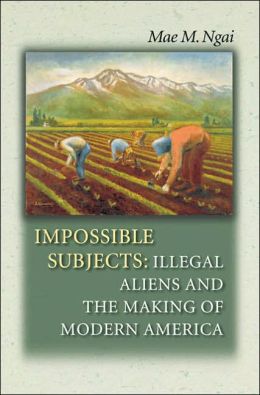
Ngai’s main argument is that illegal aliens were created through acts of positive law rather than through bad character, conduct, race or culture. In other words, prior to legislation that designated certain individuals as being in the country illegally, the category did not exist. Further, she argues that illegal immigration is a necessary by-product of a restrictive immigration process and that, in the American context, illegal immigration was not a side-channel to legal immigration. She argues instead that illegal immigration was used as a primary means of entering the U.S. by many immigrants and played a major role in populating the country. It seems that what she is attempting to clarify is the fact that many people immigrated to the country illegally, but found ways to have their status legalized after the fact, with the moral implications of illegal entry being dependent on race and the time-period examined.
While touching briefly on Filipinos, Japanese, and Chinese immigrants, Ngai’s narrative focuses primarily on migrants and immigrants from Mexico and how their experience has shaped the modern discourse regarding illegal aliens in the United States. She presents Mexicans as the archetypal illegal immigrant in the American imagination. In Ngai’s view, the focus on Mexicans as illegal immigrants is a result of the border culture in the southwest U.S. and northern Mexico as well as U.S. labor practices and policies. Ngai’s aim seems to be to show that the push by southwestern agriculturalists for cheap labor drove the importation, legal and otherwise, of Mexican laborers. Because the legal avenues for migration for work purposes became increasingly odious, many Mexicans preferred to cross into the country illegally. The best example she gives for this is the bracero program, which put Mexicans in a situation that left them generally worse off than if they hired themselves out on an individual basis.
Ngai’s argument is reasonable. She points out that illegal immigration from Mexico was the result of a failure on the part of the U.S. government to create adequate structures for legal entry by Mexican workers. She also points out that the drive for cheap labor that created the bracero program was based on a failure of the U.S. government to stand up to greedy agriculturalists and insist on fair wages for American workers. Ngai argues that this happened because the way people thought of America as a nation shifted. Laws were created to create the desired legal population. This shift created avenues for Europeans to become legalized but left Mexicans excluded from belonging to the nation in the American imagination. This exclusion was also the case for Japanese and Chinese immigrants, regardless of their legal or illegal status and whether they were citizens by naturalization or birth.
Ngai’s use of the Japanese and Filipino experience in the context of illegal immigration seems out of place. Did she include these groups to present a broader contrast between the way that Asiatic and Latin American immigrants were treated in comparison to Europeans? The experiences of these groups show that racism played a part in defining European Americans’ view of the nation, but “nullification” of citizenship rights and decolonization with voluntary repatriation are not the same as being considered an illegal entrant. The concept of being illegal connotes a violation of the law and a lack of citizenship status. For the Japanese, or at least the Nisei, their citizenship was never in question and neither was the legality of their status as Americans. The Issei did not enter the country illegally. They did not have access to citizenship but they were accepted legally, if not socially, as residents. With the Filipinos, repatriation was voluntary, rather than forced, indicating that their position was not illegal in the sense that they could be forcefully deported in an immigration sweep like Operation Wetback.
Ngai’s work is especially important in the way that it reveals the underlying assumptions about how the national body was viewed and how that view created the legal structures that created illegal immigrants. The immigration system was constructed in a way that ignored existing labor migration and pandered to the desire of agriculturalists to maximize profit with cheap labor. The willingness of Mexicans to take on jobs that were considered low paying to Americans fed into a racial image of Mexicans as undeveloped, while simultaneously painting them as lazy or arrogant if they refused to be cheated out of their wages or benefits. The Mexican stereotype that developed seems to have been applied to all non-European immigrants and work like Ngai’s helps to correct that historical narrative.
Considering the title, Becoming Mexican American: Ethnicity, Culture, and Identity in Chicano Los Angeles, 1900-1945, one would assume that George Sanchez’s book would be a history about the growth and development of a unique Chicano culture in Los Angeles between 1900 and 1945. However, the scope of the book becomes increasingly far-flung as the narrative progresses, much to the detriment of the author’s stated intention of examining cultural change in Los Angeles. Instead, Sanchez’s book shallowly covers multiple topics and areas, from labor history to radio programming, from rural villages in central and northern Mexico to El Paso, TX and points beyond, leaving the reader with the impression that much ground has been covered, but not in detail on any given subject. Despite the wide range of topics covered, Sanchez uses a variety of records and information from numerous fields of research to support his arguments, including Mexican consular documents, American government records, transcripts of oral testimonies from Mexican immigrants, and letters to provide a broad understanding of the factors that impacted Mexican immigrants to Los Angeles and their descendants.
One of the areas where Sanchez’s work excels is in his depiction of the social and economic interconnectedness of Mexico and the southwestern United States as a result of pre-existing Mexican communities in the area as well as through labor migration that led to cyclical and, eventually, additional permanent settlement. Part I of Becoming Mexican American… describes this process and is, in effect, a transnational historical narrative. Sanchez states that he wants to show that the culture that immigrants brought with them to the United States was not stagnant, but was rather a vibrant, complicated amalgamation of rural and urban mores that developed in Mexican villages in in the second half of the 19th century. However, this does not come through clearly in his writing. For one, the implication is that rural laborers somehow came to possess urban culture while migrating along rail lines for work. Additionally, it implies that laborers arrived in Los Angeles with a fully formed and static culture. It seems more reasonable to say that the process of cultural change that took place in Los Angeles was a continuation of what began in small rural villages in central and northern Mexico.
Sanchez’s comparison of labor migration within Mexico and the United States builds on the idea of regional interconnectedness. He demonstrates this primarily through his discussion of the Mexican rail system that connected northern Mexico more fully to the U.S. than it did to the rest of the country. The opportunities for labor created by the rail system pulled manual laborers away from their homes to travel and work on the rails. As they reached areas closer to the border with the U.S., they saw opportunities to perform the same labor for higher wages. However, this discussion, along with the highly detailed habits of border checkpoint guards, does not seem highly relevant to the topic of the development of a unique Chicano culture in Los Angeles.
Certainly, the openness of the border led to continued migration into the U.S., part of which created the community in Los Angeles, but why was a third of the narrative devoted to what feels like only partially relevant background information. It would have been more useful if the author had provided a brief overview of this topic and then spent more time explaining what the culture of Mexicans in Los Angeles was and how it developed over time. For example, Sanchez devotes an entire chapter to religion, but never goes further than saying the immigrants practiced what Catholic priests in the U.S. considered “folk Catholicism”. What is folk Catholicism? Exactly what were their beliefs and how did they contrast to mainstream Catholicism? Similarly, why did Sanchez spend so much time describing propaganda to encourage Anglos to move to Los Angeles? Why should we care what a Mexican intellectual who is not a resident of Los Angeles thinks about racial homogeneity in relation to the topic of this work? Also, why does Sanchez treat buying a radio as a special sign of cultural development? Is it not normal for people to be interested in purchasing devices that make their lives more comfortable, like the sewing machines he notes were prominent in rural Mexican households in Mexico?
While Sanchez’s book clearly has a lot to offer in terms of in-depth research about regional migration and labor history, most of what he presents is only coincidentally relevant to the community in Los Angeles and how their view of themselves and their position in relation to other inhabitants in the city changed over time. One is left with the feeling that certain sections of the book were originally meant to be stand-alone articles and that an original, cohesive text was supplemented by partially relevant, sometimes dense, textbook-style prose that was book-ended with an argument to attempt to tie everything together.

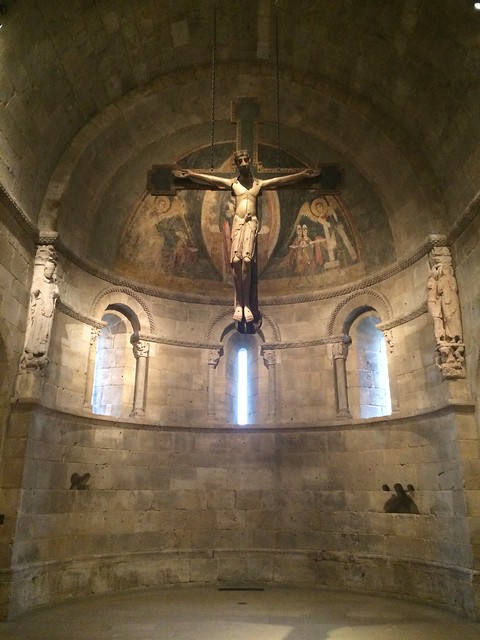 //embedr.flickr.com/assets/client-code.jsThe Cloisters is part of the Metropolitan Museum of Art. The building houses a collection of art from Medieval Europe. Because of that, most of the art depicts Christian religious stories and figures. It’s a pretty interesting collection that can be viewed in about 3 hours if you’re not stopping to read every information plaque in detail.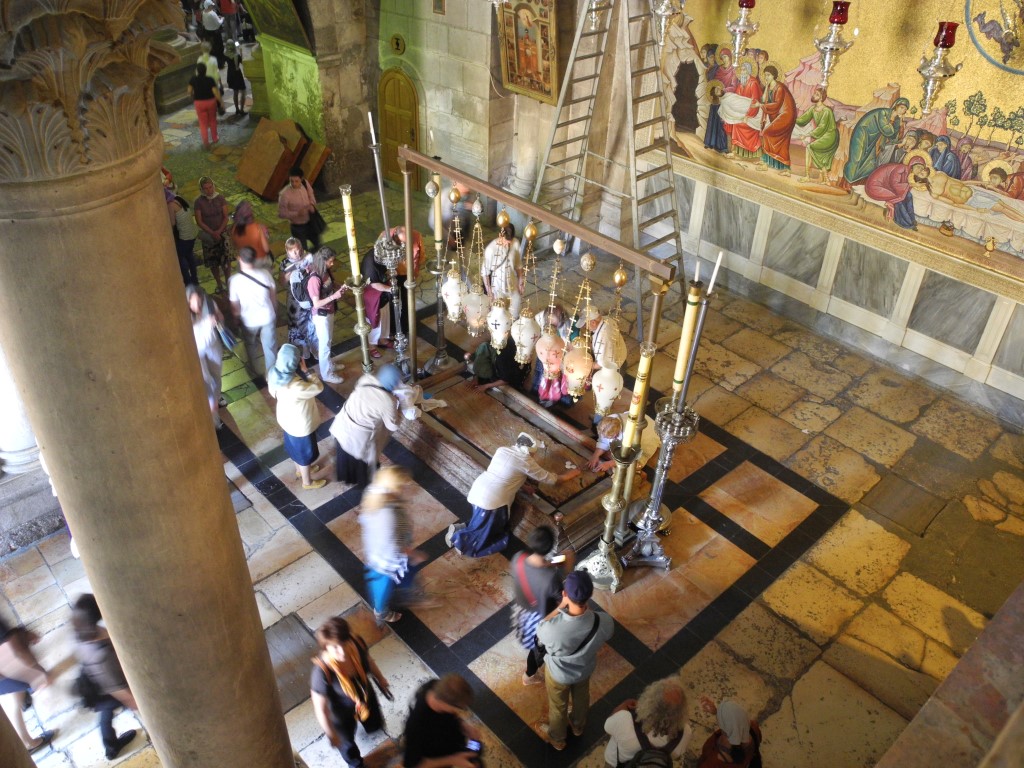
 //embedr.flickr.com/assets/client-code.jsThis post is the start of my Museum Challenge series.







 Bradley's Old Fashioned Weblog