Museum Challenge: Celebrating the Year of the Rooster @ The Metropolitan Museum of Art

In the Chinese calendar, it’s the Year of the Rooster. I didn’t even realize that until I saw an exhibit listed to celebrate the Rooster in the Chinese galleries at the Metropolitan Museum of Art.

I tried to guess at how they could put together an entire gallery of roosters. Rows and rows of roosters, in all mediums. Oil paintings of roosters, clay statues of roosters, pottery with roosters on it. Big roosters, tiny roosters. In my imagination, it was glorious, so of course, I made it a point to go check it out.

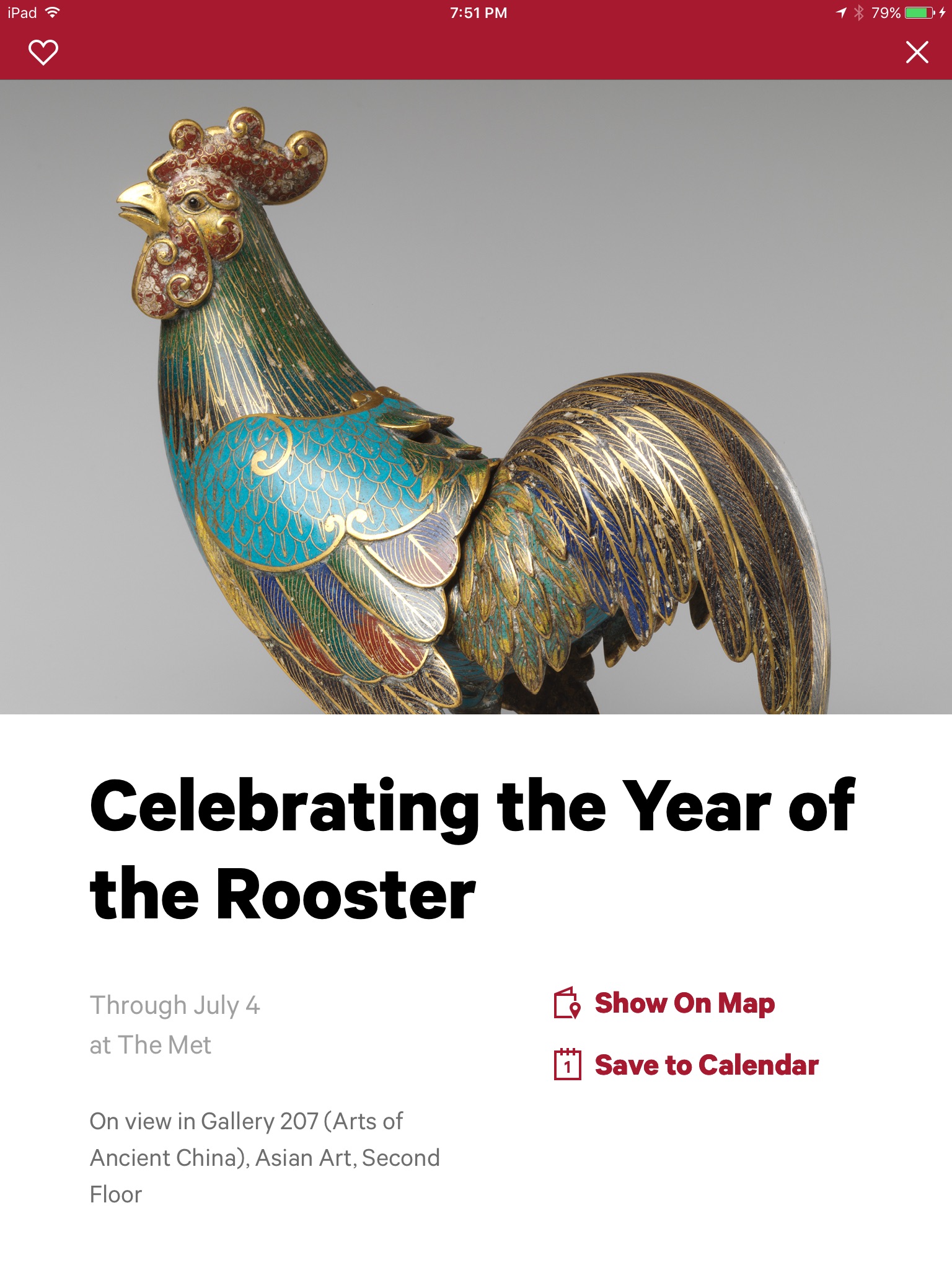
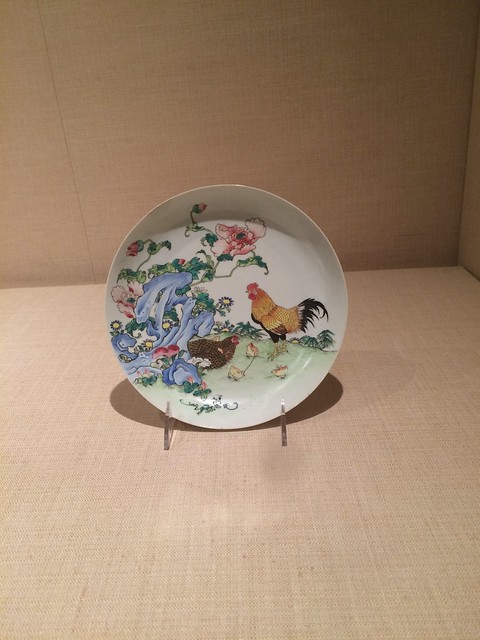
I had to ask for help finding the exhibit because I was standing where it was marked on the museum’s map, but I only saw one lonely rooster (pictured above). Unfortunately, that one lonely rooster was almost all there was to look at. There was also one wall display box with a few pieces of art in it and a wall placard explaining the significance of the Chinese zodiac animals.

When I think of an exhibit, I think of something substantial. I honestly felt like the advertisement was a bait and switch just to get people into the museum, which feels cheap and unworthy of the Metropolitan Museum of Art as an institution. Or maybe I’m just sad because I was hoping for something exciting or impressive. Something more. I guess I hold the museum to a higher standard because I hold it in such high regard.

Metropolitan Museum of Art - Year of the Rooster and Asian Art Gallery (March 2017)//embedr.flickr.com/assets/client-code.jsAnyway, I did see some really old artifacts from China while walking back out of the Asian galleries that caught my interest. They were objects placed in burial chambers for royalty. They looked like buildings and servants and objects for service and entertainment. It’s a lot like what Pharaohs were buried with in Egypt. It’s odd how similar ideas were popping up all around the world in roughly the same time period. I was reminded of how the pyramids were built in Egypt, but that there were also pyramids being built in Central America. There are the remains of ziggurats in the Middle East, but there are also remains of similar structures on the ocean floor near Japan. I wonder how they’re all connected?

Also, turns out I was born in the year of the Rooster. Gong xi fa cai!

Museum Challenge: The New York Transit Museum – Fun and Interesting

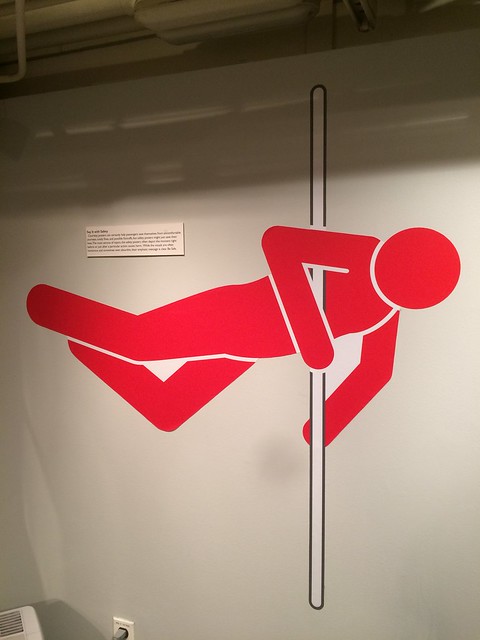
No pole dancing allowed

Of all the museums I’ve visited in New York City, the New York Transit Museum was the most fun, even though it’s also (so far) the smallest. The museum is designed in a way that allows for interaction with many of the exhibits. There was a whole class of children on a field trip playing with the turnstiles when I first got there. I think the museum staff was aiming for making the place a popular field-trip destination. Besides all of the interactive exhibits, there is also a cafeteria/classroom area.Just because it was set up for kids doesn’t mean it can’t be fun for adults too, though.

Students on a field trip trying out old subway turnstiles.

Just because it was set up for kids doesn’t mean it can’t be fun for adults too, though. On the first floor or first basement level, depending on how you look at it, there are old buses or portions of buses that you can walk into and sit in. The driver’s seats are accessible and you can have a friend take your photo through the windshield. The newer buses are definitely designed better. The driver’s seat and the angle of the pedals were much more comfortable than an older model I tried out, which required me to keep my leg elevated all the time to press the pedals. I have no idea how people actually drove those older buses all day. Their right legs must have been twice the size of their left legs.

The bottom floor of the basement is where all of the old train cars are. They had everything from A trains, supposedly mid-90s to 2010 (some of which I still see on the A line, not sure why it’s in the museum), to trains from the early 1900s. A lot of the train cars looked similar inside. Even some of the same advertisements spanned decades. It was interesting to see how the seat configurations changed over time. I also thought it was interesting to see ceiling or rotating fans in some of the older train cars. Once a year, New York City runs some of these older trains on the 7 line (I think).

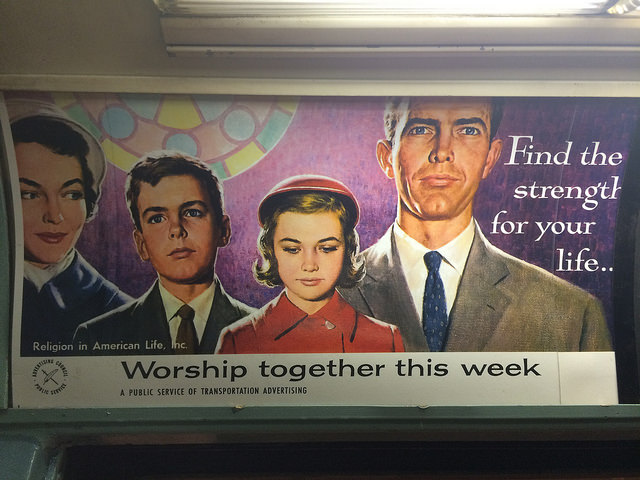
Vintage train advertisement.

What really interested me, though, were the old advertisements. I’d like to go back and just spend a few hours studying them. You can tell a lot about people during a certain time period based on the products they were buying and how the appeals made by advertisers were framed. It’s also just neat to see the artwork styles.

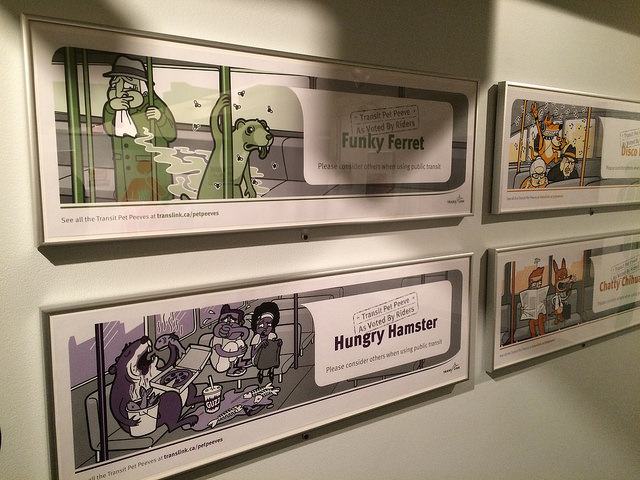
Signage meant to regulate passenger behavior.


More signage meant to regular passenger behavior.

Another awesome exhibit in the museum is of signs meant to regulate the behavior of passengers. The signs are from multiple transit systems around the world. Some of them are hilarious; all of them are necessary. Or at least, the ones for the New York transit system are necessary. I remember being shocked by how clean the trains and buses in Singapore were when I first moved there. The trains were so clean that sometimes people would sit on the floor, something that is totally out of the question in New York City trains. The buses in New York City are usually just as filthy as the trains. People litter everywhere here; they spit everywhere here. It’s a shame. The city would be so much nicer if people would take care of it, but they don’t. They just complain about how dirty the city is while contributing to the problem.

Anyhow, the New York Transit Museum is pretty awesome and I’ll definitely be going back at least one more time in the future. Take a look through the photo gallery below for more images of exhibits in the museum:


The New York Transit Museum//embedr.flickr.com/assets/client-code.js

Fashion: Functionality or Art? – Isaac Mizrahi, The Jewish Museum

In August of last year, I was able to catch the Isaac Mizrahi exhibit at The Jewish Museum on 5th Avenue during its last weekend. The previous month, I’d gone to see the Manus x Machina exhibit at the Metropolitan Museum of Art, which was very impressive. Assuming I would see something just as beautiful and fascinating, I was pretty excited to catch the Mizrahi exhibit before it closed.

I was somewhat disappointed. I think it’s because my expectations were high after seeing what the Met had to offer. The dresses on display at the Met were impressive, intricate, attractive, and, for the most part, they were outfits that I could picture people wearing in real situations. Mizrahi’s outfits bordered on the impractical or the odd, the sort of things you see in runway fashion shows but would laugh about if you saw on an actual person in the street.

Then there were things like this:

Unusual outfits at the Isaac Mizrahi exhibit at the Jewish Museum in August, 2016

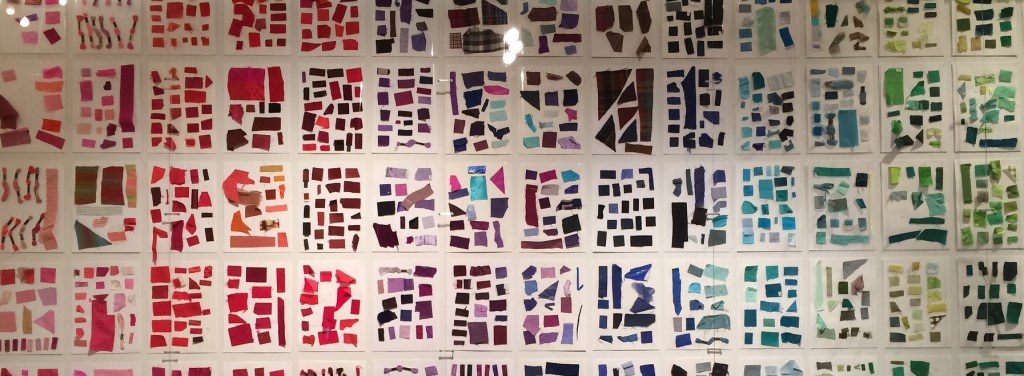
I was pretty put off by the whole experience. I found the most interesting parts of the exhibit to be the wall of cloth scraps in the featured image above and the chandeliers in the museum lobby. On the other hand, the exhibit made me re-evaluate my understanding of fashion. Does fashion need to be functional, or can it be art? Can it be both at the same time? Or one or the other?

Isaac Mizrahi Fashion Exhibit at the Jewish Museum - 2016//embedr.flickr.com/assets/client-code.jsI suppose clothing can be art, rather than something that’s worn regularly or even occasionally. Even so, Mizrahi’s work didn’t appeal to me, but that’s a matter of personal preference. He’s obviously very talented.

The Snowpocalypse that Wasn’t (New York City, 2017)

Snow accumulation on Tuesday night, March 14 2017

Listening to the news last weekend and last Monday, it sounded like disaster was imminent. Schools were shut down, public transit was suspended, and people were encouraged to remain at home if at all possible to avoid the life-threatening storm that was going to hit Monday night and continue through Tuesday.

Like most of the news commentators mentioned, the storm didn’t quite turn out as expected. I think I was listening to NPR when I heard an announcer mention the actual snow totals in New York City. He then made the comment, “Do you know what we call that in Chicago? Tuesday.” I laughed, remembering how I’d gone out on Tuesday to grab a few odds and ends for making tacos. There was a good bit of snow and the sidewalks were slippery, but it wasn’t that serious.

Snow accumulation on 176th Street in the Bronx, New York City.

The Bronx received more snow than anywhere else in the city at 8″ of accumulation. Watching from my living room window, I could see that the wind was pretty bad at times, but it wasn’t quite what I was expecting. I kept thinking about the blizzard in January of 2015 as a point of reference. The oddest thing about the day was how quiet it was. There was very little traffic, there weren’t many pedestrians, and the few trains that passed our station went by slowly and quietly, with no announcements. My apartment overlooks a train line. After living here for a year, I don’t really notice the sound of the trains, but I noticed when the sound stopped.

January 2015 Blizzard in Washington Heights:

January 2015 Winter Storm Jonas - New York City Blizzard//embedr.flickr.com/assets/client-code.jsWednesday was probably worse than Tuesday. The snow had partially melted because of sleet and rain and had frozen overnight on the sidewalks. The corners, where the pedestrian crossings are, were huge puddles of slush. Hopefully, this will be the last snow we see this year. I’m ready for spring.

Museum Challenge: The Museum of the City of New York (Feb 2017)

City of New York Quote - New York Evening Post

A few weeks ago I was standing in Barnes & Noble, looking around to see if anything would catch my eye. I didn’t really want to buy anything because I have plenty of books that I haven’t read yet, but sometimes I go to B&N just to look around and get an idea of what’s popular or new. Sometimes I can’t resist and still walk out with a few new books to add to my collection.Anyway, I saw a section for books on New York City and I realized that despite majoring in History and working on an MA in history, I haven’t read or learned much about the history of New York City.

Anyway, I saw a section for books on New York City and I realized that despite majoring in History and working on an MA in history, I haven’t read or learned much about the history of New York City. The only two books that I know I’ve read are City of Women: Sex and Class in New York, 1789-1860, by Christine Stansell and City of Eros: New York City, Prostitution, and the Commercialization of Sex, 1790-1920, by Timothy J. Gilfoyle. I think I read them as part of an American economic history master’s course that was masquerading as a course on historiography and historical methodology. They were both excellent books, by the way.

Not knowing too much of anything about New York’s history struck me as odd since I live in New York City and half of my family has lived in New York City for multiple generations. At some point, I’m going to have to sit down and plow through a few good books on the subject, but my ignorance of the topic was the inspiration for my decision to visit the Museum of the City of New York on 5th Avenue.

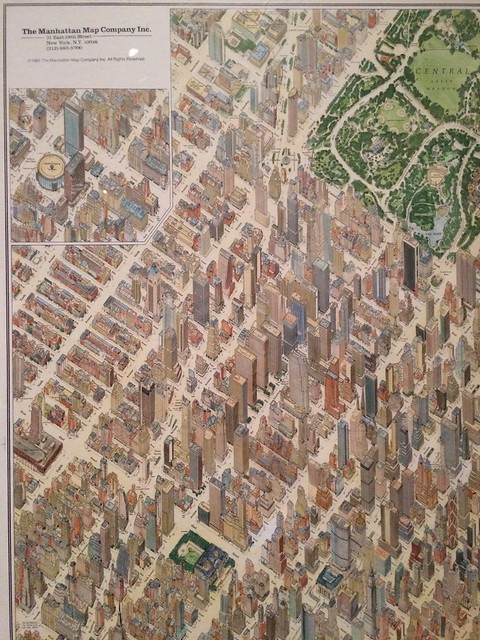
A 1985 map of Manhattan, by The Manhattan Map Company Inc.

The museum is not exceptionally large. I took the time to look at the special exhibit and read quite a few of the information placards in the galleries and still saw everything in about 3.5 hours, so it’s a great way to spend an afternoon without feeling rushed or having to go back again to see what you missed the first time through. Another bonus is that admission is free if you have a City University of New York student ID card.

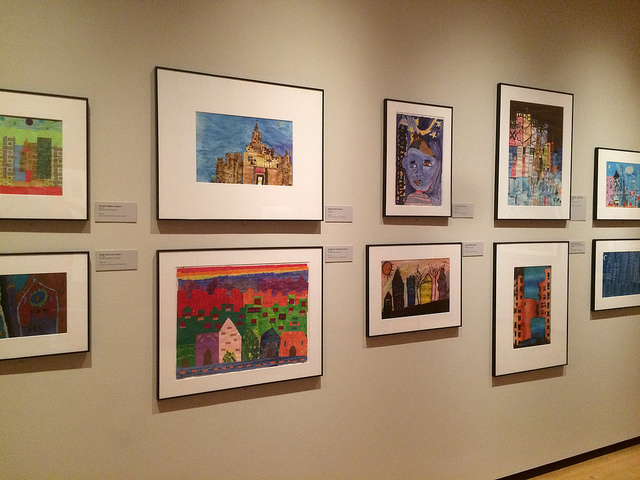
A selection of artwork by students of varying ages in New York City schools.

The building’s collection has a mix of art and artifacts. In some galleries, there are old maps of the city, detailed information on how zoning works, and models to show how buildings were designed to fit the space limitations created by whatever the current zoning laws were. Other galleries have artifacts from the early colonial period, including Native American artifacts. There are galleries describing protest movements and fashion trends. There is a small hall dedicated to Tiffany’s. There is a gallery of contemporary children’s art from city schools. The special exhibit when I visited was on gay New York and the history of the gay rights movement and gay lifestyle in the city.

A selection of Tiffany's fans.
A selection of Tiffany’s fans.

The galleries cover a lot of ground. Some exhibits felt out of place, like the Tiffany’s gallery and the Stettheimer Doll House, for example. The special exhibit on gay New York felt empty. There wasn’t enough on display to make the exhibit interesting. The children’s art exhibit was really fun but also really small. The museum should dedicate more space to current New York City art initiatives and to modern New York City. By that, I mean there should be something that showcases contemporary diversity beyond the scrolling Twitter feed display showing New Yorker’s criticizing Trump’s policies. It should be something positive, like an exhibit on interfaith initiatives, cultural festivals, street fairs, and festivals, for example. It would also be interesting to see an exhibit on historical landmarks in the city and the process for designating a site as a historic landmark.

A gallery of more photos from the museum:

The Museum of the City of New York//embedr.flickr.com/assets/client-code.jsI probably won’t visit this museum again. It was definitely worth the trip, but I didn’t see anything there that spoke to me, in the way that art at the Metropolitan Museum of Art does. This museum is more informative than awe-inspiring or inspirational.

Wide Awake: Christopher Clark’s “The Sleepwalkers” and World War I

The Sleepwalkers by Christopher Clark book cover image

Christopher Clark’s The Sleepwalkers is an eminently readable account of the events that led up to the outbreak of World War I. Written in a narrative style, but rich with detail and innovative arguments about the origins of the war, Clark’s work is meant for a general audience but will also appeal to scholars looking to broaden their understanding of the events leading up to World War I. Clark is well versed in his subject matter. He is currently the Regius Professor of History at Cambridge University with a focus on European history. His prior works include a study of Christian-Jewish relations in Prussia (The Politics of Conversion. Missionary Protestantism and the Jews in Prussia, 1728-1941, Oxford University Press, 1995), a general history of Prussia (Iron Kingdom: The Rise and Downfall of Prussia, 1600-1947, Penguin, 2006), and a biography of Kaiser Wilhelm II of Germany (Kaiser Wilhelm II, Longman, 2000).

In The Sleepwalkers, Clark attempts to fundamentally change the way the origins of the war are discussed. Rather than trying to make a claim about who bears the most responsibility for the outbreak of World War I, the author is instead more concerned with the agency of individuals within the state power structures, the decisions they made, and why. Using a wealth of primary documents in state archives as well as secondary sources, Clark brings these “characters” to life in a story that begins with the assassination of King Alexander and Queen Draga in Serbia in June of 1903 and ends with European mobilization in August of 1914.

The scope of Clark’s narrative is impressive, despite being limited. The focus is placed primarily on Serbia, the Habsburg Empire, Russia, Germany, and France. Clark goes into detail regarding meetings, conversations, letters, and press publications in these countries. Other nations that played important roles in World War I are only touched upon briefly, including Italy, Britain, and the Ottoman Empire. Does it make sense to limit the narrative to these countries? For the most part, yes. Clark demonstrates that the rivalries between Russia and the Habsburgs and between the French and the Germans were the driving forces behind the outbreak of war; the assassination of the Archduke and Archduchess of Austria-Hungary by Serbian assassins was simply a pretext used by these nations to pursue other goals. On the other hand, Clark positions the ongoing decline of the Ottoman Empire and the loss of Ottoman lands to other states as a primary cause of continuing unrest not only in the Balkans, but in Europe as well. If the loss of Libya to Italy and Russia’s longstanding conflict with the Ottomans over the Dardanelles and Bosphorus was so crucial in laying the groundwork for the events that led up to World War I, why was the Ottoman Empire (the so-called “sick man of Europe”) not given a greater place at the table in Clark’s narrative?

The role Clark attributes to the Ottoman Empire in The Sleepwalkers ties into one of his larger themes, in which he presents the alliance bloc system as a driving force behind the outbreak of hostilities. The new bi-polar system (Entente vs Central Powers) developed out of an earlier multi-polar system which hinged on the maintenance of the status quo, including the propping up of the Ottoman Empire as a vital part of the European political establishment. The formation of powerful alliance blocs coupled with the linkage of diplomacy to military power, as well as the lack of available colonial territories to barter and trade away in international diplomacy, created a situation that was inherently volatile. Clark writes that war was not inevitable, that it was the result of actions taken by individuals. The evidence Clark presents strongly supports his thesis. Clark clearly shows that the French elite were agitating for war to regain territories previously lost to Germany. Russian elites were looking for an excuse to finally capture the Dardanelles and Bosphorus. They understood that they would likely trigger a continental war, but decided to push forward with their plans anyway. These players were not sleepwalking towards war; they were wide awake, even if they were unaware of the scale of the consequences their actions would bring.

One of the larger problems with Clark’s work is that he places so much emphasis on Serbia and Serbian history when his narrative clearly shows that events in Serbia and Sarajevo were merely a pretext that France and Russia used to start a war that they hoped would allow them to achieve their own national goals. The amount of space in the book devoted to Serbian history seems disproportionate to the country’s influence on events. Without Russian backing, would a larger continental war have started at all? In his introduction, Clark writes that he is not interested in placing blame, but based on the evidence he presents, Russia is responsible for the start of World War I. Serbia was not a part of the Entente Alliance of 1907. Had Russia not intervened on its behalf, the treaty stipulations would not have been triggered. Germany, by contrast, comes across as an underdog in The Sleepwalkers.

Two minor issues stood out to me in this book. One is the mention of but lack of development of the idea that a new trend in masculinity affected diplomatic relations between the countries involved. The second is the repeated use of “public opinion” to explain events without developing the reader’s understanding of the actual relationship between the media or government and the public. Who was “the public”? The elite, or all classes? What was the literacy rate? Did people consume news by reading or through word-of-mouth in public spaces? Did people understand that some news was camouflaged diplomacy? Clark indicates that the outbreak of war surprised rural populations in Russia and France and they did not understand what was going on, so how could “public opinion” have played such a crucial role in government policy formation?

Overall, Clark’s presentation of the backdrop to World War I in The Sleepwalkers: How Europe Went to War in 1914 is brilliant. It is written in a way that is informative and yet entertaining. He opens an old topic to fresh discussion by revealing the complicated web of interactions between individuals in the state governmental systems, calling into question anew who is responsible for the start of World War I, even if that is not the author’s intention. More importantly, Clark’s work is a solid reminder that wars do not start themselves; people start wars and bad decisions by people in key positions can have devastating consequences.

Museum Challenge: The Cloisters at Fort Tryon Park

A sitting area in The Cloisters

Some photos from my trip to The Cloisters in Fort Tryon Park in January:

The Cloisters//embedr.flickr.com/assets/client-code.jsThe Cloisters is part of the Metropolitan Museum of Art. The building houses a collection of art from Medieval Europe. Because of that, most of the art depicts Christian religious stories and figures. It’s a pretty interesting collection that can be viewed in about 3 hours if you’re not stopping to read every information plaque in detail.

What stuck with me was the collection of reliquaries. It’s fascinating to think that people believed, and still believe, that being close to or touching the body part of a deceased person can confer some spiritual power or good fortune. I suppose it’s not too different from people buying souvenirs in Jerusalem today to bring back with them, or bringing dirt from Jerusalem, because people who were holy may have walked on it.I’m reminded of something I saw in the Church of the Holy Sepulchre in Jerusalem. Like The Cloisters, the Church of the Holy Sepulchre is a conglomeration of chapels that were joined together. They building covers the supposed sites of Jesus’s crucifixion and the tomb where his body was placed. There is also a stone at the foot of the hill where Jesus was supposedly crucified. Jesus’s body is said to have been brought down off the cross and placed on this stone.

The Church of the Holy Sepulchre in Jerusalem (March 2014)

I’m reminded of something I saw in the Church of the Holy Sepulchre in Jerusalem. Like The Cloisters, the Church of the Holy Sepulchre is a conglomeration of chapels that were joined together. They building covers the supposed sites of Jesus’s crucifixion and the tomb where his body was placed. There is also a stone at the foot of the hill where Jesus was supposedly crucified. Jesus’s body is said to have been brought down off the cross and placed on that stone. While I was there, women came in and poured oil onto the stone and then used a number of scarves to soak it back up. I assume they took those scarves home and distributed them to people who couldn’t make the trip and that they believed there had been some sort of transference of holiness from the stone to the scarves through the oil.

I didn’t take many photos on this trip because I’d been there before. The last time I visited The Cloisters was during the summer. I would definitely recommend visiting in warm weather. The open courtyards are much more enjoyable when there’s warm sunlight, cool breezes, and running fountains. I saw quite a few people sitting on benches and reading. There is also no herb garden during the winter, for obvious reasons.

Because The Cloisters is part of the Metropolitan Museum of Art, admission is donation based. There are suggested donations, but you can give a nickel and still be admitted to the museum.

Here are some photos from a previous trip:

The Cloisters, Fort Tryon Park, Manhattan//embedr.flickr.com/assets/client-code.jsThis post is the start of my Museum Challenge series.

Review: “The Life-Changing Magic of Tidying Up: The Japanese Art of Decluttering and Organizing”

The Life-Changing Magic of Tidying Up: The Japanese Art of Decluttering and Organizing book cover

The Life-Changing Magic of Tidying Up: The Japanese Art of Decluttering and Organizing by Marie Kondo is really inspiring. I would say the hardest thing about the book was trying to hold off on implementing the recommendations until I finished reading. The way the author describes the end-result is incredibly appealing.

Kondo is repetitive in some sections, but not in an irritating way. She reinforces the concepts she’s trying to convey by referencing them multiple times throughout the text. The way that the author refers to things in a house and houses themselves was confusing and a bit odd until I understood that this was a reflection of her Shinto beliefs regarding divine essences being present in all things. When she talks about things having energy or life or greeting your objects, that’s part of her religious belief, but it makes sense to take care of and to value and appreciate your belongings. The better you care for them, the longer they’ll last.

What did I get out of this book? It helped me to reevaluate the way that I surround myself with things. It helped me to think about my apartment as a place for living rather than for storing. Do I really need these old knick-knacks from 5 years ago? Do I even look at them? When did I see this pair of pants last? Should I hang onto this shirt because I spent money on it and haven’t used it much, or get rid of it because it isn’t something I enjoy wearing?

Kondo encourages her readers to treat the places they live as living spaces rather than as storage spaces. She wants people to understand that surrounding themselves with just those things that bring joy will improve their lives. She also thinks it can help provide direction for people’s lives because, when you pare down your possessions to what you really value, it can help you discover what you’re genuine interests are.

KonMari (as she is often called) made me think of what’s really important to me and inspired me to turn my living space into a place that I really enjoy being in. I don’t expect my screwdriver or every undershirt to spark joy in my life, but as much as possible I want to limit my possessions to just those things that I derive joy or inspiration from.

// This is not a paid advertisement. //

“Origins” January 2017 Loot Crate

The Original Since 1981 Jumpman / Mario t-shirt

I subscribed to the Loot Crate service back when it started out. It was a fun diversion once a month. I wound up canceling the service after a few months though because I just stopped being impressed with the value of what I was getting for my money.I decided to give the service another shot around Halloween last year and it looks like they’ve really improved on the items they put in their boxes.

I decided to give the service another shot around Halloween last year and it looks like they’ve really improved on the items they put in their boxes. A lot of it is still stuff that I’m going to wind up either throwing or giving away, like the Pop! figures, but the books and t-shirts usually make up for that. The January 2017 box is an exception. I like everything that came out of it:

January 2017 Loot Crate Contents

  • Action Comics #1 (1938) reprint
  • Ninja Turtles Raphael tiki mug
  • Captain America “The First Avenger” shield replica
  • “Jumpman” / Mario t-shirt (design in featured image above)

Raphael Ninja Turtles tikki mug and Captain America First Avenger Shield Replica

The boxes are still fairly hit-or-miss, but I guess that’s part of the thrill of opening one up. It’s like gambling or playing the lottery. Sometimes you get a jackpot and other times you wind up with Pop! figures on your shelf and no idea what to do with them. Loot Crate has other, theme specific, crates now that I’m probably going to look into. Maybe they’d fit my interests better, but this box was definitely a winner.