Should be required reading: “Cynical Theories”

“It is bad psychology to tell people who do not believe that they are racist—who may even actively despise racism—that there is nothing they can do to stop themselves from being racist—and then ask them to help you. It is even less helpful to tell them that even their own good intentions are proof of their latent racism. Worst of all is to set up double-binds, like telling them that if they notice race it is because they are racist, but if they don’t notice race it’s because their privilege affords them the luxury of not noticing race, which is racist.”

Helen Pluckrose, Cynical Theories: How Activist Scholarship Made Everything about Race, Gender, and Identity—and Why This Harms Everybody

This is the best book I’ve read that tackles the issues related to postmodernism and social justice activist politics, and it clearly expresses a lot of ideas that I’ve had myself but didn’t take the time to really research or fully articulate.

This should be required reading to graduate college. When I was in college, a lot of the courses I took relied heavily on postmodernism, identity politics, and social justice ideology, but I didn’t realize it because I didn’t have a name for it. Also, it was taught as fact and reality rather than just as a theory, or as the authors would say, as Theory, and it was part of everything from classes on sociology to government to history. At some point, I realized that things weren’t quite right, but you have to go along with what the professor is advocating if you want to be assured of getting a passing grade.

Updates 6.27

There’s a whole lot going on in the US right now but I’m at the point where I’ve started to tune it out. I’ll probably drop some rambling posts about the social unrest and venture into fringe conspiracy theories later, but not right now. It just gets so tiring, you know? Like, why should I try to carry the weight of the world’s problems on my shoulders (or in my head) 24/7? It’s a constant burden and it can weigh a person down.

So, I’m trying to get back to focusing on things that I actually enjoy, like manga, movies, studying Japanese, and cats. And I’ve been working more now that things are starting to get back to normal in New York City, which is nice.

This past Monday, businesses started opening back up. There’s still no dining in, which is a good thing honestly, but it was super nice to be able to get the car washed, drive downtown, and get takeout from Thai Terminal and Veniero’s. I really missed their food, especially Veniero’s cheesecake. It was so good that I didn’t even bother to take a photo of it before gobbling it down.

Hopefully, COVID-19 doesn’t spike. I’m not really interested in another shutdown, but with all of the protests and rioting, it could happen. I wasn’t really prepared last time, so if there’s going to be another shutdown I’m not going to get caught with my pants down again. I picked up my Mom and we went to New Jersey to shop at Walmart. My cart was overflowing. LOL. I didn’t hoard TP or paper towels, but I picked up quite a few canned and frozen items along with olive oil, honey, canned soups, and other staples.

We stopped by Mitsuwa Marketplace in Edgewater and the grocery was open (which was great because we needed Yakult) but the food court was still closed. Daiso was open and we wound up picking up some nice dishes with cat designs:

So, I’ve moved on to memorizing Japanese kanji. It’s actually more fun than I expected. I’m starting to remember the component parts of the kanji and it’s making it easier to start guessing at the meanings of other kanji. I’m hoping that by the end of the year I can read simple kid’s books in Japanese.

Speaking of Japanese, if you haven’t read Dungeon Meshi / Delicious in Dungeon, I highly recommend it. The last chapter was especially good. It’s probably the best chapter in the manga.

And speaking of reading, I’ve plowed through about 50 books so far this year, including the entire Witcher series. That one is really hit or miss and The Last Wish, which the Netflix series is based on, is definitely the best of the bunch. It was worth the time, though, as someone who really enjoys fantasy novels. I’m reading a book about Israeli history right now and it reminded me of why I was so fascinated with Middle Eastern history while I was studying it in college. I’ll probably go on a run of books about modern Middle Eastern history next. I also want to get around to reading The Meditations by Marcus Aurelius. I’ve been putting it off, even though I’m really interested in it.

Last thing I want to mention before putting things away so we can eat dinner is that there are new kittens in the apartment. Here’s one of them:

Finding things to do while stuck at home during the coronapocalypse

De Blasio was throwing around the idea that there might be a “shelter in place order”, basically restricting all movement except essential services I guess, but Cuomo said De Blasio was basically full of crap and there was no such plan. Apparently, shutting down New York City is off the table, probably more for logistical and enforcement reasons than anything. How do you shut down a city this size? Would the police even attempt to or be able to check everyone still out to see if what they’re doing is authorized?

Maybe? I imagine it’s easier to have the NYPD crack down on businesses that aren’t following the shutdown order than it would be to try to police millions of people out on the street.

That being said, I’m stuck at home anyway, because my work requires me to be in venues of 50 or more people and gatherings that size are currently banned. I could go out and screw around and hey, maybe I will, but today I was at home using the time to try to catch up on some things.

Basically, I was just cleaning and doing chores. Laundry, sweeping, mopping, sanitizing surfaces, dishes, cooking for my wife who is working remote. Digging out old Christmas hand sanitizers and Wet Wipes from the closet.

Small containers of holiday scented hand sanitizer from 2018. LOL. And some Wet Wipes. We ordered 4 of those when the pandemic was first getting started.

I spent time with my cats. I even stayed in bed for an hour this morning after waking up because my cat Dapper was resting on my arm. Why not? Not like I had anything that pressing to do and she always gets upset when I leave.

Dapper snuggled in next to me on the bed this morning

I updated my resume, Indeed, and LinkdIn. I transferred downloaded photos from my phone to my laptop.

I finished The Bell Jar, by Sylvia Plath and started reading East of Eden, by John Steinbeck.

I put a bunch of extra time into studying Japanese and Spanish on Memrise.

I want to do some more reading tonight. Maybe I’ll play a video game. I’ve been meaning to get back to The Witcher III on my Switch. But really I’ll probably wind up shitposting on Twitter, Pleroma, and Facebook.

Now what? I need to get out of the apartment for a while tomorrow to work out. While that’s still allowed. The gyms are closed. I guess I could do something here in the apartment and go for a bike ride.

I’m not sure how I’ll feel if this goes on for a few weeks, but right now, I’m set. If the chores run out (and with the tax deadline looming and plenty of other cleaning to catch up on, that’s not likely to happen) there’s always Netflix, video games, board games, and books.

Book Review: Soul of the Fire, by Terry Goodkind

Soul of the Fire, by Terry Goodkind

I enjoyed the exercise in world building that this book seems to represent. The author laid out the history of Anderith and then used that foundation to give us a story about political intrigue and domination.

I also enjoyed how things played out at the end, though I’m not sure it made much sense. The common people would be the ones to suffer the most, while the elites who manipulated them in the first place would likely escape retribution, like Dalton. So, could that really satisfy Richard’s desire for vengeance? It does make his actions seem more juvenile. What he’s doing at the end of the story is pretty juvenile too. “They don’t like me so I’m going home!” Isn’t this guy supposed to be Lord Rahl? Wouldn’t his past experiences have hardened him up and made a man out of him by this point? Are his actions believable?

I feel like Goodkind spends a lot of time building new characters up and developing them in really creative ways, only to have them meet their ends in extremely anti-climactic situations that felt rushed and left me wondering what the point of learning about them was in the first place.

That rushed feeling permeates the last 60 pages or so of the book. One moment everything is fine, and then suddenly the enemy is there and everything quickly wraps up in catastrophe. It doesn’t feel measured. It doesn’t feel like good storytelling. It feels like the author put too much time into the build-up and then realized he only had 50 pages to find some sort of conclusion. The ending was choppy and unsatisfying. Goodkind also puts too much weight on weak storylines. The prime example is using Franka’s situation at the end of the book to explain Dalton’s change of heart, but for that to be believable Dalton’s relationship with Franka should have been more deeply examined.

The story could have been better if Goodkind had spent less time detailing characters and a culture that were disposable and had spent more time developing the main characters instead. Throughout the story, all of the main characters fail to work together. The actions they take aren’t believable given their situations. Kahlan doubting Richard and the mud people elder about the chicken is the most glaring example. Why would they lie about it, and if it had turned out to be untrue, so what? They’d have checked and maybe killed a few chickens and then they could have settled things. Instead, she gets portrayed as a doubting, whining bitch that slows down story progression, which isn’t fair to her considering who she is supposed to be. Richard has his turn to be an idiot when he doesn’t trust Kahlan’s opinion later on in the story.

The story just feels like a wasted opportunity, or like filler material.

Shake Shack and Barnes & Noble on 86th Street

Shackburger, Fries, Peanut Butter Shake and Root Beer. Looks good, doesn't it?
Shackburger, Fries, Peanut Butter Shake and Root Beer. Looks good, doesn’t it?

After putting off going to the Shake Shack for a … well, a few years, we finally made the trip. We never went before, because it just wasn’t convenient. There was never one near where we lived. I’m still surprised that they don’t have a location near Union Square. I’d always heard good things about the place, though, so when we decided to take a trip to the Met, I suggested we eat at the Shake Shack a few blocks away on 86th street between 3rd Ave and Lexington.

I was a little surprised by the prices, but after we finished eating, we felt like it was worth it. The fries really weren’t anything special, but the burger and shake were exceptional. I had a Shackburger and my wife had the portobello mushroom burger. She said that was also delicious. I was a little worried about the “special sauce” on the burger, but it really complemented the taste. The peanut butter shake was thick and tasty, but it’s heavy so we split a small. The best part is that it tasted real. The peanut butter shake especially, but all of the food as a whole. Maybe not the fries. But, in general, it felt like I was at a family barbecue eating a real burger off the grill.

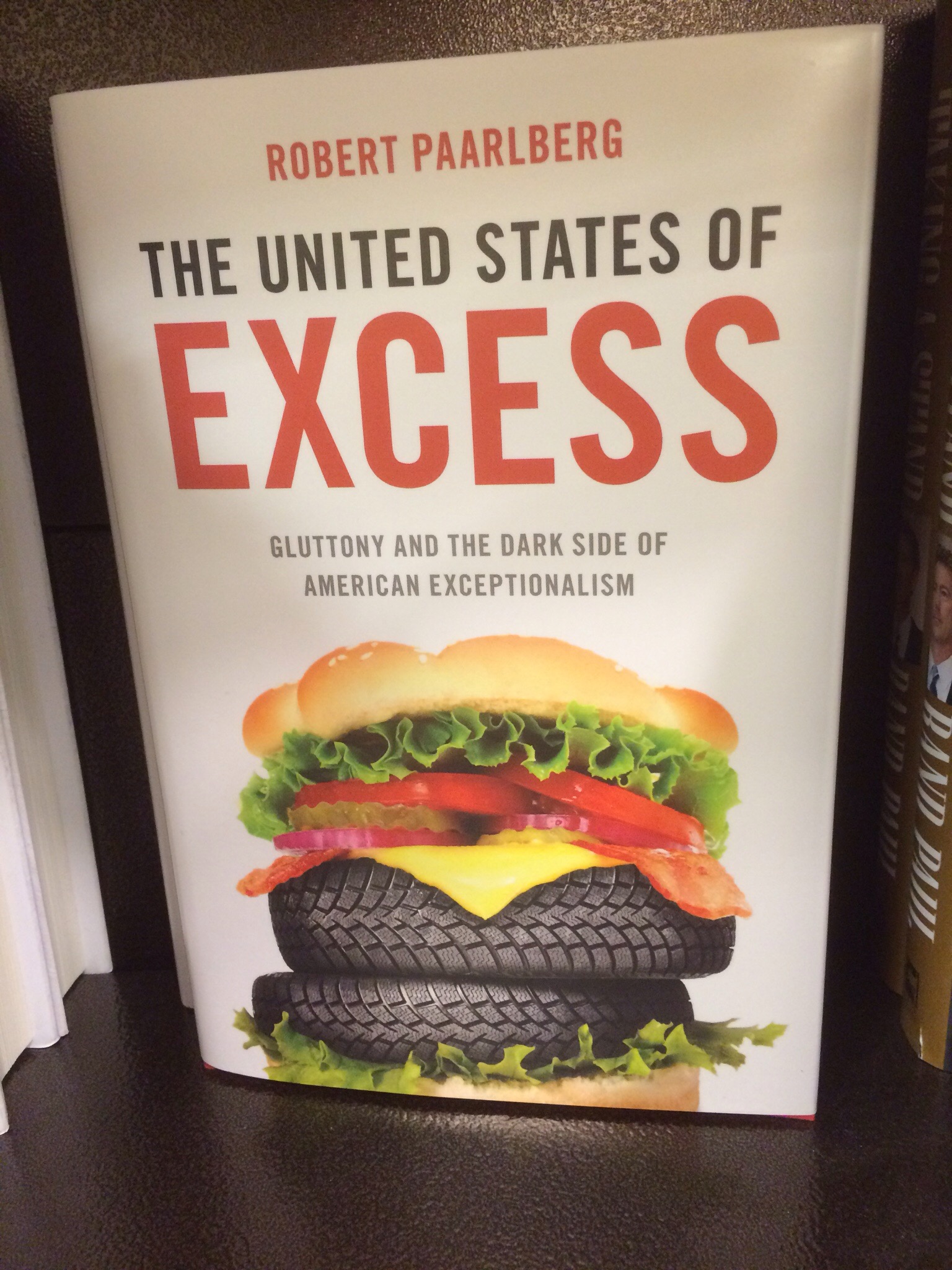
After eating, we went into the Barnes & Noble next door to take a look around. We’re both suckers for book stores. Even if we don’t plan on buying anything, we love to browse. We were surprised by how big the place is. It’s all underground in two basement levels. We never quite managed to leave and before we realized it, it was 8 pm and we were ready to head home. I wound up taking pictures of some book covers from the current events section to pick up later, when (or if) I ever get through the books I already have lined up to read. 4 years of college really put a dent in my pleasure reading.

The Origins of Power, Prosperity and Poverty: Why Nations Fail

ISIS: The State of Terror

The United States of Excess: Gluttony and the Dark Side of American Exceptionalism

The Encyclopaedia Judaica Dustica – Physical Copy

Last week, I had to do some research in a group for the last assignment for a course I’m taking this semester called “Jesus the Jew.” We spent the semester studying Jesus in the Jewish context he was born in, including society, government, religion, and politics. We also looked at the gospel narratives and examined what they said about Jesus, who the authors were, how they differed in their views of Jesus and talked about what that means in terms of early Christianity. It was all very fascinating and I’ll probably post some of my research here later, but for now I wanted to share this picture:

IMG_3185

This is a photo of a few volumes of the Encylopaedia Judaica from the City College of New York library. The dust on top was at least a quarter-inch thick. I can’t imagine anyone has opened these things in at least 10 years. The E.J. is available online in full as a free resource because it was originally published around 1916 (I think). The only reason we got physical copies was because we couldn’t connect to the school’s wifi. Not surprising. The school has been getting its internet system upgraded but I’ll probably get my MA before they finish that project.

The ABCs of Children’s Books Exhibit at the New York Public Library – 42nd Street/5th Ave

The ABC of it: why children's books matter

On the 6th of this month, my wife and I met up with friends of ours to check out an exhibit on children’s books at the New York Public Library on Fifth Avenue. I love going to that library! Right now, it’s just a reference library, meaning you can’t check any books out to take home, though there’s a chance that could change soon. There are plans being made to move a lot of the reference works to a storage facility in New Jersey and open up the area that is now called “the stacks” to the public as an area with books that can be taken home, though these plans are meeting heavy opposition from scholars who have filed lawsuits to block the removal of reference materials from the site.

Lion Statue in front of 42nd Street New York Public Library

The Fifth Avenue library branch regularly shows exhibits with different themes. Last year, we went to see an exhibit on old Automat restaurants.  I think you’d call them restaurants anyway. The exhibit we saw this time was on children’s books.

DSCN2636

I wasn’t expecting much, but I was surprised by how well the exhibit was set up and the diversity of books on display.

Dick and Jane!
Dick and Jane!

DSCN2626

A Japanese Faerie Tale

They had everything from traditional American textbooks to Hindu comic books to Japanese faerie tales.

Little Golden Books in a case shaped like a Giant Golden Box

A few of the books on display were books I remembered reading as a kid, like the Little Golden Books series. Most were older. Some were a lot newer, though, like the Harry Potter series. I’ve seen the movies and I’d like to read those books when I get a chance too. According to the display, Harry Potter books are the fastest selling of all time. My wife says it’s because the books appeal to kids, teens and adults, so the audience buying them is a lot bigger. Makes sense to me.

I’ve always been fascinated by books. I guess that’s a good thing, considering the field I chose to pursue in college. I just placed an order for 17 books for one master’s history class for this Fall semester. Woot woot! I have so many books I’ve run out of shelves to put them on. I’ve given away lots of books to charity in the past when my collection became too cumbersome to take with me when moving, but this time most of my books are history books or books on religion, politics, sociology and anthropology. In other words, they’re all books I’ll probably need in the future as a student and teacher. I suppose there are worse things to have too many of in your house!

Gallery of more photos from the children’s book exhibit:

Samskara: How To Bury An Un-Brahminical Brahmin

The following is a book review I had to write for a history course titled, “Traditional Civilizations of India.”  The book is fictional, but deals with issues that helped to explain and give a starting point for research into the Vedic religion of India.  Essentially, a very un-religious person dies in a very religious village, and no one knows quite what to do with him.  The book focuses on the conflict between religious obligations and temptation and how to navigate between the two to do what’s right.  In the end, it leads to a spiritual awakening for the main character, going out into the world and seeing first-hand how the people actually live, which is somewhat reminiscent of what happened to Siddhārtha Gautama, the Buddha.  I have no idea what my grade was for this paper, because it was turned in on the last day of class, but my final grade for the course was an A+.


Samskara book cover.

“Alive, Naranappa was an enemy; dead, a preventer of meals; as a corpse, a problem, a nuisance” (Murthy 3).  The central issue of the book Samskara, by U. R. Anantha Murthy, revolves around the death of a Brahmin who broke all the rules and flaunted it.  In Durvasapura, a village of supposedly orthodox Brahmin, Naranappa stood out as the exact opposite of everything a Brahmin should be.  He was wild, partied, socialized and had sexual encounters with people outside of his caste, destroyed holy relics and ate sacred fish.  In other words, he broke every taboo associated with being a Brahman.  His behavior while alive seriously complicated the means of disposing of his body after death for all those around him.  The fact that he died from plague and his corpse was a health hazard to the rest of the group seems to have gone completely unnoticed in this story.  The focus, instead, is on the spiritual ramifications of dealing with Naranappa’s remains.  Who is responsible for performing the rites, and should the rites be performed at all?

According to the leader of the Durvasapura Brahmin, Praneshacharya, the “Crest-Jewel of Vedic Learning,” a deceased Brahmin’s funeral rites should be performed by a relative or, in the absence of a relative, any Brahmin will do (Murthy 5-6).  This would seem to solve the problem, since Naranappa has living relatives in the village.  Unfortunately, he managed to alienate them all before dying.  Naranappa and Garuda shared a common ancestor, but Garuda had quarreled with Naranappa’s father over ownership of an orchard.  When Naranappa’s father died, Garuda attempted to gain possession of the orchard by receiving a ruling in his favor from a guru.  Naranappa ignored the ruling and, according to Garuda, they swore they’d have nothing to do with each other for many generations after that.  Lakshmana, Naranappa’s other relative, is married to the sister of Naranappa’s deceased wife.  Lakshmana argues that Naranappa’s abandonment of the woman, and her subsequent insanity and death are things that he just cannot condone (Murthy 7).  So, there are no relatives willing to perform the funeral rites.  This causes the responsibility to shift to the Brahmin community as a whole.

Rather than create an easy opportunity to get Naranappa’s funeral rites done, this does nothing to solve the problem.  Naranappa’s behavior has caused him to become polluted in the eyes of the Brahmin.  Having anything to do with him would cause them to become polluted and lower their social and spiritual standing in society.  According to Jonathan Haidt:

Hinduism very explicitly places all creatures onto a vertical dimension, running from the gods above, to the demons below.  People rise and fall on this vertical dimension based on the degree to which they behave like gods or demons in this life. [1]

For high caste Hindus, proper behavior is regulated by The Laws of Manu.  It tells them how to avoid becoming polluted and part of avoiding pollution is avoiding people who are lower on the vertical dimension, those who are impure.  This is made evident at the very beginning of Samskara, when Praneshacharya mentally debates whether or not to answer the door for Chandri, since even speaking to her would pollute him and he’d have to wash again before dinner (Murthy 2).  If speaking to someone from a lesser caste causes pollution, then certainly handling the dead body of a Brahmin who spit in the eye of Brahminism would be excessively polluting.

The Brahmin in Durvasapura are aware of the risks of pollution involved with performing funeral rites for Naranappa, and rather than take on that burden, they are intent on finding a way to avoid it, even at the cost of slightly tarnishing their Brahminism.  Obviously, performing the funeral rites would be the greater evil, and the more polluting option.  With that in mind, one of the Brahmin, Dasa, proposes that they ask the Bramin of Parijatapura to perform the funeral rites, on the grounds that they were friends with Naranappa and shared meals together (Murthy 12-13).  This is important, because a person wouldn’t eat meals with someone that they consider polluting.  Unfortunately for the Durvasapura Brahmin, the Parijatapura Brahmin understand the precariousness of their social standing and are unwilling to perform the rites.  Praneshacharya says that “friendship is as strong a bond as blood,” but obviously the fear of pollution is the stronger force in society (Murthy 13).

With Naranappa’s body still lying unattended and no one volunteering to take responsibility for the funeral rites, the question of his status as a Brahmin is raised, perhaps in the hopes of pushing him off onto a lower caste.  If Naranappa were declared to not be a Brahman, then it wouldn’t be required that a Brahmin perform his rites.  Naranappa managed to break all the rules.  He drank liquor, ate meat, socialized with Muslims, engaged in sexual relations with low caste women and destroyed sacred objects and animals.  He completely threw out the concept of purity and pollution and even made remarks like, “If I were still a Brahmin…,” that indicate he clearly considered himself to be outside of the Brahmin caste (Murthy 23).  But, was it enough to remove him from the caste system in the eyes of the greater Indian community?  There is some social mobility in the caste system, in moving from one to the other, but is it possible to be removed from the Brahmin caste posthumously?  According to Praneshacharya:

…he may have rejected brahminhood, but brahminhood never left him.  No one ever excommunicated him officially.  He didn’t die an outcaste; so he remains a brahmin in his death.  Only another brahmin has any right to touch his body. (Murthy 9)

So, this brings things back around to the original problem.  Naranappa died a Brahmin and must be given rites as a Brahmin, but because he’s extremely polluted, no one wants to perform them.

Despite the fact that Praneshacharya is a Crest-Jewel of Vedic Learning, he is unable to come to a conclusion regarding the disposal of Naranappa’s body, which is all the while rotting and literally polluting the entire agrahara with plague and a horrible stench.  Without debating the reasons for Praneshacharya’s inability to make a decision, there are several options that were available to him, most of which he was aware of, and all of which he should have been aware of.

The first solution is one that is introduced at the beginning of the story, when the Brahmin first gather to discuss the funeral rites.  Praneshacharya says:

Garuda said: an oath stands between him and Naranappa.  Yet the Books of Law have ways of absolving such oaths—you can perform a rite of absolution, give away a cow, make a pilgrimage.  But this is an expensive matter and I’ve no right to ask anyone to spend his money. (Murthy 9)

Immediately after saying this, Chandri offered up the gold that Naranappa had given her to pay for the expenses of the funeral rites.  Why did Praneshacharya not state that the gold should be used to absolve the oath, as well as perform the rite?  It would have remedied the situation immediately, and since the gold was freely given for that express purpose, then there was no harm in it, only inconvenience to Garuda.  Would it have been polluting?  Perhaps, but on the other hand, if Praneshacharya had given the advice, then Garuda could have rested easy in the knowledge that the best learned person in the community had told him it was right.

Another option available to Praneshacharya would have been to take the gold and perform the rites himself.  As the head of the community, Praneshacharya is ultimately responsible for the well-being of all the agrahara’s inhabitants.  To leave a rotting corpse lying unattended, spreading disease, while people bicker over fine points of doctrine is wholly irresponsible.  Despite the pollution, he should have made the sacrifice for the greater good of the community.  To balance out the pollution of performing the rites, he would have restored the normal flow of life in the agrahara, including the worship.  Surely that counts as good.  Additionally, he could have donated the rest of the gold to a temple.

Outside the context of the story, the translator indicates in the afterword that as a Crest-Jewel of Vedic Learning the answer to the problem should have been obvious to Praneshacharya.  The translator says that the answer to the problem is found in a text called the Dharmasindhu.  He says that “certain simple ritual modifications and offerings would have solved the problem, as the guru of Dharmasthala clearly suggests” (Murthy 145).  In the story, Chandri’s gold made the funds that would likely be necessary for such ritual modifications available to Praneshacharya.  Why didn’t he know about the Dharmasindhu?  Well, the most likely answer is that Samskara wouldn’t have made for a very good story if he had known how to solve the problem before it began.  Besides, the real conflict of Samskara isn’t so much about the inability to find a solution to performing the funeral rites for Naranappa as it is about a conflict between traditional religion and modern life, but that is not the topic of this essay.

In the sort of situation presented by the story, some amount of pollution was unavoidable.  Praneshacharya should have realized this right from the start, and instead of trying to find a perfect way to solve the problem, he should instead have been looking for the least polluting solution.  Resolving the problem would have saved the agrahara from the stench and complete disruption of their lives.  It’s hard to believe that none of the villagers knew the danger of having a plague-killed corpse sitting in their village.  Removing the body would have likely saved the lives of some of the brahmin as well.  Taken together with providing the brahmin a way to resume their prayers, the pollution caused by performing the funeral rites would likely have been balanced out, whether the person that performed them was Praneshacharya or another brahmin.


[1] J. Haidt’s work is on a single web page.  As such, no page numbers are available.

Works Cited

Haidt, Jonathan. “Elevation and the positive psychology of morality.” 10 May 2001. University of Virginia: Faculty. Web. 13 November 2011.
Murthy, U.R. Anantha. Samskara: A Rite for a Dead Man. New York City: Oxford University Press, 1979. Print.


The Human Condition, Ch. 5 “Action”, Analysis

If you’ve never heard of Hannah Arendt, well, I wouldn’t be all that surprised.  I’d never heard of her and her writing is very, very dense.  Quite a few weeks ago I was given a writing assignment, to write an analysis of a piece of writing.  We had a set of options, and I thought I wanted a challenge.  I guess I was feeling brave that day, or maybe I just really wanted to try to figure out what it is that Hannah Arendt was trying to say in Chapter 5 of The Human Condition.  Her ideas, once you can figure them out, or at least make an interpretation of them, are pretty fascinating.  I just don’t care for the density of the language.  I’ve always been more inclined to use clear, direct language.  Even then, I swear people misunderstand what I’m trying to say half the time.  But, everyone interprets things differently.

Anyway, by the time I got through my paper, I realized that what I’d done wasn’t an analysis; it was more of an exploratory writing where I wrote out my understanding of what she said, rather than discussing how she said it.  There’s a fine difference, and I suppose I wouldn’t have realized it without all the great instruction I’m getting in the class I’m taking.  I was a little anxious to see what my grade would be, and sure enough, it wasn’t an A like I was used to.  Also, it had the comment I expected, that it was too much summary.  I also got a comment about being a little “long-winded” in some areas.  Between the composition grade and the content grade I wound up with a B.  Lowest grade so far, but hey, I decided to try to challenge myself, and it was definitely a learning experience.

Anyhow, if you’re trying to get an idea about what Hannah Arendt is talking about in Chapter 5 of The Human Condition, I hope this helps!

Prisoners of Others’ Perceptions

In “Action”, the fifth chapter of the book, The Human Condition, Hannah Arendt analyzes the relationship between action and what it means to be human. She leads the reader through a progression of logic that leaves one with the conclusion that man is ultimately subject to the interpretations of others. What a person attempts to do in life passes through the filter of other people’s personal interpretations, producing reactions that may vary widely from what was intended. Essentially, man is a prisoner to the realities imposed on him by others.

Hannah Arendt bases her argument on the conflict between the indefinable ‘who’ and the sea of other ‘who’s that exist in human society. Who are you talking to? Hannah Arendt begins to answer this question by telling us how speech and action relate to the revelation of man’s unique character to others. She tells us that humanity is a paradox of plurality and that, through speech and action, individuals distinguish themselves and become distinct, revealing the ‘who’ behind the what. She goes as far as to say that to a unique individual, no one existed before he did, because they had not revealed themselves through speech and action. Each person perceives the world differently and an individual’s reality is only as large as what he or she perceives. A person that the individual hasn’t met doesn’t exist in that individual’s mind. When that unknown person intrudes on the individual’s reality through speech and action, they become real in the mind of the person experiencing them. The ‘new’ person begins to define who they are, rather than what they are. The act of revelation transitions the person from being an abstract ‘other’, another body in the sea of unknown bodies in the greater world around the individual, to being a ‘who’, another distinct individual. So, the author tells us that speech and action are a necessary part of the human experience, because they define us in the eyes of others.

But do speech and action really express who a person is, or simply what a person is? Hannah Arendt tells us that “in acting and speaking, men show who they are, revealing their unique personal identities,” but she goes on to say that “the moment we want to say who somebody is, our very vocabulary leads us astray into saying what he is.” Is it possible for a person to communicate who they are without being able to express it? The author tells us it is more likely that the ‘who’ remains hidden to the individual, but is clear to others. However, this ‘who’ that is clear to others is not the same ‘who’ that the individual wishes to express. There is a disconnection between what the person wants to express about themselves and what is perceived, perhaps because of the inability of language to express accurately who man is, rather than what man is. “He’s a kind man.” “She’s a devoted wife.” “This guy is well traveled.” These phrases express what the person is: kind, devoted, a traveler. They do not tell us who the person is. In other words, the essence of a person cannot be captured in language. The moment the individual opens his or her mouth to express themselves, they literally lose something in translation. The author indicates that the true self is something that is beyond expression, something that transcends speech, perhaps in the same way that the soul transcends definition. Hannah Arendt affirms this idea by saying that it is impossible to solidify in words “the living essence of the person as it shows itself in the flux of action and speech.” If the ‘who’ of a person cannot be quantified through language, then it is not possible to transmit the essence of that person beyond the self. If language cannot express who a person really is, then perhaps a person never really knows who they are, having no way to articulate it. Failing to articulate who they are, the people in close contact with that individual may glimpse a deeper truth about who the person is through experience of action combined with speech, but they could never verbally relay that information to another party. The essence of the person would be lost in the language, devolving into descriptions of ‘what’, instead of ‘who’.

She elaborates on this concept by discussing how the individual functions in relation to the people he interacts with, and how those people interpret the individual. She compares a person’s social relations to a web, where each movement (speech and action) a person makes causes the web to shake. In Hannah Arendt’s own words, “The disclosure of the “who” through speech, and the setting of a new beginning through action, always fall into an already existing web where their immediate consequences can be felt.” What are those consequences? Each person in the web of social relations is impacted by the movement, but it is felt differently depending on where in the web the person experiencing the movement is sitting. In the same way, a person’s speech and actions are interpreted differently by each person that experiences them, since each person is in turn a distinct individual that forms ideas and opinions based on personal experience. So, a person can make him or herself known to others through speech and action, but the exact interpretation of the ‘who’ is limited by the perceptions of those he interacts with. This is in addition to the already defined problem of using language to express ones self.

Hannah Arendt sums up this complex idea by telling us that “nobody is the author or producer of his own life story. … The results of action and speech … reveal an agent … but this agent is not an author or producer.” Though a man may act and speak with the best of intentions, his identity is subject to the interpretations of others. Those who know him personally may have a greater understanding of the ‘who’ behind the ‘what’, but they still interpret him through their own understanding. The truth that the individual projects is not the truth that is received by those he interacts with, and the legacy he leaves behind is one that will constantly be interpreted by others. The beauty of this argument is that while it makes man a prisoner in his own mind, revealing that man is so flawed that he cannot even express his true self to others, it also attests to man’s transcendence. Man is something so noble it is beyond his ability to even describe himself.

Citing ancient and respected thinkers like Plato and St. Augustine, as well as more recent medical research, Hannah Arendt has presented an argument that challenges a basic idea of freedom: that a person can choose to be the person he or she wants to be. She tells us that our freedom is limited, because we aren’t the ones that interpret what our speech and actions mean. Though we may be free to think and act, we are not at liberty to enforce how we are viewed by those around us.

New Semester, New Books

A stack of some of my college books for Fall Semester.

Fall Semester started yesterday.  I didn’t have much of a break, since I took courses over the Summer, but two and a half weeks off seemed long enough to me.  I spent most of that time rotting my brain with video games.  I haven’t sat around playing video games for hours on end in years and it was great!  Besides a game called Vindictus (by Nexon) that I’ve been playing casually since around March, I started using ‘Steam’ (My Profile) and played Team Fortress 2, Left For Dead 2, and Borderlands, among others.  Hopefully I’ll still have a little time to hack up zombies and make bandits’ heads explode with a shotgun, but considering how thick some of the books are, I’m glad I have one of those nifty book lights that clips on, because I foresee a lot of late night reading.

Some good news is, I finally decided what I want to do and declared my major as History.  I still have to figure out what particular area of history I want to focus on, though I’m leaning towards Islamic or Medieval History.  I’m also considering doing a double major since a history major only requires 11 courses (33 credit hours) out of the total of 120 credit hours required to get a BA. 

This semester I’m going to be taking two history courses that will count towards my major:  Middle East Under Islam and Traditional Civilizations of India.  The books in the picture above are for those two courses.

I’m also taking a 6 credit course involving English and Writing.  It’s called ‘Our City’ and focuses on literary perspectives on New York City.  I live here, so why not?  It might help me discover some of the history behind New York City.  Also, it fills a requirement.  I’d rather have taken a course that covers dystopian literature, but it wasn’t available and I want to get that requirement out of the way.

I also wanted to mention that Hurricane Irene is affecting the school systems here in NYC, obviously.  I got an SMS, an email and three phone calls from the CUNY alert system letting me know that CCNY will be closed today, tomorrow, and possibly Monday.  I don’t really care that the school is closed today or tomorrow.  In fact, it might not even be bad if it’s closed on Monday, since the first day of a class is usually a ‘get to know each other’ kind of thing.

Hurricane Irene has New Yorkers panicking.  By now, all mass transit will have shut down, including the airports and Amtrak.  There are mandatory evacuation zones and they may even cut power to prevent the power grid from being annihilated by salt water inundation.  I also looked at a map and discovered that the block my apartment building is on is just inside an evacuation zone.  The evacuation zone area cuts inland only for my block.  I don’t know how to feel about that, but if the block south of me and the one north of me aren’t in an evacuation zone, then WTF?  I can see them from the window and could hit them if I threw a stone.  They’re also on the same level as this building, altitude-wise.  I think I’ll stay put.