Indonesian Maid Beaten To Death By Malaysian Employers

via Yahoo! News:

Hani was rescued from her employers’ home a week ago. She was found by another Indonesian cleaner hired to replace her who noticed a foul smell coming from a locked bathroom.

Police said that when she was found she was tied up around her arms and legs, and was bruised all over her body. Among her injuries were a serious wound to the right leg that exposed the bone.

Local papers reported Hani had been abused by her employers almost daily during the two months she worked at their home.

One of Asia’s largest importers of labour, Malaysia depends heavily on domestic workers, mainly from Indonesia, but has been criticised for not passing legislation to govern their rights and conditions.

In May, the government announced plans for new laws to protect domestic workers from sexual harassment, non-payment of wages and poor working conditions.

Indonesian maids typically work seven days a week for as little as 400 ringgit (113 dollars) a month.

I hadn’t had much exposure to the practice of having hired help in the home until moving to Singapore. It’s apparently a very common practice in Asia, which surprised me.  In the United States it would be nearly impossible for the average person to afford hired help, but in Asia even middle-income families can generally afford a maid.  The reason for that is that the wages paid to these domestic helpers is very small in comparison to ‘normal’ wages made in the country where they work.

From what I’ve seen in the admittedly short time I’ve been in Asia, people rely on their domestic helpers to care for their homes and even their children in some cases.  They work long hours, often 7 days per week depending on the employer.  So, why is it that there’s no legislation to protect them?  Why is it that they’re paid a wage that’s so small local children would reject it from a part-time job?

These women leave their homes in search of a better life and are often used as the butt of a joke, or abused, sometimes sexually.  Then there is the rare occasion where a domestic helper is beaten to death, or commits suicide.  It’s disgusting.

Sometimes it’s not possible for these women to pick up and leave and go back home.  How could they if they’re paid so little they can’t afford the ticket?  Or if their wages are being withheld?  Or if they’re locked in the house and not allowed out?

Cool Twitter Error Page

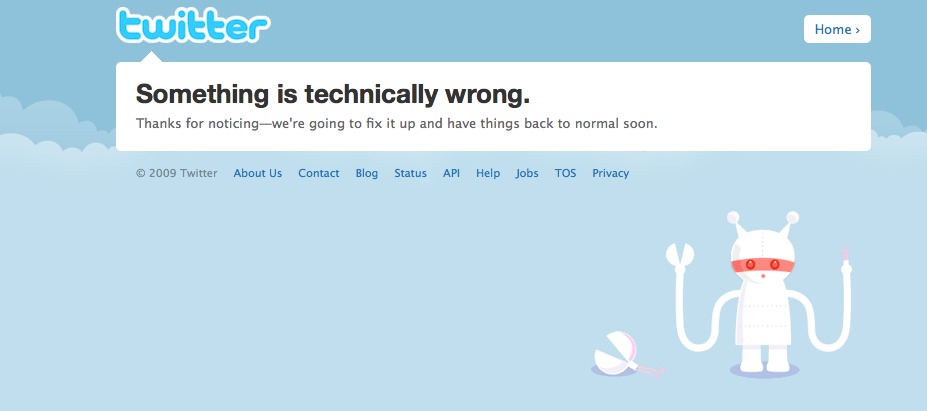
“Something is technically wrong.”

Got this page when I clicked on a ‘We’re on Twitter’ link from a web page. I’d never seen it before and thought it was really cool. I love all of the characters that new web services are coming out with. Case in point is Brizzly’s mascot, as well as the various iconic mascots from Twitter, like its bird and fail whale.

Usually, getting an error page irritates me, but when I get error pages and see cool stuff like this I can’t help but be entertained.

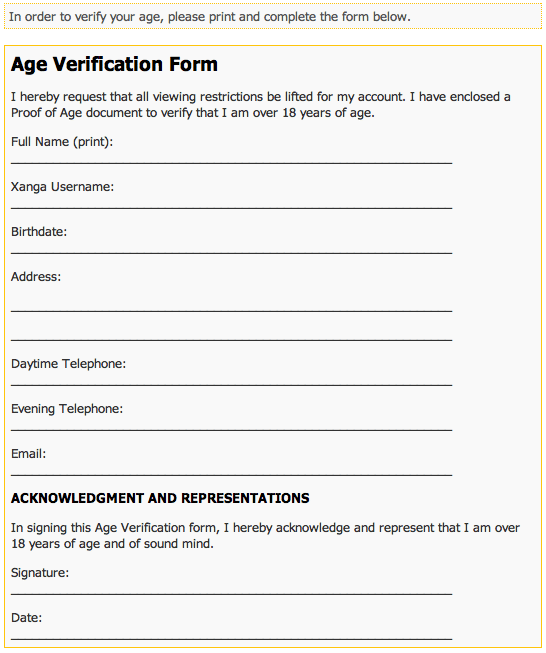
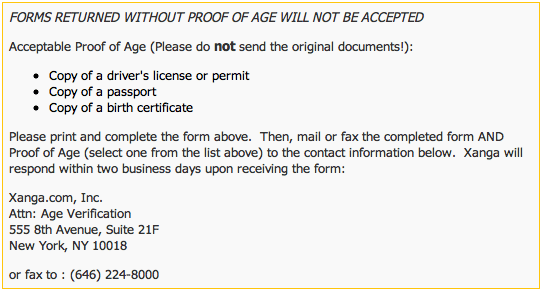
Xanga Requires MAIL IN Age Verification Form

Are you serious? In this day and age a web service is still requiring a mail in form to verify age?  In fact, I’ve never heard of that before.  The closest I’ve ever seen was being required by Funcom to mail in a scanned copy of my driver’s license and the credit card I used to verify my identity when opening an Age of Conan account. Ya, I fell victim to that failed attempt at a game, but that’s another story…

Anyhow, in an attempt to put my content out in a few more places to draw people in to my main blog I figured… ‘Xanga… why not?’ and posted some stuff there.  I surfed around a bit and wound up clicking on a profile image in a comment section (I admit it, I was drawn in by the picture of the butt) and I was asked to verify my age.  So, I clicked Verify, and instead of just accepting what I said like most web services do, Xanga then prompted me to actually physically print a form out and mail it to them.


Honestly, I was stunned.

What do you think about this policy?  Is it a step backwards and a way to alienate users, or is it a surefire way to ensure that you won’t be sued?  (Because we all know that you won’t mail in a copy of your older friend’s driver’s license).

Should You Really Get A Swine Flu Shot? It Could Be Dangerous.

A recent article in The Straits Times is advising citizens to act quickly to reserve their dosage of H1N1 vaccine.  The Ministry of Health is currently surveying clinics to see how many doses will be needed to satisfy demand.  So, clinics are compiling lists of clients who are interested in getting their shot this year, at a cost of 20 to 40 SGD, depending on your doctor and clinic.

An excerpt from the article:

Singapore will receive all 1 million doses it bought from British pharmaceutical company GlaxoSmithKline by Christmas, Mr Khaw said on Sunday at a brisk-walking event organised by the North West Community Development Council held at the Republic Polytechnic.

About 20 per cent of the vaccines will be reserved for essential personnel such as health-care workers and the police. The remaining 800,000 doses will be distributed at cost to hospitals, polyclinics and GPs in private practice.

Mr Khaw also sought to allay fears that Singapore will face a shortage of vaccines like what the United States may soon be experiencing with the traditional winter flu season approaching.


Having the swine flu is a horrible … horrible… horrible… experience.  I had it myself, a few months ago.  It’s weird too.  I woke up at a regular time that day.  I sat around doing my regular things.  Then at around 5 PM I washed up and went to Century Square in Tampines to meet my wife for dinner and a night out.  Only, things didn’t go quite as planned.  When I got out of the taxi I felt a little tired, which was weird since I’d had about 10 hours sleep the night before.  I thought maybe I’d just slept too much so I shrugged it off and went into the mall.  It was a cool night outside because it was overcast and had been raining so when I walked into the mall I wasn’t at all surprised to feel the blast of icy cool air.

It was after I’d been standing inside for a few minutes that I realized something was a bit off.  It felt too cold, like I was standing outside in the Fall in New York City.  I didn’t just feel cool or cold.  It felt icy, to the point that I was shivering.  I was really tired too.  I really wanted to sit down, so I went back outside to the taxi stand area and sat on the railing.  It felt better outside and it was nice to sit down for a while.  When my wife showed up we went to eat in the food court, but I just couldn’t manage to enjoy my meal.  I felt really cold and my appetite was starting to disappear.  We grabbed a few things from the grocery store and then took a cab home.  My wife could tell I wasn’t feeling well.  I normally devour that beef pepper rice!

We got home around 7 PM.  By 9 PM I was laying in bed, feverish.  By 1 AM my fever had risen to 38.5C / 101.3F and the following morning at 7 AM it was 39.5C / 103.1F.  I spent the next two days in and out of consciousness.  Usually, when I had fevers I knew I could only tell by the thermometer.  This time even I could notice the heat coming from my face and head.  A cool towel and a fan helped that.  I did a lot of sleeping… and I remember my cats sitting next to me while I was struggling.  That was nice of them, to come check on me.  And of course, my wife took care of me by feeding me, making sure I took meds, and frequently checking my temperature.

After that sort of experience I never want to have swine flu again.  Just like with any virus, there are different strains of it, and having one doesn’t mean you’re safe from all of them.  On the other hand, more people die each year from the regular flu than from swine flu.  I suppose the media frenzy was just their way of cashing in on people’s fears over a new virus.  First it was bird flu, then swine flu.  What’s next? Dog flu?  So, I’m not exactly frothing at the mouth to be the first in line for a swine flu shot.  Plus, there’s data to suggest that the swine flu shot may in fact be dangerous and may make you more likely to become sick with the swine flu.

From an article on Mercola.com, a health and wellness site:

A series of studies suggests that people who got a seasonal flu shot last year are about twice as likely to catch swine flu as people who didn’t.

And then there’s this news report of a case of dystonia that was potentially caused by receiving a swine flu vaccine:

So, I think I’ll just take my chances.  I survived the swine flu once.  I’m sure I can do it again. And there are plenty of people that don’t take swine flu shots that don’t get the flu.

Social Networks and Boundaries

Most people today have multiple social networking profiles.  Myspace, Facebook, Friendster, Twitter, Plurk, blogs, etc.  That makes for a pretty open flow of information, but shouldn’t there be boundaries?

What I mean is, do you open your accounts to anyone that wants to view your content?  For services like Twitter, Plurk and blogs (generally) the whole point is to have transparency and openness in your communication.  It’s to put ideas out there, to share content with other people, and to express yourself.  So, there’s no real reason to put a limit on what people can see.  But in services like MySpace, Friendster, or Facebook I think people are taking the wrong approach.

Once upon a time these services were meant to be mostly private profiles, where your content was shared with people you know by adding them as ‘friends’, or contacts.  Somewhere along the line things went wrong.  I blame MySpace.

During MySpace’s boom people started what I like to call the ‘friend game’.  It didn’t matter if you knew the person or not, you just added them in an attempt to have the highest ‘friend’ count.  To me, the idea is ridiculous.  These particular social networks were made for maintaining existing relationships and creating new relationships with people.  Can you really have meaningful relationships with over 1000 people?  How often do you have time to really ‘speak’ to those people on your social networks?  Between Facebook, Twitter, and Plurk I would say there are 80 people or so that I communicate with regularly and that’s pretty time consuming.  Not to say it’s not worth it, or rewarding, but if having a real relationship with 80 people is time consuming, how do you do it with hundreds or thousands?

You see where I’m going with this?  Once you get beyond a certain point you’re no longer doing it for friends, or for networking with people you actually know.  You’re playing the ‘friend game’.  It’s like an extension of the high school popularity contest mentality.  It’s sad though, because those relationships aren’t meaningful and really don’t mean anything at all.

That being said, I use different social services for different levels of privacy.  I reserve Facebook for my real friends and for my family, extended family and on occasion trusted friends of the family.  I don’t invite just anyone to view what’s in my profile.  It’s private and should stay that way.  My Twitter, Plurk, and blog are open and I post content on those platforms accordingly.

I wonder how other people manage their social profiles?  Do they just invite anyone, or do they think about what they’re sharing and then manage their fans into different platforms depending on how much they want that person to know about them?

Islamic Honor Killings: Tulay Goren

You know that “hot stories” sidebar thing on the right side of the Facebook newsfeed?  Well, I happened to click through on an article from Mail Online about a father accused of murdering his 15 year old daughter as an ‘honor killing’.  I’d read about another instance where that happened in Canada.

If you’re not familiar with honor killing, here’s a quick definition from Wikipedia:

An honor killing (also called a customary killing) is the murder of a family or clan member by one or more fellow family members, where the murderers (and potentially the wider community) believe the victim to have brought dishonor upon the family, clan, or community. This perceived dishonor is normally the result of (a) utilizing dress codes unacceptable to the family (b) wanting out of an arranged marriage or choosing to marry by own choice or (c) engaging in certain sexual acts. These killings result from the perception that defense of honor justifies killing a person whose behavior dishonors their clan or family.
The United Nations Population Fund (UNFPA) estimates that the annual worldwide total of honor-killing victims may be as high as 5,000.[1]

It’s a common relatively occurrence in Arab culture, which is where the majority of Muslims come from. So, it has become one more item on a long list giving Islam a bad reputation in the eyes of the rest of the world.  As if they needed anything else, what with extremists blowing themselves (and the people around them) up left and right.

I understand that there are differences in culture, but I also believe in the priceless value of human life.  It should never be taken for something as ridiculous as a perceived loss of honor.  How can a culture ever hope to mature if it continues to practice such outdated and obviously flawed ideologies?  It’s not ok to kill your daughter just because she wore shorts to school instead of a Hijab.

Article aside, I was more disturbed by the comments being left in Facebook, which seemed to paint all Muslims as being evil terrorists bent on the destruction of the world.  I’m not Muslim myself, but I’ve had the opportunity to know quite a few Muslims and I can say with some assurance that none of them want to blow me up. So, I pointed out in the comments that Christianity has been used as a reason to commit horrible acts, like the Crusades, Inquisition and even the Salem Witch Hunts.

The response was that those weren’t ‘real’ Christians and that Islam is violent, and that it’s evil in general.  I had pointed out that if Christians lived according to some of the stuff that’s in the Old Testament we’d seem pretty odd and scary too.  So, this person lambasted me, saying that Jesus did away with all that Old Testament nonsense.  That being the case I pulled out a bunch of quotes that are less than pleasant about slaying people and burning them that’s in the New Testament.  I also pointed out that you can’t blame the whole for the actions of a few, that there are extremists in both groups.  Another person chimed in that Christ didn’t abolish the law of the Old Testament.  He said that He came to fulfill it.  Christians still observe the 10 Commandments so there must be validity to that statement.  I also threw in some quotes from the Qur’an that I found that support the idea of Islam not advocated wanton murder.

In any case, this person wouldn’t have any of it.  The person is hell bent on believing that Islam “advocates violence and oppression and murder” and that “JESUS never advocated violence, oppression and murder”.

So, I told her this:

“But as for these enemies of mine, who did not want me to reign over them, bring them here and slay them before me.”

Luke 19:27

The message never really got through to her and I don’t believe it will. There are people who are so blinded by popular media, bad personal experience, or a combination of the two that they will refuse to see reason.  From what I’ve seen, different news channels in the US slant things different ways.  It’s a ratings game.  They don’t tell the news.  They cater to their audience.  I’m kinda starting to prefer Al’Jazeera, because it seems more impartial and maybe I just feel comfortable with a 3rd party (usually Brits) reporting on matters.  Of course, Al’Jazeera is funded by Qatar, so who knows?  Maybe there’s no such thing as unbiased reporting anymore.

I’m sure there are violent aspects of the Qur’an, Shari’a, and other Islamic religious texts, but the same can be said of Christianity and Christian religious texts.  Both religious groups have committed travesties over the course of history.  Does that mean that people that belong to particular religious groups are inherently bad?  I don’t think so.

I think we all just need to keep things in perspective.  Just because someone’s Christian doesn’t mean they’re going to drink poisoned Kool Aid and commit mass suicide, and just because someone’s Muslim doesn’t mean they’re going to strap on a bomb and blow themselves up.  Get a grip on reality.

Note: This is not a debate about the validity of either religion. Any comments left on this post bashing either religion, rather than discussing the idea proposed here, will be removed, and depending on what’s said, the commenter will be banned by IP address.  NO hate speech.  Thank you.

Switching to Ubuntu (9.10 Karmic Koala) Not As Hard As I Thought

ubutnu-logo.jpgMy wife had been having issues with her laptop for quite a while.  Well, that’s normal for Windows anyway, but her laptop was starting to slow down.  Normally I can do a few maintenance things to get it running at a relatively decent speed again but it was becoming less and less effective.  Not to mention it was getting old having to do it over and over.

I wasn’t really sure what to do about it until someone cool I know in Rome started talking about Ubuntu on Twitter.  She mentioned that it nearly doubled the speed of her laptop, even when switching over from XP.  That really got me thinking, because that was the main problem with my wife’s laptop, which was running Vista.

I still wasn’t too sure about the idea of installing a Linux based operating system though.  I mean, it was Linux.  That was supposed to be some wild, hard to use, super tech nerd operating system right?  How the hell could I get it running?  But then I realized that it couldn’t be that hard.  Not if so many people were using it.  Plus, the instructions on the website seemed pretty straightforward as well.  Best part of all?  You can do a test run before installing it.

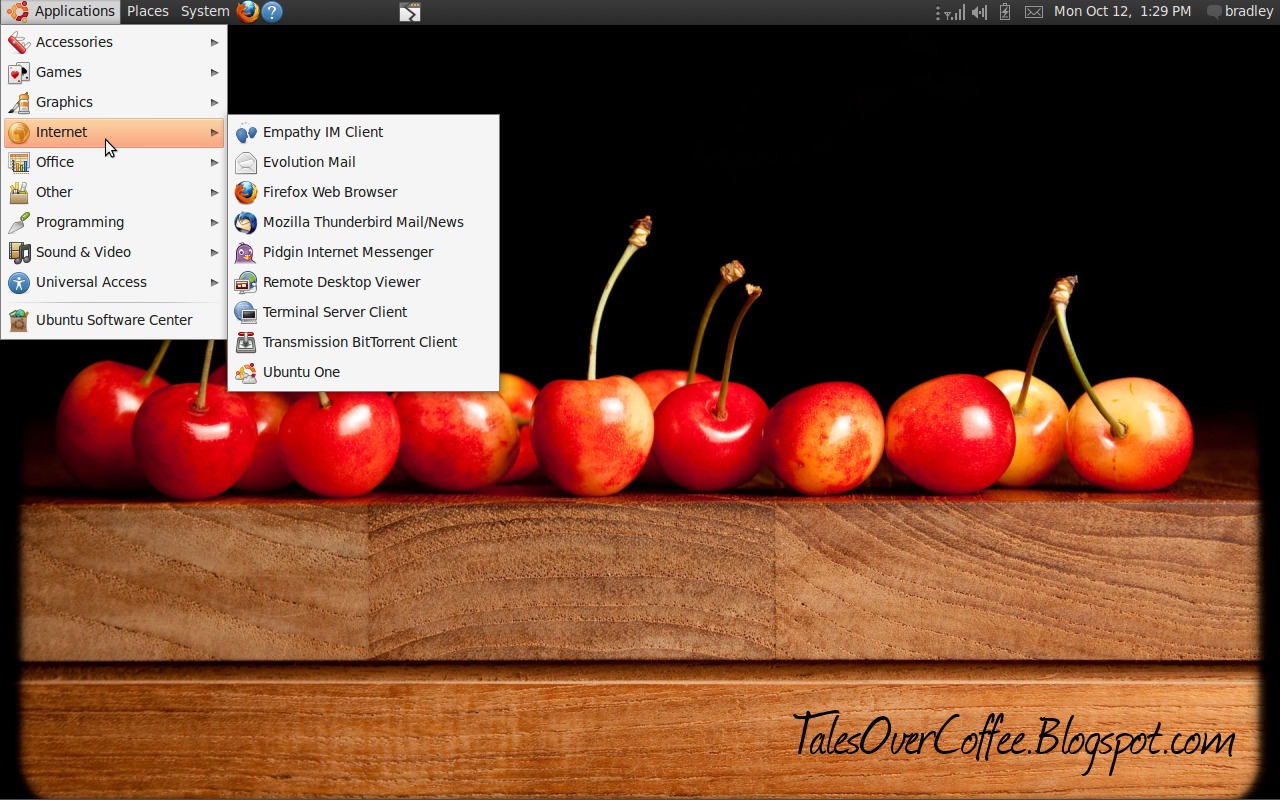
So, I downloaded the disc image using BitTorrent, burned it, and then stuck it in the drive.  It’s called a Live CD/DVD and it lets you run the OS on your system without actually installing it, so you can get a feel for it before taking the plunge I suppose.  It ran surprisingly fast, considering it was running from a disc.  That made me a bit nostalgic.  Every time I would click on something, I would hear the disc spin up.  It reminded me of when I was a kid, playing games on a Commodore 64.  I don’t know why…  That was about 20 years ago.  Anyhow, I was impressed with how easy to navigate it seemed, and with how polished Ubuntu looked, even running from a Live CD.

So, we started the process of backing up all of her picture files and music and documents and whatever other clutter she had.  It was amazing how many files she found hiding in corners.  I stuck it all on an external USB drive.

The next day I did the actual installation.  It was fairly pain free.  After getting Ubuntu installed, the PC ran incredibly fast.  Everything was clean, easy to find, and very snappy!  The best part is that it feels so … utilitarian I suppose.  It doesn’t feel cluttered.  It was like crawling out of the wreckage of a downed airplane and finding yourself in a zen garden.

screenshot-synapticpackagemanager.png

The only hiccup to the whole switching over process for me was understanding repositories.  The easiest way to translate it into easy terms for people coming from Windows and OS X is this:  It’s a way to install program that let’s them get auto-updated along with system files.  They’re managed, (mostly) to some degree by the Ubuntu team so they’re pretty safe bets for installing without worrying about malware and the like.  You get to your repositories by clicking on System < Administration < Synaptic Package Manager.  This is where it’s sort of like Windows Update.  You click on ‘Reload’ to make sure you have the latest repositories.  Then you click on Mark All Upgrades.  Then you click Apply.  I suppose you don’t have to upgrade, but it’s probably best.  Anyhow, the ugly part of repositories is that it’s mostly a bunch of file names.  It’s hard to figure out what you’re looking for.  That’s where Google comes in.  Just Google the program you want along with the term repository and you can usually find out if it has one or not, and what it’s called.  Also, some third-party programs that aren’t in the repositories already can be added in, though you should only do that with companies you trust.  Basically, anything you need to do you can find help for with a quick Google search.  Since Ubuntu is open source, the community for it is huge and there are help articles and threads everywhere, including Ubuntu’s own help pages.

ubuntu1.png

Another thing that Ubuntu has going for it is that it’s like a blend of Windows and OS X for me.  It feels a lot like OS X but it seems to honor the keyboard shortcuts of Windows.

ubuntu2.png

Ubuntu really isn’t as steep a learning curve as I’d thought it would be.  It’s easy to figure out.  The OS is free, and all the software that you get for it is free too.  Well, there are free alternatives anyway.  I think I’ve seen a few paid programs while poking around, but there’s no need for them at all.

ubuntu3

I also realized that a lot of people like Ubuntu after installing it on my wife’s laptop.  Friends tell me they’d use Ubuntu exlusively if not for iPod/iPhone syncs requiring iTunes, which only runs on OS X and Windows.

Personally, I’m loving it, and I actually enjoy using it more than OS X.  I use my wife’s laptop when she’s not on it just because it’s more interesting!  The only thing I miss is Apple’s Mail.app.  There’s just no good replacement for it, though Ubuntu’s built in Evolution e-mail app comes close.

By the way, I’m using Ubuntu 9.10 Karmic Koala, which is where these screenshots are all from.  It’s in it’s final beta stages now with the final release set for the 22nd, so I felt it was safe to just go for it.

Blog Action Day 2009: Climate Change

If you’ve been keeping up with Blogger news, either via the Blogger Twitter account or on the official Blogger Buzz blog, then you’ll have heard about this already. If not, here’s a quick rundown:

Blog Action Day is an annual event, held on October 15th (which is already is here in Singapore), where a single issue is chosen as a topic to be addressed by bloggers around the world. The idea behind it is that if enough people talk about the issue on one single day, and the web is inundated with news about it, it’ll be more likely to catch otehr people’s eyes, and thereby spread awareness. The topic for this year is climate change.

It’s an interesting coincidence that climate change should be the issue of this year’s event, given recent weather problems in Asia. There have been numerous typhoons in the past few weeks in Asia that have left trails of destruction behind them, most notably in the Philippines. I can’t recall a source for this, but gleaning over news I recall seeing where people were speculating that climate change caused by global warming is influencing the weather systems in Asia and making the typhoons more powerful than they would normally be. I’ve also seen speculation that a related topic, pollution, is partly to blame for the flooding in Manila, though with or without trash clogging gutters the area would’ve flooded anyway, given that it’s a basin that sits below sea level.

Photo via NewsHopper

What we’re doing to our planet is, basically, really screwing things up. The problem with “green” solutions right now is that they are more expensive than what we’re doing now, and they’re less profitable for companies in the long run. So, there’s no real incentive in it for the average joe, or for the businessman. No one wants to think long-term, about what we’re doing to be looking at in 50 years, or 100 years.  It will take government intervention on a global level to take on this problem, but with the way international politics stand now, I don’t see that happening. Politicians already fail too often in areas where it matters less than this, or in similar areas, like building more bombs when we should be building less and using those funds for other things, like curing diseases, creating better crops, or extending human life.

So, for now, all we can do… those of us that care… is try to keep an eye on how we’re affecting the environment through our daily actions (and if in a position to do so, place a vote where it counts). Heading downtown? Reduce emissions by taking the train. I know the cab will still be driving around with or without you in it, but over time if more people use public transit the demand on cabs will lessen, meaning the number of cabs will lessen. (Let’s not get into a debate about cutting jobs in a recession right now ok?). Car-pooling is another way to not only save on emissions, but cut personal costs as well. I’m not claiming to have all the answers, or even to know what the answer to this problem is… so I snagged this list from About.com (^_^) :

1. Reduce, Reuse, Recycle

Do your part to reduce waste by choosing reusable products instead of disposables. Buying products with minimal packaging (including the economy size when that makes sense for you) will help to reduce waste. And whenever you can, recycle paper, plastic, newspaper, glass and aluminum cans. If there isn’t a recycling program at your workplace, school, or in your community, ask about starting one. By recycling half of your household waste, you can save 2,400 pounds of carbon dioxide annually.

2. Use Less Heat and Air Conditioning

Adding insulation to your walls and attic, and installing weather stripping or caulking around doors and windows can lower your heating costs more than 25 percent, by reducing the amount of energy you need to heat and cool your home.

Turn down the heat while you’re sleeping at night or away during the day, and keep temperatures moderate at all times. Setting your thermostat just 2 degrees lower in winter and higher in summer could save about 2,000 pounds of carbon dioxide each year.

3. Change a Light Bulb

Wherever practical, replace regular light bulbs with compact fluorescent light (CFL) bulbs. Replacing just one 60-watt incandescent light bulb with a CFL will save you $30 over the life of the bulb. CFLs also last 10 times longer than incandescent bulbs, use two-thirds less energy, and give off 70 percent less heat.

If every U.S. family replaced one regular light bulb with a CFL, it would eliminate 90 billion pounds of greenhouse gases, the same as taking 7.5 million cars off the road.

4. Drive Less and Drive Smart

Less driving means fewer emissions. Besides saving gasoline, walking and biking are great forms of exercise. Explore your community mass transit system, and check out options for carpooling to work or school.

When you do drive, make sure your car is running efficiently. For example, keeping your tires properly inflated can improve your gas mileage by more than 3 percent. Every gallon of gas you save not only helps your budget, it also keeps 20 pounds of carbon dioxide out of the atmosphere.

5. Buy Energy-Efficient Products

When it’s time to buy a new car, choose one that offers good gas mileage. Home appliances now come in a range of energy-efficient models, and compact florescent bulbs are designed to provide more natural-looking light while using far less energy than standard light bulbs.

Avoid products that come with excess packaging, especially molded plastic and other packaging that can’t be recycled. If you reduce your household garbage by 10 percent, you can save 1,200 pounds of carbon dioxide annually.

6. Use Less Hot Water

Set your water heater at 120 degrees to save energy, and wrap it in an insulating blanket if it is more than 5 years old. Buy low-flow showerheads to save hot water and about 350 pounds of carbon dioxide yearly. Wash your clothes in warm or cold water to reduce your use of hot water and the energy required to produce it. That change alone can save at least 500 pounds of carbon dioxide annually in most households. Use the energy-saving settings on your dishwasher and let the dishes air-dry.

7. Use the “Off” Switch

Save electricity and reduce global warming by turning off lights when you leave a room, and using only as much light as you need. And remember to turn off your television, video player, stereo and computer when you’re not using them.

It’s also a good idea to turn off the water when you’re not using it. While brushing your teeth, shampooing the dog or washing your car, turn off the water until you actually need it for rinsing. You’ll reduce your water bill and help to conserve a vital resource.

8. Plant a Tree

If you have the means to plant a tree, start digging. During photosynthesis, trees and other plants absorb carbon dioxide and give off oxygen. They are an integral part of the natural atmospheric exchange cycle here on Earth, but there are too few of them to fully counter the increases in carbon dioxide caused by automobile traffic, manufacturing and other human activities. A single tree will absorb approximately one ton of carbon dioxide during its lifetime.

9. Get a Report Card from Your Utility Company

Many utility companies provide free home energy audits to help consumers identify areas in their homes that may not be energy efficient. In addition, many utility companies offer rebate programs to help pay for the cost of energy-efficient upgrades.

10. Encourage Others to Conserve


Share information about recycling and energy conservation with your friends, neighbors and co-workers, and take opportunities to encourage public officials to establish programs and policies that are good for the environment.

There are lots of good reasons to take action when it comes to preventing climate change. The most obvious is what I mentioned before (weather changes) and flooding, but you have to think about things in the long run. For example, the flooding in the Philippines destroyed a lot of crops, farmland and killed farm animals. Here, check out this excerpt from an ABS-CBN article:

MANILA – Total damage to crops, livestock and infrastructure wrought by the two successive typhoons that hit the country has reached P18.4 billion, according to the latest report released by the Department of Agriculture’s Center Action Center (DACAC) on Tuesday.

The DACAC said the losses—P6.8 billion from “Ondoy” and P11.7 billion from “Pepeng”—were recorded in all of Luzon’s seven regions.

The typhoons destroyed some 121,949 hectares of croplands, resulting in the loss of 925,523 metric tons of rice, corn, and high-value crops. Fishery products, livestock and poultry were affected while farm infrastructure worth P2.7 billion were ruined.

Rice areas were the most affected, with some 109,188 hectares reported to have no chance of recovery.

So, climate change doesn’t just affect the weather. It doesn’t just mean that it’s going to be sunnier, or that you’ll have to run the air conditioner more. It also means that it’s going to cause problems with food supplies around the world. It could cause famine, higher crime rates, and even war if the need escalated high enough. Just look at Japan. Their need for imported materials from the United States during the height of World War II, and our denial of those materials, is what drug the United States into the war in the first place with the retaliatory bombing of Pearl Harbor.

Do what you can, day to day, to reduce your impact on our planet. If not for ourselves, then for those who come after us. Don’t shit in the next generations’ crib before they’re even born.

Now watch this nifty video, and then click through on the link below it to find out more.

Blog Action Day 2009 
Philippine President Arroyo Reminded To Not Steal Aid Money From Typhoon Victims

An excerpt from an ABS-CBN News post:

    ““Given the critical situation of our brothers and sisters in the evacuation centers and areas ravaged by Ondoy, it is urgent to ensure that the funds the Arroyo government received in the name of the victims benefit only the victims and their families. The administration’s well-deserved reputation for corruption leaves one uneasy to think that the money for the victims is left to this government’s management,” Ocampo said.
    “Every single centavo must be utilized to ensure the health, security and rehabilitation of the victims and their homes, as well as their damaged communities. The Arroyo government must be frequently reminded that it’s a mortal sin to steal from those who have already lost everything,” Ocampo added.”

My take on it:

Wow. It’s pretty harsh when other members of your own government are telling you that you shouldn’t steal money from victims of a national-scale natural disaster. But, in Arroyo’s case I think the criticism is well deserved. Everything I’ve read about the woman reeks of corruption, from the way she cheated her way into office, admitted it on TV, refused to leave office, to her wasting 1 million Philippine Pesos on a dinner in NYC.

Of course, I’m no expert on the matter, having only visited the Philippines a few times, but my wife lived there, and my wife’s friends lived there, and no one seems to hold this woman in high regard.  Not to mention her son doesn’t seem to care all that much that there’s a disaster.  During the height of this tragedy he was in Rustan’s, buying expensive booze.  You can’t tell me that was for aid relief.  When he was later confronted about it, he made the statement that there should be more regulation of Facebook and social networks.  I guess he thinks he lives in a Communist country.  Instead of admitting fault and taking responsibility, he instead expressed a desire to limit freedom of speech on the internet to hide the truth from people more effectively.  Funny that his statement should come at a time when the FCC in the United States is preparing to institute laws that will make it illegal to perform traffic shaping based on content, otherwise known as Net Neutrality.  I also thought it worth pointing out that there’s a vast difference between what Mikey Arroyo is saying and the transparency policy that helped make Obama popular in the US.

Corruption in the Philippine government seems to be traditional, like having a Christmas celebration on the 25th of December. From what I’ve been told, the last time the government actually worked and the economy wasn’t screwed was when the country was under martial law. That’s kinda sad in a way.

McDonald’s Steals Money? No Wonder Ronald’s Smiling!

Somehow I’m not really surprised.  I’ve been to fast food places before and had them leave out something I ordered.  It was something small enough for me to not want to waste my time going back, but if they did it often enough it would add up to a lot of “savings” for them.

From now on I’ll be double check my orders and make sure I get everything I paid for.

Update: Found out this was a fake.