Why The Philippines?

Philippines SEP 08 - 0025

This is a question my wife has asked me on more than one occasion.  It seems to boggle her mind that I would really look forward to moving there.  The Philippines is a ‘poor’ country and many Filipinos strive to find ways to leave and find what they consider a better life abroad.  There’s something of a joke that the primary export of the Philippines is human beings, as a labor force.  With so many of her countrymen trying to get out of the Philippines she finds it curious and a bit odd that I’m so excited about moving there.

Just to clarify, I’m not going there with some wealthy expat package lined up.  I’m moving there for other reasons, which I’ll get into later in this post.  But, for all intents and purposes, when I move to the Philippines I’ll be living pretty much as the average Filipino does.  That will have both its ups and downs, but I look at this as a great opportunity rather than a disadvantage.  The easy answer is that I’m moving to Manila to go to college, but there’s more to it than that.

I spent the first part of my life in the US Army.  I was actually enlisted in the US Army Reserves before I even finished high school and shortly after I applied for and was accepted to active duty.  During that time I had a few odd jobs on the side, but my service in the Army was the only ‘real’ job I’ve held.  I wouldn’t call service in the Army a waste of time, but it can seriously set you back if you don’t intend to see it all the way through, or if you later decide that you’ve had enough and don’t want to do 20 years for a retirement.  I didn’t completely gimp myself.  During the last year and a half I was in, I realized I wasn’t going to make a career of it after all and managed to squeeze in almost 2 years worth the college credit hours through CLEP tests, sit down courses and online courses through Park University and the University of Maryland UC.  Those college credits paid off by giving me enough points to get promoted to Sergeant before getting out, and by giving me a leg up on getting a degree.  I earned a scholarship while in the Army that will pay 100% of my tuition.  There’s a time limit on it, and it’s hard to go to school full time and still make it financially, but I’m in a position to make it happen now and I want to take advantage of this opportunity, because it may never come again.

In the US, it’s possible to get a decent job based on military service alone, but outside of the US that’s nearly impossible.  I’ve found that out the hard way.  Having a degree on top of my military service would make me look real good though, both to peers and to potential employers.  It’s a nice thing to be able to say you have a tertiary education and a piece of paper to prove it.  I want that.  I am by no means an idiot, but just saying you’re smart or good at something isn’t going to win you a job interview or a high paying executive position.  People want proof.  They want evidence that you’ll be a good, solid investment.  Even if your degree isn’t necessarily applicable, it will show that you’re at least smart enough to learn.

Eventually I’ll make my way back to the US, and I think that having lived abroad for a number of years and having a degree from a foreign, but US accredited university, will give me an advantage.  The work climate in the US right now seems to be focused on finding people that can interact in multiracial groups of people from diverse backgrounds, and having lived abroad and having gone to school abroad would be a clear indicator that I at least have experience with getting along with people who are different than I am.  That’s also something you learn in the Army, though to a lesser degree.

The time I spend in the Philippines will also be an opportunity for me to enrich myself on a personal level by gaining a greater understanding of the world around me.  The Philippines is a place rich with history and culture in a way the US can’t quite match, now or in hundreds of more years.  The US is a melting pot of cultures and while that has its advantages, it causes the US to lack any sort of distinctiveness, politics and war aside.  So, it’s a very thrilling prospect for me to live in a country that has so much history behind it, to learn about the people living there and to experience it all first hand.

It’s also an opportunity to connect with my wife’s family in a way that a short visit just can’t accommodate.  My wife is from the Philippines and we’ve visited a few times but the visits are brief and while we try to mix in sight-seeing with visiting time with her folks, the whole thing always feels rushed.  Living there will give me more time to hang out with them and get to know them.  It’ll also give my wife an opportunity to reconnect with her family before we move on to other things and other places.  I’m also hoping she’ll be able to finish her second degree, a master’s degree, or medical school while we’re there.

So, moving to Manila and going to college will provide me with a lot of advantages in terms of future employment when I return to the US, as well as being personally enriching for both my wife and I.  I think both reasons have equal value because living life isn’t just about the job you hold or your income; it’s about family, experiencing the world, learning, progressing, understanding and eventually contributing to society.  This move will be a win-win situation all around.

The focus of this blog will be whether or not we achieve these goals, how we make it happen or how we fail, and the adventures we encounter along the way.

Philippine President Arroyo Reminded To Not Steal Aid Money From Typhoon Victims

An excerpt from an ABS-CBN News post:

    ““Given the critical situation of our brothers and sisters in the evacuation centers and areas ravaged by Ondoy, it is urgent to ensure that the funds the Arroyo government received in the name of the victims benefit only the victims and their families. The administration’s well-deserved reputation for corruption leaves one uneasy to think that the money for the victims is left to this government’s management,” Ocampo said.
    “Every single centavo must be utilized to ensure the health, security and rehabilitation of the victims and their homes, as well as their damaged communities. The Arroyo government must be frequently reminded that it’s a mortal sin to steal from those who have already lost everything,” Ocampo added.”

My take on it:

Wow. It’s pretty harsh when other members of your own government are telling you that you shouldn’t steal money from victims of a national-scale natural disaster. But, in Arroyo’s case I think the criticism is well deserved. Everything I’ve read about the woman reeks of corruption, from the way she cheated her way into office, admitted it on TV, refused to leave office, to her wasting 1 million Philippine Pesos on a dinner in NYC.

Of course, I’m no expert on the matter, having only visited the Philippines a few times, but my wife lived there, and my wife’s friends lived there, and no one seems to hold this woman in high regard.  Not to mention her son doesn’t seem to care all that much that there’s a disaster.  During the height of this tragedy he was in Rustan’s, buying expensive booze.  You can’t tell me that was for aid relief.  When he was later confronted about it, he made the statement that there should be more regulation of Facebook and social networks.  I guess he thinks he lives in a Communist country.  Instead of admitting fault and taking responsibility, he instead expressed a desire to limit freedom of speech on the internet to hide the truth from people more effectively.  Funny that his statement should come at a time when the FCC in the United States is preparing to institute laws that will make it illegal to perform traffic shaping based on content, otherwise known as Net Neutrality.  I also thought it worth pointing out that there’s a vast difference between what Mikey Arroyo is saying and the transparency policy that helped make Obama popular in the US.

Corruption in the Philippine government seems to be traditional, like having a Christmas celebration on the 25th of December. From what I’ve been told, the last time the government actually worked and the economy wasn’t screwed was when the country was under martial law. That’s kinda sad in a way.

What Can I Expect in the Philippines?

A guy I know told me he’s going to be making a trip to Davao in the Philippines and asked me if I’d been there, and what he could expect, and if I had any tips for him.  So, I gave him a quick heads up of what you should really keep an eye out for when you’re in the Philippines.  This is the message I sent him:

I’ve been to the Philippines quite a few times. My wife is Filipina and I’ve gone there to visit with her family in the Manila area. I’ve also been out to Pampanga Province. There are over 7000 islands in the Philippines, so I can’t say I’m an expert or anything but here’s what I can tell you:

…[Personal details removed]…

That aside:

For your spending money, beyond airfare and hotel, I doubt you’ll need more than 400 [USD] bucks. […] That should be cool. Just to give you an example, a movie in the Philippines is only about 3 USD. You can also both eat for about 500 PHP, or 10 USD. That would be a meal at a place like an Applebee’s. If you wanna get fancier than that the price goes up, but not by much.

If you need more beyond that, there are ATMs all over the place that you can withdraw from. Depending on your bank of course. You should ask them in advance, and notify them in advance so they don’t reject an ATM request from the Philippines. Also, if you do take cash with you, don’t carry more than 2 -3k PHP on you at any given time. Don’t carry a fancy cell phone. If you have a nice watch, buy and use a cheap one for your trip. Don’t wear extremely expensive clothing. Try to look poor. I know it sounds ridiculous, but you don’t want to look like a juicy target. Oh, and if you have a cheap camera to use, I recommend taking that one with you instead of whatever expensive fancy camera you have. Crime is rampant there and as a white guy walking around you’re already going to draw a LOT of attention.

Also, if you purchase anything that’s not in a store with a price tag on it, expect to have people try to rip you off. Even when I was with my wife and father-in-law they would try to do it. They’d try to charge double or triple for a pack of smokes. I wound up waiting with my wife around the corner while my father-in-law bought the smokes for us. So ya, just keep an eye on your wallet, don’t carry a lot, and don’t try to be flashy. Being white and in the Philippines is flashy enough, [especially when you start to get further away from major tourist cities].

On the upside, you can expect to eat well while you’re there. I don’t know much about tourist attractions in the Davao area, but if you want to know about good beaches, there’s Boracay and Palawan. I don’t know the price details on those but you can Google it and add it to that $400 amount. Most people, except when it comes to money, are going to treat you very well.

[Personal details removed]

Oh, something you might want to keep in mind is that Filipinos are VERY family oriented.

[Personal details removed]

Also, most Filipino families still live in multi-generational households, like what you hear about in Mexico. [You’ll often find many family members, like brothers and sisters, still living in the parents house along with their wives and possibly their children.] Not all Filipinos are that fortunate. You’ll see some people living in houses that look like they’re made of corrugated metal and plywood. It’s really depressing sometimes to think about, but the odd thing is that most Filipinos know they’re poor but still are fairly positive about life.

Out and about in the city you’ll definitely know you’re in another country, but it’s weird… when you step in a mall you’ll feel like you could be somewhere in the US. Oh and speaking of malls… carry some toilet paper with you. The public restrooms usually don’t have it. They usually don’t even have toilet seats because people try to steal them to resell.

If you’re going to stay in Davao City this won’t be an issue, but if you go out to the provinces there usually aren’t taxis around. [There will be buses, jeepneys, and tricycles around. They typically have set prices, so you’re not likely to get stiffed too hard there, but it’s best to be with a local who knows the ropes when trying to ride those.] The tricycles are pretty fun to ride in, but hold on because there aren’t seat belts…

My last word of warning is do not, under any circumstances, let anyone trick you into eating something called balut. Sinigang, adobo, menudo (Filipino style, not pig guts like Mexican style), tinola, pancit canton (instant noodles, take some home with you, they rock), ox tail kare-kare, are all good local dishes. But… not balut. That’s just disgusting. If you see a place called Max’s Chicken, I highly recommend it. Get the half chicken. I did, and I stripped it to the bones. I don’t know what they put in there but it’s delicious! Jollibee isn’t that great. It’s a step down from McDonald’s. Most Filipinos love it though. Uh… longanisa is a sausage that’s pretty good, depending on what kind you get. You might see it at McDonald’s there if you stop in fro breakfast.

On reflection, what I can add to this is that most beggars are part of a syndicate and aren’t really poor. If someone’s poor in the Philippines you can really tell.  They won’t just be dirty.  They’ll look like they haven’t eaten well in weeks.  These beggars can be damned persistent and will sometimes even try to help you give them money by reaching into your pocket for you.  Keep your eyes peeled.  Even the cute little ones selling flowers are just trying to rip you off.  I need to send this little bit of information to him too!

Note: The text in brackets and italics has been edited or added to make the message more clear for posting on a blog.

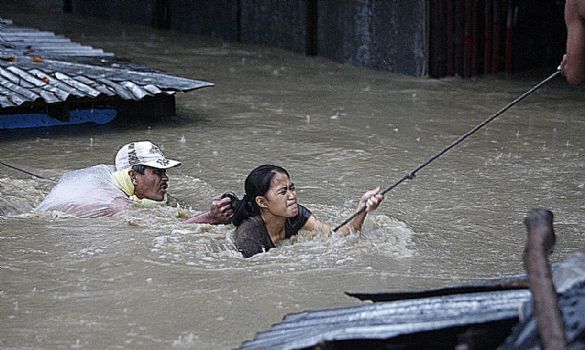
Typhoon Ondoy Aftermath, More Disaster


(Image via bardagols on Flickr)

The aftermath of Typhoon Ondoy is turning into a huge disaster.  I’ve been hearing bits and pieces of news and I figured I’d try to put it all together here.  It’s very disheartening to say the least.  Of course, you can’t expect a lot of good news in the middle or immediate aftermath of a disaster, but some of the things that are going on are just ridiculous.


One of the biggest problems right now is that there are vacant homes everywhere.  Granted, they have water damage, but there are still valuable items in some of them.  Unscrupulous people are taking advantage of this and there is rampant looting in affected areas.  These families have already sustained massive damages to their homes, and they’re going to be financially crippled for quite some time.  Having their possessions stolen will only make matters worse.  Plus, vandals aren’t going to be using the spare key, so there’ll be additional property damage on top of what was caused by the typhoon.

One thing that’s really bothering me is reports of politicians “branding” the relief packages with their faces and names.  This practice is common in the Philippines.  Every time there is road construction, or some new public facility is being built, politicians waste plenty of citizens’ tax money to put up huge billboards describing the work in progress, the responsible politician’s name, and more often than not that politicians face, or even a family portrait.  Is that really necessary?  Everyone knows who was elected to serve in that region, so it should be plain who backed the roadwork or the new construction.  Putting up all of those billboards is a waste of funds that could be put to better use in a country that is, on a normal day, already struggling to keep afloat economically.  Now, after this huge disaster, when so many people are suffering, the politicians aren’t worried about providing relief.  They’re worried about advertising and branding.  It’s fucking disgusting.  They have no sense of propriety.  This is not the place or time for that sort of thing.  What’s even worse is these packages aren’t being provided by those politicians.  It’s being provided by multiple donations from all around the world.  The politicians are repacking it and putting their name on it, as if they paid for it all themselves.

Many Filipinos are also claiming that relief goods are only being handed out when media is present, and not before, nor after.  It’s as if this whole tragedy has become a platform for politicians to advertise themselves.  How heartless is that?  Rather than focussing on what’s important, they’d rather use it as an opportunity to try to ensure they get reelected.

Here’s a news flash.  It was partially through failure on the part of elected officials that this disaster happened in the first place.  Lack of awareness campaigns to reduce pollution, lack of announcing the impending disaster, lack of rescue personnel and equipment, lack of funds.  Lack of leadership.

This raises the issue of government misuse of public funds, most notably the Philippine president, Gloria Arroyo, and her huge expenditure of approximately 1 million Philippine Pesos in New York City for a dinner.  Personally, I hope that this causes a shift in the right direction in Philippine politics where there is more accountability of where and how money is being spent.

The icing on the cake is that another tyhpoon, named Pepeng in the Philippines and internationally known as Parma , is expected to make landfall tonight Friday night, and only 1/4 of the rainfall produced by Ondoy will be required to recreate flash flood conditions.  Oh, and Pepeng is a stronger typhoon than Ondoy was.

I’ll be keeping the Philippines in my thoughts and prayers tonight.  Good luck guys.

Heroes of the Typhoon Ondoy Tragedy

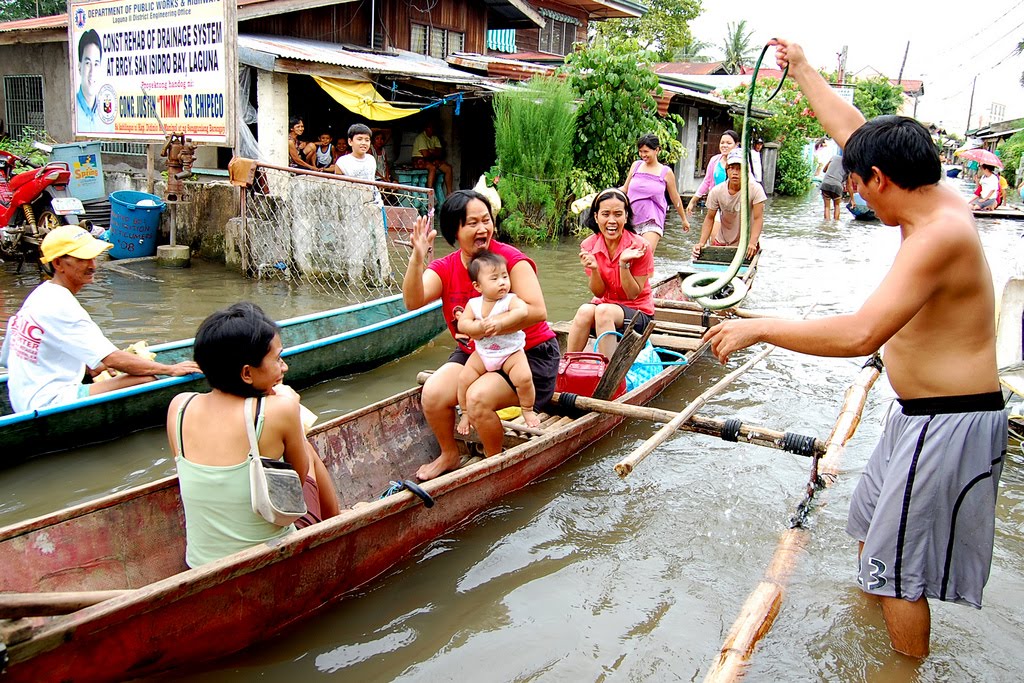
This is a photo of the Laguna area, roughly 60 km south of Manila. It’s not the exact location where the following events took place, but it’ll give you an idea of what the area looks like. Also, I found the sign in the image to be rather ironic, given the circumstances. Maybe putting up huge billboards describing what you’re doing isn’t such a great idea, politicians.

Typhoon Ondoy brought a lot of tragedy to the Philippines but it has also brought out the best in people in terms of risking themselves to save others.

One inspiring story is that of PFC Venacio Ancheta, who was able to save 20 civilian lives before losing his own to the floodwaters. PFC Ancheta belonged to the 2nd Infantry Division disaster response team, led by Lt. Arnel Marcos. His team was responding to affected residents of Barangay Tunhac, Famy, Laguna when he bravely lost his life.

PFC Venancio Ancheta was just one of seven Philippines Army casualties suffered during rescue operations, but his actions inspired many others to put their lives on the line to save their fellow Filipinos. A quote from the statement issued by the Philippine Army says: “His heroism [serves] as an inspiration for the whole Philippine Army and, in particular, his teammates who continued the mission and rescued another 600 civilians in Famy, Laguna”

Another inspiring story is that of CPL Adriano Regua, who lost his life while trying to save one of the militiamen on his team. The militiaman was drowning and CPL Regua risked himself to save him. Unfortunately, neither made it. This selfless act spoke highly of his dedication to his duty and his team, as well as his quality as a leader. Additionally, under his supervision his rescue team was able to save 200 residents in the area. Perhaps the most telling sign of the quality of his character was that he was putting forth his best effort to perform his duties, despite the fact that his own family was in danger in Tanay, Rizal, which was also hard hit by the storm.

On the other end of the spectrum you have something that initially looks heroic, but doesn’t stand up to reason when you really think about it.

Christina Reyes, a famous young actress in the Philippines, was stranded on top of her house with her family. That’s a situation that was faced by thousands of Filipinos, and yet her case was somehow made special because she is a celebrity. I think this is one of those times when social class and celebrity status shouldn’t make a difference. Everyone’s life is just as valuable.

Richard Gutierrez, fellow actor and co-star of an upcoming movie, somehow appropriated an Army speed boat and made his way through the wreckage of Manila to Reyes’ house to rescue her. Some sites are describing it as a real life scene from a movie that should be hailed and praised. I see it as misuse of government property, shameless self promotion (on Gutierrez’ part) and a gross mockery of the suffering Filipino flood victims are experiencing. Also, I can’t help but wonder how many victims he passed on his way to and from rescuing her.

I found a rather poorly made fan video of the incident, which is embedded below, but what really caught my eye was the sentiment of one of the commenters, included below the video embed.

A YouTube user had this comment to make about the situation:

Don525 (6 hours ago) [[As of 11:04 PM, Tuesday September 29th]]

Whats so special about this BITCH?The whole country is in chaos..hundreds already died,thousands are homeless some are hungry and missing and they are worried about a famous 2 face celeb..?VERY SAD,,very sad indeed,,who gives a shit!!there is more at stakenow help our kabayan..and dont be an asshole like our gov..blame it global warming and bad devlopment and bad dicipline…

I can’t really say that it’s Reyes’ fault, because it’s only natural for someone to appeal for help. I blame Gutierrez, for being selfish in taking an Army speedboat that could have otherwise been used for rescue operations to save just one person.

The Reyes incident aside, PFC Venacio Ancheta and CPL Adriano Regua are heroes. They’re certainly not the only ones, but they’ve become figureheads for the relief efforts in the Manila area.

I sincerely hope that a portion of tax money is used for something noble, the erection of a monument in Manila to honor the heroes and the dead in this tragedy.

Hurricane Ondoy. What the hell happened?

(Image Source: Times Online)

Typhoon Ondoy is one of the worst disasters to hit the Philippines in years.  I believe I also read that this was the worst typhoon in 42 years.  It also raises a lot of questions about why there was so little warning, why there was such a poor response, and what’s going to happen to all of the victims.  It also illustrates the usefulness of social media in spreading information and requesting help during national emergencies.

Click through to Read More.

Why Was There No Warning?

Typhoon Ondoy didn’t just sneak up on the Philippines.  There was plenty of warning.  PAGASA had even issued warnings that there could be flash flooding and landslides and people in low lying areas may be affected.  So, where did communication break down?  Why weren’t people alerted?  How much of this could’ve been avoided had people been properly evacuated in advance?

Some of the news I’ve read on the internet has compared Typhoon Ondoy to Hurricane Katrina in the US.  There was massive destruction and the local population was caught totally unprepared.  I even saw a few Tweets claiming that Ondoy dropped more rain than Katrina, and that the hurricane category was higher.  I don’t know about that for sure, but Ondoy was definitely a monster of a storm!

Why Was There Such A Poor Response?

Filipinos didn’t receive proper warning before the storm, but on top of that they received an inadequate emergency response as well.  The Philippines is in an area that sees multiple typhoons every year, and flooding isn’t a pink elephant, it’s something that should be expected.  So, where were the amphibious vehicles?  Surely the military has some.  The Philippines is an island chain after all.  Where were the boats?  I remember seeing lots of complaints about the lack of boats.

Some blogs and news sites I’ve read concerning the poor government response to Ondoy are calling for a Senate review, similar to what happened in the US after Katrina, to analyze and improve obviously defective emergency response systems and institutions.  That would be a good move in my opinion.  In this day and age, with the technology we have available to us, there should be no reason for people to have to spend days sitting on their roofs waiting for help to arrive.

Social Media, The Unexpected Hero of the Ondoy Catastrophe

My wife and I actually didn’t know anything about Ondoy until the flooding was well underway.  I believe it was late Saturday afternoon when my wife saw an update on her Facebook claiming there was flooding in the Philippines.  So, that’s when we started searching and, like many people, we used social media like Twitter, Facebook, Blogs, and YouTube to keep updated on the situation.  In fact, if it weren’t for social media, I don’t think we’d have ever known what was going on.

Many people complained that there wasn’t enough international coverage of such a massive event.  I’d have to agree.  If Ondoy was worse than Katrina, then it should have received more coverage than Katrina, which was in the news everywhere for quite a while.  Is it because of where the storm happened?  The value of a human life is the same, regardless of where that person is from, so I’m a bit disappointed with the traditional media response.

Through social media we saw everything from video of the flooding to calls for help.  That’s right!  People were using Facebook and Twitter to request help, passing along addresses and locations of stranded people.  I don’t know if traditional methods were unavailable, but even if they were they would’ve been overwhelmed.  So, people were using social media to call out to their fellow Filipinos for aid.  It really was inspiring to see, and made me wish I were there to lend a hand as well.

Additionally, people used social media, especially Twitter, to request information about current conditions, and to ask people to check on friends and family.  It was an incredible boon and aid to Filipinos and others with relatives and/or friends in the Philippines.

Social Media is also being used to pass information about where and how to donate to victims of the flood.

I personally spent a lot of time requesting information about where my relatives in the Philippines live, but it’s a rather out of the way spot, so we never did get much in the way of positive information.  In the end, we got through to my wife’s brother when he made it into the town area to get supplies from the grocery store Sunday afternoon around 4 PM.  Luckily, the part of the Antipolo they live in wasn’t too badly affected, which is a relief, considering the news about the majority of Antipolo.

Scandal And Heroism

Like any major event, this tragedy has brought out both the best and the worst in people.  There were scandals like Jaque Bermejo telling the world through Facebook that the victims must have deserved it, as a punishment from God and nature.  Then there was the President’s son leisurely purchasing liquor in Rustans.  Good job, hero.

But, there were stories of bravery and heroism too, where people gave their lives to save their fellow Filipinos.  I really hope that some of the nation’s tax money is used appropriately and a memorial is erected to honor the dead, and especially to honor those that gave their lives saving others.

What Now?

I suppose the biggest question people are asking themselves is, “What do we do now?”  Some people simply have flood damage and need to wait until the waters recede before returning home.  Even that’s no small thing, considering how much of a person’s personal belongings may be totally ruined.  Having to replace furniture is a heavy expense.  Having to replace electronics is even more costly.  Having to replace everything is worse still.  But, at least there’s a structure to call home to return to.

Some people don’t even have that anymore.  Imagine sitting in your only pair of shorts in a refugee camp somewhere, realizing that you no longer have anything to your name at all.  Some people don’t exactly have much in the bank and what was in their home may have been all they had of value.  What will these people do?  Where will they go?  How are they going to rebuild when they have nothing left to build with?

I don’t have a solution for that, but I hope there’s a government committee that does, or it will certainly cause problems later.  When a person has nothing, and has nothing to lose, they’ll almost certainly turn to less than legal means to make sure ends meet.  It’s quite likely that there will be a spike in the crime rate following this storm.

Hopefully, everything is handled well and a solution is found.  It would be an even bigger disaster for the destruction Ondoy left in its wake to be followed by even more tragedy.

Philippine President Arroyo’s Son Boozing It Up While Filipinos Are Dying? #Ondoy

While several of our countrymen were waiting to be rescued, Mikey Arroyo, the son of that Malacanang bitch was photographed buying liquor in Rustans in Katipunan. MAGSAMA KAYO NG NANAY MO, KUPAL KA!!!

via Grachelle Bravo

From everything I’ve heard I don’t have much faith in politicians in the Philippines. They’re nothing but a bunch of crooks that steal money from the people to line their own pockets.

First their president spends 1 million Philippine Pesos on a dinner in New York City, and now her son is boozing it up during the middle of a national crisis. Good job, Arroyo and little Arroyo.

Good luck illegally forcing your bill through the congress to have your term extended past its max length.

Goldilocks Treats

Goldilocks is a pretty well known bakery in the Philippines.  You can find outlets all over the place there and the things they sell are really tasty.  The first time I was in the Philippines over a year ago I noticed the place and we wound up buying some cakes to try them out.  Well, my wife already knew they were good.  She just wanted to share the joy I guess.

The cakes were very good, and I’m looking forward to the next time I’ll be able to get something from them.  There are bakeries all over Singapore but the things that are produced here aren’t quite as “Westernized” as what I’d like.  Generally they’re more bland and it’s nearly impossible to find fruit filled pastries.

The snack pictured at left is called ‘polvoron’.  I’d never heard of it before, and found the following information about it when I looked it up (source):

Polvoron is powdered milk candy, made of flour, sugar butter and powdered milk. The flour is toasted, all the ingredients are mixed and shaped into round or oval-shaped molds. It is believe that making polvoron started during the American occupation to use up the huge amount of powdered milk brought in by the Americans. Polvoron over the years has become one of the most loved sweet Filipino delicacy.

It has a sweet taste to it, but it’s mild.  It’s not something that will make your teeth feel like they’re rotting out of your head with every bite.  Also, it’s dry and has a tendency to stick to the teeth and gums, so it’s best to have a drink handy while eating this.

Air Conditioning: US vs Singapore & Philippines

Living in the US, I got accustomed to central air conditioning.  Besides the fact that it’s generally cooler in the US than it is in Singapore, the idea of having your air conditioner on all day long is culturally acceptable in most parts of the country.  The air conditioner is simply set to maintain a certain temperature.  It’s a set and forget type of deal, and some even have timers that will automatically disable it during the hours when no one is in the house.  When someone is in the house though, it’s on, and that’s just normal.

Imagine my surprise when I found out that the same air conditioning usage patterns aren’t only uncommon, but are seen as socially unacceptable, or at the least unusual or a waste of money, in Asia?  Doesn’t make sense right?  Especially since it’s so much hotter here.  Besides that, houses in the US are built with insulation in mind.  The buildings I’ve been in here in Singapore and in the Philippines seem to be plain cinder block and plaster, with no sort of insulation at all.  That means the buildings build up heat during the day and then maintain it through the majority of the night. The place I’m living now stays at an average of 33 C (91.4 F) all day long, and all night long too.  We’ve even come in at 1 AM, having left the window cracked all day, and seen that it still read 32 C on the temperature gauge on the AC remote.

A typical family in Singapore (based on what I’ve seen) will only turn on the air conditioner at night, after they’ve showered, when they’re about to get in bed.  During the rest of the day and evening, they simply leave the windows open and use a lot of fans.  Also, the air conditioners here aren’t central, with vents in each room.  They’re either window mounted units, or they’re the type that mount outside and have smaller ‘control’ units inside the bedrooms.

That’s another thing I wanted to mention.  The air conditioners in Singapore are typically only located in bedrooms.  From what I’ve seen myself, and heard from my wife, it’s basically the same in the Philippines, if the family even owns an air conditioner at all.  The difference there, though, is that most parts of the Philippines are a lot cooler than Singapore.

At my last place, I would run the air conditioner almost non-stop.  I wasn’t acclimated to the weather here and it was just so damn hot all the time that it seemed impractical to open the windows.  Plus, the air conditioner provided with the room was a piece of shit (see the photo below). Who wants to sit in their own house sweating like they’re in a sauna?  Not to mention that high temperatures can’t be good for electronics.


(This POS, tiny AC was meant to cool a master’s bedroom. Even blasting on maximum, with the temperature set to the minimum, the room would rarely cool below 30 C (86 F))

Another thing to note is that I read on Jonna Wibelius blog, SHE in China, that in China they only turn on the air conditioners during certain seasons.  It reminded me of the way they did it in schools in the US.  I remember days when it was incredibly hot, but the scheduled day for the air conditioners to be turned on hadn’t arrived yet.  The same with the heaters.

I’m constantly finding new things that amaze me about the differences between Asian and American culture, what is and isn’t considered socially acceptable, and the way people live here.