Singapore’s National Day

So, Sunday is August 9th, Singapore’s National Day. The country will be celebrating it’s 44th birthday, it’s 44th year of nationhood, supposedly. I say supposedly because I remember reading recently that the Prime Minister said that Singapore is not yet a nation. I know he was speaking figuratively, but it still can’t be a fun thing to hear if you’re a Singaporean. I’ve seen that same sentiment echoed quite a few times on forums and in blog posts, though. There are plenty of Singaporeans that feel as though Singapore doesn’t belong to the Singaporeans anymore.

Somehow, I can’t blame them. A full third of the population isn’t native. About 68% of the country’s jobs are given to foreigners. The country has been built up quite nicely for just 44 years of self-government, but somehow it has failed to produce people who feel like they belong.

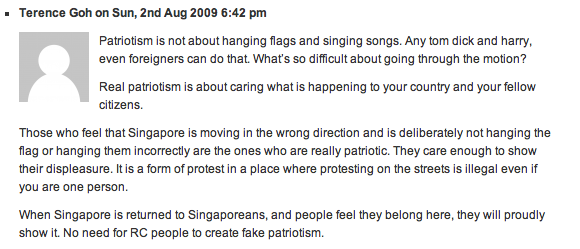
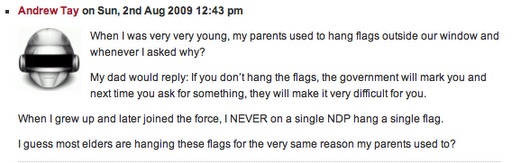
Here are some quotes I pulled from a blog post’s comment section:

This is just a small sampling. You can visit the blog post itself for more, but this is just to show that there’s a lot of dissatisfaction with the current situation in Singapore. There were even comments from Singaporeans stating that they planned to wear black on National Day, rather than the national colors, to represent the fact that they’re mourning rather than celebrating.

Still, not everyone was full of doom and gloom. My wife and I walked through Pasir Ris Park tonight and it was packed full of people barbecuing and camping out for the night. There were tents everywhere! It sort of reminded me of parks and neighborhoods in the US on July 4th, with groups of family and friends getting together to celebrate.

From what I’ve read, and I’ll admit it isn’t too much since I try to steer clear of much involving Singapore politics, people have come to believe that National Day in Singapore is more of a celebration of the PAP (People’s Action Party?) than a celebration of the people, and so a large portion of Singaporeans aren’t as enthusiastic about the day as they used to be. It’s pretty sad that many people in Singapore are opposed to celebrating their own national holiday.

Singapore is a young country. It has a lot of maturing and learning to do yet, and I’m sure that in time it will become a place that all Singaporeans are proud to call home. So, here’s hoping for that day. Happy 44th Singapore.
Dead Smiley

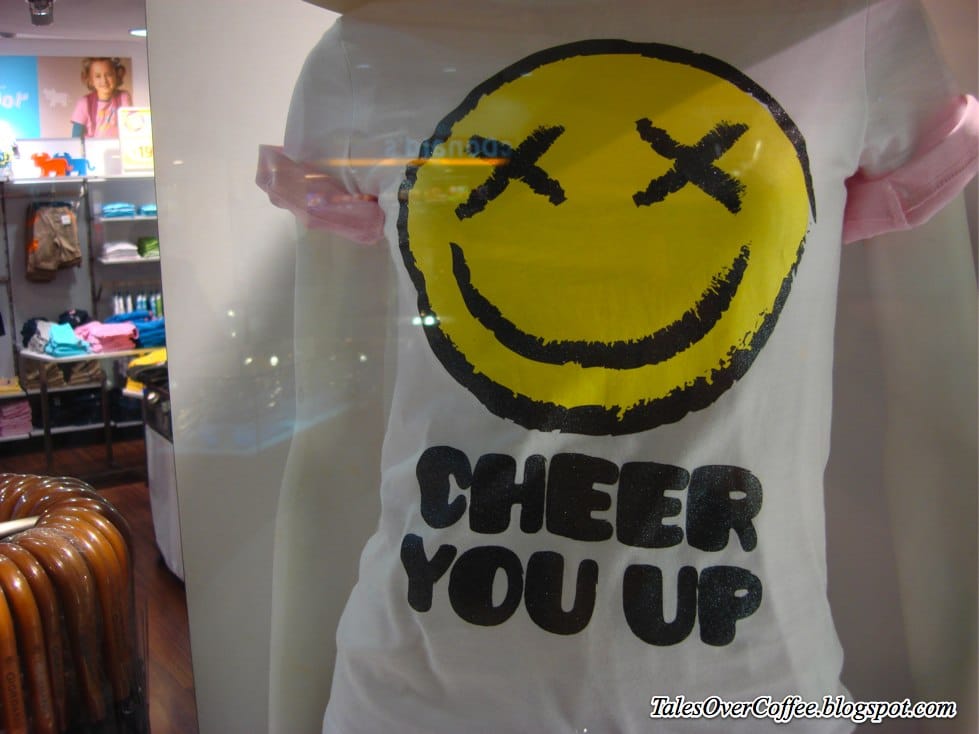
I found this shirt in the mall a few weeks ago and I’ve also seen quite a few people out and about wearing it here in Singapore.

Anyone who has used he internet much has been exposed to “smilies”.  They’re cute icons used to express an emotion in chat.  Sometimes they’re called emoticons.

Given that, what does this shirt say?  A dead smiley = “CHEER YOU UP”?  So, death is the way to be cheered up then is it?

Either people are blissfully unaware of what the smiley means, or there’s just some meaning behind this that I’m totally missing.  It’s not uncommon for Asians who have poor English language ability to wear a shirt with something totally screwy on it, but this should have been pretty easy to steer clear of.

Singapore McDonald’s Seaweed Shaker Fries

From what I’ve seen, the McDonald’s menu is tailored to the country it’s in, to appeal more to the locals.  In the Philippines there is a longganisa (Filipino sausage) and rice meal, for example.  Up until today I hadn’t noticed anything too different about the meals in Singapore, except for the choice of drinks.  There are different teas offered here, rather than the sweet iced tea you might be accustomed to in the US.

Today though, I saw something that was a big deviation from the norm.  Seaweed shaker fries.  They give you the large fries and a packet with some sort of seaweed flakes / flavoring in it.  They also give you a small paper bag.  You dump the fries and the seaweed flakes / flavoring into the bag and shake it up.  Then you enjoy your ‘seaweed shaker’ fries.  Sounded kinda gross to me, so I passed.  I don’t do the whole ‘up-sizing’ thing anyway.  The regular sized meal is full of enough calories, fat and grease as it is.

The Abuse of Non-Resident Workers in Singapore

If you’ve been keeping up with my blog recently you’ll have read that Singapore can be a pretty rough place for a foreigner.  There’s plenty of racism and discrimination from locals.  Unfortunately, this type of discrimination is also common in the work place.

In Singapore business, appearance is everything.  Companies want to present the best image they can, regardless of the internal cost and that’s usually going to be at someone’s expense, because they want a certain level of service to be rendered but at the same time they don’t want to put forward the capital or manpower required to adequately meet their goals.  Someone winds up suffering, and those someones are typically foreign workers.

You see, being in Singapore on a work permit is a rather unique situation.  People usually apply for jobs in Singapore through recruitment agencies in their home countries.  If they’re approved they receive a card that designates them as being about to legally enter Singapore without needing their passport stamped and remain for the duration of their work contract.  Now, people that do this sort of thing are either looking to improve their lives, or they have financial obligations at home, like a family to support.  Either way, they have to maintain their job.  If a person loses their job they’re only given so many days to find a new one before they have to leave Singapore, and sometimes that time-frame is only 2 weeks.  You see what I’m saying?  There’s a lot of pressure to make sure you stay in your employer’s good graces, because you’re almost guaranteed to have to leave the country if you leave your job.  Moving from one country to another can be a big deal.  It can be even more stressful when your income is cut off and you have obligations to meet.

In other words, there’s really no wriggle-room.  You work, or you get put out and you have to leave the country.

Being the pricks they are, people like to take advantage of that here.  They create unrealistic expectations in their KPIs.  They ask employees to stay longer hours, often unpaid, to do more work, even if that employee has exceeded the target set for the day.  This is done so that the company can get around hiring more people to manage the workload more effectively, but is an abuse to the worker.  In the case of maids, I’m sure there are far worse abuses that happen despite the strict rules regulating maids in Singapore.

Regardless, there’s no much of a recourse for these foreign workers.  If they decline the request to work the longer hours too many times, they’ll simply be let go and they’ll have to pack up the life they’ve made in Singapore and return to their country, often with not much to show for their efforts and no immediate prospects for work.  If they file a complaint with the company?  Same result.  File a complaint with MoM?  Well, something might happen in the future but the company would find a reason to fire that person.    Change their job?  Well, it’s not always that easy.  Most foreigners come to Singapore on a contract, so they can’t change jobs.  If they can, it could be hard to find one, and if they do, and there’s even the slightest delay in the paperwork, they could have to pack up and leave the country and then come back once the new contract is approved.

You see what I’m getting at here?  The labor laws in Singapore regarding foreigners are either not strict enough or they’re not being properly enforced to protect the interests of the foreign workers that are being hired.  These people are employees, not slightly paid slave labor.

(Image Source)

Undisciplined Children on a Singapore Bus

On Friday afternoon I was on the bus, heading to the MRT station so I could meet my wife for dinner. I was on a single story bus in the standing area, leaning against the padded rest.

(For those of you not familiar with Singapore buses, I found the photo at left on Jom Naik Bas!, which seems to be a blog dedicated to reviewing modes of transportation, mostly in the Malaysia/Singapore area.)

So, anyway, I was standing there, leaning against that rest and chatting with my wife via SMS. There were two kids playing around in front of me (towards the rear of the bus). I wasn’t paying much attention to them, but after a brief stop, when the bus lurched back into motion, the kids stumbled. Like I said, they were goofing off, being noisy, and they weren’t holding onto anything. So, one of the kids stumbles and stomps down on my foot. I was only wearing slippers (flip-flops), and the boy had rubber shoes on, so it hurt. I wasn’t that upset about it because it was an accident, so I stood there, looking at the kid, waiting.

What was I waiting for? Can you guess? Well, apparently the boy didn’t know or care, because instead of doing what was proper, he glanced at me briefly and then went back to playing. His mother, who was sitting to my right and saw the whole thing, didn’t bother to speak up either.

Why did I have to be the boy’s parent for a few minutes on the bus that day? Why did I have to teach him a lesson his mother should have already taught him, and should have scolded him for forgetting?

I closed the cover on my iPhone and put it in my pocket and then I leaned towards the boy and said, loudly enough for his failure of a mother to hear as well, “You know, the polite thing to do when you step on someone’s foot is to apologize.

The kid looked at me as if he were shocked. Is it so uncommon a thing to ask people to be polite to each other? No reaction from the mother. Perhaps she doesn’t care about what her child learns? I bet she would have reacted if I had simply reached out and smacked the boy in the back of the head. That probably would have made headlines here. I can see it now: “Ang moh asshole abuses boy on bus for stomping his foot and not saying sorry.”

Anyhow, the boy looked at me, all shocked, and said, “Oh, sorry.” Then returned to playing with his friend. I was satisfied at the time, but later I would remember that honorifics are used in this country. I don’t exactly think of myself as an “uncle“, though I’ve been referred to that way before by kids that are about 10, but a “Sorry, sir” or a “Sorry, uncle” would have sounded much more convincing to me.

The kid is probably already spoiled if he’s that indifferent to other people’s space, or to the fact that he caused injury to another person. I blame his parents, and I blame society. This is where it starts. The kid doing something wrong and the parent not correcting them, or no one correcting them. This leads to a self-centered “me me me” attitude that produces kids who think they walk on water, foreigners are trash, and anyone who does an “un-glam” job is a failure.

There will be a lot of wailing and gnashing of teeth when that bubble bursts.

What Determines A Person’s Worth?

I was thinking about this question because of something that happened earlier today. I woke up briefly in the morning and I thought I heard the maid crying. I’m sick, though, so I rolled over and went back to sleep. Later, I found out that there had been a problem.

She had recently bought a laptop computer. It was her first so I had to give her a few pointers, and she seemed really excited by things like Yahoo! Messenger and Facebook. This morning, she was on Facebook chatting with someone she had met. Apparently the guy was really into her. Then she told him what she does as a profession.

In her own words, “…then he ridiculed me and rejected me like a dog.”

Is it really that serious? A woman brought to tears and rejected out of hand just because of what she does for a living? She’s a maid, not a prostitute.

Let me quote something I wrote just recently:

As another example, maids in Singapore are typically foreign laborers and it’s not uncommon to hear someone say, “You look like my Filipina maid”, with a voice full of derision and disrespect. While being a maid is by no means a glorious job, these women accepted an opportunity to better themselves by earning more money in a foreign country, far from their homes. To me, that shows a desire to progress and improve and is far from being a fault. Also, I’m not really clear what makes these people think that maids are inherently ugly, except that perhaps they associate profession with looks, class, and appeal. Or perhaps the average Singaporean equates attractiveness with the amount of a persons’ paycheck? I’d also like to highlight that this common saying emphasizes many Singaporeans’ real belief that they are better than foreign laborers, just because of where they’re from.

I really can’t express enough how disgusting and ridiculous this superior mentality is. A person’s value is not based on what job position they hold, or how many years they went to school. If you get along with someone, why shut them down just because of what job they hold? Our maid is one of the sweetest, kindest people I’ve ever met. Ethnicity and education have nothing to do with that.

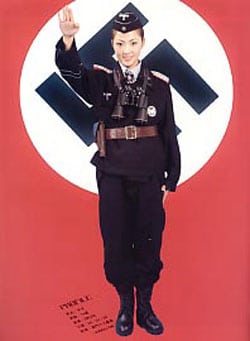
This is Singapore, not Nazi Germany. This country was built up by a collective of peoples from all over Asia and is today a fairly multicultural center. There are people from all over the world living in Singapore. So why is it there are still these ridiculous ideas that some people should be shunned based on where they’re from? A lot of Westerners would shun Singaporeans because they’re from Asia, and dismiss educational certificates because they’re from a second-rate country. Wouldn’t feel nice to be on the receiving end would it?

Also, just being born in an somewhat affluent country doesn’t mean you’re better than someone from a poorer country. It just doesn’t work that way. A difference in the value of a nation’s currency doesn’t indicate a difference in the value of the people. Singapore is just lucky. That’s all. The country is in a good location to make money from shipping, and the government instituted imported labor policies that allowed Singapore to become a wealthy nation. Imported labor. Ya, those same people that are being mocked and ridiculed are the people that made Singapore what it is.

I hadn’t planned on revisiting this topic, but after this fiasco with our maid, I had to speak up again.

The whole “We’re better than you because you’re not one of us” thing didn’t work for Nazi Germany. It didn’t work for Japan. It’s not going to work for Singapore either.

July 2009 Solar Eclipse in Singapore

I’d been looking forward to this solar eclipse for weeks, ever since I first heard about it. I even took the time to write it down, and enter it as an entry with an alarm in my iPhone’s calendar. I didn’t want to miss it! Last night I went to bed, rather anxious to wake up and witness this, the longest solar eclipse for the century.

So, I wound up waking up early and, much to my dismay, I could hear the sound of rain. I hoped it would clear up but as the time for the eclipse got closer, it kept coming down harder and harder.

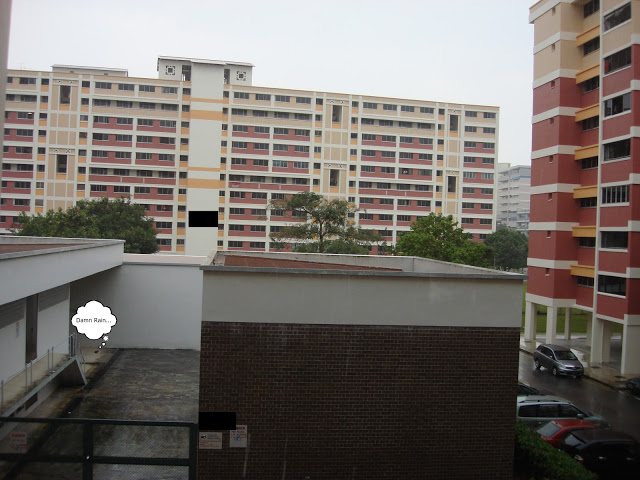
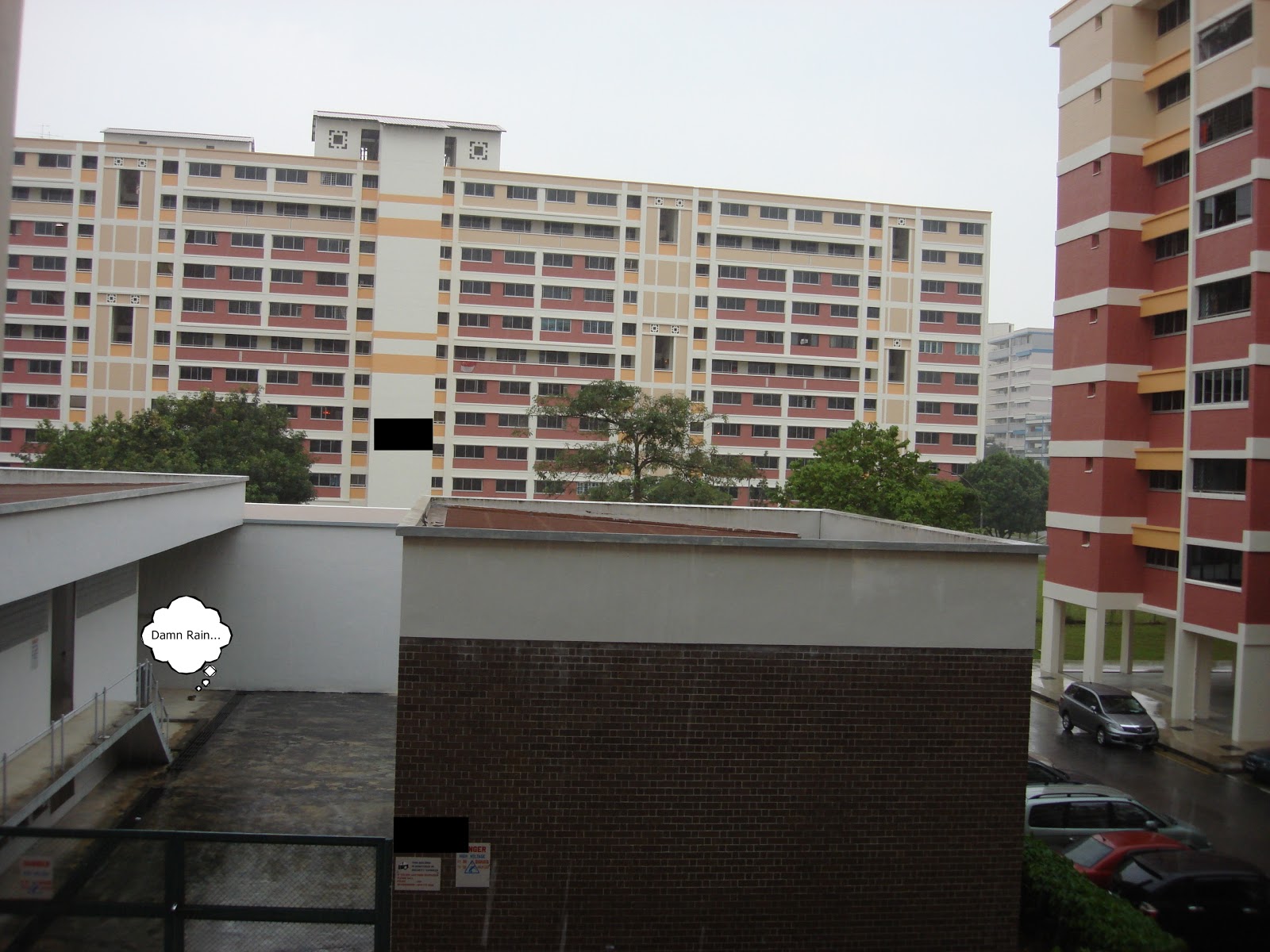
When it was time for the actual eclipse, I looked out my window and saw only this:

And then I realized my laundry was hanging to dry…

Singapore was supposed to be along the southern edge of the solar eclipse’s path, so I was hoping to see something exciting. The animated map I’d looked at showed Singapore in shadow. It did get a bit darker during the minutes when the eclipse was supposed to affect Singapore, but it wasn’t that noticeable. It wasn’t much darker than it would normally be during a thunderstorm.

So, it wasn’t quite what I’d hoped for, but we can’t have everything right?

Pocari Sweat

No, a Pocari isn’t an animal, or a person’s name.  It’s a drink!

I’ve seen this quite a few times and always intended to snag a photo of it, but I just never got around to it.

Would you drink something called Sweat?  When I look at this can I think of the sweat sliding down someone’s back, so … well no.  Just not for me!

What this does make me wonder though is who was in charge of naming this product?  In today’s world, multicultural awareness is something of a must, and I get the feeling that the company missed the mark when they branded this.

Any idea what the original message was supposed to be here?